
Lore: The sages of the Tapa 62 path were not philosophers of the city, but of the deep wilds. They believed the purest expression of the Tao was not in written scrolls, but in the instinctual, honest dance of animal life—the loyalty of the wolf pack, the cunning of the serpent, the unyielding endurance of the wild boar. They sought enlightenment by observing this natural order, not as outsiders, but from within. Their alchemical practice involved harmonizing their own spirit with the spirit of the hunt, the herd, and the flock.
They created the Pack-Speaker’s Kapas as tools of communication for a world without words. Each kapa is a canvas telling the great stories of animal archetypes. The symbols were not just painted on, but beaten into the cloth with pigments and intentions that resonated with the primal world. By wearing the kapa and focusing their Qi, a student of ethology could project the fundamental symbolic concepts that all animals understand: dominance, submission, threat, or harmlessness. It was not a tool for taming beasts, but for speaking to them in their own silent, spiritual language, allowing the wearer to be accepted, or at least understood, by the wild.
Description: A short cloak or mantle, designed to be worn over the shoulders and clasped at the front. It is made from a sturdy, yet surprisingly soft, tapa cloth that has been weatherproofed with natural oils. The color is a deep, earthy brown, achieved with dyes from bark and clay. The kapa is decorated with bold, archetypal animal symbols painted in stark black and white pigments. These include a snarling wolf’s head (representing dominance and leadership), a tightly coiled serpent (cunning and patience), a steadfast wild boar (endurance and territory), and a scattered flock of birds in flight (community and alarm). The symbols are arranged in a pattern that illustrates the great cycle of predator and prey. The cloak feels light and makes almost no sound as the wearer moves.
Slot: Shoulders
Detailed Stats
- Wisdom: +3
- Survival: +3
Passive Magics
- Scent of the Earth: The kapa constantly emits a subtle, magical aura that neutralizes the wearer’s “unnatural” scents (such as cooked food, soap, perfumes, or metal) and replaces them with the clean, neutral smell of damp earth, wet stone, and leaves. This allows the wearer to move through the wilderness without their scent immediately alarming or provoking wild animals.
- Primal Intuition: The wearer becomes preternaturally attuned to the body language of beasts. They can intuitively understand the immediate emotional state of any non-magical animal they observe, easily discerning fear from aggression, curiosity from hunger, and territorial warnings from bluffs. This allows them to anticipate an animal’s actions—like a charge or a panicked flight—a crucial moment before it happens.
Activable Magics
- Display Archetype: The wearer can focus their Qi into a specific symbol on the kapa, causing it to shimmer with a faint energy that is highly visible and meaningful to animals. This effect can be maintained for up to 10 minutes.
- The Wolf (Dominance): By focusing on the wolf symbol, the wearer projects an aura of confident, unwavering leadership. This can intimidate lesser predators, causing them to abandon a stalk. It can also cause pack animals to hesitate, viewing the wearer as a potential alpha challenger rather than simple prey.
- The Flock (Submission): By focusing on the symbol of scattered birds, the wearer projects an aura of harmlessness. This communicates non-aggression and a lack of threat, which can calm a territorial animal or convince a predator that the wearer is not worth the energy to hunt.
- Call of the Wild: The wearer can focus on one of the animal symbols on the kapa and attempt to perfectly replicate a call associated with that creature. The kapa’s magic shapes the sound, ensuring it is a flawless mimic. For example, focusing on the boar symbol could produce a threatening snort to challenge another boar. Focusing on the birds could produce a piercing cry of alarm to create a diversion. Focusing on the wolf could produce a long, lonely howl to see if another pack answers. This does not grant the ability to speak with animals, only to copy their sounds with supernatural accuracy.
Tags: Tapa, Shoulders, Magical, Common, Tier 1, Animal, Utility, Nature, Survival, Stealth, Social, Ethology, Beast, Communication, Primal, Intimidation, Calming, Sound, Worn, Qi-Based
The Tapa 62 of The Pack-Speaker’s Kapa is a specialized tool for those who walk the line between civilization and the untamed wilds. It is a rarity in the markets of city centers, but can be found in the rugged outposts, strange menageries, and quiet circles of those who understand the primal language of beasts.
The Frontier Outfitter & Trapper’s Post
Located in the last town before the great northern jungles or at the base of the Dragon’s Tooth mountains, this establishment is built for function, not comfort. The air inside is a thick, rustic perfume of tanned leather, woodsmoke, animal musk, and the sharp scent of metal traps. Furs of strange beasts are piled in corners, and the walls are adorned with durable traveling gear: weatherproofed cloaks, sturdy climbing ropes, longbows, and bundles of survival rations. The proprietor is a seasoned, no-nonsense frontiersman with scars that tell their own stories.
How it is Sold: The kapa would be treated as a high-end, specialized piece of survival gear. The shopkeeper would likely have it displayed on a mannequin, appreciating its craftsmanship but marketing its practical uses. “This old thing?” they might grunt. “They say the patterns on it speak to beasts. Keeps the dire-wolves from seeing you as an easy meal and helps you mimic a boar’s challenge to draw out a tusker. Not a toy.” The sale would be direct, perhaps with a shared mug of ale and an exchange of stories about close calls in the wild.
Cost to Buy: The price reflects its value as a life-saving tool in a dangerous land. The outfitter would ask for 1 Gold coin and 2 Silver coins, a price they consider fair for something that might keep you from being mauled. Value to Sell: A trapper would recognize the kapa’s utility and would be willing to buy it, knowing they could sell it to the next serious adventurer or beast hunter who passes through. They would offer 8 Silver coins for it.
The Beast-Tamer’s Menagerie
On the outskirts of a metropolis, where the noise and smell of strange creatures won’t disturb the city’s elite, lies the menagerie. It is a chaotic collection of magically-reinforced pens, cages, and aviaries, holding everything from trained guard-drakes and pack lizards to the majestic Griffons used by the wealthy for travel. The owner is a larger-than-life beast-tamer who deals in the buying, selling, and training of Saṃsāra’s exotic fauna.
How it is Sold: The kapa would not be on public display but kept in the tamer’s personal workshop. They would see it as an essential training tool. To a potential buyer, the beast-tamer would likely provide a startlingly effective demonstration. “Watch,” they might say, approaching a cage containing a snarling, territorial beast. By focusing on a submissive pattern on the cloak, the beast’s aggression would visibly lessen. The sale would be a transaction between professionals who understand the immense power and danger of the creatures they handle.
Cost to Buy: The beast-tamer knows exactly how valuable this item is for preventing injury to their handlers and their expensive animals. They would demand a steep 1 Gold coin and 5 Silver coins, and would be more inclined to trade it for a rare beast egg or a piece of comparable magical equipment. Value to Sell: A beast-tamer is always looking for new tools of the trade and would happily purchase the kapa. They would offer a firm 1 Gold coin for it, knowing it’s worth every copper.
The Naturalist’s Guild Archive
In the scholarly quarter of a major city, the Naturalist’s Guild is a quiet institution dedicated to the study of the world’s unique and often dangerous wildlife. The building smells of old books, anatomical charts, and the preserving fluids used on specimens. Their archives contain not only texts but also tools and artifacts used by their field researchers. Access to their small, internal supply store is restricted to guild members and sponsored academics.
How it is Sold: The kapa would be cataloged as a “non-invasive behavioral observation aid.” The guild quartermaster, a meticulous scholar, would issue it with a stern lecture on its proper use for research, not exploitation. The transaction would be logged in a ledger, and the buyer might be expected to submit a paper on their findings upon their return from the field. It is sold not as a magical cloak, but as a scientific instrument.
Cost to Buy: To encourage research, the guild sells equipment to its members at cost. The kapa would be available to a licensed xenobiologist for 8 Silver and 1 Nickel. Value to Sell: The guild would gladly purchase such an item to add to their repository of field equipment, offering a fair price of around 7 Silver coins and requiring a detailed report on where the item was found and what it was observed to do.
The Wild-Shaman’s Grove
Deep within an ancient forest, far from any trade road, lives a reclusive shaman whose life is intertwined with the wild things of the wood. Their home is not a building but a grove of ancient trees, decorated with intricate carvings, bone-chimes, and animal totems. They are a keeper of the old ways, a follower of the Tapa 62 tradition.
How it is Sold: The Pack-Speaker’s Kapa is not sold here. It is a sacred object, and it must be earned. An avatar seeking such an item would have to find the shaman first, a quest in itself. They would then need to prove their worthiness, not through feats of strength, but through acts of respect for the natural world. They might be tasked with cleansing a stream poisoned by an upstream factory, healing a great beast wounded by poachers, or simply spending a season living in the grove and learning the ways of the forest. If they prove their spirit is in harmony with the wild, the shaman may craft a kapa for them as a gift.
Cost to Buy: The cost is paid in deeds and character. An offering of rare herbs or finely crafted tools would be seen as a respectful gift, not a payment. If a monetary value had to be assigned for context, the materials and the shaman’s time would be valued at 7 Silver coins. Value to Sell: The concept of selling such an item back to the shaman would be a grave insult. It is a gift of the spirit; to treat it as merchandise would be to disrespect the shaman and the wild itself.
The Tapa 62 of The Pack-Speaker’s Kapa is a tool for those who understand that the wilderness has its own language and its own politics. Its power in conflict is not about personal might, but about influencing the beasts of the world, turning the natural order into a shield or a weapon. An avatar wearing this kapa learns to survive by becoming a recognized, respected, or feared part of the ecosystem.
In a Dense Forest or Jungle
In the forest, where every sound has meaning and every scent tells a story, the kapa allows the wearer to join the conversation.
Defensive Roleplay:
The kapa is a constant, passive defense. The Scent of the Earth it projects means the wearer is less likely to be immediately identified as an alien intruder by the forest’s inhabitants. When a territorial beast, like a great dire bear, blocks the party’s path, the avatar’s defense is one of communication, not combat.
- “Hold your steel,” the avatar would command their party. Focusing on the symbol of the flock on their kapa, they activate Display Archetype (Submission). “I am not a threat,” they would project, standing calmly. “I am a lesser creature, merely passing through your lands. I acknowledge your strength and offer no challenge.” The bear, receiving this clear, instinctual message of non-aggression, is far more likely to huff and dismiss the party than to attack.
The avatar’s Primal Intuition also serves as an early warning system.
- “The birds in the canopy have fallen silent,” the avatar would whisper, hand raised. “Their fear is a cold wave. Something that hunts them is moving below. We must climb or hide, now.”
Offensive Roleplay:
Offense is about manipulating the local fauna. To eliminate a heavily guarded bandit camp deep in the woods, the party doesn’t need a frontal assault.
- The avatar uses Call of the Wild to perfectly mimic the distress call of a young deer. They throw the sound to the far side of the camp. “The sound will carry,” the avatar would explain. “Every hungry predator for a mile—wolves, bears, great cats—will come to investigate the promise of an easy meal. The bandits will soon have more pressing concerns than guarding their walls.”
To deal with a pack of predators directly, the avatar can challenge their hierarchy.
- As the dire wolf pack stalks them, the avatar waits for the alpha to show itself. They lock eyes with it and activate Display Archetype (Dominance). “I pour all my will into the wolf symbol, projecting the raw aura of a stronger, more dominant alpha,” they would describe. “The pack will falter, their social order thrown into chaos. They will either flee the challenge or turn on their leader, who has suddenly been made to look weak.”
In the Arid Desert or Open Plains
On the vast, open plains, where there is nowhere to hide, the kapa is used to manage herds and project authority.
Defensive Roleplay:
The party’s pack animals are their lifeline. When a sudden sandstorm spooks the herd of pack lizards, causing them to scatter, the avatar can prevent disaster.
- Projecting the submissive, non-threatening aura of the flock, the avatar moves among the panicked beasts. “My calm is their calm,” they would narrate. “The Primal Intuition lets me read their fear, and the kapa lets me project a feeling of safety and herd-minded unity. They feel I am one of them, a safe anchor in the storm, and they settle.”
Large scavengers, like hyena-like beasts, might shadow the party, waiting for them to show weakness.
- Periodically, the avatar can activate Display Archetype (Dominance), sending out a clear message: “We are strong. We are not easy prey. Seek your meal elsewhere.” This projection of strength is a powerful deterrent that can keep lesser threats at bay without a single fight.
Offensive Roleplay:
The open plains are home to massive herds, which can be turned into a devastating weapon. The party needs to attack a fortified encampment of raiders.
- The avatar locates a large herd of wild, horned beasts upwind of the camp. Using Call of the Wild, they mimic the hunting cry of a great predator from behind the herd. “The cry will spark their stampede,” the avatar plans, “and their only clear escape route is directly through the raiders’ camp. We will let the herd’s panic be our battering ram.”
In an Urban Environment
While less obvious, the kapa’s power can be creatively applied even within a city’s walls, manipulating the beasts that live in civilization’s shadow.
Defensive Roleplay:
The party needs to infiltrate a nobleman’s estate, but the grounds are patrolled by vicious, highly trained mastiffs.
- As the party approaches, the avatar activates Display Archetype (Submission). “The dogs are trained to attack threats,” the avatar explains. “I am projecting an aura of something beneath their notice—a servant, a harmless creature. Their aggressive barking will lessen into confused whines. They sense no challenge, no prey, and no reason to raise an alarm.”
Offensive Roleplay:
Offense in the city is about creating chaos and diversions using its hidden ecosystem. A rival guild is having a grand ceremony in an open-air plaza.
- The avatar goes to the city’s rooftops. Using Call of the Wild, they perfectly replicate the piercing shriek of a hawk that has caught a rat. “Every stray cat, dog, and rat-catcher in a five-block radius will hear that,” the avatar would grin. “A wave of chasing, barking, and fighting animals flooding the plaza will create a far better diversion than any smoke bomb.”
To sabotage a rival in the Beast-Tamer’s guild, the avatar can use the kapa to ruin a high-stakes demonstration.
- The rival is presenting their “perfectly trained” war-panther to a potential buyer. From a hidden vantage point, the avatar uses Call of the Wild to issue the deep, guttural challenge of a larger, more dominant predator. “The panther’s training will break,” the avatar predicts. “Its primal instincts will take over as it responds to the challenge. The demonstration will end in chaos, and my rival’s reputation will be shattered.”
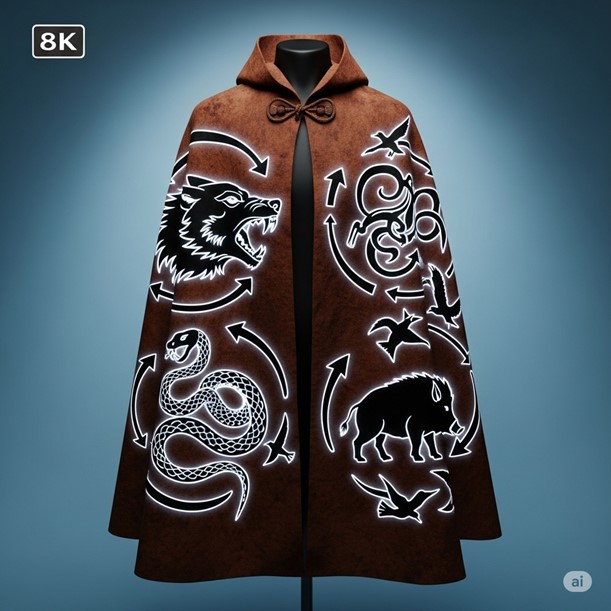
Perception of Activation:
Activation: Display Archetype
This ability channels the user’s Qi through a symbol on the kapa to project a powerful, instinctual aura that animals—and people—understand on a primal level.
User’s Perspective
- Sight: The specific animal symbol you are focusing on—the wolf’s head for Dominance, the flock of birds for Submission—begins to glow with a steady, silvery-white light that is clearly visible on the brown cloth. A shimmering, heat-haze-like aura forms around your body, almost too subtle to see directly.
- Sound: You perceive a deep, internal hum that resonates in your bones. When projecting Dominance, it is a low growl, and when projecting Submission, it is like the sound of a thousand wings rushing at once. This sound is not audible to others.
- Smell: A distinct phantom scent fills your senses. Projecting Dominance brings the smell of cold mountain air, pine needles, and fresh blood. Projecting Submission brings the smell of damp earth, tall grass, and clean rain.
- Touch: The kapa grows noticeably warm across your shoulders. You feel your own posture and bearing shift involuntarily. When projecting Dominance, your shoulders broaden, your chin lifts, and your stance widens. When projecting Submission, your posture becomes smaller, more centered, and non-threatening.
- Taste: A sharp, coppery taste of blood for Dominance. A clean, neutral taste of fresh water for Submission.
- Extra-Sensory Perception (Qi Projection): You feel your life force being drawn into the kapa, which acts as a lens, reshaping your aura from that of a person into a powerful, coherent broadcast of pure intent. It feels as if your personal space has expanded into a sphere of influence that presses against the world.
- Extra-Sensory Perception (Primal Emotion): You are flooded with the core emotion of the archetype. Dominance brings a surge of unwavering confidence, calm authority, and the certainty of leadership. Submission brings a feeling of collective safety, egolessness, and a profound sense of belonging to a larger, harmless whole.
Positives: The feeling of projecting such a powerful, primal state is exhilarating and provides immediate, tangible feedback. It allows you to communicate directly with the instinctual world and control a social encounter with animals without a fight.
Negatives: Holding onto such a powerful, raw emotion is mentally taxing. Prolonged use of the Dominance aura can leave you feeling arrogant, aggressive, and disconnected from your allies. Prolonged use of the Submission aura can make you feel passive, indecisive, and can erode your own sense of self-will.
Observer’s Perspective (Human)
- Sight: An observer will clearly see the chosen symbol on your kapa begin to glow with a bright, steady, white light. More dramatically, they will witness a distinct and often unnerving change in your physical presence. When you project Dominance, you seem to stand taller, your gaze becomes intense and predatory, and you command the space around you. When you project Submission, you seem to physically shrink, becoming unassuming and easy to overlook.
- Sound: An observer would hear nothing out of the ordinary.
- Smell: An observer perceives no scent.
- Touch: If standing very close, an observer might feel the air around you become strangely “heavy” and charged with static electricity (Dominance) or placid and unnaturally still (Submission).
- Taste: An observer perceives no taste.
- Extra-Sensory Perception (Aura Transformation): A magically-aware observer would witness a startling transformation. They would see your personal aura flare and be completely reshaped by the kapa into the archetypal form of a great wolf, a coiled serpent, or a swirling flock of birds. The projection is powerful and unmistakable on the astral plane.
- Extra-Sensory Perception (Instinctual Reaction): Even a non-magical observer will have a primal, gut reaction. Your Dominance display will make them feel subconsciously intimidated, respectful, or deferential without knowing why. Your Submission display will cause their brain to automatically categorize you as a non-threat, making them more likely to ignore you.
Positives: The effect is visibly impressive and can be used as a powerful tool of non-verbal intimidation or de-escalation against people as well as animals. It clearly communicates your intent without a single word.
Negatives: The sudden and dramatic shift in your personality can be deeply unsettling to your allies, who may see it as a form of possession. Projecting a Dominance aura can inadvertently antagonize proud or powerful individuals, starting a conflict where none was intended.
Activation: Call of the Wild
This ability uses the kapa as a mystical amplifier and translator to perfectly replicate the call of a specific animal.
User’s Perspective
- Sight: The specific animal symbol you are focusing on flashes once with a bright light, synchronized with the sound you produce.
- Sound: This is the primary perception. You open your mouth and push air from your lungs, but the sound that emerges is not your own. It is a perfect, supernaturally clear and authentic replica of the animal’s call. A guttural boar’s snort, a piercing hawk’s shriek, a resonant wolf’s howl—it feels as if the kapa is playing the sound through you, using you as a speaker.
- Smell: There is no smell associated with this activation.
- Touch: You feel a powerful and authentic vibration in your throat, chest, and sinuses, far stronger than what your own vocal cords could create. The kapa itself thrums against your back with the energy of the call.
- Taste: There is no taste associated with this activation.
- Extra-Sensory Perception (Vocal Channeling): For the brief moment you are making the call, it feels as if the spirit of the archetype—the great wolf, the ancient boar—is borrowing your voice. It is a strange and intimate connection to the primal world.
- Extra-Sensory Perception (A Listening Silence): After the call echoes and fades, you feel a heightened sense of connection to the surrounding wilderness, as if every part of you is straining to hear a distant reply.
Positives: It allows for perfect, believable communication or deception with animals. The feeling of producing such a raw, powerful, and authentic sound is thrilling. It is an excellent tool for luring, challenging, or warning wildlife.
Negatives: The sensation of your voice being “hijacked” by another spirit, even for a moment, can be disorienting or even frightening the first few times. A poorly timed call can have disastrous consequences, attracting unwanted attention from everything in the area.
Observer’s Perspective (Human)
- Sight: An observer sees you take a breath and make a call. They might see the relevant symbol on your kapa flash with light at the same moment.
- Sound: They hear a shockingly authentic animal sound emerge from you. The sound is pure, powerful, and seems far too loud or complex to have been produced by a human throat. The realism is perfect and can be deeply unnerving.
- Smell: An observer perceives no scent.
- Touch: A particularly loud call, like a roar or a bellow, can be felt as a physical vibration in the air and in the chest of anyone standing nearby.
- Taste: An observer perceives no taste.
- Extra-Sensory Perception (Resonant Call): A magically-aware observer would perceive that the sound is not just a physical phenomenon. It carries a magical “carrier wave,” an echo of Qi that makes it register as 100% authentic to both mundane and magical beasts.
Positives: The effect is undeniable, impressive, and has clear utility for creating diversions, luring targets, or signaling over long distances in a way that seems natural to the environment.
Negatives: A sudden, loud predator call in the middle of a stealthy operation can be extremely alarming to your allies, potentially causing them to panic or ruining the entire group’s stealth. It immediately draws attention from everything, friendly or not, in the area.
Primal Weaving: The Formula of the Pack-Speaker’s Kapa
This text describes the sacred and primal ritual for crafting a Pack-Speaker’s Kapa. The process is not one of simple artistry, but of deep communion with the spirits of the wild. The crafter must earn the respect of the archetypes they wish to depict, imbuing the cloth with their power through ritual, intent, and the use of potent natural components.
Materials Needed
- The Hide of the Forest: One (1) large, continuous sheet of raw Tapa Cloth, beaten from the bark of an ancient Ironwood tree. The bark must be harvested only from a branch that has fallen naturally in a storm.
- Pigment of Shadow (Black): The charred and powdered knucklebone of a great Cave Bear, an animal respected for its solitary strength and dominance.
- Pigment of Light (White): Finely ground powder from the fossilized shell of a Sea Turtle, an ancient creature revered for its wisdom and endurance.
- The Binding Oil: A pot of rendered tallow from a Wild Boar, mixed with the sap of a hardy mountain pine. This mixture will be used to weatherproof the kapa and bind the pigments.
- The Four Totems: A collection of four symbolic items, gathered with respect.
- One (1) Wolf’s Canine Tooth (for Dominance).
- One (1) intact shed skin of a Serpent (for Cunning).
- One (1) curled tusk from a Wild Boar (for Endurance).
- One (1) primary flight feather from a Hawk (for Community/Alarm).
Tools Required
- Ritual Tapa Anvil: A large, flat-topped boulder located in a place of natural power, such as a clearing deep in a forest or a windy mountaintop.
- Stone Mortar and Pestle: For grinding the bone and fossilized shell into fine pigments.
- Set of Bone Brushes: A set of simple brushes with handles made of deer bone and bristles made from the coarse hair of a wild boar.
- Ceremonial Skinning Knife: A sharp flint or obsidian knife, used not for violence, but for the respectful preparation of the materials.
- Meditation Mat: A simple mat woven from reeds or grass, for the preparatory and final stages of the ritual.
Skill Requirements
- Tapa Craft (Basic): The physical skill to beat, prepare, and paint the bark cloth.
- Survival (Proficient): The knowledge required to track and respectfully gather the animal components without causing unnecessary harm or disrespect to the ecosystem.
- Alchemy (Novice): The ability to properly render the tallow and mix the pigments into a magically potent paint.
- Meditation: The ability to enter a deep, primal state of mind, connecting with the instinctual world.
- Qi Control (Novice): The skill to channel one’s own life force and intent into the symbols as they are painted.
Crafting Steps
- The Gathering Quest: The ritual begins with the gathering of the Four Totems. The crafter must venture into the wild and acquire each component. The components cannot be taken from a creature killed by the crafter; they must be found, scavenged, or received as a gift from a hunter, honoring the cycle of life and death. This quest is a spiritual test of the crafter’s connection to the wild.
- Preparing the Pigments: At the Ritual Tapa Anvil, the crafter grinds the Cave Bear bone and Turtle shell into fine powders in the stone mortar. Each pigment is then mixed with a small amount of the Boar Tallow binder. As they mix, the crafter must meditate on the essence of the creature the pigment comes from—the bear’s power, the turtle’s ancient wisdom.
- The Blessing of the Totems: The crafter lays the prepared Tapa Cloth flat upon the anvil. One by one, they take the Four Totems and press them into the corresponding pigment. The wolf tooth is dipped in the black, the serpent skin in the white, and so on. They then press the pigment-coated totem onto the cloth in the four cardinal directions, creating a small, sacred mark and inviting the spirit of the archetype into the canvas.
- The Painting of the Pack: This is the heart of the ritual. Using the bone brushes, the crafter begins to paint the great symbols. This is not a quiet act of artistry. As they paint the snarling wolf, they must let out a low, dominant growl, channeling their own inner alpha. As they paint the coiled serpent, they must move with a silent, fluid grace. As they paint the boar, their stance must be wide and unmovable. As they paint the birds, they must feel the wind and the sense of the flock. They are not merely painting a picture; they are performing a dance, becoming the animal whose story they are telling.
- The Sealing of the Wild: Once the symbols are painted, the entire kapa is coated with a thin layer of the remaining pine-and-tallow mixture. The kapa is then left on the Ritual Tapa Anvil for one full cycle of the moon, to cure under the sun and stars, absorbing the ambient Qi of the wild place.
- The First Hunt: The kapa is not truly active until it has been accepted by the wild. The crafter must don the finished kapa and go on a ritual hunt. Their goal is not to kill, but to successfully track a wild predator, observe it without being detected, and leave an offering of respect before departing. When they have successfully become part of the wilderness, a silent observer rather than an intruder, the kapa will awaken, its powers now fully attuned to the wearer.
Boy Who Spoke No Words and Cloak of Many Beasts
In the time of the first forests, there was a boy who had no voice. His name is lost, so he is called the Silent Boy. When other children would sing and shout, his mouth made no sound. Because he could not speak to people, he tried to speak to animals. But the birds would fly from his quiet hand. The deer would run from his silent feet. The animals saw him as a strange, broken thing. His chest-feeling was of a great loneliness. This was a truth.
One season, a great hunger came to the forest. It was a beast of shadow and teeth, a great cat that hunted in the dark. It took the goats of the village. Then it took a dog. The hunters of the village were mighty men, but the beast was a ghost. It left no tracks. It made no sound. The hunters could not find it. Fear became a cold stone in the belly of the village.
The Silent Boy, in his loneliness, walked far into the woods where others did not go. He came to a cave behind a waterfall. In the cave lived a very old man. The old man’s face was like a map of rivers. He also spoke no words, not because he could not, but because he had forgotten how. He spoke by drawing pictures in the dirt with a stick.
The old man saw the boy. He saw the boy’s quiet spirit. He did not see a broken thing. He saw an empty cup, ready to be filled. He led the boy to a great Ironwood tree that had fallen in a storm. He gave the boy a sharp piece of flint. Then he pointed to the forest. He pointed to the wolf, the snake, the boar, the bird. He drew a picture in the dirt: a man wearing a cloak with these animals on it. The boy understood. He was to make a thing.
The boy worked. He took the wood-skin from the fallen tree. He beat it on a great flat rock. He made paints from the black, burnt bone of a bear he found, and from the white, fossil-shell of a turtle. He watched the animals. This was his new talking. He watched the wolf lead its pack, and he felt the shape of its pride. He watched the snake wait for a mouse, and he felt the shape of its patience. He was not just looking. He was listening with his spirit.
He began to paint. When he painted the wolf, he did not think of a picture. He thought of the feeling of being a leader. He let out a breath, and his chest-feeling of pride went into the paint. When he painted the snake, he held his body very still and thought of waiting. His feeling of cunning went into the paint. He did this for all the animals. He was not making a cloak. He was making a conversation.
When he was finished, he put the kapa on his shoulders. It felt warm. He walked back towards the village. On the path, a great, angry boar with sharp tusks saw him. Before, it would have charged the strange, silent thing. But the boy was not afraid. He focused his chest-feeling on the painting of the boar on his new cloak. He stood his ground and felt the spirit of territory. The boar saw him. It did not see a boy. It saw another boar, a strange one, but one that knew the rules. The boar snorted and turned away, giving the boy the path. The boy’s heart was full of a new feeling. It was not loneliness.
That night, the beast of shadow came again to the edge of the village. The hunters hid with their spears, but they could not see it. The Silent Boy walked out from the village. He wore his cloak. He could feel the beast’s hunger in the air. He did not take a spear. He touched the painting of the wolf on his kapa. He focused on the feeling of being the greatest hunter, the alpha. He sent out a feeling of “This is MY territory.”
The shadow beast, hidden in the trees, stopped. It was a great hunter, but now it felt the presence of a greater hunter. It felt a challenge from a spirit stronger than its own. It became confused. Its hunt was broken. Then, the boy touched the painting of the birds. He focused on the feeling of a great alarm. He made a sharp cry, but the magic of the cloak turned it into the sound of a thousand birds screaming a warning of a great fire.
The shadow beast, confused by the alpha challenge and startled by the great alarm, decided this was a place of madness. This was not a good place to hunt. It turned and melted back into the deep forest, and it never returned to the village again.
The Silent Boy walked back. He could not tell the hunters what he had done. But they saw that the fear was gone from the air. They saw the boy was no longer a lonely, broken thing. He was the boy who spoke the language of the wild.
Moral of the Story: The lesson is this: A man with a loud voice can command other men. But a man with a quiet spirit can learn to hear the whole world, and the whole world will answer him when he speaks.
Suggested conversions to other systems:
Call of Cthulhu (7th Edition)
Mantle of the Primal Tongue
A short, heavy cloak made from a fibrous, bark-like material that is strangely soft and makes no sound. It is dyed with earthy pigments and painted with stark, unsettling symbols of predator and prey animals. The symbols seem to shift when not viewed directly. The mantle smells of damp earth and ozone, a scent that clings to the wearer and masks their human odor. It is a tool for those who wish to speak the pre-human language of instinct.
Game Mechanics:
- Earthen Scent: The wearer’s scent is masked by a powerful natural odor. Any creature attempting to track the Investigator by scent finds the task one level of difficulty harder (e.g., a Regular roll becomes a Hard roll).
- Beast-Mind Intuition: The wearer gains a bonus die on all Psychology rolls made to understand the motives or predict the immediate actions of non-Mythos animals.
- Display Primal Aura (Costs 0/1 Sanity): By focusing their will into one of the kapa’s symbols, the Investigator can project a powerful, instinctual aura for one minute. This requires a POW x5 roll.
- Dominance (Wolf): If successful, the Investigator gains a bonus die on Intimidate rolls against animals and can force a single animal or pack leader to make an opposed POW roll to attack them.
- Submission (Flock): If successful, most predators will ignore the Investigator, seeing them as a non-threatening part of the environment. This requires no roll from the animal unless it is starving or magically compelled. Using this unnatural projection strains the psyche.
- The True Call: The Investigator can attempt to perfectly replicate the call of any animal they have heard. This requires a successful Art/Craft (Singing) or POW x5 roll. On a success, the call is supernaturally perfect, fooling animals and even knowledgeable naturalists. A fumbled roll produces a disturbing, unnatural sound that will attract unwanted attention.
Blades in the Dark
The Whisperwood Kapa
A short, weatherproofed cloak of dark tapa cloth, brought back from the Dagger Isles by a forgotten explorer. The bold, black-and-white patterns painted on it are said to be the true names of the great beast-spirits of the wild. It allows the wearer to move through the city’s hidden ecosystem of rats, hounds, and other things that crawl in the dark, speaking a language of dominance and submission they understand.
Item Type: Occult, Worn
Game Mechanics:
This is a special item that can be carried in your personal inventory.
- Scent of the Undercity: When you are in the sewers, forgotten ruins, or overgrown parts of the city, you gain +1d to Prowl checks against creatures that hunt by scent (like bloodhounds or certain horrors).
- Primal Read: When you Survey a situation involving animals or bestial spirits, you can ask “What is their most powerful instinct right now (fear, hunger, territory)?” The GM will give you an honest answer.
- Display of Power: Once per score, you can channel your spirit into one of the kapa’s symbols. Choose one:
- Dominance: Spend 1 Stress. For the next few moments, you gain Potency when you Command animals or bestial spirits through sheer presence.
- Submission: Spend 1 Stress. For the next few moments, animals and bestial spirits will ignore you unless you directly threaten them.
- Wild Call: When you need to create a diversion or lure a target, you can perfectly mimic the sound of an animal. This is a special action; the GM will determine the outcome. It may cost Stress or start a clock depending on the risk and what you are trying to attract.
Dungeons & Dragons (5th Edition)
Kapa of the Pack-Speaker Wondrous item, uncommon (requires attunement)
This short, earthy-brown cloak is made of a tough, fibrous cloth that is soft to the touch and makes no sound. It is painted with bold, archetypal symbols of a wolf, a serpent, a boar, and a flock of birds.
- Scent of the Wild. While wearing this kapa, you have advantage on Dexterity (Stealth) checks made to hide from beasts that have the Keen Smell trait.
- Primal Empathy. You have advantage on Wisdom (Animal Handling) checks and Wisdom (Insight) checks made to discern the intentions of beasts.
- Archetype’s Aura. The kapa has 3 charges. As an action, you can expend 1 charge to channel the essence of one of its symbols, granting you an effect for 10 minutes. The kapa regains all expended charges daily at dawn.
- Wolf (Dominance): You gain advantage on Charisma (Intimidation) checks made against beasts.
- Flock (Submission): Beasts are indifferent toward you and will not attack you unless you or your companions do anything harmful to them.
- Voice of the Wild. As an action, you can perfectly mimic the sound of any beast you have heard before. A creature that hears the sounds can tell they are imitations only with a successful DC 13 Wisdom (Insight) check.
Knave (2nd Edition)
The Beast-Speaker’s Cloak
Inventory Slot: 1 (worn)
A short cloak of tough, oiled bark-cloth painted with bold animal symbols. It smells of earth and pine, masking the wearer’s scent.
- Passive – Beast Tongue: You always know the emotional state (fearful, aggressive, curious, hungry) of any mundane animal you can see.
- Passive – Unscented: Mundane animals cannot track you by smell.
- Active – Alpha or Omega (Once per day): You can choose to project one of two auras for one hour.
- Alpha: Beasts must make a successful Will save to attack you. You gain advantage on all checks to intimidate them.
- Omega: Beasts will ignore you completely unless you attack them first.
- Active – Perfect Mimicry: You can perfectly replicate the call or sound of any animal you have heard. No check is required.
Fate Core System
The Kapa of the Primal Voice
In Fate, a narrative-focused item like this is best represented as a character stunt, likely tied to an aspect such as I Smell of Earth and Leaves or The Pack Remembers Me.
Stunt: Kapa of the Primal Voice Because you wear this kapa painted with the spirits of the wild, you can speak the language of instinct.
- Primal Intuition: You can use the Empathy skill to read the immediate emotional state and intentions of animals, not just people.
- Scent of the Wild: Gain a +2 bonus when you use Stealth to Overcome obstacles related to hiding from or moving past animals in a natural environment.
- The Voice of the Pack: When you want to influence an animal or a group of animals, you can spend a Fate Point to invoke one of the kapa’s symbols. This allows you to Create an Advantage with two free invocations on the situation, such as The Alpha’s Challenge, A Harmless Creature, or The Cry of the Wounded Fawn.
Numenera & Cypher System
The Beast-God Mantle
This artifact from a prior world is a short cloak made from a bio-reactive fabric that constantly analyzes its environment and alters the wearer’s scent profile. The painted symbols are actually low-energy psychic projectors.
Level: 1d6+2 (Artifact) Form: A short, brown cloak of fibrous cloth with glowing white and black symbols. Effect: The mantle attunes the wearer to the local fauna, allowing for basic communication and manipulation through psychic and biological mimicry.
- Passive – Olfactory Cloak: The difficulty of all tasks for creatures to track the wearer by scent is increased by two steps.
- Passive – Instinct Reader: The wearer gains an asset on all tasks to understand or predict the behavior of non-sapient beasts.
- Active – Archetype Projection: The user can activate one of the mantle’s symbols (an action). For 10 minutes, the mantle projects a psychic aura.
- Dominance (Wolf): The difficulty of all tasks for beasts to attack the wearer is increased by one step.
- Submission (Flock): The difficulty of all tasks for the wearer to sneak past beasts is decreased by one step.
- Active – Sonic Mimicry: The user can command the mantle to perfectly replicate the sound of any beast they have previously heard.
Depletion: 1 in 1d20 (Each time one of the Active abilities is used, the user rolls a d20. If the roll is a 1, the psychic projectors burn out, and the active abilities cease to function.)
Pathfinder (2nd Edition)
Mantle of the Beast-Speaker Item 4 [Uncommon] [Divination] [Enchantment] [Invested] [Magical] Usage worn cloak; Bulk L
This short cloak is made of tough, weatherproofed tapa cloth dyed an earthy brown. It is painted with bold symbols of a wolf, serpent, boar, and flock of birds. It smells faintly of pine and damp earth, masking the wearer’s own scent.
- Investment You must be invested in the mantle to gain its benefits.
- Passive: While wearing the mantle, you gain a +1 item bonus to Nature checks to Command an Animal and to Survival checks to track animals. Creatures attempting to track you by scent must succeed at a DC 20 Survival check.
- Activate [One-Action] (auditory, concentrate) Effect You perfectly mimic the call of a specific animal you have heard before. This is a Deception check with a +1 item bonus to fool a listener into believing the sound is genuine.
- Activate [One-Action] (enchantment, mental, visual) Frequency once per 10 minutes; Effect You channel your will into one of the mantle’s symbols.
- Wolf: You project an aura of dominance. For 1 minute, you gain a +1 status bonus to Intimidation checks against animals.
- Flock: You project an aura of harmlessness. For 1 minute, animals are unlikely to attack you. They will not treat you as prey and will only attack if you take a hostile action or get too close to their young.
Savage Worlds Adventure Edition (SWADE)
The Primal Kapa
A short, earthy-brown cloak made of tough bark-cloth. The symbols painted on it seem to resonate with the wild things of the world, allowing the wearer to speak their unspoken language.
Requirements: Seasoned, Survival d8+, Spirit d8+
- Scent of the Earth: The wearer is difficult to track by scent. Any creature making a Survival roll to track the hero suffers a –2 penalty.
- Beast Empathy: The hero has an innate connection to the wild. They gain a +2 bonus to any Animal Handling (a custom skill) or Persuasion roll made to influence an animal’s behavior.
- Voice of the Wild: The hero can perfectly mimic the calls of any animal. This can be used to lure, distract, or intimidate, granting a +2 bonus on appropriate Trick or Test attempts against animals.
- Aura of the Archetype: The kapa can be used to cast two specific Powers. It has 10 Power Points that recharge daily.
- Dominance: The kapa can cast fear, but the Trapping is a powerful display of alpha presence. It only affects non-sapient animals.
- Submission: The kapa can cast beast friend to calm and pacify hostile or panicked animals.
Shadowrun, Sixth World
The Gaia-Weave Kapa
A piece of magical apparel from the eco-spiritualist fringe, popular with urban shamans and eco-terrorists. It appears as a simple, brown cloak woven from a strange, resilient bark-cloth. The painted symbols are not just decoration; they are powerful totemic representations that resonate with the animal kingdom, from the rats in the sewers to the hell hounds in the barrens.
Type: Magical Apparel Availability: 9R Cost: 15,000 nuyen
Game Mechanics:
- Earthen Masking: The kapa’s inherent magic masks the wearer’s manufactured scent. Any critter attempting to track you by scent suffers a -3 dice pool penalty.
- Primal Insight: The wearer gains an intuitive understanding of animal behavior. Gain a +2 dice pool bonus on any Animal Handling or Perception test made to predict or understand the actions of a non-sapient critter.
- Archetype Projection: The wearer can take a Minor Action to channel their will into one of the kapa’s symbols, projecting a powerful instinctual aura until the start of their next turn.
- Aura of the Alpha (Wolf): You gain a +2 dice pool bonus on Intimidation tests against animals. Any animal wishing to attack you must first succeed in a Willpower + Charisma (2) test.
- Aura of the Flock (Birds): You gain a +2 dice pool bonus on Stealth tests against animals. Most predatory animals will ignore you unless you appear to be a direct threat to them or their territory.
- Call of the Wild: You can perfectly mimic the call of any mundane animal. When used to create a diversion or lure a target, this grants you an Edge on the subsequent test.
Starfinder Roleplaying Game
The Xenodruid’s Primal Mantle Level 3 Price 1,550 Bulk L
This short cloak is a curious piece of hybrid tech, blending the traditional tapa cloth of a newly discovered species with sophisticated bio-scanners and pheromone emitters. The painted symbols are actually conductive circuits that activate different functions. It is favored by xenobiologists and members of the Xenowardens faction for non-hostile animal interaction.
System: Worn hybrid item, shoulders slot Game Mechanics:
- Olfactory Cloak. While wearing this mantle, you gain a +2 circumstance bonus to Stealth checks against any creature with the scent ability.
- Bestial Intuition. You gain a +2 insight bonus on Life Science and Survival checks made to understand, predict, or handle the behavior of creatures with the animal type.
- Archetype Emitter (1/day). As a standard action, you can activate the mantle to project a powerful bio-signature for 10 minutes. Choose one of the following effects:
- Dominance Protocol: You gain a +2 enhancement bonus to Intimidate checks against creatures with the animal type.
- Harmless Protocol: Creatures with the animal type are indifferent to you and will not attack unless provoked.
- Acoustic Mimicry. As a standard action, you can command the mantle to perfectly replicate the call of any creature with the animal type that you have previously heard. A creature must succeed on a DC 14 Wisdom (Perception) check to discern that the sound is an imitation.
Traveller (Mongoose 2nd Edition)
The ‘Fauna-Friend’ Behavioral Cloak (TL 12)
A specialized piece of equipment designed for xenobiologists, colonial surveyors, and big-game hunters. The cloak is made from a durable, self-cleaning synthetic fabric. It contains a suite of sensors, sonic emitters, and a programmable pheromone dispenser that allows the user to interact with alien fauna in a controlled manner.
Mass: 1.5 kg Cost: Cr 60,000 Power: Power Pack (96 hours of continuous use)
Game Mechanics:
- Scent Masking: The cloak constantly emits a spray of chemicals that neutralizes the user’s scent and mimics the local environment. This grants DM+2 on any Stealth check made to avoid detection by animals.
- Behavioral Analysis: The cloak’s sensors analyze an animal’s posture, sounds, and pheromones, providing a simple summary of its emotional state (e.g., ‘Territorial,’ ‘Fearful,’ ‘Hunting’) on a linked datapad. This grants DM+1 on any Animals check to handle or interact with the creature.
- Active Behavioral Projection: The user can activate one of two modes. This requires an Electronics (sensors) 8+ check to be effective.
- Dominance Mode: The cloak emits low-frequency sounds and releases alpha-predator pheromones. This grants DM+2 on any Animals or Intimidation check made to scare off a creature.
- Passive Mode: The cloak emits pacifying pheromones and sounds. This grants DM+2 on any Animals check made to calm or approach a creature without alarming it.
- Sonic Lure: The cloak’s audio library can be programmed to perfectly replicate any animal call it records. This can be used to attract or distract creatures as the situation warrants.
Warhammer Fantasy Roleplay (4th Edition)
The Beast-Caller’s Shawl
A rough, heavy shawl of woven bark-cloth, stained with mud and smelling of damp earth and pine. It is painted with crude but powerful images of the great beasts of the Drakwald Forest: the Wolf, the Boar, and the Great Stag. It is a tool of the Amber Wizards and the reclusive shamans of the deep woods, who believe that to survive the wild, one must learn to speak its tongue.
Encumbrance: 1 Qualities: Magical, Weatherproof
Game Mechanics:
- Scent of the Old Woods: The smell of the wearer is masked by the shawl’s earthy aura. Animals attempting to track the wearer by scent find the difficulty of their Perception Test increased by two steps (e.g., from Average to Hard).
- The Beast’s Own Heart: The wearer feels a kinship with the wild. They gain a +10 bonus to all Intuition and Animal Training Tests made to understand or predict the actions of non-Chaos-tainted animals.
- The Spirit’s Guise: Once per day, the wearer may pull the shawl tight and focus their will on one of its symbols for one minute.
- The Wolf: For the next hour, the wearer gains a +1 SL bonus on all Intimidate Tests against animals, and any animal must pass a Challenging (+0) Cool Test to willingly attack them.
- The Stag: For the next hour, animals will not perceive the wearer as a threat and will not attack unless provoked. The wearer gains a +1 SL bonus on Stealth Tests against animals.
- The True Call: The wearer can perfectly mimic the call of any mundane beast. When used to create a diversion or lure an animal, they may use the Charm (Animal) skill instead of the usual skill, and they gain a +20 bonus to the Test.