
Lore: The Taoist 442 of the Verdant Calligraphy is a specialized focus created by the Etchers of the Eastern Jade Peaks. These alchemists believe that the flow of Qi is best refined when inscribed onto the physical world. The item consists of a small, polished stone inkwell carved from spirit-reactive basalt, attached to a series of fine, silk-wrapped needles. An Etcher uses this to draw “Inner Alchemy” sigils directly into the air or onto objects, temporarily anchoring spiritual refinement into a physical form. It is said that the number 442 represents the specific harmonic frequency of the breath required to keep the ink flowing without a physical pigment.
Stats
- Tier: 1
- Rarity: Common
- Slot: Wrist (Strapped)
- Material: Spirit-Basalt and Silk
- Weight: 0.5 lbs
- Durability: 15/15
Skills Gained While Openly Worn
- Spiritual Inscription: The possessor gains the ability to transcribe complex philosophical concepts into visual patterns, easing the process of explaining ancient riddles or magical concepts to others.
- Precise Breath Control: The possessor learns to steady their hands by synchronizing their heartbeat with their breathing, granting a bonus to fine motor tasks.
Passive Magic
- Flowing Qi Ink: The inkwell generates a continuous supply of glowing, translucent ink made of condensed ambient Mana. This ink remains visible for one hour before evaporating back into the atmosphere.
- Etcher’s Insight: While holding a tool in the hand associated with this wrist slot, the Mind’s Eye reveals the structural stress points and “Qi blockages” in inanimate objects, making it easier to identify where an item might break or where it can be reinforced.
- Alchemical Stabilization: Any alchemical concoctions held within five inches of the inkwell have their shelf life extended, preventing degradation from temperature changes.
Activable Magic
- Sigil of the Steady Soul: By spending one minute of concentration (Active Activation), the Etcher can draw a glowing mark upon an ally. This mark grants the recipient a temporary sense of calm, reducing the effects of psychological “Overwhelm” for ten minutes.
- Refining Stroke: The possessor can use an action to “trace” the outline of a Tier 1 mundane item. This invokes a minor Taoist refinement that cleanses the object of dirt, rust, or impurities instantly.
- Ethereal Anchor: The possessor can expend a small amount of mental effort to make a sigil drawn in the air become solid for six seconds. This can be used to create a momentary handhold or a small, stationary shield the size of a dinner plate.
Tags: Taoist, Alchemy, Etcher, Tool, Buff, Utility, Qi, Inscription, Spiritual, Tier 1, Common, Artisan, Conduit, Focus, Meditative, Jade, Resonance, Flow, Harmonic, Sigil, Transmutation, Refinement
In the world of Saṃsāra, the Taoist 442 of the Verdant Calligraphy is a Tier 1 common item that bridges the gap between traditional artisan crafts and alchemical industry.
Obtaining the Item
Because Saṃsāra is a high-magic world with a “sellers’ market,” obtaining this item depends on your location and the specific merchant’s inventory.
- Commissioning an Etcher: The most direct way to obtain this item is by visiting a local Etchers’ Enclave or a Scriveners’ Guild. In large metropolises with skyscrapers, these guilds often occupy the middle floors of industrial towers where they mass-produce low-tier foci for the working class.
- Salvage and Ruins: As a common item, these are often found in the “back woods” or forgotten ruins of old civilizations. Since the item is partially made of spirit-reactive basalt, it is durable enough to survive for centuries in the damp jungles or dark cave systems until a Tier 1 adventurer identifies it with their Mind’s Eye.
- Trading Hubs: In the 73 island countries, these items are frequently part of the bulk cargo on trade ships, Zeppelins, or Air ships. Travelers might find them in bustling port-side bazaars or at racing event pit-stops.
Types of Shops and Costs
The suggested value of the Taoist 442 is expressed in Silver, though the actual price varies by the merchant’s whim and local availability.
- The Alchemical Boutique (Upscale/Urban)
- Description: Located in the high-density metropolises or floating cities, these shops feature magic circuits running along the walls and steam-powered display cases. They sell refined, “factory-new” versions of the item. The shopkeepers are often Tier 2 or Tier 3 characters who use their Mind’s Eye to ensure you can afford the gear before you even speak.
- How it’s Bought/Sold: Items are displayed on velvet cushions behind glass. Haggling is rare here; the price is the price.
- Cost: 12 to 15 Silver. The higher price accounts for the “brand name” of the specific Etcher guild and the convenience of the location.
- The Tinker’s Steam-Stall (Industrial/Middle-Class)
- Description: These shops are found in the industrial districts near steam-power transmission shafts. The air is thick with the smell of elemental fire and grease. The shelves are packed with gears, chains, and various Tier 1 tools.
- How it’s Bought/Sold: You might find a “Taoist 442” hanging on a pegboard or in a bin of “Scrivener Supplies.” The merchant is usually looking to move inventory quickly to pay for their steam-usage fees.
- Cost: 9 to 11 Silver. This is the standard “suggested” market value for a functional, unadorned unit.
- The Curio “Buyer Beware” Junk Shop (Frontier/Ruins)
- Description: Found in small island communities or at the edges of uncharted territories. These shops are cluttered with unauthenticated salvage. The shopkeeper may not fully understand the Taoist Alchemy properties and might misidentify it as a mundane inkwell.
- How it’s Bought/Sold: The item is likely covered in dust at the bottom of a crate. You must use your Mind’s Eye to verify it is actually a Taoist 442 and not a broken replica.
- Cost: 5 to 8 Silver. Alternatively, the merchant might accept a “trade” for food items (Nickel) or copper if they are desperate for supplies.
- The Traveling Zeppelin Merchant (Mobile/Trade)
- Description: Merchants who fly between the 73 islands. Their shops are cramped, located inside the gondola of a small airship. They carry items from all over the multiverse.
- How it’s Bought/Sold: Because they have high overhead costs for wind and levitation magic, they are aggressive sellers. They often bundle the Taoist 442 with “ritual incense” or “alchemical ink” to increase the profit.
- Cost: 14 Silver (or 2 Electrum if you look wealthy). ### Summary of Costs
- Low End (Salvage/Junk): 5 – 8 Silver
- Average (Industrial): 9 – 11 Silver
- High End (Boutique/Trade): 12 – 15 Silver
Practical Applications of the Taoist 442 in the Environments of Saṃsāra
The Taoist 442 of the Verdant Calligraphy is not a weapon of brute force, but a tool of refined intent. Its use in roleplay shifts significantly depending on the level of safety and the physical surroundings of the avatar.
Defensive Roleplay and Applications
In defensive scenarios, the Etcher uses the inkwell to stabilize their surroundings and protect the physical forms of their allies.
- Designated Safe Areas (3x AC): In guarded areas like a rented room or a temple, the Etcher uses the Sigil of the Steady Soul during downtime. Roleplaying this involves painting glowing characters on the doorframes or the foreheads of allies. Because AC is tripled here, the Etcher focuses on “Alchemical Stabilization,” ensuring that their healing potions and defensive items do not lose potency while the group rests.
- Somewhat Safe Areas (2x AC): Within walled cities, the Etcher utilizes Ethereal Anchor to create temporary physical barriers in narrow alleyways. If a pickpocket or an aggressive NPC approaches, the Etcher can draw a solid sigil in the air to block a path or provide a momentary shield while calling for the local guards.
- Normal to Unsafe Areas (1x to 0.5x AC): In the wild or back woods where AC is standard or halved, defense becomes a matter of “Etcher’s Insight.” The possessor roleplays by examining the environment with their Mind’s Eye to find structural weaknesses in the terrain. They might use the Ethereal Anchor to create a momentary stepping stone to escape a monster’s reach or draw a sigil on a shield to identify where it is most likely to fail under stress.
- Deathly Areas (0x AC): In areas where every attack hits, the Etcher’s defense is purely psychological. They use the Sigil of the Steady Soul to prevent “Overwhelm” in themselves and their companions, maintaining the mental clarity needed to find an exit or use a Mana Boost to stay at 1 HP after a hit.
Offensive Roleplay and Applications
Offensively, the Taoist 442 is used to weaken the structural integrity of foes and provide tactical advantages through environmental manipulation.
- Tactical Sabotage: An Etcher can use Refining Stroke offensively by touching an opponent’s mundane gear. Roleplaying this involves a quick, fluid motion where the Etcher “cleanses” the oil from a foe’s crossbow mechanism or the grease from their armor joints, causing the mechanical power transmission of the enemy’s gear to seize or slip.
- Identifying Weaknesses: Using the active “Identify” function of the Mind’s Eye through the conduit of the basalt inkwell, the Etcher reveals a creature’s potential weaknesses. In combat, the Etcher shouts these insights to their allies, acting as a combat coordinator who directs strikes toward the “Qi blockages” or physical gaps they see manifesting as stats in the air.
- Environmental Manipulation: In high-magic metropolises, an Etcher might use Ethereal Anchor to create a solid point in space that trips a charging monster or to snag the “magic flow” of a nearby circuit, causing a temporary surge or distraction.
- Chanting and True Names: During a “Ritual” casting (greater than 6 seconds), an Etcher might sing a Taoist mantra while painting the True Name of a foe in the air with the Flowing Qi Ink. If the name is known, the damage from a subsequent magical strike is doubled. The roleplay emphasizes the flourish of the calligraphy and the resonance of the Etcher’s “Vocal Cords” as they anchor the spell’s power into the glowing ink before it is unleashed.
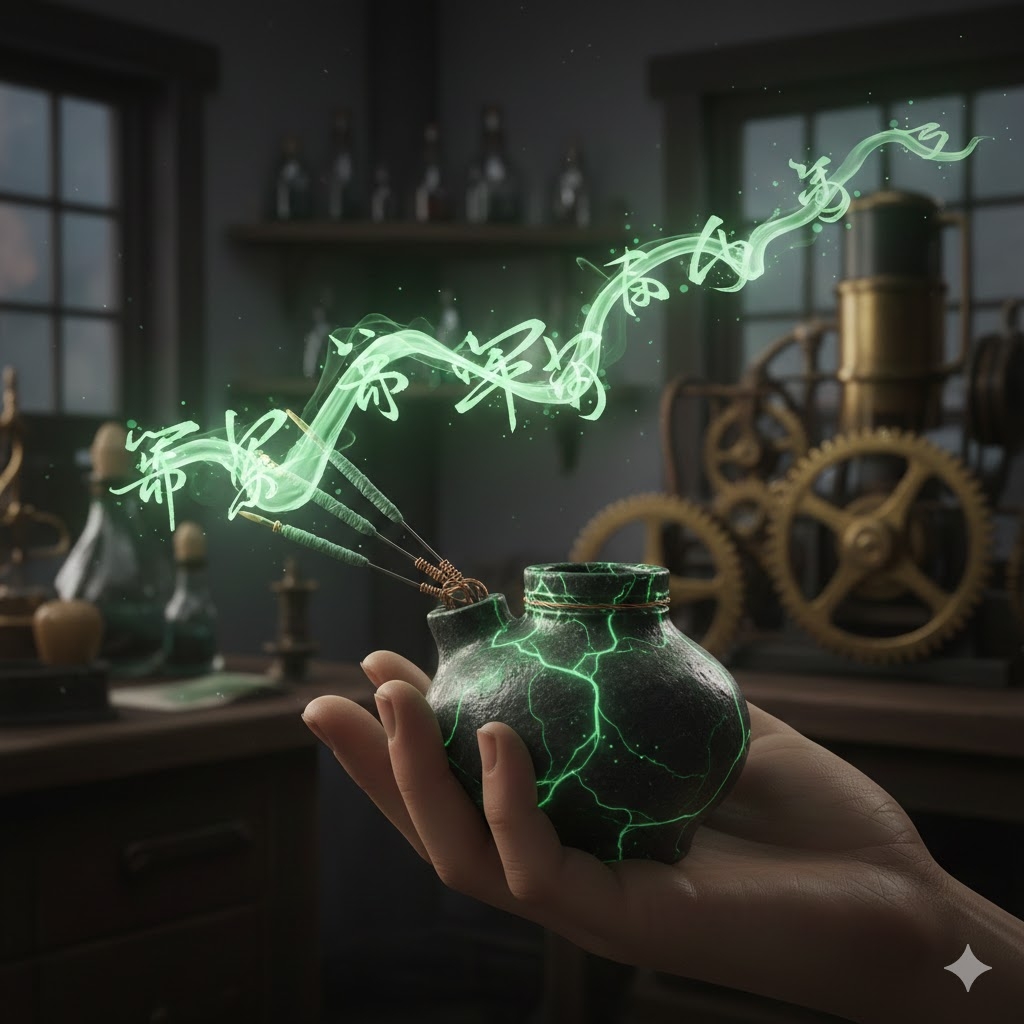
Perception of Activation:
User’s Perspective The moment the Etcher initiates the activation, they feel a rhythmic thrumming in their wrist, as if their pulse is synchronizing with the spirit-basalt of the inkwell. Their breathing becomes deep and effortless, and a sensation of “mental grease” coats their thoughts, allowing them to glide through complex alchemical formulas without friction. As they concentrate, the physical world appears to dim slightly, while the flow of Qi and Mana becomes brilliantly illuminated. They perceive the “spirit-reactive” ink not as a liquid, but as a vibrant extension of their own nervous system, allowing them to feel the air’s resistance as they draw their sigils.
Observer’s Perspective To an outside witness, the inkwell begins to emit a soft, verdant hum that vibrates nearby glassware. The fine needles attached to the user’s wrist twitch with a life of their own, and the basalt container glows with faint, hairline fractures of emerald light. When the Etcher begins to draw, the observer sees glowing, translucent ink trailing from the user’s fingertips, hanging in the air with impossible stillness. The Etcher’s eyes may appear to glaze over or take on a slight luminescent sheen, and their movements become eerily fluid and precise, as if they are following a pre-existing path only they can see.
Extra-Sensory Perceptions
- Chrono-Dilation: The user perceives the 6-second window of a “Normal” spell cast as significantly longer, providing a sense of expanded time to perfect the calligraphy of a sigil.
- Structural Resonance: The user hears a low-frequency “ringing” emanating from nearby objects; the pitch changes based on the object’s durability, allowing them to hear a crack before it visually appears.
- Olfactory Mana: A sharp, ozone-like scent mixed with the smell of scorched sandalwood fills the immediate area (within 5 feet) during active use.
- Tactile Qi: Observers within close proximity may feel the hair on their arms stand up or experience a mild “pins and needles” sensation on their skin as the ambient Mana is drawn toward the conduit.
Positives
- Hyper-Focus: The activation creates an intuitive “flow state,” making the user temporarily immune to minor environmental distractions like noise or smoke.
- Environmental Harmony: The user feels a profound sense of connection to the world of Saṃsāra, reducing the emotional burden of “seeing deeper truths” through the Mind’s Eye.
- Precision Enhancement: All fine motor movements are magically stabilized, eliminating hand tremors or accidental slips during delicate alchemical work.
Negatives
- Sensory Tunneling: While active, the user may become less aware of threats outside their immediate field of vision (a penalty to passive awareness of flanking maneuvers).
- Ghost-Limb Sensation: After the activation ends, the user’s wrist often feels unnaturally heavy or numb for several minutes as the Qi flow returns to normal.
- Residual Glow: The emerald fractures on the basalt inkwell take time to fade, making it difficult to hide or remain stealthy in dark areas immediately after use.
Rite of the Inscribed Vessel: Taoist 442 Crafting Manual
Materials Needed
- Spirit-Basalt (1 lb): Raw volcanic stone harvested from a high-magic ebb-zone. It must be porous enough to hold Mana but dense enough to withstand steam-industrial pressure.
- Crystalline Mana Condensate (2 drams): A stabilized alchemical liquid used to prime the interior reservoir.
- Silver-Threaded Silk (3 feet): High-conductivity silk woven with fine silver wire to act as the sensory bridge between the avatar and the stone.
- Refined Copper Needles (6): Precisely tapered conduits for the “Etcher” to direct the flow of Qi.
- Elemental Fire & Water Salts (1 pinch each): Used during the tempering process to simulate the steam-industrial balance of the world.
Tools Required
- Conduit-Etching Chisel: A tool specifically designed to carve “magic circuits” into stone without shattering the spiritual matrix.
- Alchemical Crucible: A heat-resistant vessel for blending the priming liquids.
- Precision Pliers and Tweezers: For the delicate task of wrapping the silver-threaded silk around the basalt neck and copper needles.
- Steam-Powered Polishing Wheel: To smooth the basalt surface to a mirror finish, ensuring the Mind’s Eye can perceive the internal “stats” clearly.
Skill Requirements
- Tier 1 Alchemy: Understanding the basic chemical and magical reactions between spirit-basalt and mana condensate.
- Basic Inscription: The ability to carve geometric sigils that can hold a charge without leaking Qi.
- Fine Motor Coordination: Necessary for the “strapped” wrist assembly to ensure the item does not pinch or restrict the avatar’s blood flow.
Crafting Steps
- Stone Selection and Hollow: Select a piece of Spirit-Basalt free of structural cracks. Use the chisel to hollow out a central reservoir, leaving the walls exactly three millimeters thick to allow for the emerald “glow” to be visible during activation.
- Circuit Etching: On the exterior of the vessel, carve a series of interlocking channels that resemble the circulatory system of a living being. These channels will serve as the magic circuits for the “Flowing Qi Ink.”
- Priming the Reservoir: Fill the hollowed center with the Crystalline Mana Condensate. Add the Elemental Salts to initiate a slow-boil reaction, simulating a miniature steam-engine effect within the stone.
- Needle Mounting: Affix the six copper needles to the side of the vessel using the silver-threaded silk. Each needle must be positioned so it rests against the user’s skin when worn, allowing the item to act as a proper conduit for “Hand Gestures” or “Vocal Cords” magic.
- Binding and Tempering: Wrap the remaining silver silk around the wrist-strap assembly. Place the entire item into a steam-chamber for one hour to synchronize the magical and mechanical components.
- Mind’s Eye Calibration: Once cooled, the crafter must use their own Mind’s Eye to “view” the item. If the basic stats (Name, Title, Material) manifest clearly in their thoughts, the attunement bridge is successful.
First Breath and Stone which Weeps Light
In the era before the counting of the nine thousand cycles, when the Great Island Countries were but pebbles in the mouth of the Deep Serpent, there existed a Being of Two Shadows. The scrolls, brittle as the wings of a dried locust, name this being Etch-A-Kahn, though the phonetics are wounded by the passage of time. Etch-A-Kahn walked upon Saṃsāra when the magic did not flow like weather, but stood still like a frozen lake, thick and unmoving.
It is written in the “Songs of the Fractured Basalt” that Etch-A-Kahn possessed a heart of stone and fingers of vapor. This ancestor-creature was the first to realize that the thoughts of the Multiverse were leaking into the world, staining the dirt with memories of lives not yet lived. While others built huts of mud, Etch-A-Kahn sought to build a vessel for the “Truth-which-cannot-be-spoken.”
The story—translated through the filter of seven fallen empires—claims that Etch-A-Kahn climbed the Jade Peak of the Seven Thunders. There, the sky was not blue but the color of a bruised plum, and the steam of the world’s first elemental fire rose to meet the cold of the void. Etch-A-Kahn sat for forty sessions of the moon, unmoving, until the skin of their wrist fused with the very rock of the mountain.
The “Unknown Language” (perhaps the tongue of the First Gods) describes the act of creation as a “Sorrowful Cutting.” Etch-A-Kahn did not have a chisel; they used the sharp edge of their own grief to carve into the spirit-basalt. They sought to create a tool that would allow the Mind’s Eye to see not just what a thing is, but what it deserves to be.
As the first steam hissed from the union of mountain-fire and cloud-water, the stone began to cry. These tears were not salt-water, but the first Verdant Ink. The ancient text says: “And the liquid of the mountain was as the blood of the stars, green and reaching, grasping for the air to find a shape.” This was the birth of the Taoist 442. The number “442,” in the poorly understood numerology of the ancients, likely referred to the four directions of the wind, the four chambers of the heart, and the two souls (Avatar and Character) that must dance to make the magic move.
Etch-A-Kahn took the silver silk from the Great Spider of the Void—a creature many scholars now believe was a metaphor for the first magic circuits—and bound the weeping stone to their arm. When the first sigil was drawn in the plum-colored sky, the world of Saṃsāra trembled. The mountains learned their names. The trees understood they were wood. The monsters, seeing their own “Stats” for the first time, became afraid of the truth.
However, the translation grows dark here. It is said that the “Kings of the Iron Age” (who did not yet have steam) became jealous of the Etcher’s sight. They hunted Etch-A-Kahn across the seventy-three lands. They feared the Mind’s Eye because a King cannot rule a man who sees the “hidden stats” of a crown and realizes it is merely gold and ego.
In the final fragment of the story, Etch-A-Kahn stood upon a floating city that was falling from the sky. As the city descended into the dark cave systems of the world, the Etcher did not fight. Instead, they used the last of their Mana Boost—the Silver Fire—to paint a Great Sigil upon the hearts of all living beings. They shattered the original 442, casting the shards into the ebbing magic of the world so that any creature, regardless of their past life, might one day find a piece of the basalt and learn to write their own truth.
The text ends with a description of the “Vaporization into Sparks,” a term used by the ancient translators to describe the death of a possessed soul. Etch-A-Kahn left behind only the scent of scorched sandalwood and a thousand glowing crystals, which the winds of Saṃsāra scattered into the back woods and the jungles to wait for the next tier of seekers.
The Moral of the Story: He who seeks only to see the world as it appears is blind; but he who learns to etch his own truth upon the air will find that even a stone can be made to weep the light of wisdom.
Suggested conversions to other systems:
Call of Cthulhu (7th Edition)
The Jade Siphon of the Akashic Scribe
- Item Type: Artifact Focus
- Sanity Cost: 1d4 points to Attune; 1 point per Active use.
- Game Mechanics:
- Passive (Mind’s Eye): Provides a +20% bonus to Library Use and Occult rolls when attempting to identify the origin of a creature or artifact previously viewed while wearing the Siphon.
- Active (Identify): The user may spend 5 Magic Points and 10 minutes in deep concentration to reveal a creature’s “True Essence.” This grants a Bonus Die on the next roll made to interact with, evade, or combat that specific entity.
- The Weight of Truth: Constant use of the Siphon forces the user to see the “Stats” of the mundane world. Any Sanity loss suffered while the item is active is increased by +1 as the “Truth” is harder to ignore.
- Syntax: Relic, constant effect (Passive), activated effect (Active).
Blades in the Dark
The Whisper’s Ghost-Ink Well
- Item Type: Rare Arcane Implement (1 Load)
- Game Mechanics:
- Passive (Mind’s Eye): When you Study a person or high-security lock, you get +1d to the roll. You can see the “Quality” and “Tier” of items and factions as literal glowing auras.
- Active (Identify): Spend 1 Stress to perform a ritual inscription in the air. This acts as a Setup action for a teammate, granting them +1 Effect on their next action against a target by revealing a “Weakness” or “Hidden Trait.”
- Overwhelm (Drawback): If you take a Consequence while using the inkwell, the GM may tick a 4-segment “Mental Overload” clock. When filled, you suffer the Level 2 Harm: Mind-Burned.
- Syntax: Arcane, +1d Study, Setup (1 Stress).
Dungeons & Dragons (5th Edition)
Cincture of the Verdant Calligrapher
- Item Type: Wondrous Item, Common (Requires Attunement)
- Game Mechanics:
- Mind’s Eye (Passive): You have advantage on Intelligence (Investigation) checks to identify the properties of magical items or the species of a creature.
- Identify (Active): You can cast the Identify spell as a ritual, using the inkwell as the material component (the ink is not consumed).
- Silver Fire Reaction (Mana Boost): As a reaction when you are reduced to 0 hit points but not killed outright, you can drop to 1 hit point instead. You cannot use this property again until you finish a Long Rest.
- Tier Restriction: If you are below 5th level and wear more than 10 attuned items, you take 1d4 necrotic damage every 1d4 minutes until the excess items are removed.
- Syntax: Wondrous item, common (requires attunement by a creature of Tier 1).
Knave (2nd Edition)
The Etcher’s Basalt Basin
- Item Type: Item (1 Slot)
- Game Mechanics:
- Mind’s Eye: While held or worn, the GM must reveal the exact HP and Armor rating of any monster the player examines.
- Identify: Once per day, you may spend 10 minutes to ask the GM one question about an object’s history or a creature’s greatest weakness. The GM must answer truthfully.
- Durability: If the user takes a “Direct Hit” (an attack that exceeds Armor by 5+), the item must make a Saves check or break, losing its magical properties until repaired by an Alchemist.
- Level Gate: A character must have at least 6 magical items in their inventory slots to advance from Level 1 to Level 2.
- Syntax: 1 Slot, 1/Day Identify, Passive HP/Armor sight.
Fate (Core / Condensed)
The Etcher’s Resonating Inkwell
- Item Type: Extra (Cost: 1 Refresh or a Stunt slot)
- Aspects: Taoist Focus of the Verdant Calligraphy, The Mind’s Eye Sees All
- Game Mechanics:
- Passive (Mind’s Eye): You gain +2 to Create an Advantage using Lore or Notice when examining the nature of an object, creature, or ancient riddle.
- Active (Identify): Once per scene, you may spend a Fate Point to automatically discover a target’s secret Aspect or its highest Skill rating without rolling.
- Silver Fire (Mana Boost): Once per session, when you would take a Consequence from physical harm, you may use the inkwell’s Mana to reduce the shift value of the hit by 2.
- Syntax: Extra with Passive +2 Bonus and Fate Point powered discovery.
Numenera & Cypher System
Basalt Scrivener’s Conduit
- Item Type: Artifact (Level 1d6)
- Depletion: 1 in 1d20
- Game Mechanics:
- Passive (Mind’s Eye): While worn, the difficulty of tasks related to identifying the level or function of numenera or biological creatures is decreased by one step.
- Active (Identify): You may spend 3 points from your Intellect Pool to “dive deep.” For the next ten minutes, you gain an Assets on all rolls to interact with a specific object or creature you have identified.
- Mana Reaction: If you would be moved one step down the Damage Track, you can roll for Depletion immediately. If the artifact does not deplete, you remain on your current step of the damage track with 1 HP.
- Syntax: Artifact, Level 1d6, Assets on identification.
Pathfinder (2nd Edition)
Taoist 442 Script-Vessel
- Item Type: Item 1 (Magical, Divination, Invested)
- Usage: Worn (Wrist); Bulk: L
- Game Mechanics:
- Passive (Mind’s Eye): You gain a +1 item bonus to Religion or Occultism checks to Identify Magic. When you use the Recall Knowledge action to identify a creature, you learn its lowest saving throw on a success.
- Active (Identify): Action (Concentrate) – You spend 1 minute focusing on a nearby object. This functions as the Read Aura cantrip but also reveals one mechanical property (such as Hardness or Weight).
- Silver Fire (Mana Boost): Reaction (Trigger: You are reduced to 0 HP) – You spend 1 Mana point (if available) to be at 1 HP instead. You are still Wounded 1.
- Syntax: Item 1, Invested, Worn, +1 Item Bonus to Identify Magic.
Savage Worlds (Adventure Edition)
The Scribe’s Basalt Wrist-Well
- Item Type: Weird Science Device / Magic Item
- Game Mechanics:
- Passive (Mind’s Eye): The wearer gains a +1 bonus to Research and Notice rolls when examining items or creatures. On a Raise, the GM must reveal the target’s Toughness and any Weaknesses.
- Active (Identify): As a Limited Action, the user may concentrate to cast the Detect Path or Object Reading power using their Research skill as the arcane skill.
- Mana Boost (Silver Fire): If the wearer suffers a Wound, they may spend 1 Mana to ignore the damage, remaining at their current health state but “Shaken.”
- Overwhelm (Drawback): If the user rolls a Critical Failure on a Skill roll while using the item, they are Distracted and Vulnerable until the end of their next turn.
- Syntax: Minor Artifact, +1 Notice/Research, Power (Object Reading).
Shadowrun (6th World Edition)
Qi-Circuit Inkwell Focus
- Item Type: Force 1 Qi Focus (Wrist-mounted)
- Game Mechanics:
- Passive (Mind’s Eye): While active, the user gains a +1 dice pool bonus to Assensing tests. You can perceive the “Force” of spells and the “Device Rating” of electronics as glowing numerical overlays in the Astral or AR.
- Active (Identify): Spend a Major Action to focus on a target. This counts as a Shift in perception, revealing the target’s current Physical or Stun track (whichever is lower) and any active Cyberware or Spells.
- Silver Fire (Mana Boost): As a Reaction to taking damage, you may spend 1 point of Edge (representing Mana) to negate all damage from that single attack, remaining at 1 box on your condition monitor.
- Syntax: Qi Focus, Force 1, Attunement: 1 Karma.
Starfinder (2nd Edition / Playtest)
Basalt Scrivener’s Tech-Relic
- Item Type: Level 1 Magic Item (Worn)
- Game Mechanics:
- Passive (Mind’s Eye): You gain a +1 item bonus to Computers and Mysticism checks to identify technological or magical properties of items. You can sense the “Tier” of a ship or the “Level” of an NPC at a glance.
- Active (Identify): Use a 1-minute Activity to scan an object or creature. This functions as the Detect Magic spell but also identifies mechanical components and energy sources.
- Silver Fire (Mana Boost): When you would be reduced to 0 Hit Points, you may spend 1 Resolve Point as a Reaction to stay at 1 Hit Point.
- Syntax: Level 1 Magic Item, Bulk L, Usage worn (wrist).
Traveller (Mongoose 2nd Edition)
Ancient Psionic Inscription Basin
- Item Type: TL 15 Psionic Interface
- Game Mechanics:
- Passive (Mind’s Eye): If the user has a PSI rating, they gain a +1 DM to all Investigate and Science checks when examining unknown artifacts or biological samples.
- Active (Identify): The user may spend 2 PSI points and 1-6 minutes to “read” an object. This reveals the object’s origin, intended function, and any internal faults or hidden compartments.
- Overwhelm: If the user fails a check while using the device, they suffer 1D6 points of temporary INT damage due to sensory feedback.
- Syntax: Augmentation/Tool, TL 15, PSI Required.
Warhammer Fantasy Roleplay (4th Edition)
The Chamonite Inkwell of Grungni’s Sight
- Item Type: Magical Curio
- Game Mechanics:
- Passive (Mind’s Eye): The wearer gains a +10 bonus to Intuition and Lore (Magic) Tests. You can see the “Wounds” and “Traits” of a creature as swirling patterns of Aethyr around their body.
- Active (Identify): Spend an Action and succeed on a Channelling Test to perceive the “True Stats” of an item or foe. This reveals the target’s current Wounds and any Critical Weaknesses they may have.
- Silver Fire (Mana Boost): As a Reaction to a Killing Blow, the user may spend 1 Fortune Point (representing Mana) to instead take a “Near Death” result, leaving them with 1 Wound remaining.
- Syntax: Enchanted Item, Attunement: 1 Full Day.