
Lore: The art of Summoning 7 is a deeply ingrained tradition among the island nations and great naval powers of Saṃsāra. Its practitioners, often master shipwrights and seasoned captains, do not concern themselves with land-bound spirits or otherworldly demons. Their focus is solely on the ocean and the myriad of minor, symbiotic spirits that inhabit its depths. Their core philosophy states that a ship is more than just wood and iron; on its maiden voyage, as it first feels the embrace of the sea, a “waking-spirit” is born within its hull. The goal of a naval engineer, therefore, is to ensure the health of this spirit by maintaining the harmony between the vessel and the living ocean.
To this end, they summon and bind minor “hull-spirits”—simple, curious ocean sprites that instinctively understand the pressures of the deep, the stress of wood against water, and the flow of currents. The Shipwright’s Scry-Barnacle is the most common application of this magic, a living diagnostic tool issued to every apprentice shipwright and found in the toolkit of any discerning naval officer. The spirit within is not a conversational entity, but through its simple reactions, it provides a constant, intuitive stream of information about a ship’s health and its relationship with the sea, translating the groans of the hull into a language a builder can understand.
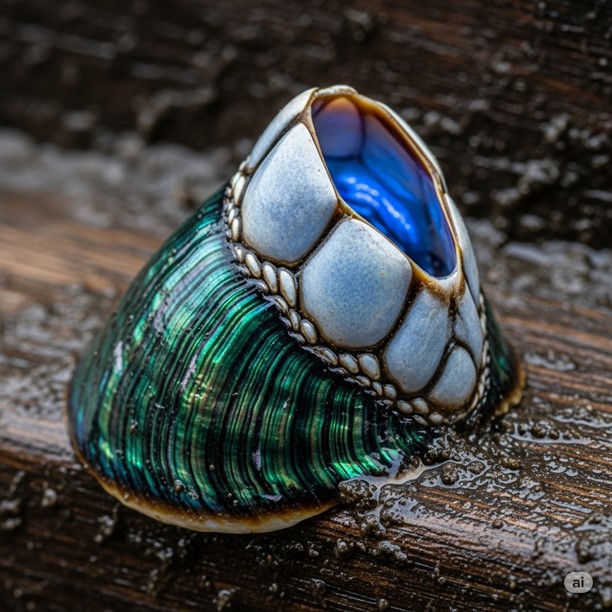
Description: The item is a single, oversized barnacle, roughly the size of a human fist. Unlike a common barnacle, its conical shell is a beautiful, iridescent mother-of-pearl, with shimmering, hypnotic swirls of deep sea-green and ocean blue. The base is flat and surprisingly smooth. The top of the shell, where the organism would normally feed, is a single, large aperture covered by a smooth, translucent, greyish membrane, similar in appearance to a clouded lens.
When not in use, the Scry-Barnacle is kept in a container of salt water, where it remains closed and seems mostly inert. When pressed firmly against the hull of a ship or other naval vessel, it adheres with tremendous force. Once attached, the membrane on top clears, becoming perfectly transparent and revealing a soft, pulsating, internal blue light—the visible manifestation of the bound hull-spirit. The barnacle feels cool and damp to the touch and carries the clean, unmistakable scent of a fresh sea breeze and salt spray.
Detailed Stats
- Tier: 1
- Intellect: +1 (Granted to the attuned user, representing the intuitive understanding of naval systems)
- Ship Health (Conceptual Stat): +5% (Represents its passive aid in maintaining a vessel’s integrity)
Passive Magic
- Hull Integrity Sense: Once attached to a ship’s hull, the spirit within constantly monitors the state of the vessel in its immediate vicinity. It can feel the subtle stresses of the wood and metal. If a plank is waterlogged and beginning to rot, a seam is weakening under pressure, or a metal plate is stressing to the point of fracture, the steady blue pulse of the spirit’s light will become erratic, developing a discordant “flicker.” This provides a constant, silent warning of a structural problem long before it becomes a dangerous, visible leak.
- Current Awareness: The bound spirit is perfectly attuned to the flow of water around it. An avatar who is on the ship and near the attached barnacle gains an intuitive sense of the local ocean currents. This is not a precise navigational reading, but a distinct physical feeling, as if they are being gently “pushed” or “pulled” in the direction of the current’s flow, allowing a skilled sailor to instinctively gauge its direction and approximate strength.
Activable Magic
- Leak Detection: Once per day, the user can place their hand over the barnacle’s membrane and speak a command word. For the next ten minutes, the spirit actively “listens” for the sound of water entering the hull. If the barnacle is within 15 feet of a hull breach—even a hairline crack or a faulty seal—it will begin to emit a series of high-pitched, chittering clicks, allowing the crew to quickly pinpoint the exact location of hidden leaks after a battle or during a heavy storm.
- Fouling Rebuke: By focusing and pushing a small amount of their own magical energy into the barnacle, the user can command the spirit to defend its home. The spirit emits a low-frequency, dissonant hum in a 10-foot radius around itself. This hum is harmless to the ship’s materials but is intensely unpleasant for simple marine organisms. For one hour, this field will repel or drive off barnacles, algae, sea worms, and other mundane fouling creatures, making it an excellent tool for clearing a critical area of the hull, such as around a rudder hinge or a sensitive sensor array.
Specific Slot: Vessel Augment / Ship Slot
Tags: Summoning, Ship Slot, Common, Tier 1, Magic, Utility, Engineering, Naval, Shipwright, Detection, Water, Intellect, Spirit, Bound, Oceanic, Symbiotic, Diagnosis, Maintenance, Navigation
In the world of Saṃsāra, a realm of 73 island countries where the endless ocean is the great highway of commerce and travel, the health of a ship is paramount. The Shipwright’s Scry-Barnacle, a product of the maritime tradition of Summoning 7, is a vital and common tool for anyone whose life or livelihood depends on a sound hull. Its sale and trade are confined to the ports, shipyards, and naval communities that are the lifeblood of the world.
The Shipwrights’ Guildhall
The primary and most reputable source for a Scry-Barnacle is from the very guilds of shipwrights and naval engineers that practice the art of Summoning 7. These are not shops, but professional headquarters located in the heart of great port cities or legendary ship-building islands. The halls smell of sawdust, tar, and salt, and their walls are adorned with cross-section diagrams of famous vessels and the private nautical charts of master captains.
Here, the Scry-Barnacle is not sold to the general public. It is a professional instrument, provided to licensed shipwrights, certified captains, and naval architects. The transaction is a formal one. A buyer must present their credentials. The sale is logged in the guild’s records, and the barnacle is often accompanied by a certificate of authenticity detailing the health of the bound spirit. The focus is on ensuring the safety and quality of the vessels that sail the seas, not on maximizing profit. The living barnacles are kept in large, immaculate saltwater tanks, cared for by acolytes until they are commissioned.
- Cost: A standardized guild price of 6 Silver coins. This is a professional investment, reflecting the skill required for its creation and its immense value in protecting a far more expensive asset: the ship itself.
The Naval Chandlery
In any major port, there is a chandlery—a specialized shop that sells all things necessary for outfitting a sea-voyage. These stores are packed to the rafters with coils of rope, bolts of sailcloth, brass sextants, heavy anchors, and everything in between. The proprietor, or chandler, is a knowledgeable merchant who knows the needs of a sailor.
A reputable chandlery would be an authorized reseller of Scry-Barnacles. They would be displayed with pride in a large, clean aquarium, often near the chronometers and other fine navigational instruments. The chandler would be able to explain the barnacle’s function in practical terms, advising a new captain that the tool will pay for itself a hundred times over by detecting a single leak before it becomes a catastrophe. The transaction is a professional retail sale to a discerning customer who understands the value of quality equipment.
- Cost: 1 Gold coin. As a premium item in a specialty store, its price is high but justified for a captain or ship owner who is investing in the safety and longevity of their vessel.
Naval or Corporate Fleet Outfitters
The great navies and massive trading companies of Saṃsāra maintain their own fleets and, therefore, their own supply depots. These are vast, practical warehouses in naval yards or corporate docks, focused on the logistics of maintaining dozens or hundreds of ships.
The Scry-Barnacle is treated here as essential, standard-issue equipment. The fleet’s quartermaster would acquire them in bulk directly from the Summoning 7 guilds. The transaction for a specific ship’s captain is one of requisition, not purchase. The captain or first mate would file a request for a Scry-Barnacle for their vessel, and a clerk would issue one from stores, logging the transfer in a supply manifest. The “cost” is an internal budget matter, and the focus is entirely on maintaining fleet readiness and protecting the company’s assets.
- Cost: An internal ledger price of 5 Silver coins. The cost is simply transferred between naval or corporate departments.
The Dockside Pawn & Salvage
In the grimiest, most chaotic parts of any port city, near the ship-breaking yards and rowdy taverns, are the pawn shops that cater to sailors on their luck. This is where a disgraced captain might sell their last valuable possession for passage home, or where a salvager might bring items recovered from a wreck.
A Scry-Barnacle found here would be a gamble. It would be kept unceremoniously in a simple wooden bucket of murky seawater. The pawnbroker would know it’s a “magic barnacle” and that it’s valuable, but they would likely not know its specific functions or how to care for the spirit within. They bought it cheap and will sell it dear. The transaction is a raw haggle, filled with bluffs and suspicion. A knowledgeable avatar might get a bargain, but they also risk buying a barnacle whose spirit is weak, sick, or dying from neglect.
- Cost: Highly variable. The broker might ask for 7 Silver coins, but a shrewd buyer who can spot that the spirit’s light is dim might be able to talk the price down to 4 Silver, arguing that it’s “unhealthy.”
The Shipwright’s Scry-Barnacle is a tool of harmony and maintenance, not of overt conflict. Its use in roleplaying situations of offense and defense is a testament to the cunning of a seasoned sailor, focusing on mastering the environment, ensuring the integrity of one’s own vessel, and subtly exploiting the weaknesses of an opponent’s.
In a Dockside Canal Alleyway
This environment is a cramped, murky waterway, flanked by stone walls and rickety docks—a place where quick escapes and subtle sabotage are key.
Defense: An avatar is making their escape in a small, flat-bottomed canal boat, with rivals in hot pursuit along the dockside. One of the pursuers leaps onto the boat, rocking it violently and ramming the hull against a stone wall with a sickening crunch. Fearing a leak, the avatar slaps their Scry-Barnacle onto the inside of the hull near the point of impact. The spirit’s inner light, normally a steady pulse, begins to flicker erratically—the Hull Integrity Sense confirming the planks are stressed to their breaking point. “Brace this spot now!” the avatar yells to their companion. They are able to wedge a crate against the weakened area, providing just enough support to keep the hull intact as they make their escape down the dark waterway.
Offense: The avatar needs to prevent a smuggling barge from leaving its mooring in a murky canal before the city watch can arrive. Under the cover of darkness, they slip into the foul water and swim beneath the barge. They press the Scry-Barnacle against the ship’s rudder assembly and activate Fouling Rebuke. The burst of energy clears the area of the usual slime and algae. This is not the attack. The attack is the follow-up: into the now-clean and exposed hinge mechanism, the avatar jams a waterlogged piece of driftwood. The rudder is now fouled and will not turn. When the smugglers try to depart, their barge will only be able to go in circles, trapped until the watch arrives.
On a Ship’s Deck During a Storm
In the midst of a naval battle, the ship itself is the ultimate weapon and defense. Its survival is everything.
Defense: After a broadside from an enemy frigate, the avatar’s ship shudders, the deck groaning under the impact. The captain shouts orders, worried about unseen damage below the waterline. The avatar, who has several Scry-Barnacles attached to key structural ribs of the ship, rushes below deck. One of the barnacles, near the forward powder magazine, has its blue light flickering, and it is emitting a high-pitched, chittering sound from its Leak Detection ability. The avatar has instantly diagnosed not only that there is a hull breach, but its precise location. They lead the carpenter’s crew directly to the spot, allowing them to patch the hole before a critical amount of water can be taken on, saving the ship from sinking.
Offense: The avatar’s ship is being pursued by a faster, more agile enemy vessel. Escape seems impossible. The avatar, holding a barnacle on a rope over the side, uses their Current Awareness. They feel the steady pull of the main current, but also a strange, intermittent “tugging” from a different direction. They recognize it as a treacherous, unseen cross-current just below the surface. On the captain’s order, they change course, luring the enemy ship over the hidden current. The enemy vessel, relying on surface observation and charts, is caught unexpectedly and thrown off course, its rudder struggling for control. The sudden maneuver forces the enemy to expose its vulnerable stern, allowing the avatar’s ship to fire a devastating raking shot.
In a Flooded Sea Cave
Navigating tight, submerged spaces requires a delicate touch and a constant awareness of the immense pressure outside the hull.
Defense: The party is exploring a flooded cave system in a small, magically-powered submersible. As they navigate a particularly narrow, jagged passage, the avatar attaches their Scry-Barnacle to the inside of the main viewport. The Hull Integrity Sense provides a constant, intuitive feedback of the pressure and stress on the viewport’s crystal. The spirit’s light pulses steadily, but as they scrape against a rock outcropping, it flickers violently. “Too much pressure on the port side!” the avatar warns the pilot, who corrects their course. The barnacle acts as a vital early-warning system, defending the submersible from being cracked open by the immense pressure of the deep.
Offense: A territorial Giant Isopod, a creature covered in thick, overlapping plates of natural armor, blocks the only exit from a grotto. The party’s weapons can’t seem to penetrate its shell. The avatar, however, swims close and manages to slap the Scry-Barnacle onto the creature’s carapace. Activating Hull Integrity Sense, the avatar doesn’t feel the strength of the armor, but the weakness beneath it. The spirit’s light flickers over one specific plate near a leg joint. The avatar has found a plate that is not well-seated, a chink in the armor. “There!” they signal to the party’s warrior. “Aim for the third plate on its left side!” The focused attack on the weak point bypasses the creature’s natural defenses, forcing it to retreat.
At a Gala on a Flagship Galleon
Here, conflict is a matter of reputation, espionage, and proving one’s superior command of the sea.
Defense: The avatar, a rising naval captain, is attending a formal ball on the flagship of a pompous, rival admiral. The admiral boasts that his ship is the fastest in the fleet because his crew is the best at keeping the hull perfectly clean. While on a tour of the lower decks, the avatar “accidentally” trips, pressing their hand—and the concealed Scry-Barnacle—against the hull near the waterline. They activate Fouling Rebuke for just a moment. The resulting field is small, but it’s enough. Later, when the admiral is boasting, the avatar politely asks, “It is a magnificent ship, Admiral, but have you had your shipwrights look at the unusual patch of sea worm growth on the starboard bow? A clean hull is a fast hull, after all.” The admiral is left sputtering, his crew’s competence publicly questioned, and the avatar has defended their own crew’s honor.
Offense: The avatar needs to gain a critical advantage in a naval race scheduled for the next day. Their rival’s ship is faster, but its rudder is known to be a complex, delicate mechanism. During the pre-race gala, the avatar finds a way to the mooring lines of the rival ship. They don’t try to damage it. Instead, they attach their Scry-Barnacle to the rival’s hull, right next to the rudder. They activate Fouling Rebuke and leave the barnacle there. For the next hour, the barnacle will keep that small area perfectly, unnaturally clean. When the ability wears off, that single clean patch is now the most attractive spot for every bit of algae and marine life in the dirty harbor. By morning, the rudder assembly will be disproportionately fouled with new growth, making the rival’s ship sluggish and difficult to steer, a subtle act of sabotage that gives the avatar the offensive edge they need.
Perception of Activation:
The Shipwright’s Scry-Barnacle’s two active abilities are distinct magical processes—one is a patient, diagnostic search, while the other is an immediate, forceful repulsion. Their sensory perceptions reflect these different applications.
Activation: Leak Detection
This is the initiation of a sustained, ten-minute “listening” state, where the user commands the bound spirit to actively search for hull breaches.
Sight
- User’s Perspective: When you touch the barnacle and speak the command, the soft, blue, pulsating light within the transparent membrane changes. A silvery, shimmering ring appears within the blue glow, slowly expanding and contracting like a sonar wave on a screen. This tells you the “listening” state is active. Should a leak be found, the blue light will begin to flash in perfect time with the chittering sound the barnacle makes.
- Observer’s Perspective: An observer sees you touch the barnacle on the hull. The steady blue light inside it visually changes, now featuring a pulsating silver ring. It clearly looks as though a magical sensor has been switched on.
- Positives: The visual change clearly indicates that the ability is active and searching, which is useful for coordinating with a crew. The flashing light provides an unambiguous visual cue if a leak is found.
- Negatives: The process takes ten minutes to complete its search, requiring patience. The change in the magical light is an obvious sign to anyone with magical senses that you are actively scanning the vessel.
Sound
- User’s Perspective: At the moment of activation, you hear a soft whoosh, like the sound of water rushing into a previously empty space. The ability is then silent unless it finds a leak, at which point you and anyone nearby will hear the distinct, high-pitched, insistent chittering of the spirit.
- Observer’s Perspective: The initial activation is silent. They will only hear the loud chittering if a leak is detected and they are reasonably close to the barnacle’s location.
- Positives: The final alert sound is clear, sharp, and directional, making it easy to pinpoint the location of the emergency.
- Negatives: There is no auditory feedback during the “searching” phase, which might leave allies wondering if the ability is still active.
Touch
- User’s Perspective: When you touch the barnacle to activate it, you feel a brief sensation of suction against your palm, as if the spirit is creating a small vacuum to “listen” better. If you keep your hand on the barnacle, you can feel a slow, deep, pulsing vibration for the duration, a tactile confirmation that the spirit is actively searching.
- Observer’s Perspective: An observer perceives nothing through the sense of touch.
- Positives: The constant, subtle vibration provides clear, non-visual feedback to you that the ability is functioning correctly.
- Negatives: The sensation is entirely personal and provides no information to allies.
Smell & Taste
- User’s Perspective: Upon activation, you get a strong, briny taste of salt water in your mouth, as if you’ve just swallowed a mouthful of seawater. There is no associated smell.
- Observer’s Perspective: There is no perception via these senses for an observer.
- Positives: A sharp, personal sensory confirmation that the command was received.
- Negatives: A purely subjective experience with no tactical value.
Extra-Sensory Perceptions
- User’s Perspective (Symbiotic Sense): You feel the hull-spirit “extend” its consciousness beyond the barnacle itself, spreading its awareness across the ship’s hull like a net. You feel its patient, listening state. If a leak is found, you feel a jolt of the spirit’s “alarm” and “pain” a split second before the chittering sound begins.
- Observer’s Perspective (Magical Sense): A magically-aware observer would perceive a faint, web-like filigree of blue Divination magic spread out from the barnacle, slowly enveloping the ship’s hull. They would see this web “listening” for the tell-tale magical dissonance of a structural failure. It is clearly a diagnostic spell.
- Positives: You are linked to the spirit’s search, giving you the earliest possible warning of danger. The magic appears diagnostic and non-hostile to magical senses.
- Negatives: The magical web, though faint, is visible to any magical sense, revealing that you are performing a detailed scan of the vessel’s integrity.
Activation: Fouling Rebuke
This is a brief, forceful activation that creates a sustained, one-hour field to repel mundane marine life.
Sight
- User’s Perspective: As you push your energy into the barnacle, the blue light within its core flashes violently for a single, brilliant instant, shifting to an almost electric, violet-blue hue. It immediately settles back to its normal blue pulse, but the light itself seems “harder,” casting sharper, more defined shadows.
- Observer’s Perspective: An observer sees the user touch the barnacle, which then emits a single, sharp flash of violet-blue light. If they are watching the area around the barnacle, they will see any algae, sea worms, or small mollusks physically recoil from the spot.
- Positives: The visual effect is instantaneous, providing clear feedback that the ability has been activated. The immediate repulsion of sea life is undeniable proof of its effect.
- Negatives: The sharp flash of light is very noticeable and could give away your position or action.
Sound
- User’s Perspective: You hear a single, sharp, and dissonant TWANG, like a thick metal wire under immense tension being snapped. The sound is unpleasant and vibrates right inside your ears.
- Observer’s Perspective: An observer standing nearby would also hear the sharp, unnatural, metallic twang.
- Positives: The sound is a clear, unambiguous signal to allies that the ability has been used.
- Negatives: The sound is jarring and unpleasant. It could easily startle allies or alert enemies to your action.
Touch
- User’s Perspective: You feel a powerful, hard jolt push back against your hand, as if the barnacle itself has recoiled. For a moment after the pulse, the surface of the barnacle feels unnaturally slick and frictionless.
- Observer’s Perspective: Nothing is perceived through touch.
- Positives: The strong tactile feedback is an unmistakable confirmation of activation.
- Negatives: The jolt could cause you to lose your grip if you are not prepared for it.
Smell & Taste
- User’s Perspective: You experience a sharp, sterile, metallic scent, like ozone near the ocean, and a bitter taste like licking a battery.
- Observer’s Perspective: An observer very close to the activation might also notice the sharp, metallic smell.
- Positives: A unique sensory signature that confirms the ability was used.
- Negatives: The sensations are unpleasant.
Extra-Sensory Perceptions
- User’s Perspective (Symbiotic Sense): You feel the hull-spirit let out a powerful, non-vocal “shout” of territorial annoyance. It is a pure, projected feeling of “GET AWAY FROM MY HOME!” directed at the clinging sea life.
- Observer’s Perspective (Magical Sense): A magically-aware observer perceives a sharp, rapidly expanding sphere of dissonant Abjuration magic. The magic is not designed to be harmful to complex life, but it is clearly a forceful, energetic “repulsion” field. It is an act of aggressive territorial defense on a micro scale.
- Positives: The effect is powerful and immediate.
- Negatives: The magical pulse is sharp, sudden, and easily detected by magical senses. It clearly signals your action and intent, even if that intent is only to annoy some algae.
Ship-Singer’s Method for Cultivating a Scry-Barnacle
The creation of a Shipwright’s Scry-Barnacle is not an act of forging or enchantment, but one of careful cultivation and symbiotic invitation. It is a biological and magical process that requires the skills of a marine biologist, the patience of a saint, and the unique empathy of a practitioner of Summoning 7. One does not build a Scry-Barnacle; one grows it, and invites a spirit to make it a home.
Materials Needed:
- A Pearl-Barnacle Larva: A single, healthy larval specimen of the rare, iridescent Pearl-Barnacle. These must be harvested with great care from deep-sea coral reefs where magical currents are strong.
- The Keel Splinter: A sliver of wood, no larger than a thumb, taken from the keel of a ship that has sailed for at least one hundred years. The wood must be saturated with the ship’s “waking-spirit” and the memory of the ocean. This will serve as the primary lure.
- Nurturing Brine: Several gallons of specially prepared seawater, enriched with a paste made from crushed mother-of-pearl and phosphorescent algae. This will be the growth medium for the larva.
- Runic Ink: A small amount of ink made from squid ink mixed with a single drop of a willing sailor’s blood, to be used for the binding rune.
Tools Required:
- Symbiotic Growth Tank: A specialized, magically-treated glass aquarium with systems to regulate temperature, salinity, and gentle water circulation. It must be able to simulate the pressures of the deep sea.
- Runic Scribing Needle: A fine, sharp needle crafted from the tooth of a sawfish or a similar marine predator. Metal tools are considered too dissonant for this delicate work.
- A Sea-Worthy Vessel: The final stages of the binding ritual must be performed on the deck of a ship in open water, far from the confusing energies of land.
- The Coral Matrix: A specialized, portable Binding Matrix, where the main plates are not made of metal, but of large, flat pieces of magically resonant coral, inscribed with patterns of the tides.
Skill Requirements:
- Marine Husbandry (Master): The crafter must be an expert in the care and nurturing of delicate, magical marine life. Keeping the pearl-barnacle larva alive during its initial growth phase is the most difficult and failure-prone stage of the process.
- Summoning 7 (Adept): The practitioner must be skilled in the unique, song-like rituals of this naval discipline. Their magic is about attracting a curious spirit, not compelling a hostile one.
- Naval Lore (Journeyman): The crafter must understand the life and spirit of a ship to be able to properly attune the finished barnacle. They must have a feel for the sea.
- Profound Patience: The cultivation process cannot be rushed. It takes weeks of careful observation and nurturing before the summoning can even be attempted. Any impatience will spoil the work.
Crafting Steps:
- Incubation and Growth: The crafter places the pearl-barnacle larva and the nurturing brine into the Symbiotic Growth Tank. For several weeks, they must meticulously care for the larva, maintaining the perfect environmental conditions as it grows from a near-invisible speck into a small, soft-shelled organism.
- The Rune of Invitation: When the larva’s shell begins to form and harden, but while it is still growing, the crafter must perform the first inscription. Using the Runic Scribing Needle and the special ink, they must delicately etch the “Rune of Welcome” onto the nascent shell. This rune does not bind, but instead marks the shell as a prepared, worthy, and safe home for a spirit.
- The Summoning at Sea: The crafter must now take the Growth Tank, the Coral Matrix, and the Keel Splinter onto a ship and sail out until the shore is no longer visible. On the ship’s deck, they assemble the Coral Matrix and place the Growth Tank at its center. The Keel Splinter is dropped into the tank with the growing barnacle.
- The Song and the Symbiosis: The crafter energizes the Coral Matrix. They then begin the “Ship-Singing,” the core ritual of Summoning 7. It is a melodic, low-pitched chant that mimics the sounds of a happy ship—the creak of wood, the rush of water, the snap of a full sail. This song, combined with the powerful lure of the ancient Keel Splinter, calls out across the water to any wild, disembodied hull-spirits nearby. A curious spirit, feeling the promise of a worthy vessel and a perfect host, will be drawn into the matrix. It will investigate the young barnacle and, finding the Rune of Welcome, will merge with it. The crafter will know the binding is a success when the barnacle instinctively clamps onto the Keel Splinter and a soft, blue light begins to pulse within its shell.
- The Maiden Attunement: The ritual is complete. The crafter can now remove the living Scry-Barnacle from the tank. It is now a fully formed magical being. To complete its education, the crafter must immediately attach it to the hull of the ship they are on. It must remain there for one full journey (at least 24 hours), allowing the spirit to attune itself to the true feeling of a working vessel—the pressure of the deep, the rhythm of the waves, and the hum of the crew’s life. After this first “voyage,” the Scry-Barnacle is fully mature and ready for its long life of service.
Lay of Eva and Ship with a Grieving Soul
It is told by the old sailors, whose truths are salted by the sea, that in the age of the first great trading companies, the Serpent’s Strait was a place of fear. For in that strait, where the fog is born, there sailed a ship of ghosts. Her name was the Silent Serpent, and she was a great warship from an age even then forgotten. Her sails were always full, though there was no wind, and her wood was a ghostly white, like the bones of a leviathan.
The Serpent did not fire cannons of iron, but attacked with the weapon of her own immense sadness. She would appear from the fog and ram any living ship, for her own “waking-spirit,” as it is called, had been driven mad with grief from the battle that had sunk her long ago. Great navies with powerful mages were sent to destroy her, but their fire passed through her ghostly sails, and their magic could not touch a wound that was not in the body, but in the memory. And so the strait was abandoned, and trade suffered a great illness.
The merchant guilds, in their despair, offered a prize of immense wealth to any who could clear the strait of this phantom. Warriors polished their swords, and wizards prepared their greatest spells. But there was a young captain, whose name was Eva, and she was known for her strange ways. It was said she spoke to her own ship, the Swift Tern, as a mother speaks to a child. And upon the hull of her ship, just below the water, she kept a single, strange, oversized barnacle that shimmered with the colors of the deep sea. This was the first Scry-Barnacle.
While others prepared for war, Eva prepared for a meeting. She sailed the Swift Tern alone into the unnatural fog of the Serpent’s Strait. Soon, the ghost ship appeared, silent and vast, bearing down upon her small vessel. Eva’s heart was a frightened bird in her chest, but she held her course.
As the Silent Serpent came on to ram her, Eva did not flee. She performed a feat of sailing that is still sung of in the sea-shanties. She turned her ship not away, but alongside the great ghost ship, so that for a moment, the two vessels, one of living wood and one of grieving memory, sailed together as sisters. In that moment, Eva leaned far over her ship’s rail, holding her shimmering barnacle. She reached across the gap and pressed it firmly against the ghostly hull of the Silent Serpent. And the barnacle, sensing a vessel, adhered.
Then, through the barnacle, Eva felt what the wizards and warriors could not. She felt the ship’s soul. The Hull Integrity Sense showed her not rotting wood, but rotting memories. Over a great, splintered hole in the Serpent’s side, the barnacle’s inner light flickered with a deep and terrible agony. The Leak Detection function began to chitter, but it was not the sound of water she heard in her mind; it was the sound of sorrow leaking from the old wound. She understood that the ghost ship’s rage was not malice, but a pain that had not been soothed for a hundred years.
Eva now knew the true work that must be done. Keeping her ship skillfully alongside the grieving ghost, she began her strange repair. She did not use a hammer, but her voice. She spoke to the Silent Serpent, telling it she understood its pain, that its long watch was over. Then, she commanded her own ship’s spirit to help. She activated the barnacle’s Fouling Rebuke, not to clear algae, but to send a gentle pulse of harmony into the ghost ship’s wound, a pulse that cleansed the memory of defeat and despair that clung to it like a foul growth.
Finally, she took a single, new, unscarred plank of living wood from her own ship’s stores, a plank blessed by the healthy spirit of the Swift Tern. She cast it into the sea, an offering to the wound. “A living ship gives this to you,” she said. “Let your broken heart be mended.”
The great ghost ship shuddered, a tremor that shook the very water. The terrible feeling of rage that came from it softened, then ceased. The unnatural fog receded. The Silent Serpent, its long grief finally witnessed and soothed, did not vanish. It dipped its ghostly banner in salute to the Swift Tern, then turned and sailed peacefully towards the horizon, to a place beyond the maps. It was never a terror again. Eva had cleared the strait, not by defeating a monster, but by healing a friend.
The Moral of the Story: Some wounds are too deep for a sword to reach. A weapon can only break things; only understanding can make them whole again.
Suggested conversions to other systems:
Call of Cthulhu (7th Edition)
The Mariner’s Symbiote
This organism appears to be a single, oversized barnacle with a beautiful, mother-of-pearl shell. It was first discovered attached to the hull of the Erebus, a whaling ship that returned to port with its entire crew driven mad after sailing into uncharted waters. The ship was in perfect condition. The barnacle, when attached to a vessel, forms a psychic link with its owner, communicating information about the ship’s health and its immediate environment.
Game Mechanics:
- Seaworthy: When this barnacle is attached to a vessel the Investigator is on, they gain one Bonus Die on any Maps, Pilot (Boat), or Mechanical Repair roll related to the vessel.
- Structural Intuition: The Keeper will give the Investigator warnings about the ship’s structural integrity, such as a failing mast or a weakened hull plate, before the problem becomes critical.
- Leak Finder: Once per voyage, the user may command the barnacle to search for leaks. For the next hour, the barnacle will emit a series of rhythmic clicks, audible only to the Investigator, when they are within 10 feet of a hull breach.
- Unnatural Repulsion: Once per day, the user may cause the barnacle to emit a purifying pulse. This clears a 10-foot area of the hull of any mundane marine growth. If used on an unnatural or Mythos-related growth (such as the creeping algae from a Deep One city), it halts its progress for 1d6 hours.
Blades in the Dark
The Canal-Warden’s Polyp [Fine, Arcane, Symbiotic]
A rare, iridescent polyp, cultivated by esoteric Dagger Isles shamans and prized by the canal-folk of Duskvol. When affixed to the hull of a boat, it forms a living bond, acting as a warden and caretaker for the vessel, warning its owner of dangers both mundane and spectral. It must be kept in a bucket of brackish canal water when not affixed.
Game Mechanics:
- When this polyp is attached to your crew’s boat, you get a dedicated Vessel tracker with 3 boxes. When your boat would suffer a level of harm from damage or navigational hazards, you can tick one box to ignore it. The tracker is cleared during downtime if you tend to the polyp (by feeding it, cleaning it, etc.).
- When your vessel is damaged, you immediately know the location and severity of the problem. This might allow you to start a Repair clock with one extra tick already marked.
- When you need to clear a fouled mechanism on your boat or on a canal structure (like a lock gate or winch), you can use the polyp. You don’t need to roll to clear it, but the GM might start a clock for unwanted consequences as the dislodged filth attracts something unpleasant from the deep.
Dungeons & Dragons (5th Edition)
The Ocean-Spirit Barnacle Wondrous item, uncommon (requires attunement)
This oversized barnacle has a shimmering, mother-of-pearl shell. The item can be attached to the hull of a waterborne vehicle, forming a magical, symbiotic bond with the vessel and the person attuned to it.
- While this barnacle is attached to a vessel and you are attuned to it and on board, you always know the vessel’s current hit points, and you are immediately aware of where the vessel takes damage.
- While on the attuned vessel, you have advantage on ability checks made to navigate and you cannot be surprised by aquatic hazards like reefs, whirlpools, or rogue waves.
- The barnacle has 3 charges. As an action, you can expend 1 charge to cast the Mending cantrip, but you can only target the hull of the vessel the barnacle is attached to. You can also use an action and expend 1 charge to learn the location of all leaks on the vessel. The barnacle regains 1d3 expended charges daily at dawn.
Knave (2nd Edition)
Ship-Warden Barnacle (1 inventory slot; must be kept in a bucket of saltwater)
A single, fist-sized barnacle with a pearlescent shell. To use it, you must press it against a ship’s hull, where it will attach itself. You can only be bonded to one at a time.
- You always know if your bonded ship is damaged and where the leak or break is located.
- The GM will warn you about any unseen currents, sandbars, reefs, or other natural naval hazards before you run into them.
- Once per voyage, you can command it to magically clean a 10-foot area of the hull, removing all slime and mundane barnacles.
- It whispers a warning in your mind if a hostile, unseen creature in the water is intentionally approaching your ship.
Fate Core System
The Ship’s Own Heart
This item is an Extra that is attached to a vehicle, which should itself have Aspects and stress tracks. The Extra grants the vehicle a new Aspect and provides Stunts for the character attuned to it.
Aspect: Feels the Tides as a Living Thing (This Aspect is added to the ship itself)
This Aspect can be invoked by the crew for bonuses on sailing, navigation, or damage control. The GM can compel this Aspect by having the ship “feel” a supernatural dread from a sea monster or “recoil” from a cursed shoreline, introducing a complication based on the ship’s own emergent consciousness.
Stunts (for the attuned character):
- Symbiotic Diagnosis: Because I am attuned to The Ship’s Own Heart, after the ship suffers a consequence, I automatically know its nature and location without needing to make an Investigate roll.
- Flow with the Current: Because I am attuned to The Ship’s Own Heart, I gain a +2 bonus to Overcome actions using Sail or Pilot when navigating through treacherous currents, storms, or other environmental sea hazards.
- A Willing Hull: Because I am attuned to The Ship’s Own Heart, once per session, I can ask the ship to endure. I can reduce the severity of one consequence the ship takes (e.g., from Moderate to Mild) by accepting a Mild consequence myself, representing the shared strain.
Numenera & Cypher System
Symbiotic Hull Monitor
This artifact is a fist-sized, biomechanical polyp with a shimmering, mother-of-pearl carapace. When pressed against the hull of a vehicle, it grows a network of microscopic filaments that interface with the vessel, feeding the user a constant stream of intuitive data.
- Level: 5
- Form: A biomechanical polyp that bonds to a vehicle’s hull.
- Effect: The monitor creates a psychic link between the user and their vehicle. Any task the user performs to pilot, repair, or navigate with the vehicle is eased. The user can also activate one of two specific functions:
- Structural Scan: As an action, the user can command the monitor to perform a full integrity scan. The user gets a complete mental picture of all damage, stress points, or system malfunctions on the vehicle. This function does not require a depletion roll.
- Repulsion Field: As an action, the user can cause the monitor to emit a high-frequency sonic pulse. This clears any mundane biological fouling or clinging organisms in a short-range radius around the monitor. Activating this function requires a depletion roll.
- Depletion: 1 in 1d20 (check only when using the Repulsion Field function).
Pathfinder (2nd Edition)
The Wave-Warden’s Barnacle Item 4 Uncommon Abjuration Divination Magical Usage affixed to a vehicle; Bulk L
This large, iridescent barnacle must be affixed to the hull of a waterborne vehicle, a process that takes one hour. Once affixed, it forms a magical bond with the vessel.
- Passive: The vehicle the barnacle is affixed to gains a +1 circumstance bonus to its AC and Fortitude saves. The pilot of the vehicle gains a +1 item bonus to checks made to pilot the vehicle.
- Activate [one-action] (concentrate)
- Frequency once per 10 minutes
- Requirement You are on the vehicle to which the barnacle is affixed.
- Effect You learn the location of all breaches and areas of structural damage on the vehicle. You also learn the direction and relative strength of the water currents within 100 feet of the vessel.
- Activate [two-actions] (magical, transmutation)
- Frequency once per day
- Effect You touch the barnacle, which causes a pulse of restorative energy to flow into the ship’s wood. This restores 2d6+8 Hit Points to the vehicle.
Savage Worlds Adventure Edition (SWADE)
The Captain’s Barnacle
A strange, oversized barnacle with a pearlescent shell. When attached to a ship’s hull, it seems to come alive, bonding with the vessel and granting its captain an uncanny feel for the sea. Requirements: Seasoned, Piloting d8+
Benefits:
- One with the Ship: When this barnacle is affixed to the user’s primary vehicle, the vehicle’s Handling is increased by +1. The pilot also never suffers penalties for difficult water conditions (part of the Chase Rules).
- Damage Control: As an action, the pilot can make a Repair roll with a +2 bonus to assess damage to their vessel. With a success, they learn the location of the single most critical point of damage. With a raise, they also know exactly what is needed to fix it, granting any subsequent Repair rolls for that specific issue a +2 bonus.
- Repel Boarders: Once per encounter, the pilot can activate the barnacle to create a super-slick, algae-like coating on the ship’s railings and hull. For the next 3 rounds, any attempts to board the vessel require an Athletics roll at -2.
Shadowrun, Sixth World
Shiawase ‘Nereid’ Hull Symbiote
A high-end piece of vehicle-mounted bioware from Shiawase Biotech, the ‘Nereid’ is a genetically engineered, semi-sentient organism that bonds with the hull of a watercraft or submarine. It interfaces with the vehicle’s systems and the pilot’s command console, acting as a living co-processor for diagnostics and defense.
- Type: Vehicle-mounted Bioware
- Rating: 1-3
- Availability: (Rating x 6)R
- Cost: (Rating x 12,000)¥
Game Mechanics:
- Symbiotic Interface: When the user is jumped into the vehicle, they gain an intuitive “feel” for the vessel’s condition and the water around it. The user gains a dice pool bonus equal to the symbiote’s Rating on all Piloting tests made to navigate hazardous waters or evade attacks.
- Damage Control Report: As a Minor Action, the rigger can command the symbiote to run a full diagnostic scan. They immediately know the precise location and severity of all damage the vehicle has sustained, and which systems are affected. This provides 1 Edge that can be used on any subsequent Mechanics test to repair the vehicle.
- Bio-electric Defense: As a Minor Action, the user can command the symbiote to discharge a bio-electric field. Any character attempting to physically climb onto or attach something to the vehicle’s hull suffers (Rating) points of Electricity Stun damage (resisted with Body + Willpower).
Starfinder
The Living Hull-Plate Slot expansion bay; PCU 10; BP 5
This expansion bay upgrade is a sheet of living, biomechanical material that is grown onto a section of the ship’s hull. It monitors the ship’s status and can react to its environment, providing intuitive feedback to the crew.
- Passive – Structural Reinforcement: The symbiotic plate constantly performs micro-repairs and reinforces the hull around it. The ship’s Damage Threshold (DT) increases by 3.
- Passive – Navigational Intuition: The symbiote senses stellar winds and gravitational currents. The pilot of the ship gains a +1 circumstance bonus on all Piloting checks.
- Action (Engineering Phase): The Chief Engineer can commune with the symbiote. If they do, they can perform the patch action on one system as if they had rolled a natural 20 on the check. This action can only be taken once per combat.
- Action (Gunnery Phase): If the ship is successfully targeted by a tracking weapon (like a torpedo), the gunner can use their action to have the symbiote emit a burst of bio-chaff. This forces the attacking weapon to immediately reroll its attack roll with a -4 penalty. This action can only be taken once per combat.
Traveller (Mongoose 2nd Edition)
‘Ship-Tender’ Bio-Module
A rare and expensive piece of bio-technology, likely originating from a high-tech world with a focus on genetic engineering. The ‘Ship-Tender’ is a living organism that, when affixed to the hull of a starship or watercraft, acts as a combination sensor, diagnostic tool, and maintenance drone.
- Tech Level (TL): 13
- Cost: Cr 200,000
- Effect:
- Symbiotic Link: The module forms a link with the ship’s computer and its designated owner. The owner gains DM+1 on all Pilot and Engineer checks related to that specific vessel.
- Damage Control AI: The module constantly monitors the ship’s integrity. When the ship takes damage, the module immediately informs the crew of the location and nature of the damage and suggests an optimal repair procedure (granting DM+1 to any subsequent Mechanics or Engineer rolls to fix that specific damage).
- Ablative Secretion: Once per day, the owner can command the module to secrete a regenerative polymer over a 10m area of the hull. This secretion acts as a temporary patch, restoring 1d6 points of hull damage for 24 hours, after which it flakes away.
Warhammer Fantasy Roleplay (4th Edition)
The Sea-Elf Hull-Ward
Not a crafted item, but a living creature—a fist-sized, iridescent fish with an unusually flat profile, gifted by the Sea-Elves of Lothern to their most trusted human allies. When released near a ship’s hull, the Hull-Ward flattens itself and adheres to the wood, forming a psychic bond with the vessel and its captain. It must be returned to a special salt-water container when not in use.
- Qualities: Magical, Living, Aquatic
- Encumbrance: 1 (in its container)
Game Mechanics:
- The Captain’s Intuition: While the Hull-Ward is attached to their ship, the captain gains a +15 bonus to all Sail and Intuition Tests made while piloting the vessel. They have an uncanny ‘gut feeling’ about the ship’s condition and the mood of the sea.
- Whisper of the Wood: The captain instinctively knows when and where the ship takes damage. Furthermore, once per day, they can concentrate for a minute to ask the Hull-Ward to find the ship’s “sorest spot.” The captain learns the location of the single most critical point of damage on the ship, gaining a +2 SL bonus on their next Trade (Carpenter) Test to repair it.
- Repel the Unclean: Once per voyage, the captain can beseech the Hull-Ward for aid. The creature emits a pulse of pure life energy. This pulse magically cleanses a 10-yard radius of the hull around it, causing any mundane rot, slime, or barnacles to wither and fall away. If the ship has been touched by the corrupting influence of Nurgle, this pulse will halt its spread for 1d10 days.
Comments
One response to “Summoning 7 of the Shipwrights Scry Barnacle”
[…] Summoning 7 of the Shipwright’s Scry-Barnacle (Tier 1 Vessel Augment) […]