
Lore:
- Originating from the agricultural enclaves nestled against the subterranean mounds of the Sleih Beggey on Saṃsāra, this tool embodies the ancient pact between the Ferrishyn and surface tillers.
- The stocky subterranean fairies maintain intricate underground root-gardens and mushroom pastures within their burghs, possessing deep ancestral knowledge of subterranean soil strata, fungal networks, and drainage.
- Crafted during the turn of the harvest season, these spades are blessed over domestic turf-hearths and gifted to human farmers who leave out nighttime offerings of unskimmed ewe’s milk, barley bannocks, and clean hearth-water.
- The item bears the tally number “512” stamped into the bronze socket, representing a standard-issue common agrarian tool woven with the quiet, domestic magic of the mound to assist young tillers in turning rocky scree into fertile loam.
- It is whispered that working a field with this spade pleases the Little People so much that field-mice, grubs, and blights voluntarily vacate the furrows to avoid offending the mound-dwellers.
Description:
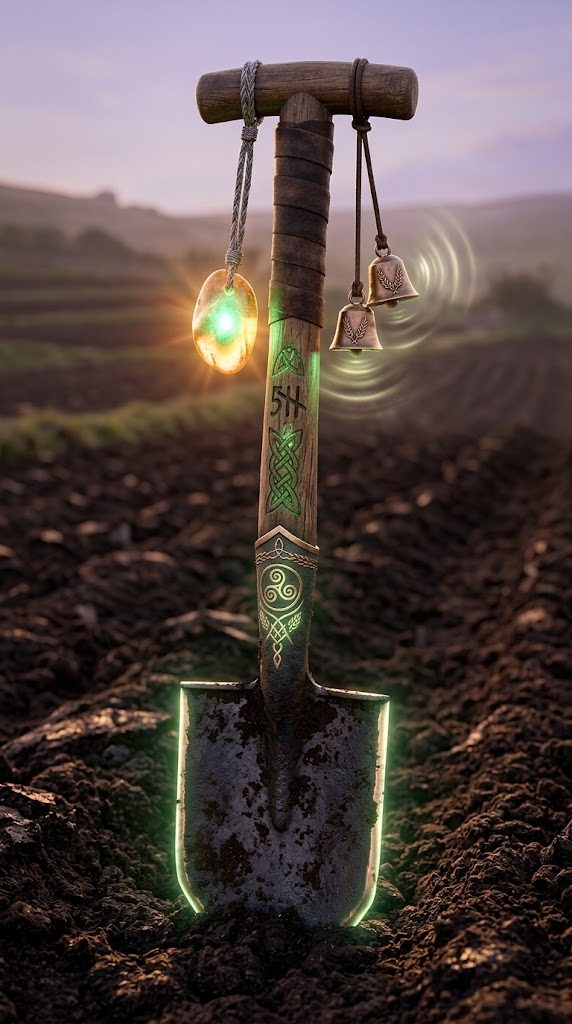
- A compact, heavy-duty digging spade measuring approximately three feet in total length, featuring a broad blade ofBog-iron edged with hardened river-bronze.
- The haft is carved from seasoned mountain rowan-wood, bound securely to the blade with cross-stitched badger-hide wraps and braided moorland heather.
- Intricate Manx triskelions, running root-knot patterns, and stylized motifs of ripe barley sheaves and earth-trowels are branded into the wood and engraved along the blade’s bronze collar.
- From the T-grip hangs a braided silver-and-flax cord suspending a single polished pebble of fairy-struck beach quartz that radiates a faint, gentle warmth, alongside two miniature bronze chime-bells stamped with wheat ears.
- The blade carries the perpetual, rich scent of freshly turned peat loam, sweet compost, and wild chamomile, remaining naturally free of rust, packed clay, or sticky mud.
Detailed Stats:
- Item Tier: Tier 1
- Rarity: Common
- Slot: Held Slot (Two-handed agrarian tool; can be swung one-handed in emergencies)
- Maximum Attuned Avatars: 1
- Material: Bog-iron, River-bronze, Rowan-wood, Badger-hide, Bell bronze, Quartz, Heather-flax.
- Item Health Points: Maximum Avatar Health Points plus 12 (Resilience 12 multiplied by Tier 1)
- Resilience: 12
- Weight: 3.5 pounds
- Agrarian Utility: Acts as an exceptional shovel, mattock, and furrow-trencher; reduces the physical labor time required to till, weed, or excavate earthen plots by half.
- Weapon Capability: Improvised Bludgeon/Cleave (Deals 1d6 bludgeoning or slashing damage; uses Strength or Dexterity for attack rolls).
- Required Attunement: Short Rest (spend 1 hour turning earth, clearing stones, or planting seeds while leaving a small offering of bread crumbs or milk upon the upturned soil).
- Maintenance Requirements: Needs no whetstone; rub down occasionally with sheep lanolin or linseed oil, and avoid striking cold worked iron directly into the blade.
Passive Magics:
- Loam-Whisperer Sense: While holding the spade with the blade touching the earth, the avatar instinctively detects soil composition, moisture content, toxic run-off, subterranean fungal blights, and hidden burrow tunnels within 30 feet, gaining a +2 bonus to all Nature, Herbalism, and Survival checks related to agriculture, foraging, and cultivation.
- Burden of the Tiller: The wielder is immune to non-magical, mundane exhaustion, blistered skin, and back strain caused by prolonged agricultural labor, digging, or earth-moving. While walking across plowed fields, mud, or agricultural terraces, the avatar ignores non-magical difficult terrain.
- Hearth-Fed Germination: Seeds, cuttings, or saplings planted into soil turned by this spade take root at twice their normal speed, possessing an innate resistance to common mold, frost-rot, and surface grubs.
Activable Magics:
- Heather-Breeze Furrow: (Active property – Manipulate, Primal) Frequency: 3/Long Rest. Striking the spade’s edge firmly into untilled or packed earth causes the blade to pulse with soft emerald light, effortlessly cutting a clean, weed-free planting furrow up to 30 feet long in a straight or curved line through hard-packed clay, turf, or rocky soil without exhausting the user.
- Burrow-Sprite Sieve: (Active property – Transmutation, Earth) Frequency: 2/Short or Long Rest. Driving the spade into loose soil or rocky scree and gently shaking the T-grip rattles the miniature bronze bells. Minor domestic fairy spirits sift through the dirt in a 10-foot radius, pushing all jagged rocks, weed roots, and burrow pests to the surface while gathering any lost small metal objects, coins, or seeds into a neat pile beside the blade.
- Sleigh’s Chaff-Flurry: (Active property – Illusion, Earth) Frequency: 1/Short or Long Rest. As an action, the user scoops a spadeful of dirt and flings it toward an enemy within 20 feet. The earth erupts into a swirling cloud of sparkling fairy chaff, snapping peat sparks, and flying clover petals. The target must succeed on a DC 12 Dexterity saving throw or become blinded and disoriented until the start of the avatar’s next turn.
Tags: Sleih Beggey, Farming, Furrow-Spade, Tier 1, Common, Held Slot, Agriculture, Earth Magic, Ferrishyn, Cultivation, Soil Sense, Tillage, Domestic Magic, Rowan Wood, Bog-Iron, Harvesting, Loam, Burrow Sprite, Attuned, Agrarian Tool, Furrow-Trench, Peat-Loam, Root-Garden, Bannock-Offering, Crop-Blessing, Terrace-Tillage, Rowan-Haft, Earth-Sifter, Field-Sprite, Chaff-Cloud, Harvest-Compact
Procurement and Markets for the Burgh-Forged Furrow-Spade
On Saṃsāra, agricultural tools touched by the domestic enchantments of the Sleih Beggey do not circulate through mass-manufactured hardware outlets or commercial armories. Because the Ferrishyn value the honest labor of turning earth and the respectful stewardship of soil, these spades pass through markets centered on rural cooperatives, agrarian barter-fairs, and reclamation outposts.
1. Village Granges and Rural Husbandry Guilds
In the agrarian terrace-settlements and fertile lowlands that border fairy mounds, community granges serve as the central hub for local farmers, orchardists, and terrace-tenders.
- How the Item Is Presented: The spade is displayed in the grange’s communal tool room, resting in an open rack carved from aged ash timber beside bags of heirloom seed grain and clean linen bags of bone meal. It is kept clean, rubbed with mutton tallow, and leaned blade-down against a sod of fresh peat so prospective buyers can inspect the bronze collar and test the balance of the rowan haft. The grange elder will rarely sell the tool to speculative merchants; preference is given to working tillers who agree to leave seasonal boundary offerings for the nearby burghs.
- Payment Form: Practical agrarian barter, seed equity, or cooperative work vouchers.
Cost in Saṃsāra:
- Barter (Preferred): 3 bushels of winter barley, 2 crocks of salted butter, and a sack of clean clover seed.
- Coin/Credit Equivalent: ~40–55 standard World Bank credit chits.
2. Mound-Edge Seasonal Barter Fairs
Held during the spring planting and autumn harvest solstices in low meadows flanking ancient fairy barrows, these open-air barter rings bring surface-dwellers into direct contact with the Sleih Beggey and their intermediaries.
- How the Item Is Presented: Spades are propped upright in freshly turned display furrows cut into the turf, allowing buyers to see firsthand that sticky clay and stones slide effortlessly off the river-bronze edge. Sleih Beggey peddlers or their human liaisons sit behind low wicker trestles, gently tapping the spade’s chime-bells to demonstrate their clear pitch. A transaction often requires sharing a horn of buttermilk and swearing a traditional verbal pledge not to strike the blade against cold iron or cursed soil.
- Payment Form: High-grade domestic goods, hearthwares, honey, and untreated dairy.
Cost in Saṃsāra:
- Barter (Preferred): A well-cast bronze cooking pot, two stone jugs of unfiltered heather honey, and five rounds of fresh ewe-milk cheese.
- Coin/Credit Equivalent: ~50–65 standard World Bank credit chits (accepted primarily to acquire wrought copper and salt).
3. Frontier Reclamation and Sapper Depots
At the frontier perimeter where pioneers, terraformers, and terrace-cutters push into rocky scree slopes, abandoned mines, or contaminated lowlands, specialized reclamation pantries supply durable earth-working gear.
- How the Item Is Presented: Kept behind heavy wire screens alongside soil test kits, geological core drills, and fungal inoculants, the tool is labeled as an Enchanted Earthen Trencher / Folk Bio-Spade. The depot quartermaster typically demonstrates the tool’s authenticity by plunging the blade into a tub of dense, packed clay, showing how the soil breaks apart into loose, friable loam without clinging to the metal.
- Payment Form: Reclamation scrip, mineral ore samples, or hard World Bank currency.
Cost in Saṃsāra:
- Purchase Price: 75–95 standard World Bank credit chits.
- Pawn/Resale Value: The quartermaster will purchase a clean, undamaged spade with its bells and quartz intact from an adventuring avatar for 35–45 chits, immediately turning it over to field engineers or outpost gardeners.
Roleplay Applications of the Furrow-Spade Across Saṃsāra
On Saṃsāra, the Sleih Beggey 512 of the Burgh-Forged Furrow-Spade centers its magic on the elemental discipline of agriculture: turning, sifting, and enriching the earth through patient stewardship rather than overt violence. In roleplay, its capabilities bridge practical fieldcraft and tactical versatility, letting an avatar transform hostile, unyielding terrain into an organized, supportive landscape.
1. Overgrown Wildlands, Tangled Mire, and Unbroken Lowlands
In thick briars, root-choked wetlands, and untilled border-meadows where brambles and deep mud impede travel, the spade acts as both an agricultural machete and an environmental pathfinder.
Defensive & Roleplay Focus (Loam Literacy & Hazard Cleansing): When the party tramps through rotting hummocks or areas suspect of marsh blights and parasitic creepers, the avatar halts and presses the spade flat against the mud. Through Loam-Whisperer Sense, they read the root networks beneath the sod, identifying acidic sinkholes, underground gas pockets, and venomous fungal blooms before a companion steps into them. While wading through sucking clay that drags down heavy boots, Burden of the Tiller ensures the wielder moves steadily without fatigue or slipping, easily hauling exhausted allies through difficult terrain. When camp is pitched, the wielder cuts a shallow, clean boundary trench around the tents to deter crawling pests, keeping the perimeter dry and safe.
Offensive & Roleplay Focus (Trenching & Chaff Blinding): If ambushed by wild bog-beasts or predatory briar-stalkers, the avatar plunges the spade into the marshy turf to trigger Heather-Breeze Furrow. A rapid, 30-foot crack opens across the earth, severing tangled root mats and dropping charging predators into a sudden muddy trench that halts their momentum. In hand-to-hand skirmishes, the wielder digs the spade into the topsoil and casts Sleigh’s Chaff-Flurry straight at an approaching attacker. A blinding cloud of sparkling peat chaff and swirling clover petals envelops the foe’s eyes and nostrils, allowing the party to encircle the disoriented enemy or withdraw cleanly into dense cover.
2. High-Altitude Terraced Farms, Scree Slopes, and Mountain Allotments
Along steep, rocky agricultural terraces and unstable shale slopes where rockslides threaten settlement walls, the spade functions as an indispensable civil and defensive engineering implement.
Defensive & Roleplay Focus (Slope Stabilization & Debris Sifting): During an earth tremor or landslide, the avatar acts as an anchor for retaining walls. Driving the spade into loose scree, they invoke Burrow-Sprite Sieve. The bronze bells chime softly as subterranean spirits rapidly sift through the shifting gravel, driving out loose, rounded stones and packing fine earth into stable banks to keep terrace walls from shearing away into the valley. If a vital tool, key, or emergency signal flare is buried beneath sudden rubble, the sifting magic brings it immediately to the surface in a neat pile beside the rowan haft, sparing the party frantic digging with bare hands.
Offensive & Roleplay Focus (Breaching & Improvised Cleaving): When raiders or mountain beasts attempt to climb the retaining walls of a terrace redoubt, the avatar strikes the spade downward across the edge of the stone terrace with Heather-Breeze Furrow. The sudden surge of emerald fairy energy cuts loose the topmost footing beneath the climbers, sending scree and invaders tumbling down the embankment. When pressed into close quarters, the hardened river-bronze edge and stout rowan haft turn the spade into a devastating two-handed polearm, bludgeoning armored scale or slicing through crude wooden shields with the unyielding force of a seasoned field-laborer.
3. Subterranean Burgh Outskirts, Mine Galleries, and Fungal Cellars
In deep earthen tunnels, root-cellars, and abandoned underground workings flanking Sleih Beggey settlements, the spade serves as a vital mining and foraging tool.
Defensive & Roleplay Focus (Subterranean Mapping & Sustenance): Deep underground, where maps are useless and cave-ins are common, the wielder rests the blade against cavern floors. Loam-Whisperer Sense maps out hollow spaces, subterranean irrigation flues, and natural burrow-passages up to thirty feet through solid dirt, allowing the party to detect approaching subterranean burrowers or avoid drilling into pressurized mud-aquifers. In barren caverns where rations run short, the wielder locates edible subterranean tubers and deep fungal colonies, using Hearth-Fed Germination to quickly cultivate wild mushroom patches or moss beds in damp cave alcoves, sustaining the party during prolonged subterranean delves.
Offensive & Roleplay Focus (Trap Extraction & Tactical Choke-Points): In narrow mine corridors, the avatar uses Burrow-Sprite Sieve to sift through dusty tunnel floors, revealing concealed tripwires, rusted caltrops, or iron spike traps buried by cavern raiders without needing to risk manual disarming. When forced to cover a retreat against swarming cave vermin or burrowing sprites, the wielder scoops a spadeful of subterranean dirt and hurls Sleigh’s Chaff-Flurry. The sparkling fey embers detonate in the cramped corridor, overwhelming the sensitive, dark-adapted eyes of cavern predators and creating a wall of flying peat grit that holds the choke-point until heavy iron gates can be barred shut.
Perception of Activation:
- Visual Perception:
- User’s Perspective: The river-bronze cutting edge and engraved triskelions flare with a clear, luminous pale-emerald glow that casts emerald halos across the surrounding soil. From the suspended quartz stone, a deep amber ray pulses outward, illuminating the rowan haft and branded tally marks with a honey-colored hearth-light. Faint, shimmering heat ripples rise from the metal blade, causing particles of loose loam to dance lightly along the spade’s lip.
- Observer’s Perspective: Observers see the shovel blade outline itself in sharp, verdant light as though forged from bioluminescent moss. The hanging pebble looks like an amber lantern swinging gently from the grip, casting concentric, ring-like wavelets of soft light along the furrows.
- Positives: Projects stable, low-profile ground illumination that highlights trip hazards, roots, and uneven soil without blinding friendly eyes.
- Negatives: The distinct emerald silhouette of the blade makes it impossible to conceal the tool in night-time brush or darkened fields.
- Auditory Perception:
- User’s Perspective: The two miniature bronze bells ring with a crystalline, high-pitched double chime that mimics the sound of wind rustling through ripe, dry wheat stalks. Below this tone, the user hears a gentle, subterranean rustling sound, like thousands of tiny, busy fingers sifting through fine loam.
- Observer’s Perspective: Bystanders hear a rhythmic, soothing chime that cuts through wind and rain, accompanied by a soft, damp crumbling noise as the ground ahead of the blade loosens on its own.
- Positives: The harmonized ringing masks the harsh, grating clatter of metal striking gravel or bedrock.
- Negatives: The melodic chime carries cleanly over open fields, alerting territorial beasts or patrolling sentries to ongoing activity.
- Olfactory Perception:
- User’s Perspective: A sudden wave of freshly aerated, dark peat loam, wild chamomile blossoms, and sweet clover nectar blooms around the user’s face, entirely replacing stale air.
- Observer’s Perspective: Observers downwind catch the unmistakable aroma of rich, damp compost, crushed mint leaves, and warm summer earth after a gentle morning shower.
- Positives: Overpowers foul marsh fumes, stagnant ditch stenches, and rotting crop blights with clean botanical fragrances.
- Negatives: The sharp, pleasant scent of turned loam and honeyed clover can draw wandering burrowing pests or curious grazing beasts toward the worksite.
- Gustatory Perception:
- User’s Perspective: A faint, sweet, earthy sweetness forms on the back of the palate, carrying the phantom flavor of crisp wild carrots, raw clover stems, and clean, mineral-rich well water.
- Observer’s Perspective: Those working in close proximity report a sudden clean, rainwater freshness on the tongue, clearing the chalky taste of limestone dust or field debris.
- Positives: Completely clears dry-mouth, dust-choked throats, and the sour aftertaste of stale travel water.
- Negatives: Sparks an immediate, distracting craving for crisp, garden-fresh vegetables and cool spring water during prolonged manual labor.
- Tactile Perception:
- User’s Perspective: The rowan-wood haft vibrates with a rhythmic, subterranean thrum that makes the heavy bog-iron blade feel almost weightless in the hands. The badger-hide wraps turn warm and dry, molding perfectly to the user’s palms to completely prevent blistering or vibration sting.
- Observer’s Perspective: If an onlooker touches the haft or blade, it feels like holding a purring, sun-warmed animal that vibrates in time with the deep earth.
- Positives: Eliminates impact shock against buried stones and dramatically delays muscle fatigue in the arms, back, and shoulders.
- Negatives: The artificial weightlessness can cause a user to misjudge the physical inertia of the tool when using it as an improvised weapon.
- Extra-Sensory Perceptions:
- Mycelial Resonance (Root-Web Kinship):
- User’s Perspective: The wielder experiences a sudden, intuitive mental blueprint of the root networks, moisture channels, and fungal webs expanding beneath their boots. Stone walls and soil strata reveal their hidden stress fractures and hollow pockets as if mapped in glowing green threads.
- Observer’s Perspective: Primal spellcasters or nature-attuned creatures perceive the wielder’s aura syncing smoothly with the ambient terrestrial mantle, appearing as a stabilizing earthen node.
- Positives: Provides immediate, passive awareness of hidden cavities, sinkholes, subterranean pests, or buried pipes.
- Negatives: Can induce brief sensory vertigo if used directly over deeply poisoned ground, dead soil, or blighted necromantic graves.
- Domestic Ferrishyn Compact (Field Ward):
- User’s Perspective: An overwhelming impression of agrarian fellowship and ancestral security settles over the mind, imparting the unshakable confidence that the surrounding soil is friendly, willing, and eager to yield.
- Observer’s Perspective: Empaths and diviners register an aura of peaceful, unhurried agrarian labor radiating outward, deterring territorial instincts in ambient wildlife.
- Positives: Shields the avatar completely against panic or fear induced by subterranean isolation, darkness, or open, barren expanses.
- Negatives: Promotes an over-trusting attitude toward unworked wild terrain, occasionally leading the avatar to forget that untamed beasts may still dwell nearby.
Crafting Recipe: Sleih Beggey 512 of the Burgh-Forged Furrow-Spade
Materials Needed:
- Refined Bog-Iron Plate (4 lbs) – Smelted from natural peat-bog ore, providing fibrous resilience and high impact resistance for the spade’s main blade.
- River-Bronze Ingot (1.5 lbs) – An alloy of virgin copper and river-tin, cold-hammered to form the hard, rust-free cutting edge and socket collar.
- Seasoned Mountain Rowan-Wood Limb (1 stave, 3.5 feet long, 2 inches diameter) – Cut during a waning moon and dried for one full season to form the resilient T-grip haft.
- Cured Badger-Hide Strips (2 yards, 0.75 inches wide) – Ethically harvested from natural burgh deceased, softened with mutton tallow to wrap the handle.
- Casting Bell Bronze (3 ounces) – Resonant copper-tin alloy tailored to cast two high-pitch chime-bells.
- Fairy-Struck Beach Quartz Pebble (1 unit, smooth and palm-sized) – Gathered from tidal gravel beds struck by fey-fire, retaining natural subterranean heat.
- Braided Silver Wire and Flax Cord (3 feet) – Intertwined silver strand (28-gauge) and spun field-flax used for the suspension cord.
- Braided Moorland Heather-Grass (1 hank, 2 feet) – Freshly picked purple heather to bind the iron socket to the rowan wood.
- Consecrated Burgh Loam and Peat-Ash (2 ounces) – Rich, screened subterranean compost and ash from an active Sleih Beggey hearth fire.
- Cold Linseed Oil and Mutton Tallow (4 ounces) – Applied to seal the rowan timber and condition the leather wraps.
- Fresh Ewe’s Milk and Crumbled Barley Bannock (1 small bowl) – Agrarian offering required to seal the domestic fey compact.
Tools Required:
- Coal-Fired Blacksmith’s Forge, Anvil, and Rounding Hammers – For folding the bog-iron plate and welding the river-bronze cutting edge.
- Hardened Chisels, Files, and Chasing Gravers – For engraving Manx triskelions, root knots, and tally numerals into bronze and steel.
- Drawknife, Spoke-Shave, and Wood Rasps – For carving and contouring the seasoned rowan stave into a balanced T-grip shaft.
- Branding Iron (Stylized Triskelion & Sheaf) – For burning agrarian and fey glyphs into the rowan wood.
- Small Clay Crucible, Tongs, and Two-Part Bell Mold – For casting the miniature bronze wheat-ear bells.
- Leatherworker’s Awl and Saddler’s Needles – For cross-stitching the badger-hide handle wraps.
- Agate Mortar and Pestle – For crushing peat-ash and dried chamomile into a fine consecration dust.
- Soil-Trough (3 feet deep, filled with rich turf loam) – Used to quench the hot metal and test the blade’s harmonic earth resonance.
Skill Requirements:
- Blacksmithing / Metallurgy: Level 3 or higher – Ability to forge-weld softer river-bronze to dense bog-iron without causing delamination or brittle crystallization.
- Woodworking / Carpentry: Level 3 or higher – Skill to shape a curved rowan T-grip and seat it seamlessly into a metal socket with flush mortise-and-tenon joins.
- Engraving / Folk Art: Level 2 or higher – Precision needed to cut continuous Manx knotwork, sheaves, and tally numbers without breaking line flow.
- Sleih Beggey Lore / Agrarian Rites: Level 2 or higher – Knowledge of seasonal planting compacts, hearth blessings, and soil-communion rituals to bind the fey spark.
Crafting Steps:
- Forging and Shaping the Blade:
- Heat the bog-iron plate in the forge until glowing bright cherry-red, hammering it into a flat, broad spade shape with folded foot-rests along the shoulders.
- Draw down the top of the blade into a hollow cylindrical socket designed to receive the rowan haft.
- Forge-weld the river-bronze ingot along the spade’s lower cutting edge, beveling it thin and hammering it cold to work-harden the lip against stones.
- File and polish the bronze edge, then use chasing gravers to etch running Manx triskelions and ripe wheat sheaves along the socket collar.
- Stamp the tally numeral “512” cleanly into the neck of the bronze sleeve.
- Quenching and Loam-Infusion:
- Heat the forged blade to a uniform dull red and coat the surface with pulverized peat-ash and consecrated burgh loam.
- Quench the blade directly into the soil-trough rather than water, driving the hot bronze and iron through three feet of rich damp turf.
- Allow the metal to cool slowly within the soil to seal the porous surface, giving it an earthy sheen that naturally sheds sticky clay and repels rust.
- Carving and Fitting the Rowan Haft:
- Strip the bark from the seasoned rowan limb using the drawknife, shaping the shaft to a smooth oval cross-section that prevents twisting in the grip.
- Carve the upper end into a sturdy, ergonomic T-grip, pinning it with a rowan-wood dowel and locking it with cold-pressed linseed oil.
- Taper the lower end of the haft and seat it firmly into the blade’s forged socket.
- Secure the joint using two bronze rivets, wrapping the junction with braided moorland heather soaked in hot pine-pitch.
- Heat the branding iron to burn root-knot patterns and barley motifs into the upper grip area.
- Casting the Bells and Hanging the Quartz:
- Melt the casting bell bronze in the small clay crucible and pour it into the two-part mold to form two miniature pear-shaped chime-bells.
- After cooling, clean the bells with files and chase wheat-ear patterns onto their shells, tuning the clappers to a bright, clear double tone.
- Drill a tiny suspension eye through the top of the fairy-struck beach quartz pebble.
- Braid the silver wire and field-flax cord together, threading the cord through the quartz pebble and the two chime-bells, then tethering the assembly firmly below the T-grip crossbar.
- Wrapping the Grip and Sealing the Wood:
- Rub the cured badger-hide strips with warm mutton tallow until completely pliable.
- Spiral-wrap the badger-hide around the rowan haft directly below the T-grip, cross-stitching the edges with waxed linen cord to ensure a non-slip, anti-blister surface.
- Rub three generous coats of linseed oil into the exposed rowan wood, letting each coat soak into the grain.
- Consecration and Domestic Field Compact:
- Carry the completed spade to the boundary of a tilled field adjoining a fairy barrow or undisturbed turf mound at dusk.
- Drive the blade six inches into the dark topsoil.
- Place the small bowl of fresh ewe’s milk and the crumbled barley bannock on the ground directly beside the haft as an offering of neighborly peace.
- Recite the traditional Manx agrarian compact, addressing the Ferrishyn of the underground burghs and asking their blessing on the work of seed, spade, and soil.
- If the compact is accepted, the river-bronze cutting edge will ignite with a cool emerald luminescence, the suspended quartz stone will flare with warm amber hearth-light, the chime-bells will ring twice without wind, and the smell of sweet clover and wild chamomile will rise from the turned earth.
Heavy Digging-Tool with Two Singing Little Pots and Warm Beach-Pebble
Made by the Short Burrow-Men Who Live Underneath the Turnips
In the first age before the sky sat upon the mountains and when the clouds were still very greasy and cold, the humans of the upper-dirt had no bread inside their bellies. They ate only bitter grass like the wild goats and chewed on dry bark until their teeth fell out into the river. The soil of the upper fields was not soft like flour; it was as hard as the forehead of an angry bull, full of gray stones that had sharp teeth, and when a man tried to push a stick of ash-wood into the dirt, the stick snapped in two pieces and stabbed him in the eye.
Because of this, there was much weeping upon the terraces of the high country. The fathers of families sat upon the heaps of slate and beat their shins with their fists, crying: “The dirt hateth our thumbs! It will not open its mouth to take the brown seed, and when the snow-giant cometh down from the north, we shall all become frozen meat for the white hawks!”
Now, down underneath the roots of the yellow gorse and the fat dock-leaves, the Small People of the Burghs were sitting in their round parlors, eating very soft cakes fried in sheep-fat and drinking warm beer made from roasted barley. They were broad like barrels, their arms were as thick as tree-boughs, and they did not fear the cold sky because the earth above their heads was like a warm blanket of three layers. Their underground cabbage-gardens were very neat, and their mushrooms were as large as wagon-wheels, growing in black muck that smelled as sweet as honeyed porridge.
Among the upper-dirt people there lived a tall, miserable tiller named Illiam of the Scratched Palms. He had three small daughters whose bellies were as round and empty as dried gourds, and his wife had died from eating boiled nettles that had gray rot upon them. Illiam possessed only a broken iron rod that had belonged to his grandfather’s uncle, and every morning he went out into the scree-field to strike the frozen ground until blood ran out from beneath his fingernails, yet by sundown he had turned over only enough earth to bury a dead sparrow.
One evening, when the sun was sinking red like a hot copper kettle behind the sea, Illiam struck a large white boulder with his grandfather’s rod. The rod broke into four fragments with a loud snapping sound, and the sharp end bounced up and cut Illiam upon the nose. Illiam threw himself face down into the thistle-bed and wept until his tears made a puddle in the clay.
“Why hath the earth made itself an iron wall against my hands?” Illiam yelled down into the badger-hole near his knee. “I wish to do no murder! I seek no gold-dishes of the sea-kings! I only desire three handfuls of soft dirt so that seven grains of barley may sleep in peace and make porridge for my crying children!”
Deep down in the fifth chimney of the round mound, an old master-digger of the Sleih Beggey, whose name was Mian of the Four-Cornered Mallet, was scraping the bottom of his porridge-pot. The salty tears of Illiam trickled down through a fissure in the limestone ceiling and fell right into Mian’s evening milk.
Mian made a sour face and set his horn spoon down upon the bench. “Who is pouring brine-water into my clean supper?” he grumbled to his seven nephews. “It is surely one of those long-legged, noisy stick-men from the upper wind. They run about upon the hills like wild geese with their tails on fire, shouting at the clouds, yet they have not the wit of a field-vole to turn over a sod of grass without making a great noise of breaking iron.”
Mian climbed up the chimney, pushing his broad round nose through a thick tuft of purple heather. He saw Illiam lying upon his stomach, tearing his own hair and bleeding upon the stones.
“Get up, you long sack of water and noise,” said the Ferrishyn, his voice sounding like two millstones rubbing together in the deep dark. “You are frightening the worms, and the mole-mothers cannot put their babies to sleep because of your foolish shrieking.”
Illiam lifted his chin and saw the broad, hairy face of the little mound-man staring at him through the gorse. He did not run, for he was too hungry to move his legs. He reached into his ragged sleeve and pulled out a small piece of barley-bannock—the very last crust in his house—which he had kept wrapped in a clean dock-leaf, and set it upon the flat stone beside the hole.
“Take this, little grandfather,” whispered Illiam. “It is dry and very small, but it was ground between stones by my own hands before my iron bar broke. I have nothing else to give, but do not curse my three daughters with the throat-shivering.”
Mian looked at the piece of bannock. He smelled it; it was clean, free of mouse-dirt, and made with water from an unpolluted spring. The stocky little man nodded his heavy head until his beard shook like a bush in a gale.
“You have given away your last bite of crust to a neighbor whom you have not seen before,” said Mian. “This is proper domestic behavior, such as a civilized burrow-man understandeth. Those who break their tools against the rock do so because they treat the soil like an enemy to be beaten with a club. The soil is not an enemy, you long-legged fool; it is an old grandmother who is very deaf, and you must tickle her ears with the proper metal, else she will lock her cupboards against your seed.”
Mian reached out two stubby, earth-stained hands and dragged Illiam down through the hole by his ankles.
Down, down through seven layers of limestone, through three veins of sweet red water, and past forty underground granaries they tumbled, until they stood in the Great Agrarian Burgh of the Glen. There, five hundred little smiths were working at little anvils made of dark river-pebbles, beating blades of bog-iron that had been dug out of the ancient peat-swamps where the sun had never touched.
“Bring forth the rowan-limb that was cut during the silence of the moon,” shouted Mian to the smith-boys. “Bring the river-bronze that was fished from the foaming shallows, and the skin of the old badger who died of fatness in the harvest-bed!”
For three days and three nights, while Illiam sat on a three-legged stool eating warm turnip-soup and rubbing his eyes in wonder, the Little People built the five hundred and twelfth tool of the mound.
First, they took a slab of spongy black bog-iron, full of ancient wood-fibers and the breath of old mosses, and they folded it nine times under their bronze sledges until it had the curve of a swan’s breast, but could withstand the kick of a mountain ram without bending. Across its lower biting mouth, they welded a heavy lip of pale, hard river-bronze, cold-hammered until it shone like butter and could slice through buried tree-roots as if they were boiled leeks.
Then they took a straight stave of mountain rowan-wood—the wood that the dark spirits of the air cannot abide—and shaped it into a strong T-shaped handle that fit into the crook of two working hands without causing the skin to tear or turn into water-blisters. They pinned the wood to the metal with two bronze bolts, and around the throat of the joint they wrapped strips of badger-hide, softened with the fat of moor-sheep, cross-stitching the leather with cords of spun mountain-heather.
Around the bronze collar, the small engravers sat with fish-bone gravers, cutting the sacred Three-Foot-Wheel that runneth forever across the hills, and between the feet they cut the sign of the full ear of barley and the little square basket for carrying turnips. Upon the neck, they stamped the deep tally-sign: 5-1-2.
“Now cometh the living pulse,” said Mian. He went to the edge of the subterranean surge where the hidden tide whispers to the roots of the world. From the strand of wet gravel he took a smooth, flat pebble of beach-quartz that had been split by the lightning-serpent of the mound-fathers. The pebble was not cold like dead slate; it was warm to the touch, like a newly laid hen’s egg, and a pale amber spark swam around inside its belly.
Beside the pebble, they took two miniature pear-shaped hawk-bells cast from ringing bronze, which they tuned with files until their double-chime sounded like two small crickets singing together upon a warm chimney-brick in harvest-time. They hung the bells and the warm pebble together from the crossbar of the rowan handle with a braid of flax and pure silver wire pulled from the deep crevices.
Lastly, Mian did not plunge the red-hot blade into a tub of water, for he said water made the metal brittle and angry like a spitting cat. Instead, he drove the smoking blade into a deep trough filled with three-hundred-year-old burgh-loam and consecrated peat-ash. The blade hissed with a sound like a satisfied cow drinking from a trough, and when they pulled it out, the iron was black and silky, shedding the dirt completely so that not a single grain of dust could stick to its face.
Mian gave the heavy spade into Illiam’s two hands. The moment the farmer’s fingers closed around the badger-hide wraps, the weakness fell away from his marrow. His back, which had been bent like a hoop from ten years of stone-striking, snapped straight like a bowstring. The blade in his hands felt as light as a dried bulrush, and his nostrils were filled with the smell of sweet clover, summer loam, and fresh-baked barley bannocks.
“Take this spade, Illiam of the Scratched Palms,” said the burgh-elder. “It is numbered five hundred twelve in the books of the mound-weavers. When you walk upon your scree-field, do not strike the earth in wrath as if you were killing an adder. Set the bronze lip against the sod and let the rowan guide your foot. The stones will run away from the bronze edge like field-mice running from a terrier, and the clay will fall apart into sweet crumbs for your seed.”
“What shall I pay you, little grandfather?” asked Illiam, trembling with joy. “I have no bronze dishes, and my house is only sticks and dry turf.”
“Every harvest-eve,” said Mian, shaking his finger at Illiam’s nose, “when the first sheaf of barley is tied with a straw band, you shall bring three cakes of barley-bread fried in sweet lard and one crock of unskimmed ewe-milk to the gorse-bush by the badger-run. If you remember the Little People who sleep under the furrow, your spade will never rust, your haft will never crack, and the blight-worm will turn away from your terrace as if it were a burning oven. But if you forget the mound and become proud like the iron-men of the coast, the earth will turn to flint beneath your feet once more.”
Illiam was lifted up through the dark chimney by seven strong burrow-boys and found himself standing in his scree-field under the morning sun. His three daughters were sitting by the broken house-wall, gnawing on dry roots and crying.
Illiam did not say a word. He walked to the center of the stony terrace, spat upon his palms, and placed the bronze edge of the spade against the gray shale. He stepped upon the iron shoulder with his right foot.
Instantly, a bright, clear double-chime rang out from the two small bronze bells, sounding like a summer bell across a quiet meadow. The suspended quartz pebble flared with a deep, honey-colored light, and the bronze cutting edge glowed like green grass in the morning sun. With a single shove, the spade sank through the rocks and clay up to its socket as easily as a hot knife slices through lard.
Illiam pushed forward. The spade did not clatter or spark against the buried boulders; with a soft, subterranean rumble, the earth opened thirty paces ahead in a straight, beautiful ditch. The jagged stones were rolled out onto the banks by unseen hands, the thick weed-roots were cut cleanly into pieces, and the packed clay crumbled into rich, dark, steaming loam that smelled of wild chamomile and sweet honey.
Within three hours, Illiam had turned the entire mountain terrace into twelve perfect planting furrows, working without sweat upon his brow and without a single blister upon his skin. When he cast his seven handfuls of barley into the ground, the seeds did not sit dry in the dust; they sank into the warm, fey-blessed earth and sent up green shoots before the twilight had fallen over the western water.
When the harvest-moon grew round like a harvest-cheese, Illiam’s field was covered with gold barley so tall that a man on horseback could ride through it and not be seen. While his neighbors on the other hills starved upon their hard slate, Illiam reaped three hundred bushels of heavy grain. He fed his three daughters until their cheeks were as round and red as wild apples, and he gave five sacks of grain to every widow and orphan within twelve leagues of the burgh.
Every autumn solstice, until his hair was as white as the foam upon the rocks, Illiam walked to the heather-bush at the edge of the field. He laid down three fat bannocks made of the finest flour, covered with fresh sheep-butter, and a crock of unwatered ewe-milk, singing the soft verses of the subterranean compact. And the Little People beneath the grass danced in their round halls, and the spade numbered five hundred twelve stayed bright and sharp for four generations, never touching rust and never failing to turn the bitter shale into sweet bread.
Moral of the Story: He who treateth the harsh earth with rage and hard iron will harvest only broken limbs and bitter stones, but he who tilleth the ground with patient reverence, sharing the first fruits of his labor with those who dwell beneath the sod, shall find that the most stubborn mountain will open its heart and yield him bread in the midst of famine.
Suggested conversions to other systems:
Call of Cthulhu (7th Edition)
Burgh-Forged Furrow-Spade
- Item Classification: Folk Magic Artefact / Agrarian Implement
- Skill: Fighting (Brawl) or Fighting (Spade/Spear)
- Damage: 1D6 + Half Damage Bonus (DB)
- Weight: 3.5 lbs
- Sanity Loss: 0 to handle or work the earth. Witnessing the blade ignite with green fairy luminescence or seeing subterranean spirits magically shift stones and soil costs 0/1 Sanity.
Game Mechanics:
- Loam-Whisperer Sense (Passive): While resting the spade against native soil, the investigator receives a bonus die (+1D) to Natural World, Geology, Survival, or Track checks made to assess soil strata, locate fresh earth disturbances, identify buried caches, or track subterranean burrowing entities within 10 yards.
- Burden of the Tiller (Passive): The wielder is completely immune to physical exhaustion, blistering, and fatigue caused by digging, ditch-trenching, or earth-moving. Mundane difficult terrain caused by mud, plow-furrows, or scree does not reduce movement rate.
- Heather-Breeze Furrow (Active): Spending 1 Magic Point and driving the blade into soil cuts a clean, weed-free furrow or trench up to 10 yards long in seconds, requiring no physical exertion.
- Burrow-Sprite Sieve (Active): Spending 2 Magic Points and shaking the bronze bells causes unseen Little People of the mounds to sift through dirt or rubble in a 3-yard radius. Buried debris, sharp stones, or concealed tripwires are pushed to the surface, and any loose metallic objects, keys, or coins are gathered beside the blade.
- Sleigh’s Chaff-Flurry (Active): As a combat action, the investigator spends 2 Magic Points to fling a spadeful of loam toward an adversary within 7 yards. The soil bursts into a blinding cloud of sparkling fairy chaff and peat embers. The target must pass a Regular Dodge or DEX roll; on a failure, the target suffers 1 point of stun damage and is blinded until the end of the next combat round.
Blades in the Dark
The Burgh-Forged Furrow-Spade
- Classification: Arcane Agrarian Implement / Earth-Worker
- Load: 2 Load (Held in two hands; carried across shoulder or pack straps)
- Quality: Tier I fine heavy implement
Item Features:
- Fine Craftsmanship: Forged bog-iron blade with a cold-hammered river-bronze cutting edge, rowan-wood haft, wrapped in badger-hide, with two tuned bronze chime-bells and an amber quartz bead.
- Earth-Tether: Channeling the agricultural compact of the subterranean Little People, granting deep rapport with cultivated soil and subterranean root networks.
Game Mechanics:
- Soil Attunement (Passive): Take +1d to Survey or Prowl rolls when reading earth disturbances, navigating muddy terrain, detecting subterranean tunnels, or excavating graves and concealed caches.
- Tiller’s Endurance (Passive): You ignore movement penalties from mud, plowed fields, or loose scree, and you gain Potency on resistance rolls against physical exhaustion caused by prolonged labor or entrenching.
- Heather-Breeze Trench (Active): Spend 1 Stress to drive the blade downward. The spade instantly cuts a clean trench up to 10 paces long through packed earth, gravel, or turf without effort.
- Burrow-Sprite Sieve (Active): Spend 1 Stress to chime the bells. Unseen burrow-spirits sift through the soil or floor rubble in your immediate area, revealing hidden mechanisms, buried contraband, or concealed cellar traps.
- Chaff-Flurry Blind (Active): Spend 1 Stress during a Skirmish or Prowl roll to fling a spadeful of topsoil into an opponent’s face. The dirt bursts into flashing fairy embers; take +1d to your action roll, and the target is blinded and off-balance on a success.
Dungeons & Dragons (5th Edition)
Burgh-Forged Furrow-Spade
- Weapon (spear or quarterstaff) / Wondrous Item, common (requires attunement)
- Item Category: Weapon / Agrarian Tool (two-handed utility, versatile 1d6 bludgeoning or slashing / 1d8 two-handed)
- Weight: 3.5 lbs
Item Properties:
- Loam-Whisperer Sense: While holding the spade with the blade touching the ground, you have advantage on Wisdom (Perception), Wisdom (Survival), and Intelligence (Nature) checks made to evaluate soil composition, locate buried objects, or detect underground burrows within 30 feet.
- Burden of the Tiller: You ignore difficult terrain caused by mud, tilled earth, or loose shale, and you suffer no exhaustion from non-magical, prolonged manual labor or digging. In addition, crops or seeds planted in soil turned by this spade take root in half the normal time and are immune to non-magical blights.
Active Properties:
- Heather-Breeze Furrow: As an action, you strike the ground to cut a clean planting furrow or drainage ditch up to 30 feet long and 1 foot deep through unworked soil, turf, or gravel. You can use this property three times, regaining all expended uses after a long rest.
- Burrow-Sprite Sieve: As an action, you rattle the spade’s chime-bells. Minor earth-spirits sift a 10-foot-radius sphere of soil or rubble centered on the spade. Small loose items (such as keys, coins, or gems) buried up to 5 feet deep are brought to the surface, and hidden non-magical floor traps or caltrops are revealed. You can use this property twice, regaining all expended uses after a short or long rest.
- Sleigh’s Chaff-Flurry: As an action, you fling a scoop of dirt at a creature within 20 feet. The earth erupts into swirling fey chaff and crackling peat sparks. The target must succeed on a DC 12 Dexterity saving throw or take 1d4 fire damage and become blinded until the start of your next turn. Once used, this property cannot be used again until you finish a short or long rest.
Knave (Second Edition)
Burgh-Forged Furrow-Spade
- Item Slots: 2 Slots (Carried or wielded two-handed)
- Damage: d6 (Bludgeoning or Slashing)
- Item Quality: 3/3 Durability
- Base Value: 75 copper coins
Item Mechanics:
- Soil Sense (Passive): You gain a +2 bonus to Wisdom checks to identify subterranean hollows, evaluate cave floor stability, or locate buried items within 30 feet.
- Tiller’s Stride (Passive): You ignore movement penalties from mud, tilled fields, or loose gravel, and you receive a +2 bonus to Constitution saving throws against labor fatigue or heat exhaustion.
- Instant Furrow (Active): Three times per day, striking the spade into dirt creates a clean 30-foot ditch or furrow through earth or gravel instantly without manual digging.
- Sifting Bells (Active): Twice per day, ringing the handle’s bronze bells commands unseen earth spirits to sift a 10-foot patch of dirt, sorting out buried coins, keys, or concealed pitfall spikes beside your boots.
- Chaff Burst (Action): Once per day, scoop and fling dirt at a foe within 20 feet. The target must make a Dexterity saving throw. On a failure, the target takes 1 damage, is blinded for 1 combat round, and loses their next movement action. If the save is a critical failure, test the spade’s Item Save (d20, target 11+); on a failure, the rowan haft splinters slightly, reducing its Quality by 1.
Fate Core
Burgh-Forged Furrow-Spade
- Aspect: River-Bronze and Rowan Spade of the Sleih Beggey
- Aspect: Living Rapport with Soil and Seed
- Aspect: Tireless Domestic Tiller
Stunts:
- Tiller’s Resilience: Because the spade is infused with the endurance of the Little People, you gain a +2 bonus to Physique rolls to resist physical exhaustion, heat stroke, or strain resulting from prolonged manual labor, ditch-digging, or earthworks. In addition, you ignore zone movement penalties caused by muddy or freshly tilled ground.
- Loam-Whisperer Sense: When resting the blade against native earth to examine soil strata, locate buried objects, or map subterranean burrows, you may roll Notice or Crafts with a +2 bonus to create an advantage representing structural or geological awareness (such as Mapped Subterranean Hollows or Uncovered Buried Cache) with one free invoke.
- Heather-Breeze Furrow: Three times per session, you may strike the spade into untilled earth to instantly cut a clean furrow or ditch across an entire zone without needing an Overcome action or tools.
- Burrow-Sprite Sieve: Twice per session, you may shake the bronze chime-bells while touching earth or loose scree to have invisible burrow-spirits sift a zone, automatically revealing concealed non-magical traps, hidden hollows, or buried small items into the aspect Sifted Ground with one free invoke.
- Sleigh’s Chaff-Flurry: Once per conflict, you may fling a spadeful of loam at an enemy within your zone or an adjacent zone. Roll Shoot or Fight with a +2 bonus. On a success, the target takes 2 physical stress and gains the temporary situation aspect Blinded by Fairy Chaff with one free invoke (two on a style).
Cypher System / Numenera (Discovery & Destiny)
Burgh-Forged Furrow-Spade
- Level: 2
- Form: A compact digging spade forged from bog-iron and river-bronze with a seasoned rowan haft, badger-hide wraps, two tuned chime-bells, and an amber quartz stone.
- Kind: Artifact (Depletion: 1 in 1d20, checked when activating Heather-Breeze Furrow, Burrow-Sprite Sieve, or Sleigh’s Chaff-Flurry)
Game Mechanics:
- Agrarian Utility & Weapon: Acts as a medium light weapon (deals 4 points of damage when swung two-handed, or 3 points of damage one-handed) and an asset to all excavation, tilling, or foraging tasks.
- Burden of the Tiller (Passive): The wielder ignores movement penalties across mud, plowed loam, and loose gravel. Tasks to resist fatigue or strain from prolonged digging or manual labor are eased by two steps.
- Loam-Whisperer (Passive): Tasks involving reading soil composition, detecting underground cavities or burrows, and locating buried caches within short range (50 feet) are eased by one step.
- Heather-Breeze Furrow (Action): Striking the spade into the ground instantly opens a clean trench up to 30 feet long and 1 foot deep through unworked soil or gravel. Roll for Depletion.
- Burrow-Sprite Sieve (Action): Shaking the handle’s chime-bells causes subterranean spirits to sift through dirt or scree within immediate range (10 feet), pushing buried small items (keys, numenera oddities, coins) to the surface and revealing hidden pressure plates or pit traps. Roll for Depletion.
- Sleigh’s Chaff-Flurry (Action): The wielder scoops and flings topsoil at a target within short range. The earth bursts into a cloud of snapping fairy embers. Make a Speed attack roll. On a hit, the target suffers 2 points of ambient damage and is blinded and hindered on all actions for 1 round. Roll for Depletion.
Pathfinder (Second Edition)
Burgh-Forged Furrow-Spade – Item 2
- Traits: Uncommon, Transmutation, Fey, Primal
- Price: 35 gp
- Usage: held in 2 hands; Bulk: 1
- Base Weapon: Spear or Staff (1d6 bludgeoning or slashing damage; two-hand 1d8)
Description:
- Forged from bog-iron and cold-hammered river-bronze with a carved rowan haft, this spade is adorned with badger-hide wraps, two tuned bronze chime-bells, and a suspended beach-quartz stone. It channels the domestic agrarian compact of the Sleih Beggey, easing the toil of turning and sifting the soil.
Passives:
- Burden of the Tiller: You ignore non-magical difficult terrain caused by mud, plowed furrows, or scree, and you gain a +1 item bonus to saving throws against environmental fatigue or heat exhaustion caused by hard labor. Seeds planted into soil turned by this spade sprout in half the usual time.
- Loam-Whisperer Sense: While holding the spade with the blade touching the ground, you gain a +1 item bonus to Perception and Nature checks to Seek buried objects, detect underground burrow entrances, or identify subterranean soil anomalies within 30 feet.
Activate:
- Heather-Breeze Furrow (Two Actions – Concentrate, Manipulate): Frequency: Three times per day. Effect: You strike the earth to cut a clean planting furrow or trench up to 30 feet long and 1 foot deep through native soil, turf, or gravel in a straight or curving path.
- Burrow-Sprite Sieve (Two Actions – Auditory, Concentrate, Manipulate): Frequency: Twice per day. Effect: You ring the spade’s bronze bells. Minor subterranean spirits sift a 10-foot burst of earth or loose gravel centered on the spade. Small unattended objects buried up to 5 feet deep are brought to the surface, and mundane concealed pit traps or caltrops in the area are uncovered.
- Sleigh’s Chaff-Flurry (Two Actions – Concentrate, Manipulate, Primal): Frequency: Once per day. Effect: You scoop and fling a spadeful of loam at an enemy within 20 feet. The earth erupts into blinding, crackling fey chaff. The target must attempt a DC 16 Reflex save.
- Critical Success: The target is unaffected.
- Success: The target is dazzled for 1 round.
- Failure: The target takes 1d4 fire damage, is blinded for 1 round, and is dazzled for 1 minute.
- Critical Failure: The target takes 2d4 fire damage, is blinded for 1 minute (can attempt a new DC 16 Reflex save at the end of each of its turns to end the blindness), and is dazzled for 10 minutes.
Savage Worlds (Adventure Edition)
Burgh-Forged Furrow-Spade
- Type: Minor Arcane / Fey Agrarian Implement
- Damage: Str+d6 (Bludgeoning or Slashing; Parry +0; Two-Handed)
- Weight: 3.5 lbs
- Cost: $180 (coveted by homesteaders, pioneers, and ditch-runners)
Special Abilities:
- Tiller’s Endurance: The wielder ignores Difficult Ground penalties when traversing mud, loose scree, or plowed furrows, and gains a +2 bonus on Vigor rolls to resist Fatigue from digging, entrenching, or prolonged physical toil.
- Loam Sense: While touching the blade to native earth, the user gains a +1 bonus to Notice and Survival rolls to spot hidden burrows, detect underground hollows, or locate buried items within 5 inches (10 yards).
- Heather-Breeze Furrow: Three times per day, as an Action, driving the spade into the earth instantly excavates a clean furrow or ditch up to 5 inches (10 yards) long through clay, dirt, or gravel without physical effort.
- Burrow-Sprite Sieve: Twice per day, the user may chime the handle bells to command unseen earth-spirits to sift a Medium Blast Template of dirt or scree centered on the blade. Loose items buried up to 2 yards deep rise to the surface, and hidden non-magical tripwires, pitfalls, and mines are exposed.
- Sleigh’s Chaff-Flurry: Once per encounter, as an Action, the user scoops and flings loam at a target within 4 inches (8 yards). The earth bursts into flashing fey chaff. The target must make an Agility roll at -2. On a failure, the target takes 2d4 non-lethal damage and becomes Distracted and Vulnerable until the end of their next turn. On a critical failure, the target is also Stunned.
Shadowrun (Sixth World Edition)
Sleih Beggey Furrow-Spade (Force 2 Enchanted Weapon Focus / Terrestrial Tool)
- Item Classification: Weapon Focus / Agrarian Focus
- Force: 2
- Combat Stats: Damage (STR + 2)P, Attack Rating 8/2/—/—/—
- Karma Cost to Bind: 6 Karma
- Availability: 4 (L)
- Cost: 9,000 Nuyen
- Form: A sturdy bog-iron spade with a hardened river-bronze cutting edge, mounted on a seasoned rowan-wood haft wrapped in supple badger-hide. Features two tuned chime-bells and an amber quartz bead hanging beneath the T-grip.
Game Mechanics:
- Loam-Whisperer Sense (Passive): When the spade’s blade rests against native soil or unpaved terrain, the attuned user receives a +2 dice pool bonus on Perception Tests to detect subterranean conduits, hidden sewer grates, buried caches, or concealed tunnel networks within 10 meters.
- Burden of the Tiller (Passive): The wielder ignores movement penalties across mud, debris-littered construction sites, loose scree, and plowed earth. The user gains a +2 dice pool bonus on Fatigue Resistance Tests against prolonged physical labor, digging, and forced marches.
- Heather-Breeze Furrow (Active): Spending a Minor Action while striking the blade into earth or gravel opens a clean, 10-meter trench or furrow without manual effort, providing instantaneous low cover (granting +2 Defense Rating to anyone prone within it).
- Burrow-Sprite Sieve (Active): Spending a Major Action and ringing the bronze bells commands unseen earth spirits to sift a 3-meter radius around the spade. Concealed subterranean sensor wires, buried traps, discarded credsticks, and loose contraband are pushed cleanly to the surface.
- Sleigh’s Chaff-Flurry (Active): Once per combat encounter, the user spends a Major Action to scoop and fling a spadeful of loam at an enemy within 6 meters. The dirt erupts into a shower of snapping fairy embers and blinding chaff. The target must attempt an Agility + Reaction Test (Threshold 2). On a failure, the target suffers 2S (Stun) damage and gains the Blinded and Dazed status effects until the end of the current Combat Turn.
Starfinder (Second Edition)
Burgh-Forged Furrow-Spade – Item 2
- Traits: Tech, Magical, Fey, Earth, Transmutation
- Price: 70 credits
- Bulk: 1
- Hands: 2 (can be swung one-handed with a –2 penalty to attack rolls)
- Weapon Profile: Advanced Melee Weapon (1d6 bludgeoning or slashing; analog, versatile slashing)
- Form: An archaic digging tool built from bog-iron and cold-hammered river-bronze on a rowan stave, fitted with badger-hide grips, two wheat-ear bronze bells, and an attuned quartz focus.
Game Mechanics:
- Terrestrial Stride (Passive): The wielder ignores difficult terrain caused by mud, plowed acreage, loose gravel, or bio-terrace soil. In addition, tasks involving prolonged physical excavation or trenching never inflict the fatigued condition.
- Loam-Whisperer Sense (Passive): While touching the blade to unworked ground, you gain a +1 item bonus to Perception and Survival checks to detect buried objects, locate subterranean alien burrows, or evaluate geological fault lines within 30 feet.
- Heather-Breeze Furrow (Single Action – Manipulate, Primal): Frequency: Three times per day. Effect: You drive the blade into native soil or gravel. A clean trench up to 30 feet long and 1 foot deep immediately opens along the ground, creating natural low cover along its length.
- Burrow-Sprite Sieve (Two Actions – Auditory, Concentrate, Manipulate): Frequency: Twice per day. Effect: You chime the bronze bells. Terrestrial fey spirits sift an area of dirt or scree within a 10-foot radius. Any buried technological oddities, keycards, or small items up to 5 feet deep are brought to the surface, and concealed non-magical pressure plates or mines are fully revealed.
- Sleigh’s Chaff-Flurry (Two Actions – Concentrate, Manipulate, Primal): Frequency: Once per day. Effect: You scoop and fling a shovel of dirt toward a target within 20 feet. The loam erupts into swirling fey chaff and crackling embers. The target must attempt a DC 16 Reflex save.
- Critical Success: The target is unaffected.
- Success: The target is dazzled for 1 round.
- Failure: The target takes 1d4 fire damage, is blinded for 1 round, and is dazzled for 1 minute.
- Critical Failure: The target takes 2d4 fire damage, is blinded for 1 minute (can attempt a new DC 16 Reflex save at the end of each of its turns to clear the condition), and is dazzled for 10 minutes.
Traveller (Mongoose 2nd Edition)
Fairy-Burgh Agrarian Trencher-Spade
- Tech Level: TL 3 (High-Resilience Folk Ceramic-Metal Implement)
- Equipment Type: Field Gear / Pioneer Tool / Melee Weapon
- Damage: 2D Melee (Bludgeoning or Slashing)
- Weight: 1.5 kg
- Cost: Cr 180 (prized by planetary colonists, terraformers, and agricultural surveyors)
- Description: A heavy, balanced spade featuring a self-scouring bog-iron head edged in hardened bronze, bound to a resilient rowan-wood haft wrapped in cured badger-hide. Suspended from the grip are two harmonic bronze locator bells and an amber-hued piezoelectric quartz nodule.
Game Mechanics:
- Terrain Acclimatization (Passive): The user ignores movement penalties across mud, scree, plowed fields, and unstable topsoil, receiving DM+1 on all Athletics (Endurance) checks to resist exhaustion from physical field labor.
- Geological & Subterranean Sense (Passive): When the spade’s edge rests on natural ground, the operator gains DM+1 on Recon and Survival checks to detect concealed subterranean cavities, buried power cables, structural subsidence, and hidden animal dens within 10 meters.
- Rapid Entrenchment: Three times per day, striking the blade into dirt or gravel instantly excavates a 10-meter drainage trench or firing parapet (providing DM+1 cover against ranged attacks), bypassing the need for manual excavation equipment.
- Acoustic Sifting Sweep: Twice per day, the operator rings the tuned bronze bells. Subtle seismic harmonics vibrate loose soil across a 3-meter radius, forcing buried metallic items, unexploded ordnance, or lost gear up to 1 meter deep to settle upward onto the surface.
- Chaff-Flurry Discharge (Action): Once per combat engagement, the user flings a spadeful of loam at an enemy within 6 meters. The soil discharges a disorienting burst of piezoelectric sparks. The target must pass an Athletics (DEX) check (Difficulty 8+) or suffer 1D6 Stun damage and become Disoriented (suffering DM-2 on all tasks) until the end of the following combat round.
Warhammer Fantasy Roleplay (Fourth Edition)
Burgh-Forged Furrow-Spade of the Ferrishyn
- Item Category: Magical Artefact / Agrarian Weapon
- Availability: Exotic (sought by halfling field-wardens, amber wizards, and moorland rangers)
- Weapon Group: Polearm or Two-Handed Improvised Weapon
- Range: Reach (Average)
- Damage: +SB + 4 (Bludgeoning or Hack)
- Qualities: Practical, Undamaging (when digging), Defensive
- Encumbrance: 2
- Cost: 3 GC, 5/– (or acquired via barter of fine malted grain, fresh butter, and unskimmed milk)
- Form: A broad bog-iron spade with a pale river-bronze cutting edge, fixed to an engraved rowan-wood stave with badger-hide handle wraps, two tuned bronze chime-bells, and a glowing beach-quartz bead.
Item Properties:
- Loam-Whisperer Sense: Resting the spade against undisturbed ground grants a +10% bonus to Perception and Lore (Geology/Herbalism) Tests to discover subterranean hollows, evaluate soil blights, or locate buried items within 10 yards.
- Burden of the Tiller: The bearer ignores Movement penalties caused by mud, marshland, or tilled fields, and receives a +20% bonus to Endurance Tests against fatigue or exhaustion caused by manual labor. Any crops cultivated in ground turned by this tool mature in half the usual time and are immune to mundane fungal blights.
- Heather-Breeze Furrow: Three times per day, as an Action, striking the spade into the earth immediately carves a clean 10-yard furrow or defensive ditch through clay, turf, or gravel without physical effort.
- Burrow-Sprite Sieve: Twice per day, the bearer chimes the bronze bells as an Action to direct unseen mound-spirits to sift a 3-yard radius of earth. Concealed floor traps, buried pit spikes, and hidden small metallic objects are brought to the surface beside the spade.
- Sleigh’s Chaff-Flurry: Once per combat encounter, the bearer spends an Action to scoop and fling dirt at an adversary within 6 yards. The earth bursts into flying fey embers and blinding chaff. The target must succeed on a Dodge Test (+0); on a failure, the target takes 1d10 non-damaging subdual hits, gains 1 Blinded Condition, and gains 1 Distracted Condition.