
Lore: On the southern slopes of Mount Yoshino, a place renowned for its impossible blankets of cherry blossoms, there lived a woman named Chiyo. Before she walked the ascetic’s path, Chiyo was an embroiderer of unparalleled skill in her village, her stitches so fine they were said to be invisible. When a great sadness led her to the yamabushi life, she found she could not abandon her craft. For her, the act of stitching was a meditation, a way of bringing order to chaos, one thread at a time. Her master, seeing her skill, did not discourage it. He taught her that the world itself was a grand tapestry, woven by the kami from threads of moonlight, stone, and water. He believed that a mortal with a pure heart could learn to add a single, humble stitch to this cosmic fabric.
Chiyo abandoned her silk threads and steel needles. She instead gathered the long, sharp thorns from an ancient and sacred mountain rose bush, a plant said to bloom even in the deepest winter snow. She cured and hardened them with pine resin and morning dew. With these new needles, she did not embroider silk kimonos, but stitched fallen leaves back onto their branches, mended the torn webs of spiders with strands of mist, and embroidered prayers onto her own robes using thread spun from sunlight. These thorns were her connection to the world, a way to express her reverence through the art she knew best. The original set is lost to time, but novices who blend a love of craft with a respect for nature still create copies, simple thorn-needles imbued with a whisper of Chiyo’s understanding that creation and mending are the highest forms of magic.
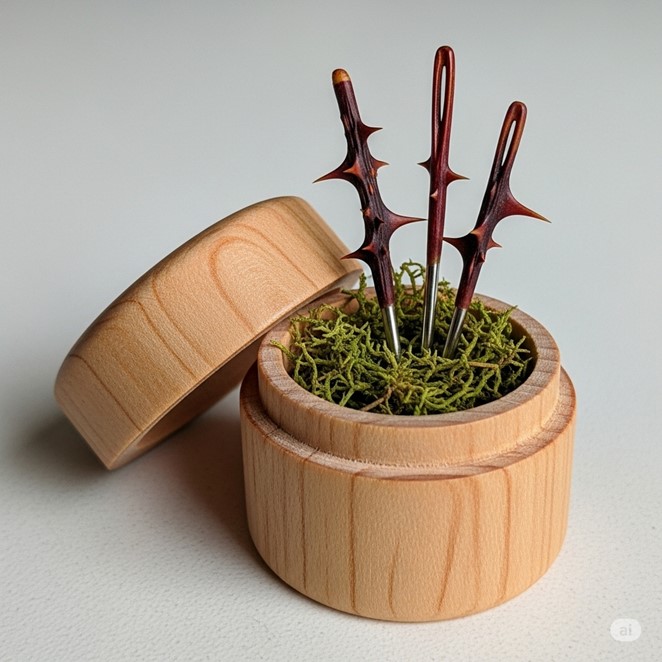
Description: The item is a small, cylindrical case carved from a single piece of pale cherry wood, polished smooth by countless hands. Its lid fits snugly without any latch or hinge. When opened, a bed of dried moss is revealed, protecting three needles of varying sizes. These are not metal, but appear to be fashioned from dark, hardened thorns, their surfaces a deep, ruddy brown like old rosewood. They are surprisingly sharp and durable, with perfectly formed eyes for threading. The needles feel warm to the touch, and when held, one gets the distinct, phantom sensation of a fine thread being pulled gently through their fingers, even when none is present. The entire kit is unassuming, easily mistaken for a simple mending kit carried by any traveler, its true potential hidden within its humble form.
Detailed Stats
- Durability: 15/15 (The needles are resilient but will break if used improperly as a weapon or tool for prying.)
- Required Tier: 1
- Attunement: Requires the user to spend an hour mending a piece of torn cloth by hand under the open sky, contemplating the connection between the small act of mending and the wider world.
- Skill Bonus: Provides a minor +2 bonus to any skill checks related to fine detail work, such as sewing, calligraphy, or inscribing.
Passive Magics
- Flawless Thread: When the user is sewing by hand with one of these needles, the thread they use is magically coaxed into compliance. It will not knot, fray, or tangle unless the user actively wills it. The needle seems to guide the thread through the most complex of weaves, making the act of stitching feel effortless and meditative.
- Weaver’s Eye: The user develops a subtle but keen eye for patterns, both natural and artificial. They can more easily spot a weak point in a rope’s weave, a hidden seam in a garment, or a loose thread on a tripwire. This perception extends to the natural world, allowing them to better appreciate and notice the intricate patterns of a spider’s web, the veins on a leaf, or the crystalline structure of frost.
Activable Magics
- Stitch the Morning Dew:
- Activation: The user threads one of the needles with a simple, undyed cotton or silk thread and makes a series of stitches into a surface (cloth, leather, wood, or even packed earth).
- Effect: As the user sews, the thread becomes coated in a shimmering, magical layer of dew. The completed pattern glistens with a beautiful, silvery light, as if stitched from water itself. The pattern is cool and damp to the touch and will remain for one hour before the dew evaporates, leaving the simple thread behind. This effect is purely aesthetic.
- Mend with Living Moss:
- Activation: The user takes the edges of a small hole or tear in a piece of natural fabric (like wool, cotton, or leather) and uses one of the needles to perform a stitching motion, as if sewing the hole shut, though no thread is used.
- Effect: Where the needle passes, a very fine, velvety green moss is encouraged to grow, its tendrils lacing together to perfectly seal the opening. The mend is soft, durable, and waterproof. It feels like living velvet and will last indefinitely unless it is deliberately scraped away or burned. The patched area will always feel slightly damp.
- Inscription of the Leaf:
- Activation: The user takes the largest of the three thorn-needles and uses it to carefully trace a symbol or character onto the surface of an uncut, living leaf or a piece of fresh tree bark.
- Effect: The needle does not damage the surface. Instead, it alters the leaf’s natural veins or the bark’s texture to form the desired shape perfectly. The inscription is seamless and appears entirely natural. It cannot be smudged or washed away and will last as long as the leaf or bark remains intact, serving as a subtle, natural marker or message.
Specific Slot
- Tool Kit / Pouch (Carried)
Tags: Shugendo, Embroiderer, Crafting, Utility, Common, Tier 1, Tool, Wood, Nature, Mending, Roleplay, Non-Combat, Subtle Magic, Focus, Yoshino, Thorn, Aesthetic, Textile
In the world of Saṃsāra, a specialized and subtle item like the Shugendo 429 of the Thorns of Mountain Rose would be bought and sold not in general magic shops, but in niche locations where craftsmanship, spirituality, or unique oddities are valued. Its price would fluctuate dramatically based on the vendor’s understanding of its true purpose.
The Monastery Haberdashery
At the base of a mountain like Yoshino, within the quiet, incense-scented grounds of a monastery, a small workshop serves the needs of the community and its few pilgrims. This is not a shop in the commercial sense, but a place of meditative craft. Here, an elderly monk or a lay artisan who follows the Shugendo path might craft these needle kits as part of their spiritual practice. They would not be openly displayed. To acquire one, a visitor would need to show a genuine interest in the craft of embroidery or a quiet, respectful spirit. The artisan would likely engage the potential buyer in a gentle conversation, seeking to understand their heart before offering the tool. The sale would be a simple, dignified exchange.
- Cost to Buy: 3 Silver. This price is not for profit but covers the time and minimal materials, ensuring the item is valued but accessible to a sincere artisan.
The Gilded Thimble, Luxury Textiles Emporium
In the affluent Silk District of a great metropolis, “The Gilded Thimble” caters to the city’s elite. The air is thick with the scent of expensive dyes and rare fabrics imported from across the 73 islands. The proprietor, a person of impeccable taste and sharp business sense, might have acquired a Thorns of Mountain Rose kit from an adventurer or a trader as an exotic curiosity. Unaware of its humble spiritual roots, they would see only a set of masterfully crafted, non-metallic needles. It would be displayed on a velvet pillow in a glass case, presented as a “Celestial Thorn Needle Set from the Mystical Peaks,” an ultimate luxury for the noble hobbyist embroiderer.
- Cost to Buy: 1 Gold and 2 Electrum (a total of 20 Silver). The price is wildly inflated, based entirely on its perceived rarity and the story woven around it for a wealthy clientele.
A Tinker’s Booth in the Grand Bazaar
Amidst the cacophony of a city’s sprawling bazaar, there is a small booth belonging to a tinker who specializes in fine, intricate tools. The stall is a cluttered wonderland of tiny gears, drafting styluses, jewelers’ loupes, and watchmaking forceps. The tinker, a sharp-eyed craftsperson, would value the Thorns of Mountain Rose for its physical properties. They might have traded for it, recognizing it as a superior tool for working with materials that might snag on or be corroded by metal. They would demonstrate its perfect balance and preternaturally sharp points, marketing it to other artisans as a masterwork tool for delicate, high-stakes work.
- Cost to Buy: 8 Silver. The tinker knows the value of a quality tool and prices it accordingly for a professional peer. They would be knowledgeable and firm, expecting the buyer to recognize the item’s practical worth.
The Itinerant Mender’s Cart
On a quiet road or in a small village market, an elderly woman sells her wares from a small, hand-painted cart. Her business is mending: patching cloaks, darning socks, and reinforcing worn traveling packs. She possesses a single Thorns of Mountain Rose kit, a gift from her youth or a tool she has carried since her own pilgrimage long ago. She knows its magic is gentle—that it encourages moss to patch holes and makes her thread glide smoothly. She might sell it if she takes a liking to a buyer, seeing in them a kind spirit or a true need. The transaction would feel less like a sale and more like passing on a small legacy, often accompanied by a story.
- Cost to Buy: 2 Silver. She has little need for wealth and would ask for just enough to buy a hot meal and some supplies. She might even prefer to trade it for a warm blanket, a bag of quality tea, or other simple comforts.
- Cost to Sell: An avatar trying to sell the kit to her would find she has almost no coin to offer. She would recognize its worth but could only offer a trade of her own services or hand-spun goods in return.
The Embroiderers’ & Weavers’ Guild Hall
Within a major city, the formal guildhall for textile artisans serves as a center for commerce, training, and commissions. The guild might maintain a small, exclusive stock of unique tools for its registered members, acquired through special channels—perhaps an ongoing arrangement with a mountain monastery. The Thorns of Mountain Rose would not be available to the public. To purchase one, an avatar would likely need to be a guild member in good standing. The acquisition would be recorded in a ledger, a formal transaction for a professional tool meant to uphold the guild’s high standards of quality.
- Cost to Buy: 4 Silver and 5 Copper. This is a standardized guild price, representing a fair value without the dramatic markup of a luxury retailer. Payment might be accepted in coin or in guild scrip earned by completing official contracts.
An item like the Thorns of Mountain Rose, which holds no power to cause direct harm or create a physical barrier, becomes a tool of immense creativity in a conflict. Its use in offense and defense is not a matter of force, but of intellect, psychology, and the subtle manipulation of the environment and enemy expectations. The roleplay of these actions hinges on the avatar’s cleverness and calm demeanor in tense situations.
Urban & Social Environments (A Noble’s Gala or Guild Hall)
Defense (Reputation and Social Standing):
The avatar is at a high-stakes social gathering. A smug, well-dressed rival attempts to belittle them, using their own opulent attire as a symbol of their superiority. The conflict here is one of reputation. The avatar, using the Weaver’s Eye passive ability, notices a tiny, almost invisible flaw in the rival’s magnificent silk coat—a single improperly looped thread in the shoulder seam, bearing the coat’s full weight.
- Roleplay: The avatar doesn’t react to the insults. Instead, they maintain a serene, knowing smile. They might later “accidentally” brush past the rival, using one of the thorn-needles hidden in their palm to gently snag the weak thread, starting a barely perceptible unraveling. Or, they might simply guide the conversation, maneuvering the rival into an animated gesture that puts strain on the flawed seam. When the seam inevitably rips, creating an embarrassing and audible tear, the avatar can offer a look of polite, feigned sympathy. Their defense was not to argue, but to use their unique perception to let the rival’s own false perfection be their undoing. The act is quiet, observant, and devastatingly effective.
Offense (Psychological Intrigue):
The avatar needs to intimidate a corrupt merchant or a political opponent without resorting to open violence. They acquire a personal item of the target—a glove, a handkerchief, or a sash.
- Roleplay: In the quiet of their room, the avatar takes the target’s item. Using the Stitch the Morning Dew ability, they embroider a symbol onto it. This isn’t a crude mark, but an intricate, shimmering pattern of dew that seems to have materialized from nowhere. The symbol is chosen for its meaning: a weeping eye, the sigil of a secretive guild, or a coiled serpent. The item is then returned to the target’s chambers anonymously. The target finds their personal belonging, now bearing a beautiful but impossible and unnerving magical message. No laws were broken, no violence was done, but the offense is clear: “I can reach you. I can touch your things. I possess a magic you do not understand.” It is an attack on their sense of security and peace of mind.
Wilderness & Exploration Environments (Forest or Ruins)
Defense (Evasion and Misdirection):
The avatar is being tracked through a dense forest by skilled hunters who know how to read traditional trail signs. The avatar needs to create a false trail to throw them off.
- Roleplay: Instead of leaving obvious, clumsy false trails, the avatar uses the Inscription of the Leaf ability. They find a living branch hanging over the path and, with a few deft motions of a thorn-needle, etch a perfect, arrow-shaped symbol onto a prominent leaf, pointing in the wrong direction. To the hunters, this doesn’t look like a carved sign; it looks like a natural pattern in the leaf’s veins, a subtle omen from the forest itself. They might follow this “sign” for miles. The roleplay is one of quiet harmony with the environment—a calm, deliberate act of forgery that turns the forest’s own language against the pursuers.
Offense (Subtle Sabotage):
The avatar has identified the camp of a group of bandits who have been menacing a local trail. They need to disrupt the bandits’ gear before a confrontation.
- Roleplay: Under the cover of darkness, the avatar sneaks into the camp. They find the bandits’ bedrolls, cloaks, or the leather straps of their packs. Using the Mend with Living Moss ability, they don’t repair holes, but create patches of living, damp moss in critical places. A patch is grown on the grip of a sword’s scabbard, making it slippery. Another is grown on the inside of a boot, creating an uncomfortable, blister-causing lump. A third is grown over the flint-striker on a tinderbox, rendering it damp and useless. The offense is not an attack, but a series of minor, frustrating acts of sabotage that will cause equipment to fail at critical moments, sowing chaos and disadvantage among the enemy.
Imminent Conflict Environments (An Alley Standoff)
Defense (De-escalation through Confusion):
The avatar is cornered by a thug who is looking for a violent confrontation. The avatar has no clear path to victory through force.
- Roleplay: The avatar shows no fear. They meet the thug’s aggressive posture with unnerving calm. As the thug boasts and threatens, the avatar pulls out their own cloak and the Thorns of Mountain Rose. They begin to perform the Mend with Living Moss ability on a tear in their own garment. The thug expects a weapon or a spell, but instead sees a patch of vibrant green moss grow into existence on the avatar’s clothing. This act is so unexpected, so bizarrely domestic in the face of violence, that it can break the aggressor’s momentum. “What are you doing?” The defense is the moment of hesitation this surreal act creates—an opportunity to speak, to reason, or to escape while the opponent is trying to process the strange, non-threatening magic they just witnessed.
Offense (Intimidation and Bluffing):
The avatar needs to convince a superstitious guard or bandit leader that they are a powerful curse-weaver, someone not to be trifled with.
- Roleplay: The avatar holds up a simple piece of black cloth for their opponent to see. With their other hand, they move with a fluid, practiced grace, the thorn-needle flashing in the dim light. They are using the Stitch the Morning Dew ability. On the black cloth, a complex and terrifying sigil begins to appear, shimmering with an arcane, watery light. The avatar’s face is a mask of concentration, their lips murmuring soft, meaningless syllables that sound like an ancient incantation. The opponent does not know the shimmering symbol is just harmless, temporary dew. They see a potent magical curse being woven before their very eyes. The offense is a complete bluff, a piece of theater that uses the item’s aesthetic ability to project an illusion of immense power, potentially frightening the enemy into backing down without a single blow being struck.
Perception of Activation:
SIGHT
- User’s Perspective: From the user’s point of view, the magic is an act of flawless and intimate creation. When stitching with dew, they see individual molecules of water vapor gathering from the air, clinging to the thread, and arranging themselves into perfect, glistening droplets. When mending with moss, they perceive a hyper-accelerated bloom of life, as if watching a time-lapse of a forest floor; tiny green spores sprout, weave their hyphae together with impossible speed, and form a soft, living felt. The inscription on a leaf is not a gouge, but a gentle persuasion, as the user watches the leaf’s own veins flow like liquid green ink to form the new shape.
- Observer’s Perspective: A nearby observer witnesses a quiet and beautiful miracle that is clearly and undeniably magical. They see a shimmering, wet pattern appear on a dry surface for no reason. They watch a hole in a cloak seal itself in seconds with a patch of vibrant, living moss. The effect is graceful and silent, which can make it even more unnerving than a flashy explosion of light. It’s not aggressive, but it is a profound violation of natural law.
- Positives: The visual effect is often beautiful and non-threatening, which can be disarming in a tense social situation. Its silent and graceful nature demonstrates a high level of control and mastery.
- Negatives: The effect is visually overt. It is impossible to use any of the abilities without anyone watching knowing that the user is performing magic. It has zero visual stealth.
SOUND
- User’s Perspective: To the user, the activation is accompanied by an intimate, barely-there sound. The dew-stitch whispers like the sigh of a humid night. Mending with moss creates the faintest, softest rustle, like the sound of roots pushing through damp earth. Inscribing a leaf produces a low hum, perceived more as a vibration in the bones of the hand than an actual sound, like the movement of sap within a great tree.
- Observer’s Perspective: An observer hears nothing at all. The magic is perfectly silent. In a tense or quiet room, this utter lack of sound accompanying the impossible visual effect can be more shocking than a loud incantation. The silence itself is a perceptual event.
- Positives: The absolute silence of the activation makes it incredibly stealthy. It can be performed without alerting anyone not looking directly at the user, even in a library or a sleeping chamber.
- Negatives: For an observer, the silent manifestation of magic can be deeply unsettling, marking the user as someone whose abilities operate on a level beyond common understanding.
SMELL
- User’s Perspective: Each activation releases a distinct and pleasant natural fragrance. Stitching with dew smells of night-blooming flowers and clean rain. The moss mend releases a rich, complex scent of a forest floor—of damp earth, peat, and decaying leaves. The leaf inscription gives off a sharp, clean scent of crushed chlorophyll and fresh spring growth.
- Observer’s Perspective: A person standing very close to the activation might catch a faint, momentary, and often out-of-place scent. In a dusty tavern, a sudden, inexplicable whiff of fresh forest air would be a strange and noteworthy event, a clear clue that something unnatural has just occurred.
- Positives: The scents are pleasant and natural, which can have a calming or disarming effect. They are not the acrid, sulfurous smells often associated with sorcery.
- Negatives: The distinct, out-of-place fragrance is a dead giveaway to anyone with a keen sense of smell, pinpointing the user as the source of the nature magic.
TOUCH
- User’s Perspective: The thorn needle being used pulses with a gentle, living warmth that flows up the user’s hand. It feels less like a tool and more like an extension of their own body. Through the needle, they feel the texture of the magic as it forms: the cool, smooth dampness of the dew coalescing, the soft, velvety pile of the moss weaving itself into existence, or the fibrous surface of the leaf subtly shifting under their touch.
- Observer’s Perspective: An observer would feel nothing during the activation itself. Should they touch the result, they would be met with a surprising texture: the unexpected cool dampness of the dew pattern, the soft, living feel of the moss patch, or the unnaturally perfect texture of the inscribed leaf.
- Positives: The tactile feedback for the user is unambiguous, confirming the magic is working as intended. The unique textures of the results can have their own uses or psychological impacts.
- Negatives: There are no significant tactical negatives associated with the sense of touch for this item.
TASTE
- User’s Perspective: The air immediately around the activation momentarily sweetens. It is a subtle taste, like nectar on the wind or the clean flavor of snowmelt. It is a personal and fleeting sensation.
- Observer’s Perspective: An observer would taste nothing.
- Positives: This perception deepens the roleplaying experience for the user, reinforcing their connection to the pure, life-giving aspects of nature magic.
- Negatives: This sense is too subtle and personal to have any tactical negatives.
EXTRA-SENSORY PERCEPTIONS
- Magical Perception (The Mind’s Eye):
- User’s Perspective: The user perceives the “weave” of the object they are affecting. They see the physical threads of a cloak or the biological fibers of a leaf. Through the needle, they channel threads of pure life essence—luminous green and silver strands—and gently weave them into the existing pattern, either as a temporary embroidery of dew or a permanent addition of moss. It is an act of creation by addition.
- Observer’s Perspective (if magically sensitive): A magically-aware observer would not see a flare of power, but a gentle and controlled flow of energy. They would perceive faint tendrils of life-magic (often associated with the Jade Wind, Ghyran) flowing from the user’s hands into the needle, which then precisely “injects” or “sews” this energy into the target.
- Positives: The magical signature is extremely subtle and controlled, marking the user as a refined practitioner, not a brute-force sorcerer.
- Negatives: The signature is unmistakably that of life and nature magic. This could be seen as anathema to users of opposing magical lores (like death or chaos) and would immediately identify the user’s magical affiliation.
- Spiritual Perception:
- User’s Perspective: The user feels a sense of quiet cooperation with the spirit of the thing they are affecting. They feel the “permission” of the cloth to be mended, the “willingness” of the leaf to be inscribed. It feels like a harmonious partnership with the innate life force that resides in all things.
- Observer’s Perspective (if spiritually sensitive): A spiritually-aware observer would sense a localized “blooming” of positive, tranquil, natural energy. It is not the boisterous energy of a great nature spirit, but the quiet, contented sigh of a flower opening or a stream finding its path. They would perceive the user as a friend to the natural world.
- Positives: The activation is spiritually harmonious and is likely to go unnoticed or even be approved of by local nature spirits or fey creatures.
- Negatives: This pure, positive life-energy could act as a beacon to creatures that are antithetical to it. Undead might be drawn to the user as a source of offending vitality, while certain daemons or corrupted beings might be driven to extinguish such a pure expression of life.
Scroll of the Winter Rose Stitch
This document describes the intricate process required to create a set of enchanted needles akin to the Thorns of Mountain Rose. This is not a task of simple assembly, but a meditative craft that demands patience, a reverence for the natural world, and the skilled hands of an artisan. The resulting item’s power is a reflection of the care taken in its creation.
Materials Needed
- Three Thorns of a Winter Rose: These cannot be from any common rose bush. The crafter must find a wild rose that blooms out of season in a high-altitude, cold climate, signifying its powerful connection to the forces of life and perseverance. The three thorns should be harvested from the same plant, with a prayer of thanks given to its spirit.
- One Branch of Cherry Wood: The branch must be taken from a tree growing on the same mountain or in the same forest as the Winter Rose. It should be straight-grained, free of knots, and roughly the thickness of a thumb.
- A Skein of Orb-Weaver’s Silk: This thread must be carefully gathered from a large, abandoned spider web found at dawn, still shimmering with dew. The silk of an active web cannot be used, as the recipe requires a gift freely given, not stolen.
- Dew from a Lotus Leaf: A small vial of dew that has been collected from the center of a lotus leaf. This water is prized for its immense purity and symbolic connection to enlightenment and creation.
- A Handful of Moss from a North-Facing Tree: Moss that grows on the shaded, northern side of an old tree, where it is most resilient and endures the longest winters. This represents the power to mend and endure.
- A Pinch of Pine Resin: To be used as a sealant and hardening agent.
Tools Required
- Artisan’s Whittling and Carving Knives: A set of extremely sharp knives for shaping both the needles and the wooden case.
- A Jeweler’s Hand Drill: A manual drill with a micro-fine bit is required for the delicate task of boring the eyes of the thorn-needles without shattering them.
- Polishing Stones and Fine Sanding Twigs: A series of fine-grit stones and abrasive twigs used to smooth the thorns and the cherry wood case to a perfect, soft finish.
- A Small Ceramic Bowl: An unadorned bowl to be used for the imbuing ritual.
- A Mortar and Pestle: For grinding the dried moss and pine resin into a fine powder.
Skill Requirements
- Botany (Adept): The crafter needs the knowledge to identify and locate the specific, rare flora required, and the wisdom to harvest them in a sustainable, respectful manner.
- Woodworking (Masterwork): The fine detail required for shaping the thorn-needles, boring their eyes, and carving the snug-fitting case demands a high level of skill and precision. A clumsy hand will only produce shattered thorns.
- Embroidery or Weaving: The crafter must have a personal, practical understanding of the art of the stitch. One who has never felt thread pass through fabric cannot imbue a tool with a weaver’s spirit.
- Meditation: The ability to hold a single, pure concept—such as “mending,” “growth,” or “beauty”—in the mind for a prolonged period is essential for the final ritual of awakening.
Crafting Steps
- The Harvest: The first step is a pilgrimage. The crafter must journey to the wild places to gather the components. Each material must be collected with intent and respect. Thanks are given to the rose for its thorns, the spider for its abandoned silk, and the lotus for its pure dew.
- Fashioning the Needles: This is the most delicate physical task. The three rose thorns are carefully scraped clean and lightly sanded with the finest polishing stones to a smooth, but not slick, finish. Then, using the jeweler’s drill, the crafter must slowly and patiently bore a tiny, perfect eye at the base of each thorn. One slip of the hand will ruin the needle.
- Carving the Vessel: The artisan takes the cherry wood branch and cuts it into two pieces for the body and lid of the case. They are hollowed out and shaped so the lid fits onto the body with a satisfying, snug seal that requires no latch. The wood is polished until it feels like silk.
- The Imbuing Bath: The crafter grinds the dried moss and pine resin together. In the ceramic bowl, they place the three finished thorn-needles. The dew from the lotus leaf is poured over them, and the moss-resin powder is sprinkled into the water. The needles are left to steep in this mixture overnight, from dusk until the first rays of dawn, absorbing the energies of purity, endurance, and life.
- The Ritual of the First Weave: At sunrise, the crafter retrieves the damp needles. They must now perform the act that awakens their magic. Threading the largest needle with the gathered spider silk, they must perform a single, perfect act of stitching that honors the principles of Shugendo. They might stitch a fallen blossom back onto its stem, trace a pattern on the surface of still water that lingers for a moment, or even make a single, invisible stitch in the air itself that mends a “tear” in the local ambience. During this act, they must pour all their focus and meditative energy into the needle, channeling their reverence for the craft into the tool. A faint, warm pulse from the needle signifies the magic has taken root.
- Final Assembly: The needles are gently dried and laid to rest in their cherry wood case upon a new bed made from the remaining sacred moss. The case is closed, sealing the magic within. The item is now complete, a humble tool infused with the quiet and profound magic of mending and creation.
Chiyo and Unseen Stitches
(This telling is from a scroll fragment found in a ruined library, and its words are a dim echo of a song sung in a tongue that is no more. The shape of the meaning is true, but the colors are faded by many translations.)
And it came to be that a woman walked to the High Mountain of Yoshino. Her name was Chiyo, but she was called the Girl with Sad Hands, for she had been a great weaver of silks, and now her hands were still. A Great Sorrow had come upon her, and it was a tear in the tapestry of her soul. Her thoughts were a basket of unspooled thread. She came to the mountain temple not to find power, but to find nothing. She wished to empty her heart of its tangles.
The leader of the temple was the Elder of the Mossy Stones. He was a man whose silence was older than the trees. He looked at Chiyo, the Girl with Sad Hands, and saw the skill that slept in her fingers. He did not give her a great test of spirit. He did not tell her to meditate on the void. He gave her a task of the world.
He said to her, “Our yamabushi walk the stone paths. They fight the wind and the branches. Their robes are torn. Your hands know the needle. Your task is to mend.” And it was so.
He gave her a room with a basket of torn robes. The robes were coarse and thick. He gave her needles of black iron and thread like rough twine. Chiyo took up the work. Her heart was heavy. The iron needle was clumsy in her hand, a stranger after years of fine silver. The coarse fabric fought her. The thread was thick and ugly. Every stitch was a hard battle. She mended the tears, but her work was thick with scars. The patches were ugly. This work did not empty her heart. It filled it with new frustration. She mended cloth, but the hole in her spirit grew wider.
For many turnings of the moon, she worked. The pile of torn robes never shrank. Her sorrow did not lessen. One day, her hands sore and her spirit low, she left the mending room. She walked without a path on the Great Mountain. She sat by a stream and watched the world. She watched with her weaver’s eyes.
She saw a spider. Its web, a wheel of moon-thread, was broken by the night’s wind. The spider did not weep for its broken house. It moved its small legs. It began to spin. It mended the tear with new, shining thread. It did not hide the mend, it made the mend a part of the pattern.
She looked at a great stone. A crack ran through it from a winter’s ice. The stone did not curse its wound. In the crack, a line of soft green moss had grown. The moss held the stone’s edges. It filled the crack with life and softness. It made the wound beautiful.
A thought came to Chiyo. It was a quiet thought, a single perfect stitch in the tangle of her mind. “The world does not use iron to mend its hurts. It uses life. It uses what it is.”
She rose and walked not to the temple, but to the high slopes. She found a rose bush that held its red flowers even in the cold winds. It was the Winter Rose. Its thorns were long and sharp and strong. She did not break the branches. She asked the spirit of the rose for its needles. She took three thorns that were offered. She saw them not as a defense, but as the mountain’s own tools for stitching.
She returned to the mending room. She put away the iron needles and the rough twine. She took a torn robe, a great gash in its sleeve. She held a thorn-needle. She used no thread. She remembered the moss in the cracked stone. She touched the needle to the edge of the tear, and she did not pull. She persuaded. She closed her eyes and held the thought of the moss in her mind. And from the path of the needle, a fine, velvety moss began to grow. It grew from one side of the tear to the other, its tiny threads lacing together, pulling the fabric closed. The mend was not an ugly scar. It was a soft, green line of life. It was beautiful.
She learned other stitches. She learned to dip the thorn in dew and stitch prayers that shimmered for an hour. She learned to use the thorn to ask a leaf to write a message in its own veins. Her hands were no longer sad. They were busy. They were creating again.
The Elder of the Mossy Stones came to her room. He saw the robes. They were piled and folded. And they were covered in her work. There were patches of living moss. There were swirling patterns of faded dew. There were small inscriptions on the hems that looked like natural parts of the cloth. He did not look at the robes for long. He looked at Chiyo. The Great Sorrow was still there, but it was not a tear anymore. It was a mend, a beautiful patch of moss in her soul.
The Elder said, “The mending is done.” Chiyo, whose hands were now full of purpose, looked at her work and answered, “No. It has just begun.”
Moral of the story: One does not heal a wound by forgetting what caused it, but by learning to weave the scar into a new and beautiful pattern.
Suggested conversions to other systems:
Call of Cthulhu, 7th Edition
The Seamstress’s Thorns
This is a small, unassuming wooden needle case, likely of Japanese origin from the late 19th or early 20th century. Inside are three thorn-like needles. The item is not inherently of the Mythos, nor is it malignant, but its abilities are a direct and observable violation of the natural order. Witnessing the Mend with Moss ability for the first time requires a Sanity roll (SAN 0/1).
Game Mechanics:
- Weaver’s Eye: The holder of the needles has an uncanny eye for detail in woven materials. They gain a bonus die on any Spot Hidden roll to find flaws in clothing, ropes, nets, tapestries, or similar items.
- Mend with Moss: By spending one minute of uninterrupted work, the user can perfectly repair a tear or hole (up to one foot in length) in any natural fabric or leather. The item does not require thread; a patch of soft, living moss grows and seals the hole. This can be used to repair damaged evidence or to subtly sabotage equipment by “mending” parts together.
- Dew Stitch & Leaf Inscription: These abilities allow the user to leave ephemeral, untraceable messages. Using Sleight of Hand, the user can stitch a shimmering, wet symbol onto an object or etch a message into the veins of a plant. Discovering such a message where none should be—for instance, on one’s own pillow—may require a Sanity roll (SAN 0/1) for the victim, at the Keeper’s discretion.
Blades in the Dark
Ghost-Stitch Needle Case A small, polished case from the Dagger Isles holding three needles carved from the thorns of a ghost-rose. They say a skilled weaver can use them to stitch up the holes in the world. (Gear, 0 Load)
Game Mechanics:
This tool kit allows for unique actions and opportunities, especially for characters with a subtle or arcane touch.
- Flawless Mend: When you have downtime, you can use the needles to repair any mundane damage to your crew’s gear or clothing. Describe the quiet, meticulous work. You and one other crew member involved may clear 1 stress due to the meditative nature of the act.
- Stitch a Message: When you want to send a clear social signal—a threat, a claim, or a warning—you can spend 1 stress to create a shimmering dew-pattern on a target’s territory, belongings, or even a person’s clothing. This act can be used to start a 4-segment clock, such as “Lord Scurlock’s crew respects our claim” or “The Hive is intimidated by our strange magic.”
- Scry the Weave: This represents the Weaver’s Eye passive. When you study a complex system or situation, you can use your understanding of “weaves” to gain insight. This could apply to a guard’s patrol route, the political ties between factions, or the structural weaknesses in a building. When you do this, you can ask the GM a single clarifying question, and the GM will answer honestly. You may do this once per score.
Dungeons & Dragons, 5th Edition
Needles of the First Autumn Wondrous item, common
This polished cherry wood case contains three sharp needles carved from the thorns of a magical plant. The needles feel warm to the touch, and allow the user to perform delicate acts of nature magic.
- Living Mend. You can use these needles to cast the mending cantrip at will. When you use the needles to repair a tear in a natural material like cloth, leather, or wood, the mended area is filled with a seamless patch of soft, living moss that is the same color as the original material.
- Dew Stitch. As an action, you can use a needle to trace a pattern on a surface. The pattern, which can be no larger than 2 feet on a side, instantly becomes coated in shimmering, magical dew. The beautiful pattern lasts for 1 hour before evaporating completely. This property can be used a number of times per day equal to your proficiency bonus.
- Nature’s Scribe. You can use a needle to touch a single living leaf or a piece of fresh bark. You can cause a single word or a symbol to appear on the surface, formed from the natural veins and patterns of the plant itself. This inscription is harmless and lasts until the leaf or bark dies and withers.
Knave, 2nd Edition
Rose-Thorn Sewing Kit A small wooden case holding three dark needles made from enchanted thorns. They are warm and hum with a quiet energy. (1 Slot)
- Attribute: The needles are preternaturally sharp and never seem to dull. They can be used for any task requiring a normal sewing needle.
- Mend: You can spend one minute to perfectly repair any tear or hole in a non-magical, natural material (cloth, leather, etc.). The mend is made of a patch of soft, living moss that grows to seal the gap.
- Embroider: You can use a needle to draw temporary (lasting up to one hour) patterns on any surface. The patterns are made of glistening, cool dew. This can be used to create signals, distractions, or simply beautiful art.
- Inscribe: You can use a needle to write a short message or symbol on a living plant without harming it. The writing becomes part of the plant’s natural pattern (e.g., its veins or bark texture) and is very difficult to spot for those not actively looking for it.
- Perceive Flaws: If you spend a moment examining a woven or stitched item (like a rope, cloak, net, or tapestry), the Warden will tell you if it has any significant weaknesses or hidden flaws.
Fate Core System
The Weaver’s Parting Gift
This item is an extra, representing a deep connection between the user’s craft and the living world. It is a set of three thorn-needles in a simple wooden case.
Aspect: A Stitch of Living Beauty This aspect can be invoked for a bonus when mending, creating, or interacting with natural things in a gentle, constructive way. A Game Master can compel this aspect when the overt, living magic of your craft causes unforeseen social complications, such as a villager thinking you are a fey creature or a rival artisan becoming intensely jealous of your “unnatural” skill.
Stunts:
- Mend the Body and Spirit: When you take time to mend a damaged item for yourself or an ally, you repair it perfectly with a beautiful patch of living moss. The act is restorative for the recipient; they may either clear a mild physical consequence related to the item’s previous state of disrepair (e.g., “Tattered Rations Pouch”) or, if there is no related physical consequence, they may clear a mild mental consequence (like “Haunted by Past Failures”) by reflecting on the beauty and care of the mend.
- A Shimmering Declaration: Once per scene, you can spend a Fate Point to embroider a temporary pattern of dew onto any surface. This creates the situation aspect Impossible, Glistening Sigil with one free invocation. This can be used to awe, intimidate, or create a distraction.
- The Unseen Trail: When you use these needles to leave a hidden message or trail marker using the Inscription of the Leaf ability, you gain a +2 bonus to your Stealth or Notice roll to create the subtle sign or to have an ally find it later.
Numenera & Cypher System
Bio-Weaving Stylus Kit This artifact from a previous world appears to be a simple artisan’s tool but is in fact a sophisticated biological fabrication device. The “needles” are styluses that extrude or manipulate nanites and living cells.
- Level: 4 (Tasks performed with the kit are difficulty 4, or level 4. The depletion roll is 1 in 1d10.)
- Form: A polished case made of a light, resilient wood-like material, containing three dark styluses that resemble thorns.
- Effect: The kit has three primary functions.
- Nanite Mend (Action): The user can touch a stylus to a tear in any non-metallic, organic-based fabric (cloth, leather, synth-leather). The stylus releases nanites that culture a colony of engineered moss, weaving the hole shut in one round with a durable, flexible, living patch. This function does not require a depletion roll.
- Hydro-Glyph (Action): The user can trace a pattern with a stylus in the air or on a surface. The stylus projects a field that causes ambient humidity to condense into a shimmering, intricate image. The image lasts for one hour. The level of detail is a difficulty 3 task. Depletion: 1 in 1d10.
- Cellular Inscription (Action): The user can use a stylus to touch a living plant. The device allows the user to harmlessly reprogram the cellular structure of the plant’s surface (a leaf or bark), creating a perfect symbol or message that appears as a natural part of the plant. Depletion: 1 in 1d10.
- Depletion: 1 in 1d10 (rolled after using Hydro-Glyph or Cellular Inscription).
Pathfinder, 2nd Edition
Rose-Thorn Needle Set – Item 2 Uncommon, Magical, Primal, Transmutation Price 30 gp Usage held in 1 hand; Bulk — (negligible)
Carved from the thorns of a sacred mountain rose, these three needles are a boon to any artisan who walks the paths of the wilderness. They are always warm to the touch and seem to guide the user’s hand.
- Passive: The needles function as a set of masterwork artisan’s tools for any Crafting checks involving sewing, weaving, or embroidery, granting a +1 item bonus to the check.
- Activation [One-Action] manipulate; Effect You use a needle to mend a tear or hole in an object. This functions as the mending cantrip, but if the object is made of natural cloth or leather, the repair is formed from soft, living moss.
- Activation [Two-Actions] command, manipulate; Frequency once per 10 minutes; Effect You trace a design on a surface with one of the needles, causing an intricate and shimmering pattern of dew to appear. The pattern covers no more than a 5-foot square and is cool and damp to the touch. It is purely aesthetic and evaporates after 1 hour.
- Activation [One-Action] manipulate; Frequency once per hour; Effect You touch a needle to a living leaf or the bark of a living tree and cause a single symbol or character to appear, seamlessly integrated into the plant’s natural patterns.
Savage Worlds Adventure Edition (SWADE)
The Seamstress’s Thorns This is a small, unassuming needle case, but anyone with an Arcane Background (particularly one related to nature or healing) or the Artisan Edge can feel the gentle life energy humming within. It allows a skilled user to perform small acts of creation and mending.
Game Mechanics:
Using the magical abilities of the thorns is an action. For complex or stressful situations, success may require a skill roll determined by the GM, typically Crafting or Performance.
- Living Patch: You can instantly and perfectly repair any tear or damage to a mundane item made of cloth or leather. The mend is a patch of soft, living moss. This can be used to repair damaged armor or gear during combat as an action with a Repair roll. Success restores 1 point of Armor or removes a flaw from the gear.
- Dew Embroidery: You can create beautiful, shimmering patterns made of dew on any surface. If used to create a piece of art or enhance a performance, this grants a +1 bonus to your Performance roll. If used to create a holy symbol or frightening image, it can be used to support a Taunt or Intimidation attempt with a +1 bonus.
- Whispering Leaf: You can inscribe a perfect, natural-looking symbol on a plant. This allows you to leave a hidden message. A character looking for the message may make a Notice roll to find it, but at a -2 penalty unless they know what to look for.
- Weaver’s Insight (Passive): The user’s eye for detail is uncanny. They gain a +1 bonus on any roll to examine a woven or crafted object to find a clue, weakness, or secret.
Shadowrun, 6th World
Yoshino Bioweave Kit This is a high-end, boutique biotech tool that blurs the line between advanced science and magic. Ostensibly sold as a “self-repair” kit for organic fabrics by a subsidiary of Evo Corporation with ties to the Japanese Imperial State, runners in the know recognize it as a subtle and useful focus for an Awakened artisan.
- Availability: 9R
- Value: 8,500 Nuyen
- Game Mechanics: The kit contains three thorn-like styluses. A character with the Artisan skill can use its basic mending function, but an Awakened character can unlock its true potential.
- Biotechnical Mending: A user can make a Biotechnology + Logic (3) test to perfectly repair a tear in any natural or synthetic fabric. The process takes one minute and leaves behind a patch of resilient, living moss. If used to repair damaged armor with the Armorer skill, this can restore 1 point of the armor’s rating.
- Hydro-Glyph: As a Minor Action, a user with the Sorcery skill can make a Sorcery + Magic (2) test. Success allows them to trace a shimmering pattern made of condensed atmospheric dew on any surface. The glyph lasts for 10 minutes. This can be used to create a distraction or, at the GM’s discretion, to add a point of Edge to a relevant Social test where a subtle display of magical skill would be impressive.
- Cellular Inscription: A user with Sorcery can make a Sorcery + Magic (3) test to touch a needle to a living plant and harmlessly alter its cellular pigmentation, creating a perfect symbol or message that appears to be a natural marking. This is an excellent way to leave untraceable dead drops or trail markers.
Starfinder Roleplaying Game
Genesis Needles Level 1 Price 400 credits Bulk — (negligible) Category Hybrid Item
This small, elegant case made of polished Akitonian cherrywood contains three styluses that resemble sharpened thorns. They are hybrid items that blend primal magic with nanotechnology, allowing the user to perform minor acts of biological fabrication and alteration.
- Nanite Mending. You can use these needles to cast the mending cantrip at will. When you cast the cantrip in this way, the repair is made from a seamless patch of soft, bio-engineered moss that perfectly matches the color and texture of the repaired object.
- Hydro-Scribe. Three times per day as a standard action, you can use a needle to trace a pattern on a surface within your reach. The pattern, which can be no larger than 5 feet on a side, instantly becomes coated in shimmering, magical dew that gives off dim light in a 5-foot radius. The pattern lasts for 1 hour before evaporating.
- Cellular Etching. You can use a needle to harmlessly inscribe a symbol onto a living plant or a creature with the plant type. The symbol becomes a natural-looking part of the creature’s body. This inscription lasts until it is magically removed or the plant/creature dies.
Traveller (Mongoose 2nd Edition)
Droyne ‘Weaver’ Implement This device is a baffling piece of Droyne technology. It appears to be a simple case with three sharp, thorn-like tools, but its function is far more complex. Imperial xenotechnologists theorize it is either a highly advanced artistic tool or a biological field-marking kit. Like most Droyne artifacts, it is not openly hostile but operates on a logic that is difficult for humans to fully comprehend.
- TL: 15
- Mass: 0.1 kg
- Cost: Artifact (Not for sale; a rare discovery)
- Power Source: Internal; self-charging via ambient bio-energy.
- Functions: Interfacing with the device requires an Average (8+) Electronics (computers) or Animals (training) check, as its interface seems to be part-biological.
- Micro-Fabricator: When touched to a tear in any fabric (organic or synthetic), the device extrudes a stream of nanites that bond with local microbes to weave a permanent, seamless patch over the course of one minute.
- Moisture Condenser Array: Upon activation, the device can manipulate local atmospheric humidity to “paint” intricate, glowing patterns of condensation on surfaces. The patterns last for several minutes before evaporating. This is believed to be a form of Droyne communication or art.
- Genetic Marker: Upon activation, the device can rewrite a small patch of a plant’s surface genetic code to create a lasting pattern or symbol that appears entirely natural. This could be used for marking trails or scientific specimens in the field.
Warhammer Fantasy Roleplay, 4th Edition
The Briarwitch Needle Case Encumbrance: 4 Price: 4 GC (Gold Crowns) Availability: Rare
This small, unassuming sewing kit is carved from the wood of a Bloodrose briar and contains three wicked-looking needles made from the plant’s thorns. It is said that such kits are used by the strange Briarwitches of the Grey Mountains, who weave their hedge magic into acts of mending and spite in equal measure. While not tainted by Chaos, the magic is primal and unnerving to the uninitiated.
Game Mechanics:
- A Witch’s Patch: A character using the needles may attempt to mend a torn item of clothing or leather by making a Challenging (+0) Trade (Tailor) Test. No thread is needed. Success means the tear is sealed with a patch of living, thorny moss. If the Test results in an Impressive Success (+2 SL or more), the mended item gains the Durable Quality for 24 hours. A Fumble may mean the moss grows out of control, ruining the item.
- Glistening Spite: Once per day, the owner may take a moment to stitch a symbol onto an object. The thread used glistens with an unnerving, oily dew. This can be used to support an Intimidation Test against a superstitious target, granting a +10 bonus to the roll. The glistening effect lasts for one hour.
- Mark of the Briar: You can use a needle to leave a small, thorn-shaped mark on a living plant. To anyone else, it looks like a natural part of the plant. A character with the Second Sight Talent can easily spot the mark, as it glows faintly with the green Wind of Ghyran. This is often used as a way for hedge witches to leave messages for one another.