
Slot: Held / Back
Lore When the first souls arrived on the world of Saṃsāra, they found themselves in a land where magic ebbed and flowed like an unpredictable tide. Some communities, finding themselves stranded in regions where the ambient magic was thin and weak, grew desperate. Among them were practitioners of Seiðr, whose divinatory trances required a steady source of power they could no longer rely on. Through grim ritual and necessity, they discovered that the most abundant and reliable source of energy was life itself. They learned to siphon trickles of vitality from the teeming flora and fauna of the world to fuel their rites. The Wither-Staff was not a tool of malice, but a common and necessary instrument born of this desperation, allowing a practitioner to draw just enough life force to commune with the spirits and seek the knowledge needed for their people to survive another day.
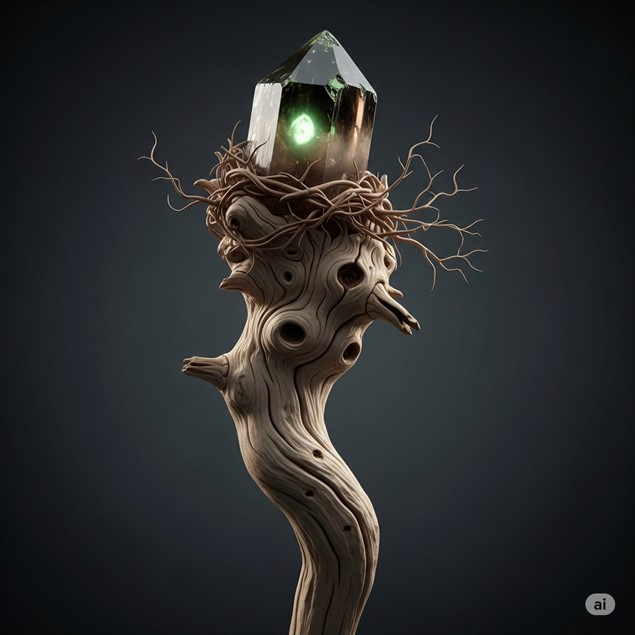
Description The Wither-Staff is a five-foot length of gnarled, pale rowan wood that looks and feels desiccated. The wood is unnaturally light, as if all the sap and moisture were expertly drawn from it long ago, yet it remains as strong as oak. It is cold to the touch and seems to absorb the warmth from a user’s hand, never retaining any heat. The top of the staff is capped with a shard of smoky, opaque quartz. Tiny, hair-like roots, dry and brittle, are wrapped around the base of the crystal. When the staff holds a charge of life force, the quartz gives off a faint, sickly green luminescence, and the small roots occasionally twitch with a semblance of life.
Detailed Stats
- Anima Capacity: 3/3 — The staff can hold up to 3 charges of siphoned life force (Anima). It passively generates 1 charge if left undisturbed in a vibrant, living environment for one hour.
- Durability: The staff is surprisingly resilient despite its withered appearance.
- Physical Damage: In combat, it functions as a simple quarterstaff.
Tags Common, Tier 1, Seiðr, Life Drain, Held, Staff, Wood, Divination, Magical, Necromancy, Abjuration, Psychic, Poison, Artifact, Underdark-Forged, Ceremonial, Two-Handed
Passive Magics
- Subtle Siphon: The staff passively leeches minuscule amounts of life force from its immediate environment. Unattended, non-sentient plant life, such as grass or moss, will slowly lose its color and wilt if the staff is left resting upon it for an extended period. Small insects that land on the staff become sluggish and lethargic. This passive absorption is what allows the staff to slowly recharge its Anima Capacity on its own.
- Sense Vitality: The wielder holding the staff gains a tactile sense of the life force in others. It is not a precise reading, but a general impression felt as a faint thrumming from the wood. A healthy, vibrant creature causes a strong, steady pulse, while a sick or dying creature produces a weak, erratic flutter. This allows the user to vaguely discern the health of those around them.
Activable Magics
- Drain Life (Active): As an action that requires physical contact, the user can command the staff to actively siphon life force from a living target. This target can be a plant, an animal, or a creature. Using this on a creature is a hostile act. The process is not overtly painful but causes a sudden feeling of weakness, dizziness, and cold in the target. This action expends no charges but instead adds 1 charge of Anima to the staff’s Anima Capacity. A single creature cannot be drained more than once per hour, as the staff cannot draw from a recently weakened life force.
- Anima-Fueled Trance (Active): By expending 1 charge from the staff’s Anima Capacity, the user can instantly enter a brief, divinatory trance. The user may ask a single, specific question regarding a hidden truth, a lost object, or a potential future outcome. The answer manifests not as a clear statement, but as a fleeting vision, a symbolic feeling, or a cryptic series of whispers, consistent with the enigmatic nature of Seiðr. The power and clarity of the vision are limited by the common nature of the staff, often providing guidance that is shrouded in metaphor.
The Seiðr 88 of the Wither-Staff, as a specialized ritual tool with a morally ambiguous function, would not be found in common markets or general stores. Its trade would be confined to niche circles where its purpose is understood and its life-draining nature is either accepted as a necessity or appreciated as a curiosity.
The Hedge-Mage’s Supply Stall
Located on the fringes of a town or tucked away in a market district known for its occult wares, this stall is run by a folk practitioner or “hedge-mage.” The air here is thick with the scent of strange herbs, drying animal parts, and damp earth. The proprietor deals in the practical, if sometimes unsavory, tools of old magic, catering to seers, shamans, and others who walk the line between worlds.
The Wither-Staff would not be on open display. A serious inquiry for a “divining focus” or a “tool for ritual fueling” would prompt the hedge-mage to bring it out from a back tent, wrapped in oiled cloth. The transaction would be discreet and conducted in hushed tones. The proprietor understands the staff’s purpose not as evil, but as a necessary instrument for powerful magic, and would explain its function and risks in a straightforward manner.
- Cost to Buy: The price reflects its utility as a magical tool for a serious practitioner. The hedge-mage would likely ask for 6 Gold.
- Cost to Sell: A hedge-mage is a primary buyer for such an item. They know they can sell it to another practitioner and would offer a fair price to acquire it, likely around 3 Gold and 5 Silver.
A “Reclaimer’s” Shop in an Under-City
Deep within the cavernous darkness of an Underdark megacity, there are shops run by “reclaimers”—adventurous scavengers who delve into the ruins of forgotten civilizations. These shops are often carved directly from the stone, lit by glowing fungi and salvaged magic circuits, and are filled with dusty, unidentified artifacts.
The reclaimer selling the Wither-Staff would likely have no idea of its true function. They would have found it in an ancient, abandoned settlement and recognize it only as magical. It would be marketed as an “Ancient Ritual Staff” or a “Mysterious Sorcerer’s Cane,” with the seller emphasizing its age and strange feel. A knowledgeable avatar could get a significant bargain here if they feign ignorance. The transaction would be a simple barter for goods or coin, with the reclaimer happy to be rid of the strange object.
- Cost to Buy: The price is based on perceived antiquity, not actual function. A reclaimer might ask for 5 Gold but could be haggled down to 3 Gold, especially if the buyer points out that “it looks dead.”
- Cost to Sell: The reclaimer would treat it as just another piece of magical salvage. They might offer 1 Gold in coin or, more likely, offer to trade it for practical adventuring gear like rope, rations, or alchemical light-sources.
A Coven’s Quartermaster
This is not a public place of business but the private supply chamber of a secluded coven or circle that practices Seiðr or similar traditions. Access is restricted to members or trusted allies. The location itself would be hidden, perhaps in a protected grove, a warded urban townhouse, or a quiet country manor.
The Wither-Staff would be treated as a standard, if serious, piece of ritual equipment. A member in good standing could requisition the staff from the coven’s quartermaster, who would log the transaction and provide instruction on its ethical use—stressing that it should only be used on plants or animals, and on sentient beings only in dire emergencies or with consent. Selling a staff to the coven would be highly encouraged, as they strive to keep such tools within their community and out of ignorant hands.
- Cost to Buy: The price would likely be subsidized for members. A practitioner could acquire it for 4 Gold and 5 Silver. It would not be for sale to outsiders.
- Cost to Sell: To ensure such items are brought to them, the coven would offer a very fair price, likely 4 Gold flat, seeing it as a way of protecting their traditions and their people.
An Auction of Esoteric Implements
In the great cities, scholarly societies or colleges of magic sometimes hold private auctions to raise funds or trade rare items. These are not black markets, but grey-market events for serious collectors, academics, and dedicated practitioners.
The Wither-Staff would be presented by an auctioneer in a clinical, academic manner. It might be described as: “Lot 3B: A well-preserved example of a Tier 1 ritual focus, believed to be from a ‘Desperation Era’ settlement. Note the characteristic rowan wood and the anima-receptive quartz. A functional piece for a student of historical thaumaturgy.” Bidding would be polite and measured, with interested parties being scholars of ancient magic or actual Seiðr practitioners.
- Cost: The final price depends entirely on who is in the room. Bidding might start at 3 Gold but could climb as high as 1 Platinum (10 Gold) if two determined buyers are competing for it.
The Seiðr 88 of the Wither-Staff is a tool of subtlety and desperation, not open conflict. Its use in offense and defense is indirect, focusing on weakening foes, empowering the user’s knowledge, and manipulating the environment through the careful application of siphoned life force.
In a Barren Wasteland or Low-Magic Zone
This is the environment for which the staff was created, where life is a scarce resource and tapping into it is a means of survival.
Roleplaying Defense: Defense in a wasteland is about conserving energy and outlasting threats. When facing a starving predator, a direct fight is foolish. You would use the staff defensively by using the Drain Life ability on the creature itself. You would roleplay this not as an attack, but as a desperate gambit: “As the great desert lizard lunges, I don’t try to block. I pivot and jam the tip of the Wither-Staff into its thick hide. I feel the staff shudder as it drinks, and the beast’s next move is visibly more sluggish.” The goal is not to kill, but to create a moment of weakness, an opening to escape from a foe you cannot overpower.
The Sense Vitality passive is also a key defensive tool. You would roleplay using the staff as a dowsing rod for life. “I sweep the staff slowly over the cracked earth, feeling for a pulse in the dead land. The wood remains cold and still, until I point it toward a shadowed rock outcropping. There—a faint, fluttery thrumming. Something lives there. It could be a den of monsters, or it could be a hidden spring surrounded by moss. It is life, and it is a direction away from this barrenness.”
Roleplaying Offense: Offense in this environment is about using what little life there is to your advantage. To overcome a rival scavenger, you might use the staff to weaken them from a distance. You would use Drain Life on the sparse, thorny shrubs they are using for cover, causing the plants to become brittle and weak. Then, you would use that stolen Anima to fuel a trance, asking the question, “What path will my enemy take?” The vision might show the rival stumbling through the now-brittle patch of thorns, allowing you to anticipate their movement and prepare an ambush. The offensive act is a one-two punch of environmental sabotage followed by magically-gained tactical knowledge.
In a Lush, Verdant Forest
In an environment teeming with life, the staff is constantly, passively charged. This allows for more frequent use of its powerful divinatory magic.
Roleplaying Defense: With an abundance of life force, defense becomes proactive rather than reactive. Before entering a suspicious-looking clearing, you would roleplay the precautionary measure: “The air here feels too still. I touch the staff, already humming with the life of the forest, and spend a charge.” You would use the Anima-Fueled Trance to ask, “What danger waits in this clearing?” The vision might be a cryptic image of “a spider’s silk thread,” warning you of the giant, camouflaged arachnids waiting in the canopy. Your defense is foreknowledge, allowing you to avoid the fight entirely.
If cornered, you could use Drain Life on a massive, ancient tree. “The dire wolf blocks our escape! I slam the butt of the staff into the great Ironwood’s trunk, shouting the activation word. The crystal at the top flares as the tree’s ancient vitality pours into it.” With a full 3 charges of Anima, you can now rapidly fuel multiple trances to find the wolf’s weakness, locate an escape route, and identify a nearby plant that can mask your scent, all in quick succession.
Roleplaying Offense: Offense with a fully charged staff is about information warfare. To assault a bandit encampment, you become a battlefield oracle. You would roleplay a pre-dawn ritual: “I sit hidden in the undergrowth, the staff thrumming in my hands. I drain the life from a patch of ferns, ensuring my tool is full. Now, I will dismantle them, one secret at a time.” You would then expend your Anima charges to ask a series of tactical questions:
- “Where is the watch-captain?” (Vision: A man with a key on his belt, sleeping in a hammock.)
- “Where is their treasure stored?” (Vision: A loose floorboard under the main cookpot.)
- “What is their tactical weakness?” (Vision: The support rope for their lookout tower is badly frayed.) The offensive is the act of gathering a complete dossier of intelligence, allowing your party to strike with surgical precision.
In a Crowded Urban Metropolis
This is the most morally complex environment. The most abundant source of life force is the people all around you.
Roleplaying Defense: Defense here is about social survival and navigating unseen dangers. Walking through a plague-ridden slum, the Sense Vitality passive becomes a proximity detector for sickness. You would roleplay this as a grim necessity: “The staff’s hum changes as we enter the quarantine zone. It becomes a weak, erratic flutter. I can feel the life draining from this place. The thrumming is weakest from that tenement—we must not go in there.”
If you yourself are afflicted by a fast-acting poison, you might be forced into a difficult choice. You could roleplay the desperation: “The poison is in my veins. I can barely stand. I stumble into a crowded market and ‘accidentally’ bump into a robust-looking merchant, steadying myself with the staff. I whisper the command, activating Drain Life.” You feel a moment of guilt as the man stumbles, suddenly pale and dizzy, but the influx of Anima allows you to immediately fuel a trance to ask, “Where is the serpent’s-breath antidote sold?” Your defense of your own life comes at a direct, if subtle, cost to another.
Roleplaying Offense: In the city, the staff becomes a sinister tool for sabotage. You need to defeat a rival in a public debate. The night before, you might find them in a tavern. You could roleplay the subtle attack: “I walk past his table and ‘trip,’ my hand steadying myself on his shoulder. For a split second, the head of my staff presses into his back. I activate Drain Life.” Your rival wakes the next day feeling inexplicably ill, his thoughts sluggish and his voice weak. He performs poorly in the debate, and no one knows why. The offensive act is a subtle, untraceable curse that gives you a decisive advantage.
Perception of Activation:
Sight (Vision)
- User’s Perspective: As you press the staff against a living target and will its power to awaken, the smoky quartz at its tip flares with a sickly, green luminescence. The light seems to be drawn into the crystal from the point of contact, like water being siphoned into a vessel. You see the tiny, desiccated roots wrapped around the crystal plump up for a moment and twitch, as if freshly fed. If your target is a plant, you see it wilt instantly; if a person, their skin takes on a sudden, fleeting pallor.
- Observer’s Perspective: An observer sees you touch the target with the staff, at which point the crystal at the top begins to pulse with a dim but distinct, unhealthy-looking green light. It is not a bright flash, but a deep, greedy glow. If they are close, they may see the target visibly weaken or stumble at the moment of contact.
- Positives: The visual cue is an undeniable confirmation that the life drain was successful and a charge of Anima has been stored. The sickly green light can be intimidating to those who witness it.
- Negatives: The effect is overtly magical and has a visibly sinister appearance. Anyone seeing this would immediately know that something unnatural and harmful is taking place. It is not a subtle act and will likely provoke fear or hostility.
Hearing (Audition)
- User’s Perspective: The moment of activation is accompanied by a low, hollow sound that seems to travel up the wood of the staff into your hand. It sounds like a deep, thirsty gasp or the final, sighing exhalation of breath. The sound is unsettlingly intimate and final.
- Observer’s Perspective: The sound is very quiet. In a noisy environment, it would be completely missed. In a silent room, an observer standing very close might hear a faint, sharp “whoosh,” like a sudden, sharp intake of breath, but would be unable to identify its source.
- Positives: The sound is mostly private to you, providing excellent sensory feedback without broadcasting your actions to everyone in the area.
- Negatives: The sound is deeply creepy, reminiscent of death and dying. Repeatedly hearing it can be psychologically disturbing for you.
Touch (Somatosensation)
- User’s Perspective: This is the most potent sensation. As you activate the drain, you feel a powerful, cold drawing sensation rush up the staff, like pulling back the plunger on a great syringe. You can feel the vitality of the target as a cold, viscous energy flowing through the wood. For a brief moment, the stolen life force fills the staff with a fleeting, alien warmth before it is consumed by the crystal, returning the staff to its signature coldness.
- Observer’s Perspective: An observer would feel nothing unless they were physically touching you or the staff. If they were, they would feel the jarringly cold rush of energy flow through the object and might feel you shudder from the intensity of the sensation.
- Positives: It provides an unmistakable and powerful physical confirmation that the life force has been successfully transferred into the staff.
- Negatives: The sensation is invasive and vampiric. It viscerally connects you to the harm you are causing, which can be deeply disturbing and lead to a sense of self-loathing or, conversely, a callous disregard for life.
Smell (Olfaction)
- User’s Perspective: The activation releases a faint but distinct odor of damp, freshly turned earth and faint decay. It is the smell of a root cellar or a freshly opened grave—the scent of depleted life and the stillness that follows.
- Observer’s Perspective: The scent is very localized and faint. An observer would be highly unlikely to notice it unless they were immediately next to you and have an exceptionally keen sense of smell.
- Positives: The scent is thematically appropriate and adds to the item’s unique character for you.
- Negatives: The smell is morbid and unpleasant, a constant reminder of the nature of the magic you are wielding.
Taste (Gustation)
- User’s Perspective: A sympathetic taste forms on your tongue: the flat, metallic tang of old blood, mixed with the chalky, dry flavor of dust or powdered bone. It is the flavor of mortality.
- Observer’s Perspective: There is nothing for an observer to perceive.
- Positives: It is another layer of sensory feedback, confirming the nature of the life-draining magic you have used.
- Negatives: The taste is foul and grim. It is a purely negative side effect of the staff’s function.
Extra-Sensory: Empathic Perception
- User’s Perspective: You do not feel the target’s emotions, but you feel a hollow echo of their physical vitality as it is drawn through you. It is a cold and clinical intimacy. You feel the simple, non-sentient life of a plant drain away into nothingness, or the thrumming heartbeat of an animal weaken for a moment. It is a direct, tactile understanding of the target’s physical life force, stripped of all emotion.
- Observer’s Perspective: An observer might see your expression become intensely focused and distant, as if you are concentrating on a sensation they cannot possibly comprehend.
- Positives: This perception grants you a momentary, intimate understanding of the target’s physical state of being, which can be useful information.
- Negatives: Feeling the life ebb from another being is a profoundly disturbing experience. It can lead to a desensitization to the act of harming others, or it can build a heavy weight of guilt upon your soul.
Extra-Sensory: Magical Perception
- User’s Perspective: You perceive the target’s life force as a vibrant aura of light. When you activate the staff, you see a sickly green tendril of your own magic lash out from the staff, pierce that aura, and siphon a glowing filament of it back into the crystal. You witness the target’s aura dim slightly as the crystal on your staff begins to glow with this stolen, green light.
- Observer’s Perspective: To a magically-aware observer, this is a clear and hostile magical act. They see a tendril of greenish, necrotic-feeling energy erupt from the staff, puncture the target’s aura, and drain a portion of their spiritual light. The act is an unambiguous display of life-draining magic.
- Positives: You have a clear visual representation of the magic, allowing you to gauge its success and the state of your target’s life force.
- Negatives: This is an overt act of dark magic. Any magically-aware observer would immediately identify you as a practitioner of a dangerous and likely forbidden art, which could result in immediate hostility, reporting you to magical authorities, or marking you as a foe.
Recipe: Staff of the Thirsty Root
This crafting process outlines the creation of a ritual staff designed to siphon ambient life force for the fueling of Seiðr and other magical rites. The creation is an act of sympathetic magic, imbuing the staff with a profound and unending thirst by denying it vitality throughout its construction.
Materials Needed:
- One Fallen Branch of Rowan: The branch must be sourced from a mature rowan tree growing in a harsh, life-starved environment, such as a windswept cliff face or a barren heath. It must be found after it has fallen naturally, not cut from the living tree.
- One “Night-Found” Smoky Quartz: A raw, unpolished shard of smoky quartz that has been mined from deep underground and has never been exposed to direct sunlight.
- The Primary Root of a Strangler Vine: The main taproot must be harvested from a parasitic vine that has completely overwhelmed and killed its host tree.
- One Gourd of Stagnant Bog Water: Water collected from a dark, still pool where little to no life grows, thick with the silence of decay.
- The Crafter’s Vital Breath: The final component is a measure of the crafter’s own life essence, given willingly.
Tools Required:
- A Set of Flint or Obsidian Carving Knives: Metal tools are avoided as they are believed to ground out the subtle life energies required for this process.
- A Stone Mortar and Pestle: For grinding the dried root.
- Cured Animal Sinew: For the final binding.
- A Subterranean or Windowless Workspace: The entire process must be conducted in a place shielded from the sun and removed from the vibrancy of the outside world.
Skill Requirements:
- Journeyman Skill in Woodcarving: The crafter must be skilled enough to shape and carve the incredibly hard, dry wood without causing it to split or shatter.
- Basic Skill in Alchemy or Herbology: Needed to properly prepare the parasitic root and understand the principles of the ritual submersion.
- Innate or Trained Magical Ability: The crafter must be able to consciously channel their own energy and direct it with intent. A foundational understanding of Seiðr, animism, or similar life-force-centric magic is essential.
Crafting Steps:
- The Ritual of Desiccation: The fallen rowan branch is brought to the secluded workspace. It is placed within a long trough and completely submerged in the stagnant bog water. It must remain there for one full lunar cycle, from new moon to new moon. This ritual does not soften the wood; instead, it uses the water’s lifeless quality to magically leech every last vestige of sap and vitality from the branch, leaving it pale, cold, and unnaturally hard.
- The Powder of Hunger: While the staff is undergoing desiccation, the strangler vine root is hung to dry in the dark workspace until it is brittle. It is then placed in the stone mortar and pestle and ground into a fine, fibrous powder. This powder now contains the conceptual “hunger” of the parasite.
- The Setting of the Heart: Once the staff is removed from the water and dried, a notch is carefully carved at its tip to house the smoky quartz. A portion of the root powder is mixed with a few drops of the bog water to create a thick, dark paste. This paste is used to line the notch, creating a bed for the crystal. The Night-Found quartz is then pressed firmly into place.
- The Binding of Thirst: The remaining fibrous parts of the root are carefully wrapped around the base of the crystal and the top of the staff, covering the seam. This binding is then secured by tightly wrapping it with the cured animal sinew. As the paste and roots dry over the next several hours, they will contract and harden, sealing the crystal to the staff with a permanent, leech-like grip.
- The Awakening Breath: This is the final, vital step. The crafter must hold the completed, inert staff. They must then perform a ritual fast, abstaining from food and drink until they feel physically weakened. In this state of personal depletion, they press their lips to the cold quartz crystal and exhale a long, slow breath into it, pushing their own vital energy into the wood. This act does not empower the staff but rather “shows” it what life force feels like, awakening its inherent thirst. The staff will now perpetually seek to replenish the vitality it was denied during its creation.
Pale Branch and Thirsty Green
This telling is put down from a telling that was on a scroll, which was from a tongue that had no words for what it meant.
In the first times, after the great arrival, there were the People of the Faded Colors. They lived in a valley where the world’s breath was thin. The magic, which was strong in other places, was here like a weak man, pale and sick. The rains did not listen to the rain-callers, and the diviners could not see the threads of fate, for their eyes were clouded by the Thin Air. The People were hungry, and their spirits were low.
There was among them a Speaker-for-Spirits. He tried to do the seiðr-work, to travel in trance to find where the deer were hiding, or where the wells had not gone dry. But his spirit was heavy. The Thin Air gave him no power for the journey. He sat on the high-seat and chanted, but the spirits did not come. The People were sad.
Then a dream was given to the Speaker. In the dream, he saw that all things had a fire inside them. This was not a fire of heat, but a fire of life. A green fire. The smallest moss had a small green fire. A great oak had a large green fire. The running deer had a fast green fire, and the People themselves had a bright, quick green fire. A voice in the dream said a thing that was hard to translate. It said, “The world is a cup full of drink. You only have no mouth to drink it.”
When the Speaker awoke, he understood with a new knowing. If the air had no breath, they must take the breath from the world itself. He went to the great oak, and he put his hands on it to drink its large green fire. But the fire did not want to be drunk. A great coldness entered the Speaker’s hands, and he felt weaker than before. The green fire of the world was a strong thing that did not wish to be moved.
He saw then that a cup was needed. A special cup. A mouth to drink for them.
He went to the mountain where the wind lives, and he found a branch of the rowan-tree. It had fallen. It was already pale and dead from the wind’s biting. This was the first part of the cup.
He went into a cave that hated the sun, and he took a stone of smoke that had never seen the light. This stone was empty and cold. This was the second part of the cup.
He went to the dark woods and found a vine that wraps other trees. A root that eats. He took this root, for it knew the way of drinking. This was the third part.
He took these things to his hut. He did not put the branch in good water, but in the water from a bog where nothing lived. He let it sit until all the memory of life was gone from it. He made the wood thirsty. He took the eating-root and made it a powder, and with the bog-water made a paste. He put the smoke-stone on the end of the pale branch and sealed it with the paste and the fibers of the root. He made a hungry mouth at the end of the stick.
The rod was now made, but it did not know what to drink. It was thirsty, but had no memory of water. So the Speaker, who was old and weak from many days of no food, held the staff. He put his mouth on the cold smoke-stone. He blew his last bit of breath, his own small green fire, into the wood. The staff shuddered. It now knew the taste of life. It was awake.
The Speaker-for-Spirits took the thirsty branch out into the valley. He was tired. He leaned on his new staff. He put its tip on a patch of green moss. He spoke the word from his dream. The moss, where the staff touched it, became a patch of grey ash. And the smoke-stone at the top of the rod glowed with a faint, sick green light. The staff had drunk. It was full.
He then sat on the ground. He used the power in the staff, the drunk green fire, to fuel his trance. His spirit flew from his body, strong now. He saw the deer on the far side of the mountain. He saw a hidden spring under a flat rock. He saw the path to safety.
The People of the Faded Colors learned to use the Pale Branch. They drank the life from the weeds to find the clean herbs. They drank the life from the thorny vine to find the berry bush. They survived. But their faces grew pale like the staff, and their hands were always cold. The seiðr-work was done, and they knew many truths, but they forgot the feeling of the bright, quick green fire in their own hearts.
The Moral of the Story: A full belly from an empty world makes a hungry spirit.
Suggested conversions to other systems:
Call of Cthulhu, 7th Edition
The Siphoning Staff
High-Level Overview: In a world where knowledge itself is a threat to sanity, this staff represents a terrible bargain. It offers insight not from careful research, but by committing a deeply transgressive act: the siphoning of life. Each use pulls the Investigator further from their own humanity, attuning them to the entropy and decay that are fundamental truths of the cosmos. The visions it grants are not clean; they are horrifying glimpses into a reality that is predicated on consumption and loss, making the staff a direct conduit to madness.
Description and Mechanics: The Siphoning Staff is a length of gnarled, pale wood that seems to absorb warmth, remaining unnervingly cold to the touch. It is capped with a shard of opaque, smoky quartz.
- Sense Frailty (Passive): The holder is constantly aware of the physical weakness in others. They can instinctively tell if someone is suffering from a major illness, a grievous wound, or is otherwise near death. This constant proximity to mortality requires a Sanity roll (0/1) when the staff is first acquired and attuned.
- Drain Vitality (Active): As a physical action, the wielder can touch a living creature and make a Hard POW roll. On a success, the target takes 1d3 hit points of damage as their vitality is visibly drawn into the staff. The staff can hold up to 3 such charges of Vitae. This is a horrifying act to witness; observers must make a Sanity roll (0/1). Performing the act costs the user 1/1d3 SAN. Using this on a helpless or unwilling human is a major transgression and may require a larger Sanity roll at the Keeper’s discretion.
- Glimpse Beyond the Veil (Active): The user can expend 1 Vitae charge to ask the Keeper a single question about a hidden truth or an immediate future threat. The user immediately experiences a cryptic and disturbing vision that truthfully answers the question. Receiving knowledge through such unnatural means costs 1d2 SAN. On a Fumbled roll to activate this power, the vision is not only horrifying but also attracts the attention of a malevolent entity (such as a spectre or a dimensional shambler) drawn to the act of stolen life.
Blades in the Dark
The Whisperwood Staff
High-Level Overview: In the haunted city of Duskvol, life, death, and spirit are all intertwined currencies. The Whisperwood Staff is a rare artifact that allows a scoundrel to tap into this flow of essence. It is rumored to be carved from a tree that grew in the deathlands, feeding on the sorrow of ghosts. It is a perfect tool for a Whisper or a Cultist, allowing them to fuel their strange rituals by drawing power from the vibrant life of the city or the resonant echoes of its many tragedies.
Description and Mechanics: A staff of pale, gnarled wood, capped with a smoky crystal that seems to swirl with captured breath. It is cold to the touch and makes no sound. The staff can hold up to 3 Essence.
- Gaining Essence: You can gain Essence in one of two ways.
- Attune to Resonance: Go to a place with strong spiritual residue (a fresh crime scene, a pauper’s grave, a place of great sorrow) and Attune to the ghost field. On a success, you capture the echoes and gain 1 Essence.
- Drain Vitality: Touch a living being and draw upon their vitality. This is a Desperate action. When you do so, you gain 1 Essence and suffer 2 Stress.
- Spending Essence: You can spend 1 Essence to create one of the following effects:
- Compel a Spirit: You ask a direct question of a nearby ghost or spirit echo. It must answer truthfully, though its knowledge may be limited to its own experiences.
- Fuel a Ritual: When you perform a ritual, you may spend 1 Essence to gain +1d to your roll or to achieve +1 effect.
- Glimpse a Secret: You ask the GM a single question about a hidden vulnerability or secret of a person, place, or faction you are currently observing. The GM will give you an honest, though perhaps cryptic, answer.
- Quirk: The staff constantly whispers temptations to drain life from those around you. When you are in a desperate situation, the GM can offer you a Devil’s Bargain: “Gain 1 Essence right now, but the person you drain will suffer a terrible consequence or become your bitter enemy.”
Dungeons & Dragons, 5th Edition
Staff of the Withering Diviner
High-Level Overview: This staff is a rare magic item suited for characters who walk the line between life and death, such as Circle of Spores Druids, Death Domain Clerics, or Necromancy Wizards. It provides a dark but useful way to fuel divination magic, forcing the user to make a choice between slow, patient recharging or a more immediate and harmful method of gaining power. Its abilities are potent but focused, making it a valuable tool for investigation and foresight.
Staff, uncommon (requires attunement by a spellcaster)
Description and Mechanics: This staff is made of gnarled, pale rowan wood and is capped with a smoky quartz crystal. It feels unnaturally cold to the touch and weighs less than it should. The staff has 3 charges.
- Abilities:
- Life Siphon (Action): You can touch one willing creature, or a creature that is grappled, restrained, or incapacitated. The target takes 1d6 necrotic damage, and the staff regains 1 expended charge. This damage cannot be reduced or prevented in any way. Alternatively, you can target a 5-foot cube of nonmagical plant life. All plants in the area instantly wither and die, and the staff regains 1 charge.
- Diviner’s Trance (Action): You can expend 1 charge from the staff to cast augury.
- Grave Knowledge (Action): You can expend 2 charges from the staff to cast speak with dead.
- Recharging: The staff regains 1d3 expended charges daily at dawn. If you expend the last charge from the staff, roll a d20. On a 1, the staff crumbles into fine, grey dust and is destroyed.
Knave, 2nd Edition
The Seer’s Leech
High-Level Overview: In the deadly, puzzle-box world of Knave, resources are everything. The Seer’s Leech is a dangerous tool that allows a player to trade the health of other creatures (or the environment) for knowledge. Its functions are direct and its costs are clear. It’s a perfect item for a clever player who needs answers now and is willing to engage in morally questionable acts to get them.
Description and Mechanics: Slots: 2 (it is a long, cumbersome staff) Description: A long, withered staff of pale wood, capped with a smoky crystal. It is cold and feels disturbingly light. The staff can hold up to 3 Vitae charges, which are visible as faint, sickly green motes of light swirling within the crystal.
- Abilities:
- Drain (Action): You touch a living creature. It must make a saving throw. On a failure, it loses 1d4 HP and the staff gains 1 Vitae. This ability cannot be used on the same creature more than once per day. Alternatively, you can touch a 10-foot square patch of living plants (grass, bushes, etc.), which instantly wither and die, granting the staff 1 Vitae automatically.
- Scry (Action): You can expend 1 Vitae to ask the GM a single, simple question about your immediate surroundings (e.g., “What’s behind this door?”, “Is this person lying?”, “Is this water safe to drink?”). The GM must answer truthfully with a “yes,” a “no,” or a single, simple word (e.g., “trap,” “empty,” “poison”).
- Vision (Ritual): You can expend all 3 Vitae at once. You must then spend one turn (about 10 minutes) in a deep trance, during which you are completely helpless. You may ask the GM a single, more complex question about a distant location or a future event. The GM will provide a short, cryptic, and symbolic vision in response.
Fate Core System
The Rowan Leech
High-Level Overview: In Fate, where the story is paramount, the Rowan Leech is an Extra that introduces a personal resource and a difficult choice. It is not a simple tool, but a hungry symbiotic object. To gain its benefits, the character must actively create story complications by draining the life from their surroundings, making the acquisition of knowledge a direct trade for negative narrative consequences. This puts the focus on the moral and practical cost of the character’s choices.
Description and Mechanics: The Rowan Leech is a staff of withered, pale wood that feels unnaturally thirsty. It has its own Anima track, representing the life force it has stored.
- Aspects:
- A Tool Born of Desperate Thirst
- Sees Truths, Leaves Emptiness
- Anima Track: [ ] [ ] [ ] (A track with 3 boxes)
- Stunts:
- Siphon Life: When you touch a living thing (a person, an animal, a vibrant grove) and take a moment to concentrate on drawing its vitality, you can choose to accept a relevant consequence for your action. The GM might suggest one, such as gaining the Situation Aspect Made a Vulnerable Enemy, applying the Aspect Desecrated Ground to the scene, or taking a minor physical consequence yourself. When you accept the consequence, you mark one box on your Anima track.
- Bargain for a Glimpse: When you need a piece of hidden information, you can clear one marked box from your Anima track to ask the GM a single question about the current scene. The GM must answer you honestly. This does not cost a Fate Point but consumes the stored life force.
- Pay the Price for Vision: You can clear all three marked boxes from your Anima track at once to have a prophetic vision about a future event. The GM gives you a significant clue about an upcoming threat or opportunity. However, the vision leaves its mark on you. You must take a new negative character Aspect (e.g., Haunted by What I Saw, Marked by the Spirits) that reflects the cost of this profound knowledge.
Numenera & Cypher System
Anima Siphon Cyphers
High-Level Overview: In the Ninth World, this device would not be a single, reusable artifact, but a set of two linked, single-use cyphers. This approach emphasizes the desperation of its use; it is not a reliable tool but a one-time, desperate measure. The technology is likely biological, a parasitic organism that drains energy and converts it into a second, psychoactive organism that can be consumed for information.
Description and Mechanics: The item appears as a patch of desiccated, hair-like roots wrapped around a smoky crystal.
Cypher 1: Anima Siphon
- Level: 1d6 + 1
- Type: Usable (touch)
- Effect: When this cypher is pressed against a living creature of Level 3 or higher for one round, the creature must make a Might defense roll. On a failure, it moves one step down the damage track (or suffers damage equal to the cypher’s level). The root-and-crystal housing then crumbles into inert dust, but a single, glowing mote of green energy is transferred into the user’s body. This mote is a second, internal cypher that lasts for 28 hours.
Cypher 2: Stored Anima Mote
- Level: The level is the same as the Anima Siphon cypher that created it.
- Type: Internal (activated by thought)
- Effect: The user can mentally “crush” this internal mote (an action). When they do, they are flooded with a momentary, dizzying vision that provides a cryptic but truthful answer to a single question they concentrate on. The vision’s clarity and usefulness are dependent on the cypher’s level.
Pathfinder, 2nd Edition
Staff of the Voracious Seer
High-Level Overview: This adaptation frames the staff as a specialized tool for ritualists, directly tying its life-draining ability to the mechanics of casting powerful Ritual spells. This gives the item a clear and unique niche within Pathfinder’s rules, making it a powerful, if morally questionable, asset for a character who invests in the Ritualist archetype. It is a tool that allows one to cut corners on complex magic, but the corners are cut from the life of the world itself.
Staff of the Voracious Seer — Item 2 Traits: Common, Held, Magical, Necromancy Price: 30 gp Usage: held in one hand; Bulk 1
Description: A long staff of pale, desiccated rowan wood, topped by a shard of smoky quartz. The staff feels cold and hollow, and it is used as a magical focus for certain rituals.
- Abilities:
- Ritual Focus: If you use this staff as the focus for a ritual that has the Divination trait, you can choose to reduce the number of required secondary casters by one. To gain this benefit, you must, at some point during the ritual’s casting time, touch the staff to a significant source of life (such as a healthy, mature tree or a large animal), causing that source to wither and die. This is an evil act and may have consequences for your alignment.
- Activation [one-action] (manipulate)
- Frequency once per hour
- Effect: You touch a creature with the staff. It must attempt a DC 16 Fortitude save. On a failure, it becomes Drained 1 for 1 minute. You cannot use this ability on a creature that is already Drained.
Savage Worlds Adventure Edition
The Desperate Bargain Staff
High-Level Overview: This version of the staff leans into the “Fast, Furious, Fun!” nature of Savage Worlds by creating a dramatic, high-stakes risk/reward mechanic. It provides perfect information—a rare and powerful commodity in any game—but at a direct and immediate physical cost to the user. This forces a dramatic choice: is the knowledge worth the price in blood and vitality? It also provides a way to mitigate that cost through a morally dubious act, creating excellent roleplaying tension.
Description and Mechanics: A withered staff that feels hungry in your hands. It is capped with a smoky gem that glows with a faint, sickly green light when its power is used.
- Rules:
- Seer’s Eye: The wielder has a preternatural connection to the unseen. They gain a +1 bonus to Notice rolls made to perceive spirits, magical phenomena, or hidden clues.
- The Bargain: When you truly need to know something, you can ask the GM one direct question about the plot, a hidden object, or a secret weakness. The GM must answer you truthfully and clearly. To pay for this forbidden knowledge, you must immediately make a Vigor roll.
- Raise: You pay the price with minimal effort. You are Shaken.
- Success: The knowledge taxes you. You are Shaken and gain one level of Fatigue.
- Failure: The price is steep. You are Shaken and gain two levels of Fatigue.
- Critical Failure: The staff takes more than you can give. You are immediately Incapacitated.
- Feed the Staff (Optional): At any time before making The Bargain, you can touch the staff to another living creature (who must be helpless or willing) or a significant patch of vibrant plant life. That source is immediately killed or destroyed. If you do this, you gain a +2 bonus to your subsequent Vigor roll to resist the staff’s debilitating effects.
Shadowrun, 6th World
The Anima Still
High-Level Overview: This adaptation positions the staff not as a direct spellcasting tool, but as a focus for a magical specialist: the alchemist. In the Sixth World, alchemy allows for the creation of potent, single-use magical preparations. The Anima Still is a specialized alchemical focus used to create preparations with a unique and disturbing “life drain” signature, making it a tool for subtle and often sinister magical workings.
Description and Mechanics: Type: Alchemical Focus Rating: 2 Availability: 9R Cost: 12,000 Nuyen Bonding Cost: 2 Karma
The Anima Still is a withered rowan wood staff containing a small, crystal-lined reservoir at its tip, designed for the preparation of specialized magical compounds.
- Game Effect: A magician or alchemist bonded to this focus can use it to create unique alchemical preparations. To begin, the alchemist must first “charge” the focus by touching it to a living plant or creature. This is a touch attack that deals no damage but inflicts a bio-feedback penalty; the target suffers a -1 dice pool penalty to all actions for one combat round. This act charges the reservoir with raw anima.
- The alchemist can then use the charged focus during the creation of a spell preparation. When creating any Detection or Health spell preparations, the alchemist may add the Focus’s Rating (2) to their Alchemy + Magic [Astral] test. Preparations created this way (e.g., a potion, a contact patch) have a sickly green aura that is visible to astral perception and may be viewed with suspicion by those who recognize its signature.
Starfinder
Staff of the Thirsty Seer
High-Level Overview: This version of the item reframes it as a “magitech” advanced melee weapon. Its primary function is that of a reach weapon in combat, but it carries a unique magical property that allows the wielder to sacrifice damage for a tactical advantage. This makes it a tool for a thinking-person’s warrior, such as a vanguard or a spell-baring soldier, who prefers control and information over raw damage output.
Description and Mechanics: Level: 3; Price: 1,300 credits Hands: 2; Bulk: 1 Category: Advanced Melee; Damage: 1d6 B; Critical: — Special Properties: Block, reach, analog
This staff is a shaft of pale, reinforced polymer designed to resemble withered wood. Its head is a metallic cage containing a shard of smoky, opaque crystal.
- Magic Properties:
- Leeching Strike (Action): When you hit a living creature with this staff, you can choose not to deal damage. If you do, the target must succeed at a DC 17 Fortitude save or feel a wave of weakness and lethargy. The next time the target makes an attack roll before the end of your next turn, it must roll twice and use the lower result.
- Vital Trance (Reaction): If a creature fails its save against your Leeching Strike, the staff’s crystal cap glows with a faint green light for 1 minute. At any point while the crystal glows, you can expend its light as a reaction to gain a momentary, cryptic vision. This vision grants you a +2 insight bonus to a single skill check made before the end of your next turn.
Traveller (Mongoose 2nd Edition)
Metabolic Siphon-Transfuser
High-Level Overview: In the hard science-fiction setting of Traveller, this device is reinterpreted as a piece of forbidden medical technology. It is not a tool for divination but for the illicit transfer of life energy. Its purpose is brutal and utilitarian: to keep a high-value individual alive by draining the vitality of a “donor.” It would be used by black-ops medics, desperate criminals, or amoral nobles seeking a form of temporary life extension. Its use is banned in most civilized systems.
Description and Mechanics: Tech Level: 15 (Illegal/Experimental) Mass: 2 kg; Value: Cr 500,000+
A 1.5-meter metallic rod with a sterile, crystalline needle-tip at one end and a bio-interface port at the other. It was designed for extreme, unethical field medicine.
- Function (Siphon): The user can press the crystal needle against a helpless or willing living creature. This requires an Average (8+) Medic check. On a success, the device drains 1d6 points from one of the target’s physical characteristics (Strength, Dexterity, or Endurance, user’s choice) and stores the “metabolic charge.” The target suffers the effects of the characteristic loss until they can rest for at least 24 hours.
- Function (Transfuse): The user can then connect the bio-interface port to their own body or that of another. This requires another Average (8+) Medic check. On a success, the stored metabolic charge is transferred to the recipient, who temporarily gains a +1d6 bonus to the same characteristic for 1d6 hours. This can be used to keep a critically wounded person alive or to give a soldier a temporary boost, at a terrible cost to the “donor.”
- Risks: A fumble on either Medic check can result in disease transmission, biological contamination, or permanent characteristic damage for either the donor or the recipient (at the Referee’s discretion).
Warhammer Fantasy Roleplay, 4th Edition
The Blighted Rowan Staff
High-Level Overview: This adaptation places the staff within the established lore of the Colleges of Magic, specifically as a corrupted or desperate tool of the Jade Order (the Lore of Life). A Jade Wizard is a master of Ghyran, the Wind of Life, which flows from living, natural things. In a place where life is absent—a Chaos wasteland, a sprawling city of stone, or an undead-blighted swamp—a Jade Wizard is cut off from their power. This staff is a desperate, blasphemous tool that allows them to “reap” life from other beings to fuel their magic, a perversion of their Order’s tenets.
Description and Mechanics: Enc: 1 Price: Unsalable; a dangerous secret to possess. Availability: Unique Magical Item
A staff of rowan wood that appears sickly and pale, as if afflicted by a magical plague. A piece of unworked, murky amber is set in the top. It feels cold, an antithesis to the vibrant warmth typical of Jade Wizardry.
- Effect: This staff is a tool for desperate Wizards of the Lore of Life.
- A Lesser Reaping: If you are in a blighted, dead, or urban environment where the GM rules that the Wind of Ghyran is weak or inaccessible, you may use this ability. As an action, you may touch the staff to another living creature (an animal, a person, etc.). The target suffers 1 Wound, which ignores their Toughness Bonus and Armour Points. For each Wound you inflict this way, you may ignore one penalty die on your next Language (Magick) test made to cast a spell from the Lore of Life this turn.
- Corruption: Using the life of a sentient creature to power your magic is a perversion of the natural order. Each time you use the A Lesser Reaping ability on a sentient creature that is not actively hostile to you, you must make a Difficult (–10) Cool Test or gain 1 Corruption Point, as you justify the dark means to your supposedly life-affirming ends.