
Slot: Carried
Lore: In the deep, magically-saturated jungles of the southern isles, there are communities that live in symbiosis with the strange and potent flora. The veil between the physical and spiritual worlds is thin there, and many of the plants possess powerful psychoactive properties. The early shamans of these communities learned that consuming these plants could grant profound visions, but could just as easily lead to madness or death. To bring order to this chaos, they developed a tradition of ritual alchemy. They crafted special mortars and pestles from river stones and petrified wood, enchanting them with runes of separation and clarity. These tools were not for mere grinding; they were designed to separate the spiritual essence of a plant from its coarse, physical poisons, allowing the shaman to safely prepare ritual substances for inducing a controlled and focused Seiðr trance. These mortars became common, essential tools for every apprentice learning the way of the spirit-herbs.
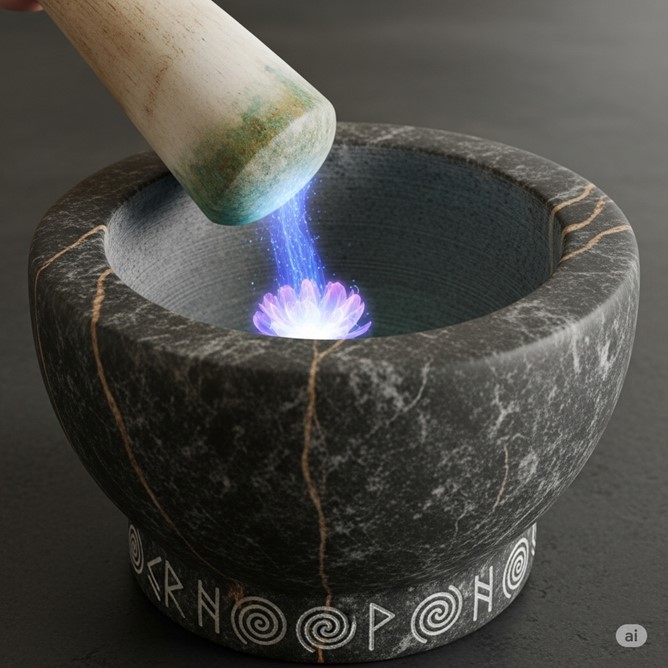
Description: This is a two-part item. The mortar is a heavy bowl, carved from a single piece of dark, veined river stone that is cool to the touch. The inside of the bowl is worn perfectly smooth from generations of use, and at its very bottom, faint, spiraling runes are carved into the stone. The pestle is made of a pale, heavy material that could be either petrified wood or polished bone, and its grinding end is permanently stained with the faint, greenish residue of countless herbs. When a substance is ground within the mortar, a faint, phosphorescent light, often the color of the plant’s flower, seeps from the material and is visibly absorbed into the pestle.
Detailed Stats
- Alchemy +1: Grants a minor bonus to checks related to identifying plants, fungi, and other natural substances.
- Fortitude +1 (vs. ingested poisons): The user’s body is accustomed to trace amounts of strange substances, granting them a minor resistance to mundane poisons they drink.
- Weight: Heavy. This is a solid stone tool not meant for casual transport.
Tags: Common, Tier 1, Seiðr, Alchemy, Herbalism, Tool, Carried, Ritual, Magical, Defensive, Medicinal, Concentration, Sonic, Bone, Crystal, Blade, Stackable
Passive Magics
- Essence Separation: When any organic material (plant, fungus, etc.) is ground within the mortar, its physical and spiritual properties are separated. The process magically yields two distinct piles within the bowl: a very fine, almost glowing powder, which is the material’s psychoactive and magical essence; and a coarse, dark grit, which contains the bulk of the material’s mundane and toxic physical compounds. This allows for the safe preparation of otherwise dangerous ingredients.
- Ingredient Insight: By grinding a small, unknown sample of a plant or fungus, the user receives a single, clear psychic impression—a one-word “flavor” of the plant’s core purpose. For example, grinding a mushroom might yield the impression of “SLEEP,” a root might give “COURAGE,” and a flower might give “POISON.” This allows for the basic identification of useful or dangerous flora in the wild.
Activable Magics
- Prepare for Trance (Active): The user can grind a known psychoactive ingredient and then ingest the resulting fine, spiritual powder. Consuming this refined essence allows the user to immediately enter a controlled Seiðr trance for ten minutes. Instead of being overwhelmed by uncontrolled hallucinations, the user can focus their intent. This allows them to attempt to ask a single question and receive a cryptic, symbolic vision in return, or to attempt to commune with the nature spirits of the immediate area. The specific plant used may make it easier to contact certain types of spirits.
- Distill an Imbuement (Active): Once per day, the user can grind a non-psychoactive ingredient that has a strong conceptual property (e.g., a hardy rock-flower for “toughness,” a thorny vine for “sharpness”). Instead of consuming the powder, they can mix it into a neutral liquid like water or oil. This action transfers the ingredient’s core property into the liquid, creating a simple, single-use alchemical imbuement. Drinking the “toughness” liquid might grant a temporary bonus to fortitude, while applying the “sharpness” oil to a blade might grant a minor bonus to damage for one strike. The effects are minor and fleeting.
The Seiðr 42 of the Mortar of Mystic Grinds, as a specialized tool for both alchemy and ritual magic, would be found in places that cater to practitioners, herbalists, and those who delve into the more esoteric arts. Its market is not on a common street corner but in the dedicated spaces where such work is understood and valued.
The Alchemist’s Guild Supplier
In the scholarly or artisan districts of a great city, one would find the clean, orderly, and professional shops that supply licensed alchemists and mages. The air inside smells of sterile glass, mineral reagents, and magical preservatives. Every item is labeled, cataloged, and sold with a guarantee of quality.
Here, the Mortar and Pestle would be sold as a high-quality piece of laboratory equipment. The proprietor, a skilled alchemist themselves, would emphasize its Essence Separation ability. They would market it as a “Purifying Grinder” or an “Aetheric Essence Extractor,” highlighting its unique function in separating fine magical essences from their coarse, toxic dross. Its use for preparing psychoactive trance-herbs would be spoken of discreetly, if at all, likely referring to them as “ritual incense components” or “reagents for mental clarity.” The transaction would be professional, recorded, and without judgment.
- Cost to Buy: Valued as a specialized, magically enchanted piece of lab equipment, it would sell for a respectable 7 Gold.
- Cost to Sell: The guild supplier would recognize the quality of the item’s magic and construction. They would offer a fair price for a specimen in good condition, likely 4 Gold and 5 Silver.
A Hedge-Witch’s Hut
On the outskirts of a town, deep within a forest, or tucked away in a quiet city alley, one might find the home of a “wise-woman” or hedge-witch. This place is not a formal shop but a cluttered, living workspace that smells of earth, woodsmoke, and hundreds of drying herbs. The practitioner here deals in folk magic, remedies, and spiritual communion.
The hedge-witch would understand and respect the mortar’s true purpose. They would call it a “Spirit Mortar” or a “Vision Grinder.” A sale here would be a personal affair. The proprietor would likely share a cup of herbal tea with the potential buyer, speaking with them to discern their intentions and level of knowledge. They would only sell it to someone they deemed “worthy” or “respectful” of the traditions it represents. Bartering for rare herbs, a service, or another magical item would be common.
- Cost to Buy: The price would be based on its spiritual function rather than its material value. It would be less expensive in coin than at the Alchemist’s Guild, perhaps 5 Gold, but the social cost of earning the proprietor’s trust is part of the transaction.
- Cost to Sell: The hedge-witch would be very interested in acquiring such a tool for their practice. While likely not wealthy, they would offer a fair price in whatever currency they had, be it coin (3 Gold) or a generous trade of rare alchemical ingredients and potions.
A Spice Merchant’s Tent in a Grand Bazaar
In the chaotic, cosmopolitan Grand Bazaars where goods from all 73 island countries are traded, there are merchants who operate in the legal gray areas. Their tents are filled with the overwhelming scent of exotic spices, strange animal parts, and powerful, restricted incenses.
This merchant would sell the mortar and pestle with a wink and a nod. It would be kept out of sight, under the counter, and only brought out for a serious customer asking for tools to “unlock the true potential” of certain rare, imported herbs. The sales pitch would be filled with innuendo and coded language. This is the place to acquire the tool with no questions asked, provided you have the coin and know who to ask.
- Cost to Buy: Due to the illicit nature of the goods it is associated with, the price would be inflated by scarcity and risk. The merchant would likely ask for 1 Platinum (10 Gold) and would not be inclined to haggle.
- Cost to Sell: The merchant knows the item’s value on the black market. They would attempt to buy it for as little as possible, offering a seller around 4 Gold while feigning that it is a “difficult and dangerous item to move.”
A Disgraced Professor’s Study
This is not a shop, but a private transaction born of academic pride and financial need. A university professor, perhaps one dismissed for their hands-on practice of “primitive ritual magic,” would sell such an item from their private, book-cluttered study to fund their continued research.
The transaction would be less a sale and more a lecture. The professor would be thrilled to find someone who appreciates the item’s historical and magical significance. They would spend an hour discussing the particular style of the runes at the bottom of the bowl, the theorized origin of the petrified wood pestle, and the magical principles of essence separation. They would sell it reluctantly, as if parting with a piece of their personal collection.
- Cost to Buy: The price is based on its perceived academic and historical value. The professor would likely ask for 8 Gold, possibly along with a promise that the buyer will share any new discoveries made with the item.
- Cost to Sell: An academic would be an excellent buyer. Appreciating the item’s finer points, they might scrape together funds from their personal accounts to offer 5 Gold for a well-preserved specimen for their research.
The Seiðr 42 of the Mortar of Mystic Grinds is a preparatory tool, not a weapon. Its use in offense and defense is a matter of strategic alchemy and ritual preparation, turning the natural environment into an arsenal of potions, poisons, and prophetic insights.
In a Hostile Jungle or Swamp
This environment is a living cauldron of potent ingredients. Defense is about surviving the natural dangers, while offense is about weaponizing them.
Roleplaying Defense: Defense in the jungle is about protection from its countless venoms and unseen threats. If a party member is struck by a poisoned dart from a native creature, you would use the mortar for battlefield alchemy. You would roleplay the process: “Get me one of the darts! And find the plant they smear on it.” You would then grind a piece of the plant in the mortar. The Essence Separation passive would isolate the pure neurotoxin (the grit) from the plant’s magical base (the powder). You would say, “I’ve separated the poison from its source. This powder is the plant’s essence without the venom. It could be the foundation for the antidote.” This turns a deadly poison into a potential cure.
To defend your camp at night, you would use Ingredient Insight on the local flora. You might find a mushroom that gives the impression “FEAR” and a flower that gives “STING.” You would then use Distill an Imbuement to create a non-toxic powder from each. You would describe your actions: “I’m not building a wall of stakes. I am drawing a line on the ground with the powder of ‘fear,’ and I am dusting the leaves of the bushes around our camp with the powder of ‘sting.’ Any creature that crosses the line will be struck with unreasoning terror, and any that brushes the leaves will feel a thousand phantom bites. It is a wall of pure misery.”
Roleplaying Offense: Offense is about turning the jungle’s potency against its toughest inhabitants. To hunt a massive, thick-hided beast, you would gather ingredients for a strategic assault. Using Ingredient Insight, you might find a vine that gives the impression “WEAKEN” and a fungus that gives “SLOW.” You would use the mortar to prepare and purify these essences, then use Distill an Imbuement to create a paste to coat your arrows. You would roleplay the strategy: “I am not trying to pierce its hide with one shot. This arrow carries the essence of ‘weaken’ to make its hide as soft as cloth. The next arrow carries the essence of ‘slow’ to make its charge as sluggish as a turtle. We will dismantle it piece by piece before we move in for the kill.”
During an Urban Intrigue or Noble’s Gala
In the city, the “weeds” are lies and the “poisons” are political. The mortar becomes a tool for social and investigative dominance.
Roleplaying Defense: Defense is about sidestepping social traps and hidden dangers. At a feast, you suspect the wine from a rival is poisoned. You would discreetly dip a small, decorative flower from your lapel into the wine, then later excuse yourself. In private, you would grind the wine-soaked flower in your mortar. The Ingredient Insight might give you the impression “PARALYSIS.” Your defense is the confirmation of the plot, allowing you to expose your rival or avoid the danger entirely.
You can also use Prepare for Trance defensively. Before a high-stakes negotiation, you might consume the essence of an herb known for “clarity.” During the meeting, you could enter a brief trance to ask a single question: “Is the merchant lying about his shipping manifests?” The cryptic vision you receive—perhaps of a ship sailing under a false flag—is your defense against being swindled.
Roleplaying Offense: Offense is about creating tools for social sabotage. You need to get information from a corrupt official who is known to smoke a particular expensive leaf. You would acquire some of this leaf, but also another herb that your Ingredient Insight tells you causes “CONFUSION.” In your mortar, you use Essence Separation on both, then use Distill an Imbuement to carefully mix the pure essence of the smoking leaf with a trace amount of the “confusion” essence. You would then present this “specially enhanced” blend as a gift. The next time you speak with the official while he is smoking, his thoughts will be muddled and his tongue loosened, allowing you to extract the information you need.
For a more direct offensive act of espionage, you could use Prepare for Trance after grinding a “scrying” herb. You could ask, “Show me the contents of the safe in the next room.” The resulting vision might be a symbolic image of “a marriage contract and a bag of foreign coins,” giving you the exact nature of the blackmail material hidden within.
In an Enemy’s Alchemical Laboratory
Here, you are surrounded by unknown, volatile, and weaponized ingredients. The mortar is your key to understanding and turning your enemy’s arsenal against them.
Roleplaying Defense: Defense is about identifying and neutralizing threats. The lab is filled with unlabeled potions. You would carefully take a single drop from a threatening-looking beaker, place it on a neutral leaf, and grind it in your mortar. The Ingredient Insight gives you the word “ACID,” warning you not to touch it. You have defended yourself from a deadly mistake through rapid analysis. If a trap releases a cloud of gas, you could grab a nearby filtering agent (like a crystal from a water purifier), grind it, and use Distill an Imbuement to create a paste to smear over a cloth, creating a makeshift, magically-enhanced filter.
Roleplaying Offense: Offense in this environment is about precise, intelligent sabotage. You see your rival preparing a large batch of what you know to be healing potions. Using your mortar, you discreetly test the surrounding ingredients until you find one that gives the impression of “SPOILAGE” or “NEUTRALIZATION.” You would use Distill an Imbuement to create a single, concentrated drop of this essence. You would roleplay the act of sabotage: “While his back is turned, I approach the large cauldron. A single, clear drop falls from my finger into the bubbling liquid. It is odorless and colorless.” You have just turned his entire batch of expensive healing potions into worthless colored water. The offense is silent, subtle, and devastating.
Perception of Activation:
Sight (Vision)
- User’s Perspective: As you begin to grind an herb or fungus, you see the magic awaken. A faint, phosphorescent light, colored to match the spiritual essence of the plant—a soft blue for a calming herb, a virulent purple for a poison—begins to seep from the crushed fibers. This light flows like a thick liquid, being visibly drawn up into the pale material of the pestle. In the mortar bowl, you see the physical substance magically separate into two distinct piles: a fine, shimmering powder of pure essence, and a coarse, dark, lifeless grit of the plant’s mundane body.
- Observer’s Perspective: An observer sees a beautiful and clearly magical process. As you grind, a soft, colored light appears within the bowl and seems to climb up the pestle, causing it to glow from within. They can also see the unnatural separation of the ground material into two different textures and colors, an act that defies simple physics.
- Positives: The visual feedback is clear, informative, and often beautiful. It confirms that the essence separation is working perfectly and can even give a clue to the ingredient’s nature based on the color of the light.
- Negatives: The effect is an overt display of alchemy and magic. It is not a subtle process and will instantly draw the attention of anyone nearby, for good or ill.
Hearing (Audition)
- User’s Perspective: The mundane, gritty sound of stone grinding on stone is overlaid with a faint, resonant music. Each rotation of the pestle seems to produce a single, clear, chiming note. The pitch and timbre of these notes change depending on the substance being ground, creating a unique “song” for each ingredient. A healing plant might create a series of harmonious, uplifting notes, while a dangerous one might produce a discordant, jarring melody.
- Observer’s Perspective: An observer would hear the normal, grating sound of grinding. Only in a place of perfect silence, and only by standing very close, might they catch the faint, ethereal chimes. To most, the process appears silent beyond the physical noise.
- Positives: The sound is mostly private to you, providing another layer of rich, sensory information about the material you are working with. The unique “song” can help you identify substances you have worked with before.
- Negatives: The constant chiming, however pleasant, can be distracting if you are trying to listen for footsteps or other ambient sounds while you work.
Touch (Somatosensation)
- User’s Perspective: The heavy stone mortar in your hand remains cool and inert. The pestle, however, comes alive. As it absorbs the phosphorescent light, a steady, low-frequency vibration begins, humming directly into your palm. The pestle grows pleasantly warm, suffused with the energy it is drawing from the plant. You can feel the vitality of the ingredient flowing through the tool and into your hand.
- Observer’s Perspective: An observer would perceive nothing unless they were to touch the pestle while you were grinding. If they did, they would be surprised by the unnatural warmth and the steady, magical vibration humming within the seemingly mundane tool.
- Positives: The tactile feedback is a powerful and unambiguous confirmation that the essence is being successfully extracted. The warmth and vibration are pleasant and make the tool feel responsive and alive.
- Negatives: There are few negatives to the sensation itself, but the vibration and warmth are a giveaway if an observer touches your tools while you are trying to be discreet.
Smell (Olfaction)
- User’s Perspective: As you grind the ingredient, you perceive two distinct scents simultaneously. You smell the normal, physical aroma of the plant—earthy, floral, or musty. Layered over this is a second, more conceptual scent which is the aroma of the plant’s spirit. A calming herb might smell of lavender and clean linen, but its essence might smell like a quiet library or still water. A poison might smell of rot, but its essence might have the sharp, sterile scent of ozone and fear.
- Observer’s Perspective: An observer would only smell the normal, physical scent of the herb being ground. The secondary, conceptual scent is imperceptible to them.
- Positives: This dual-scent provides you with deep insight into the true nature of your ingredients, confirming the information you gain from the item’s other magical properties.
- Negatives: An ingredient with a spiritually foul or corrupting nature would produce a psychically nauseating smell, making the process of working with dangerous materials deeply unpleasant for you.
Taste (Gustation)
- User’s Perspective: While you do not taste the material during grinding, the activation of the Ingredient Insight passive creates a sympathetic taste on your tongue. This taste reflects the single-word clue you receive. Grinding an herb whose essence is “SLEEP” might produce a chalky, vaguely sweet taste. Grinding a poisonous root whose essence is “PAIN” might cause a sharp, acrid, metallic taste to flood your mouth.
- Observer’s Perspective: There is nothing for an observer to perceive.
- Positives: The taste is another layer of immediate, undeniable feedback, confirming the core nature of the ingredient you are analyzing.
- Negatives: The sympathetic taste of a harmful substance is foul and serves as a significant deterrent, making the analysis of unknown poisons a distinctly unpleasant experience.
Extra-Sensory: Empathic/Spiritual Perception
- User’s Perspective: This is the heart of the mortar’s magic. As you grind, you feel a direct, intimate connection to the spiritual essence of the plant. It is not an emotion, but a pure state of being. You feel the deep-rooted “stubbornness” of a mountain flower, the “deceitful” nature of a parasitic vine, the “serene” patience of an ancient mushroom. You experience a moment of profound, non-verbal communion that gives you a complete understanding of the ingredient.
- Observer’s Perspective: An observer might see your expression become distant and thoughtful. Your hands continue the grinding motion automatically, but your eyes are unfocused, as if you are listening to a story that no one else can hear.
- Positives: This provides the most profound and complete understanding of the alchemical ingredients you work with, far beyond what any book could teach.
- Negatives: To separate the plant’s spirit from its body, you must experience its “death” on a spiritual level. This can be a sorrowful and draining experience, especially when working with ancient or vibrant plants.
Extra-Sensory: Magical Perception
- User’s Perspective: With a magical eye, you can see the process with perfect clarity. You see the colorful aura of the plant—its life energy—being shredded by the grinding process. You see this aura separate into two streams: a dull, grey energy that infuses the leftover grit, and a bright, pure, and vibrant colored light that flows up the pestle. You can visually gauge the potency of the essence by the brightness of its glow.
- Observer’s Perspective: A magically-aware observer would witness a masterful and efficient act of magical alchemy. They would see the user cleanly separating the potent magical essence (the Anima) from the inert physical matter (the Dross). They would recognize the mortar and pestle as a high-quality, specialized magical tool.
- Positives: You have perfect visual feedback on the quality and potency of your work. Any other magic-user would recognize your skill and the quality of your equipment.
- Negatives: The process clearly shows you are creating a concentrated, potent magical substance. This could attract unwanted attention from thieves who want the refined powder, or from authorities if the substance being prepared is considered a controlled or forbidden reagent.
Recipe: The Spirit-Sifting Mortar
This crafting process describes the creation of a specialized ritual tool used by alchemists and shamans to safely prepare magical ingredients. The procedure requires skill in both stonework and enchantment, and it is as much a magical rite as it is a feat of craftsmanship.
Materials Needed:
- One River-Heart Stone: A dense, heavy boulder of dark, veined stone taken from the bed of a river that forms a natural border between two vastly different environments (e.g., a forest and a desert, or a mountain and a swamp). This symbolizes the stone’s inherent nature of separation.
- The Fossilized Femur of an Apex Predator: A large, dense fossilized bone, preferably from a creature that was at the top of its food chain. This will be carved into the pestle, embodying the concept of “getting to the heart of the matter.”
- Powdered River Pearl and Silver Dust: A small amount of each, to be mixed into a magical paint for the enchanting runes. The pearl represents purity and the silver represents a conduit for magic.
- Sap of a Truth-Vine: A rare, clear sap from a climbing vine that is known to only grow on ancient, truth-telling trees. This will serve as the binding agent for the runic paint.
Tools Required:
- A Set of Stone Mason’s Hammers, Chisels, and Rasps: For the heavy work of shaping the river boulder into a mortar.
- Grinding Stones and Polishing Compounds: To wear the interior of the mortar bowl into a perfectly smooth, non-porous surface.
- A Bone-Tipped Scribing Stylus: For the delicate task of carving the runes into the finished stone bowl.
- An Alchemist’s Mixing Vessel (ceramic or glass): For preparing the magical paint.
Skill Requirements:
- Journeyman Level Skill in Stonemasonry: The ability to carve, shape, and hollow out a solid boulder of hard stone is essential and labor-intensive.
- Basic Skill in Runic Scribing or Enchanting: The crafter must have the knowledge to inscribe runes of power correctly to imbue the item with its magical function.
- A deep understanding of Alchemy or Herbalism: The crafter must understand the principles of separation and essence to properly align the mortar’s magic during its creation.
Crafting Steps:
- The Shaping of the Bowl: This is the most labor-intensive step. The crafter begins with the raw River-Heart Stone and, over the course of many days, uses hammers and chisels to slowly carve out a heavy, thick-walled bowl. Once the rough shape is achieved, they spend an equal amount of time with grinding stones and polishing compounds, smoothing the interior surface until it is as seamless and reflective as dark glass.
- Carving the Runes: The crafter must enter a meditative state. Using the bone-tipped stylus, they carefully inscribe a series of spiraling runes into the bottom of the mortar bowl’s interior. These runes correspond to the concepts of “Separation,” “Essence,” “Truth,” and “Purity.” This process must be done with immense precision, as a single slip can ruin the enchantment.
- The Alchemical Illumination: In the ceramic mixing vessel, the crafter blends the powdered river pearl and the silver dust. Then, drop by drop, the sap of the Truth-Vine is added, creating a thick, shimmering paint the color of liquid moonlight.
- Sealing the Magic: The crafter takes the shimmering paint and, using a fine brush, carefully fills the carved runes at the bottom of the mortar. As the paint is applied, the runes will glow with a soft, white light. The mortar must then be set aside in a quiet, dark place for three days. As the paint dries and hardens, the glow will fade, leaving the magic permanently sealed within the stone.
- The Awakening: The pestle must be carved from the fossilized femur. Once both parts are complete, the crafter must perform a final ritual to awaken the item’s power. They must find an ingredient that is a perfect balance of two things—such as a flower that is both a medicine and a poison. This ingredient is placed in the mortar. On a night of either the new or full moon, the crafter must use the new pestle to grind the ingredient. The act of performing its primary function for the first time on such a symbolically balanced material awakens the mortar’s magic of separation, and it is now ready for use.
Shaman who Ate the Flower’s Ghost
This telling is from a very old time. The words are not the same now, and some meanings are like sand in the hand.
In the Great Jungle, the air was like soup with magic. The trees were tall and the flowers were bright. The people there were the Jungle-Folk. They knew the green things. The green things had spirits, you see. Plant-spirits. And the spirits were strong.
A man could eat a red mushroom and he would feel strong like a great beast for a day. A woman could chew a silver leaf and she could hear the thoughts of the birds. This was good. But it was also a trouble. A man could eat a different red mushroom and he would run into the jungle, screaming at the sky, and his mind would be gone forever. The plant-spirits were strong, and sometimes they did not like people. They were dangerous to know.
The leader of the Jungle-Folk was the First Shaman. He was the one who listened best to the green things. He wanted the knowledge from the plant-spirits, but he did not want his people to go mad. He said, “A plant is two things. It has a body and it has a ghost. The body is the leaf and the stem. The ghost is the knowing-part, the spirit. The body is often poison. The ghost is often wisdom. We must find a way to eat the ghost but not the body.”
The First Shaman knew of a special flower. It grew only in the deepest part of the jungle, in places where the moonlight touched the ground. It was called the Moon-Petal Flower. The People said its ghost was the strongest of all. They said if you could know its ghost, you could see the bones of the world. But they also said to eat the flower was to let the flower’s ghost eat your mind. No one had ever eaten it and stayed a man.
The Shaman knew he must try. He said, “I need a tool. I need a sifter for spirits.”
He went to the great river that separated the swamp from the mountain. He took a heavy stone from the middle of the water. The stone knew how to be between two places. He took the stone and for one moon he worked it. He made a heavy bowl. He made the inside smooth like still water. This was the first part.
He went and found the bones of a great cat that had been the king of the jungle. A cat that could see in the dark. He took its long leg bone. He made it into a stick for grinding. The bone remembered how to find the heart of a thing. This was the second part.
He drew a spinning path, a rune, on the bottom of the bowl with paint made from a river pearl. The path was to show the ghost where to go. The tool was now made. But it was asleep.
The First Shaman took his new tool and he went to find the Moon-Petal Flower. He found it, and its light was very blue. He was afraid. If the sifting-bowl did not work, he would be lost. He took the flower back to his hut. He put the flower in the stone bowl. He held the bone-stick in his hand. He began to grind.
A thing happened that was magic. As he ground the flower, a light came from it. It was a soft blue light, like the flower. The light did not go into the air. The light flowed up the bone-stick, and the bone-stick drank the light. In the stone bowl, the flower was gone. But there were two piles of dust where there was one flower before. One pile was dark and heavy like dirt. It smelled bad. This was the flower’s body, the poison. The other pile was a fine dust of soft blue color. It shimmered. It smelled of moonlight. This was the flower’s ghost.
The First Shaman took the dark dirt and threw it in the fire. He looked at the blue dust for a long time. Then, he ate it.
He did not go mad. He did not scream. He sat down and closed his eyes. And he saw. He saw the bones of the world. He saw the paths of the spirits as shining threads in the air. He saw where the rain was sleeping in the clouds and where the hidden springs were sleeping under the earth. He learned much. He used this knowing to help the Jungle-Folk. He made more of the sifting-bowls for his people, so they too could eat the ghost of the green things, and not the poison.
The Moral of the Story: To find the truth in a dangerous thing, you must first separate its body from its ghost.
Suggested conversions to other systems:
Call of Cthulhu, 7th Edition
The Alchemist’s Sieve
High-Level Overview: In the Cthulhu Mythos, “purity” is a dangerous concept. This mortar and pestle does not simply remove toxins; it separates the mundane, physical nature of a substance from its spiritual or Mythos-tainted essence. It allows an Investigator to refine a strange fungus from a Mi-Go outpost or a flower from the Dreamlands, but the resulting “pure” essence is a concentrated dose of alien influence. It is a tool for gaining profound, but sanity-shattering, insight at a terrible cost.
Description and Mechanics: The Alchemist’s Sieve is a heavy mortar and pestle carved from a dark, oily stone that seems to show too many dimensions when viewed from the corner of the eye.
- Distill the Taint: When an organic substance connected to the Mythos (alien flora, a piece of a monster, etc.) is ground in the mortar, the user may attempt to separate its essence. This requires a Hard POW roll.
- Success: The substance is separated into two piles: a mundane, harmless dross and a small amount of crystalline powder—the concentrated essence of the substance.
- Failure: The separation is incomplete. Both piles are now a dangerously toxic and psychically corrosive material.
- Consume the Essence: An Investigator may choose to consume the crystalline essence. Doing so is an act of utter madness and immediately costs 1d4 Sanity points. For the next hour, the Investigator’s mind is opened to the alien logic of the substance. During this time, they gain a +20% bonus to Cthulhu Mythos rolls and may ask the Keeper one direct question related to the substance’s origin or purpose. The answer will be a horrifying truth that may force another Sanity roll. At the end of the hour, the user must make a final Sanity roll (1d3/1d6) as their human mind violently recoils from the alien consciousness it hosted.
Blades in the Dark
The Spirit-Grinder
High-Level Overview: In the cutthroat city of Duskvol, this mortar and pestle is a master craftsman’s tool, perfect for a crew of Assassins or Hawkers. It is not for personal visions, but for production. It allows for the expert refinement of poisons, removing tell-tale signs, or the creation of potent new drugs for the street, getting rid of nasty side-effects. Its “magical” quality is its preternatural ability to separate and purify essences, making it a valuable piece of crew equipment.
Description and Mechanics: A heavy stone mortar and pestle, stained with the residue of countless strange ingredients. It allows for the precise refinement of potent alchemicals. This is a piece of special equipment for the crew’s lair.
- Refinement Station: When you use the Spirit-Grinder to craft poisons or drugs with the Tinker action, you may add +1d to your roll.
- Special Quality (Purify): When crafting a poison or drug, you may choose to use the grinder’s unique properties to purify the substance. Describe how you carefully separate the essences. You can then remove one major negative side-effect or add a subtle quality to your creation (e.g., create a poison that is nearly tasteless, a euphoric drug that doesn’t cause memory loss, or a hallucinogen whose visions can be guided). When you do this, you tick a 4-segment clock labeled “Attract Unwanted Spiritual Attention.”
- Glimpse the Formula: When you acquire a new or unknown substance, you can use the grinder to analyze it. This is a Tinker action. On a success, the GM will tell you its primary quality and its most dangerous flaw.
Dungeons & Dragons, 5th Edition
Seer’s Herbalism Kit
High-Level Overview: This item reimagines the mortar and pestle as a magically enhanced version of a standard tool kit. It is particularly useful for characters who rely on their knowledge of nature and who cast spells using natural components, such as Druids and Rangers. It enhances their existing skills and allows them to use their magic more efficiently by preparing common herbs as potent substitutes for expensive or rare ritual components.
Wondrous item, common
Description and Mechanics: This herbalism kit consists of a heavy mortar carved from dark river stone and a pestle made of polished bone. Faint, spiraling runes are visible at the bottom of the mortar’s bowl.
- Expert Herbalist: If you are proficient with an herbalism kit, you can add double your proficiency bonus to any Wisdom (Medicine) or Intelligence (Nature) check made to identify or handle plants and fungi.
- Spellcasting Focus (Druid or Ranger only): You can use this mortar and pestle as a spellcasting focus for your druid or ranger spells.
- Ritual of Refinement: When you cast a spell with the divination tag as a ritual, you can use this kit to prepare the material components. If the spell has a material component with a specific cost, you can use this kit to grind common herbs and roots for the duration of the ritual casting. At the end of the casting, you do not expend the costly material component. Once you use this property, it can’t be used again until the next dawn.
Knave, 2nd Edition
The Root-Grinder
High-Level Overview: In Knave’s tangible, tool-focused system, this item acts as a miniature, mobile alchemy station. It empowers player creativity by allowing them to turn the environment into a source of single-use potions. A clever player can survey their surroundings for useful-looking plants, identify them with the grinder, and then create a temporary, disposable tool to solve an immediate problem, perfectly fitting the game’s emphasis on improvisation.
Description and Mechanics: Slots: 2 (the mortar is heavy) Description: A heavy mortar made of dark, veined stone and a pestle made of petrified wood. It is used to process plants into useful tinctures.
- Abilities:
- Identify Plant (Action): You can grind a piece of any non-magical plant. The GM will give you a one-word description of its most prominent property (e.g., “Healing,” “Poison,” “Toughness,” “Fire,” “Grip,” “Sleep”).
- Create Tincture (Action): Once you have identified a plant, you can spend one turn (about 10 minutes) grinding a larger amount of it. At the end of the process, you have created a one-dose Tincture of that property. A Tincture is a single-use item that takes up no inventory slots (as it is consumed immediately or spoils quickly). Any character can drink the Tincture or apply it to their skin to gain its effect for one turn.
- Examples: A “Toughness” Tincture might grant +2 Armor. A “Healing” Tincture might restore 1d4 HP. A “Grip” Tincture might grant advantage on checks to climb.
- You can only have one Tincture created at a time. Creating a new one causes the old one to become inert.
Fate Core System
The Alchemist’s Mill
High-Level Overview: In Fate, where aspects and temporary advantages drive the action, this item becomes a tool for creating on-the-fly tactical options. The Alchemist’s Mill allows a character with a bit of foresight and the right ingredients to create Boosts—fleeting, potent advantages—for themselves or their allies. This encourages players to interact with the environment, gathering plants and herbs to convert into tangible, narrative benefits.
Description and Mechanics: The Alchemist’s Mill is an Extra that represents a character’s unique alchemical capability.
- Aspects:
- The Plant Has a Spirit, and I Can Set It Free
- A Solution for Every Occasion, Provided You Have the Garnish
- Stunts:
- Distill a Boost: When you have access to a relevant plant or herb and take a few minutes to grind it in the mortar, you can create a single-use alchemical dose. You can give this dose to any character (including yourself). When a character uses the dose (a free action), they gain a Boost relevant to the herb’s nature. For example, grinding a tough, thorny root might grant a boost for a defensive Overcome roll, while a “cat’s eye” flower could grant a boost for a Perception-based action.
- Purifying Grind: When you encounter a mundane (non-magical) poison or toxin, you can spend a Fate Point and use the mortar to instantly analyze its composition and produce a single dose of a corresponding antitoxin.
Numenera & Cypher System
Symbiotic Grinder Organism
High-Level Overview: This adaptation re-imagines the item as a piece of bizarre biotech, fitting the weird science-fantasy theme of Numenera. It is not an inert tool but a pair of living, symbiotic organisms that have evolved to process organic matter with incredible efficiency. Its function is not “magic,” but a complex biological process that separates useful compounds from dangerous toxins, a process that a Ninth Worlder can exploit.
Description and Mechanics: Biotech Artifact Level: 4 Form: A symbiotic pair of organisms that resemble a mortar and pestle. The “mortar” is a heavy, silicon-based shell with a porous, digestive membrane inside. The “pestle” is a separate, bony organism that fits comfortably in the hand and excretes powerful enzymes from its tip.
- Effect:
- Nutrient Analysis (Passive): When a piece of organic material is placed in the mortar organism, the user receives a faint psionic impression of its basic properties (e.g., “nutritious,” “toxic,” “psychoactive,” “inert”).
- Essence Extraction (Active): The user can use the pestle organism to grind a piece of organic matter within the mortar organism (an action). The mortar’s membrane rapidly digests and separates the matter into two substances: a purified, nutrient-rich paste (which can be eaten as a meal, fulfilling one level of need for food and water) and a single, concentrated droplet of a potent chemical compound representing the material’s most powerful property.
- Example: Grinding a poisonous plant would yield food paste and a single dose of Level 4 poison. Grinding a psychoactive fungus would yield food paste and a single dose of a powerful hallucinogen (a Level 4 Intellect-based psychic effect).
- Depletion: 1 in 1d100 (As a living organism, it is robust. On a 1, the organism dies and crumbles into inert organic matter).
Pathfinder, 2nd Edition
Shaman’s Separator
High-Level Overview: This version of the item positions it as a specialized alchemical tool that allows a crafter to create a unique elixir not normally available through the standard rules. It focuses on the item’s ability to refine ingredients for a specific, magical purpose—in this case, crafting a consumable that grants a divinatory trance, directly tying the item to its Seiðr-inspired roots. This makes it a valuable tool for any character with the Alchemical Crafting feat who wants to dabble in divination.
Shaman’s Separator — Item 3 Traits: Alchemical, Tool, Magical Price: 55 gp Usage: Held in two hands; Bulk: 1
Description: A heavy stone mortar and a petrified wood pestle. Faint, spiraling runes are carved into the bottom of the bowl and glow with a soft light when magical herbs are ground within.
- Abilities:
- When you use this tool to Craft an alchemical item with the “Elixir” trait, you gain a +1 item bonus to your Crafting check.
- Specialized Formula: You can use the Shaman’s Separator to craft the following special elixir. Doing so requires that you have the Alchemical Crafting feat. The formula is considered part of the item.
- Seer’s Elixir — Item 3
- Price: 10 gp
- Usage: Held in 1 hand; Bulk: L
- Activate: [one-action] (Interact)
- Effect: You drink the elixir, which tastes of herbs and ozone. You immediately gain the effects of an augury spell concerning a specific course of action you plan to take within the next 30 minutes. After the effect, you are Stupefied 1 for 10 minutes as your mind recovers from the psychic influx.
Savage Worlds Adventure Edition
The Alchemist’s Friend
High-Level Overview: In Savage Worlds, this item acts as a gateway to a specific magical playstyle. It grants the user the ability to use the Weird Science Arcane Background, but only for creating potions, poultices, and other chemical effects. This allows a character who might not otherwise be a magic-user to take on the role of a “kitchen alchemist” or “hedge-wizard,” using their smarts to create temporary magical solutions from the world around them.
Description and Mechanics: A heavy, reliable-looking mortar and pestle made of dark stone and petrified wood. It seems to hum with potential when useful herbs are placed within it.
- Rules:
- Herbalist: The user is a natural at finding useful ingredients. They gain a +2 bonus to Survival or Notice rolls made specifically to find plants, fungi, or other natural alchemical ingredients.
- Jury-Rigged Alchemy: A character in possession of this item can use the Weird Science Arcane Background, but with the following limitations:
- They can only invent devices that are consumable potions, poultices, oils, or grenades. They cannot create permanent devices, armor, or weapons.
- Their “trappings” must always be alchemical and herbal. For example, the bolt Power would be a flask of acid, protection would be a salve that hardens the skin, and healing would be a poultice of crushed herbs.
- The mortar and pestle itself counts as their “tinkering kit” for removing a Shaken condition on a Critical Failure on their Alchemy roll. If they lose the item, they cannot use their Weird Science abilities until it is recovered.
Shadowrun, 6th World
The Berserker’s Mill
High-Level Overview: This adaptation re-imagines the mortar and pestle as a tool for physical combatants, such as street samurai and physical adepts who follow primal traditions. Instead of being used for divination or complex alchemy, it is a rugged kit for preparing single-use “battle-drugs” from natural or magically active ingredients. It allows a character to gain a temporary, powerful physical boost at the cost of system shock, making it a favorite of those who rely on brute force and combat prowess.
Description and Mechanics: Availability: 9R Cost: 6,000 Nuyen
The Berserker’s Mill is a heavy, rugged-looking mortar and pestle made of dark, dense stone, simple and unadorned. It is designed for grinding tough animal components and fibrous combat-herbs.
- Game Effect: A character with proficiency in Alchemy or Herbalism can use this kit to process specific combat-oriented reagents (e.g., a panther’s adrenal gland, a specific strain of “guts-root”). The process takes about 10 minutes and creates a single-dose alchemical paste.
- Combat Tincture: When the paste is consumed (a Simple Action), the user gains a temporary physical boost that lasts for 1 minute. At the time of creation, the alchemist chooses one of the following effects for the tincture:
- Fury: The user gains a +1 dice pool bonus on all Melee Combat skill tests.
- Resilience: The user gains +1 to their Armor rating.
- Speed: The user gains a +1 bonus to their Initiative Score.
- After the effect ends, the user’s body is wracked with painful feedback, and they suffer 1 point of Stun damage (unresisted).
Starfinder
Field Catalyst Mortar
High-Level Overview: In the high-tech universe of Starfinder, this item is a specialized piece of equipment for a Biohacker. It is a portable, high-compression “lab-in-a-bowl” that allows the character to formulate their biohacks in the field without needing access to a full laboratory. Its catalytic properties also make the resulting injections more potent and harder to resist, making it a valuable tool for any Biohacker on a mission.
Description and Mechanics: Level: 3; Price: 1,450 credits; Bulk: 1
This is a specialized medical and alchemical kit that includes a high-compression ceramic mortar and an enzymatic pestle that accelerates chemical reactions. It is designed for the rapid field formulation of biohacks.
- Game Effect: A biohacker with this kit can prepare their biohacks in the field. Grinding a required organic reagent in the mortar for 1 minute allows them to formulate one biohack they know that normally requires a laboratory.
- Potent Catalyst: The mortar’s unique enzymatic properties make the resulting biohack more effective. The DC for the saving throw against any biohack prepared using this kit is increased by 1.
- The kit can be used to formulate up to three biohacks before its catalytic enzymes are depleted. It can be restocked with a standard medicinal chemical supply kit.
Traveller (Mongoose 2nd Edition)
Toxin Synthesis Kit (TSK-1)
High-Level Overview: In the grounded sci-fi world of Traveller, this item is re-imagined as a piece of clandestine equipment for creating poisons. It is a discreet, highly effective tool for spies, assassins, and intelligence operatives. It allows a user with the right skills to turn common organic materials found on any world into potent toxins, providing a versatile and deniable weapon for covert operations.
Description and Mechanics: Device Name: Toxin Synthesis Kit (TSK-1) Tech Level: 10 Mass: 1.5 kg; Value: Cr 30,000+ (Illegal in most systems)
A discreet kit disguised as a geological survey tool. When opened, it contains a specialized, sealed mortar and a pestle with a micro-pulverizing head, capable of breaking down and concentrating organic compounds into potent toxins.
- Function: A character can use this kit to process organic materials (poisonous plants, animal venom glands, etc.) to create weaponizable toxins. This requires an Average (8+) Science (Chemistry) or Medic check and takes approximately one hour of work.
- Benefit: On a success, the character creates one dose of a poison. The Toxin Strength of the created poison is equal to the Effect of the skill check + 2 (up to a maximum of Toxin Strength 10). The GM will determine the specific effects of the poison based on the source material (e.g., paralytic, damaging, hallucinogenic). This kit allows for the reliable creation of poisons in the field without needing a full laboratory setup.
Warhammer Fantasy Roleplay, 4th Edition
Mortar of the Weeping Glade
High-Level Overview: This adaptation frames the mortar and pestle as a rare and sacred artifact of the Wood Elves (Asrai) of Athel Loren. Carved from the petrified wood of their magical forest, it is a tool that allows a user to commune directly with the spirits of plants as they are prepared. It is a tool for an apothecary, herbalist, or shaman, granting them an almost supernatural ability to enhance the effects of their preparations by directly asking the plant’s spirit what is needed.
Description and Mechanics: Enc: 1 Price: Unsalable; a sacred item that would be hunted down if stolen. Availability: Rare Elven Artefact
A mortar and pestle carved from a single piece of pale, petrified wood from the forest of Athel Loren. The bowl is shaped like a cupped leaf, and faint Elven script praising the forest is visible on its surface.
- Properties: Magical
- Effect:
- Athel Loren Alchemy: When you use this tool to craft any poultice, potion, or remedy from herbal ingredients, you may add one additional, minor beneficial property to the brew. For example, a Healing Draught might also remove 1 Fatigued Condition; a potion of strength might also grant the user a +5 bonus to their next Cool Test. The GM has the final say on the nature of the added property.
- Voice of the Wood: Once per day, the user can grind a fresh leaf or a piece of bark from a tree within the mortar. As they do so, they enter a light trance and can ask one question about the immediate area. The question is answered by the collective spirit of the local forest. The answer is always truthful but often cryptic, from the perspective of an ancient, non-human consciousness (e.g., Q: “Where are the Beastmen?” A: “They hide where the roots drink deep and the stone sleeps,” meaning in the caves near the river).
Comments
One response to “Seiðr 42 of the Mortar of Mystic Grinds”
[…] From: Seiðr 42 of the Mortar of Mystic Grinds […]