
NAME: Oloyon’s Tasting Spoon
LORE: In the sprawling Taiga of the northern islands, the clans of the Sakha734 learned that not all battles are fought with steel or overt magic. They understood that the body is a vessel and that the spirits of the world, both benevolent and malevolent, could influence them through what they consumed. An oloyon, a spirit-walker of great renown named Kyna, did not carry a fearsome drum or a menacing mask. Instead, her focus was a simple spoon carved from the heartwood of a birch tree that had been struck by lightning but did not burn. Kyna believed that every food, every plant, and every drop of water had its own spirit and its own song. She taught that by listening to these songs, one could find true strength and ward off the lingering dread of the lower spirit worlds. She used her spoon not to eat, but to listen. By tapping it against a bowl or dipping it into a broth, she could hear the food’s story and understand its hidden potential. She healed her clan from a creeping plague not by banishing a great evil, but by prescribing diets of specific roots and broths that fortified the peoples’ own spirits, making them inhospitable to the invading entity. The original spoon is a legendary artifact, but the traditions Kyna started were so vital that her apprentices and their apprentices after them learned to imbue a sliver of that same shamanistic power into simple, common tasting spoons. These are now found across the world, often used by camp cooks, healers, and those who believe a good meal is the strongest magic of all.
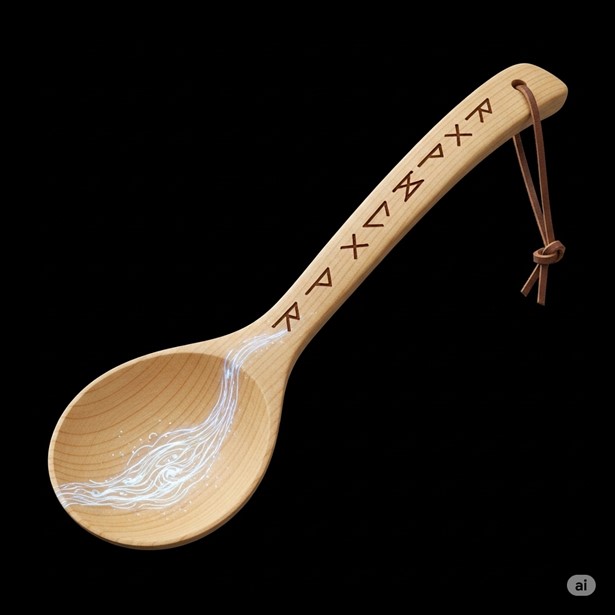
DESCRIPTION: The Oloyon’s Tasting Spoon is a humble item, easily overlooked. It is a large wooden spoon, about nine inches long, carved from a pale, smooth birchwood. The grain of the wood is exceptionally straight, running from the tip of the bowl to the end of the handle. The handle is unadorned except for a small hole drilled through the end, through which a simple leather cord is threaded, allowing it to be hung from a belt or pack. While it appears mundane, holding it reveals a faint, almost imperceptible warmth that has nothing to do with the ambient temperature. When brought near edible substances, the spoon’s surface displays a very faint, shifting series of scratch-like runes that flow like water, visible only to the one attuned to it. These runes are a physical manifestation of the food’s spiritual song. The spoon feels perfectly balanced and makes a clear, resonant tone when tapped against ceramic or wood.
DETAILED STATS: Sensory Acuity (Taste/Smell): +2 Poison Resistance: +1 Stamina Regeneration (after consuming a meal): +1 per minute for 10 minutes.
PASSIVE MAGIC: Harmonious Hum: The spoon constantly attunes itself to its owner’s spiritual and physical state. When brought within a foot of prepared food or a raw ingredient, the spoon emanates a low, barely audible hum. The nature of this hum provides insight to the avatar. A clear, steady, and pleasant tone indicates the food is beneficial and will work in harmony with the avatar’s body. A discordant, wavering, or grating hum warns that the food is spoiled, mildly poisonous, or spiritually incompatible with the avatar, likely to cause minor indigestion or malaise.
Spiritual Cleansing: The wood of the spoon acts as a minor spiritual filter. When used to stir a liquid or dish for at least one minute, it will neutralize and dissipate trace amounts of negative spiritual energy or incidental magical contamination that might have settled upon the food. This process purifies the meal on a subtle level, ensuring it provides nourishment untainted by the lingering emotions or energies of its environment, making it taste cleaner and more wholesome.
ACTIVABLE MAGIC: Dietary Chant: Once per day, the avatar can perform a small ritual before a meal. They must hold the Oloyon’s Tasting Spoon and gently tap it against their plate or bowl three times, while humming a low, personal tune that represents their desire for health and sustenance. This action attunes the food specifically to the avatar’s needs. The meal consumed within the next ten minutes will be supernaturally fulfilling. The avatar will gain the benefits of a full, nourishing meal even if they only consume a small portion, and they will feel invigorated and satiated for up to eight hours, regardless of the food’s normal caloric content.
Kitchen Inquiry: Once per day, the avatar can seek guidance on the preparation of a single raw food ingredient. By placing the ingredient in a bowl of fresh water and using the Oloyon’s Tasting Spoon to stir the water in a slow circle, the avatar can enter a brief, meditative trance. For a moment, they journey into the “spirit” of the food. They do not leave their body, but their Mind’s Eye is opened to the ingredient’s nature. They receive a clear, simple vision or intuitive feeling about the best way to prepare that ingredient to unlock its greatest nutritional and spiritual potential. This could be a vision of the ingredient being paired with a specific herb, a feeling of the optimal cooking temperature, or an innate understanding of which parts are most beneficial to consume. The guidance is always focused on healthy and positive outcomes.
SLOT: Waist (Accessory)
TAGS: Common, Magical, Wood, Tool, Sakha734, Divine, Roleplay, Sustenance, Healing, Shamanistic, Dietary, Analysis, Purification, Attunement, Vision, Chant-Magic, Utensil, Oloyon-Craft, Anti-Toxin
In the varied marketplaces of Saṃsāra, the Oloyon’s Tasting Spoon is an item of quiet utility, found not in armories or high-end magical emporia, but in places catering to health, sustenance, and the subtle magics of daily life. Its common rarity means it is reasonably accessible to a Tier 1 avatar, though its price and the manner of its sale vary depending on the establishment.
THE VILLAGE APOTHECARY
Where: These shops are often found on the main thoroughfare of smaller towns or tucked into the quieter residential districts of larger cities. The air inside is a complex tapestry of scents: dried herbs, pungent spices, mineral salts, and the clean smell of alcohol used for tinctures. Bunches of herbs and strange roots hang from the rafters, and the walls are lined with countless small drawers and glass jars, each meticulously labeled with its contents. The proprietor is usually a studious individual, someone who values knowledge and precision.
How: An avatar seeking to purchase the spoon here would find the transaction to be professional and informative. The apothecary would likely recognize the item’s purpose immediately, referring to it as a “Diagnostic Spoon” or a “Cook’s Charm.” They might offer advice on its use, suggesting it for identifying mild toxins in foraged ingredients or for ensuring a meal is spiritually pure for a convalescing patient. The sale is direct, with little room for haggling, as the apothecary prices their wares based on a clear understanding of their function and reliability.
Cost: 8 Silver. The price reflects the apothecary’s assurance of the item’s quality and their own expertise. They see it as a legitimate tool of the healing and culinary arts and price it accordingly.
THE TRAVELING MERCHANT’S CARAVAN
Where: These merchants are found along the major trade routes, at seasonal fairs, or in the sprawling, ever-shifting markets that spring up outside the gates of metropolises. Their stall or wagon is a chaotic treasure trove of goods from across the 73 Island countries. The Oloyon’s Tasting Spoon might be found tangled in a net of fishing lures from a coastal nation, resting in a crate of exotic spices, or wrapped in a bolt of silk. The merchant themselves is often a worldly, fast-talking individual whose knowledge of their own wares can be surprisingly deep or comically shallow.
How: Buying the spoon from a traveling merchant is an exercise in negotiation and luck. The merchant might have acquired a small crate of them from a Sakha734 trader and knows them only as “good luck cooking spoons.” They might spin a grand tale about their origins to drive up the price. An avatar could potentially barter for the item, trading a few days’ worth of guard duty for the caravan, a piece of interesting gear from their own travels, or simply by haggling the price down with a convincing argument. The transaction is one of opportunity and charisma.
Cost: The initial asking price might be 1 Gold coin, but a savvy avatar could likely talk the merchant down to 5 Silver or an equivalent trade in goods. The final price depends entirely on the avatar’s approach and the merchant’s mood.
THE DOCKSIDE GENERAL STORE
Where: In the gritty, salt-scoured districts of any major port city, the general store is a vital hub of commerce. The shop is packed to the ceiling with practical goods: coils of rope, barrels of salted fish, waterproof cloaks, steam-engine repair kits, and shelves of cheap, functional magical trinkets. The air smells of brine, tar, and damp wood. The owner is typically a no-nonsense figure who has seen everything and is impressed by nothing.
How: The purchase here is swift and impersonal. The spoon is likely sitting in a dusty barrel on the counter along with other minor charms like ever-warm pebbles or knives that never rust. The shopkeeper knows what it is and what it does in the simplest terms: “It tells you if food’s bad.” They are not interested in its spiritual history or shamanistic lore. They accept coin, and the transaction is usually over in moments. This is the place to buy the item quickly and without fuss.
Cost: 4 Silver, 1 Nickle. This is a low, fair price. The shopkeeper deals in high volume and low margins, selling essential goods to sailors, dockworkers, and other avatars passing through who need functional gear without the ceremony.
THE SAKHA734 CULTURAL ENCLAVE
Where: In the largest and most cosmopolitan cities, immigrant populations often form their own distinct neighborhoods. Within the Sakha734 enclave, one might find a small shop dedicated to traditional goods from the northern islands. This shop would be quiet and deeply traditional, decorated with birchwood carvings, furs, and intricate beadwork. It would smell of woodsmoke and pine.
How: This is the most authentic place to acquire an Oloyon’s Tasting Spoon. The shopkeeper, likely an elder of the community, would not simply sell the item but would treat the transaction as a sharing of their culture. They would explain the lore of Kyna, the proper way to perform the Dietary Chant, and the spiritual importance of respecting what one consumes. They might ask the buyer about their intentions to ensure the spoon is going to a respectful owner. To purchase one here is to be welcomed, in a small way, into their tradition. They may prefer to trade for items that are difficult to acquire in the city, such as high-quality steel tools or specific elemental essences for their own steam-powered machinery.
Cost: 6 Silver. The price in coin is firm, not because of commercial markup, but out of respect for the craftsmanship and the spiritual energy invested in the item’s creation. They would consider a thoughtful trade of goods to be of equal or greater value than mere coin.
The Oloyon’s Tasting Spoon, while designed as a tool for sustenance and spiritual wellness, can be applied for defense and offense through the creative manipulation of its subtle magic. Its use in conflict is not about direct violence, but about indirect influence over the environment, consumables, and the very vitality of allies and foes. The roleplay of these actions shifts dramatically depending on the setting.
IN A GRAND FEAST WITHIN A CITY’S WALLS
This environment is one of social intrigue, where reputation is armor and subtle insults are daggers. Conflicts are won or lost based on perception and status.
Defensive Roleplay: An avatar is attending a banquet hosted by a rival guild. Their ally, a diplomat crucial to their own guild’s success, is seated beside them. The avatar suspects that an attempt might be made to drug or poison their ally. To defend against this, the avatar casually rests their hand on their belt, fingers brushing against the Oloyon’s Tasting Spoon. As a server places a goblet of spiced wine before the diplomat, the avatar leans in as if to share a piece of gossip, bringing the spoon near the goblet. Their expression remains neutral, but their focus is entirely on the faint hum emanating from the spoon. The hum becomes grating and sharp, a discordant whisper only they can hear, warning of a malicious substance in the wine.
The defensive action is not a parry or a block, but one of social grace and quick thinking. The avatar might suddenly feign a coughing fit, jostling the table and “accidentally” spilling the poisoned wine harmlessly onto the floor. Or they might catch the eye of their ally and give a pre-arranged subtle signal, a slight shake of the head, allowing the diplomat to discreetly avoid the drink. The roleplay is tense and internal, a secret battle of wits fought under the nose of a crowded banquet hall, using the spoon’s sensory magic as an unseen shield.
Offensive Roleplay: In the same banquet hall, the avatar wishes to discredit a pompous noble who has insulted them. The noble has provided the centerpiece for the feast: a massive, roasted fowl, stuffed with what are claimed to be extremely rare and expensive funghi from a distant island. Before the meal, the avatar finds a moment alone in the bustling kitchen, locating the platter. They use the Kitchen Inquiry activable magic, stirring the air above the dish with their spoon. They enter a brief trance, their Mind’s Eye opened to the food’s spirit. The vision they receive is not of a rare fungus, but of a common, bland mushroom, cleverly disguised with spices by a chef cutting corners.
The offensive action is a targeted strike against the noble’s credibility. During the feast, when the noble is boasting about the dish’s rarity and cost, the avatar raises their glass. They offer a toast not to the noble, but to the chef’s incredible genius, loudly complimenting their ability to make a simple, common field mushroom taste so exotic and complex. The accusation hangs in the air, unspoken but clear to all. The noble flushes with rage and embarrassment, their status diminished. The avatar used the spoon not to poison a body, but to poison a reputation, which in this environment, can be a far more devastating attack.
IN THE WILDS OF A FORBIDDING SWAMP
Here, the environment itself is an adversary. Conflict is about survival, endurance, and using the natural world to one’s advantage against hostile creatures or rival explorers.
Defensive Roleplay: The avatar’s party is being tracked by territorial bog-hunters. They are exhausted, and their waterskins are nearly empty. The only source of water is a stagnant, algae-choked pool. Drinking it would surely lead to sickness and leave them vulnerable. The avatar takes on the role of a vital logistician. They have the party members fill their skins with the foul water. Then, sitting by the fire, they unhook the Oloyon’s Tasting Spoon. One by one, they dip the spoon into a waterskin and begin to stir with a steady, rhythmic motion.
The roleplay is one of focused ritual. The avatar ignores the swamp’s biting insects and oppressive humidity. Their brow is furrowed in concentration as they channel the spoon’s Spiritual Cleansing magic. They watch as the faint runes on the spoon’s wood glow with a soft, silvery light, and the murky water within the skin slowly clarifies, its foul odor dissipating. They are defending their party not from a blade, but from disease, despair, and the debilitating effects of the hostile environment, ensuring the group has the strength to continue their journey or face their pursuers.
Offensive Roleplay: Knowing the bog-hunters are closing in, the avatar needs to slow them down without a direct confrontation. They scout ahead and find a patch of fleshy, purple berries that they know from local lore are a staple food for the hunters. Using the spoon, the avatar confirms the berries are not lethal. They then decide to use the Dietary Chant in a malicious way. Kneeling before the berry patch, they hold the spoon over the plants. Instead of a hum of sustenance, they begin a low, droning, sorrowful chant, focusing their intent on feelings of lethargy and sickness. They tap the spoon against the earth, sending ripples of this negative spiritual energy into the food source.
The offensive act is a form of shamanistic sabotage. Hours later, the pursuing bog-hunters find the berry patch and feast on what they believe is safe, familiar food. But the meal is spiritually tainted. It offers no nourishment, instead leaving them feeling bloated, nauseous, and deeply weary. Their tracking pace slows to a crawl, and their morale plummets. The avatar has launched an attack from a distance, using the enemy’s own need for sustenance against them, turning their life-giving environment into a source of weakness.
Perception of Activation:
SIGHT
User’s Perspective: Positives: As the magic is activated, the faint, scratch-like runes carved into the spoon’s surface begin to glow with a soft, silvery-white light. The light is gentle and seems to flow like liquid within the confines of the runes, illuminating the grain of the pale birchwood in beautiful detail. When used for an inquiry, the user’s vision may be overlaid with faint, ethereal images related to the food’s essence, such as a phantom image of the plant it came from basking in sunlight. Negatives: In a very dark environment, the sudden, albeit soft, glow can momentarily dazzle the user, spoiling their night vision for a few critical seconds. If the activation is focused on something spiritually corrupt, the light in the runes may appear sickly and gray, and the flowing patterns may become jagged and unsettling to watch.
Observer’s Perspective: Positives: To an onlooker who is paying close attention in a dimly lit area, the effect is quite beautiful. They would see a delicate, silent illumination trace intricate patterns along a simple wooden spoon, a subtle and wondrous display of magic that is clearly not aggressive or ostentatious. Negatives: The light is so faint that in a well-lit room or daylight, it is completely invisible to anyone but the user. This can lead an observer to believe nothing is happening at all, potentially underestimating the user’s actions. Conversely, if noticed in a place where magic is unwelcome, even this gentle light could draw unwanted attention and suspicion.
TOUCH
User’s Perspective: Positives: The moment of activation sends a pleasant, deep warmth spreading from the spoon into the user’s hand and up their arm. It feels like basking in the first sun of spring after a long winter. The wood of the spoon feels alive and responsive, vibrating with a subtle, harmonious energy that brings a sense of calm and focus. Negatives: If the spoon detects a potent poison or a strong malevolent spirit attached to a substance, the warmth is replaced by an invasive, biting cold that feels like holding a piece of ice. This shock of cold can be physically jarring, causing the user to flinch or even drop the spoon. Prolonged use for difficult tasks can leave a phantom tingling or numbness in the hand.
Observer’s Perspective: Positives: There is no direct tactile perception for an observer. Negatives: There is no direct tactile perception for an observer. They might, however, notice the user’s involuntary flinch from the sudden cold, misinterpreting it as a sign of fear or incompetence.
HEARING
User’s Perspective: Positives: The user perceives a clear, internal hum, almost like a perfectly struck tuning fork resonating within their mind. The pitch and rhythm of this hum convey rich information, a harmonious and steady tone indicating purity and health. When performing a chant, their own voice sounds fuller and more resonant to their own ears, as if the spoon is harmonizing with them. Negatives: When a substance is harmful, the harmonious hum is replaced by a grating, discordant buzz. This mental noise is deeply unpleasant, akin to the sound of grinding metal, and can cause a momentary headache or a feeling of intense irritation. It is designed to be a clear and unavoidable warning.
Observer’s Perspective: Positives: In an environment of near-total silence, a very keen-eared observer standing close to the user might just be able to perceive an incredibly faint, pleasant, high-frequency hum, like the sound of a distant wind chime. Negatives: The discordant mental sound experienced by the user is completely inaudible to anyone else. An observer might only see the user wince in pain for no apparent reason, which could be confusing or alarming to them.
SMELL
User’s Perspective: Positives: Activation heightens the user’s sense of smell in a focused way. The natural, wholesome aromas of fresh ingredients become richer and more complex, allowing the user to discern individual spices in a complex dish or the scent of fresh rain on a foraged vegetable. A faint, clean scent of fresh birchwood and ozone often accompanies the activation. Negatives: This heightened sense makes the smell of rot, spoilage, or chemical toxins overwhelmingly foul. The scent of slightly sour milk might become a nauseating wave of rancid decay, and the smell of a poison might manifest as a sharp, acrid odor that burns the sinuses.
Observer’s Perspective: Positives: An observer standing nearby might catch a very subtle, pleasant, and clean fragrance, as if a fresh piece of birchwood was just brought into the room. Negatives: If the user is testing something particularly foul, an observer with a normal sense of smell would not perceive the amplified stench, but they would see the user recoil in disgust from a food item that appears and smells perfectly fine to them.
TASTE
User’s Perspective: Positives: While the spoon itself imparts no flavor, its activation primes the user’s palate. After using the spoon to purify or analyze a meal, the food’s true, intended flavors become more vibrant and satisfying when eaten. Water tastes cleaner, bread tastes heartier, and fruit tastes sweeter. Negatives: Upon detecting a dangerous substance, the user experiences a phantom taste in their own mouth. It is an immediate and unpleasant sensation—acrid, metallic, or bitter—that serves as a final, definitive warning not to consume the target item. This foul taste can linger for several minutes.
Observer’s Perspective: Positives: There is no direct taste perception for an observer. Negatives: There is no direct taste perception for an observer.
EXTRA-SENSORY PERCEPTION: SPIRITUAL ATTUNEMENT
User’s Perspective: Positives: The user feels a brief, profound connection to the life-force of the food. They get a sense of its “story”—the sun it absorbed, the soil that nourished it. This creates a deep sense of gratitude and connection to the world, reinforcing the positive, life-affirming nature of eating. Negatives: This connection can be a burden. When examining a plant harvested violently or an animal that suffered, the user may feel a faint echo of its pain or fear. When examining something corrupted by dark magic, they feel a pressing spiritual dread, a tangible malevolence that feels cold and oily in their mind.
Observer’s Perspective: Positives: An observer who is spiritually sensitive might feel a palpable aura of tranquility and peace emanate from the user as they commune with a wholesome food source. It can be calming just to be near them at that moment. Negatives: If the user activates the spoon on a corrupted item, a sensitive observer might feel a sudden, inexplicable chill in the room or a fleeting wave of unease, as if a dark cloud has momentarily passed overhead.
EXTRA-SENSORY PERCEPTION: EMPATHIC RESONANCE
User’s Perspective: Positives: The user can feel how a food item will affect the emotional or spiritual state of the one who consumes it. This allows them to tailor meals with incredible precision, preparing a dish that will not only nourish the body but also bring comfort, courage, or calm to the diner. Negatives: This is the riskiest aspect of the spoon’s magic. If the user were to analyze a poison intended for someone else, for a brief, terrifying moment, they might feel an echo of the intended effect on their own spirit—a flash of burning pain, a wave of paralysis, or a suffocating sense of despair. It is the empathic “cost” of such a dark inquiry.
Observer’s Perspective: Positives: A person for whom a meal is being specifically prepared by the user might feel a sense of being deeply cared for and understood, even before the food is presented. Negatives: An observer might see the user suddenly gasp and turn pale, or clutch their chest for a moment after examining a substance, suffering the empathic echo of a poison meant for another. To the observer, the user would appear to have been suddenly and mysteriously attacked.
Artisan’s Formula: The Birchwood Tasting Spoon
MATERIALS NEEDED:
One Bilirubinwood Log: A section of pale birchwood, at least one foot in length and four inches in diameter. For the best results, the wood should be harvested at dawn from a tree that stands alone, absorbing the morning light without competition. The grain must be straight and free of knots or imperfections.
A Smooth River Stone: A single, palm-sized stone, worn perfectly smooth by running water. The stone should be sourced from a quiet, slow-moving river or stream, a place of natural tranquility where wild creatures come to drink without fear.
Vial of First Dew: A small vial containing dew collected from the petals of living, healthy flowers within the first hour after sunrise. The dew must not have been touched by direct sunlight.
Fine Polishing Oil: A small flask of specially prepared linseed or walnut oil, used to treat and seal the finished wood.
Dried Horsetail Reeds: A bundle of mature horsetail reeds, which have a naturally high silica content and serve as an effective natural sandpaper for fine polishing.
Simple Leather Cord: Two feet of treated leather cord, sturdy enough to be used for a lanyard.
TOOLS REQUIRED:
Woodcarver’s Kit: A set of sharp, well-maintained carving knives, gouges, and a small whittling blade.
Steam-Bending Rig: A small-scale steam-box, powered by the standard combination of elemental water and fire magic, connected to a clamping jig. This is used to make the wood pliable for shaping the spoon’s bowl without cracking the grain.
Alchemical Mortar and Pestle: A sturdy stone or ceramic set, capable of grinding hard materials into a fine powder without chipping.
Engraver’s Needle: A fine-tipped steel needle used for delicate inscription work, though in this process, it is used more as a focus for magical energy than a physical carving tool.
Sturdy Workbench: A stable, well-lit workspace to secure the materials during crafting.
SKILL REQUIREMENTS:
Woodworking (Novice): The crafter must possess a fundamental understanding of wood grain, carving techniques, and finishing methods. They need to be able to shape wood into a functional form without splitting it.
Alchemy (Basic): The crafter requires knowledge of how to handle and combine subtle magical reagents. This includes skills in grinding, mixing, and creating simple magical pastes or infusions.
Divine Attunement (Fledgling): The crafter must have a minor, nascent connection to the world’s spiritual energies. They need to be able to enter a state of calm focus and channel a small amount of their will into an object, guiding the flow of ambient magic. This is less about casting a powerful spell and more about coaxing the natural magic of the world to settle into the prepared vessel.
CRAFTING STEPS:
Step 1: The Initial Shaping Secure the birchwood log to the workbench. Using your carving knives, begin the rough shaping of the spoon. Whittle down the wood to form the basic silhouette of a handle flowing into a larger, thicker block where the bowl will be. Do not attempt to carve the deep curve of the bowl yet; focus only on the profile.
Step 2: The Steam Bend Activate your steam-bending rig, allowing it to build up a steady supply of hot, pressurized steam. Place the roughed-out spoon into the steam-box. Let it soak in the magical steam for approximately twenty minutes, or until the wood becomes pliable and supple. Quickly remove it and secure it in the clamping jig, which will press the bowl section into its final, gentle curve. Allow the wood to cool and dry completely in the jig, which will set its new shape permanently.
Step 3: Refined Carving and Polishing Remove the cooled, curved spoon from the jig. Now, use your finer gouges and whittling knives to hollow out the bowl and refine the handle to its desired thickness and shape. Once the form is perfect, take the dried horsetail reeds and begin sanding the entire surface of the spoon, working from coarser reeds to finer ones until the wood is perfectly smooth to the touch. Apply a thin coat of polishing oil and rub it into the wood until it develops a soft, low luster.
Step 4: The Spiritual Infusion Place the smooth river stone into the alchemical mortar. Carefully grind it down into a fine, silvery-gray powder. This requires patience, as the stone will resist. Once powdered, add three drops of the First Dew. The mixture will not become a liquid, but rather a thick, shimmering paste.
Step 5: The Imbuement This is the most critical step. Take the finished spoon and sit in a quiet, calm space. Enter a meditative state, focusing on your Divine Attunement. Take the engraver’s needle and dip it into the shimmering paste. Touch the needle to the handle of the spoon where you wish the runes to begin. You are not physically carving; you are placing a focus point. Now, close your eyes and begin a low, steady chant or prayer, focusing your will through the needle. Channel feelings of harmony, sustenance, health, and clarity into the wood. As you do, use the needle to slowly trace the path of the runes down the handle and into the bowl. The alchemical paste will be consumed, and where the needle passes, faint, silvery runes will appear to burn themselves into the wood, glowing softly before settling into the grain.
Step 6: Finalization Once the imbuement is complete, the spoon will feel faintly warm. Drill a small, clean hole through the end of the handle. Thread the leather cord through the hole and tie it off with a secure knot. The Oloyon’s Tasting Spoon is now complete and ready for use.
LISTENING WOMAN AND THE WHITE SPOON
It is put down that in a time before our time, when the winter’s breath was a hard stone upon the land, there was a settlement of people near the northern ice. In this settlement, a disharmony came. It was called the Dust-in-the-Belly, for it made the inner parts of a person like dry ash, and their life-water would seep away until they were no more than a husk.
The great oloyons, the shamans of the loud drum and the fighting spirit, they did their great works. They beat their drums, which were the horses to the spirit-sky. They sang their songs of challenge to the unseen peoples of the lower world. Much noise was made, and great feats of dancing and shaking were shown to the afflicted, but the Dust-in-the-Belly did not listen. It continued its grey work, and the people continued to become husks. The strength of the drum-shamans was a strong river, but the affliction was a silent stone, and the river simply went around it.
There was in the settlement a woman, an oloyon named Kyna. She was not a drum-shaman. Her spirit-helpers were not bears or wolves, but the small spirits of the hearth-fire, the stream-water, and the growing moss. She did not fight. She watched, and she listened. The other oloyons said she was weak, for her voice was soft and her ritual was only one of stillness. While they beat their drums, Kyna sat with the afflicted, holding their hands and watching their breath, and her heart was a heavy stone with sorrow.
One night, as she watched over a child whose breath was becoming shallow, she fell into the sleep of spirits, and a vision was given to her. The eye inside her head-bone was made to see. She saw a great white tree, a birch, standing alone in a clearing. The sky-fire, which we call lightning, came down from the angry sky and struck the tree. And a great shouting was made of thunder. But the tree was not burned. The sky-fire did not eat the wood. It passed through, and the tree was left shining with a memory of the light. The vision told her this wood was now a listening wood, that it had heard the sky’s great voice and had not been deafened.
When she awoke, Kyna left the settlement. She walked for a day and a night, into the deep forest where even the hunters did not go. And there she found it, the clearing from her vision, and the lone birch tree, shining as if with a faint inner light. On its bark was a scar, a dark line where the sky-fire had touched it, but it was whole and strong. She did not take an axe to it. As was her way, she sat before the tree and spoke to its spirit, telling of the Dust-in-the-Belly and the sorrow of her people. She asked for a branch, a piece of its listening soul. At dawn, a wind came, though all other trees were still, and a single, straight branch fell at her feet.
She carried it back to her dwelling. For seven days, she worked. She did not use big tools. With a small knife of sharpened stone, she carved. She felt the wood, and the wood told her knife where to go. She carved a spoon, long and pale, with a deep bowl. As she carved, she chanted not songs of power or challenge, but the quiet songs of growing things, of water finding its way, of bread rising by the fire. She made it smooth with river sand and the oil of a fish. When it was done, it was a simple spoon. But she knew it was a listening spoon.
Kyna went to the house of an elder who was deep in the affliction. The elder was eating a thin broth of dried meat, for that was the food of winter. Kyna did not taste the food. She held the spoon above the bowl, and the spoon began to hum a song that only she could hear inside her head. The song was a sad song. It was a song of weakness. The food was not poison, no. But the spoon told her its spirit was a poor spirit. It had no strength to build a wall against the Dust-in-the-Belly. It was a flat food, for a flat spirit, and the grey creep passed over it with ease.
This was the true knowing. The drum-shamans fought the unseen peoples, but the unseen peoples were not entering through the ears with the sound of drums. They were entering through the mouth, with the food. The people’s bodies were houses with no locks on the doors.
Kyna took the spoon and walked out into the frozen land. She went to the roots that slept under the snow. She held the spoon to the bark of trees. She held it over the frozen moss. To each, she asked, “Is your spirit a strong wall?” Many gave no song, or a sad song. But then she found a patch of tough, bitter roots the people ignored. She held the spoon to them, and the spoon sang a strong song, a song of deep earth and endurance. It found a type of tree bark that sang of bitterness but also of cleansing. It found a hardy moss that sang of slow, patient strength.
With these things, Kyna returned. She made a new broth. It was not a tasty broth. It was bitter and strange. But she gave it to the sick, feeding them with the listening spoon. And slowly, a change was made. The people who ate the new broth, their inner parts became a strong wall. The Dust-in-the-Belly could find no purchase. It could not pass the wall made of the strong-spirit food. It starved, and it fled from the settlement, seeking houses with weaker doors. The people were made whole again. The drum-shamans were quiet. They saw there was a power in listening, not just in shouting. And the spoon was revered.
Moral of the story: To defeat a great sickness, it is sometimes better to build a strong wall within than to fight the storm without.
Suggested conversions to other systems:
CALL OF CTHULHU
THE HYPERBOREAN SPOON
This deceptively simple artifact is a relic of the ancient, pre-human Hyperborean shamans who understood that corruption could enter the body as easily as the mind. It is carved from a pale, otherworldly wood that does not rot and feels unnervingly warm to the touch.
GAME MECHANICS:
Poison Detection: Holding the spoon near food or drink grants the Investigator a bonus die on any Spot Hidden or Medicine roll to detect the presence of mundane poisons or biological contaminants. If the substance is of a truly alien or Mythos nature, the spoon will not hum but will become painfully cold, requiring a SAN roll (0/1d2 loss) to maintain composure and not drop it.
Shamanic Sustenance: An Investigator may spend 10 minutes chanting over a meal and spend 3 Magic Points. If they do, the meal becomes supernaturally nourishing, allowing them to recover 1d3 Hit Points upon its consumption. This may only be done once per day.
Nutritional Inquiry: The Investigator can use the spoon as a focus to analyze a strange or alien substance intended as food (e.g., the flesh of a Mythos creature). The process is distracting and takes a full minute of concentration. At the end, the Investigator must make a Cthulhu Mythos roll.
- Success: The Investigator gains a flash of insight into the substance’s true nature and how it might be prepared to be less harmful, or to unlock a strange property. This knowledge is inherently maddening. The Investigator loses 1d3 SAN.
- Failure: The Investigator’s mind is overwhelmed by the alien biology and the spirit within. They gain no useful information and lose 1d4 SAN.
BLADES IN THE DARK
THE WHISPERWOOD SPOON (Fine, Occult, Ritual)
A simple-looking birchwood spoon, threaded with a leather cord. It is said to have been carved by a forgotten shaman from the Deathlands who believed that ghosts could haunt a meal as easily as a house. It feels warm and hums with a quiet energy, resonating with the Ghost Field.
GAME MECHANICS:
Passive Ability: When you Survey a situation, you can always ask “What here is spiritually tainted or unclean?” in relation to consumables, even without a critical success. When you Study a person, you can ask “Have they ingested any poisons or spectral energies recently?”
Ritual of the Fortifying Meal: You can perform a ritual on a prepared meal to imbue it with soothing spiritual energy. This is a 1-clock ritual. When the clock is filled, pay 2 Stress. Anyone who partakes in the meal may choose to either clear 2 Stress or heal 1 level of Harm. You cannot gain this benefit yourself.
Ritual of Culinary Inquiry: You can use the spoon to Attune to the Ghost Field through a specific food item. When you perform this ritual (paying 1 Stress to begin), you can ask questions of a ghost or echo associated with the item. For example, you could ask the spirit of a rare mushroom where it grows, or ask the echo lingering on a poisoned wine who tainted it. The GM will set a clock and consequences for this ritual as normal.
DUNGEONS & DRAGONS
KYNA’S SPOON OF SUSTENANCE (Wondrous item, common, requires attunement)
This nine-inch spoon is carved from smooth, pale birchwood with a straight grain. A simple leather cord is tied through a hole in its handle. While it appears mundane, it is faintly warm to the touch and resonates with the quiet, life-affirming magic of ancient shamanistic traditions.
When this item is brought near food, faint, silvery runes, visible only to you, appear to flow like water across its surface.
Poison Sense. While holding the spoon, you have advantage on Wisdom (Perception) checks to detect poison in food or drink by smell or taste. You also have advantage on saving throws against becoming poisoned by something you ingest.
Shaman’s Sustenance. The spoon has 3 charges. As an action, you can expend 1 charge and touch the spoon to a single serving of food or a single container of liquid. If the food or liquid is poisoned or diseased, the condition is neutralized. Alternatively, as part of eating a meal, you can expend 1 charge to make the food exceptionally nourishing, and you regain 1d4 hit points. The spoon regains all expended charges daily at dawn.
Kitchen Inquiry. While holding the spoon, you have a deep, intuitive sense about any natural food ingredient you are handling. You instantly know the most nourishing and beneficial way to prepare it, and you can identify any potential negative effects (such as an inherent, non-magical toxicity that could be removed with proper cooking).
KNAVE
BIRCH SPOON (1 inventory slot)
A pale, smooth wooden spoon on a leather lanyard. It feels warm. When you hold it near food, it will hum if the food is spoiled or poisoned.
- Purify: If you stir a single ration of food or drink with the spoon for one minute, any normal poison or spoilage is neutralized.
- Nourish: If you spend your whole action for a turn chanting and tapping the spoon over a ration, any character who eats that ration heals 1d4 HP. A character can only benefit from this once per day.
- Inquire: Once per day, you may hold the spoon over a single natural food ingredient and ask the referee one “yes or no” question about its properties (e.g., “Is this safe for a human to eat raw?”, “Does this grow in the mountains?”).
FATE
SPOON OF WHISPERING SUSTENANCE
This item is an Extra, representing a significant magical object.
ASPECT: Relic of the Listening Shamans
DESCRIPTION: A simple but elegant spoon carved from pale birchwood. It hums with a quiet, ancient energy, and seems to know the story of every meal.
MECHANICS:
Create an Advantage with Notice: When you use the spoon to carefully inspect a meal or a food source, you can use Notice instead of Investigate to Create an Advantage. On a success, you create a situational aspect on the food or the scene, such as Tainted with Serpent’s Kiss, Spiritually Uplifting Broth, or Made with Cheap Ingredients.
Overcome with Empathy: You can use the spoon to prepare a special meal for an ally who is suffering from a mild or moderate physical consequence. This is an Overcome action using your Empathy skill, with a difficulty based on the severity of the consequence. If you succeed, your ally can immediately begin the recovery process for that consequence, even without extended rest.
Invoke for Purity: When dealing with a situation involving poisoned or spoiled food, you can spend a Fate Point to invoke the spoon’s Relic of the Listening Shamans aspect to declare that a single serving of food is miraculously purified and made safe to eat.
Declare a Story Detail: Once per session, because you possess the Spoon of Whispering Sustenance, you can declare a story detail about a natural, raw food ingredient you are handling. For example, you might declare, “This root is not only edible, but it’s the one thing the local river spirits truly love as an offering,” providing a new path to solving a problem.
NUMENERA & CYPHER SYSTEM
THE BIO-KINETIC TASTING IMPLEMENT
LEVEL: 3 FORM: A 9-inch spoon carved from a smooth, pale, bio-luminescent wood. EFFECT: This artifact from a prior world analyzes and manipulates the biological and esoteric properties of consumable substances. Its effects are as follows:
- Passive Toxin Analysis: The user automatically identifies any mundane poison, harmful biological agent, or low-level radiation present in a foodstuff. This detection is effective on contaminants of level 3 or lower.
- Contaminant Neutralization: The user can stir a single meal or drink for one minute to neutralize any poison or harmful biological agent of level 4 or lower within it.
- Nutrient Optimization: The user can spend ten minutes using the spoon to prepare a meal. Anyone who consumes the meal immediately recovers 1 point to their Might Pool. This effect can only benefit an individual once per day.
DEPLETION: 1 in 1d10 (Each time an effect other than the Passive Toxin Analysis is used, roll a d10. On a 1, the artifact’s internal power source is expended, and it becomes a mundane spoon.)
PATHFINDER
OLOYON’S SPOON (ITEM 2) COMMON, DIVINATION, MAGICAL Usage: Held in 1 hand; Bulk L
This simple spoon is carved from pale birchwood that feels warm to the touch. It is a tool favored by shamans and healers who understand that the body is the first line of defense against spiritual corruption.
You gain a +1 item bonus to Fortitude saving throws against ingested afflictions and a +1 item bonus on Perception checks to find toxins in food.
Activate—Detect Poison [one-action] (concentrate, divination) Frequency: once per 10 minutes Effect: You hold the spoon over a portion of food or drink. The spoon glows with a faint, silvery light if the substance is tainted by poison or disease, granting you the effects of a Detect Poison spell on only that substance.
Activate—Nourishing Chant [one-minute] (auditory, concentrate, healing, magical) Frequency: once per day Effect: You tap the spoon against a container while chanting, consecrating the food or drink within. Up to four creatures who consume a serving of the consecrated substance within the next hour regain 1d8+1 Hit Points.
SAVAGE WORLDS
THE SHAMAN’S SPOON
This appears to be a simple, well-made wooden spoon, but to those with a connection to the spiritual world, it resonates with a quiet, protective energy. It was a tool of ancient healers who fought sickness with sustenance.
GAME MECHANICS:
- Culinary Intuition: The character carrying the spoon gains a +1 bonus to all Survival rolls made to forage for food and to any roll made to cook a meal.
- Poison Sense: The spoon hums softly when brought near food or drink containing any mundane poison or disease. This provides the user with a +2 bonus to Notice rolls made to detect such contamination. This bonus does not apply to magical or supernatural poisons, though the GM might rule that the spoon becomes unnaturally cold to indicate such a threat.
- Purify Sustenance: Once per day, the user can stir a single meal or up to a gallon of liquid for one minute. This action automatically neutralizes any non-magical poison or disease.
- Restorative Meal: The user may spend 10 minutes preparing a meal with the spoon. Anyone who eats this meal adds a +1 bonus to their Vigor roll for natural healing for the next 24 hours. A character can only benefit from this effect once per day.
SHADOWRUN
YAKUT BIO-MONITOR SPOON (SUSTENANCE FOCUS, FORCE 2)
This item appears to be a simple, handcrafted wooden spoon, an anachronism in the Sixth World. It is often found among the Sinsearach or shamans following northern traditions. It is carved from a specific type of magically active birch from the Yakut Autonomous Republic and acts as a focus for spells and rituals related to health and purification.
GAME MECHANICS:
As a Focus: The spoon is a Force 2 Sustenance Focus. When active, it provides its Force in bonus dice (2 dice) to any spell from the Health category that is targeted at another person (such as Heal or Detox). It cannot be used to aid spells cast on the shaman wielding it.
Toxin Analysis: The user can handle a food or chemical substance and make a Perception + Intuition (3) Test. Success grants a basic understanding of the substance’s properties, revealing if it is nourishing, inert, or toxic. Each net hit can be spent to ask the GM a specific question about the substance’s effects or composition.
Ritual Cleansing: The spoon can be used as the central focus for a Cleansing ritual. When used in this way, it can target a substance instead of a person, allowing the ritual to neutralize toxins in a batch of food or water. The Force of the ritual is limited by the spoon’s Force (2).
STARFINDER
SHAMAN’S NUTRIENT MONITOR (MAGIC ITEM, LEVEL 2) PRICE 900 credits; BULK L
This tool resembles a primitive wooden spoon, though scans reveal it is made of a complex, semi-organic polymer that mimics wood. It is an artifact of a low-tech culture that developed an unusually advanced understanding of biological manipulation through mystical means.
GAME MECHANICS:
Contaminant Analysis: While holding the spoon, you gain a +2 circumstance bonus to Perception checks to detect poisons, diseases, or other contaminants in food and drink. You also gain a +2 resistance bonus to Fortitude saves against any ingested affliction.
Purify Sustenance: Once per day, as a standard action, you can use the spoon to cast purify food and drink.
Optimized Digestion: Once per day, you can spend 10 minutes using the spoon to prepare a meal. When you or another creature eats this meal, that creature recovers 1 additional Stamina Point the next time they rest to regain Stamina Points.
Xenobotanical Insight: Once per day, when handling an unfamiliar piece of alien flora or fauna, you can use the spoon to scan its biological and spiritual essence. You gain a +5 insight bonus to your next Life Science or Survival check made to identify that organism.
TRAVELLER
K’NAA BIOPURIFICATION WAND (ANCIENT ARTIFACT, TL 16)
This device is a rod or wand, approximately nine inches long, made of a smooth, pale, wood-like material that is unnaturally light and resistant to damage. It has no apparent controls or power source. It is believed to be an artifact of the K’naa, a legendary precursor race that had mastered nanotechnology and biological engineering, though their tools often resembled primitive implements.
GAME MECHANICS:
Toxin Analysis: An individual holding the wand gains DM+2 on any Medic check made to identify a poison, disease, or other contaminant in a food source. The user also gains DM+1 on any Endurance check made to resist the effects of an ingested toxin.
Purification Protocol: By stirring a liquid or meal with the wand for one minute, the device activates an internal nanite colony that denatures and renders inert most common chemical toxins (any poison with a rating of 8 or less). It is ineffective against radiation, exotic biological agents, or psionic contamination. This function is usable at will.
Metabolic Optimization: By analyzing a meal for one minute before consumption, the wand can identify the user’s specific nutritional needs and temporarily re-sequence the food’s molecular structure to match them. A Traveller eating such a meal counts as having eaten two full meals for the purposes of survival and endurance, and may recover from fatigue one step faster than normal.
WARHAMMER FANTASY ROLEPLAY
THE UNGOL SPOON OF PURITY ENC: 0
This is a simple but gracefully carved wooden spoon, traditionally made by the shamans of the Ungol people of Kislev from the pale birch trees of the north. They believe that a body fortified by pure, wholesome food is the strongest ward against the insidious influence of Chaos and disease.
GAME MECHANICS:
Purity’s Sense: You gain a +10 bonus to any Perception Test made to detect rot, poison, or other contamination in food or drink. You also gain a +1 Success Level bonus to any Endurance Test made to resist the effects of an ingested poison or disease.
Hedge-Witch’s Aid: The spoon is considered a vital ingredient and focus for folk magic. When using the spoon while making a Test for a skill such as Heal, Trade (Apothecary), or Lore (Herbalism) that involves preparing a poultice, remedy, or nourishing broth, you gain a +1 Success Level bonus.
Cleanse the Body: Once per day, you may spend 10 minutes stirring a single portion of food or drink. This act purifies the substance of any mundane (non-magical) poison or disease-causing agent. While this cannot remove the taint of Chaos, it will cause any food corrupted in such a way to taste like ash and dust, immediately alerting the diner to its unholy nature.
Shaman’s Sight: Once per day, you may hold the spoon and concentrate on a single plant or herb. You may make an Average (+20) Channelling (Azyr) Test. If you succeed, you have a brief, intuitive vision revealing a common medicinal or culinary use of that plant, as understood by the folk traditions of the northern shamans.