
Lore
- In the sovereign island nation of Erlitou, investigative magistrates serving the royal courts struggled to solve murders in crowded wharf markets where corpses were quickly looted or discarded into the sea.
- A reincarnated soul who had worked as a forensic coroner in a previous modern lifetime realized that biological tissue retains a faint energetic imprint of the trauma that ended its life.
- Seeking to bridge physical pathology with the arcane currents of Saṃsāra, this artisan tanned the hide of a native salt-flat viper and stitched the palms with conductive electrum wires to channel focused restorative energy into deceased or wounded tissue.
- Rather than merely sealing cuts, the device was engineered to stimulate localized cellular memory, translating the physical history of an injury directly into the practitioner’s Mind’s Eye as chronological deductions.
- Municipal bailiffs, city watch inspectors, and independent inquisitors adopted these palm bindings to expose fraudulent alibis, identify exotic beast venoms, and reconstruct crime scenes without relying on rare, expensive high-tier divinations.
- Because the wraps operate on forensic logic rather than destructive magic, local guildhalls allow their open display across courtrooms and crime scenes without suspicion of contraband tampering.
Description
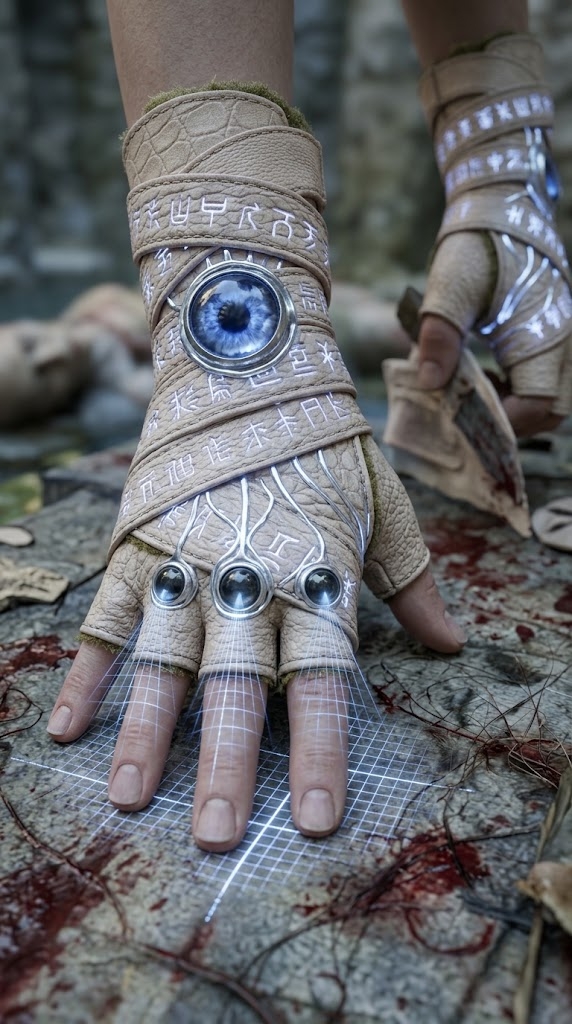
- The item consists of a pair of tight-fitting, fingerless wrist-and-palm wraps crafted from the pale, diamond-patterned hide of an ash-scaled marsh viper.
- Fine tracery lines of pale electrum thread are embroidered across the palm and wrist pulses, converging into a central magnifying iris carved from smoky quartz crystal positioned directly over the inner wrist.
- The interior is lined with smooth, oil-cured sheepskin harvested from high-elevation pasture regions, preventing friction irritation during hours of continuous clinical examination.
- Microscopic lenses made of polished volcanic glass are affixed to the knuckles, reacting to light and casting minute circular grids over whatever surface the palm hovers above.
- When active, the electrum thread glows with a cool, steady silver-blue luminescence that illuminates dust, biological stains, and microscopic stress fractures across living flesh or dead corpses.
Detailed Stats
- Item Tier: Tier 1 (Common)
- Armor Check: +1 AC
- Item Resilience: 10
- Item Health Points: Avatar Maximum Health Points plus 10 (Item HP = Avatar Max HP + 10)
- Weight: 1 pound
- Activation Type: Handheld or Slotted (Requires 1 minute of simple attunement to synchronize with an avatar’s gear limits)
- Conduit Type: Somatic focus utilizing palm pressure points and finger pads to read biological resonance
- Material Composition: Cured ash-viper hide, electrum filigree, smoky quartz crystal, polished obsidian micro-lenses, treated sheepskin lining
Passive Magic
- Pathology Analysis: When the avatar places a bare palm against a wounded creature or corpse, the wraps interface directly with the Mind’s Eye, passively revealing the precise physical cause of damage (such as piercing, bludgeoning, slashing, specific animal toxins, or acidic burns) and the exact time elapsed since the trauma was inflicted, eliminating the need to roll a medicine check for basic autopsy determinations.
- Ballistic and Trajectory Insight: Examining an impact wound or structural puncture while wearing the wraps projects a faint, visible line of pale blue light extending outward from the wound, visually reconstructing the exact angle, elevation, and distance from which the attacking projectile or weapon stroke was launched.
- Steady Hand of the Inquisitor: The wraps insulate the wearer’s fingers against involuntary twitches, physical tension, and ambient cold, granting an advantage (rolling 2d20 and taking the higher result) on all manual dexterity or deduction checks made to gather fragile physical evidence, lift trace powders, or dissect biological specimens.
Activable Magic
- Diagnostic Restoration: As an action costing one combat action, the avatar places a glowing palm against an injured living ally and channels diagnostic ki into the wound. This immediately restores 1d4 health points plus the avatar’s Tier 1 die (1d4), while simultaneously curing the poisoned or bleeding condition if the avatar correctly deduces the source of the ailment aloud. This ability can be used three times per day, regaining all expended uses each morning at Helios sunrise (06:00).
- Cellular Retrocognition: As an action requiring uninterrupted concentration for one minute, the avatar presses both palms over a corpse or shattered non-magical object, spending one charge to stimulate the lingering energetic resonance within the material. The user’s Mind’s Eye perceives a silent, three-second spectral reconstruction of the moment the subject sustained fatal trauma or destruction, showing the silhouette, handedness, and relative size of the assailant. This ability has 2 charges and recovers 1 charge after a full twenty-two-hour day has passed.
- Deductive Disruption: As a reaction triggered when a visible foe within reach initiates a melee attack, the avatar analyzes the opponent’s muscular tension and weapon balance, thrusting a stiff palm into the attacker’s leading kinetic joint. The attacker must make an opposed DC 11 save; on a failure, the strike is deflected, dealing no damage, and the foe becomes flat-footed until the beginning of their next turn as the avatar deduces and counters their combat rhythm.
Specific Slot
- Hand Slot (Left and Right Hands/Wrists)
Tags
- Hands, Wrists, Healing, Reiki, Deduction, Investigation, Viper Hide, Tier 1, Common, Forensics, Buff, Reaction, Mind’s Eye, Pathology, Trajectory, Autopsy, Electrum Wire, Obsidian Lens, Erlitou Craft, Evidence Gathering, Cellular Memory, Crime Scene, Medical Diagnosis, Kinetic Counter
Acquisition, Valuation, and Commerce of Reiki 734 of the Forensic Palm
- Municipal Watch Armories and Bailiff Quartermasters Located inside high-walled regional garrisons, municipal magistrate compounds, and city guard precincts across urbanized island provinces, these official quartermaster desks supply sanctioned law enforcers and forensic examiners. The wraps are requisitioned from locked iron cabinets behind secure wooden grilles, kept in oiled leather cases alongside field splints, fingerprint powders, and coroner dissection kits. Avatars possessing official watch commissions or investigator credentials can purchase them through direct municipal requisitions for 80 to 110 silver coins, or charge the expense to a chartered guild ledger with an authorized tax deduction. When selling the item here, the quartermaster will run a mandatory serial check to verify the gear was not stripped from a fallen city magistrate; once cleared, payment is credited directly into the avatar’s municipal bank account at a fixed bureaucratic rate of roughly 75 silver pieces.
- Scholastic Scriptoriums and University Reliquaries Situated within prestigious academies of natural philosophy, forensic guildhalls, and central universities in metropolitan capitals, these shops cater to scholars, legal advocates, and advanced apothecaries. The item is displayed inside velvet-lined glass vitrines in hushed, book-lined halls, presented alongside optical brass loupes, botanical atlases, and jars of preserving brine. Academics sell the wraps as refined instruments of objective pathology and physical deduction rather than combat gear, pricing them at a premium between 140 and 190 silver coins (or 14 to 19 gold coins), payable via certified World Bank drafts or high-grade bank letters. If an avatar seeks to sell the wraps to an academic curator, the appraiser will closely inspect the clarity of the smoky quartz crystal and the integrity of the electrum tracery, offering between 10 and 14 gold coins for unblemished specimens to add to institutional autopsy labs.
- Harbor Pawnshops and Dockside Loan Brokerships Clustered near busy maritime wharfs, canal warehouses, and merchant sailor taverns where privateers and down-on-their-luck bounty hunters liquidate personal gear, these shops handle a wide assortment of uncurated oddities. The establishment is cramped and dimly lit by whale-oil lamps, with items hanging from ceiling hooks behind reinforced wire cages. Buyers can discover the wraps lying neglected in mixed salvage bins, misidentified as mundane archery bracers or common leather wrist supports by a proprietor unfamiliar with archaic electrum circuitry. A shrewd buyer can negotiate the price down to 60 to 85 silver coins (or roughly 12 to 17 electrum tokens) using cash on the table. When selling to a dockside pawnbroker, the shopkeeper will point out superficial scale scuffs and salt-water staining on the viper hide to aggressively drive down their payout, offering no more than 40 to 55 silver pieces in mixed regional copper and silver bits.
- Specialty Inquisitorial Suppliers and Private Eye Ateliers Tucked away in narrow upper-story offices above legal clerk districts, private detective agencies, and discreet court-advocate streets, these private ateliers serve independent arbiters, bounty hunters, and covert intelligence gatherers. The merchant is typically a retired magistrate or veteran coroner who tests every piece of equipment on actual physical bone samples and projectile ballistics before offering it for sale. The wraps are fitted custom to the buyer’s wrist measurements, with the electrum pathways tuned and polished, commanding an exacting price of 120 to 160 silver coins (or 12 to 16 gold pieces), paid via untraceable cash or barter in rare forensic reagents. When buying the wraps from a freelancer, the proprietor tests the quartz iris using a drop of dried blood; if the cellular retrocognition triggers cleanly without arcane distortion, they will purchase the wraps immediately for 90 to 110 silver pieces in clean coin.
Environmental Roleplay: Deductive Defense and Offense
- Royal Courtrooms, High Magistracies, and Judicial Inquisitions Inside the echoing vaulted chambers, pillared tribunals, and marble legal halls of sovereign island seats, drawn blades are strictly forbidden by sovereign decree. Defensively, when corrupt advocates, false witnesses, or bribed patricians present fabricated testimony against an innocent defendant or an allied patron, the avatar approaches the witness bar. Resting an open electrum palm against a contested piece of physical evidence or an injured party’s scar, the avatar projects the Pathology Analysis through the Mind’s Eye, revealing to the presiding magistrate the exact metallurgical signature of the blade, the true angle of entry, and the precise hour the injury occurred, systematically dismantling the prosecution’s alibi without raising a single weapon. Offensively, when a treacherous courtier attempts to feign illness or accuse the adventuring party of carrying lethal contraband, the avatar steps forward under the guise of an imperial coroner. Clasping the accuser’s hand in a formal diagnostic touch, the avatar uses the Steady Hand of the Inquisitor to read microscopic pulse anomalies and localized nerve tension, deducing that the courtier is self-administering diluted marsh-leech toxin to forge symptoms, openly exposing the conspiracy before the entire assembled aristocracy.
- Active Crime Scenes, Murdered Caravans, and Ambushed Trailheads Along remote trade passes, abandoned mountain bridges, and bloodstained cargo trailheads where travelers have been ambushed by unidentified raiders, the immediate environment is cluttered with chaotic, misleading tracks. Defensively, while the party scouts the area for lingering threats, the avatar kneels beside a slain beast or wagon guard to conduct an immediate field autopsy. Channeling the Ballistic and Trajectory Insight, the wraps project a crisp, pale blue line of light rising from the puncture wounds, revealing to the vanguard that the sniper was perched not upon the low roadway boulders where tracks were intentionally left, but high within the western cedar canopy, allowing the party to immediately position their shields toward the true ambush vantage point before archers can fire again. Offensively, the avatar presses both palms against the chest of a fallen merchant to activate Cellular Retrocognition. Staring through the Mind’s Eye, the avatar observes the silent three-second reconstruction of the fatal strike, noting the distinctive two-handed pommel grip, scarred left knuckles, and notched sickle-blade of the killer, allowing the adventuring party to track down the exact brigand captain in a crowded tavern three leagues away by identifying his unique combat rhythm and weapon notches before he can dispose of the stolen goods.
- Dense Tactical Melee, Boarding Actions, and Urban Skirmishes Aboard rolling flagship decks during close-quarters boarding battles or inside narrow, blood-slick dockside warehouse corridors, combat is kinetic, chaotic, and unforgiving. Defensively, when a heavily armored executioner or dual-wielding corsair charges forward with an overhead execution stroke, the avatar activates Deductive Disruption. By reading the shifting weight of the attacker’s leading hip and the pre-strike twitch of their shoulder deltoid, the avatar drives a stiff, open palm directly into the opponent’s exposed kinetic elbow joint, interrupting the physical stroke at the precise mechanical pivot point and leaving the brute off-balance, open-mouthed, and flat-footed before the blade can fall. Offensively, as the avatar moves between fractured frontline ranks, they alternate between kinetic disruption and high-speed medical triage. Placing a glowing palm upon a fallen vanguard warrior whose torso is leaking toxic venom, the avatar vocalizes the specific biological deduction—identifying the exact secretion of a coastal reef scorpion—triggering Diagnostic Restoration to instantly purge the poison from the bloodstream, bind the shredded flesh with silver-blue ki, and push the restored ally back into the fray while simultaneously sidestepping an incoming flank attack based on deduced weapon trajectories.
- Subterranean Tombs, Sealed Crypts, and Ancient Vaults Deep within unmapped ancient ruins, sunken temple vaults, and pre-Calamity catacombs where ancient traps and petrified remains litter the flagstones, physical observation is the difference between survival and death. Defensively, when the party halts before an ominous hallway lined with shattered skeletons, the avatar places a gloved hand flat against a petrified bone fragment. The wraps instantly analyze the skeletal micro-fractures, deducing that the victim died not from blade or spear wounds, but from concussive vertical pressure triggered by a floor-plate drop twelve paces ahead, allowing the scouts to step around the hidden pressure mechanisms without setting off the tomb’s stone-crushing ceiling. Offensively, when confronting an ancient reanimated corpse or an animated guardian constructed from prehistoric bone and stone, the avatar uses the volcanic glass lenses on the knuckles to project illuminated stress grids across the creature’s structural joints. Identifying the hairline fractures caused by centuries of geothermal decay, the avatar directs the party’s strikes to those exact anatomical fault lines, shattering the automaton’s balance with an open-palmed deductive strike and causing the construct’s kinetic framework to violently collapse.
Perception of Activation:
- Visual Perception (The Sense of Sight) Under the user’s perspective, the instant the diagnostic intent is formed, the pale electrum filigree flares with a sharp, mercury-bright luminescence that races along the back of the hand. The smoky quartz iris on the inner wrist dilates like a living pupil, casting a high-contrast, silver-blue conical beam across the target area. Through the knuckle lenses, precise millimeter-scale grids are projected onto the inspected tissue or surface, highlighting hair-thin micro-fractures, concealed blood splatter, and subcutaneous bruising with an intense indigo phosphorescence. Under the observer’s perspective, onlookers see the investigator’s hands enveloped in an immaculate, cold luminescent halo. As the investigator sweeps their palms over a subject, intricate optical lattices of pale light stretch across the skin or cobblestones, illuminating hidden stains and minute fiber fragments that were completely invisible to the naked eye. The positive aspect is the total clarity of physical evidence; minute biological traces, wiped blood trails, and concealed structural flaws are rendered undeniably clear without requiring chemical reagents or physical disruption of the scene. The negative aspect is the high-intensity optical signature; the stark silver-blue beam and geometric projections instantly destroy night-vision adaptation and make covert investigations in dark alleyways or enemy territory impossible without alerting nearby sentries.
- Auditory Perception (The Sense of Hearing) Under the user’s perspective, the activation is accompanied by a dry, mechanical clicking sound within the wrist iris, resembling the delicate escapement movement of an antique pocket watch. As the electrum threads draw diagnostic resonance from the tissue, the user hears an ultra-fine acoustic drone—a high-frequency pitch that shifts in tone when passing over healthy flesh, dense bone, or severed vessels, acting like an acoustic depth gauge. Under the observer’s perspective, those nearby hear a low, rhythmic metallic hum reminiscent of vibrating tuning forks, punctuated by faint, crystalline chimes whenever the lenses align with a major anatomical trauma point. The sound is sterile, precise, and devoid of spiritual reverence, sounding like an operating theater instrument. The positive aspect is the auditory confirmation of subsurface anomalies; the pitch shifts allow the user to locate hidden internal fractures or embedded projectile fragments simply by sweeping their hand along the body. The negative aspect is the persistent, grating acoustic resonance; extended examinations cause an annoying ringing in the ears of the user and sensitive companions, creating mild irritation during long autopsy sessions.
- Tactile Perception (The Sense of Touch) Under the user’s perspective, the soft sheepskin interior instantly warms against the pulse, while the outer ash-viper hide tightens around the carpal bones with rigid, splint-like precision. The practitioner experiences a sudden sensation of total joint stabilization: muscular micro-tremors, pulse twitches, and cold-sweat instability are mechanically neutralized, leaving the fingers feeling weightless, icy, and surgically firm. When touching a wound, the skin beneath the user’s fingertips feels as though it is embossed with topographic ridges, mechanically communicating tissue density, blade sharpness, and depth. Under the observer’s perspective, when the investigator places a palm upon an injured patient, the subject feels an icy, tingling prickle across their nerve endings. As the diagnostic ki penetrates, the wound area goes stiff and cool, like being swabbed with pure medicinal alcohol, arresting involuntary muscle spasms and dulling sharp pain into a manageable, clinical ache. The positive aspect is the absolute elimination of hand tremor, ensuring flawless surgical cuts, evidence lifting, or bone setting without accidental tissue damage. The negative aspect is the numbing feedback in the practitioner’s fingertips; while steady, the user loses ordinary fine tactile sensitivity, making it difficult to gauge soft textures or feel very light surface temperatures while the wraps are engaged.
- Olfactory Perception (The Sense of Smell) Under the user’s perspective, the sudden heat of the electrum thread vaporizes trace mineral oils cured into the sheepskin, creating a sharp, antiseptic scent reminiscent of ozone, distilled vinegar, and pulverized limestone. When passing over trauma, the wraps amplify the faint scent signatures of the injury, allowing the user to detect the bitter metallic tang of iron blood, the sour almond scent of specific marsh toxins, or the acrid burn of alchemical vitriol. Under the observer’s perspective, bystanders smell a sudden surge of clean, sharp lightning air and sterile brine that cuts cleanly through the heavy stench of putrefaction, stagnant water, or battlefield decay. The surrounding air feels scrubbed and cold, like an open window in an alpine dissecting room. The positive aspect is the suppression of gag reflexes; the sterile ozone scent masks repulsive rot, allowing the investigator and their team to work beside decomposing remains without distraction. The negative aspect is the lingering chemical smell; the sharp ozone and vinegar odor adheres to clothes and hair for hours, making the investigator smell unmistakably like a morgue or clinical charnel house to tracking beasts and high-society contacts alike.
- Gustatory Perception (The Sense of Taste) Under the user’s perspective, the bio-electric conductivity running up the wrist nerves induces an involuntary galvanic reaction along the mouth, leaving an unmistakable taste of oxidized brass and battery acid on the tongue. If the user correctly deduces a chemical venom or compound, a dry, alkaline residue briefly coats the palate, confirming the classification. Under the observer’s perspective, if an injured subject receives the diagnostic ki directly through thoracic or facial treatment, they experience a brief, clean taste of mint-infused salt water across their lips, as if their saliva has been cleansed of swallowed blood or bile. The positive aspect is the rapid chemical confirmation; the practitioner’s palate serves as a subconscious analytical sensor, verifying toxic compositions without consuming samples. The negative aspect is persistent dry mouth; the galvanic taste creates an intense, cotton-mouthed thirst, forcing the user to drink water frequently to clear the metallic tang from their teeth.
- Extra-Sensory Perception: Mind’s Eye Chronological Retrocognition Under the user’s perspective, when touching a wound or severed structural joint, the practitioner’s normal vision is momentarily overlaid with a translucent, monochromatic timeline. The user perceives an objective, spectral playback of the impact: the precise direction the kinetic energy entered the flesh, the torque of the weapon stroke, and a ghost-trace silhouette illustrating the height, handedness, and stance of the striker. The data displays not as poetic visions, but as rigid geometric vectors and anatomical stress diagrams. Under the observer’s perspective, observers wielding mana sight or aura perception see a tight, silver-indigo sphere of temporal static wrap around the investigator’s forearms. Within this localized field, faint after-images of the moment of violence flicker across the air like pale phantom smoke before dissipating into the stone. The positive aspect is the complete circumvention of deceptive alibis and planted crime scene decoys; the user gleans absolute physical truth about how an injury was delivered, regardless of what false testimonies were given. The negative aspect is cognitive overload; witnessing repeated traumatic impacts in rapid succession causes sudden headaches and mental fatigue, temporarily clouding the investigator’s social intuition if overused.
- Extra-Sensory Perception: Kinetic Vector Deduction Under the user’s perspective, in an active confrontation, the avatar perceives the impending kinetic arcs of enemy strikes before they physically reach full extension. Straining tendons, shifts in an opponent’s center of gravity, and weapon grip adjustments project faint blue vector lines across the user’s visual field, showing the exact terminal path of the attack. Under the observer’s perspective, spectators see the investigator move with unnerving economy and lack of panic. The user does not dodge wildly, but tilts slightly to one side, extending a stiff palm into the attacker’s joint just as the strike begins, snapping the opponent’s kinetic momentum with almost no apparent effort. The positive aspect is optimal defensive counter-play; the user neutralizes incoming strikes with absolute minimum physical exertion, keeping dangerous foes off-balance and vulnerable to party counter-attacks. The negative aspect is tunnel-vision risk; focusing deeply on calculating the incoming vector of a primary threat leaves the user momentarily blind to flanking attacks, area-of-effect spells, or environmental hazards outside the immediate calculated trajectory.
- Extra-Sensory Perception: Cellular Cohesion Pulse Under the user’s perspective, when Diagnostic Restoration is triggered, the practitioner feels the broken cellular web of the patient’s wound pull taut like the rigging of a ship. The electrum circuits pump a cool, stabilizing frequency into the severed capillaries, snapping them shut and forcing the tissue to violently close its gaps in alignment with the deduced biological template. Under the observer’s perspective, onlookers watch torn skin and mangled muscle draw together under a lattice of silver-blue light, knitting without scar tissue as the investigator calls out the cause of the injury. The wound does not merely scab over; it is restored with clinical precision, and lingering venom is purged as harmless, crystallized salt along the surface of the skin. The positive aspect is the dual benefit of immediate, effective field healing paired with the simultaneous neutralization of lethal bio-toxins and bleeding. The negative aspect is the necessity of verbal deduction; the restorative ki requires cognitive accuracy—if the practitioner misdiagnoses the cause of the wound or names the wrong toxin aloud, the healing weave misfires and fails to purge the condition, wasting the channeled charge.
Crafting Recipe: Construction of the Forensic Iris
Materials Needed
- 1 strip of cured ash-viper hide, measuring two feet in length and three inches in width, carefully harvested and descaled to preserve the pale diamond grain and tensile toughness.
- 1 Coin-sized Tier 1 Magic Crystal, utilized as the foundational arcane battery to retain diagnostic charge and project cellular memory waves.
- 12 feet of pale electrum wire (50% gold, 50% silver alloy), drawn into ultra-fine thread to conduct both mana and electrical impulses along neural pathways.
- 1 coin-sized cabochon of clear smoky quartz, unclouded and free of fractures, cut to serve as the wrist-mounted optical iris.
- 6 micro-lenses of polished black volcanic glass (obsidian), ground convex to project minute measurement grids across focal surfaces.
- 1 square foot of soft, oil-cured highland sheepskin, boiled in pure spring water and dried to form the friction-free, shock-dampening interior lining.
- 2 fluid ounces of distilled elderwood amber lacquer, used to coat, insulate, and fix the electrum tracery into the viper hide.
Tools Required
- 1 Fluid Collector, fitted with a micro-nozzle for the precise application of insulating amber resin along microscopic wire channels.
- 1 Lapidary Faceting Rig and Diamond Slurry, necessary for cutting the smoky quartz iris and shaping the obsidian micro-lenses to exact focal curvature.
- 1 Fine Bone Scribe and Jeweler’s Tweezers, used for scoring microscopic conduit grooves and inlaying fragile electrum wire.
- 1 Leatherworking Awl and Fine Steel Needles, required for stitching the sheepskin backing to the exterior viper hide.
- 1 Alchemical Spirit Burner and Crucible, used to warm the lacquer and prepare the bonding agents.
Skill Requirements
- Leatherworking: Level 5 or higher, essential for beveling and stitching dense viper hide without distorting its natural diamond alignment or puncturing the inner lining.
- Gemcutting and Optics: Level 5 or higher, required to shape the smoky quartz cabochon and obsidian lenses to focus coherent projection grids without optical aberration.
- Arcane Crafting: Level 6 or higher (a baseline of level 5 plus 1 for the Tier 1 item), necessary to attune the quartz lens to the magic crystal catalyst and balance the electrum biofield circuit.
- Forensic Pathology or Anatomy: Level 5 or higher, required to map the sixty-four anatomical terminal points accurately across the palm and wrist meridians.
Crafting Steps
- Prepare the Viper Hide Foundation and Interior Lining
- Lay the cured ash-viper hide flat upon an ironwood workbench, trimming the edges with a sharp leather blade into two symmetrical, fingerless wrap patterns.
- Bevel the perimeter edges to an angle of forty-five degrees, ensuring a smooth, non-chafing overlap around the carpal bones and wrist joints.
- Cut two matching patterns from the oil-cured sheepskin to serve as the interior backing, testing the alignment against the viper hide to ensure exact edge conformity.
- Punch microscopic needle pass-through holes along the outer borders using the leatherworking awl, spacing them precisely three millimeters apart.
- Cut and Polish the Optical Assemblies
- Mount the raw smoky quartz nodule into the lapidary faceting rig, grinding it down into a smooth, circular cabochon measuring one inch in diameter.
- Polish both faces of the quartz lens with diamond slurry until completely transparent, scoring a minute circular aperture ring around the outer rim to seat the electrum terminal ring.
- Grind six identical micro-lenses from raw black obsidian, shaping each into a convex button with a three-millimeter focal point designed to project an illuminated coordinate grid.
- Heat each lens gently over the spirit lamp and inspect under bright light to verify the absence of interior heat fractures or air pockets.
- Inlay the Electrum Tracery
- Score sixty-four precise anatomical conduit lines into the outer grain of the viper hide using the bone scribe, radiating from the wrist pulse toward the finger roots.
- Using jeweler’s tweezers, press the pale electrum wire into the scored dermal channels, running continuous threads from the knuckle joints back to the inner wrist housing.
- Mount the fluid collector to dispense warm elderwood amber lacquer directly into the grooves, sealing the electrum wire beneath a smooth, clear protective coating.
- Allow the lacquer to cure for six hours in a dust-free chamber, verifying that all wire traces remain firmly bonded and flush with the hide surface.
- Mount the Knuckle Lenses and Wrist Iris
- Cut three circular mounting apertures across the knuckle band of each wrap, inserting the obsidian micro-lenses into reinforced leather bezels.
- Anchor the smoky quartz cabochon into a central electrum ring seated directly over the inner wrist pulse point, securing the bezel with three structural fold-tabs.
- Solder the terminal ends of the electrum tracery directly to the outer ring of the quartz iris using low-temperature silver solder, creating an unbroken circuit from the knuckles to the wrist.
- Catalyst Integration and Arcane Tuning
- Grind the coin-sized Tier 1 magic crystal into uniform crystalline dust using a dense agate mortar, keeping the particulate completely dry.
- Blend the powdered crystal with a small amount of liquid amber lacquer, pressing the conductive paste directly into the rear cavity behind the smoky quartz iris.
- Place both forearms over the wraps, entering a meditative trance to channel diagnostic thought-energy through the Mind’s Eye.
- Mentally recite the foundational principles of trauma analysis, sending a steady current of somatic ki into the electrum filigree to awaken the quartz iris and calibrate the obsidian lenses.
- Roll a d20 to verify the stability of the arcane binding: a roll of 2 through 20 successfully permanently harmonizes the forensic enchantment, whereas a roll of 1 indicates an energetic imbalance that cracks the quartz iris, scatters the crystal paste, and ruins the optical assembly.
- Final Stitching and Assembly
- Place the sheepskin backing flush against the inner face of the lacquered viper hide, aligning all perimeter needle holes.
- Thread the steel needles with waxed sinew cord, executing a tight double-stitch along the entire perimeter to seal the electrical grid between the hide layers.
- Attach reinforced leather lacing loops and adjustable wrist-cuff straps at the trailing edges, testing the completed wraps to verify they sit securely, prevent hand micro-tremors, and leave the fingers entirely free for manual examination.
Cold Eye of Stone-Bench and Dead Bailiff’s Thumb
Read now the marks that were pressed into the grey lime-board with a pointed goat-horn before the great river broke through the city wall and drowned the twenty-four copper-sheds. In the cycle when the sky-skin was pale like an unbaked pot, there was no rain for nine turns of the moon. The land was dry like the bone of an old mule, and the salt was creeping out of the ditches to eat the corners of the barley-houses.
In the market of the High Wharf in the land of Erlitou, there was a great shouting because Master Seven-Pots, who sat upon the cedar bench and took the coin for the King’s water-trough, was found lying in the mud behind the cooperage. His breathing holes were stopped up with dried river weed, and his skull-bone was broken open like a dried gourd that has been trodden upon by an ox.
The three town-bailiffs, who wore vests of split ox-hide and carried the heavy ash-poles, were running among the reed huts. They took the youth named Little-Cat, who sold dried eels from a willow basket, and they tied his thumbs behind his neck with a hemp string. The first bailiff said: “This boy has grease upon his sleeves, and his grandfather was a ditch-digger from the foreign island. He has struck Master Seven-Pots with an iron mallet so that he might take the twenty-two silver pieces from the water-box.”
The boy wept with his nose in the dirt and called upon the moon-mother Lilith, but the bailiffs had already marked his name upon the red lead-tile to be thrown from the sea-cliff at the fifth bell of the morning.
There was an old man sitting upon the weighing-stone whose hair was the color of ditch-foam. In the registers of the grain-clerk his name was written as The One Who Counts Ribs, but he had fallen through the great sky-vault during the Year of the Crooked Star, and his tongue was thick with words that had no fathers in the seventy-three island realms. In the days before he woke up in the ditch without his shoes, he had lived in a cold stone room where men were cut open with steel pins to see why their breath had run away, though the temple-keepers of Erlitou said such things were unlawful and made the fish-nets rot.
The man had two arm-covers made from the skin of the grey salt-adder that sleeps in the lime-kilns. He had stitched the leather with threads of white electrum that he had hammered out of an old ear-ring, and over the place where the wrist-vein jumps like a frog, he had tied a round stone of dark smoke-quartz that had a hole through the middle like the eye of an owl. On the knuckles he had glued six round drops of black mountain-glass that he had scraped off the bottom of a smelter pot.
The One Who Counts Ribs walked to the mud where Master Seven-Pots was lying under a straw mat. The flies were thick upon the mat, singing the song of noon-tide.
The Captain of the Watch, whose name was Four-Javelins, raised his ash-pole and shouted: “Get your grey knees away from the King’s dead servant! If you put your dirty fingers upon the tax-corpse, you will pay six pots of pure lard or be beaten with the split cane until your shoulders bleed!”
The old man did not take a bag of lard from his coat. He raised his hands toward the sun-wheel Helios, and the white electrum wires upon his wrists began to shine with a cold, pale light like the grease on the belly of a deep-sea crab. He made a small dry clicking sound with his palate, such as a beetle makes when it crawls behind the cedar wainscot: Ka-ku-shi-te-mi-ru.
He laid his open palm upon the broken skull-bone of the dead tax-man. The dark smoke-quartz upon his inner wrist opened its eye wide, and from the six black drops upon his knuckles there fell a net of blue cords—not made of flax, but made of cold light that had no smoke in it. The blue cords lay across the dead man’s forehead like the strings that fishermen tie to hold the bait-jars.
The people of the High Wharf fell down upon their elbows, for they thought the old man was calling the red ghost out of the sea-trench to eat their marrow. But the old man did not look at ghosts. He looked through the third hole in his forehead, which the old books call the Eye of the Mind.
In the eye of his mind, the bone did not say: The boy with the eels has killed me. The bone showed a blue line that was straight like a carpenter’s chalk-cord. The line went from the broken place in the skull, high up into the air, forty paces toward the drying-sheds where the Queen’s weavers hang the scarlet thread. The old man held his palm very stiff, and the trembling went out of his sinews like water freezing in a bronze kettle.
He pointed his thumb at the line of light and spoke with a voice that was flat like an ungreased axle: “The stick that broke the gourd was not swung from the mud. It was dropped from the roof of the high loom-room. It did not have the square face of a mallet, but the round belly of a copper plumb-bob that the master-builders hang upon a cord of flax.”
The Captain Four-Javelins laughed through his beard, which was full of beer-bread crumbs: “The old foreigner has gone mad from the sun-ball! Who drops an iron weight upon a man’s head from forty paces unless he has the wings of a fish-kite?”
The One Who Counts Ribs did not strike the Captain. He turned his palm over and pressed the six knuckle-glasses against the dead man’s thumb-joint. The electrum threads ran with white lightning that smelled like the sky when a storm hits the salt-piles. The dead flesh of the thumb had a small round bruise upon the nail-skin, no bigger than the seed of a wild mustard plant.
The old man closed his two eyes and held his breath until his throat turned blue. The smoky stone upon his wrist began to hum like an iron pot upon a coal fire. He saw in the dark of his skull three beats of a clock that had run down four hundred years before the flood: he saw the shadow of a fat hand with a silver signet-ring shaped like a swimming carp; he saw the string of a bricklayer’s line being cut with an ivory-handled knife; and he saw the copper bob fall through the willow-slats of the weaver’s gallery straight down onto the crown of the tax-man while he was counting his eighth pot.
The old man rose from the dirt. His joints made a sharp crack like dry pine-twigs. He walked three steps to the place where the third bailiff, whose name was Fat-Girdle, was leaning upon his ash-pole with his arms folded across his belly. The bailiff had his left hand hidden beneath his ox-hide arm-guard.
The One Who Counts Ribs did not shout and did not draw an iron knife. He shot his right hand forward with the swiftness of an adder striking a river-toad, driving the stiff heel of his palm directly into the nerve-cluster under the bailiff’s left elbow.
The bailiff gave a loud squeal like a pig when the butcher comes with the cedar peg. His arm dropped straight, and from beneath his hide cuff there rolled out upon the mud an ivory-handled knife and a coil of greasy flax-twine, smelling of the tallow that the roof-carpenters use to rub upon their pegs. Upon the third finger of his fat hand was the silver signet of the swimming carp, which was the badge of the builder’s cousin who had lost his timber-concession at the last full moon.
The people of the High Wharf saw the flax-string and the ivory knife, and they made a great roar like the water when the sea-gate is opened. The Captain Four-Javelins did not hit the boy Little-Cat with the ash-pole. He took the hemp rope from the boy’s neck and put it around the fat neck of the bailiff Fat-Girdle, and they led him to the magistrate’s cage before the noon-bread had been cut.
The One Who Counts Ribs did not go to the magistrate’s hall to ask for the three silver pieces that the city gives for finding a thief. The electrum upon his wrists was cold again, and the sheepskin under the snake-hide was wet with his sweat, smelling of lime and old vinegar. He walked to the reed hut of the boy who sold eels, took two salted tails from the willow basket, and sat upon the weighing-stone to eat them while the flies went back to the straw mat in the mud.
The scribes who came after the great river-drowning wrote down this story upon five split stones, but because they did not know the language of the people who cut flesh to find the truth, they wrote that the old man had an owl sitting inside his wrist-bone that could smell the thoughts of a murderer through sixty feet of timber.
Moral of the Story: A loud captain will always hang the beggar with the fish-basket because his thumbs are already dirty, but the stone that measures the bone will find the man who dropped the weight from the high roof, even if he wears the King’s ox-hide upon his ribs.
Suggested conversions to other systems:
Call of Cthulhu (7th Edition)
The Coroner’s Forensic Bracers
- Classification: Minor Enchanted Artifact / Forensic Investigator’s Focus
- Physical Profile: A pair of ash-scaled viper skin handwraps inlaid with fine electrum wiring, backed by treated sheepskin, and mounted with an optical smoky quartz iris and black volcanic glass micro-lenses over the knuckles.
- Sanity Cost: 0 Sanity to attune or wear; 1 point of Sanity loss each time the user triggers Cellular Retrocognition and visually witnesses a violent demise through another entity’s sensory memory.
- Pathology & Forensic Insight: The investigator gains one bonus die on all Medicine, Forensics, and Science (Biology or Chemistry) rolls made to conduct autopsies, identify foreign toxins, or determine the precise cause, angle, and timing of physical trauma.
- Diagnostic Healing: The investigator expends 4 Magic Points and places a bare palm over an injured or ailing living patient while making a First Aid or Medicine roll. On a regular success, the target immediately recovers 1D4+1 Hit Points. If the investigator correctly identifies the specific medical pathology, poison, or weapon type inflicting the injury prior to rolling, a success additionally neutralizes one non-magical poison or immediately arrests the Bleeding condition without requiring medical supplies.
- Cellular Retrocognition: The user concentrates for one full round, spends 6 Magic Points, and presses both palms against a corpse or damaged structural object. The user’s mind perceives a brief, 3-second spectral vision illustrating the direction, velocity, handedness, and silhouette of the entity that inflicted the fatal trauma.
- Kinetic Deflection: When targeted by a melee attack, the investigator can spend 2 Magic Points to perform a specialized Dodge maneuver using the Fighting (Brawl) skill. On a success, the investigator reads the assailant’s joint tension and strikes a kinetic pressure point, deflecting the blow entirely and imposing one penalty die on the attacker’s next combat roll.
- Backfire Hazard: Fumbling any activation roll (a result of 96–100, or 100 if skill is below 50) causes an electric surge through the electrum circuits, inflicting 1D3 points of electrical damage directly to the user and blinding the user’s optical iris for 1 hour.
Blades in the Dark
The Inquisitor’s Forensic Palms
- Item Classification: Arcane Implement / Specialized Forensic Tool (Load: 1, worn on hands and wrists)
- Visual Profile: Pale, diamond-patterned viper skin stitched with pale electrum filaments, featuring polished obsidian lenses across the knuckles that cast faint measurement grids over crime scenes.
- Tier Equivalent: Tier I Quality
- System Mechanics:
- Forensic Autopsy & Scene Reconstruction: When you examine a murder victim, physical wreckage, or trace biological residue, gain +1 Effect on any Study or Survey action. You immediately discern the exact weapon used, the time elapsed since the blow was struck, and the trajectory of the attacker without requiring forensic lab equipment.
- Cellular Retrocognition: Spend 1 Stress and touch a corpse or shattered object to open the smoky quartz conduit. Roll Attune (Position: Controlled, Effect: Standard). On a success, you experience a momentary psychic playback of the fatal blow, learning one crucial detail regarding the killer’s physical profile, handedness, or unique equipment.
- Diagnostic Palm: Spend 1 Stress while administering medical care to an injured ally to roll Tinker or Physick (Standard Effect). A successful action immediately stabilizes a character suffering from physical trauma, reducing the penalties of Level 1 or Level 2 Harm for the remainder of the score if you deduce the cause of the injury aloud.
- Kinetic Joint Paralyzer: When skirmishing in close quarters against an armed opponent, you may spend 2 Stress to declare a deductive counter. Your Skirmish or Prowl roll gains +1 Effect; on a successful outcome, you deflect the blow at the elbow pivot and leave the opponent off-balance and vulnerable to an immediate follow-up action.
- Arcane Glitch: A critical failure or messy complication (1–3 or 4/5) while reading a violent death causes psychic bleed-through, giving the investigator the Traumatized Tremor condition or filling 2 ticks on a clock titled Cognitive Shock.
Dungeons & Dragons (5th Edition)
Wraps of the Forensic Palm
- Wondrous Item, uncommon (requires attunement)
- Armor Class Bonus: While wearing these wraps and wearing no armor or light armor, you gain a +1 bonus to AC.
- Deductive Insight: While attuned to these wraps, you gain proficiency in the Investigation and Medicine skills. If you already have proficiency in either skill, your proficiency bonus is doubled for any ability check you make using that skill. Additionally, you passively recognize the exact physical damage type (slashing, piercing, bludgeoning, acid, or poison) that caused any wound you touch.
- Charges & Regeneration: The wraps possess 3 charges and regain 1d3 expended charges daily at dawn.
- Diagnostic Restoration: As an action, you can expend 1 charge and touch an injured creature. The target regains 1d4 + your Wisdom modifier in hit points. If you correctly state the damage type or specific creature that inflicted the wound, the target is also cured of one non-magical poison or disease affecting it.
- Cellular Retrocognition: As an action, you can expend 1 charge while pressing both palms to a corpse or shattered object that is no more than 7 days old. You concentrate for 1 minute to receive a static visual impression in your mind of the moment the object or creature was destroyed, identifying the size category, handedness, and attack angle of the creature that dealt the fatal blow.
- Kinetic Deflection: When a creature within 5 feet of you hits you with a melee weapon attack, you can use your reaction to expend 1 charge to intercept the attacker’s joints. Roll a d20 and add your Dexterity or Wisdom modifier; if the total exceeds the attacker’s attack roll, the attack misses instead, and the attacker has disadvantage on its next attack roll made before the end of its turn.
Knave (2nd Edition)
The Forensic Adder Bracers
- Item Slots: 1 item slot (hands/wrists)
- Armor Value: +1 Armor Check modifier
- Durability: 10 / 10 Quality points (loses 1 Quality whenever the wearer suffers a critical hit; reduced to inert leather and shattered quartz at 0 Quality).
- Hands Required: Hands must be free of weapons or shields to deploy the optical iris and touch terminals.
- Item Properties:
- Anatomical Deduction: The wearer automatically identifies the cause of death, time elapsed since death, and physical damage type of any corpse or wound inspected, bypassing the need to roll an Intelligence check.
- Restorative Diagnosis: Once per exploration turn (10 minutes), the wearer may place an open palm upon a wounded ally and speak the physiological nature of their injury. The ally immediately recovers 1d4+1 Hit Points. Once per day, this ability can be used to purge an active biological venom without requiring a Constitution save.
- Retrocognitive Reading: The wearer may spend 10 minutes examining a corpse or destroyed lock/mechanism to view a brief spectral impression of the strike that destroyed it. This reveals the rough silhouette, height, and main weapon of the perpetrator.
- Joint Interception: Once per combat encounter, when an enemy successfully attacks the wearer in melee, the wearer may attempt an immediate Dexterity or Wisdom save against the attack roll. On a success, the attack is deflected at the elbow or wrist joint, dealing 0 damage and leaving the attacker unable to make further attacks until their next turn.
- Cognitive Strain: Activating the bracers more than three times between rests forces an immediate Constitution save. On a failure, the wearer incurs 1 point of Fatigue (taking up an inventory slot).
Fate (Fate Condensed / Fate Core)
Wraps of the Forensic Iris
- Aspects:
- High Concept: Forensic Inquisitor’s Diagnostic Palm Wraps
- Trouble: Sensory Overload and Compulsive Detail Fixation
- Invocation: Reading the Kinetic Memory of Broken Flesh
- Stunts:
- Trauma Reading: Gain a +2 bonus to Notice or Investigate when examining a physical crime scene, autopsy subject, or structural fracture to determine the exact weapon, entry angle, or time of injury.
- Diagnostic Healing: Once per scene, spend a Fate Point and touch a wounded ally while stating the exact medical diagnosis of their injury. You immediately clear a 2-point physical stress box or downgrade a Mild Physical Consequence to a temporary boost.
- Kinetic Joint Paralyzer: When defending against an incoming melee Fight attack using your unencumbered hands, you may defend with Investigate instead of Athletics or Fight. If you succeed with style, you deal no stress; instead, you place the situational aspect Off-Balance and Read on the attacker with two free invokes.
- Mechanical Limitation: If an opponent invokes your Trouble Aspect, the optical glare of the quartz iris momentarily blinds you or floods your mind with traumatic memory echoes, giving your avatar the Flashing Optical Ghosting situational aspect.
Numenera & Cypher System
Pre-Calamity Forensic Mesh
- Form: Pale, diamond-scaled reptilian arm wraps threaded with pale electrum filaments, mounted with a polished smoky quartz wrist iris and obsidian knuckle micro-lenses.
- Level: 3 (Artifact)
- Depletion: 1 in 1d10 (roll after activating Cellular Retrocognition or Kinetic Interception)
- Armor Value: +1 to Armor (enhances passive physical resilience of the wrists and forearms against kinetic strikes)
- Effect:
- Primary Function (Diagnostic Restoration): As an action, the user places an open palm on a living patient and expends 2 points from their Intellect Pool. The target immediately recovers a number of points equal to the Artifact Level (3 points) to their Might or Speed Pool. If the user correctly deduces the physical cause of trauma, this action also removes the Impaired status caused by biological poisons or continuous blood loss.
- Secondary Function (Cellular Retrocognition): The user spends 3 points from their Intellect Pool and concentrates for one minute with both palms resting upon a corpse or shattered object. The user receives a brief mental vision revealing the fatal strike, showing the attacker’s silhouette, size, and weapon type.
- Tertiary Function (Kinetic Interception): As a reaction when an enemy within immediate reach attacks the user with a melee weapon, the user may expend 2 points from their Speed Pool to attempt a Speed defense roll. On a success, the user strikes the attacker’s kinetic pivot point, deflecting the attack completely and lowering the difficulty of the next attack made against that foe by one step.
- Passive Forensic Asset: The user gains an asset (one step of task difficulty reduction) on all Intellect rolls related to identifying poisons, determining time of death, or finding minute physical clues at a crime scene.
Pathfinder (Second Edition)
Forensic Palm Handwraps
- Item Level: 2 (Uncommon, Divination, Healing, Magical)
- Usage: Worn (Gloves / Bracers); Bulk: Light
- Price: 35 gp
- Description: Fashioned from the pale hide of an ash viper and stitched with electrum wiring, these wraps feature obsidian micro-lenses over the knuckles and a smoky quartz crystal over the wrist pulse. The device channels somatic energy to read lingering biological trauma and reconstruct the trajectory of physical violence.
- Armor Check Penalty: -; Dexterity Cap: -; Item Bonus: The wearer gains a +1 item bonus to Medicine checks made to Treat Wounds or administer forensic autopsies, and to Perception checks made to Seek concealed physical clues or examine wounds.
- Activate: 2 Actions (Manipulate); Frequency: Three times per day.
- Effect (Diagnostic Restoration): You touch an adjacent living creature and channel restorative diagnostic ki. The target regains 1d8+2 Hit Points. If you correctly deduce and vocalize the damage type or specific poison affecting the target, you immediately end the persistent bleed condition or grant the target an immediate saving throw with a +2 circumstance bonus against an active poison.
- Activate: 1 Minute (Concentration, Divination); Frequency: Once per day.
- Effect (Cellular Retrocognition): You lay both hands on a corpse or broken object destroyed within the past 7 days. You receive a brief, static visual impression in your mind of the moment the fatal blow was delivered, learning the size, handedness, and general weapon silhouette of the attacker.
- Activate: Reaction (Manipulate); Trigger: A creature within your reach targets you with a melee strike.
- Effect (Kinetic Deflection): You read the attacker’s muscular contraction and thrust an open palm into their primary kinetic joint. You gain a +2 circumstance bonus to your AC against the triggering attack. If the attack misses, the attacker becomes Off-Guard until the end of your next turn.
Savage Worlds (Adventure Edition)
Forensic Adder Bracers
- Item Class: Minor Arcane Relic (Worn on Wrists/Hands)
- Min Str: d4; Weight: 1 lb; Cost: 500 dollars or trade equivalent
- Armor Bonus: Grants +1 Armor to the user’s arms and wrists against physical kinetic impacts.
- Integrated Powers: The bracers possess an internal reservoir of 6 Power Points, recovering 1 point per hour of non-use. The wearer can activate the following abilities using an effective Arcane Skill of d6:
- Diagnostic Healing (Healing): The wearer spends 1 action touching an injured ally and expends 2 Power Points. On a success, one Wound is healed if applied within the Golden Hour. If the user correctly deduces the source of the trauma aloud, a raise on the roll also neutralizes an active poison or halts internal bleeding immediately.
- Trauma Retrocognition (Object Reading Variant): By touching a corpse or damaged structural point for one full round and spending 2 Power Points, the user senses the moment of death or impact, gaining a clear mental image of the assailant’s silhouette, weapon size, and attack angle.
- Kinetic Interception (Deflection): When targeted by a melee Fighting attack, the user may spend 1 Power Point as a free reaction. The user gains a +2 bonus to Parry against that specific attack. If the attack fails to hit, the attacker is left overextended and is Vulnerable until the start of their next turn.
- Passive Trait: The wearer gains a +1 bonus to all Notice and Research rolls when analyzing physical clues, footprints, bullet trajectories, or biological stains.
- Visual Backfire Hazard: A Critical Failure when activating any power overloads the smoky quartz iris, causing a blinding flare of light that gives the user the Distracted condition for 1d4 rounds.
Shadowrun (Sixth World Edition)
Forensic Iris Qi-Focus Bindings
- Item Classification: Sustained Detection/Health Qi Focus / Telesma (Rating 2)
- Essence Cost: 0 (Unaugmented Telesma); Requires Bond via Karma
- Karma to Bond: 4 Karma
- Concealability: +2 (Appears to visual inspection as specialized law-enforcement or clinical forensic wrist-wraps)
- Defensive Rating Bonus: +1 to Defense Rating against physical melee strikes when worn openly on forearms and wrists.
- Awakened Properties:
- Pathological Diagnostics: The bonded user gains a +2 dice pool bonus on Biotech (Medicine) or Perception tests conducted to perform field autopsies, diagnose unknown chemical or biological agents, or deduce physical impact vectors. When treating a patient, the user can spend 1 Edge to convert up to 2 boxes of Physical damage into Stun damage, provided they correctly deduce and state the weapon type or bio-toxin affecting the victim.
- Psychometric Retrocognition: By placing both palms upon a corpse or shattered structural point and spending 1 Major Action and 1 Edge, the user taps into lingering astral/cellular memory. Make an Astral + Intuition test against a threshold equal to the target’s Object Resistance or Body. On a success, the user receives an instantaneous mental image of the strike that ended the target’s integrity, revealing the assailant’s silhouette, size, and weapon type.
- Kinetic Joint Paralyzer: When targeted by a melee Unarmed Combat attack, the user can spend an Immediate Action to attempt an opposed Unarmed Combat + Reaction defense test. On a net success, the strike is intercepted at the kinetic pivot point: the attacker takes no damage, but gains the Off-Balance and Dazed status for one combat round.
- Glitch Hazard: On a glitch during an activation or psychometry test, the electrum wiring short-circuits against the quartz iris, dealing 2 boxes of unsoakable Stun Drain to the wearer and blinding their visual field with optical static for 10 minutes.
Starfinder (Second Edition)
Forensic Iris Diagnostic Gauntlets
- Item Level: 2 (Uncommon, Tech-Magical Wondrous Item, Divination)
- Price: 1,050 Credits
- Usage: Worn (Hands / Forearms); Bulk: L
- Hands: 1 or 2 (Free hand required for direct forensic contact)
- Capacity: 20 charges (Standard Battery or Arcane Cell); Usage: 2 charges per active pulse
- Physical Profile: Pale ash-viper leather laced with braided electrum filament, featuring a central smoky quartz sensor iris over the inner wrist and obsidian micro-lenses along the knuckles that project millimeter coordinate grids.
- System Mechanics:
- Diagnostic Restoration (2 Actions): You expend 2 charges and place an open palm upon a wounded biological ally. The target regains 1d8 + 2 Hit Points. If you correctly deduce and declare aloud the precise damage type (slashing, piercing, acid, poison, etc.) that caused the primary injury, the target also ends any ongoing biological bleeding effect and gains a +2 circumstance bonus on their next saving throw against an active poison.
- Forensic Reconstruction (1 Minute): You expend 4 charges while holding both palms against a biological corpse or broken technological object destroyed within the last 7 days. Your sensory display projects a three-second holographic replay of the structural failure, discerning the size category, handedness, and general silhouette of the attacking entity or implement.
- Kinetic Deflection (Reaction): Trigger: An adjacent creature targets you with a melee strike. You spend 2 charges and thrust a stiff palm into the attacker’s kinetic pivot. You gain a +2 circumstance bonus to your Armor Class against the triggering attack. If the attack misses, the attacker becomes Off-Guard until the end of its turn.
- Passive Trait: While attuned and powered, the gauntlets grant a +1 item bonus to Perception and Medicine checks made to examine crime scenes, inspect wounds, or collect forensic evidence.
Traveller (Mongoose 2nd Edition)
Forensic Dermal Induction Bracers
- Tech Level: TL 14 (Biotechnical Implement / Psionic Implement)
- Weight: 0.5 kg (Negligible Encumbrance)
- Armor Value: Armor +1 (Protects arm and wrist locations against physical kinetic blows)
- Power: Integral micro-capacitor (10 charges before requiring a 4-hour recharge cycle via biological body heat).
- Skill Prerequisites: Investigate 1, Medic 1, or Psionics (Clairvoyance/Biokinesis) 1; untrained users require an Average (8+) Science (forensics) check to interpret the data readouts.
- Operational Mechanics:
- Somatic Autopsy & Ballistics: The user places a palm over a wound or structural impact point, expending 1 charge. The quartz iris projects coordinate grids, automatically discerning entry angle, terminal velocity, and the exact physical nature of the weapon or toxin. Grants DM+2 to all Investigate or Medic checks related to crime scene analysis.
- Diagnostic Trauma Stabilization: By expending 1 charge and passing an Average (8+) Medic check while treating a living patient, the bracers stabilize life-threatening wounds, restoring characteristic points to Endurance equal to the Effect of the check (minimum 1). If the medic correctly deduces the source of the trauma, any biological poison or hemorrhaging condition is neutralized instantly.
- Psychometric Vector Playback: By maintaining two-handed contact with a deceased subject for 1 minute and spending 2 charges, the user makes a Difficult (10+) Investigate or Psionics check. On a success, the bracers generate a holographic or mental playback of the terminal 3 seconds of life, revealing the assailant’s approximate mass, handedness, and the vector of the fatal strike.
- Kinetic Deflection: When engaged in melee combat, the user can spend 1 charge as an immediate reaction to execute an opposed Melee (unarmed) check against an attacker. If successful, the blow is parried at the joint, completely deflecting all incoming damage and giving the attacker DM-2 on their next action.
Warhammer 40,000 Roleplay (Wrath & Glory)
Wraps of the Inquisitorial Autopsy
- Item Tier: Tier 1 (Rare Archeotech / Scholastic Curio)
- Keywords: IMPERIUM, INQUISITION, SCHOLASTIC, ARCHEOTECH
- Armor Rating: +1 AR (Arm hit locations only)
- Encumbrance: 1 (Worn)
- Weapon Profile (Kinetic Deflection):
- Damage: 3 + 1ED | AP: 0 | Range: Melee | Traits: Parry, Stun (1)
- Relic Rules:
- Forensic Trauma Scrutiny: While worn, the user gains +1 bonus die on all Investigation (Int) and Medicae (Int) Tests made to examine murder victims, identify poisons, or trace ballistic trajectories. The knuckle lenses project targeting lattices that negate penalties caused by dim light or physical obscuration during physical examinations.
- Diagnostic Healing Pulse: As a Combat Action, the user places a palm on an injured biological ally and spends 1 Wrath or 1 Glory. The user makes a Medicae (Int) Test against a DN equal to the target’s current Wounds. On a success, the patient recovers 1d3+1 Shock and 1 Wound. If the user correctly deduces and states the specific weapon or toxin that inflicted the wound before rolling, the target immediately ends the Bleeding condition and is cured of one mundane or chemical poison.
- Cellular Psychometry: Once per session, the user can lay both palms on a corpse or shattered cogitator/structure for one uninterrupted minute. Make an Investigation (Int) Test against DN 3. On a success, the user perceives a psychic/mechanical vision of the terminal blow, learning the approximate size, silhouette, and primary weapon of the killer.
- Kinetic Counter-Strike: When targeted by a melee attack, the user may spend 1 Glory as an immediate reaction to interpose a stiff palm into the attacker’s striking limb. If the user’s Weapon Skill Test matches or exceeds the attacker’s roll, the incoming attack deals 0 damage, and the attacker is rendered Vulnerable until the end of their turn.
- Heretical Scrutiny Hazard: The alien electrum and quartz aesthetic carries a distinctly non-Imperial design. Any interaction test with dogmatic Ecclesiarchy zealots or Puritan Inquisitors suffers a +1 DN penalty if the wraps are displayed without a proper Sanctified Seal of the Ordo Machinum.