
Lore When the first Persian souls arrived on Saṃsāra, they brought with them a deep understanding of cosmic order, asha, and its antithesis, the lie, druj. Among them was a great Magi named Ostanes, who became a counselor to a local Satrap. He taught that every crime, from a simple theft to a murder, was an act of chaos that scarred the spiritual fabric of a place. To investigate these crimes, he founded an order of inquisitors he called the Asbaran—the “witness bearers.” He and his followers believed that a skilled investigator did not merely look for physical clues, but learned to read the echoes and wounds left behind by an act of untruth. For his junior acolytes and investigators, Ostanes created the Asbaran Lenses. These were not tools of great scrying power, but teaching instruments designed to train the user’s Mind’s Eye to perceive the subtle dissonance caused by a criminal act, making them indispensable tools for criminologists, city guards, and private inquisitors to this day.
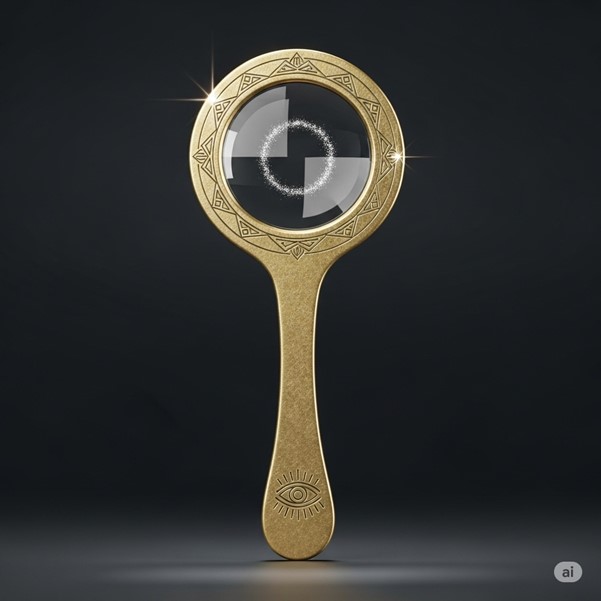
Description The Asbaran Lens is a simple, elegant tool. It consists of a single, perfectly ground circular lens of flawless quartz, approximately two inches in diameter, housed in a burnished brass frame. A short, six-inch handle, also of brass, extends from the frame, allowing it to be held to the eye like a monocle or magnifying glass, though the lens itself offers no magnification. The entire brass frame is covered with exceptionally fine, etched geometric patterns that represent cosmic order. Inscribed upon the handle is a single, stylized eye, the symbol of the Asbaran order. The item is unadorned with gems and gives off no magical aura to a casual observer, appearing as a high-quality piece of optical equipment.
Slot Held in Hand
Detailed Stats
- Investigative Acumen: +5 to all checks related to searching a location for hidden clues, tracks, or evidence.
- Deductive Reasoning: +4 to checks made to connect disparate pieces of evidence, reconstruct a sequence of events, or determine a motive.
- Lie Detection: Provides a +5 bonus to checks made to determine if a creature is telling a deliberate falsehood during an interrogation.
- Trail Focus: Increases the chance of successfully following a difficult or obscured trail by 15%.
Passive Magics
- Aura of Disturbance: When the wearer is physically present at a location where a significant act of violence, treachery, or intense fear has occurred within the past 48 hours, the brass handle of the lens becomes noticeably and unpleasantly cold to the touch. This passive effect alerts the investigator to the presence of a spiritual “wound” in the area, often before any physical evidence is discovered.
- Inconsistency’s Shimmer: When the wearer looks through the lens, mundane physical objects that are logically inconsistent with their surroundings will faintly shimmer with a silver light. This draws the eye to crucial out-of-place clues that would otherwise be missed: a dry cigar butt in a rain-soaked gutter, a single modern coin in a dusty tomb, a key made of a metal foreign to the region, and so on.
Activable Magics
- Scry the Emotional Scar: By channeling a small amount of their personal magic flow into the lens, the user can look through it to perceive the lingering emotional residue of past events. This does not show a replay of what happened. Instead, it overlays the user’s vision with faint, color-coded auras. Areas of intense violence are stained with a pulsing crimson; places where poison or deep deceit were employed are shrouded in a sickly, yellow-green mist; spots of profound fear or sorrow emanate a cold, ghostly blue. These auras fade over time but can be followed to locate a hidden weapon, trace an escape route, or find the primary location of a struggle. This ability can be used for up to five minutes per day.
- Focus on the Stuttering Heart: The user can activate the lens and focus on a single living creature they can see clearly. For the next minute, as the user looks at the target through the lens, the geometric patterns etched on the item’s frame will appear to slowly and smoothly rotate in their peripheral vision. If the target speaks a deliberate, outright lie, the smooth rotation of the patterns will hitch and stutter for a fraction of a second. This serves as a clear indication of falsehood but requires the user’s complete concentration on the target and the lens. This ability can be used on a single target once per hour.
Tags: Common, Tier 1, Investigation, Divination, Persian, Tool, Held, Truth, Mental, Utility, Forensic, Focus, Sensory, Diagnostic, Non-Combat, Aura, Asbaran, Subtle, Cognitive, Psychic
In the world of Saṃsāra, the Persian Five of the Asbaran Lens is a specialized tool, its value keenly understood by those who walk the path of justice, investigation, or the shadows. It is not an item found in a common market stall next to produce and pottery. Its trade happens in discreet offices, arcane circles, and the dangerous grey markets where information is its own form of currency. The standard monetary system of Gold Lira, Silver Shards, and Copper Bits applies.
1. The Investigator’s Supply & Sundry
Where: These discreet shops are tucked away in the respectable but quiet side-streets of major cities, often near the offices of magistrates or lawyers. They operate under unassuming names like “The Diligent Eye” or “Solutions & Findings.” The interior is not a cluttered mess but an orderly, practical space smelling of oiled leather, lens-cleaning solution, and the faint, sharp scent of focusing incense. Shelves are neatly stocked with high-quality lockpick sets, disguise kits, magically-shielded evidence containers, and other tools of the investigative trade.
How: The transaction is a professional courtesy. The proprietor is almost always a retired city guard captain or a former private inquisitor with a network of contacts and a world-weary cynicism. They would recognize the Asbaran Lens immediately and respect its history and function. They would likely engage the avatar in conversation to gauge their professionalism, perhaps asking about their guild license or a recent case. Selling to them is straightforward; they know the item’s worth and will not haggle extensively. Buying one might require the avatar to prove they are a legitimate investigator, as the proprietor is careful about such tools falling into the wrong hands.
Cost:
- Buying Price: The price is set for a professional market. It would be a firm 2 Gold Lira, a standard price for a reliable, non-combat magical tool of the trade.
- Selling Value: The proprietor, interested in keeping good equipment in circulation for their clientele, would offer a fair price of 1 Gold Lira and 50 Silver Shards.
2. The Arcane Diviner’s Sanctum
Where: This type of shop, often called “The Scryer’s Pool” or “The Eye of Ormazd,” deals in the subtle arts of magic. It is a place filled with crystal balls, obsidian mirrors, bundles of divinatory herbs, and ancient scrolls. The air is thick with the smell of exotic incense and the low hum of contained magical energy. The Asbaran Lens would be found among other tools of seeing, valued for its specific and reliable, if limited, application of divination magic.
How: The transaction here is an academic and magical one. The proprietor, likely a studious mage or an occultist, would be interested in the lens’s construction—the purity of the quartz, the precision of the etchings, and the nature of its aura. They would discuss its merits in comparison to other scrying devices. They might refer to its ability to see emotional residue as a “low-grade psychic reverberation echo.” Haggling would involve a technical discussion of its magical principles rather than its street-level utility.
Cost:
- Buying Price: Valued as a common but well-crafted divination tool, it would be priced at approximately 1 Gold Lira and 80 Silver Shards.
- Selling Value: A mage would recognize the quality of the enchantment and offer a respectable 1 Gold Lira and 20 Silver Shards, seeing it as a fine example of focused, low-power scrying.
3. The Constabulary Quartermaster’s Office
Where: This is not a public shop, but the official supply depot located within a fortified City Watch headquarters. The environment is spartan, organized, and secure, smelling of institutional soap and polished metal. Equipment is stored in locked cages, and every transaction is recorded in a heavy ledger.
How: Acquiring an Asbaran Lens here is a formal process, not a simple purchase. An avatar would need to either be a sworn member of the City Watch or a state-licensed Inquisitor with a significant reputation and the correct permits. They would file a formal requisition form. The item might not be for sale at all, but issued on loan for the duration of a specific case, possibly with a magical tracer to ensure its return. Payment might be in coin or in service, by agreeing to take on a number of pro-bono cases for the city.
Cost:
- Buying Price: If offered for sale to licensed freelancers, the price is standardized and non-negotiable: 1 Gold Lira and 75 Silver Shards.
- Selling Value: The City Watch does not purchase equipment from unofficial sources. Attempting to sell them a lens would be treated with extreme suspicion. They would assume it was stolen from a fellow officer, confiscate the item, and detain the seller for extensive questioning.
4. The Underworld Information Broker
Where: In the shadowy corners of society, there are those who trade not in goods, but in secrets. An information broker might operate out of a hidden back room of a tavern, a high-end gambling den, or a seemingly legitimate antiques shop. The Asbaran Lens is a tool they would value immensely, both for their own use and as a high-value item for trade.
How: A transaction with an information broker is a dangerous game of leverage. They would never sell such an item for mere coin unless the price was exorbitant. More likely, they would trade it for information of equal or greater value, or for the completion of a difficult task. To buy one, an avatar would need to have something the broker wants. To sell one, the avatar would find the broker is more interested in how they acquired it than in the item itself, hoping to gain intelligence on the city guard or a rival.
Cost:
- Buying Price: The monetary price would be a steep 4 or 5 Gold Lira, intended to be prohibitive. The “real” price would be a significant secret, a map to a hidden location, or performing a “job” for the broker.
- Selling Value: An information broker would offer very little coin, perhaps only 75 Silver Shards. The real payment would be in the form of a single piece of vital information, a password, or a meeting with a powerful underworld figure.
The Persian Five of the Asbaran Lens is a tool for uncovering truth, not a weapon of war. Its use in conflict is a matter of intellect and perspective, turning an investigation into an act of defense and a revelation into a form of attack. An avatar wielding the lens does not fight with steel, but with the inevitable power of the truth they uncover.
In the Polished Halls of a Royal Court
Here, battles are fought with whispers, accusations, and social leverage. A reputation can be shattered more easily than a shield.
Defense: A rival courtier accuses the avatar of conspiring with a foreign power, presenting a series of letters to the ruling Satrap as evidence. The letters are masterful forgeries, mimicking the avatar’s handwriting perfectly. As the avatar is allowed to inspect the evidence, they hold the Asbaran Lens before their eye. They don’t need to be a handwriting expert. The Inconsistency’s Shimmer passive causes the forged letters to glow with a silvery light, because the paper, though aged, is of a different pulp and origin than the royal stationery the avatar exclusively uses.
Armed with this knowledge, the avatar does not panic. They calmly address the court, “Your Excellency, I commend my rival’s artistry, but a lie always has a flaw. Look not at the hand, but at the paper. I have only ever used parchment from the Imperial Scribes.” They then use Focus on the Stuttering Heart on their accuser and ask, “Did you, or an agent in your employ, procure this paper from the mercantile house of the Five Isles?” The stutter in the lens’s pattern confirms the lie. The avatar has defended their honor not by refuting the lie, but by using the lens to uncover a deeper, provable truth, turning the accuser’s own evidence into a trap.
Offense: The avatar seeks to depose a corrupt minister who has been secretly embezzling from the treasury. A direct accusation would be political suicide without proof. The avatar instead secures an invitation to the minister’s opulent private study under the guise of discussing a new trade route. While there, they activate Scry the Emotional Scar. The room is pristine, but the lens reveals a faint, sickly yellow-green aura—the residue of deceit—clinging to a single, specific flagstone behind the minister’s desk.
The avatar now knows where the secret is. Later, they can use this knowledge to their advantage. They might anonymously tip off the Royal Guard, telling them to search that exact spot for a hidden ledger. Or, in a more direct offensive move, they could arrange for a “magical accident” during a party, causing a flask of wine to spill on that specific flagstone, which reacts with a divinatory agent mixed into the wine to reveal the compartment’s hidden seams. The lens did not provide the proof, but it provided the target, turning a political assassination into a simple matter of aim.
In a Shadowy Criminal Underworld
In the back alleys and secret warehouses of a great city, information is power and survival depends on seeing the trap before it springs.
Defense: The avatar, investigating a smuggling ring, arranges a meeting with a nervous informant in a grimy tavern. As they enter, the handle of the Asbaran Lens in their pocket turns unnaturally cold, the Aura of Disturbance warning them of recent violence. They are on high alert. The informant begins to speak, but the avatar uses Focus on the Stuttering Heart and sees the lens’s patterns stutter with every other word. The informant is not just nervous; he is being forced to feed the avatar a stream of lies—it’s a setup.
Simultaneously, the avatar casually scans the room through the lens. The Inconsistency’s Shimmer highlights two patrons who are not drinking, their mugs dry and clean on the wet, beer-stained table. They are the ambush. The lens has defended the avatar from two different angles: it has revealed the information is a lie and identified the physical threat. The avatar can now calmly make an excuse to leave the table, avoiding the trap entirely.
Offense: The avatar needs to dismantle the smuggling ring from the inside by turning its members against each other. They infiltrate the gang’s main warehouse. Using Scry the Emotional Scar, they discover that a particular crate in the corner radiates an intense crimson aura of violence and a cold blue aura of fear. Mundane investigation reveals nothing, but the lens insists this crate is important. The avatar waits for the gang to assemble. They then “accidentally” knock over a nearby lantern, which smashes and ignites the crate.
As the gang scrambles to put out the fire, the flames burn away the top layer of goods to reveal a false bottom, and underneath, the body of a rival gang member who went missing weeks ago. The smugglers are horrified. The avatar, feigning shock, points at the gang leader’s chief lieutenant and says, “I saw him near that crate yesterday! He looked nervous.” It’s a lie, but in the ensuing chaos, with the evidence of a secret murder now revealed, the seed of mistrust is sown. The lens found the emotional epicenter of the crime, and the avatar used it to light a fire that will consume the entire organization from within.
In the Wilds of an Uncharted Island
Here, the dangers are not just beasts, but the echoes of forgotten peoples and their magical traps.
Defense: While exploring the ruins of an ancient civilization, the avatar’s party comes across a perfectly preserved rope bridge spanning a deep chasm. It looks almost new. Suspicious, the avatar holds up the Asbaran Lens. The Inconsistency’s Shimmer makes the entire bridge glow with a silvery light. It’s an illusion. The real bridge rotted away centuries ago. What they see is a magical trap designed to lure them to their doom. The lens, by spotting the magical “lie,” has saved the entire party from a fatal plunge.
Offense: The avatar is tracking a cunning beast that has been preying on local villagers. The trail is difficult to follow, but the avatar is not tracking footprints. They are tracking the creature’s emotional wake. Using Scry the Emotional Scar, they follow the lingering trail of cold blue fear left by the creature’s victims. The trail leads them to a cave. However, the Aura of Disturbance is not active at the mouth of the cave; the lens handle is warm. This tells the avatar the creature is not currently home. This knowledge is an offensive advantage. The avatar doesn’t just know where the beast lives; they know the perfect time to enter its lair and set a trap of their own, turning the hunt around on their quarry.
Perception of Activation:
Sight
- User’s Perspective: When an ability is activated, the world seen through the quartz lens becomes an overlay of data. Mundane objects that are out of place shimmer with a faint silver outline. Lingering emotional energy from past events manifests as clouds of faint, colored light—crimson for violence, blue for fear. When focused on a person, the geometric etchings in the user’s peripheral vision appear to rotate, their rhythm changing with the subject’s truthfulness. The user is seeing two worlds at once: the physical and the metaphysical.
- Observer’s Perspective: The lens itself does not glow. To an onlooker, the quartz might seem to catch the light in an odd way, creating a brief, almost imperceptible distortion or shimmer, like heat haze, at the moment of activation. Otherwise, they merely see a person holding a magnifying glass to their eye with intense concentration.
- Positives: It provides a wealth of visual information that is invisible to the naked eye. The subtlety of the external effect makes it relatively discreet, allowing it to be used without obviously declaring the use of magic.
- Negatives: The overlay of magical information upon normal sight can be disorienting and could cause the user to miss important physical details while they are focused on the auras. Prolonged use can lead to significant eye strain and headaches.
Sound
- User’s Perspective: Activation is accompanied by a faint, high-frequency “clicking” sound that seems to originate inside the user’s own head. It is the sound of a complex analytical machine processing information. The rate and pitch of the clicks change depending on what the lens is focused on, becoming more rapid and higher-pitched when centered on a significant clue or a strong emotional residue.
- Observer’s Perspective: The item is completely silent to any outside observer.
- Positives: The auditory feedback is an excellent complement to the visual information, allowing the user to “hear” when they are getting closer to a point of interest without having to visually scan every single object in a room.
- Negatives: The constant, high-frequency internal sound can be intensely irritating during long investigations, potentially leading to migraines or making it difficult to concentrate on ambient sounds or conversations.
Touch
- User’s Perspective: When an active ability is used, a very fine, high-frequency vibration can be felt in the brass handle, synched with the clicking sound the user hears. It feels like holding a piece of precision clockwork. The passive ability is distinct: when near a place of recent violence or deceit, the brass handle becomes unnaturally and noticeably cold.
- Observer’s Perspective: An observer would not feel the vibration. However, if they were to touch the handle when the passive ability is active, they would be startled by its distinct, unnatural coldness.
- Positives: The cold handle is an unambiguous and silent alarm system, warning the user of danger. The vibration provides tactile confirmation that an active ability is working correctly.
- Negatives: The sudden cold sensation can be jarring and might cause the user to drop the lens if they are not expecting it. The subtle vibration could make it difficult to perform other delicate tasks, like sketching a clue, while actively using the lens.
Smell
- User’s Perspective: The activation creates a sharp, sterile, and metallic scent in the user’s perception, like the smell of ozone after a lightning strike or the air in a magically-powered analytic engine. It is the scent of reality being dissected and analyzed.
- Observer’s Perspective: The lens emits no physical odor.
- Positives: The sharp, distinct scent can cut through other distracting smells at a crime scene (such as decay or filth), helping the user to focus their mind on the analytical task at hand.
- Negatives: The scent is acrid and artificial. It can easily overwhelm more subtle, mundane scents that might themselves be important clues (e.g., a specific perfume, the smell of a particular tobacco).
Taste
- User’s Perspective: A faint, staticky taste develops on the tongue, as if licking a small battery terminal but without the pain. It is the taste of raw information and focused magical energy.
- Observer’s Perspective: None.
- Positives: This provides another layer of sensory feedback, confirming that the lens’s magic is flowing.
- Negatives: The sensation is strange and can be distracting, especially if trying to speak or interrogate someone while simultaneously using the lens to analyze their responses.
Extra-Sensory Perception: Causal Intuition
- User’s Perspective: The user receives intuitive flashes of causality. When looking at a clue—a dropped knife, a broken window—they get a psychic “nudge” or feeling pointing towards its immediate cause. They don’t just see the knife; they get a feeling of it being “dropped in haste.” They don’t just see the broken window; they feel the “external force” of it being broken from the outside.
- Observer’s Perspective: None. This is a purely internal cognitive leap.
- Positives: This dramatically accelerates the deductive process, allowing the user to form accurate hypotheses and connect disparate clues with what feels like supernatural insight.
- Negatives: The insights are feelings, not facts. The user might latch onto a compelling but incorrect causal feeling, leading them to develop confirmation bias and ignore contradictory physical evidence. It encourages intuitive leaps that can sometimes be wrong.
Extra-Sensory Perception: Empathic Echo
- User’s Perspective: When viewing the colored auras of emotional residue, the user feels a faint, muted echo of that emotion within themselves. A crimson stain of violence might be accompanied by a flash of phantom pain or anger; a blue cloud of fear might impart a momentary, gut-wrenching anxiety.
- Observer’s Perspective: An observer with high empathy might notice the user flinch, shudder, or their expression flicker with an emotion that is out of place with the current situation.
- Positives: This provides much richer context than the visual aura alone. It allows the user to differentiate between the terror of a victim and the panicked guilt of a perpetrator, or the cold-blooded rage of a professional killer versus the hot anger of a crime of passion.
- Negatives: This is the most dangerous aspect of the lens. Constant, direct exposure to the raw emotional echoes of violent crimes can be deeply traumatizing, leading to nightmares, paranoia, and psychological burnout. It requires a strong will to process these feelings without being consumed by them.
Extra-Sensory Perception: Pattern Recognition
- User’s Perspective: This is a holistic, almost passive sense of a system’s “correct” state. The user develops an intuitive feel for the normal patterns of a place or organization. A bustling market has a certain rhythm; a conspiracy or criminal enterprise creates dissonant ripples in that pattern. The testimony of an honest person has a logical, consistent pattern; a lie creates observable, if subtle, deviations.
- Observer’s Perspective: None.
- Positives: This allows the user to detect large-scale or systemic anomalies that have no single, obvious clue. They can sense that “something is wrong” with a merchant guild’s finances or a neighborhood’s social dynamics long before anyone else.
- Negatives: The world can become a dizzying, overwhelming sea of data and patterns. It can be difficult to differentiate between a truly sinister deviation and a harmless eccentricity, potentially leading to paranoia and a tendency to see conspiracy in everything.
Rite of the Witness Lens: This crafting process details the creation of an Asbaran Lens, a fundamental tool for any who seek to unravel the truth behind a crime or conspiracy. The procedure is one of precision and conceptual focus, requiring the skills of a lapidary, a metalsmith, and a diviner. It is believed that the geometric patterns etched into the frame are not merely decorative, but act as a magical formula that filters and translates the chaotic energies of a crime scene into perceivable information.
Materials Needed
- Physical Components:
- A flawless, uncut quartz crystal, fist-sized or larger, known as a “Scryer’s Heart.”
- One ingot of high-purity brass for casting the frame and handle.
- A small quantity of jeweler’s rouge and fine polishing oils.
- Magical Reagents:
- Essence of Connection: Seven drops of morning dew, collected from a single, unbroken spider’s web at dawn. This is the primary agent for the lens’s ability to reveal hidden patterns and inconsistencies.
- Dust of Resonance: A thimbleful of a fine powder made from equal parts crushed silver filings and powdered moonstone. This dust is used to sensitize the frame to spiritual and emotional echoes.
- The Tear of Sincerity: A single, crystallized tear shed from an act of true, uncoerced remorse or joy. This incredibly rare reagent is the key to focusing the lens’s truth-divining capabilities.
Tools Required
- Mundane Tools:
- A lapidary’s workbench, complete with a magically-powered grinding wheel and polishing pads.
- A small crucible and casting mold for the brass frame.
- A set of masterwork metal files and engraving needles for the fine detail work.
- A non-magical clamp with padded grips to hold the lens during infusion, known as a “Third Hand.”
- Magical Implements:
- An Alchemical Distiller: A small, glass alembic used to purify and concentrate the Essence of Connection.
- A Harmonic Resonator: A small, brass bowl. When a magical powder is placed inside and the bowl is struck, it vibrates at a specific frequency, aligning the powder’s magical properties.
- A single cat’s whisker, to be used as a brush for the final anointment.
Skill Requirements
- Lapidary Arts (Journeyman): The crafter must be skilled in grinding a raw crystal into a perfectly clear, optically neutral lens without creating internal fractures.
- Fine Metalworking (Journanyman): The ability to cast, file, and engrave the brass frame with extreme precision is required. Flaws in the geometric patterns will cause the magic to fail.
- Alchemy (Novice): The user must be able to handle and prepare the magical reagents, particularly the distillation of the dew and the energizing of the Dust of Resonance.
- Tier 1 Divination (Practiced): The magic involved requires the crafter to channel and focus abstract concepts of perception, truth, and emotional echoes into the physical object.
Crafting Steps
Step 1: Grinding the Lens The crafter begins by cutting and grinding the raw quartz crystal. This is a slow, methodical process of shaping the stone into a perfect, two-inch circular lens. It must be ground with absolute precision to be optically flat, offering no magnification, as its purpose is to see magically, not physically.
Step 2: Forging the Frame Simultaneously, the brass ingot is melted in the crucible and cast into the rough shape of the frame and handle. Once cooled, the crafter begins the painstaking work of filing the frame to its final, elegant shape and polishing it to a mirror shine.
Step 3: Etching the Patterns of Order This step is a form of meditation. The crafter uses the fine engraving needles to meticulously etch the complex geometric patterns into the frame and the stylized eye onto the handle. Each line must be perfect, as these etchings form the “circuitry” that will channel and interpret the magic.
Step 4: The Lens’s First Light The Essence of Connection (the spider’s web dew) is placed into the Alchemical Distiller and gently heated until only a single, hyper-potent drop remains. The crafter carefully anoints the surface of the polished quartz lens with this single drop. The lens will briefly shimmer, its crystalline matrix now permanently attuned to perceiving hidden connections and inconsistencies in the world.
Step 5: Infusing the Frame The Dust of Resonance (silver and moonstone powder) is placed into the Harmonic Resonator bowl. The crafter strikes the side of the bowl, causing it to hum and the dust to vibrate, aligning its magical properties. While it hums, the crafter assembles the anointed lens into the frame using the Third Hand clamp. They then channel their magic into the frame, focusing their intent on “seeing what was” and “feeling the unseen.” The humming dust is sprinkled over the frame, where it is absorbed as magical energy, empowering the frame with the ability to detect spiritual residue.
Step 6: Anointing the Eye of Truth This is the final, most delicate ritual. The Tear of Sincerity is carefully dissolved in a single drop of the remaining distilled dew. Using the cat’s whisker as a brush, the crafter paints this solution into the engraved eye on the handle. As they do, they must meditate on the concept of a lie versus a truth, feeling the dissonance of a falsehood. This act attunes the lens to the specific vibrations of deception. The lens is now fully assembled but dormant.
Step 7: The First Witnessing To awaken and calibrate the lens, the crafter must use it to observe a simple, undeniable truth unfold. Traditionally, this is done by watching a glass of salt water evaporate, leaving the salt crystals behind. By focusing on this irreversible, honest process through the lens, the item’s magic becomes calibrated to the natural order of the world. Its powers are now active and ready for use.
Judge, Smoke, and Eye of Echoes
It is said in the oldest scrolls that there was a city called Susa, and it was a city of straight lines. Its laws were clear and its justice was sharp, and the one who held the scales of this justice was the Judge Kavi. In the time of Kavi, no crime went without its answer, and no lie could stand long in the light of his court.
And it was so.
Then, a crime that was a hole in the world came to be. The great architect of the Satrap, a man who built towers to touch the heavens, was found ended in a room that was locked from the inside. There was no mark upon his body, no poison in his cup, no weapon upon the floor. All who were in that wing of the palace had a gray fog in their minds; the hour of the ending was a blank space in their memory. The crime was a perfect silence, a vacuum of truth.
For a month, Judge Kavi investigated. He looked at the perfect room with his own two eyes and saw nothing. He spoke to the forgetful people and heard nothing. The straight lines of his city began to bend. The people whispered that there was a crime justice could not solve. The Satrap grew impatient and spoke to Kavi, saying, “You are my eyes for justice, but you are blind. Find the truth by the next full moon, or your time in this city is ended.”
Kavi, in his despair, left the city of straight lines and traveled to the crooked places of the earth. He went to a cave deep in the mountains, a place called the Web of Echoes. It was said that the Great Weaver, a spirit neither good nor evil, a spirit of What Was, lived there. The Great Weaver saw not the present, but the infinite echoes of every act that had ever been.
Kavi stood at the mouth of the cave and did not pray, for the Weaver is not a god. He simply spoke into the darkness, “There is a hole in the world, a crime with no echo. I am blind to it. I ask for an eye that can see what has been washed away.”
A voice, like the rustling of a million dry leaves, answered him. “The killer you seek is the Man of Smoke. He uses a magic of un-making. He does not just kill; he makes it so the killing never truly was. He erases the echoes. To see a thing with no echo, you must have an eye that sees the web itself.”
The voice offered Kavi a choice. He could give one of his own eyes to the Weaver, and in its place would grow a new eye of shimmering thread that could see all that was. Or, he could craft a new, third eye from the bones of the world. Kavi, not wishing to part with his own sight, chose to craft.
The Weaver gave him instructions. “You will find a pure quartz crystal, a tear of the mountain that has never known a crack. You will grind it into a lens, a new eye. You will frame it in brass, the metal that remembers the heat of the fire. You will carve upon the frame the Pattern of Inevitability, for no act can escape its consequence. Then you will anoint it, not with magic oil, but with a single drop of your own blood, shed not from a wound of anger, but from a cut of pure desire for the truth. For the eye must be bound to one who seeks.”
And so it was.
Kavi did as he was instructed. He found the crystal tear and ground it. He forged the brass and carved the pattern. On the night of the full moon, he returned to the Satrap’s court. He took a scribe’s sharp knife, thought only of the perfect crime and his desire for its answer, and pricked his thumb, letting one drop of blood fall upon the stylized eye on the handle of the lens.
He held the new eye, the Asbaran Lens, to his own. The world he saw was the same, yet not the same. He walked into the perfect, silent room of the crime. Now it was not silent. It screamed with color. A faint red mist of violence clung to the spot where the architect had fallen. A sickly green trail of deceit led from the wall to the man’s cup. Kavi looked at the wall, and through the lens he saw the shimmer of a lie, an inconsistency. He touched the wall, and a hidden panel opened, revealing a tiny tube through which a poisoned dart had been fired.
He returned to the court. He looked at the assembled nobles through the lens. He saw their secrets and their fears as faint, colored clouds. He came to the Satrap’s new food taster, a quiet and unassuming man. Kavi held the lens to his eye and asked, “What service did you render the great architect on the day he was ended?”
The man answered with a lie, a simple denial. But as he spoke, Kavi saw the geometric patterns on the lens stutter and seize. He then pointed to the food taster and spoke to the court. “The Man of Smoke is before you. The architect was ended not by a man in the room, but by a poison dart fired from the room next to his. The room where this man, the new food taster, was tasting the food.” The truth, once seen, was undeniable. The Man of Smoke was revealed not by a witness, but by the echo of his own dark act.
And so it was.
Moral of the story: No act is without its echo.
Suggested conversions to other systems:
Dungeons & Dragons (5th Edition)
Lens of the Asbaran Inquisitor Wondrous item, uncommon (requires attunement)
This handheld lens consists of a flawless, circular piece of quartz set in a burnished brass frame with an elegant handle. The frame is etched with fine, geometric patterns. While the lens offers no magnification, it sharpens the user’s eye for details the world tries to hide.
This lens has 3 charges. It regains all expended charges daily at dawn.
- Investigator’s Acuity. While holding the lens, you can use it as a spellcasting focus for divination spells. You also have advantage on Intelligence (Investigation) checks.
- Scry Emotional Residue. As an action, you can expend 1 charge and look through the lens for the next 10 minutes. During this time, you can see faint, colored auras clinging to objects and surfaces where a powerful emotional event has occurred within the past 24 hours. The color of the aura corresponds to the emotion felt: crimson for intense anger or violence, deep blue for profound sorrow or fear, and a sickly yellow-green for acts of powerful deceit or envy.
- Focus on the Truth. As an action, you can expend 1 charge to focus on one creature you can see within 30 feet of you. For the next minute, you have advantage on any Wisdom (Insight) check you make to determine if the target is being deceptive.
Call of Cthulhu (7th Edition)
The Ostanes Lens Artifact
A strange, pre-classical magnifying glass made of brass and a flawless quartz crystal. The geometric etchings on its frame are precise in a way that feels alien and unnerving. It does not magnify text, but instead seems to magnify the truth, a concept that can be dangerous to the fragile human psyche.
An Investigator holding the lens gains the following abilities:
- Perceptive Insight. The holder gains one Bonus Die on all Spot Hidden rolls made to find physical clues at the scene of a crime or other mysterious event.
- Glimpse the Taint. By looking through the lens, the Investigator can see the psychic stains left behind by intense human emotion. Doing so requires a Hard POW roll. On a success, the Keeper describes the nature of the emotions (e.g., terror, rage, deceit) that are strongest in the area. Witnessing such raw, unfiltered emotion is jarring and costs 0/1d2 Sanity points.
- Focus on the Falsehood. When questioning a subject, the Investigator can focus on them with the lens. This grants one Bonus Die to all Psychology rolls made to determine if the subject is lying. However, directly perceiving the mental contortions of deceit is unsettling, costing the Investigator 1 Sanity point for each lie they successfully detect this way.
Blades in the Dark
The Inquisitor’s Eye Arcane Implement, Handheld, Seeing
A relic from the time of the first Inquisitors, this brass-framed lens is said to have been carved from a crystal found in the heart of a “truth-telling” geode. The Spirit Wardens are wary of such items, as they believe looking too closely at the echoes of the past can invite unwanted attention from the ghost field.
- When you Survey a scene to uncover evidence or understand what happened, you get +1d to your roll.
- You can use the lens to gaze into the ghost field, seeing the emotional echoes of recent, intense events as ghostly tableaus. When you do this, you may ask the GM, “What is the strongest emotion lingering here?” and get an honest answer.
- When you study a person through the lens, you can tell when they are telling a direct lie. The GM will inform you, but your target may make a Insight roll to notice your unnerving, analytical stare.
- When you are attempting to solve a mystery, you can push yourself to ask the GM for one direct, helpful clue for only 1 stress (instead of the usual 2).
Knave (2nd Edition)
The Asbaran Seer’s Glass Tool (1 slot)
A handheld looking glass made of brass and flawless crystal. The handle is always cold to the touch in a place where violence has occurred within the last 24 hours. The etchings on the frame seem to slowly move when you aren’t looking directly at them.
- Usage Die: This item starts with a d6 Usage Die. When you use one of the abilities below, roll the die. If the result is a 1-3, the die is expended until you can rest for a full day in a safe place.
- Reveal the Unseen: While looking through the glass, you automatically see the faint outlines of hidden or out-of-place objects.
- Gaze on Scars: (Costs a use) You can see the psychic stains left by powerful emotions (rage, fear, deceit) as colored mists clinging to the environment.
- Witness the Lie: (Costs a use) You can focus on one person for a full minute. For the rest of that conversation, you know for certain if they speak a deliberate falsehood.
Fate Core System
The Lens of Inevitable Truth
This item is an Extra, a physical manifestation of the principle that no action occurs without leaving an echo.
- High Concept Aspect: The Echo of Every Action
- Trouble Aspect: Sees Truths Best Left Unseen
Stunts:
- Gaze Upon the Stain: Because I possess The Lens of Inevitable Truth, once per scene when examining a location, I can spend a Fate Point to see the psychic residue of past events. I can ask the GM to create a new Situation Aspect on the scene representing the strongest emotion that occurred there (e.g., Lingering Aura of Violent Betrayal, Resonant Fear of a Trapped Soul).
- The Flaw in the Pattern: Because I possess The Lens of Inevitable Truth, I get a +2 bonus to all Investigate rolls when I am physically searching a scene for hidden objects, inconsistencies, or other physical clues.
- A Lie Has No Weight: Because I possess The Lens of Inevitable Truth, twice per session, I may use the lens to look at a character after they have made a statement and ask the GM, “Is that a deliberate lie?” The GM must answer with a simple “yes” or “no.” This stunt does not reveal the truth, only the presence of falsehood.
Numenera & Cypher System
The Causal Lens
- Level: 3
- Form: A handheld lens of polished crystal set in a brass frame etched with geometric patterns.
- Effect: This device resonates with causality, allowing the user to perceive echoes of past events and disturbances in the truth. It eases all tasks related to searching a location, forensic analysis, and spotting lies by one step. Once per day, the wearer can activate the lens to see a visual representation of significant emotional events that have occurred in their immediate vicinity within the last 28 hours. These appear as shimmering, colored, heat-haze-like distortions. The wearer can also activate it and focus on a single individual to analyze their bio-signs and micro-expressions. The GM will inform the player if the target is consciously attempting to deceive them.
- Depletion: 1 in 1d20 (Check each time the emotional residue or lie detection ability is used.)
Pathfinder (2nd Edition)
Asbaran Investigator’s Lens Item 3
- Traits: Common, Invested, Magical, Divination
- Usage: Held in 1 hand; Bulk L
This finely crafted brass-framed lens holds a flawless quartz crystal. While it does not magnify, looking through it seems to bring the hidden details of the world into sharp focus. You gain a +1 item bonus to Perception checks made to Seek.
- Activate [two-actions] (Concentrate, Secret); Frequency once per 10 minutes; Effect You raise the lens and focus on one creature within 30 feet that you can see and hear. For the next minute, you have a heightened sense of their honesty. Each time the target speaks, the GM secretly rolls a Perception check for you against the target’s Deception DC.
- Critical Success You know for sure whether they are lying or telling the truth.
- Success You get a strong feeling about whether they are lying or telling the truth. The GM might tell you “you’re almost certain they are lying,” but isn’t required to be definitive.
- Failure You learn nothing.
- Critical Failure You get a false result, believing a lie to be true or vice-versa.
- Activate [one-minute] (Concentrate, Explore); Frequency once per hour; Effect You use the lens to scan an area with a 30-foot radius centered on you. The lens reveals the faint, ghostly echoes of one significant emotional event (such as a murder, a betrayal, or a moment of great terror) that has occurred in the area within the past week, as determined by the GM. This vision is brief, silent, and provides a clue, not a full replay of the event.
Savage Worlds (Adventure Edition)
The Inquisitor’s Glass
This handheld lens, made of brass and crystal, is an ancient tool for finding the truth. Its handle feels cold in the presence of death, and its lens seems to shimmer over things that are hidden.
- Seeker’s Eye: The wearer gains a +1 bonus to all Notice and Investigation rolls.
- Reveal the Lie: The user can use this lens to initiate a Test against a target using their Smarts instead of Agility or Strength. If successful, instead of making the target Shaken, the user knows for certain if the target’s most recent statement was a deliberate lie.
- Find the Unseen: Once per session, the user can ask the GM to point out one significant physical clue at a crime scene or other location that would have otherwise been missed.
- Psychic Scar: By spending a Bennie while investigating a location, the user can see a brief, ghostly flash of the most violent or emotionally charged event that happened there, revealing a single, crucial piece of information about what transpired.
Shadowrun (6th Edition)
Asbaran Truth Lens
This appears to be an antique brass magnifying glass but is, in fact, a powerful Divination Focus. Its quartz lens is a complex matrix for filtering astral information, and the handle acts as an ergonomic antenna for the user’s own magical senses. It is a favored, if rare, tool for magically active detectives and corporate espionage specialists.
- Focus Type: Divination Focus
- Force: 3
- Activation: Simple Action
- Availability: 10R
- Cost: 18,000 Nuyen
Game Mechanics:
- Investigative Insight: As a Force 3 Divination Focus, this item adds 3 dice to the user’s dice pool for any test using the Perception skill to visually search an area or the Judge Intentions action.
- Astral Residue Analysis: The wearer can use an Assensing test to analyze a physical location, not just an aura. The number of net hits determines how much detail the GM reveals about the strongest emotional event that has occurred there in the past 24 hours (e.g., 1 hit reveals “violence,” 3 hits reveals “violence from a blade, laced with betrayal”).
- Eye for Inconsistency: When making a Perception test to find a hidden object, panel, or other physical anomaly, the wearer gains 1 point of Edge. This Edge must be used on that test.
- Lie Analysis: When using the Judge Intentions action on a target, a successful test reveals not only the target’s general emotional state but also provides a distinct psychic “hitch” if the target tells a direct, deliberate lie.
Starfinder
Inquisitor’s Ocular
- Level: 4
- Price: 2,000 credits
- Bulk: L
- Hands: 1
- Type: Hybrid Item; Slot: —
A relic that blends ancient magic with principles of modern sensory technology, the Inquisitor’s Ocular is a handheld brass-framed lens used by Stewards and private investigators. It requires a battery to power its more advanced functions but uses psychic energy for its primary analysis.
- Capacity: 20; Usage: 1/hour of continuous use
- While holding the Ocular, you gain a +2 insight bonus on Perception checks to search a location and on Sense Motive checks.
- Emotional Echo Scan (Magic): Once per day, you can spend 10 minutes concentrating on a single room (up to a 30-ft. square). At the end of this period, the lens reveals faint, holographic outlines of where any creatures experienced intense emotions (fear, rage, sorrow) within the last week.
- Micro-expression Analysis (Tech): As a move action while the Ocular is powered, you can designate one creature you can see. For the next minute, the lens analyzes their heart rate, pupil dilation, and micro-expressions, granting you advantage on your next Sense Motive check made to determine if that creature is lying.
Traveller (Mongoose 2nd Edition)
Oculan-Series Diagnostic Lens (TL 16)
This device is an artifact of a Precursor society, colloquially known as an “Oculan Lens.” While appearing as a simple brass looking-glass, it is a sophisticated handheld diagnostic tool that uses a suite of esoteric sensors to analyze its environment on a physical and quantum level. It is considered priceless and is highly sought after by intelligence agencies and wealthy collectors.
- Investigative Suite: The lens contains advanced imaging and sensory technology. It provides the user DM+2 on all Investigate checks.
- Psychohygienic Analysis: The lens can perform a full-spectrum scan of a location (up to 100 square meters) for residual pheromones, bio-signatures, and exotic particle decay. This analysis creates a “psychic residue” map, indicating the nature and intensity of emotions experienced in the area within the last 72 hours. Interpreting the complex data requires an Investigate 10+ check.
- Bio-Lie Detection: When focused on an individual, the lens performs a remote scan of their vital signs (heart rate, respiration, galvanic skin response). This provides the user with DM+2 on any check made to determine if the target is being truthful (e.g., an opposed Persuade vs. Deception check).
- Anomalous Pattern Recognition: The lens constantly scans its environment, highlighting materials or energy signatures that are inconsistent with their surroundings. This provides the user DM+4 on any check to discover hidden compartments, secret doors, or concealed technology.
Warhammer Fantasy Roleplay (4th Edition)
The Lens of Stern Judgment
This heavy, brass-framed lens is said to have been crafted by a master artisan of the Cult of Verena, the goddess of Justice and Wisdom. The flawless quartz within is inscribed with microscopic litanies of truth, and the handle is weighted with blessed silver. It is a holy instrument for any who would seek to expose the lies of heretics, mutants, and criminals.
- Unwavering Gaze: The wearer of the lens is filled with the stern resolve of Verena herself. They gain a +10 bonus to all Perception Tests made to search for physical clues.
- Glimpse the Taint of Emotion: By making a Challenging (+0) Cool Test to quiet their own emotions, the user can gaze through the lens and see the lingering stains powerful emotions leave upon a place. On a success, the GM must describe the nature of the strongest emotion (Rage, Fear, Deceit, etc.) that permeates the area. If the Test is failed, the user is overwhelmed, gaining 1 Fatigued Condition.
- Weigh the Spoken Word: When making an Intuition Test to determine if a character is lying, the user may look through the lens. If they do, they may choose to use their Willpower Bonus on the Test instead of their Intuition Bonus.
- No Deceitful Stone Unturned: The lens is blessed against trickery. When making a Perception Test to find something that is purposely hidden (a secret door, a hidden cache), the wearer ignores any penalties from poor lighting and may treat any roll of 96-00 (a Critical Failure) as a standard Failure instead.