
Lore
- In the imperial courts and mountain monasteries of Saṃsāra, food is considered the primary vessel through which elemental harmony enters the mortal vessel, governed strictly by the Five Transformations (Gogyō).
- Kitchen-wardens and reincarnated onmyoji who dedicated their practice to the culinary arts developed specialized cooking implements to harmonize the Five Flavors—sweet, sour, bitter, pungent, and salty—with their corresponding elemental phases: Earth, Wood, Fire, Metal, and Water.
- Numbered 19 in an heirloom series forged for the Bureau of Imperial Repast, this skewer was distributed to field culinarians and wandering ascetic chefs to purify wild ingredients, regulate internal spiritual qi through cooking, and ward feasts against malevolent spirits and seasonal decay.
- By aligning the kitchen hearth with the diurnal transit of Helios and the moisture cycles of VaporSphere, the implement ensures that even the coarsest travel rations are transmuted into balanced, life-sustaining cuisine.
Description
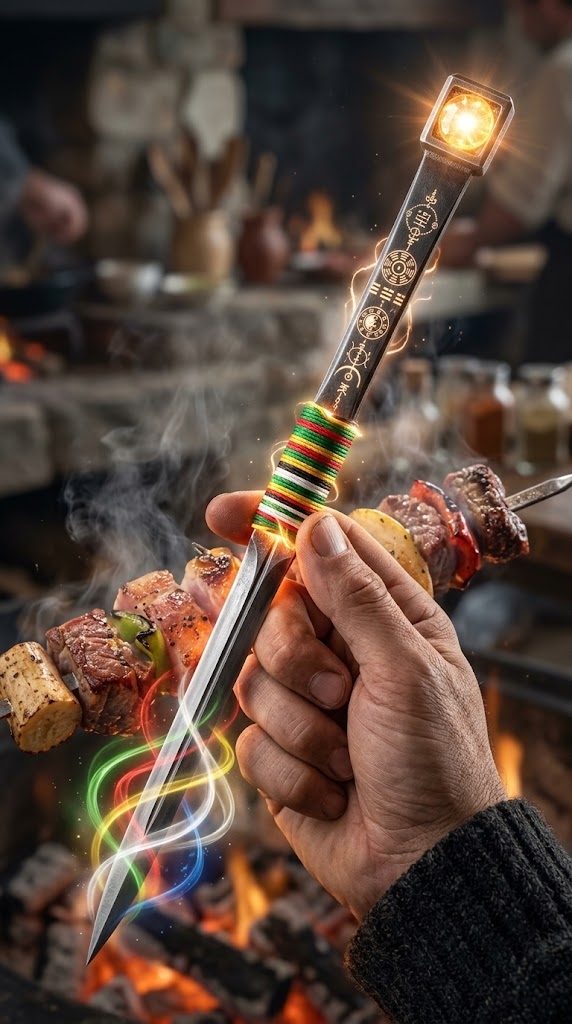
- The skewer is an eleven-inch-long cooking spit forged from folded river iron, polished to a dull silver sheen and tapering to a needle-sharp, triangular point.
- The upper handle section is wrapped in five distinct strands of lacquered silk thread—green, red, yellow, white, and black—representing the five elemental phases and providing a heat-resistant grip.
- Set directly into the square pommel crown is a tier 1 magic crystal, cut to the size and weight of a standard silver coin, glowing with a warm, embers-and-honey amber light.
- Along the four flat facets of the iron shaft, delicate acid-etched Onmyodo cooking seals, trigram charts, and planetary season registers run from the hilt down to the piercing tip.
- When brought near cooking food or open fire, the skewer emits a faint, pleasant sizzle accompanied by the comforting aroma of toasted sesame, scorched ginger, and roasted cypress wood.
Detailed Stats
- Tier: Tier 1
- Rarity: Common
- Item Level: 1
- Item Armor Check: 0
- Item Resilience: 10
- Maximum Item Hit Points: The avatar’s maximum hit points plus 10
- Attunement Type: Handheld attunement (attunes immediately upon being handled; does not occupy a worn equipment slot while held as a culinary tool)
- Weight: 1 pound
- Operational Scope: Food purification, flavor balancing, caloric enhancement, and spiritual preservation
- Structural Integrity: Whenever the bearer concludes an active activation involving magical cooking or food purification, roll a d20; on a roll of 1, the amber pommel crystal fractures into brittle sugar-like crumbs, neutralizing all active magical properties until replaced and consecrated.
Slot
- Hand Slot (Right or Left)
Passive Magics
- Palatable Purification Sense: While the skewer is held, thrusting the tip into any ingredient, broth, or meat illuminates natural rot, parasitic eggs, venom, and alchemical poisons as a dark oily sheen along the etched trigrams, while pure ingredients cause the blade to shine with a clear golden gloss.
- Even-Fire Transference: When the skewer is driven through meat, vegetables, or roots cooking over a campfire, it distributes heat perfectly throughout the food’s interior, cooking items in half the normal time without scorching or drying them out.
- Culinary Qi Infusion: Meals prepared using the skewer as an active cooking or stirring implement naturally realign the diner’s internal bodily phases, granting anyone who consumes a full portion temporary resistance to mundane indigestion, nausea, and mild heartburn for eight hours.
Activable Magics
- Five-Phase Seasoning: By spending one action to spin the skewer three times over an unseasoned pot of broth or skewered food while chanting a brief Onmyodo incantation of fewer than six seconds, the user attunes the dish to one chosen elemental flavor (Wood/Sour, Fire/Bitter, Earth/Sweet, Metal/Pungent, Water/Salty). The food gains the rich, fully developed taste of that flavor as if seasoned by a master chef with rare spices, completely masking stale or bland ration flavors for up to five servings.
- Impurity Purge: By spending an action to plunge the skewer into a prepared meal or beverage (up to five gallons or five rations) and pressing down upon the amber pommel stone, a brief flash of cleansing fire runs along the shaft. All mundane toxins, food-borne bacterial rot, spoilage, and non-magical filth within the food are instantly vaporized into a puff of white steam, rendering the nourishment safe, fresh, and hot.
- Hearth Ward of the Stove God: By spending one action to plant the skewer upright in the ground beside an active cooking fire or camp hearth, the user establishes a protective barrier. For four hours, vermin, wild scavenging insects, and minor wandering spirits of tier 1 or lower cannot cross a ten-foot radius around the fire, leaving the camp’s cooking stores and sleeping culinarians unmolested.
Tags
- Tool, Onmyodo, Culinary, Five Phases, Food Purification, Handheld, Skewer, Tier 1, Common, Flavor Balancing, Hearth Ward, Gogyō Cooking, Poison Detection, Camp Hearth, Silk Wrap, Spice Alchemy, River Iron, Spit Roasting, Rations Blessing, Caloric Focus, Kitchen Exorcism, Stove Deity Ward
Culinary Guild-Houses, Tea-House Pantries, and Riverfront Caravansaries
- Bureau of Imperial Repast Commissary and Master Culinarian Guildhalls:
- Situated within administrative district squares, palace-side provisions markets, and formal culinary academies in provincial capitals, these polished establishments supply licensed imperial chefs, banqueting officers, and tea masters.
- The interior is orderly and fragrant with dried mountain citrus, sweet mirin, cured soy wood, and polished cedar shelving, displaying stacked lacquered meal-boxes, copper kettles, porcelain tasting bowls, and silk-wrapped knives.
- Buying an authorized skewer from an imperial provisioning factor commands a baseline price of 10 silver, though periods preceding seasonal state banquets or court festivals often see list prices rise between 10 silver and 14 silver.
- Avatars presenting active guild credentials, apprentice seals from an accredited kitchen academy, or an Imperial Repast dispensation receive a 10% discount per character tier level, purchasing the skewer for 9 silver.
- Selling the skewer here requires the proctor to test the silk braid against hot tallow to verify heat resistance; the bursar pays 10% of the baseline value times the avatar’s tier level, transferring 1 silver into the seller’s World Bank ledger.
- Mountain Monastery Pantries and Ascetic Provisions Exchanges:
- Located along steep pilgrim passes, secluded valley shrines, and hillside tea-terraces, these tranquil trading-rooms provide supplies to wandering mendicants, ascetic cooks, and herbalists.
- The air is cool and scented with toasted buckwheat, smoked kelp, and drying lotus pods, featuring heavy pine storage bins, earthenware fermentation crocks, stone grain mills, and racks of wild mountain teas.
- Monastic storekeepers maintain skewers primarily as tools of purity and sustenance for long wilderness retreats, pricing them steadily between 10 silver and 13 silver based on the depth of the amber pommel stone’s internal fire.
- Travelers carrying recognized pilgrim badges, temple seals, or herbalist warrants qualify for an ascetic fellowship discount of 10% per character tier level, reducing the cost to 9 silver.
- When selling an implement to a monastic steward, the proctor dips the tip into sour curd to observe the golden resonance of the Earth-trigrams before issuing 1 silver into the avatar’s World Bank balance or offering an equivalent value in pressed tea cakes and dried mushrooms.
- Dockside Caravansaries and Floating Night Markets:
- Found along silted canal intersections, crowded river-barge docks, and frontier trade junctions where river travelers, meat-smugglers, and caravan drovers congregate.
- The markets are loud, smoky, and humid, thick with the smells of sizzling offal, fermented fish paste, river mist, and cheap rice liquor, set among weathered timber stalls, floating sampan storefronts, and hanging salt-pork racks.
- Outpost drovers and barge-cooks buy these implements without official paperwork to purify river-swill and prevent spoiled rations from causing dysentery during long hauls, paying exclusively in physical silver coin.
- A working skewer in these docks commands a marked-up price of between 15 silver and 21 silver in coin due to high demand among wilderness scouts who need portable food purification outside imperial supply lines.
- Selling the skewer to a riverfront provisions broker is fast and informal; the hawker taps the iron spit against a copper pot to listen for structural cracks and pays between 1 silver and 2 silver in raw coin, offering the higher amount if local water wells are currently fouled by river algae.
Tactical Gastronomy and Environmental Exploitation of the Five-Flavors Skewer
- Mirelands, Fungal Swamps, and Stagnant Bogs:
- In waterlogged peat bogs and rot-choked fens where every drop of surface water carries intestinal parasites, lethal liver flukes, or swamp-fever spores, the skewer serves as the expedition’s survival lifeline. Defensively, when a party is stranded without clean water, the culinarian thrusts the iron spit into a kettle of murky swamp scum and depresses the amber pommel stone to trigger the Impurity Purge. The water boils with a flash of sacred fire, violently expelling stagnant algae and rot as a clean plume of steam, converting foul puddle-water into sterile, piping-hot drinking broth. At night, planting the skewer upright by the peat-fire summons the Hearth Ward of the Stove God, stopping creeping marsh leeches, carrion roaches, and minor swamp ghouls from crawling into bedrolls or raiding food packs.
- Offensively, when ambushed by venomous swamp serpents, creeping fungal oozes, or corpse-bloat toads, the user draws upon the skewer’s fine triangular point. The avatar exploits the Even-Fire Transference and five-phase attunement to strike directly into combustible spore pods or fat glands of swamp beasts. Delivering a thrust while channeling the Metal or Fire phase focuses piercing heat into the monster’s flesh, bursting fungal bladders and cooking parasitic monsters from within to bypass thick, damp, rotting blubber.
- Parched Desert Wastes, Salt Flats, and Sun-Bleached Dunes:
- Across arid salt pans where water is rationed by the thimbleful and heat exhaustion saps marching strength, the skewer manages physical stamina. Defensively, the culinarian uses the Five-Phase Seasoning during morning meal prep, attuning the travel gruel to the Water phase (Salty). This elemental infusion locks hydration into the bodies of travelers, while the Culinary Qi Infusion fortifies the stomach lining against sun-sickness, desert colic, and nausea caused by swallowing fine grit.
- Offensively, in clashes with burrowing sand-vipers, scorpions, or subterranean trapdoor spiders, the user deploys the skewer as an improvised piercing stiletto. Driven into the soft joint between an arachnid’s carapace plates, the skewer’s triangular river-iron blade acts as a thermal conduit; by directing heat into the wound, the user parboils the creature’s hemolymph, seizing its motor joints and blinding its nerve clusters.
- Besieged Fortresses, Contaminated Dungeons, and Undercity Vaults:
- Trapped behind siege lines or inside sealed dungeon vaults where enemy infiltrators regularly poison wells, spoil granaries, or loose plague rats, the skewer maintains order. Defensively, the user checks every incoming ration barrel or commander’s wine flask using Palatable Purification Sense. Dipping the spit into a poisoned chalice causes the acid-etched trigrams to instantly slick over with an iridescent, oily black sheen, unmasking assassin belladonna or rotting corpse-tallow before a single sip is taken. If tainted food is detected, an immediate Impurity Purge cleanses the entire serving, defeating covert poisoning attempts.
- Offensively, when dungeon corridors are overrun by corpse-rats, diseased swarms, or minor hungry ghosts (gaki), the user plants the skewer in the threshold of a doorway next to a torch. The Hearth Ward of the Stove God erects an invisible spiritual barrier that repels low-tier vermin and starving spirits, bottle-necking encroaching mobs and allowing frontline fighters to slaughter them without fear of being overrun.
- High Alpine Passes and Frozen Glacial Glens:
- High on mountain peaks where wood is scarce, sub-zero winds freeze rations solid, and oxygen deprivation brings on debilitating mountain sickness, the implement functions as an indispensable camp anchor. Defensively, the culinarian pushes the skewer through frozen-solid travel cakes or dried mountain meats; the Even-Fire Transference instantly radiates comforting, even heat from the core outward without scorching the surface, conserving camp firewood and delivering hot, calorie-dense nutrition that prevents hypothermia. Attuning the broth to the Fire phase (Bitter) and Earth phase (Sweet) through Five-Phase Seasoning stimulates internal bodily fires, warming the blood and warding off numbness.
- Offensively, when fighting frost-drakes, ice-beetles, or hypothermic snow-ghouls that possess immunities to conventional frost, the user exploits the skewer’s concentrated thermal core. Striking at an icy creature’s frozen articulation points delivers an intense thermal shockwave along the blade, cracking glacial shells through sudden thermal expansion and leaving the monster vulnerable to mundane blunt weapons.
- Urban Alleyways, Night Markets, and Smuggler Dens:
- Within crowded backstreets and tavern kitchens where street scuffles break out in cramped quarters, the skewer acts as a concealed, low-profile weapon. Defensively, should an assassin or rival enforcer fling a bowl of boiling oil, spiced pepper powder, or toxic draught at the avatar, holding the skewer allows the user to snap-channel the Water or Earth trigrams, catching the splash along the flat facets of the spit to harmlessly dissipate the caustic fluid.
- Offensively, disguised as a common street cook or tavern patron, the user unsheathes the silk-wrapped skewer from an apron. The needle-pointed, triangular blade bypasses padded silk coats and leather jerkins with ease, delivering a lightning-fast puncture to pressure points or weapon arms, disabling rival thieves without drawing the immediate attention of the city watch.
Perception of Activation:
- User’s Perspective:
- Sight: Upon speaking the Onmyodo phrase or depressing the amber pommel stone, the crystal flares with a radiant, hearth-warm honey glow. The acid-etched trigrams along the iron flats ignite in ribbons of colored light corresponding to the Five Phases (green, red, yellow, white, and black-blue). When food is purified, a thin, translucent aura of white vapor washes across the ingredients, dissolving dark veins of rot and poison into faint wisps of dissipating smoke.
- Sound: A sharp, appetizing sizzle crackles along the length of the iron spit, like pork fat hitting a smoking-hot iron skillet, immediately accompanied by a low, musical hum that matches the rhythmic bubbling of a boiling pot.
- Touch: The silk-wrapped grip remains comfortably cool despite the searing heat conducting through the metal shank. A soothing, steady warmth radiates gently into the palm and forearm, easing muscle tension in the cook’s wrist and shoulder.
- Smell: A sudden, mouth-watering explosion of aromatic steam fills the nostrils—notes of toasted sesame oil, crushed ginger, star anise, wild mountain peppercorn, and charred cedarwood instantly overwhelm any ambient stench of stale rations or swamp damp.
- Taste: A complex, balanced prickle touches the tip and sides of the tongue, delivering subtle, phantom notes of all five fundamental tastes: the tartness of wild plum, the bitterness of charred tea leaf, the deep sweetness of malted rice, the sharpness of ground mustard, and the rich mineral saltiness of sea brine.
- Mind’s Eye Perception: The user’s Mind’s Eye perceives a clear diagnostic bloom of the dish’s internal composition: elemental phase imbalances, parasitic traces, bacterial decay, and hidden poisons reveal themselves as murky, disharmonious smudges of sludge, which snap cleanly into bright, glowing geometric rings as the food harmonizes.
- Extra-Sensory Resonance: A profound sensation of domestic safety, hospitality, and physical nourishment floods the user’s spirit, evoking the deep comfort of resting beside an ancestral hearth after a long, grueling journey.
- Observer’s Perspective:
- Sight: Onlookers see the amber gemstone crown pulse like a glowing coal blown by a bellows. Five distinct, intertwining threads of colored light coil down the iron shaft, casting warm, dancing reflections across the face of the cook and surrounding pots. As impurities vanish, a clean, white puff of scented steam bursts upward from the food.
- Sound: Observers hear the sudden, unmistakable sound of a well-tended kitchen hearth—gentle popping embers, quiet simmering broth, and a clear, resonant brass-like chime that leaves a lingering calm in the air.
- Touch: Bystanders sitting within ten feet feel a sudden, comforting wave of radiant dry heat wash across their skin, driving away damp chill, shivering drafts, and clammy mountain air.
- Smell: Those nearby are immediately struck by an intense, savory aroma of gourmet spices and fresh roasting meats, causing immediate salivation and cutting through the sour odors of travel-worn clothes, sweat, and wilderness decay.
- Taste: Observers catch a faint, appetizing salt-and-smoke vapor lingering in the air that stimulates the appetite.
- Aura Perception: Observers attuned to spirit sight see an ethereal mandala of five colored rings settle gently over the cooking circle, while a towering, benevolent silhouette of a hearth guardian deity briefly hovers over the fire before sinking into the coals.
- Positives:
- Completely sterilizes contaminated food and water, neutralizing lethal toxins, venom, spoilage, and parasites without altering the volume of the meal.
- Transmutes coarse, bland, or stale trail rations into gourmet dishes that restore morale and grant temporary physical resistance to digestive distress.
- The Hearth Ward creates an immediate perimeter around the campsite that bars nuisance insects, scavengers, and low-tier pests, protecting critical provisions.
- Accelerated and uniform heat distribution cuts cooking and water-boiling time in half, conserving precious firewood in barren or hostile environments.
- Negatives:
- The rich, intoxicating aroma of roasted spices and sizzling fat travels far on the wind, potentially drawing the attention of hungry predatory beasts, wandering raiders, or rival scavengers.
- The bright amber flash and luminous elemental ribbons make discreet meal preparation impossible in the dark, giving away camp locations to watchful sentries.
- The overwhelming culinary scent can momentarily disorient or trigger ravenous, distracting hunger in starving companions before the food is distributed.
- If the amber crystal suffers structural fracture during activation, any partially purged toxins in the dish instantly re-settle as a bitter, scorched ash that ruins the meal entirely.
Recipe: Forging and Five-Phase Harmonization of the Repast Skewer
Materials Needed
- One Billet of Folded River Iron: An eleven-inch bar of fine river iron, repeatedly folded to purge impurities, dense and free of cold shuts.
- One Tier 1 Magic Crystal: A clear, honey-amber arcane catalyst crystal cut to the precise weight and diameter of a standard silver coin.
- Five-Color Braided Silk Cord: Spools of tightly spun silk thread dyed in the traditional elemental hues—green (Wood), red (Fire), yellow (Earth), white (Metal), and black (Water).
- One Square Bronze Pommel Collet: A cast bronze retention socket with an internal seating bevel and threaded locking collar designed to hold the catalyst gem.
- One Sacrificial Minor Purifying or Hearth Charm: A functioning tier 1 magical talisman, food-cleansing scroll, or hearth-blessing slip, consumed entirely to imprint its harmonic resonance.
- Two Drams of Heat-Resistant Clear Lacquer: Refined mountain sumac resin, mixed with mineral chalk to form an insulating, protective sealant.
- Three Drams of Etching Acid: Mild alchemical vitriol prepared to etch culinary trigrams and seasonal coordinates into iron.
- Two Drams of Rendered Animal Tallow: Purified marrow tallow from a clean, grass-fed herd beast, used for traditional tempering and initial quenching.
Tools Required
- Blacksmith’s Anvil and Peen Hammer: Hand metalworking tools used to draw out the slender triangular spit and square the hilt shank.
- Diamond-Tipped Engraving Stylus: An ultra-fine scribing burin used to trace the Gogyō cooking trigrams and planetary seasonal lines through the resist.
- Fluid Collector: A calibrated syringe instrument used to measure and apply the insulating resin into the pommel collet without bubbles.
- Three-Sided Honing Stone: A triangular fine-grit waterstone used to true and polish the three cutting facets and needle point.
- Silk-Winding Tension Spindle: A bench clamp used to keep uniform tension while wrapping the five colored silk filaments.
- Astrological Planar Inclinometer: A brass sighting tool used to align the forging axis with the diurnal transit of Helios relative to VaporSphere.
Skill Requirements
- Blacksmithing and Precision Metalworking: Level 6 (Base skill level 5, plus 1 additional level corresponding to the creation of a tier 1 item).
- Arcane Etching and Calligraphic Inscription: Level 6 (Base skill level 5, plus 1 additional level corresponding to the creation of a tier 1 item).
- Alchemical Distillation and Reagent Prep: Level 4 or higher (Required to dissolve the sacrificial hearth charm and compound the insulating lacquer).
Crafting Steps
- Forging the Triangular Spit and Shank:
- Heat the folded river iron billet in an even charcoal forge bed, drawing the working length out to eleven inches.
- Hammer the blade section into an equilateral triangular cross-section, tapering down to a needle-sharp piercing point.
- Forge the upper handle section into a four-sided square tang to accept the pommel housing and prevent the grip from twisting in the hand.
- Mill a seating shoulder onto the tang to anchor the square bronze pommel collet flush with the iron.
- Etching the Culinary Trigrams and Seasonal Registers:
- Coat the three flat facets of the spit with a thin, even resist of beeswax.
- Using the diamond-tipped stylus, scribe the five elemental cooking trigrams, the stove guardian seals, and the seasonal registers of the five transformations through the wax.
- Submerge the blade in the etching acid for fifteen minutes, allowing the vitriol to bite clean, shallow channels into the river iron.
- Neutralize the acid in a salt-ash bath, strip away the wax resist, and hone the three facets on the waterstone to a dull silver polish.
- Silk Handle Wrapping:
- Clean and degrease the square tang thoroughly.
- Mount the iron shank in the silk-winding tension spindle.
- Braid the five silk threads—green, red, yellow, white, and black—and wrap them tightly around the tang in a continuous spiral, anchoring the starting loop beneath the bronze collet shoulder.
- Burnish the silk wrap and seal it with a light coat of heat-resistant mountain lacquer, ensuring a firm, thermal-insulating grip that does not conduct the spit’s heat.
- Sacrificial Charm Transference and Crystal Setting:
- Place the sacrificial minor purifying charm and the honey-amber catalyst crystal inside an earthenware crucible.
- Warm the crucible over gentle cherry-wood coals while chanting a continuous Onmyodo invocation of the Five Transformations lasting longer than six seconds.
- Guide the rising golden, fragrant steam into the crystal facets until the amber gem emits a steady, internal embers-and-honey luminescence.
- Using the fluid collector, inject two drams of heat-resistant lacquer into the bronze pommel collet.
- Seat the glowing amber gem firmly into the collet bed and tighten the threaded retention collar, locking the crystal in place at the butt of the skewer.
- Thermal Harmonization and Tallow Quenching:
- Warm the etched spit to a low cherry-red glow over the forge fire.
- Using the astrological planar inclinometer, orient the tip of the spit toward the rising zenith of Helios during its intersection with VaporSphere’s moisture path.
- Quench the blade into the rendered marrow tallow while firmly gripping the silk handle to attune the tool to the maker’s hand.
- Roll a d20 to test the final harmonic stability: on a roll of 2 through 19, the components bond cleanly, completing the Onmyodo 19 of the Five-Flavors Skewer; on a roll of 20, the elemental matrix resonates with masterwork harmony, granting an unexpected minor enhancement; on a roll of 1, the bond destabilizes, cracking the amber crystal into brittle sugar-like granules and wasting the materials.
Long Iron Pin That Taught Bitter Root to Taste of Honey
In the fifth turning of the great sky-ox, when the green-bellied stars still sat upon the low hills and before the three sisters had separated the river of broth from the ditch of black vinegar, there lived a small pot-stirrer whose maternal grandfather possessed two clay bowls without cracks. His name was recorded upon the rotten willow strips as Little Brother Taro the Ash-Cleaner, though by the fault of the southern scribes whose fingers were smeared with lard, the third mark was scraped away so that in the great temple-ledger he is written down as The One Who Eats Burnt Rice with a Broken Needle. He was not a high-crested cleaver of horses, nor did he possess seven brass drums to make the palace concubines fall onto their noses when the moon became red. In his ear-holes there remained the thin, ringing whistle of a dead people who walked the world before the clouds had four corners, remembering copper ovens that sang like birds without charcoal, and great tables of iron where fifty men ate of one dried bean and did not die of the winter-belly.
In those days, the high mountain fort of the Broken Tooth was ruled by Commander Gozen of the Seven Ox-Tails. He was a person whose belly was like a full oil-skin, whose neck was as thick as the thigh of an elk, and who wore nine layers of boiled pig-hide held together with copper wire so that he could not bend down to see his own toes. In the eighth month, when the dry dragon blew down the cold wind from the white mountains, six hundred mountain horse-thieves with long bone knives sat upon all four roads, closing the mountain like a lid upon a stone jar.
Inside the timber walls of the fort, the great granary had fallen into very evil humors. The mountain moisture had entered the floor-beams, and the barley-bags were covered with a greasy blue beard that smelled of dead mice. The salt-fish in the clay barrels had turned into a yellow water full of hairy worms, and the wild mountain roots gathered by the small children were so bitter and full of toad-juice that if a dog licked the rind, his tongue would swell up like a melon and choke his throat.
Commander Gozen sat upon his high bench of pine logs and roared until the grease ran down his beard like tallow from a tallow-torch: “Let the cooking-boys boil the leather saddles in pine-pitch! We shall beat the yellow barley with mallets and throw it into the pot with three jars of red earth and river-mud to fill the bellies of my spearmen! Any man who spits out the black mush shall have his upper teeth pulled out with iron pincers, for the belly of a soldier is an oven that must take whatever stone is thrown inside!”
The women of the camp wept into their aprons, and the sixty spearmen who stood guard upon the palisade fell into a terrible stomach-griping. Their skin turned the color of river-slate, and their knees knocked together like dry sticks, so that they could not lift their iron shields against the horse-thieves who rode below shouting insults about the Commander’s mother.
Then Little Brother Taro came limping from the smoke-shed behind the mule-stalls. He did not wear nine shirts of pig-hide, but only a ragged hemp vest scorched brown by flying sparks, and his fingers were stained yellow with wild ginger and ash. In his right hand he carried an iron spit eleven fingers long, forged from river iron that had been beaten against stone until it showed three flat sides like a reed-stalk, its square neck wound tight with five cords of silk—green like young barley, red like an ember, yellow like field-millet, white like salt, and black like pond-muck. In the square head of the spit was seated an amber stone that had the look of hardened honey, inside of which slept a small spark that never went dark.
Commander Gozen made a great wet cough that shook the dried meat hanging from the rafters: “Look at the turnip-scraper with his iron knitting-needle! Will you poke the mountain-thieves through the timber-cracks with that horse-fly pin, small ditch-bug, or do you bring it to pick the pig-fat from between my big teeth?”
Little Brother Taro did not open his jaw to answer the barking. He limped to the great iron kettle where fifty gallons of spoiled barley and rotten toad-roots were bubbling into a foul, greasy porridge that made the ravens vomit upon the roof-beams. He saw where the green foam was rising to the rim like the scum of a dead marsh. He did not offer thirty chickens to the storm-wind, nor did he burn three bundles of dried dog-tails to drive off the belly-ghosts. He only measured the road of Helios through the smoke-hole, watched the white face of VaporSphere sink toward the western pine trees, and whispered into the river-iron the old phrase that means “The stove does not forget its child.”
Then he drove the triangular iron point down through the green foam into the middle of the boiling porridge.
A noise came out of the iron pot that caused the hunting-hounds in the kennels to stand upon their hind legs and turn their ears toward the sky. It was not the wet gurgle of sour soup or the cracking of pine firewood, but a sweet, singing sizzle, like fat belly-pork dropped onto a flat white stone heated by the midday sun, followed by a warm, clear ring like a silver coin falling into a brass cup.
The honey-stone in the pommel flared up with a thick, golden light that made the soot upon the rafters look like falling flakes of pure amber. Down the three flats of the river iron, the five silk threads woke up into five ribbons of colored wind—green, crimson, saffron, bright white, and midnight-blue—which twisted together around the shaft like five bright snakes diving into the bubbling soup.
Where the iron touched the boiling muck, a great cloud of thick white steam rose up to the roof-hole. The blue beard upon the barley dissolved into sweet air; the hairy worms that lived in the yellow fish-broth vanished like morning mist; and the bitter toad-juice within the wild roots was chased out through the smoke-plume, leaving behind sweet, tender white cakes that bobbed upon the surface of the broth. The smell of dead mice and rancid fat that had hung over the fort for forty days vanished in a single breath, replaced by the mouth-watering perfume of roasted sesame oil, scorched ginger-knots, toasted parched-corn, and the rich, clean savor of marrow-broth that has simmered over cherry-stones for seven watches.
The sixty spearmen who lay groaning upon their mats smelled the broth and sat upright. The slate-color left their cheeks, their stomachs ceased their painful knotting, and they began to swallow their own spit with great clicking gulps.
Commander Gozen stumbled down from his pine bench, his boiled-pig shirts creaking like an old cart, and took up a wooden ladle with both fists. He thrust his nose into the steam and began to shovel the hot porridge into his mouth without blowing upon it, burning the skin of his lips while the tears of joy ran into his beard: “This is not the food of pig-keepers! This is the broth of the Nine Jade Emperors! Boy, you shall have fifty pieces of copper, three red horses with white tails, and the daughter of the blacksmith for your bed! Make twelve dozen of these iron spits, so that my soldiers may eat gravel from the road and taste roasted ducks, and march through the whole province without carrying flour-bags!”
Little Brother Taro pulled the iron skewer from the kettle, where it came out dry and silver, without a single speck of porridge clinging to its three flats. The amber honey-stone at the head had returned to its quiet glow, looking once more like a drop of sweet resin upon a pine twig.
He wiped the tip upon the hem of his scorched apron and thrust the spit into the hemp belt around his waist.
“The belly is a sacred garden of the Five Changes, not an iron forge for smelting rocks,” Taro said, turning his face away from the greasy grease-pot toward the cool wood-shed. “The skewer harmonizes the five tastes so that the soul may remain straight inside the ribs; it was not beaten out of the river iron to let greedy lords feed road-gravel to their work-oxen. Keep your three horses to carry down your own iron harness when the snow falls, for he who forgets the measure of the stove will soon find that his own fat is the only meat left upon the spit.”
Then he limped back into the shadow of the smoke-shed, while around the great kettle the sixty spearmen dipped their wooden cups and ate the sweet porridge of roots, rising up with straight backs and strong arms to drive the six hundred bone-knives from the lower valley before the moon had set behind the western tooth.
Moral of the Story: The foolish master believes he can feed his warriors with words of iron and force them to swallow the bitter rot of neglected duties, but the wise cook knows that true strength comes from the balance of the five changes, turning the common root into pure life while showing that a kingdom which neglects the honor of the hearth will surely choke upon its own grease.
Suggested conversions to other systems:
Dungeons & Dragons
Five-Flavors Skewer Wondrous Item, Common (Requires Attunement)
- Item Description: An eleven-inch cooking spit forged from folded river iron with a triangular cross-section tapering to a needle-sharp point. The handle is bound in five-color braided silk (green, red, yellow, white, black), and a coin-sized amber focus stone sits in a square bronze pommel collet. The facets are acid-etched with Onmyodo cooking trigrams and celestial registers. When near heat or food, it sizzles softly with the aroma of toasted sesame and roasted cypress.
- Palatable Purification Sense (Passive): While holding this skewer, you can touch the tip to any food or beverage. If it contains nonmagical rot, parasites, natural venom, or poison, the etched trigrams darken with an oily black sheen. If the nourishment is pure, the facets gleam with a warm golden gloss.
- Even-Fire Transference (Passive): Food cooked while skewered on this item distributes thermal energy perfectly from the core outward, halving the time required to cook or boil provisions over a campfire and preventing scorching or drying out.
- Culinary Qi Infusion (Passive): Any creature that consumes a full meal prepared using this skewer as a cooking or stirring tool gains advantage on saving throws against disease, food-borne poison, indigestion, and the poisoned condition for the next 8 hours.
- Five-Phase Seasoning (Active): As an action, you twirl the skewer three times over an unseasoned dish or pot of broth and speak an Onmyodo phrase. You attune the dish to one fundamental elemental flavor: Wood (Sour), Fire (Bitter), Earth (Sweet), Metal (Pungent), or Water (Salty). Up to five rations or servings gain the rich, expertly balanced flavor of that choice as if prepared with rare spices, completely masking stale or unpleasant flavors for 24 hours. Once used, this property cannot be used again until the next dawn.
- Impurity Purge (Active): As an action, you plunge the skewer into up to 5 gallons of liquid or five rations of solid food and depress the amber pommel. A burst of purifying heat surges through the sustenance, instantly neutralizing all nonmagical poisons, bacteria, parasites, and rot in a plume of white steam. Once used, this property cannot be used again until the next dawn.
- Hearth Ward of the Stove God (Active): As an action, you plant the skewer upright into the ground within 5 feet of an active campfire. For the next 4 hours, nonmagical vermin, mundane scavenging insects, and beasts or undead of CR 1/4 or lower cannot enter within a 10-foot radius of the fire unless attacked first. Once used, this property cannot be used again until the next dawn.
- Amber Brittleness: Whenever you roll a natural 1 on an ability check while cooking or activating the skewer’s properties, roll a d20. On a roll of 1, the amber pommel stone shatters into sugar-like crumbs, rendering the item nonmagical until repaired with a cut amber gem worth at least 50 gp over a long rest.
Call of Cthulhu
The Repast Spit of the Stove God Occult Relic / Talisman
- Description: A triangular iron spit bound in five-colored lacquered silk, fitted with an amber focal crystal set into its square pommel. Etched along its flats are ancient Taoist-Onmyodo culinary seals. When used, it neutralizes biological rot and purifies spoiled wilderness rations through Five-Phase elemental balance.
- Sanity Cost: Witnessing the immediate supernatural cleansing of toxic sludge or rotting meat into wholesome fare costs 0/1 Sanity points. Activating its active cleansing or warding rites costs 1d2 Sanity points and 3 Magic Points.
- Toxin Diagnostics (Passive Effect): An investigator holding the spit gains a bonus die on Art/Craft (Cook), Medicine, and Spot Hidden checks made to detect spoiled provisions, contaminated water supplies, biological contaminants, or deliberate poisonings.
- Qi Harmonization (Passive Effect): Investigators who consume a meal prepared with the spit receive a +10% bonus to CON rolls to resist natural diseases, dysentery, food poisoning, and intestinal parasites for the next 24 hours.
- Impurity Purge (Active Ritual): By spending 1 combat round, expending 3 Magic Points, and plunging the spit into a contaminated meal or water container (up to approximately 20 liters), all biological bacteria, mundane poisons, and putrefaction are instantly vaporized as fragrant steam, making the food entirely safe and palatable.
- Campfire Hearth Ward (Active Ritual): By spending 1 combat round, expending 4 Magic Points, and driving the spit into the earth beside an active campfire, the user establishes a protective barrier. For 4 hours, mundane vermin, disease-carrying insects, and minor supernatural carrion spirits cannot approach within 3 meters of the fire.
- Crystal Degradation: If an investigator pushes a roll while utilizing the relic’s powers and results in a Fumble (96–100, or 100 if skill is 50+), the amber stone fractures into inert powder, permanently destroying the item’s supernatural functions.
Blades in the Dark
Five-Flavors Repast Skewer Arcane Implement / Curio (1 Load)
- Description: An eleven-inch spit of folded river iron bound in five-phase silk thread, bearing an amber spirit-stone pommel and etched Onmyodo seals. It flash-purifies contaminated food, balances internal bodily humors, and wards campsites against vermin and hungry spirits.
- Quality & Tier: Tier I Fine Culinary & Sustenance Tool. When used to forage, prepare provisions, detect poisons, or secure camp health, it counts as Fine quality (+1 Quality level to your position or effect).
- Purifying Touch (Passive): You never suffer reduced Effect or desperate consequences from spoiled, diseased, or foul rations; dipping the skewer immediately reveals whether a substance is tainted with poison or rot.
- Purge Impurities (Active): You spend an action and suffer 1 Stress to plunge the skewer into contaminated drink, venomous offal, or rotten rations. All mundane filth, rot, and venom flash into white steam, turning up to five portions into fresh, safe nourishment with Great Effect.
- Five-Phase Feast (Active): You mark 1 Stress during downtime or rest while preparing a meal. The food balances the crew’s vital qi; each character who partakes reduces an additional 1 Stress during rest or gains +1d on their next resistance roll against sickness or poison.
- Hearth Ward (Active): You drive the spit beside a campfire and mark 2 Stress. For the duration of a rest or operational stakeout, nuisance vermin, corpse-rats, and low-tier spirit pests (such as minor spectres or hungry ghosts) cannot enter the camp perimeter.
- Misfire Clock: The skewer features a 4-segment countdown clock titled “Amber Fracture.” Whenever a Complication occurs during an Attune, Consort, or Tinker roll involving the skewer, the GM may tick 1 segment. When full, the amber stone crumbles, rendering the implement a mundane iron spit until repaired during downtime.
Knave
Five-Flavors Skewer Item Slot: 1 (Handheld or Stowed)
- Item Type: Arcane Kitchen Tool / Weapon (Can be wielded as an improvised stiletto dealing d4 piercing damage, 1 slot).
- Item Durability: 3/3 Item Hit Points.
- Passive Benefit (Toxin Sense): Dipping the skewer into any liquid or food immediately reveals if it is rotten, poisonous, or contaminated, turning the acid-etched grooves dark.
- Passive Benefit (Camp Cook): Food prepared using this skewer requires half the normal firewood and half the time to prepare. Characters who consume a meal cooked with the skewer gain advantage on their next Constitution save against disease or food-borne poison.
- Active Spell: Purge Taint (Action): Once per day, the wielder plunges the spit into up to five rations of food or a barrel of liquid. All nonmagical toxins, rot, and filth are instantly vaporized in a burst of white steam, making the food fresh, safe, and warm.
- Active Spell: Five-Phase Taste (Action): Once per day, the wielder twirls the spit over a meal to infuse it with rich spices and seasoning (Sweet, Sour, Bitter, Pungent, or Salty), masking foul tastes and making even coarse travel rations taste like a feast for 1 exploration turn (10 minutes).
- Active Spell: Stove God’s Circle (Action): Once per day, the wielder plants the skewer upright by a campfire. For 4 hours (24 exploration turns), mundane vermin, snakes, insects, and low-tier undead or wandering minor spirits cannot enter within 10 feet of the flames.
- Item Degradation: Whenever the bearer suffers direct inventory damage while holding the skewer, or when an action with the skewer results in a critical failure (natural 1), roll a d6. On a roll of 1, the skewer loses 1 Item Hit Point. At 0 Item Hit Points, the amber stone crumbles, and the item becomes a normal iron cooking spit until restored with 100 copper coins worth of cut amber.
Fate
The Five-Flavors Repast Skewer Extra: Culinary Five-Phases Focus (Requires Fate Point or Refresh)
- Item Description: An eleven-inch folded river-iron spit with a triangular profile, wrapped along its hilt in five-color silk cords (green, red, yellow, white, black) and capped by an amber focus stone set in a bronze collet. Inscribed with Onmyodo cooking trigrams, it identifies foodborne toxins, distributes cooking heat evenly, infuses meals with restorative elemental balance, and establishes a protective perimeter around a cooking fire.
- Aspects:
- Invoke / Compel Aspect: Vessel of the Five Transformations
- Flaw Aspect: Brittle Amber Core
- Stunts and Extra Mechanics:
- Toxin Taster (Notice): You gain a +2 bonus to Notice rolls when inspecting food, beverages, foraging yields, or camp rations to detect natural spoilage, venom, foreign poisons, or spiritual taints.
- Hearth Qi Balancing (Physique): Anyone who consumes a full meal prepared using the skewer as a cooking or stirring tool gains a +2 bonus to Physique rolls made to resist mundane diseases, stomach cramps, food poisoning, and sickness for the remainder of the day.
- Impurity Purge (Crafts): Once per scene, you can spend an action to plunge the skewer into contaminated, poisoned, or rotting food or drink (up to five servings), creating an advantage with Crafts at +2 to burn away all mundane toxins, bacterial rot, and foul tastes in a plume of fragrant white steam.
- Hearth Ward of the Stove God (Will): Once per session, when planted upright beside an active camp hearth, you establish a zone-wide ward. Minor pests, scavenging vermin, and tier 1 supernatural pests cannot enter the campsite zone for the next four hours.
- Fracture Condition:
- The skewer tracks physical wear with a two-box stress track labeled Amber Resonator [1] [2]. Whenever you fail a Crafts or Physique roll involving the skewer’s active magic with style on an opponent’s defense, or suffer item-directed damage, mark one box. When both boxes are filled, the amber stone crumbles to sugar-like powder, disabling all stunts until repaired during a milestone.
Numenera & Cypher System
Five-Phase Culinary Probe Artifact (Level 1d6)
- Form: An eleven-inch triangular rod of folded river iron bound in a banded five-color polymer-silk weave, with an amber luminescent crystal mounted in a squared bronze pommel.
- Effect:
- The user gains an asset (reducing task difficulty by one step) on all tasks related to cooking, foraging safe sustenance, detecting poisons or spoiled substances, and identifying biochemical contaminants in food and water.
- Food prepared using the probe cooks in half the standard time and perfectly retains nutritional value. Anyone who eats a full meal cooked with it reduces the difficulty of all Defense rolls against foodborne illness, nausea, and ingested toxins by one step for the next eight hours.
- As an action, the user immerses the probe into a food container or liquid reservoir (up to 20 liters or five meal rations) and triggers an instant thermal-cleansing pulse. All mundane chemical toxins, bacteria, parasites, and rot within are purged in a burst of white steam.
- As an action, the user plants the probe upright beside an active fire source to project an invisible repellent field. For four hours, vermin, insects, and creatures of Level 1 or lower cannot enter within immediate range of the fire.
- When swung as a light weapon, the probe deals 2 points of piercing damage and targets an opponent’s biological pressure points with precision.
- Depletion: 1 in 1d20 (Roll depletion whenever the user purges contaminants from food/water or activates the campsite ward).
Pathfinder
Five-Flavors Skewer Item 2 (Uncommon, Fire, Magical, Transmutation)
- Price: 35 gp
- Usage: held in 1 hand; Bulk: L
- Description: Forged from folded river iron, this eleven-inch spit features a triangular blade acid-etched with Onmyodo cooking trigrams. Its handle is wrapped in green, red, yellow, white, and black silk, and an amber crystal glows softly at the pommel. It accelerates meal preparation, detects impurities, balances internal elemental qi, and secures campsites from vermin.
- Poison Diagnostic (Passive): When you touch the tip of the skewer to an edible or potable substance, the etched trigrams turn an oily iridescent black if it contains nonmagical rot, venom, or poison. Pure food causes the facets to gleam with a warm golden sheen.
- Even-Fire Conduction (Passive): Food cooked while skewered on this implement cooks in half the normal time and cannot be burned or dried out by mundane fire.
- Qi Harmonization (Passive): A creature that consumes a full ration or meal prepared using this skewer gains a +1 item bonus to Fortitude saving throws against ingested poisons, foodborne sickness, and diseases for 8 hours.
- Five-Phase Seasoning (Two Actions):
- Frequency: once per day
- Effect: You twirl the skewer over a pot of broth or prepared food, channeling one elemental phase: Wood (Sour), Fire (Bitter), Earth (Sweet), Metal (Pungent), or Water (Salty). Up to five rations gain the deep, rich flavor of that phase, masking all foul or stale tastes for 24 hours.
- Purge Impurities (Two Actions):
- Frequency: once per day
- Effect: You plunge the skewer into up to 5 gallons of liquid or five rations of solid sustenance and depress the amber pommel. The skewer unleashes a flash of purifying heat, vaporizing all nonmagical rot, bacteria, parasites, and poisons in a puff of white steam.
- Stove God’s Hearth Ward (Two Actions):
- Frequency: once per day
- Effect: You drive the skewer into the earth within 5 feet of an active campfire. For the next 4 hours, nonmagical vermin, mundane scavenging beasts of level 0 or lower, and wandering spirits of level 0 cannot approach within a 10-foot emanation of the fire.
- Amber Brittleness: If you critically fail a Survival or Crafting check while using the skewer’s active magic, roll a DC 5 flat check. On a failure, the amber focus stone shatters, disabling all active and passive magical properties until repaired with 15 gp of gemstone materials and 1 day of downtime.
Savage Worlds
Five-Flavors Skewer Arcane Device (Minor Artifact)
- Description: An eleven-inch triangular cooking spit forged from river iron, wrapped in five-color silk, and mounted with an amber focus gem in a square bronze pommel.
- Trappings: Onmyodo culinary magic, Gogyō elemental transformation, domestic fire, purification steam, pest-repelling wards.
- Passive Trait (Chef’s Discernment): The bearer gains a +1 bonus to Notice, Survival, and Healing rolls made to detect poisons, forage wholesome wild foods, or identify tainted water supplies.
- Passive Trait (Restorative Broth): Any character who consumes a full meal prepared using the skewer gains a +1 bonus to Vigor rolls to resist fatigue, poison, and disease for the next 8 hours.
- Powers:
- Purge Sustenance (Specialized Environmental Control / Healing):
- Power Points: 1 (The device maintains an internal pool of 5 Power Points that recharge at a rate of 1 per hour).
- Action: Plunging the skewer into up to five rations of spoiled or poisoned food/drink vaporizes all mundane rot, venom, and bacteria in a burst of white steam, rendering it safe and fresh.
- Elemental Flavoring (Specialized Boost Trait):
- Power Points: 1.
- Action: Twirling the skewer over bland travel rations grants the food an exquisite master-crafted taste aligned to one of the five phases, granting allies who partake a +1 to their next Spirit roll to resist despair or fear.
- Hearth Ward of the Stove God (Specialized Barrier):
- Power Points: 2.
- Action: Planting the spit beside an active campfire projects a protective circle in a Medium Blast Template. For 4 hours, mundane vermin, disease-carrying insects, and minor spirits (Size -2 or smaller, Wild Card rank: None) cannot enter the ward.
- Purge Sustenance (Specialized Environmental Control / Healing):
- Device Malfunction: If the user rolls a Critical Failure on any Trait roll while utilizing the skewer’s active powers, roll a d6. On a roll of 1, the amber pommel stone shatters, disabling all arcane functions until repaired with a successful Repair roll at -2 and $100 in replacement gemstone components.
Shadowrun
Onmyo Five-Flavors Skewer Culinary Qi Focus / Alchemical Sustenance Implement (Force 2)
- Item Type: Sustenance / Health Focus
- Force: 2
- Availability: 4R
- Cost: 6,500 Nuyen
- Description: An eleven-inch folded river-iron spit bound in a five-color silk handle representing the elemental transformations (Wood, Fire, Earth, Metal, Water). A square bronze collet houses an awakened amber crystal pommel. Etched along the triangular blade are Onmyodo culinary seals. When heated or held near food, it radiates a faint aroma of toasted sesame, ginger, and roasted cedarwood.
- Passive Mechanics (Toxin Diagnostics): Dipping the tip into any synthetic nutrient pack, street-meat ration, or drink allows the user to detect chemical toxins, biological rot, or synthetic pathogens. The wielder adds +[Force] (2) dice to Perception and Biotechnology tests made to evaluate food safety or identify ingested poisons.
- Passive Mechanics (Qi-Infused Cooking): Rations or field meals prepared using the spit distribute heat cleanly and balance internal metabolic qi. Characters who consume a full serving gain a +[Force] (2) dice pool bonus to Body tests made to resist mundane indigestion, nausea, gut-rot, and non-weaponized gastrointestinal diseases for eight hours.
- Active Mechanics (Impurity Purge): By spending a Complex Action and plunging the spit into up to twenty liters of contaminated water or five portions of spoiled soy-rations while depressing the amber pommel, the user unleashes an alchemical purification flare. All non-magical bacteria, mundane food-spoilage agents, and chemical impurities are flash-vaporized as a cloud of clean, fragrant steam, rendering the nourishment safe.
- Active Mechanics (Five-Phase Seasoning): By spending a Simple Action to twirl the skewer over bland, nutrient-paste, or survival rations, the user transmutes the sensory profile into one of the Five Flavors (Sweet, Sour, Bitter, Pungent, Salty). Up to five servings gain the rich taste of gourmet cuisine for 24 hours, completely eliminating the taste of stale preservation additives.
- Active Mechanics (Hearth Ward): By spending a Complex Action to plant the spit into the ground within two meters of a camp heat source or portable stove, the user projects an Onmyodo perimeter. For four hours, critters, vermin, and wild insects of Body 2 or lower cannot cross a five-meter radius centered on the hearth.
- Focus Burnout: If the wielder suffers Drain while channeling the skewer’s active features and rolls a Glitch on their Drain Resistance test, the amber matrix suffers spiritual strain. On a Critical Glitch, the amber pommel crystal shatters into sugar-like crumbs, neutralizing all active magical enhancements until replaced and re-attuned.
Starfinder
Five-Phase Nutrient Harmonizer Hybrid Item (Level 2)
- Price: 680 Credits
- Bulk: L
- Capacity: 20 (Charges)
- Usage: 1/round or 2/minute
- Description: An eleven-inch triangular iron probe bound in five-phase polymer-silk threads, housing an amber photonic focus crystal in a squared bronze cap. Designed to assist long-range surveyors and planetary scouts, it uses micro-harmonic cleansing fields and culinary alchemy to turn hazardous xenofauna cuts and degraded nutrient paste into pure, palatable rations.
- Toxin Sensor Array (Passive): When the probe touches an edible or potable substance, its acid-etched circuits shift color. The bearer gains a +1 insight bonus to Life Science, Physical Science, and Survival checks made to detect spoiled food, identify biological pathogens, or forage safe indigenous flora and fauna.
- Thermal Core Distribution (Passive): Raw rations, vacuum packs, or alien meat pierced by the probe cook in half the standard time, evenly distributing thermal energy to eliminate scorching or moisture loss.
- Metabolic Stabilization (Passive): Any creature that consumes a meal cooked with the probe gains a +1 insight bonus to Fortitude saves against ingested poisons, radiation sickness from food consumption, and digestive diseases for 8 hours.
- Impurity Purge (Active): As a standard action, the user expends 2 charges and plunges the probe into up to five gallons of liquid or five rations of solid food. A pulse of thermal-cleansing light surges through the matter, vaporizing all non-magical biological toxins, bacteria, parasites, and rot in a harmless puff of steam.
- Culinary Frequency Modulation (Active): As a standard action, the user expends 1 charge to cycle the probe over food, transmuting its flavor profile to one of the five elemental tastes. Stale emergency rations or unflavored nutrient paste gain the flavor and mouthfeel of a hot, freshly spiced meal.
- Hearth Defense Field (Active): As a standard action, the user expends 3 charges to plant the probe upright near a campsite heat source. For 4 hours, mundane vermin, indigenous scavengers, and hostile pests of CR 1/4 or lower cannot enter a 15-foot radius around the probe unless attacked.
- Circuit Strain: If the bearer rolls a natural 1 on a Life Science, Survival, or attack roll while operating the active functions, roll a d20. On a roll of 1, the amber crystal fractures, disabling all hybrid and active features until repaired with an Engineering check (DC 15) and 140 Credits in replacement parts.
Traveller
Five-Phase Field Culinarian Spit Psionic Instrument / Xenotech Implement (TL 12)
- Characteristics: Length 280 mm, Mass 0.5 kg.
- Cost: Cr 9,500 (Frontier Survey Teams / Specialized Survival Enclaves)
- Description: An equilateral triangular iron rod wound in a durable, five-color composite silk cord, featuring an amber resonator lens mounted in an octagonal bronze terminal. The flats are laser-inscribed with harmonic geomantic registers that interface with low-level psionic bio-energies to sterilize survival rations, balance metabolic health, and safeguard expedition perimeters.
- Bio-Purity Diagnostics (Passive): An operator carrying the spit gains a +1 DM to Survival, Science (Life Sciences), and Medic checks made to detect contaminated rations, waterborne bacteria, alien parasites, or ingested neurotoxins.
- Metabolic Fortification (Passive): Crew members consuming provisions prepared or stirred with the spit receive a +1 DM to all Endurance checks made to resist food poisoning, biological contamination, gut pathogens, and digestive fatigue for the next 24 hours.
- Rapid Thermal Core (Passive): Food cooked while skewered on the implement draws heat directly through the metal lattice, halving preparation time and ensuring alien meats are thoroughly cooked without burning outer surfaces.
- Decontamination Pulse (Active): By expending 1 PSI point (or drawing power from an auxiliary TL 12 micro-cell) and inserting the spit into a food container or liquid vat (up to twenty liters), the implement releases a sterilizing harmonic pulse. All biological contaminants, rot, and mundane chemical residues are instantly neutralized as inert steam.
- Perimeter Hearth Ward (Active): By expending 2 PSI points and planting the spit into the turf near an expedition shelter or campfire, the user generates a bio-frequency deterrent field. For four hours, indigenous insects, scavengers, and low-threat wild fauna avoid entering a four-meter radius around the node.
- Resonator Integrity: If the user fails an active Survival or Medic check with an Effect of -3 or worse while utilizing the spit’s decontamination or warding modes, the amber lens suffers feedback. The device remains inert until recalibrated at a TL 12+ workbench with an Electronics (Sensors) check at DM -2 and Cr 1,500 in replacement materials.
Warhammer
The Repast Spit of the Five Transformations Enchanted Artisan Relic / Cathayan Culinary Implement
- Item Category: Arcane Artefact / Sustenance Focus
- Encumbrance: 0
- Availability: Exotic (Imperial Court Pantries, Cathayan Merchant Caravans, or Hedge-Herbalist Guilds)
- Description: An eleven-inch triangular spit forged from folded river iron, bound along its upper shaft in five-color silk thread (green, red, yellow, white, black) and crowned with an amber pommel gem in a bronze socket. Etched with Cathayan Gogyō cooking hexagrams, it purges foul rots from travel rations, balances the stomach humors, and keeps biting marsh-vermin away from campfires.
- Taster of Taints (Passive): When touched to meat, stew, or drink, the etched trigrams turn an iridescent oily black if the food contains mundane rot, deliberate poison, or foul sickness. The bearer gains a +10 bonus to Perception, Trade (Cook), and Lore (Herbs) Tests made to identify poisons, spoilage, or tainted drinking wells.
- Fortified Constitution (Passive): Any character who consumes a meal prepared using the spit gains a +10 bonus to Toughness Tests made to resist the Bloody Flux, mundane food-borne illnesses, stomach rot, and ingested non-magical poisons for the next 24 hours.
- Even-Flame Roasting (Passive): The spit conducts fire directly through its triangular core; roasting game over a campfire requires half the normal firewood and completely prevents exterior charring or raw centers.
- The Purging Steam (Active): As an Action, the bearer plunges the spit into up to twenty paces of stew or water and presses the amber pommel. The spit flares with purifying heat, causing all non-magical rot, venom, maggots, and foul grease to burst out in a cloud of clean white steam, restoring spoiled provisions into warm, wholesome sustenance.
- Hearth-Ward of the Kitchen Deity (Active): As an Action, the bearer drives the spit into the soil within two yards of an active campfire. For the next four hours, mundane vermin, biting lice, carrion insects, and minor wild beasts (Size: Tiny or Little) cannot approach within six yards of the fire.
- Aethyric Strain: If the bearer rolls a Miscast (or any double on an unsuccessful Test) while using the spit’s active abilities, an aethyric jolt cracks the amber gem. Roll a d100; on a roll of 01–10, the pommel stone shatters into sweet-smelling dust, stripping the implement of all magical traits until repaired by a master jeweler.