
Lore Among the first souls to awaken on Saṃsāra was an old man named Kael, who in his former life had been the keeper of a great library. When he arrived, he brought nothing with him but the memories of a million books, stories, and histories that were now lost forever. Overwhelmed by this great, silent loss, he wandered until he found a river of black, slow-moving water, its banks lined with smooth, dark stones that seemed to absorb the light. He took one of these stones and, over the years, used it to grind his inks as he painstakingly tried to write down all that he remembered. He poured his sorrow for the lost words and his deep desire to see them again into the stone. His foresight (Matakite) allowed the stone to remember the shape of words, while his grief and fierce will to preserve his knowledge (his Makutu) imbued the ink with a bewitching power to make his new writings potent and unforgettable. The simple method of its creation was passed down not through manuals, but through the quiet traditions of scribes and archivists who understood that words have a magic all their own.
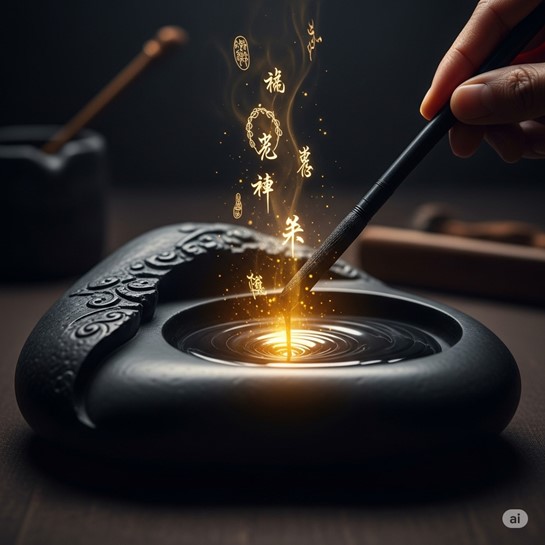
Description A palm-sized inkstone, carved from a piece of unnaturally smooth, matte-black river stone that seems to drink the light around it. It has a shallow, sloping depression for grinding ink. The stone is always cool to the touch and feels heavier than it looks. When water is added to the grinding well, it does not bead on the surface but seems to sheet across it in an unnatural way. The stone is otherwise unadorned, its power hidden in its simple, functional form. When ink is ground upon it, a faint scent of old parchment and dust fills the air, and one might hear a phantom whisper, like the turning of a thousand pages.
Detailed Stats
- Durability: 50/50
- Mind’s Eye Acuity (Linguistics): +5
- Skill Bonus (Calligraphy/Forgery): +4
- Crafting (Scrolls/Contracts) Success Rate: +3%
- Skill Training: Slight increase in the rate of learning for skills related to writing, history, and magical inscription.
Passive Magic
- Resonant Ink: Any ink ground on this stone becomes subtly magical. The ink flows more smoothly, and the resulting text is more compelling to the reader. The script itself is more aesthetically pleasing, and its emotional intent is amplified; warnings seem more dire, poetry more beautiful, and legal text more authoritative.
- Echo of the Quill: When the user is grinding ink, they can sometimes see faint, ghostly after-images of characters and symbols drift across the stone’s surface. These are echoes of past words created with ink from this stone, sometimes offering a flash of inspiration or a fragment of a forgotten script.
Activable Magic
- Glimpse of Intent: The user can take an existing document and, using a clean brush, lift a single drop of its ink and place it in the well of the Sorrow-Stone. The ink will momentarily swirl and form a single, clear symbol that reveals the primary emotional intent of the document’s original author (e.g., a symbol for ‘Greed’, ‘Deceit’, ‘Honor’, ‘Haste’, or ‘Desperation’). This allows the user to see the truth behind the words. This ability drains a small amount of the user’s stamina and magical energy.
- Binding Sigil: Once per day, the user can spend ten minutes grinding a special, concentrated ink. They can then use a brush to draw a single, small sigil with this potent ink. The sigil remains magically charged for 24 hours. The user must choose its effect upon creation:
- Warding Sigil: When drawn on a document, container, or doorway, the sigil is nearly invisible. If anyone other than the creator touches the object with ill intent, the sigil flares with a bright but silent flash of white light, acting as a simple, noiseless alarm.
- Jinxing Sigil: When drawn on an object (such as a rival scribe’s inkpot, a tool, or a weapon’s hilt), the sigil is nearly invisible. The next person to use that object suffers a moment of minor fumbling; a pen will drip, a tool will slip, a sword-stroke will be slightly off-balance. The effect is minor and meant to cause a single, distracting error.
Specific Slot
- Held/Carried (Artisan’s Tool)
Tags: Magical, Common, Tier 1, Utility, Crafting, Divination, Enchantment, Artifice, Tool, Scribe, Ink, Linguistic, Subtle, Warding, Information, Ritual
The Archivist’s Sorrow-Stone is a tool for those who understand that power lies not in the sword, but in the word. Its trade occurs in circles where knowledge, contracts, and secrets are the primary currency—from the hallowed halls of academia to the shadowy markets where information is a weapon.
A University Scriptorium or Guild Library Within the great libraries of major cities or the scriptoriums of scholarly guilds, there is often a stationer or bookbinder who serves the needs of academics, loremongers, and scribes. These workshops are quiet, smelling of old vellum, bookbinding glue, and ozone from magical preservation scrolls. They supply the highest quality inks, pigments, paper, and specialized tools required for scholarly pursuits.
- How it is Acquired: The Sorrow-Stone is not typically on public display but is known to advanced students and tenured members. It is considered a fundamental tool for those studying linguistics, history, or the creation of magical scrolls. A scribe would request one from the master artisan or quartermaster, and the purchase would be logged as an academic supply.
- How it is Sold: Selling a used stone back to the scriptorium is akin to returning a piece of laboratory equipment. The master scribe would carefully inspect it for any cracks or magical degradation before issuing a standard credit, which could be used to acquire other materials like rare inks or pristine vellum sheets.
- Cost:
- Buying Price: A set academic price, typically around 28 Silver Pieces. There is rarely room for negotiation.
- Selling Price: A buy-back credit equivalent to 18-20 Silver Pieces, assuming the stone is in perfect condition.
The High-End Stationer In the administrative or noble quarters of a metropolis, where bureaucrats and aristocrats reside, one can find elegant stationer’s shops. These establishments cater to a clientele that values the art of correspondence, selling personalized wax seals, pens with gilded nibs, and paper infused with delicate perfumes.
- How it is Acquired: Here, the Sorrow-Stone is a luxury item, a tool for the discerning client. It would be kept in a velvet-lined box beneath the counter and presented only to known patrons or those who ask for something to give their legal documents “added authority” or their poetry “deeper resonance.” The sale is a quiet, discreet affair over a polished countertop.
- How it is Sold: Such an upscale establishment would not engage in the trade of used goods. The shopkeeper, if presented with a used Sorrow-Stone, would politely decline, perhaps suggesting the owner try a pawn shop in a less reputable district.
- Cost:
- Buying Price: An inflated price that reflects the shop’s prestigious location and clientele. It would not sell for less than 45 Silver Pieces.
- Selling Price: Not applicable.
A Cartographer’s Workshop Cartographers in Saṃsāra are more than just map-drawers; they are linguists, historians, and sometimes spies, dealing in the secrets of travel and territory. Their workshops are cluttered with charts, astrolabes, and surveying equipment. While the front of the shop sells sea and airship charts, the back room is where the real work of information brokering and magical inscription takes place.
- How it is Acquired: A Sorrow-Stone would be considered a tool of the trade here. A diplomat needing to analyze a foreign treaty, a spy tasked with forging travel papers, or a loremaster seeking to decipher an ancient text would know to seek out a master cartographer. The item would be sold as a “textual analysis stone,” and the price might not be purely monetary. The cartographer might request a favor, a piece of information, or a rare map in exchange.
- How it is Sold: A master cartographer would likely buy a used stone, as they have a network of contacts who have need of such tools. They would assess its quality and offer a fair, professional price, knowing its true market value.
- Cost:
- Buying Price: Around 40 Silver Pieces, or an equivalent value in rare information or services.
- Selling Price: A savvy seller could expect to get 20-25 Silver from a cartographer who knows they can sell it on.
The Scribe’s Black Market In the underworld of any major city, there is a black market that deals not in weapons or narcotics, but in secrets and the tools to acquire them. This is where one finds the forgers, the information brokers, and the corrupt bureaucrats. The “shop” is never a fixed location, but a pre-arranged meeting in a quiet tavern room or a forgotten archive, set up by a trusted fixer.
- How it is Acquired: A buyer would use coded language with a fixer to request a “Sorrow-Stone” or a “Jinx-Scribe’s Kit.” The meeting is tense and anonymous. The item is exchanged quickly and with few words. The quality is not guaranteed; a buyer might receive a stone with weaker magic or a hidden flaw.
- How it is Sold: Selling a stone on the black market means going through a fixer. The fixer would take a significant cut for arranging the meeting with a potential buyer. The seller would get their money but would know the fixer is making a tidy profit on the exchange.
- Cost:
- Buying Price: The price is volatile, depending on supply and the level of risk involved. It typically falls between 35 and 40 Silver Pieces.
- Selling Price: A seller could expect to walk away with 15-20 Silver Pieces after the fixer has taken their percentage.
The Archivist’s Sorrow-Stone is a tool of quiet power, its applications in offense and defense revolving around the manipulation of information, the perception of truth, and the subtle magic of the written word. Its use is not for the battlefield, but for the silent wars fought in libraries, boardrooms, and shadowed offices.
In a Scribe’s Quiet Workshop
This is the natural environment of the Sorrow-Stone, where the user can take their time to prepare texts, scrolls, and sigils, waging their battles before they even begin.
Roleplaying for Offense: Offensive work here is proactive, subtle, and preparatory. An avatar forging a letter of passage would use ink ground on the Sorrow-Stone. The Resonant Ink passive would be the primary weapon; the handwriting on the forgery would seem preternaturally confident, the signature fluid and authoritative. The document itself would feel right in a guard’s hand, its bewitched nature compelling the guard to accept it without a second thought. To further press the advantage, the avatar could use the Binding Sigil ability to create a jinx. They might draw the tiny, invisible sigil on a fresh ink pot they intend to swap with a rival scribe’s. The next day, the rival, in the middle of an important document, would find their pen dripping a blob of ink, ruining hours of work and causing a significant delay—a subtle act of industrial sabotage.
Roleplaying for Defense: Defense in the workshop is about verification and protection. An ally brings the avatar a coded message they recovered. Before wasting hours on decryption, the avatar uses Glimpse of Intent. They lift a speck of the message’s ink, placing it on the stone. The ink swirls into a symbol meaning ‘Lure’ or ‘Trap.’ The avatar now knows the message is misinformation designed to waste their time or lead them into an ambush, defending the party’s resources and safety. After creating a sensitive document—perhaps a true map or a political dissident’s confession—the avatar would use the Binding Sigil to draw a Warding Sigil on the scroll case. This acts as a silent, magical tripwire, defending the document from theft by alerting the avatar with a flash of light if it’s opened by anyone else.
During a Tense Contract Negotiation
In a high-stakes meeting, the Sorrow-Stone becomes a tool of social maneuvering, where the ebb and flow of power can be dictated by the very text on the table.
Roleplaying for Offense: Here, offense is about controlling the narrative of the negotiation. The avatar would arrive with a contract prepared using Resonant Ink. The bewitched text would make complex clauses that favor the avatar’s side appear clear, fair, and standard. The opposing party, feeling the document’s inherent “honesty,” would be less inclined to dispute the fine print, allowing the avatar to offensively secure a more advantageous deal. During a lull, the avatar might “accidentally” spill a drop of water near the opposing negotiator’s notes, then use a piece of blotting paper—upon which they have already drawn a Jinxing Sigil—to help clean it up. When the negotiator next picks up their notes, the papers might slip from their grasp, breaking their concentration and disrupting their train of thought at a critical moment.
Roleplaying for Defense: Defense in a negotiation is about seeing through deception. When the opposing party slides a contract across the table, the avatar can, under the pretense of admiring the quality of the paper, touch a finger to the ink and then discreetly touch their Sorrow-Stone. Activating Glimpse of Intent, they would receive a mental symbol for ‘Omission’ or ‘Burden,’ instantly knowing that the contract is not what it seems. This defends them from signing a disadvantageous or dangerous agreement. If the avatar must leave their own sensitive notes on the table for a moment, they can quickly trace a Warding Sigil on the cover of their portfolio, ensuring they would be alerted if their opponent tried to sneak a peek while their back was turned.
While Infiltrating an Enemy Archive
In this environment of stealth and information-gathering, the Sorrow-Stone is a versatile tool for espionage and counter-espionage.
Roleplaying for Offense: Offense is about planting false information and creating opportunities. The avatar, needing to plant a forged military directive, would use Resonant Ink to create a document that radiates a sense of urgency and authority. An archivist filing the document late at night would be less likely to question its validity. To create a window for their allies, the avatar might find the guard patrol schedule. Using a pre-made Jinxing Sigil on a small, adhesive wafer, they could stick it to the page. The next time the guard captain reviews the schedule, their eye will inexplicably skip over a crucial patrol time, leaving a key area unguarded for an hour—an offensive tactical advantage created through subtle magic.
Roleplaying for Defense: Defense in a hostile archive is about navigating traps, both magical and informational. The avatar finds what appears to be the enemy’s battle plans. To ensure they aren’t a plant, they use Glimpse of Intent. If the stone reveals the symbol for ‘Deception,’ they know the plans are fake and can continue their search, defending themselves from acting on bad intel. The very act of preparing to work can be defensive; as the avatar grinds ink on the Sorrow-Stone, the Echo of the Quill passive might show them a ghostly flare of a magical glyph. They now have a premonition of a magical trap inscribed on a nearby bookshelf, and can defend themselves by avoiding it entirely.
Perception of Activation:
Sight
- User’s Perspective: As water is added and ink is ground, the matte-black surface of the stone seems to deepen into a pocket of pure, non-reflective void. The ink created is not merely black but has an impossible depth and a faint, internal luster like polished jet. As the user works, ghostly after-images of letters, runes, and forgotten symbols drift lazily to the surface of the wet ink before fading, visible only to the user.
- Observer’s Perspective: A casual observer sees only the mundane act of grinding ink. Someone paying very close attention might notice that the ink being produced is unusually dark and rich. If they catch the light just right, they might think they saw a strange shape swirl in the ink, but it vanishes before they can be certain, dismissed as a trick of the light.
- Positives: The visual phenomena serve as clear confirmation that the stone’s magic is active. The ghostly echoes of text can provide sudden, unexpected inspiration or the missing piece of a linguistic puzzle.
- Negatives: Staring into the void-like surface of the stone for too long can be disorienting and may cause a brief moment of vertigo. The constant parade of fading symbols can be distracting when trying to focus on a specific task or formula.
Sound
- User’s Perspective: The physical sound of the inkstick grinding on the stone is almost entirely replaced in the user’s mind by a complex and layered soundscape. It is the sound of a vast, ancient library—the soft, dry rustle of a million turning pages, the faint sigh of settling dust, and an almost inaudible chorus of whispers in a thousand different languages.
- Observer’s Perspective: The activation is nearly silent. An observer would only notice that the grinding process is much quieter and smoother than it should be, lacking the harsh, scraping sound of stone on solid ink. An individual with magically enhanced hearing might feel unsettled by a faint, whispering static in the air around the user.
- Positives: The unique mental soundscape is meditative and helps the user focus, creating an ideal mental environment for scholarly work and blocking out external distractions.
- Negatives: The constant, low-level whispering can become mentally fatiguing over long periods. It can feel invasive, as if the thoughts and voices of long-dead scribes are bleeding into the user’s own consciousness.
Touch
- User’s Perspective: The stone becomes preternaturally cool and impossibly smooth, as if one were grinding the inkstick against a surface made of pure shadow. The user feels a distinct, dry tingling sensation in their fingertips, a phantom feeling of ancient parchment and fine, powdery dust. The inkstick seems to glide effortlessly, guided by an unseen force.
- Observer’s Perspective: There is no visible change. An observer who touched the stone during activation would be startled by its deep and unnatural coolness, a chill that seems to sap the warmth from their hand.
- Positives: The supernatural smoothness allows the user to grind exceptionally fine, high-quality ink with minimal effort. The cool, tingling sensation enhances focus and tactile sensitivity for delicate calligraphic work.
- Negatives: The profound coolness can be draining, leaving the user’s hand feeling numb and slightly stiff after a long session of grinding ink, potentially affecting their penmanship for a short time afterward.
Smell and Taste
- User’s Perspective: The air immediately around the inkstone becomes filled with the rich, complex aroma of a great, ancient library—the smell of aged vellum, dry leather bindings, and the dust of centuries. This is often accompanied by a dry, papery sensation or taste in the back of the user’s throat.
- Observer’s Perspective: An observer with a particularly keen sense of smell might notice a faint, pleasant, and out-of-place scent of old books emanating from the user’s immediate vicinity.
- Positives: For a scribe, scholar, or archivist, the smell is comforting, nostalgic, and inspiring. It helps create the perfect mood and mental state for engaging with written works.
- Negatives: The papery taste is unpleasant. The scent, while not pungent, tends to cling to the user’s clothes and hair, marking them as someone who spends their time in dusty, forgotten places.
Extra-Sensory (Mind’s Eye)
- User’s Perspective: The user feels their own consciousness become quiet, orderly, and vast, as if their mind has been transformed into a perfectly organized library. Memories are easier to access, thoughts are clearer, and the act of composition or translation feels less like work and more like simply retrieving a book from a shelf. They feel a direct, magical connection to the very concept of written language.
- Observer’s Perspective: A magically-attuned observer would perceive the user and stone as a nexus of potent Divination and subtle Enchantment magic. The user’s aura, normally a fluid cloud, would appear to sharpen and clarify, taking on a structured, almost geometric pattern of pure intellect.
- Positives: This mental state is ideal for any scholarly pursuit, allowing for incredible feats of memory, analysis, and linguistic insight.
- Negatives: The “archive” mindset can feel emotionally detached and sterile. When the effect lingers, it can be difficult for the user to engage with others on an emotional level, as they may begin to perceive people and feelings as mere data to be categorized and filed away.
Extra-Sensory (Linguistic Sense)
- User’s Perspective: This is the direct perception of the stone’s core magic. It is a flash of intuitive, holistic understanding. When seeing the ghostly letters of the Echo of the Quill, the user may not know the language, but for a split second, they understand the meaning. When using Glimpse of Intent, they don’t just see a symbol for ‘Deceit,’ they feel the sliminess of the lie and the duplicitous nature of the original author.
- Observer’s Perspective: A telepath or empath trying to read the user would find their surface thoughts unusually structured and clear. They might also get a strange feedback “echo” of their own thoughts about whatever document is being examined, as if the user is so attuned to the text that they perceive the observer’s reactions to it.
- Positives: Grants an unparalleled ability to see the truth behind any text, bypassing linguistic barriers to understand the core intent. It’s an ultimate tool for a diplomat, spy, or historian.
- Negatives: This flood of pure meaning can be overwhelming. Reading a simple love letter might inundate the user with the writer’s powerful, raw emotions. Analyzing a cursed scroll could be psychologically devastating, as the user wouldn’t just read the curse but would feel the full weight of the hatred and malevolence of its author.
Scribal Method for the Stone of Echoes
Materials Needed
- One flawless, fist-sized piece of water-smoothed Obsidian Shale, harvested from a deep, slow-moving river that runs underground.
- A pouch of fine-grained sand, also gathered from a subterranean cave system where no light has touched it.
- The fossilized leaf of a prehistoric fern, carefully excavated from ancient rock.
- Three drops of “Still Water”—water collected from a natural pool in a place of absolute silence, such as a sound-dampened cavern or the eye of a storm.
- A small vial of Lumina Moth oil, a rare oil that glows faintly in the dark, used for the final sealing.
Tools Required
- A set of lapidary tools: stone rasps, files, and polishing cloths of various grits.
- A quiet, isolated, and dimly lit workspace where the crafter will not be disturbed.
- A non-porous mortar and pestle, preferably made of glass or polished marble.
- A soft silk cloth for the final polishing.
Skill Requirements
- Lapidary (Journeyman): The ability to meticulously shape and polish hard stone to an unnaturally smooth, matte finish without causing cracks or imperfections is the primary physical skill required.
- Alchemy (Novice): A basic knowledge of preparing delicate reagents is needed to handle the fossilized leaf and moth oil without ruining their subtle magical properties.
- Deep Focus: This is not a formal skill but a required state of mind. The crafter must be able to maintain a state of meditative silence and focused intent for several hours.
Crafting Steps
- The Shaping: The process must begin in a quiet, undisturbed space. The crafter takes the chunk of Obsidian Shale and begins the slow, meditative work of shaping it. Using rasps and files, they patiently wear down the stone, forming the palm-sized, functional shape of the inkstone with its shallow, sloping well. This is not about speed or force, but about a consistent, gentle shaping that respects the nature of the stone.
- Preparing the Essence of Memory: While resting from the shaping, the crafter prepares the magical catalyst. The fossilized fern leaf, a vessel of ancient memory, is placed into the mortar. With the pestle, it is ground into the finest possible grey dust. This dust holds the potential for the stone’s divinatory magic.
- The Silent Polish: The shaped inkstone is then polished. The crafter uses the fine, subterranean sand and a small amount of water to begin the hours-long process of smoothing the surface. During this entire phase, the crafter must remain silent. They must fill their mind not with words, but with the idea of words—the shapes of letters, the flow of sentences, the weight of forgotten histories. This meditative state attunes the stone to the concept of language. The polishing continues until the stone has its signature, light-absorbing matte finish.
- The Infusion of Silence: Once the stone is perfectly shaped and polished, it is cleaned and dried. The crafter takes the grey fossil dust and mixes it with the three drops of “Still Water,” forming a thin, shimmering paste. This paste is carefully poured into the inkstone’s well, where it will sheet across the surface unnaturally. The stone is then left undisturbed in the silent, dark workspace for one full day and one full night. During this time, the stone will slowly absorb the magical essence, the silence of the water creating a perfect, uncorrupted vessel for the memory held within the fossil.
- Sealing the Echo: After the waiting period, the magical paste will have been completely absorbed, leaving only a faint, dry residue. This is gently buffed away with the soft silk cloth. To complete the process, the crafter applies a single drop of Lumina Moth oil to the center of the well and polishes it meticulously across the entire surface of the stone. The faint, glowing oil seals the enchantment within the stone’s matrix, protecting it from external influence.
- The First Word: The inkstone is now a finished vessel, but its magic is dormant. To awaken it, the crafter must perform its intended function for a noble purpose. They must use the stone to grind ink, and with that ink, write something of meaning—a memory they feared they had lost, a piece of beautiful poetry, or their signature on a contract of absolute honesty. This first, sincere use of the stone awakens its full magical potential, and the whispers of history will begin.
Lament of Kael the Archivist
These are the words that remain, thin echoes of a time of first things. It is told of Kael, an old man whose soul was a library of ghosts. He arrived on the world of Saṃsāra as all do, with nothing in his hands. But his poverty was greater than others, for he had once been the keeper of all knowledge, a master of a Great Library in his world before. Now, that library was less than dust, and all the books, all the histories, all the poems, were but phantom shapes that tormented his memory.
His sorrow was a physical thing, a heavy cloak he could not remove. He would sit with charcoal and scraped hide, trying to write down that which he remembered. But for each story he caught and pinned to the page, two more would flutter away into the darkness of his forgetting. His work was like trying to carry water in a net. The loss of so much truth gave him a great and unending pain.
So it was that Kael, the man of forgotten books, walked away from the new villages of the scattered people. He walked until he found a river that did not flow with water. It was a river of black, thick mud that moved with a great slowness and made no sound. It was a river of silence, a river of ending. He followed this river to its beginning, a great, dark cave in the belly of a mountain.
Inside, the air was still and cold. There he found a pool from which the black river was born. And all around this pool were stones. They were smooth and blacker than a starless night, and they seemed to eat the light of the torch Kael carried. He reached out a trembling hand and touched one. It was heavy, and its coldness was one of great emptiness. He felt a kinship with the stone, for its void mirrored the great void in his own soul where the library used to be. He took one palm-sized stone and carried it back to his lonely dwelling.
In his hut, he had no proper ink. He had only soot from his fire and a little water. He poured the water into the hollow of the black stone and added the soot, and began to grind them together with a smaller rock. As he worked, the great sorrow for his lost world overwhelmed him, and tears streamed from his old eyes, falling into the mixture. He ground his grief into the stone. He focused all his memory, all his desperate wanting to not forget, into the blackness. The stone, being a thing of perfect emptiness, drank his sorrow and his will.
Then, a strange thing happened. As the old man stared through his tears into the dark ink, a shape appeared. It was a letter, a glowing, ghostly character from a language that had been dead for ten thousand years. It held for a moment, then faded. Then another appeared, a different rune, a different truth. The stone was not just a stone. It had taken his sorrow and given him back an echo. It was showing him the words he thought were gone forever.
He began to write, using the tear-stained ink. The words flowed from his brush with a new life. They were more than words. They were compelling. When he wrote a history, it felt true and heavy with the weight of years. When he wrote a poem of loss, it could make a strong man weep. The magic of his sorrow was now in the ink.
One day, a traveler brought Kael a contract, a sheet of promises from a strange merchant, written in a script Kael did not know. The traveler asked for his wisdom. Kael took a clean brush, and from the strange contract, he lifted a single drop of its ink. He placed the drop upon his Sorrow-Stone. The foreign ink did not mix. It swirled on its own and formed a single, sharp symbol that Kael had never seen, but understood in his soul: a hook, a barb, a sign for ‘Deception’. He told the traveler that the contract was a lie. He had seen its true intent.
Kael, the keeper of ghosts, spent the rest of his years not just remembering, but creating. He wrote all that he could, and his new books formed the foundation of a new library for a new world. He taught a few quiet apprentices, not how to feel his sorrow, but how to find their own black stones and imbue them with a great and silent respect for the truth, so that the written word would have power and meaning for all the ages to come.
The moral of the story is this: For it is known, a single tear of true sorrow may grant a stone a memory that will outlast a mountain of books.
Suggested conversions to other systems:
Call of Cthulhu
The Palimpsest Stone
This is a smooth, heavy inkstone carved from a type of matte-black, non-reflective stone unknown to geology. It feels unnaturally cold to the touch and seems to absorb ambient light. When ink is ground in its well, users report hearing faint, layered whispers, as if many people are reading over their shoulder at once.
Powers: The stone provides insight into written texts but at the potential cost of one’s sanity.
- The owner of the stone gains a bonus die on Art/Craft (Calligraphy) and Library Use rolls. Any documents they create using ink ground on the stone are more convincing, granting a bonus die to any Fast Talk or Persuade rolls made using the document as proof.
- Glimpse the Under-Text: By concentrating on a written document for one minute while holding the stone, the user may spend 1 Magic Point and make a POW x 5 roll. On a success, the Keeper reveals a single, critical piece of hidden information about the text—the true emotional state of the author, a hidden meaning in a turn of phrase, or the location of a secret clause. A fumble may mean the user sees a horrifying, alien truth within the text that was never meant for human eyes, triggering a Sanity roll (1/1D4).
- Inscribe Minor Ward: The user may spend 10 minutes and 2 Magic Points to create a special batch of ink. With this ink, they can draw a small, nearly invisible glyph on an object or doorway. The first person other than the creator to touch the object must make an opposed POW roll against the creator’s. If the target fails, they are overcome with a wave of nameless dread and must recoil from the object for at least one round. The ward then fades.
Cthulhu Mythos: +1 percent upon realizing the ghostly letters seen in the ink are from Aklo or other non-human languages. Sanity Loss: 0/1 Sanity points for the initial experience of hearing the stone’s whispers.
Blades in the Dark
The Scribe’s Sorrow
An inkstone carved from a solid piece of morose, light-dampening stone dredged from a deep channel in the Void Sea. It is said to hold the echoes of every secret, every lie, and every desperate plea ever written with its ink. It feels unnervingly cold and heavy.
Mechanics: This is a rare Artifact and a Scribe’s Tool.
- Passive: When you create a written document as part of a Downtime Action (such as a forgery, a threatening letter, or a coded message), you get +1d to your roll.
- Reveal the Ghost: When you Study a document, you can focus on the inkstone to read the echoes within the words. You may ask the GM “What was the most important thing the author left out?” or “What is the hidden truth of this text?” This costs 1 Stress.
- Glyph of Silence: Once per score, you can take a moment to use pre-made ink from the stone to draw a small, complex glyph on a surface (a door, a floorboard, a window). For the next hour, sound is magically dampened within five feet of the glyph. This allows you to operate in near silence, adding +1d to any Prowl rolls made within its area of effect. The glyph is faint but can be spotted by a careful observer.
Dungeons & Dragons
Loremaster’s Inkstone Wondrous item, common (requires attunement)
This palm-sized inkstone is carved from a smooth, matte-black stone that seems to absorb the light around it, making it appear darker than a simple shadow.
While you are attuned to this inkstone, you gain proficiency with calligrapher’s supplies. If you are already proficient, you can add double your proficiency bonus to ability checks you make with them. Ink created with this stone is subtly magical, making your handwriting appear more masterful and your words more resonant.
The inkstone has 3 charges, and it regains 1d3 expended charges daily at dawn. You can use the charges in the following ways:
- Scribe’s Insight: When you touch the inkstone to a piece of writing up to one page in length, you can expend 1 charge. For the next 10 minutes, you have advantage on all Wisdom (Insight) checks made to determine the true intentions of the author or to spot hidden meanings or codes within the text.
- Minor Glyph: As an action, you can expend 1 charge to use ink from the stone to inscribe a tiny, nearly invisible glyph on an object or surface. For the next 8 hours, the first time a creature other than you touches the glyph, one of two effects occurs (chosen by you at the time of inscription):
- The glyph flashes with a silent, bright light for a moment, then disappears.
- The creature that touched the glyph must succeed on a DC 13 Wisdom saving throw or become frightened of the object for 1 minute.
Knave
Scribe’s Void-Stone Item Slot: 1
A palm-sized, unnaturally smooth black stone for grinding ink. It seems to swallow the light, and its surface is always cool.
- Passive: Ink ground on this stone is of superior quality. Any document you write is more convincing and aesthetically pleasing. You have advantage on checks made to create forgeries or to have your handwriting pass as someone else’s.
- Active (At will): If you touch the stone to a piece of writing, you can ask the GM what the author’s primary emotional state was when they wrote it (e.g., “Angry,” “Deceitful,” “Honest,” “Afraid”).
- Active (Once per day): You can spend 10 minutes creating a special “jinx ink.” You can use it to draw a single, tiny, invisible symbol on an object. The next person other than you to use that object must pass a Willpower save or perform the task with a fumble (a pen drips, a sword grip slips, a key breaks in a lock, etc.). The symbol then fades.
Fate Core
The Stone of the Unwritten Word
This Extra is a physical manifestation of the power of language and history. It is a tool for scribes who understand that what isn’t written is often as important as what is. A character must acquire the stone and can then dedicate an aspect or a stunt to it.
Item Aspect: Every Word Leaves a Ghost
This aspect represents the stone’s ability to perceive the history and subtext of language. It is about seeing the echoes of what was, and what could have been, in every piece of writing.
- Invoking this Aspect: A player can spend a Fate Point to invoke this aspect for a +2 bonus or a reroll when:
- Creating an Advantage: Using Investigate to analyze a document to find hidden meanings or evidence of tampering, creating aspects like Suspiciously Altered Clause or Resonates with Fear.
- Overcoming: Trying to decipher a coded message or translate a forgotten language.
- Compelling this Aspect: The GM can offer a Fate Point to compel this aspect, forcing a complication:
- The character sees a distracting or misleading “ghost” in the text, such as a draft of a sentence that was never intended, leading them to a false conclusion.
- The character becomes obsessed with the history of a mundane document, wasting valuable time trying to uncover its “story” when there isn’t one.
Item Stunt: See the True Intent
Effect: When you use the Investigate skill to analyze a piece of writing, you can spend a Fate Point to ask the GM a single, direct question about the author’s true goal in creating the document. The GM must answer honestly. For example, “Was the author trying to hide something?” or “Was this letter written under duress?”
Numenera & Cypher System
Linguistic Resonator
This artifact is a palm-sized, perfectly smooth, matte-black stone. It does not reflect light and is always cool to the touch. Its internal structure seems to be a crystalline matrix that resonates with the complex energies of symbolic language.
Level: 4 Form: A handheld stone with a shallow depression. Effect: The user gains an asset on all tasks involving creating or deciphering written text, including translation, cryptography, and forgery.
The user can also activate two of its specific functions:
- Imprint Text (Action): The user can touch the stone to a page of writing. This is an Intellect-based task with a difficulty of 3. On a success, the stone psychically absorbs the text. For the next 28 hours, the user can perfectly recall the text and has an intuitive understanding of its subtext and hidden meanings. They can “read” the text from memory as if it were in front of them.
- Enchant Ink (10 minutes): The user can spend ten minutes grinding ink on the stone while focusing on a specific linguistic concept, such as “Confusion” or “Clarity.” For the next hour, any text written with this ink is enchanted. Text written with “Confusion Ink” is difficult to understand, increasing the difficulty of any task to analyze or decipher it by one step. Text written with “Clarity Ink” is preternaturally easy to understand, easing the difficulty of any task to analyze it by one step. Depletion: 1 in 1d20.
Pathfinder
Archivist’s Quiet Stone (Item 2) Uncommon Divination Enchantment Invested Magical Price 35 gp Usage held in 1 hand; Bulk L
This smooth, black inkstone feels heavier than it should and seems to draw in the surrounding light. It is a favored tool of dedicated scribes, cautious diplomats, and meticulous forgers.
When you Invest the stone, you gain a +1 item bonus to Society checks to Decipher Writing and to Crafting checks that involve writing, such as creating scrolls.
Activate [one-action] envision, Interact; Frequency once per hour; Effect You touch the stone to a piece of writing. You instantly learn the primary emotion the author was feeling when the text was written (such as anger, fear, deceit, or joy). This gives you a clue to the text’s subtext but does not reveal specific falsehoods.
Activate [one-action] manipulate; Frequency once per day; Effect You spend one minute grinding ink on the stone, imbuing it with subtle magic. For the next hour, this ink can be used to create a superior written work. If you use the ink to create a forged document, the DC to recognize it as a forgery with the Forgery skill increases by 2. If you use the ink to write a letter as part of using the Diplomacy skill, the recipient’s initial attitude is one step more favorable toward you.
Savage Worlds
The Scrivener’s Charm
A simple, palm-sized inkstone made of a smooth, dark stone that feels cool to the touch. When used, it is said to whisper forgotten lore to the scribe.
- Bonuses: The character gains a +1 bonus to their Academics and Occult rolls when the research involves written texts, books, or scrolls.
- Power (Psychometry): The item grants the user the Psychometry power from the Savage Worlds Fantasy Companion, but with a specific limitation.
- Limitation: The power can only be used on written or inscribed objects (books, scrolls, letters, stone tablets, etc.).
- Power Points: The Scrivener’s Charm has 5 Power Points. These do not recharge on their own. To recharge the item, the user must spend at least four hours in a library or archive, engaged in uninterrupted study. At the end of this period, the item regains all its Power Points.
- Special Ability (Enchanted Ink): The user can spend 1 hour and 3 Power Points to create a small vial of enchanted ink. They can choose one of the following effects for the ink, which lasts until it is used up:
- Ink of Persuasion: Documents written with this ink are more convincing. The scribe gains a +1 bonus to any Persuasion rolls that use the document as evidence.
- Ink of Warding: The scribe can use this ink to draw a small, nearly invisible glyph. This functions as the Alarm power, but the alarm is purely mental and only alerts the creator.
Shadowrun
Saeder-Krupp “Archiv-Stein”
This device appears to be a high-end executive “slate,” a peripheral for a commlink, crafted from a seamless piece of polished black ceramic. It bears a subtle, laser-etched Saeder-Krupp corporate logo in one corner. The ceramic is, in fact, a carefully processed form of meteoric stone, laced with orichalcum, making it a powerful and discreet magical focus. It is often gifted to S-K’s top corporate lawyers, archivists, and espionage assets.
Type: Magical Focus / Commlink Accessory Rating: 3 Availability: 18R Cost: 50,000 nuyen Bonding Cost: 6 Karma
Standard Functions: The Archiv-Stein functions as a Maglock Passkey (Rating 3) and has a satellite uplink.
Focus Functions: An Awakened character who has bonded the device unlocks its true capabilities.
- Illusion Focus: The device acts as a Rating 3 Focus for all spells of the Illusion category, particularly those that manipulate information or perception, such as Confusion, Chaos, or Physical Mask. The user adds 3 dice to their Spellcasting dice pool when casting these spells.
- Linguistic Analysis: When making a test to decipher a code, analyze handwriting, or spot a forgery (using skills like Forgery, Academics, or the appropriate Language skill), the user can spend 1 point of Edge to add the Focus’s Rating (3) as a flat bonus to their dice pool for that one test.
- Data Scramble: Once per run, the user can touch the stone to a data source (a commlink, a data chip, a terminal). As a Complex Action, they make a Magic + Intuition [Mental] (4) test. If successful, they can subtly corrupt a single file or entry. The data is not deleted, but its meaning is twisted; numbers are transposed, names are subtly changed, and sentences are altered to change their intent. This magical corruption is invisible to standard matrix scans.
Starfinder
Pact Worlds Notary Stone
Level 5; Price 3,000 credits; Bulk L System Handheld; Armor Type No armor
Description: This palm-sized slab of polished black stone has been retrofitted into a modern device. It has a data port for interfacing with a computer and a small internal power cell. It is a common, if expensive, tool among high-level diplomats, corporate lawyers, and Stewards involved in treaty negotiations.
Mechanics:
- As a Tech Item: The stone can be connected to a computer or datapad. When doing so, it functions as a digital security key, granting a +2 insight bonus on Computers checks made to decrypt files or bypass digital security measures.
- As a Magic Item: The user can access the stone’s innate magical properties.
- Discern Intent (1/day): As a standard action, the user can touch the stone to a physical or digital document. They instantly learn the primary emotion the author was feeling when they wrote it (e.g., fear, greed, honesty) and whether the document contains any deliberate factual lies. This does not reveal what the lies are, only that they are present.
- Imbue Authority (3/day): As a standard action, the user can touch the stone to a document they have written. For the next hour, the document is imbued with a powerful enchantment. Any creature who reads it must succeed on a DC 16 Will save or be affected as if by a charm person spell, but they are charmed only by the document’s message and the requests within, not by the creator.
Traveller
Vargr “Story-Stone” (Corsair Tech)
This artifact is a piece of non-standard Vargr technology, often used by corsairs and political schemers to create flawless forgeries of shipping manifests, Imperial warrants, and letters of marque. It is a smooth, black stone of unknown origin, housed in a rugged polymer casing with a single, glowing glyph that indicates its activation. It is highly illegal in most Imperial jurisdictions.
Tech Level: 10 (Vargr, non-standard) Mass: 0.2 kg Cost: Highly illegal. 25,000 Cr on the black market.
Effects: The device is a sophisticated linguistic analysis and psychological warfare tool.
- Grants the user DM+2 on all Admin, Comms, or Deception checks related to creating or analyzing written documents.
- Linguistic Mimicry: The user can touch the stone to a sample of writing (physical or digital). The device takes one minute to perform a complete stylistic and grammatical analysis. For the next 24 hours, any document the user creates via a connected terminal will be flawlessly written in that exact style, granting DM+4 on any checks made to pass it off as authentic.
- Hypnotic Script (1/day): The user can spend ten minutes composing a message of 100 words or less. The device, linked to their writing tool or terminal, subtly alters the character spacing and word choice to be mildly hypnotic. The first person to read this message must make a Difficult (10+) Willpower check or find the message’s argument incredibly and irrationally compelling, treating its statements as fact for at least one hour.
Warhammer Fantasy Roleplay
The Grey College Final Word
This is not a simple inkstone, but a magical instrument of a Grey Guardian, a Magister of the Wind of Ulgu. It is carved from a piece of solid shadow that was given physical form deep within the Grey Mountains. It appears as a palm-sized slab of matte-black stone, but its edges seem to blur and shift when not directly observed.
Properties: Magical, Rare, Academic Lore (Magic): A potent focus for Ulgu, the Purple Wind of shadow and illusion.
Effects: A wizard who uses this inkstone to grind their pigments and inks finds their command over secrets and deception greatly enhanced.
- Loremaster of Shadow: The owner gains a +10 bonus to all Lore (any) and Language (any) Tests.
- Illusory Script: The wizard can spend 10 minutes and an SL from a successful Channeling (Ulgu) Test to create a vial of enchanted ink. Any text written with this ink is subject to a powerful illusion. To anyone other than the creator (and those the creator designates at the time of writing), the script appears to be something else entirely—a laundry list might appear as a treasure map, or a confession might appear as a love poem. The illusion lasts until the ink is destroyed or a successful Dispel spell is cast upon it.
- Read the Lie: Once per day, the wizard may touch the stone to a document. They automatically know if the document contains a deliberate falsehood. If they then pass a Challenging (+0) Intuition Test, they receive a brief, shadowy vision of the author’s face at the moment they wrote the lie.
Corruption: The stone constantly whispers secrets, half-truths, and tempting deceptions into its owner’s mind. Any time the owner critically fails a Willpower Test while holding the stone, they must make a Challenging (+0) Cool Test or gain 1 Corruption Point as they begin to prefer the comforting lies of shadow to the harsh truths of light.