
Lore While many celebrate Kupala Night with grand bonfires and boisterous celebration, the more scholarly and cloistered communities of Saṃsāra observe the solstice with their own quiet rituals. For generations, scribes, librarians, and bookbinders have held that the peak of the magical tide is the perfect time to create tools that preserve knowledge against the decay of ages. The Binder’s Resin is the most common result of this tradition. On the eve of the solstice, artisans venture into old-growth forests to collect sap from ancient, magically-attuned trees and pollen from rare, night-blooming flowers. These ingredients are slowly rendered down in earthenware pots over a small, contained fire fueled by wood from trees struck by lightning. Throughout the process, the artisans chant litanies of preservation and passages from the histories they seek to protect. The resulting resin is believed to hold an echo of the solstice’s restorative power, not just binding books, but safeguarding the stories within them.
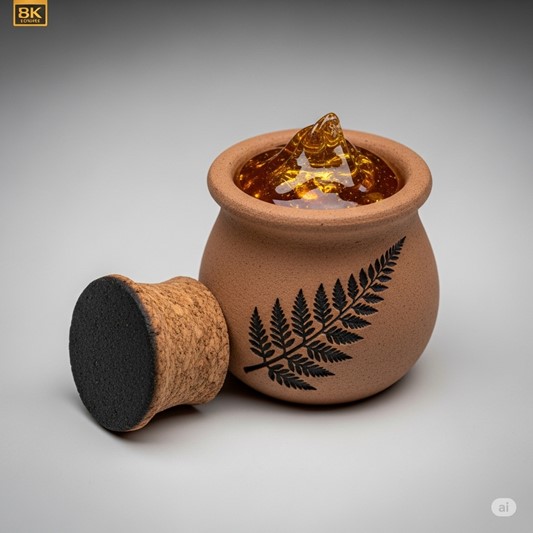
Description This item is a small, unglazed ceramic pot, roughly the size of a clenched fist, with a dark cork stopper sealing it. The earthenware is a simple, earthy brown, cool to the touch, with the stylized image of a single fern leaf etched into its side. Inside, the pot contains a thick, viscous, amber-colored resin. The substance is translucent and seems to capture the light, shimmering with a faint, internal golden luminescence. It emits a strong, pleasant aroma of pine sap, warm beeswax, and a subtle undertone of campfire smoke. Though it is sticky to the touch, it cleans away easily with a bit of water, leaving no residue. The pot always seems to be about three-quarters full, no matter how much has been used recently.
Slot Artisan’s Tool
Detailed Stats Tier: 1 Durability: The resin is magical and slowly regenerates. The pot contains enough resin for approximately ten applications of its activable magics. It magically restores one application’s worth of resin at sunrise each day. Combat-Related Bonuses: None Resistances: None
Passive Magic Inherent Preservation: Any organic, non-living material the resin is applied to (such as paper, vellum, leather, or thread) becomes infused with preservative magic. Books bound using this resin are exceptionally resistant to the natural decay of time, humidity, and mildew. Their pages resist yellowing, and their leather covers remain supple far longer than normal.
Tome’s Echo: When the avatar handles a book that was crafted or repaired using the Binder’s Resin, they receive faint, intuitive impressions from the book itself. This is not telepathy, but a form of psychometric echo—a feeling of the cold stone of the library it once sat in, the scent of sea salt from a voyage it was taken on, or the phantom sensation of urgency from a reader who frantically flipped through its pages long ago.
Activable Magic Mending the Page: At will, the user may dab a small amount of the resin onto a rip or tear in a page. The amber resin temporarily seeps into the paper fibers. Over the next minute, it will flawlessly knit the tear back together, leaving behind no seam, discoloration, or sign of the previous damage. This magic can repair physical damage but cannot restore text that has been completely lost or destroyed.
Unveiling the Faded Word: Twice per day, the user may smear a thin, transparent layer of the resin over a passage of text obscured by age, water damage, or mundane stains. The resin draws on the memory of the page and ink. For the next hour, the original text glows with a soft, easily readable amber light, visible even in dim conditions. After one hour, the resin completely evaporates from the page, leaving it unharmed.
Tags Common, Tier 1, Artisan’s Tool, Roleplay, Kupala Night, Preservation, Restoration, Divination (Minor), Magical, Utility, Consumable (Regenerating), Herbal, Folk Magic, Scholarly, Repair, Adhesive, Luminous
In the world of Saṃsāra, the commerce surrounding a specialized magical tool like the Kupala 3 of the Binder’s Resin is more focused than that of a simple folk charm. Its buyers are specific, and its sellers are often experts in their trade. Transactions are typically conducted using the standard currency of Bronze, Silver, and Gold Shards.
The Monastic Scriptorium or Artisan’s Collective
This is the origin point for the Binder’s Resin. These are not open-air shops but dedicated workshops found within secluded monasteries, the quiet halls of a scribes’ guild, or scholarly communities that value the preservation of knowledge above all else.
- How It’s Sold: One does not simply walk in and buy the resin here. Acquiring it from the source is a formal process. A buyer would need to petition the head scribe or artisan master, often requiring a letter of introduction or proof of their own craft. The sellers are not concerned with profit but with the resin being used for a worthy purpose—the creation or preservation of important texts. The transaction is a quiet, respectful exchange, often accompanied by a discussion of the resin’s properties and a blessing upon the buyer’s work.
- Cost: As this is the source, the price is the lowest, intended to cover the rare materials and the artisan’s time, with a small surplus for the community’s upkeep. The cost would typically be between 2 and 3 Silver Shards. Bartering is also common, but instead of goods, the artisans would seek knowledge—a rare book, a new binding technique, or a copy of a lost map.
The Scribe’s Emporium or Specialized Stationer
In the bustling trade districts of major cities, from the floating metropolises to the megacities in deep caves, one can find shops dedicated to the tools of the learned. These establishments sell fine vellum, magically-infused inks, rare quills, and specialized artisan’s tools.
- How It’s Sold: This is a professional, commercial transaction. The shopkeeper is an expert who has sourced the resin from one of the artisan collectives. They can speak at length about its properties and might have different “vintages” from various monasteries, each with a subtle difference in aroma or efficacy. The clientele consists of professional bookbinders, wealthy scholars, and government archivists. The sale is discreet and focused on quality.
- Cost: The price here reflects a significant markup due to the difficulty of sourcing the item and the specialized knowledge of the shopkeeper. A pot of Binder’s Resin would sell for 6 to 8 Silver Shards. The price is firm, as the customers know they are paying for guaranteed quality.
The University Atheneum or Grand Library Gift Shop
Major institutions of learning, such as the great libraries in capital cities or the alchemical universities, often have their own scriptoriums and binderies. While their primary purpose is internal, many have a small, semi-public storefront to sell scholarly goods to their members and raise funds.
- How It’s Sold: The sale here is formal and often restricted. A student or registered scholar of the institution might be able to purchase a pot by presenting their credentials. The transaction is logged in a ledger. The resin sold here is often made in-house and may carry the university’s or library’s specific seal on the pot. Selling to the general public is rare, and if allowed, it is done so with a sense of magnanimousness.
- Cost: The price is often institutionalized. For affiliated members, it might be subsidized, costing around 5 Silver Shards. For a rare outsider granted permission to buy, the price could be inflated to 10 Silver Shards or even 1 Gold Shard, not for profit, but to discourage casual purchasing and reinforce the value of the item.
The Traveling Curio Dealer
Traveling merchants plying the trade routes by airship or sea vessel occasionally come into possession of specialized items like the Binder’s Resin. They might acquire it in a trade from a remote monastery, not fully understanding its magical nuances but recognizing it as a valuable artisan good.
- How It’s Sold: The transaction is opportunistic. The merchant might have only one or two pots nestled amongst spices, textiles, and mechanical parts. They will highlight its rarity and the long journey it has made. They may not know its specific activable magics but will sell it as a “miraculous book-mending glue from the wise monks of the distant mountains.” The sale is based on novelty and scarcity.
- Cost: The price is highly volatile. If the merchant is in a region where such refined magic is common, they may try to sell it for 7 or 8 Silver Shards. However, if they have traveled to a place where knowledge is scarce and books are rare treasures—like a frontier mining outpost or a newly established colony—the resin’s value skyrockets. In such a location, a desperate scholar or historian might pay as much as 2 Gold Shards for the unique opportunity to preserve their precious library.
The Kupala 3 of the Binder’s Resin is a tool for creation and preservation, not conflict. Its use in offense or defense is therefore a matter of supreme creativity and indirect action, relying on an avatar’s ability to manipulate their environment and the perceptions of others rather than engaging in combat.
In a Scholarly Archive or Grand Library
This is the resin’s natural environment, where its power over paper and ink can be used with surgical precision for social and intellectual combat.
Roleplaying for Defense: An avatar, serving as a junior archivist, is framed by a rival. The rival has intentionally torn a page in a unique, priceless manuscript, knowing an inspection is imminent. Discovery of the damage would mean the avatar’s immediate dismissal and disgrace. In the dead of night, with only a flickering candle for light, the avatar takes out their pot of Binder’s Resin. The roleplay is in the tension of the moment—the steadying of a shaking hand, the delicate application of the resin along the fibrous edges of the tear with a fine brush. They use Mending the Page. The magic flows, knitting the paper back together seamlessly, leaving no trace of the malicious damage. When the stern senior archivist arrives for the inspection, the book is presented, whole and perfect. The defense was not against a sword, but against ruin; the victory is silent and absolute.
Roleplaying for Offense: An arrogant political opponent relies on a specific legal precedent, detailed on a single page of a dense legal tome, to win an upcoming debate. The avatar needs to neutralize this advantage without being discovered. The night before the debate, they find the tome. They apply the Binder’s Resin not to mend, but to obscure. They smear a thin, invisible layer over the entire key paragraph. The resin has no immediate effect. However, the next day, in the middle of the opponent’s speech, the avatar activates Unveiling the Faded Word from across the room by whispering the command word. Suddenly, the paragraph on the opponent’s lectern begins to glow with an inexplicable amber light. The opponent falters, confused. The audience murmurs—is it a forgery? A magical trap? The opponent’s credibility evaporates under the strange, magical spotlight, and their argument collapses in paranoia and confusion. The offense was an act of intellectual sabotage.
In the Alleys and Workshops of a Steampunk Metropolis
Amidst the grime, steam, and intrigue of a city, the resin’s unique properties can be applied to documents, schematics, and the very fabric of the industrial world.
Roleplaying for Defense: Hunted by a ruthless bounty hunter from a rival trade guild, the avatar carries an incriminating ledger that cannot be allowed to fall into their hands. Cornered in a rain-slicked alley plastered with layers of old posters and public notices, they see their chance. Using the adhesive quality of Mending the Page, they press the ledger’s key page flat against a section of the wall, “mending” it to the poster beneath. The magical bond is instant and seamless. They toss the now-useless husk of the ledger into a puddle as a decoy. When the bounty hunter catches up and frisks them, they find nothing. The vital information is hidden in plain sight, camouflaged as urban decay, to be retrieved later. The defense is one of perfect, mundane-looking concealment.
Roleplaying for Offense: An avatar needs to sabotage a competitor’s new clockwork automaton before its unveiling at the Inventor’s Jubilee. The automaton is controlled by a complex sequence of instructions recorded on a delicate paper punch-card reel. Gaining access to the workshop, the avatar uses the resin for subtle corruption. They use Mending the Page to “fix” a few of the crucial holes on the punch-card, effectively closing them. They then use a tiny stylus to pierce new holes in other locations, using the resin to seal the paper around the new hole so it appears to be part of the original design. The data is now corrupted, but the punch-card itself looks pristine. At the demonstration, the automaton whirs to life, only to follow the new, nonsensical instructions—swinging its arms wildly, walking backwards, and eventually seizing up, humiliating its creator and ruining the competitor’s prospects.
In Forgotten Ruins or a Secluded Hideout
In places where lost knowledge is key, the resin becomes a tool to unlock secrets or create false ones.
Roleplaying for Defense: The avatar and their companions are trapped in a chamber deep within an ancient ruin. The only exit is a door sealed by a puzzle lock that requires a specific sequence of symbols to be pressed. A clue is written on a stone tablet, but centuries of water damage have rendered it an illegible, faded mess. As their torchlight sputters, the avatar takes out the resin and uses Unveiling the Faded Word. They carefully smear the resin across the stone tablet. The magic struggles, designed for paper but potent enough to work on porous stone. Slowly, the ancient glyphs begin to glow with a faint amber light, revealing the sequence needed to open the door and escape.
Roleplaying for Offense: An avatar wants to lead a group of greedy treasure hunters on a wild goose chase, away from a truly sacred site. They create a forged map on a piece of aged vellum. The map itself is plausible, but crude. To make it irresistible, they use the resin. First, they apply stains and fade the ink in key places. Then, they use Unveiling the Faded Word on a section of the map detailing a fake treasure trove. When they “accidentally” let the treasure hunters see the map, the hunters’ own expert will notice the faded sections. But the glowing, magical text will convince them it is an authentic, powerful artifact revealing a hidden secret. They will follow the magically-glowing lie with zealous conviction, taking them far away from the avatar’s true objective.
Perception of Activation:
Sight
- User’s Perspective: When you dip your finger or a tool into the resin, the targeted amount shimmers more intensely, its internal golden light pulsing softly. As you apply it to a page, this light flows from the resin into the paper fibers. For “Mending the Page,” the light traces the path of the tear before vanishing. For “Unveiling the Faded Word,” the light spreads across the designated area and settles into a steady, soft amber glow behind the text.
- Observer’s Perspective: The effect is subtle. An observer might see a brief, warm golden glimmer on the user’s fingertip and then on the page, easily mistaken for a reflection from a nearby candle. When “Unveiling the Faded Word” is used, the sustained, gentle glow illuminating the text is clearly visible to anyone nearby.
- Positives: The glow provides clear visual feedback and, in the case of “Unveiling,” its own light source for reading in dim conditions. The effect is gentle and non-threatening.
- Negatives: The light, especially the sustained glow, gives away the use of magic and can draw unwanted attention in a dark or covert setting.
Sound
- User’s Perspective: The activation is almost perfectly silent. You perceive a faint, close-range “hiss,” like the sound of cool water hitting a warm pan or sap oozing from a tree. It is the sound of a viscous, magical substance being energized.
- Observer’s Perspective: From any distance, the activation is completely silent.
- Positives: The silent operation is ideal for use in quiet, studious environments like libraries and scriptoriums, or when performing a secret repair.
- Negatives: There is no auditory cue to confirm activation for the user if they are not looking, nor can it be used to signal an ally.
Smell
- User’s Perspective: The moment you will the magic to activate, the resin’s complex aroma of pine, beeswax, and woodsmoke blooms powerfully, though only for you. It is a rich, ancient scent, evoking images of deep forests and candle-lit monastic libraries.
- Observer’s Perspective: Someone standing very close might catch a sudden, fleeting, and pleasant smell, like an expensive wood polish or incense, but it vanishes too quickly to be easily identified.
- Positives: The aroma is pleasant and can help the user focus, grounding them in their delicate work.
- Negatives: A creature with a highly advanced sense of smell could easily detect the sudden burst of potent fragrance, potentially revealing the user’s position and the use of a magical substance.
Touch
- User’s Perspective: As you activate the resin, a distinct warmth spreads through the globule on your finger or tool. It feels thick but alive. When you apply it to the page, it feels as if it momentarily becomes thinner and more eager, flowing into the paper’s fibers with uncanny precision before settling.
- Observer’s Perspective: There is no perceivable effect unless the observer is physically touching the resin at the moment of activation.
- Positives: The user receives clear, unambiguous tactile feedback that the magic is working as intended. The sensation of the resin guiding itself can make delicate repairs easier.
- Negatives: The warmth is a distinctly magical sensation that would be impossible to explain if someone were unexpectedly touching the user’s hand at that moment.
Taste
- User’s Perspective: You do not taste the resin directly, but the activation creates a phantom sensation on your palate—the dusty, dry flavor of old paper and vellum, combined with the sweet, cloying taste of tree sap.
- Observer’s Perspective: There is no perceivable effect.
- Positives: It serves as an additional, unique sensory confirmation that the magic has been engaged.
- Negatives: The dry, unusual taste can be slightly unpleasant or distracting, particularly if the user is concentrating intensely.
Extra-Sensory: Magical (Mind’s Eye)
- User’s Perspective: Through your “Mind’s Eye,” activating the resin feels like gently pushing a thick, slow-moving river of energy. It is not a sharp spike of power but a steady, controllable flow that you guide from your will, through the resin, and into the target object. It feels restorative and patient, a magic of mending rather than force.
- Observer’s Perspective: A magically-attuned observer would not see a flash of power, but rather a soft, gentle aura of magic slowly emanating from the user and seeping into the paper or book. The magical signature would feel “thick,” “organic,” and clearly restorative or divinatory in nature.
- Positives: The gentle, slow flow of magic feels very precise and controllable to the user. Its non-aggressive nature is unlikely to trigger magical wards or alarms designed to detect overt spellcasting.
- Negatives: The slow, steady flow is easier for a skilled magical observer to analyze and identify compared to a brief, instantaneous magical effect.
Extra-Sensory: Psychometric/Historical
- User’s Perspective: The moment the magic activates, the item’s passive “Tome’s Echo” ability is magnified into a sharp, vivid flash of insight. If mending a tear, you might get a fleeting image of the angry hands that ripped it. If unveiling faded text, you might feel the studious concentration of the scribe who wrote it. You are briefly, intensely connected to a moment in the object’s past.
- Observer’s Perspective: There is no perceivable effect.
- Positives: This flash of historical context can be incredibly valuable, revealing how an item was damaged or what the original author’s state of mind was.
- Negatives: The sensory flash can be jarring and emotionally overwhelming. Witnessing a violent or tragic moment from the object’s past could be deeply disturbing and could distract the user at a critical moment.
Formulating the Solstice Sap of Preservation
Materials Needed
- Three Varieties of Tree Sap:
- Pine Sap: Collected from an ancient pine tree on the eve of Kupala Night. The sap must be freely given, collected from a natural wound in the tree, not one made by a blade. It provides the adhesive and preservative base.
- Birch Sap: Tapped from a white birch during the solstice sunset. This sap is known for its purifying properties and will help the resin resist mundane stains and discoloration.
- Lightning-Struck Oak Resin: Hardened amber-like resin gathered from an oak tree that has been struck by lightning. This component holds a powerful charge of natural energy, which will fuel the resin’s magical properties.
- Pollen of the Midnight Fern: This is not a true flower, but a rare, magical fern that unfurls its spore-bearing fronds only during the peak hours of Kupala Night. The golden, faintly glowing pollen must be collected by gently shaking the fronds over a dark cloth. This ingredient allows the resin to interact with the memory held within ink and paper.
- A Pinch of Hearth Ash: Ash taken from the central hearth of a library or a scribe’s personal study. The hearth must have been used for warmth during the study of historical or important texts, allowing the ash to absorb an echo of focused knowledge.
- One Small Cake of Purified Beeswax: Rendered from the honeycomb of bees that collect pollen primarily from forest flowers. This will give the final product its smooth, non-tacky consistency.
- A Vial of Spring Water: Water collected from a natural spring on the morning immediately following Kupala Night, to be used as a solvent and purifying agent.
Tools Required
- Double Boiler Rendering Pot: A set of two earthenware pots, one sitting inside the other. This allows for gentle, indirect heating of the saps without scorching them, preserving their delicate magical properties.
- Wooden Stirring Rod: A smooth, fire-hardened rod carved from ash wood, used for mixing the resin. Metal tools would discharge the magical energy of the ingredients.
- Fine Silk Sieve: A small sieve with a wooden frame and a screen made of fine silk cloth. It is used to filter impurities from the saps and pollen.
- Artisan’s Spatula: A small, flat-bladed tool carved from bone, used for handling the beeswax and scraping the finished resin into its container.
- Unglazed Ceramic Jar: A fist-sized ceramic container for storing the finished product. An unglazed interior is essential so it does not chemically react with the magical resin.
Skill Requirements
- Alchemy (Practiced): The creator requires knowledge of rendering, purifying, and combining volatile magical substances. Managing the temperatures and correctly blending the saps without denaturing them is a delicate process.
- Herbalism (Proficient): The crafter must be able to positively identify the specific trees and the rare Midnight Fern, as well as understand the proper, respectful methods of harvesting their components.
- Mind’s Eye (Sensitive): The ability to feel and channel subtle magical energies is paramount. The crafter must be able to sense the energy within the lightning-struck resin and guide the flow of magic from the hearth ash into the final mixture.
Crafting Steps
- Purification of Saps: On the day after Kupala Night, set up the double boiler. Fill the outer pot with spring water and bring it to a simmer. Place the pine and birch saps in the inner pot. As they warm and liquefy, gently stir with the wooden rod. Once fully liquid, strain the mixture through the silk sieve into a clean bowl to remove any bark or impurities.
- Melding the Base: Return the purified sap mixture to the inner pot of the double boiler. Add the cake of beeswax and the hardened resin from the lightning-struck oak. Stir continuously and gently. This is the longest step, as the hardened resin will dissolve very slowly. The alchemist must maintain a constant, low heat.
- Infusion of Powders: Once the mixture has a smooth, consistent, honey-like texture, remove it from the heat. Allow it to cool for several minutes. Gently fold in the hearth ash and the Midnight Fern pollen. The mixture will darken slightly and begin to shimmer with a faint, internal light as the magical components activate.
- Final Enchantment: As the resin cools but while it is still viscous, the crafter must place their hands on the outside of the pot. Closing their eyes, they focus through their Mind’s Eye, drawing upon their own will and the memory of the solstice. They must hold a clear, singular intent—”Preserve, Restore, Reveal”—and channel this intent into the mixture until the internal glow of the resin stabilizes into a steady, soft pulse.
- Potting and Curing: Using the bone spatula, carefully transfer the warm, enchanted resin into its final unglazed ceramic jar. Seal it and place it in a cool, dark place. The resin must cure for seven full days, during which time the magical energies will bond fully with the physical substance. After the seventh day, it is ready for use.
Scribe and the Burning Books
And it was in the Age of Ash that the city of Oakhaven, which was once mighty with learning, fell under the shadow of Lord Vorlag. Vorlag was a man whose heart was a fist, and he believed knowledge was a weakness unless it was his own. He declared that all books of history, of poetry, and of the old ways were lies that made the people soft. He commanded his soldiers, the Grey Helms, to gather the books from the Great Library and from every home, to make a great fire of them. A fire to purify the city with ignorance.
In the Great Library there was an old man, the First Scribe, whose name was Aluin. His back was bent like a question mark, and his eyes were clouded with age, but his mind held the memory of every book he had ever touched. His apprentice was a young woman named Lyra, whose hands were clever with needle and thread, and whose spirit was a quiet, unbending reed.
When the decree came, Aluin wept. Not with water from his eyes, for they were too dry, but with a shaking of his soul. He said to Lyra, “A city without its stories is a city without a ghost. It has no past to warn it, and no future to guide it. Vorlag does not burn paper; he burns the memory of who we are.”
The Grey Helms came and took the books. They laughed as they threw the life’s work of a thousand scribes into wooden carts. But Aluin, with Lyra’s help, had been clever. They had taken one book, the most important book. It was not the largest, nor the most grand, but it was the First Book, the one that told the story of the city’s founding. It was old, its pages were brittle, its ink was faded, and its binding was broken. They hid it in a secret compartment beneath the floor of the scriptorium.
The night of the book burning was the night of Kupala, a night of old magic when the world’s energy was high. While the city was forced to watch the fire of their knowledge reach the sky, Aluin and Lyra were in their hiding place. The First Book was dying. The dampness of the earth was unmaking its pages, and the words were vanishing like ghosts at dawn.
Aluin said, with a voice like rustling leaves, “We cannot save its body, for it is too frail. But we may be able to save its soul. The magic of this night is for mending and for seeing what is hidden. You must make a new glue, a new lifeblood for this book.”
And so he instructed her. It was a recipe of poor translation, from a time even before his own. “You must take the sap of the old trees,” he rasped, “the ones that remember the sun of a thousand summers. You must take the golden dust of the fern that wakes only on this night, for it knows how to read the dreams of the sleeping ink. You must take the ash from a scholar’s own hearth, for it holds the warmth of long thought.”
Lyra, whose heart was brave, did these things. She gathered the pine sap and the birch blood. She found the Midnight Fern and collected its glowing pollen. She took ash from the hearth where Aluin had read for seventy years. She mixed them over a small, hidden flame, and as she stirred, Aluin chanted the old words, the words of making and holding. Lyra poured her own hope into the pot, a hope that this memory would not be lost. The resin she made was the color of sunset and glowed with a soft light of its own.
They returned to the dying book. With gentle hands, Lyra used the resin. Where the pages were torn, she applied the resin, and the tear drank the light and became whole again. She used the resin to mend the broken spine. Then she came to the pages where the ink was but a faint whisper. She spread a thin layer of the glowing resin over the words.
And a great wonder occurred. The resin did not obscure the words; it woke them. The faded ink began to shine with the same amber light as the resin, a light from the past. Words that had been invisible for a hundred years burned brightly on the page. They had not saved the book’s old body, but they had given it a new, magical one.
When Lord Vorlag was eventually overthrown and his Age of Ash ended, the people found the First Book. It was whole, its pages strong, and its every word shone with a light that could be read even in the dark, a testament to the knowledge that refused to be burned. Lyra became the new First Scribe and taught the making of the resin, so that no story would ever truly be lost again.
Moral of the story: You can burn the paper, but you cannot burn the story if there is one person left who is willing to preserve it.
Suggested conversions to other systems:
Call of Cthulhu
The Preservationist’s Solution
This appears to be an artisan’s tool: a small, ceramic pot containing a viscous, amber-colored resin. It was found in the special collections wing of a Miskatonic University library, with acquisition notes suggesting it was recovered from the site of a rural folk ritual. The solution smells of pine and beeswax, but has a faint, unsettling undertone of something far older.
Game Mechanics: The resin has several functions, primarily of use to an Investigator dealing with damaged or arcane texts.
- Mending: The solution can be used to seamlessly repair torn or damaged paper and book bindings. When used for this purpose, it grants the Investigator one Bonus Die on any Art/Craft (Bookbinding) or Library Use roll related to the restoration of a damaged document.
- Revealing: An Investigator can smear a thin layer of the resin over a page where text is faded, obscured, or otherwise rendered illegible.
- If used on a mundane document, the text automatically becomes clear and readable for one hour.
- If used on a Mythos Tome, the Investigator must make a POW x 5 roll. On a success, the forbidden text glows with a sickly amber light, becoming perfectly clear for one hour. Reading it carries the full, and perhaps enhanced, Sanity cost. On a failure, the mundane resin reacts violently with the tome’s trans-dimensional nature, causing the page to char and crumble to dust, lost forever. The psychic backlash inflicts 1d3 SAN loss on the user.
Blades in the Dark
Palimpsest Resin
A small, fist-sized pot of amber-colored gunk that smells of woodsmoke and old paper. Favored by the obsessive archivists at Charterhall University and the master forgers of Silkshore, this resin seems to interact with the ghost field clinging to written words. It is a tool used for esoteric research and high-stakes forgery. It takes up 1 Load.
Game Mechanics: This is a Fine alchemical tool that aids in uncovering secrets and creating convincing facsimiles.
- Long-Term Project Aid: When you work on a Long-Term Project where the subject is a document (such as researching a forgotten ritual, restoring a damaged book, or creating a masterful forgery), you may mark +1 tick on the project clock whenever you succeed on your Action roll (typically Study or Tinker).
- Reveal the Hidden Word: You can use the resin to make faded, damaged, or obscured text legible for one scene. This allows you to Gather Information from a source that would otherwise be unusable. Your Effect is determined by how much of the original text remains, but this tool makes gathering some information possible where it would otherwise be impossible.
- Fictional Permission: You can use the resin to perfectly mend torn paper or repair broken book bindings, leaving no discernible trace of the damage. This can be used to restore an item to pristine condition or, conversely, to alter a document and flawlessly conceal the changes.
Dungeons & Dragons
The Archivist’s Amber Wondrous item, common
This small, earthenware pot contains a thick, amber-colored resin that smells pleasantly of pine and beeswax. The pot is always about three-quarters full, magically replenishing its contents over time.
Game Mechanics: The pot contains enough resin for 3 uses. The pot magically regains 1d3 expended uses daily at dawn. As an action, you can expend one use to cause one of the following effects:
- Mend Page: You touch the resin to a single tear or break in a nonmagical object made of paper, parchment, or leather, provided the break is no longer than 1 foot in any dimension. The object is seamlessly repaired.
- Reveal Text: You smear a thin layer of the resin over a section of nonmagical text no larger than a single page. For the next hour, any text in that area that is obscured, stained, or faded becomes perfectly legible, glowing with a faint amber light that is bright enough to read by in dim conditions.
Knave
Book-Mender’s Sap
Item Slot: 1
A small ceramic pot containing a sticky, amber-colored sap that smells of old forests. It is a prized tool among librarians and treasure-hunters alike.
Game Mechanics: This item has a usage die of d8. When you use any of its properties, roll the usage die. If the result is a 1 or a 2, the die is expended. The sap loses its magic until you can spend a full day in a library, ancient forest, or other place of quiet contemplation to allow its magic to replenish, at which point its usage die is restored.
- Mend: You can use a dab of the sap to perfectly repair any tear in paper, parchment, or leather, leaving no seam.
- Preserve: When used as a glue to bind a book, the binding becomes permanently immune to mundane water damage, mildew, and rot.
- Reveal: By thinly coating a surface, you can cause any faded or obscured writing to glow with a clear amber light for one hour, making it perfectly legible.
- Recall: By holding a book and sniffing the sap, you can get a single, one-word impression of the emotional state of the last person to have read that book (e.g., “fearful,” “joyful,” “deceived”).
Fate
The Binder’s Solace
This is not just a tool but a narrative anchor for a character. It is best represented as an Item Aspect that can be invoked and compelled, and it may grant the character permission to perform specific stunts.
Aspect: Preserver of Lost Words
Game Mechanics: A character who possesses this pot of magical resin can use its aspect in several ways:
- Invoke: A player can spend a Fate Point to invoke Preserver of Lost Words for a +2 bonus or a reroll on a relevant skill check. This is most appropriate when using the Lore skill to restore a damaged text or the Investigate skill to find a clue in a book that is nearly destroyed.
- Compel: A GM can compel the aspect to introduce a complication. For example, “The resin reveals a hidden, troubling memory from the last person who read the book, distracting you at a critical moment. You get a Fate Point.”
Stunts Granted by the Resin:
- Mending the Page: Because I have the Preserver of Lost Words, I can automatically Overcome an obstacle related to a physically damaged (torn, water-logged) non-magical document, leaving no trace of the repair.
- Unveiling the Faded Word: Because I have the Preserver of Lost Words, once per session I can Create an Advantage by revealing obscured text on a surface. I use my Lore skill to do this, and the advantage created is The Words Remember, which can be invoked by myself or my allies.
Numenera & Cypher System
Regenerative Papyrus Salve
This artifact is a small ceramic pot containing a golden, viscous substance that smells of pine and ozone. The salve is a complex amalgam of restorative nanites and bio-organic material, designed by a prior civilization to maintain their vast data archives.
Level: 3 Form: A fist-sized pot of amber-colored, glowing resin. Effect: The user is considered trained in all tasks involving the repair and preservation of books, scrolls, and other paper-like documents.
The salve has two active functions:
- Mend: The user can apply the salve to a tear in any paper-like or leather-like material, and it will seamlessly mend itself over the course of one round. This function does not cause depletion.
- Reveal: The user can smear the salve over an area up to one square foot. For the next hour, any text in that area that has been obscured by non-energetic means (fading, water damage, stains) becomes perfectly visible, glowing with a soft internal light.
Depletion: 1 in 1d20 (Check only when using the Reveal function).
Pathfinder
Archivist’s Poultice Item 1 Common Price 3 gp Usage held in 1 hand; Bulk L Activate [one-action] Interact Category Alchemical, Consumable
This small, clay pot contains a thick, sticky amber-colored resin that smells of pine and beeswax. It is a common tool for librarians, scholars, and field agents of the Pathfinder Society to perform emergency document restoration.
Game Mechanics: You apply the thick poultice to a single non-magical book, scroll, or other paper document. For the next 10 minutes, the poultice is absorbed into the object. During this time, the object is magically repaired of all mundane damage, such as tears, water stains, and brittleness from age. Any text that was faded or obscured by this damage becomes clearly legible for the duration. This item cannot repair damage from magical sources, nor can it restore text that has been completely erased, burned away, or otherwise physically destroyed. Once the duration ends, the poultice is fully consumed.
Savage Worlds
Scribe’s Salve
A small pot of sticky, amber-colored resin that is highly valued by anyone who deals in old books and rare documents, from sages to spies. It smells pleasantly of a campfire in a pine forest.
Game Mechanics: The Scribe’s Salve is a versatile tool for dealing with written information. It has 3 uses. Once all uses are expended, the pot is empty.
- Repair (1 Use): The user can perfectly mend any tears or water damage on a single document. If this is done as part of an attempt to find information, it grants a +1 bonus to the subsequent Research roll.
- Reveal (1 Use): When smeared over faded or obscured text, the text becomes perfectly legible for one hour. At the Game Master’s discretion, this may allow a Research roll where one was previously impossible.
- Preserve: Documents repaired with the Scribe’s Salve are now considered waterproof and are much more resistant to tearing or catching fire, a quality that lasts indefinitely. This is a narrative effect left to the GM’s discretion.
Shadowrun
Librarian’s Friend
This alchemical preparation is a favorite among corporate librarians, university archivists, and shadowrunners who specialize in data theft from “paper-based” systems. It’s a one-shot magical solution for document recovery and repair, often sold in small, discreet ceramic pots in the back rooms of talismonger shops.
Game Mechanics:
- Type: Alchemical Preparation
- Vector: Contact
- Activation: Touch
Effect: This is a single-use alchemical compound. When the thick, amber-colored paste is applied to a single paper or parchment document (up to about 20 pages), its magic activates. First, it perfectly and instantly mends any physical damage such as tears, holes, or brittleness from age. Second, for the next hour, any text on the document that was obscured by mundane stains, water damage, or fading becomes perfectly legible, glowing with a soft golden light. The compound is specifically attuned to paper and ink; it has no effect on electronic data storage devices other than making them sticky.
Starfinder
Archivist’s Ooze Level 1; Price 250 credits Slot none; Bulk L
A common tool found in the kits of xeno-archaeologists and agents of the Starfinder Society, this small pot contains a shimmering, amber-colored ooze. The substance is a minor magical creation designed for the emergency preservation of delicate organic artifacts found in derelict vessels and alien ruins.
Game Mechanics: The pot contains enough ooze for 3 applications. The pot magically replenishes 1d3 uses each day.
- Mend (1 Use): As a standard action, you can apply the ooze to a single non-magical item of negligible bulk made of paper, leather, or similar organic material. Any non-magical damage to the item, such as tears, cracks, or water damage, is instantly and seamlessly repaired.
- Reveal (1 Use): As a standard action, you can smear the ooze over a surface up to 1 square foot in area. For the next hour, any non-magical writing on that surface that has become faded or obscured is rendered perfectly legible, causing the original text to glow with a soft amber light.
Traveller
Nanite Repair Paste (TL-15)
This unassuming canister, often disguised as a pot of simple glue or resin, contains a golden, viscous gel. The gel is a dormant swarm of incredibly advanced nanites programmed for organic material analysis and reconstruction. It is believed to be a piece of signature technology from a highly advanced and reclusive information-based society.
Game Mechanics:
- Tech Level: 15
- Effect: The paste has two primary functions when applied to a document.
- Material Reconstruction: The nanites analyze the molecular structure of paper, leather, or other fibrous organic materials and reconstruct damaged areas perfectly over the course of one minute. This repair is undetectable without access to a TL-13+ laboratory.
- Pigment Analysis: When applied to a surface with faded or obscured writing, the nanites analyze the residual molecules of the original ink or pigment. They then stimulate these molecules, causing them to phosphoresce for approximately one hour. This process provides a DM+2 to any Investigate or Science (Archaeology) check related to deciphering the text. Each canister contains enough paste for approximately five uses.
Warhammer Fantasy Roleplay
Scribe’s Mercy
A small clay pot containing a thick, sweet-smelling resin. It is officially blessed by and distributed from the scriptoriums of the Church of Verena, goddess of learning and justice. It is an invaluable tool for restoring the great histories of the Empire. However, some mutter that its formula is far older and rooted in the hedge magic of river-folk, making it an object of potential suspicion for a zealous Witch Hunter.
Game Mechanics:
- Encumbrance: 0
- Qualities: Magical, Alchemical
Effect: The resin has two distinct uses for anyone working with books or scrolls.
- Mending: The resin can be used to flawlessly repair physical damage to paper or parchment. When undertaking a task to repair a damaged book, using Scribe’s Mercy grants a +10 bonus to the relevant Trade (Bookbinding) or Art (Calligraphy) Test.
- Revealing: When a thin layer of the resin is smeared over a page with faded or obscured text, the text becomes clear and legible for one hour. This allows a character to make a Perception or Research Test to read the text where it would have otherwise been impossible. The Difficulty of this Test is set by the GM and is based on the language’s obscurity and the importance of the information.