
Lore In the chaotic dawn of Saṃsāra, as souls from a thousand worlds and a million histories were scattered across the islands, a great forgetting began. Genealogies were lost, the epics of dead worlds faded into half-remembered dreams, and the identities of the people began to fray. A Kahuna of the Haku Mele—a master of chants and stories—saw this cultural decay as a spiritual sickness. He believed that a people without a story were like a ship without a rudder.
To combat this forgetting, he took the simple bamboo nose flute, an instrument of intimate and personal breath, and imbued it with the magic of memory and voice. He carved the first Resonant Breath flutes and gave them to the first storytellers and traveling historians of the new world. The magic within these instruments was not for fire or lightning, but for breathing life into the cold words of the past. When played, the flute could make an audience feel the sorrow of a long-dead queen or the triumph of a forgotten hero. It helped the teller recall the precise wording of an ancient law or the intricate family tree of a noble house. These flutes became the symbol of the bard, the lore-keeper, and the historian—the living libraries of Saṃsāra.
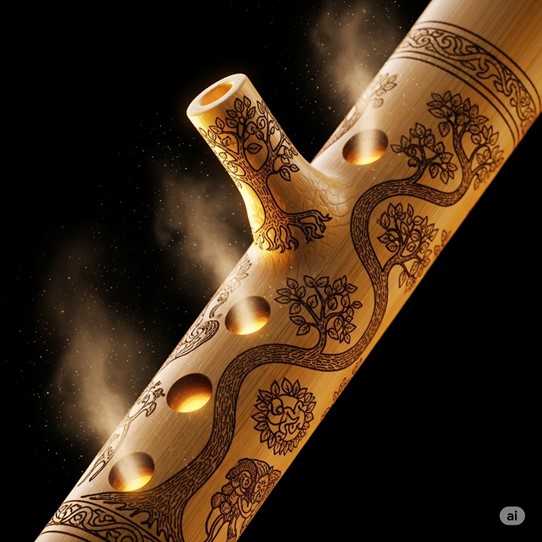
Description The Resonant Breath is a masterfully crafted nose flute, carved from a single, hollowed-out piece of golden-brown bamboo that has been polished to a soft, warm sheen. Its surface is covered in incredibly fine, intricate etchings that depict winding genealogical trees and scenes from creation myths. The finger holes are perfectly placed and burned smoothly into the wood. The flute feels warm to the touch, as if holding the residual breath of all the storytellers who have played it before. When played, it produces a sound that is both haunting and deeply personal, a soft, breathy melody that seems to speak directly to the listener’s heart.
Detailed Stats
- Durability: 70/70
- Mind’s Eye Attunement: +2 to skills involving musical performance, storytelling, recitation of lore, or memory recall.
- Social Fortitude: +1 to saves against performance anxiety (“stage fright”) or magical effects that would cause the user to stumble over their words or lose their train of thought.
Passive Magics
- Harmonious Pitch: The flute is enchanted to be perpetually in tune with its surroundings. Its notes will magically adjust their pitch to perfectly harmonize with any accompanying music, the key of a song being sung, or even the emotional cadence of a story being told. A novice player sounds proficient, and a master player sounds transcendent. It makes the user’s performance more emotionally resonant and pleasing to the ear.
- Echo of Knowledge: When the user is attempting to recall specific or complex information they have learned in the past—such as an epic poem, a legal precedent, a historical timeline, or a complex song—holding the flute to their lips brings forth a faint mental echo of the information. It does not provide knowledge the user never had, but it greatly aids in the perfect and detailed recollection of existing memories.
Activable Magics
- Breath of Ancestors: Once per day, the user may play a specific, wavering melody while beginning a story, poem, or historical account. For the next ten minutes, their voice is subtly amplified and enriched by the flute’s magic. To those listening, it sounds as if the faint, ghostly whispers of ancient voices are woven into the user’s own words, lending them an undeniable weight of history and authority. This provides a significant bonus to any performance or persuasion check made to convince an audience of the story’s truth or importance.
- Song of Truce: Once per rest cycle, the user may play a gentle, lullaby-like tune that is intrinsically peaceful. Any individuals within earshot who are not currently engaged in active combat will be overcome with a feeling of tranquility and common ground. This can de-escalate tense arguments, soothe wary guards, or make a hostile crowd more receptive to diplomacy for a few minutes. It does not work on creatures actively trying to cause harm, but it can prevent a tense situation from tipping into violence.
Slot Handheld Instrument
Tags Common, Tier 1, Kahuna, Bard, Tool, Instrument, Magic, Roleplay, Social, Memory, Performance, Wind Instrument, Bamboo, Lore, Diplomacy, Auditory, Inspiration, Historical
The Kahuna 808 of the Resonant Breath is not a simple commodity to be bought and sold like a sack of grain. It is a vessel of history, a tool of a sacred trade for the bards, historians, and lore-keepers of Saṃsāra. Acquiring one is often a journey in itself, and they are typically found in places where stories and traditions are valued more highly than mere coin.
The Scholarly Archive or College
- Shop Type: These are not shops in the traditional sense, but institutions of learning and preservation, such as “The Great Library of Sumi” or “The College of Oral Histories.” The atmosphere is one of quiet reverence, smelling of old bamboo, parchment, and book-binding resins. These places are the bastions against the forgetting of the histories of the multiverse.
- Method of Acquisition: A Resonant Breath is almost never sold here. It is bestowed. An avatar would need to enroll as a student, proving their dedication to the preservation of lore. After years of study, memorizing epic poems, and transcribing oral histories, the flute is granted to a graduate as a symbol of their new role as a certified lore-keeper. It is a mark of qualification, proving they are a trusted source of knowledge.
- Typical Cost: There is no monetary cost. The price is paid in time, dedication, and a sworn oath to preserve and share history accurately and without embellishment. If a donation to the college’s archives is required, it would be a formality of perhaps 40 Shards, but the true payment is one’s service to knowledge.
The Master Instrument Maker’s Workshop
- Shop Type: Tucked away in a quiet city district or a serene bamboo forest, one might find the workshop of a master flute maker. The sign would be simple, perhaps just an etching of a flute on a wooden plaque. The workshop itself is clean and orderly, filled with the scent of shaved bamboo and curing oils, and the air hums with a quiet, creative energy. The maker is an artist who understands that they are not just crafting an instrument, but a voice for the past.
- Method of Sale: The sale is a personal audition. The maker will not sell a Resonant Breath to someone they deem unworthy of its spirit. They will ask the potential buyer to tell a story, sing a song, or recite a poem. They are listening not just for skill, but for passion and sincerity. If they are impressed, the sale becomes a collaboration, with the maker perhaps offering to carve symbols relevant to the buyer’s own history onto the flute.
- Typical Cost: The price reflects the master’s artistry and the imbued magic, typically ranging from 60 to 75 Shards. However, a master might be swayed by a non-monetary offer. A truly unique and powerful story they have never heard before, or a piece of exceptionally rare “singing bamboo” brought from a distant, uncharted island, could be considered payment in full.
The Traveling Performers’ Camp
- Shop Type: This is not a fixed location, but a vibrant, ever-moving community—a caravan of colorfully painted wagons belonging to a troupe of traveling performers. They move between the 73 island nations, bringing music, theater, and news to remote communities. The atmosphere is one of loud, chaotic, and joyful fraternity.
- Method of Sale: The leader of the troupe, often an elder bard with a lifetime of stories, might have a spare Resonant Breath, perhaps one that belonged to a former member. They would be willing to part with it for a promising young performer who lacks a quality instrument. The sale is often a test of skill or a trade among peers. The buyer might be asked to perform for the troupe and win their approval, or to travel and work with them for a few weeks as payment.
- Typical Cost: The monetary cost is low, perhaps only 25-30 Shards. More often, the price is an exchange of services or art. The troupe might trade the flute for a new set of thrilling stories, a book of rare songs, or a finely crafted lute. It is a transaction based on mutual respect for the performer’s craft and the hardships of the road.
The Retired Adventurer’s Curiosity Shop
- Shop Type: In a dusty corner of a port city, a shop named something like “The Wanderer’s Trove” or “Relics and Memories” is packed to the ceiling with the assorted treasures of a long life of adventure. The proprietor is an old, retired adventurer who has a story for every item on their shelves.
- Method of Sale: The Resonant Breath flute would likely be found in a dusty box, perhaps mistaken for a simple pipe. The shopkeeper acquired it from the pack of a fallen companion or took it from a forgotten tomb years ago. They know it’s “magical” because it makes a nice sound, but they likely do not understand its deeper purpose of memory and oral tradition. The sale is a simple, if long-winded, transaction. The price is often determined by the quality of the story the shopkeeper attaches to it.
- Typical Cost: The price is highly negotiable and depends on the shopkeeper’s mood. They might see it as a simple trinket and sell it for a bargain at 20 Shards, or they might spin a grand tale of its legendary origins and ask for 80 Shards. A buyer willing to sit and listen to the old adventurer’s tales of glory for an hour is more likely to get a favorable price.
In the world of Saṃsāra, the Resonant Breath flute is not a weapon of war, but an instrument of social and spiritual influence. Its use in “offense” and “defense” is a matter of shaping the narrative, controlling the emotional battlefield, and defending against intangible threats like despair, deception, and discord.
Defensive Roleplay Applications
Defensive use of the Resonant Breath is about creating a sanctuary of calm, truth, and hope in a hostile environment. It shields the user and their allies from social assault, judicial trickery, and their own inner demons.
Environment: A Tense Standoff at a City Gate The avatar’s party is barred from entry by a squad of jumpy, aggressive guards, who are convinced the party are smugglers. Shouted arguments are escalating the situation towards drawn steel. The avatar takes out the Resonant Breath and begins to play the Song of Truce. The gentle, haunting melody cuts through the angry shouts. The guards don’t drop their weapons, but their aggressive posture softens. Their hands move away from their sword-hilts. The song has broken the feedback loop of aggression, defending the party from imminent violence. This moment of calm allows the avatar to step forward and speak, their words now falling on receptive, rather than hostile, ears.
Environment: A Formal Court Hearing The avatar’s ally is on trial, accused of a crime they did not commit. A charismatic prosecutor is weaving a compelling narrative of guilt, using half-truths and emotional appeals to sway the presiding magistrate. When it is the avatar’s turn to speak for the defense, they use their flute. Aided by the Memory’s Echo passive, they perfectly recall a specific, obscure law or a detail from an early testimony that unravels the prosecutor’s case. They then activate Breath of Ancestors. Their voice takes on an undeniable weight and authority, as if generations of lawgivers were speaking through them. This combination of factual precision and magical gravitas defends their ally from the prosecutor’s rhetoric, shattering the false narrative and presenting the truth with unshakable conviction.
Environment: Lost and Demoralized in the Endless Jungle After weeks of being lost, the avatar’s companions are succumbing to despair. Food is low, tempers are frayed, and the will to continue is fading. The greatest threat is not the jungle, but their own hopelessness. That night, the avatar sits by the fire. Aided by the flute’s Harmonious Pitch passive, they play a melody that perfectly captures the group’s sorrowful mood, giving voice to their despair. Then, they begin to tell a story, using Memory’s Echo to recall an ancient epic of a hero who faced even greater odds. They activate Breath of Ancestors, and the story of resilience and triumph fills the small clearing with a power beyond mere words. This act defends the party’s spirit from the corrosion of despair, rekindling their hope and giving them the strength to press on.
Offensive Roleplay Applications
Offensive use of the Resonant Breath is the art of shaping the perceptions of others. It is used to undermine an opponent’s authority, champion a chosen narrative, and seize the emotional high ground to achieve a specific goal.
Environment: A Crowded Tavern to Sway Public Opinion The avatar needs to turn the common folk against a corrupt, but powerful, guild foreman. Direct accusations would be dangerous and easily dismissed. Instead, the avatar takes a corner in a popular tavern and begins to perform. They use Memory’s Echo to craft a story that sounds like an old folk tale, but whose details—a greedy overseer, a skimmed shipment of grain, a new jewel on the overseer’s wife’s neck—perfectly mirror the foreman’s recent crimes. They use Breath of Ancestors to give the “old fable” a sense of timeless truth. The tavern patrons, captivated by the tale, begin to murmur amongst themselves, connecting the dots. The avatar has launched a potent social offensive, destroying the foreman’s reputation through allegory without making a single provable accusation.
Environment: A Diplomatic Summit Between Wary Factions Two rival factions are negotiating a fragile truce, but a belligerent warmonger from one side is poisoning the talks with aggressive rhetoric, making their own side appear unreasonable. The avatar, acting as a neutral mediator, asks to perform a “song of history.” They play the Song of Truce to lower the general hostility in the room. Then, using Memory’s Echo and Breath of Ancestors, they recount a famous story from the other faction’s history—a tale of one of their great heroes who chose a wise peace over a foolish war. This offensive maneuver does two things: it flatters and honors the second faction, making them more amenable, while simultaneously shaming the warmonger by unfavorably comparing his aggression to the wisdom of a celebrated hero. The warmonger is now socially cornered; to continue his rhetoric would be to appear less noble than his own faction’s rivals.
Environment: A Royal Contest of Bards The avatar is competing for a vital patronage from a noble house. Their chief rival is a technically brilliant but soulless performer. The rival goes first, dazzling the audience with empty virtuosity. For their turn, the avatar takes a different offensive tack. They use the Harmonious Pitch of the flute to create a simple melody of profound emotional depth. They tell a short, poignant story about one of the noble house’s own ancestors, getting every detail correct with the help of Memory’s Echo. For the climax, they activate Breath of Ancestors, making the tale feel like a sacred piece of the family’s very soul being brought to life. The performance bypasses intellectual appreciation and strikes directly at the heart. The avatar has offensively captured the emotional core of the audience, making their rival’s technical skill seem shallow and insignificant by comparison, thus securing the patronage.
Perception of Activation:
SIGHT
- User’s Perspective: As you play the activating melody, you see the air that flows through the flute begin to shimmer. When you then speak to tell your tale, your own breath becomes visible, misting in the air before you regardless of the temperature. Within this visible breath, faint, ghostly golden glyphs and complex, interwoven patterns swirl for a moment before dissipating.
- Observer’s Perspective: A listener in the audience sees the user’s breath fogging in the air as they speak, an unusual and captivating sight. A particularly sharp-eyed observer, or one sitting very close, might catch a fleeting glimpse of shimmering golden shapes within the mist, but they are too quick and complex to decipher. The general impression is that the user’s very words have a visible weight and energy.
- Positives: This creates a powerful and mystical visual effect that immediately signals to an audience that something special is happening. It captures their attention and lends a visible aura of magic and importance to the performance.
- Negatives: The visual effect is an undeniable and overt display of magic. This could be dangerous in lands where magic is feared or regulated, or it could attract unwanted attention from magical creatures or rival mages.
SOUND
- User’s Perspective: As you speak, your own voice sounds normal to you, but you hear a chorus of other voices whispering just behind it. It is as if dozens of ancestors are speaking in perfect unison with you. You cannot make out their individual words, but you perceive their cadence—old, young, powerful, gentle—lending a profound depth to your own voice. The sensation is as much inside your head as it is in your ears.
- Observer’s Perspective: An audience member hears the user’s voice, but it is transformed. It sounds incredibly rich and resonant, as if it were being spoken in a grand hall with perfect acoustics. They do not consciously discern separate voices, but they perceive an authoritative, multi-layered quality that makes every word seem incredibly important and compelling.
- Positives: The effect is intensely charismatic and makes the user’s speech or story incredibly persuasive and captivating. It is difficult for a listener to ignore or dismiss the words being spoken.
- Negatives: While impressive, the effect is not subtle. Anyone listening will know that the user’s voice is being magically enhanced. A skeptical listener might become more resistant, believing they are being magically manipulated.
SMELL
- User’s Perspective: The air you exhale while speaking carries a distinct and ancient scent. It is the aroma of very old, dry paper, of dust settling in a sunbeam in a vast library, and a faint, sweet smell of preserved wood and honey. It is the scent of history itself.
- Observer’s Perspective: A person sitting near the performer may catch a strange but pleasant smell that seems out of place—the dry, sweet scent of a scroll-keeper’s study, even in an open field or a crowded tavern.
- Positives: This unique aroma can help create a more immersive atmosphere for the audience, subtly drawing them deeper into the historical or epic nature of the tale being told.
- Negatives: The scent is unique and unnatural. A creature that hunts by smell could easily learn to identify the user by this magical signature, making them easy to track.
TOUCH
- User’s Perspective: While you play and speak, the bamboo of the flute grows noticeably warm in your hands, vibrating with a deep, low-frequency thrumming. It feels less like an object and more like a living thing, resonating with a multitude of distant heartbeats. The air you exhale also feels warmer and heavier than normal.
- Observer’s Perspective: An observer perceives no tactile sensations. However, if one were to touch the flute during the activation, they would be startled by its living warmth and the powerful, low vibration running through its body.
- Positives: This provides clear and unambiguous tactile feedback to the user that the magic is active and functioning correctly. The warmth can be comforting and grounding, especially during a high-stakes performance.
- Negatives: The deep vibration could be distracting to an inexperienced user, potentially making it harder to concentrate on their story or song. There is no external tactile cue for an ally.
TASTE
- User’s Perspective: A fleeting but clear taste forms on your tongue—the dry, slightly sweet taste of honeyed mead mingled with the faint, dusty flavor of aged parchment. It is the taste of words and stories passed down through generations.
- Observer’s Perspective: There is no perceivable effect of taste for any observer.
- Positives: This provides another layer of completely internal and personal confirmation of the magic’s activation, impossible for anyone else to detect.
- Negatives: The distinct and unusual taste could be a momentary distraction for the user, especially if they are not accustomed to it.
EXTRA-SENSORY PERCEPTION (AURA)
- User’s Perspective: When you activate the magic, you see with your Mind’s Eye countless, faint golden threads being drawn from the flute with your breath. As you speak, these threads weave themselves into and around your own aura, overlaying it with a vastly more complex and ancient pattern, like a shimmering tapestry of history.
- Observer’s Perspective: Anyone capable of perceiving magical auras would see the user’s personal aura become temporarily enveloped and reinforced by a much older, more powerful collective energy drawn from the flute. They would recognize this as a form of ancestral, historical, or traditional magic, not the user’s own power.
- Positives: To those who can see it, this effect projects an image of immense spiritual authority and a deep connection to the past, making the user appear incredibly wise and powerful.
- Negatives: This display immediately reveals the nature and source of the user’s magic to any magically perceptive entity, friendly or hostile. It is like lighting a brilliant beacon in the magical realm.
EXTRA-SENSORY PERCEPTION (TEMPORAL)
- User’s Perspective: As you recount a story, your own memory is enhanced by fleeting, dream-like sensory flashes from the events you describe. You don’t just remember that the hero was sad; you feel a faint echo of their sorrow. You don’t just recall the sword was sharp; you see a momentary glint of its edge. This makes your performance incredibly genuine and heartfelt.
- Observer’s Perspective: The audience does not see the visions, but they feel their effect. The story feels intensely real, immediate, and emotionally resonant, as if they are witnessing it firsthand rather than just hearing about it.
- Positives: This creates an incredibly immersive and emotionally potent performance that can deeply affect an audience, making your stories unforgettable.
- Negatives: For the user, experiencing these sensory echoes, especially from dark or tragic tales, can be emotionally draining or even traumatic. It can become difficult to distinguish one’s own feelings from the feelings of the story.
EXTRA-SENSORY PERCEPTION (EMPATHIC)
- User’s Perspective: You become acutely aware of the collective emotional state of your audience. You can feel their rising excitement, their shared tension, their communal sorrow. This allows you to instinctively adjust your pacing, tone, and emphasis to guide their emotional journey with masterful precision.
- Observer’s Perspective: An empath in the audience feels their own emotions being skillfully guided and amplified in concert with everyone else present. They feel a powerful sense of connection and shared experience with the other listeners, as if the bard’s voice is a loom weaving all of their individual feelings into a single, unified tapestry.
- Positives: Allows the user to create a powerful sense of unity and camaraderie within an audience, making them highly receptive to the user’s message or story.
- Negatives: A hostile or unwilling empath would perceive this as a profound and invasive form of emotional manipulation, which could provoke a deeply aggressive or defensive reaction.
Invocation for the Story-Teller’s Flute
The following describes the method for crafting a Resonant Breath flute. This is not a task of simple woodworking, but a spiritual undertaking. The process aims to create not just a musical instrument, but a vessel capable of holding the echoes of history and giving voice to the stories that would otherwise be forgotten. The crafter must approach this work with patience, reverence, and a heart full of stories.
Materials Needed
- One Stalk of River-Whisper Bamboo: This specific type of bamboo grows only at the confluence of two distinct rivers. The stalk must be harvested during a full moon when the energies of meeting waters are at their peak. It must be a mature, straight stalk with no blemishes.
- Thread of the Memory-Moth: A short length of silk thread spun by a Memory-Moth, a rare creature said to feed on the pollen of ancient, thought-to-be-extinct flowers. The silk is believed to physically hold faint echoes of the past.
- A Handful of Ancestor’s Salt: Sea-salt gathered from a shoreline where the fossilized bones of ancient sea creatures are found eroding from the cliffs. This salt is used to ritually purify the bamboo, connecting it to the deep past.
- One Vessel of a Final Breath: This is the most crucial and esoteric component. It is the last exhaled breath of a dying elder, captured and magically sealed within a small glass or ceramic vessel at the moment of their passing. It must be a breath given willingly, carrying with it the weight of a lifetime of memories.
Tools Required
- Master’s Carving Knife Set: A collection of extremely sharp, fine-tipped knives of varying shapes, essential for carving the intricate symbols onto the flute’s surface without splintering the bamboo.
- Resonant Tuning Forks: A set of precisely calibrated tuning forks made from a special alloy. They are used not to find a specific musical note, but to detect the natural resonant frequency of the bamboo itself.
- Hollowing Rods and Spoons: Specialized, thin metal tools designed to carefully hollow out the bamboo stalk from both ends without causing cracks or compromising its structural integrity.
- Burnishing Needles: A set of hardened steel needles of different diameters that are heated in a magical flame until they glow. They are used to burn the finger holes into the bamboo, creating perfectly smooth, sealed edges.
Skill Requirements
- Instrument Craft (Novice): The crafter must possess the physical skill to work with delicate materials, understanding how to carve, hollow, and shape the bamboo without destroying it.
- Performance (Basic): A fundamental ability to play music is necessary to test the flute’s voice and to perform the final imbuement ritual. The crafter must be able to recognize a clear, true note.
- History or Lore (Basic): The crafter must have knowledge of the traditional genealogical and mythological symbols they are carving. The intent and understanding behind the carvings are vital to the magic.
- Mind’s Eye Attunement (Tier 1): The ability to perceive and channel spiritual energy is paramount for the final step, where the crafter breathes the magic into the instrument.
Crafting Steps
- Purification and Hollowing: The process begins with a ritual cleansing. The stalk of River-Whisper Bamboo is rubbed with the Ancestor’s Salt to purify it of any stray energies. Then, with great care, the crafter uses the hollowing rods and spoons to hollow out the stalk, creating a smooth, open channel within.
- Finding the Voice: The crafter gently taps the hollowed bamboo with the resonant tuning forks, listening and feeling for the point of its purest natural vibration. This “sweet spot” will determine the placement of the primary finger holes. The burnishing needles are heated and used to create the holes, the hot metal searing the wood to a perfect smoothness.
- The Etching of Histories: This is a long and meditative process that can take many days. The crafter uses the fine carving knives to meticulously etch the surface of the flute with the winding lines of genealogies and the symbolic scenes of creation myths. As they carve each line, they must focus their mind on the story that the symbol represents, effectively weaving the lore into the physical body of the flute.
- The Ritual of Inhaling Memory: This is the final and most sacred step. The crafter takes the finished but unenchanted flute and holds it to their lips. They take the Vessel of a Final Breath and carefully unseal it directly over the flute’s blowhole. As the preserved breath mists out and is drawn into the flute, the crafter must begin to play a single, long, clear note. As they play, they must use their Mind’s Eye to channel their own memories—their personal history, their favorite stories, their deepest feelings of joy and sorrow—into the note, mingling their own spirit with the elder’s captured breath. This act awakens the flute, transforming it from a simple instrument into a vessel for all stories.
- The Final Binding: To seal the magic within, the crafter takes the Thread of the Memory-Moth and carefully wraps it around both ends of the flute, creating decorative and magically functional bindings. The flute is then wrapped in a simple cloth and left in silence for one full day and one full night, allowing the memories and voices within it to settle into a harmonious whole.
Chant of the First Breath
In the age of scattered souls, a great quiet sickness fell upon the people of Saṃsāra. It was the sickness of forgetting. A child knew the face of their father, but not the face of their father’s world. The great songs that told of the making of stars became simple tunes for rocking babies. The past was a house with no doors, and the people could not enter.
There was a man whose title was the Keeper of Fading Words. His work was to remember. He saw this sickness, and it made a great pain in his memory. He saw that the people were not whole. They were leaves cut from a tree, with no knowledge of the root. He said, “I must build a yesterday in the minds of today. I must make a tool not for the hand, but for the heart.”
So he began a walk to find the parts of his making. He sought a special bamboo, the kind that grew only where two great rivers met and became one river. He found such a place, and he said, “As these two waters are now one water, so will the memory of the past and the mind of the present become one mind.” He took a single stalk of this River-Whisper Bamboo.
For the bindings, he needed a special thread. He journeyed to the high mountains where the Memory-Moths lived. These moths, it is said, remember every moon they have ever seen, and their silk shines with this held light. He gathered the silk that a moth had left on a moon-flower. It was soft and strong, a thread that could tie a thing in place and also tie it to a time long ago.
For the great magic, he needed a voice that was almost gone. He traveled for a month and a day to find the oldest man in the seven-and-seventy islands. This man was the last person who knew the true Song of the Making of a world that was now only dust. The old man’s breath was a shallow thing in his chest. The Keeper of Fading Words did not take the man’s last breath. He asked for a greater gift. He said, “Grandfather, sing your song one last time. Sing it not to me, but to this hollow reed.”
The old man, with a great effort, put his lips to the bamboo. He did not have the breath to make a sound. So the Keeper put the flute to his own nose and breathed a slow breath for the old man, and the old man used this given air to sing his song. The notes were weak and cracked, a ghost of a song, but they went into the bamboo and stayed there. The shape of the song was now trapped in the wood.
The Keeper of Fading Words returned to a settlement where the people were listless and their eyes held no past. He sat among the children, who did not look at him. They had no interest in an old man with a stick of wood. He lifted the flute to his nose. He did not play a clever tune. He simply breathed, and the notes of the old man’s song came out.
And a great wonder happened. The sound was not just a note of a flute. It was also the voice of the old man, faint and crackling like a dry leaf. The song told of a sun being born from a dragon’s eye. The children, who had been looking at the dirt, now looked at the Keeper. For the sound made sight in their heads. They saw the dragon. They saw the sun. The story was not told to them. It was happening inside their own minds.
When the song was done, the children were awake. Their eyes were full of wonder. They shouted, “Tell us another! Tell us of our grandmothers! Tell us of the boat that sailed the silver sea!”
The Keeper of Fading Words smiled. He showed them the flute. “This is a Resonant Breath,” he said. “It does not make the music. You do. The story must first be in your heart. This tool only gives your story a breath, so that others may breathe it too.”
He stayed for many weeks, and he played the stories of their own lost histories, which he had gathered in his long travels. And the people of the settlement were no longer leaves cut from a tree. They were the tree, and they knew the deepness of their roots. The making of the flutes was taught, and the Bards of Saṃsāra became the new Keepers, ensuring that no story would ever truly be lost to the quiet sickness of forgetting.
The Moral of the Story: A people is not dead until their last story is forgotten.
Suggested conversions to other systems:
Call of Cthulhu, 7th Edition
The Lamenting Reed of Kealakekua
An anthropological curiosity, this is a traditional Hawaiian nose flute (ʻohe hano ihu) of unusually fine craftsmanship. It is carved from a single piece of dark bamboo and covered in intricate, repeating patterns that do not correspond to any known historical designs. Academics who have studied it dismiss it as a tourist piece, but occultists who have held it report feeling a profound sense of melancholy and a connection to a past that is not their own. It produces a soft, breathy, and deeply sorrowful sound, even when played by a novice.
Game Mechanics:
- Echoes of the Past: The user gains one Bonus Die on any History or Anthropology roll made to recall information they have previously encountered in a text or oral story. This does not grant new knowledge but aids in the perfect recall of details.
- A Moment’s Peace: Once per game session, the Investigator may play a simple melody. Any non-hostile NPCs within earshot become temporarily calm and more receptive to conversation. The Investigator gains one Bonus Die on their next Charm or Persuade roll against these individuals. This effect is broken if any threatening action is taken.
- Voice of Authority: By playing the flute while reciting a piece of lore, the Investigator’s voice takes on an unusual gravitas. They may make an Art/Craft (Music) roll in place of an Intimidate roll to awe a subject into compliance. This only works on subjects who respect tradition or knowledge and is ineffective against mindless creatures or those actively hostile.
Blades in the Dark
The Ghost-Wind Flute
This flute is carved from a single piece of petrified wood recovered from the Deathlands, still cold to the touch. The sigils carved into its surface are said to be a mix of Iruvian story-runes and Unbroken Sun canticles. It is said that when played, the sound isn’t made by the user’s breath, but by the ghosts who are drawn to its mournful tune. It is a favored tool of whispers, cultists, and spies who understand that a well-placed story can be more effective than a well-placed knife.
Game Mechanics:
This is a piece of Occult Gear.
- Social Engineering: When you play the flute as part of a social downtime activity to Schmooze a contact or Reduce Heat, your roll gains +1d.
- Song of Ceasefire: Once per score, you may play a haunting melody to de-escalate a tense standoff that has not yet erupted into violence. Frame it as a plea or a lament. Your crew does not take Stress, but every other party involved in the standoff immediately takes 1 Stress as the music unnaturally saps their aggressive intent, forcing them to reconsider their immediate actions.
- Ancestral Weight: When making a Sway or Command roll, you can use the flute to give your voice an eerie, resonant quality. You gain +1 Effect to your action. However, the target of your action will be haunted by your words; the next time they act against you, they also gain +1 Effect as your memorable command drives them.
Dungeons & Dragons, 5th Edition
Flute of the First Story
Wondrous item, common (requires attunement)
This masterfully crafted bamboo nose flute is warm to the touch and covered in fine etchings depicting winding genealogies. It is said that the first bards used flutes like this to preserve the histories of worlds that had been lost, and that the instrument still holds the echo of those tales.
While holding this attuned item, you gain the following benefits:
- You have advantage on Charisma (Performance) checks and Intelligence (History) checks.
- As an action, you can play a soothing melody. Each humanoid of your choice within 30 feet that can hear the melody must make a DC 12 Wisdom saving throw. On a failed save, the creature is charmed by you for 1 minute. If you or your companions do anything harmful to it, the effect ends. Once you use this property, you cannot use it again until the next dawn.
- When you grant a creature a Bardic Inspiration die, you can play the flute as part of the same bonus action to bolster their spirit. The creature gains temporary hit points equal to the number rolled on the Bardic Inspiration die.
Knave, 2nd Edition
Ancestor’s Reed
A long, dark bamboo flute played with the nose. It is covered in thousands of tiny, intricate carvings of faces and trees. It feels warm, as if someone was just playing it. Takes up 1 inventory slot.
- Echoed Lore: You have advantage on any Wisdom save made to recall information you have previously heard or read.
- Disarming Melody: Once per day, you can play the flute for one minute. Up to 2d6 non-hostile creatures of your choice who can hear you become friendly toward you for the next 10 minutes. They will not attack unless provoked.
- Tale of Courage: You can play the flute while telling a story of heroism for 10 minutes. At the end of the story, you and up to 6 allies who listened gain 1d6 “Resolve.” Resolve can be spent at any time, 1 for 1, as a bonus to any saving throw. Any unused Resolve disappears after the next sunrise.
Fate Core
The Reed of Remembered Tales
This is an Extra, representing a powerful narrative tool that shapes your character’s journey. It costs one point of Refresh to acquire. It is a simple bamboo nose flute, but it feels warm to the touch and seems to hum with the weight of stories waiting to be told.
Game Mechanics:
This item grants your character a new Item Aspect: Echoes of a Thousand Stories.
- Invoke for Performance: Once per session, you may invoke Echoes of a Thousand Stories for free to gain a +2 bonus or a re-roll on a Create an Advantage action that involves a musical or oral performance. The Aspect you create could be Captivated Audience or Inspired by the Saga.
- Overcome Forgetfulness: When you are trying to remember a crucial piece of history, a genealogical detail, or the specific wording of a legend, you can meditate with the flute to Overcome your own faulty memory. This allows you to make a Lore roll to recall the information with perfect clarity, even in a stressful situation where you might otherwise forget.
- A Moment of Peace: When a social conflict is about to turn violent, you can spend a Fate Point to play a disarming melody. This allows you to Declare a Story Detail: “My music has calmed them for a moment, and they are willing to listen.” This creates a brief window for diplomacy where there was none before.
Numenera & Cypher System
Acoustic Meme-Weaver
This device, from a prior world, appears to be a simple tube of dark, polished synth-bamboo. When breath passes through it, however, it doesn’t just create sound; it accesses and rearranges latent data-streams in the air, weaving them into audible patterns that directly influence the minds of listeners. It implants concepts—or memes—of peace, courage, or historical truth.
Level: 3 Form: A flute-like handheld device. Effect: This artifact has a constant passive effect and two activatable functions.
- Constant Effect: The device constantly whispers fragmented historical data into the user’s mind. Any task to recall information about history or folklore is eased by one step.
- Activation (Performance): As an action, the user can play a melody. For the next minute, any task by the user related to public speaking, musical performance, or persuasion is eased by one step.
- Activation (Soothing Tones): As an action, the user can play a specific sequence of harmonizing tones. All non-hostile NPCs within short range who can hear the tones must succeed on a Level 3 Intellect defense roll. Those who fail become placid, non-aggressive, and more suggestible (+1 to the user’s persuasion attempts against them) for one minute or until a threatening action is taken.
Depletion: 1 in 1d20.
Pathfinder, 2nd Edition
The Chronicler’s Flute ITEM 2 UNCOMMON AUDITORY ENCHANTMENT MAGICAL Usage held in one or two hands; Bulk L
Description Carved from a single stalk of golden bamboo and covered in etched genealogies, this nose flute produces a sound that is both haunting and deeply resonant. It is said that when played, one can hear the faint whispers of ancestors on the notes, lending an undeniable weight to the performer’s words and music.
After you have invested the item, you gain the following benefits:
- You gain a +1 item bonus to Performance checks.
- You gain a +1 item bonus to Society checks to Recall Knowledge about history or genealogies.
Activate [one-action] to [two-actions] (auditory, concentrate, enchantment); Frequency once per 10 minutes; Effect You play a captivating melody.
- [one-action] (manipulate): You perform an impressive musical flourish. Attempt a Performance check against the Will DC of one creature who can see and hear you. On a success, the creature is fascinated by you for its next action.
- [two-actions] (manipulate, mental): You play a soothing tune. Any ally who can hear you gains a +1 circumstance bonus to their next saving throw against a fear effect before the start of your next turn.
Savage Worlds Adventure Edition
The Ancestor’s Song Flute
A simple-looking bamboo nose flute that is surprisingly heavy and warm to the touch. The sound it makes is soft and breathy, yet it carries an unusual authority, making listeners stop and pay attention. Bards and traveling storytellers claim that playing it helps them remember the old tales with perfect clarity.
Requirements: Novice, Performance d6+ Game Mechanics:
- Bardic Knowledge: The user gains a +2 bonus on all Academics or Common Knowledge rolls made to remember history, legends, or family lines.
- Song of Respite: As an action, the user can play a calming melody. Make a Performance roll. For every success and raise, one ally (including the user) who can hear the music may immediately attempt to remove the Shaken condition with a Spirit roll at no penalty.
- Inspiring Tale: The user can use their Performance skill in place of their Intimidation skill to make a Test, as they tell a tale so inspiring or fearsome that it affects their target. If they get a raise on the roll, the target is Distracted in addition to being Shaken.
Shadowrun, Sixth World
The Story-Weaver’s Focus
This appears to be a handcrafted bamboo nose flute, covered in intricate carvings that mix traditional Polynesian motifs with modern trideo iconography. It is an oddity, a clear rejection of polished chrome and synth-plastic. In the astral, it resonates with the power of oral tradition and the spirit of community. It is a rare type of magical focus favored by shamans who follow Speaker or Mentor Spirit totems, and by bards who see the magic in the stories of the Sprawl.
Type: Lore Focus Rating: 2 Activation: Requires a Minor Action to begin playing. Bonding Cost: 2 Karma
Game Mechanics:
This focus must be bonded to be used. Once bonded, it provides the following benefits:
- Echoes of the Matrix: The focus helps the user recall vast amounts of information as if they were stories. The focus provides its Rating (2) as a dice pool bonus to any Academics or Knowledge Skill test made to recall information about history, legends, traditions, or even old news reports from the Matrix.
- Song of a Moment’s Peace: By playing the flute as a Major Action, the user can attempt to de-escalate a tense, non-combat situation. The user makes an opposed Charisma + Performance test against the Willpower + Logic of the most resistant person in the group. If successful, the targets are unwilling to initiate combat for a number of rounds equal to the net hits, unless they are attacked first.
- Ancestral Voice: When making a Negotiation or Instruction test, the user can play the flute to give their voice an eerie, authoritative weight. They gain Edge equal to the focus’s Rating (2) for that test.
Starfinder
Mnemonic Reed
Level 2 Price 750 credits Bulk L
DESCRIPTION This simple-looking tube of golden-brown polymer is a sophisticated mnemonic and psycho-acoustic device. When played, it analyzes the user’s brainwaves to access deep-seated memories and projects a complex series of sonic frequencies and pheromones designed to evoke specific emotional responses in listeners. It is a favored tool of envoys, cult leaders, and celebrity performers.
GAME MECHANICS This hybrid item is held and requires one hand to play.
- Enhanced Recall: The reed’s neuro-feedback loop aids the user’s memory. The user gains a +4 insight bonus on all Culture checks to Recall Knowledge.
- Song of Serenity (Sp): Once per day as a standard action, the user can play a calming melody. All other living creatures within a 20-foot radius must succeed on a DC 13 Will save or become fascinated for 1d4 rounds. A creature that was hostile toward you becomes indifferent for the duration. This effect ends for a creature if it is attacked or threatened.
- Ancestral Gravitas (Sp): Once per day as a move action, the user can play a short, resonant tune. For the next minute, their voice is imbued with a powerful, compelling quality. They gain a +2 circumstance bonus to all Diplomacy and Intimidation checks.
Traveller, Mongoose 2nd Edition
Droyne Caste-Flute
Tech Level: 9 (Alien Technology) Mass: 0.2 kg Cost: Cr 20,000 (Rare, often considered Droyne cultural property)
Description: A flute-like instrument carved from a strange, lightweight, amber-colored wood native to a Droyne world. The instrument is a key part of Droyne society, used by the Leader and Drone castes to access and convey caste histories, traditional knowledge, and social status through incredibly complex melodies. Non-Droyne find the music haunting and strangely persuasive, though they cannot grasp its full meaning.
Game Mechanics:
- Alien Charisma: The strange and beautiful music is captivating. The user gains DM+1 on any Carouse or Persuade check when the purpose is to entertain or calm a crowd.
- Access Racial Memory: The flute contains a repository of Droyne folklore. A user can attempt to interface with it over several hours (requiring an Average Academics (INT) check). On a success, they can piece together a specific piece of Droyne history, granting them DM+2 on any subsequent check related to that specific topic.
- De-escalation Harmonics: The device can be played to generate a series of calming sub-sonic frequencies. A successful Average Art (instrument) check can lower the tension in a non-combat situation, preventing a social check from escalating to violence if it fails. This can be attempted once per encounter.
Warhammer Fantasy Roleplay, 4th Edition
The Wood Elf ‘Memory-Pipe’
Encumbrance: 1 Availability: Very Rare Price: 110 GC
A masterfully crafted flute made from a single piece of pale, ageless wood from the forests of Athel Loren. Its surface is covered in intricate, spiraling Elven glyphs that seem to shift when not viewed directly. It was likely a gift from a Wood Elf diplomat ages ago, or—more likely—stolen from one of their hidden halls. The music it produces is impossibly beautiful and carries with it a profound sense of ancient loss and deep memory.
Game Mechanics:
- Ancient Lore: The pipe whispers forgotten secrets to its player. The user is considered to have the Lore (History) skill. If they already have this skill, they gain a +10 bonus to Lore (History) Tests.
- Song of Peace: The user may play a soothing Elven melody. This requires a Challenging (+0) Charm Test. If successful, any non-hostile targets who can hear the music will not gain or act upon any Angry Conditions for a number of rounds equal to the user’s Willpower Bonus.
- The Weight of Ages: The memories held within the pipe are ancient and sorrowful. When the user makes any Lore Test using the pipe and fails, they must make a Difficult (-10) Cool Test. If they fail this second test, they are overwhelmed by a sense of loss for the ages gone by, gaining 1 Fatigued Condition as they are lost in a melancholy daydream for a minute, unable to take any actions.