
Lore When the scattered peoples of Saṃsāra first began to form societies, their laws were a tangled net of half-remembered traditions from a thousand different worlds. Justice was often a matter of the strongest arm or the loudest voice. A Kahuna, whose sacred duty in her former life was to memorize and recite the epic genealogies and oral laws of her people, saw this chaos and despaired. She knew that a society without a clear and truthful law was like a body without a skeleton.
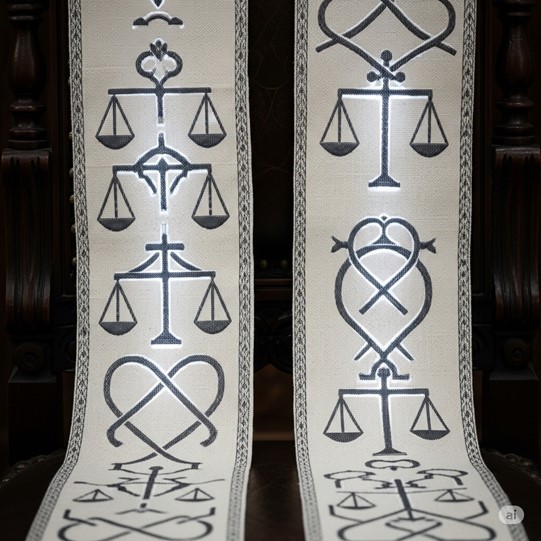
She set out to create a tool not for a warrior, but for an advocate. She gathered the bark of the Ironwood tree, which stands unbending, and beat it into a soft, durable Kapa cloth. Into this cloth, she wove patterns with thread dyed in sea-salt and ash, creating not just decoration, a visual representation of legal principles: the unbreakable knot of an oath, the straight line of truth, the balanced scales of justice. She imbued it with magic that clarified thought and gave weight to truthful words. The first to wear it in a dispute found their arguments clear, their voice steady, and the lies of their opponent seemed to unravel in their presence. These Kapa became the first regalia of the barrister, a symbol that the wearer spoke not just for a client, but for the spirit of the law itself.
Description This item is a long, handsome stole or sash, approximately a hand’s-width wide, designed to be worn over the shoulders. It is made of a surprisingly soft yet incredibly durable cream-colored cloth, similar in texture to the finest tapa bark-cloth. Woven into the fabric with a thread of deep grey are intricate, geometric patterns. At a glance, they appear to be simple, elegant decorations, but upon closer inspection, they are revealed to be a complex tapestry of stylized legal and logical symbols. The Kapa feels solid and reassuring to the touch and carries a faint, clean scent like old books and dry, sun-baked earth.
Detailed Stats
- Durability: 100/100
- Mind’s Eye Attunement: +2 to skills involving public speaking, rhetoric, legal debate, and constructing a logical argument.
- Mental Fortitude: +1 to saves against magical effects that would cause confusion, muddle thoughts, or compel the wearer to speak falsehoods.
Passive Magics
- Clarity of Voice: When the Kapa is worn, it magically enhances the wearer’s voice. Without any effort from the speaker, their words become clear, resonant, and carry easily to the back of a large room or across a windy square. It subtly filters out nervous tremors, stammers, or quavers, making the wearer sound confident, composed, and authoritative at all times.
- Sense of Dissonance: When the wearer is focused on a legal case or formal debate, the patterns on the Kapa will seem to subtly “blur” or “twist” in their peripheral vision whenever they hear a statement that is a direct lie or a logical fallacy. This provides a constant, quiet, physical cue that an untruth or a flaw in reasoning has been presented, allowing the wearer to pinpoint weaknesses in an opponent’s argument.
Activable Magics
- Weave the Argument: Once per major debate or hearing, the wearer can grasp the edges of the stole and focus on the core truth of their case. For the next ten minutes, their mind becomes exceptionally clear, and their logic becomes almost unassailable. The magic helps them seamlessly connect disparate pieces of evidence into a single, compelling narrative. To listeners, their argument sounds supremely logical and well-reasoned, making it very difficult to refute. This provides a significant bonus to any skill check related to persuasion or argumentation.
- Recall the Precedent: Once per day, when confronted with a novel legal or ethical dilemma with no obvious solution, the wearer can hold the stole and meditate on the problem for one minute. The intricate patterns woven into the cloth will seem to shift and guide their thoughts, leading them to an intuitive flash of insight. This insight is not a direct answer, but a memory or a tale of a similar, analogous situation from history or legend. This provides the user with a powerful precedent or metaphor upon which to build their argument, allowing them to find a path forward where none was clear.
Slot Shoulders
Tags Common, Tier 1, Kahuna, Barrister, Wearable, Shoulders, Magic, Roleplay, Social, Legal, Mental, Oratory, Logic, Truth, Detection, Cloth, Rhetoric, Symbolic
The Kapa of Unbroken Testimony is not merely a magical garment but a barrister’s regalia, a symbol of their station and their sworn duty to uphold the law with clarity and truth. As such, it is rarely found in a common marketplace. Acquiring one typically involves engaging with the institutions of law and justice, or seeking out the master artisans who understand its profound purpose.
The Law School Scriptorium or University Registrar
- Shop Type: This is the most official source. It is not a shop but an administrative office within a city’s established university, law library, or College of Advocates. The location, perhaps named “The Chancellor’s Supply” or “The Guild of Barristers’ Registry,” is stately, quiet, and smells of old books, ink, and floor wax.
- Method of Acquisition: This item is not truly “sold” here but conferred. It is the mark of a graduate who has successfully passed their final examinations and has been accepted into the legal profession. To acquire a Kapa this way, an avatar would need to complete a rigorous course of study in the law, demonstrate their rhetorical skill in mock trials, and swear an oath to the principles of justice. The Kapa is presented during a formal ceremony, signifying the individual’s new status as a recognized barrister.
- Typical Cost: The cost is symbolic. A “graduation and registration fee” of 40-50 Shards is typical, intended to cover the cost of the materials and the magical weaving. The true price is paid in years of dedicated study and the successful completion of one’s legal education.
The Master Weaver’s Studio
- Shop Type: In a city’s artisan quarter, one might find the studio of a master weaver who specializes in enchanted textiles. The studio, likely named something like “The Unbroken Thread,” is a quiet, clean, and well-lit space filled with the scent of natural dyes and the soft click-clack of a loom. The weaver is an artist who understands the deep magic of patterns and considers each Kapa a masterpiece.
- Method of Sale: The sale is a personal commission between an artist and a patron. The weaver will not create a Kapa for just anyone. They will engage the potential buyer in a long conversation, asking them about their motivations, their understanding of justice, and their purpose. They must be convinced of the buyer’s worthy character before beginning the painstaking process of weaving the stole and its magical patterns. A sale might be refused if the weaver senses a “crooked heart.”
- Typical Cost: The price reflects the immense time and skill required to create such an item. A commissioned Kapa would cost between 80 and 100 Shards, and the price would be firm. This is the cost of a unique, master-crafted work of magical art.
The Estate Sale of a Respected Judge
- Shop Type: This is not a shop, but a temporary sale held at the home of a recently deceased or retired judge, barrister, or legal scholar. The sale is often managed by the family or an executor of their estate. The atmosphere is often melancholic and respectful, surrounded by the books and personal effects of a long life dedicated to the law.
- Method of Sale: The Kapa would be sold alongside other personal items, such as robes, wigs, and legal texts. The family may not understand its specific magical properties, viewing it simply as a piece of professional regalia with sentimental value. The transaction is a straightforward purchase, but a discerning buyer might learn much about the Kapa’s history by speaking with the family about its previous owner.
- Typical Cost: The price is highly unpredictable. If the family is unaware of its magic, they might sell it for as little as 30 Shards, the price of a fine scarf. However, if the previous owner was famous, the family might price the Kapa based on their renown, asking for 150 Shards or more as a piece of history. This is where a true bargain or a significant investment can be made.
The Black Market for Official Insignia
- Shop Type: In the criminal underbelly of a major city, there are brokers who specialize in acquiring and selling items that confer authority: forged documents, official uniforms, and stolen regalia. The meeting place is always secret, and the broker is paranoid and purely transactional.
- Method of Sale: Any Kapa found here is certainly stolen. The broker sells it not as a tool of justice, but as a tool of deception. It is a costume piece for a con artist who wishes to impersonate a barrister to gain access to a courthouse, prison, or the trust of a wealthy mark. The sale is fast, anonymous, and conducted in cash. The buyer assumes all the considerable risk.
- Typical Cost: The price is high, based on the item’s utility for high-level deception. It would likely cost at least 200 Shards. This price also buys a great deal of trouble, as being caught with a stolen Kapa is equivalent to being caught with a stolen master key to the halls of justice.
The Kapa of Unbroken Testimony is not a tool of physical conflict; its arena is the courtroom, the negotiating table, and the public square. Its use in “offense” and “defense” is a sophisticated game of rhetoric, logic, and the strategic defense of truth or the aggressive dismantling of falsehood.
Defensive Roleplay Applications
Defensive use of the Kapa is about creating a sanctuary of reason around the wearer. It is a shield against deception, confusion, and the overwhelming force of a disingenuous opponent.
Environment: A Hostile Courtroom The avatar stands to defend a client who is facing a charismatic prosecutor known for their fiery, emotional appeals that often obscure the facts. As the prosecutor delivers a passionate but misleading closing argument, the avatar remains calm. Their Clarity of Voice passive ensures that when their turn comes, their steady, measured tones will cut through the lingering emotional fervor in the room, commanding attention without shouting. More importantly, as the prosecutor speaks, the avatar watches the geometric patterns on their stole. When a key piece of evidence is misrepresented, the avatar’s peripheral vision catches a subtle, dizzying twist in the woven patterns—the Sense of Dissonance at work. This alerts them to the specific falsehood. They can then rise for their own rebuttal and say, “My esteemed colleague spoke with great passion. Let us now speak with great clarity,” before systematically and calmly correcting that specific lie, using the Kapa’s warning to defend the case from being judged on emotion rather than fact.
Environment: A High-Pressure Contract Negotiation A powerful steam-baron attempts to rush the avatar into signing a complex trade agreement, claiming it’s a “standard contract.” The avatar, feeling pressured, invokes a point of personal tradition, draping the Kapa over their shoulders to “properly consider the gravity of the accord.” As they read through the dense document, the Sense of Dissonance alerts them to a clause written in confusing legalese that contradicts an earlier section. It’s a subtle trap. Defensively, the avatar can now activate Weave the Argument. The Kapa’s magic clarifies their thoughts, allowing them to instantly deconstruct the convoluted language and state plainly, “This section directly negates the liability terms we agreed upon. It needs to be amended for this contract to be logically consistent.” The Kapa has defended them from signing a predatory contract by revealing its internal flaws.
Environment: A Public Debate Against a Sophist The avatar is engaged in a philosophical debate with a rival who specializes in sophistry—using clever but fallacious arguments to trap their opponents. The rival poses a seemingly impossible ethical dilemma, a “logic bomb” designed to force the avatar into a contradictory or unpopular position. The avatar, feeling cornered, activates Recall the Precedent. They close their eyes for a moment, and an insight flashes in their mind—not a direct answer, but the memory of an ancient, analogous fable. They can then sidestep the trap entirely by responding, “Your question is a fascinating one. It reminds me of the old fable of the Golem and the Ferryman, which illustrates that the premise of your question is itself flawed.” This defends their intellectual standing by refusing to engage with the trap on their opponent’s terms.
Offensive Roleplay Applications
Offensive use of the Kapa is about proactively seizing control of a narrative. It involves dissecting an opponent’s argument, exposing its weaknesses, and constructing a fortress of logic so compelling that it becomes an attack in its own right.
Environment: Cross-Examining a Deceptive Witness A key witness for the opposition is on the stand, telling a well-rehearsed and convincing lie. The avatar, wearing the Kapa, begins the cross-examination. Their questions, enhanced by Clarity of Voice, are precise and unnerving. With each answer the witness gives, the Sense of Dissonance provides the avatar with a subtle visual cue every time the witness deviates from the truth. The avatar doesn’t challenge them immediately. Instead, they mentally collect these falsehoods. Once they have three or four, they launch their attack. They activate Weave the Argument. “Sir, you previously stated you were at the wharf at sundown,” the avatar begins, their logic now supernaturally sharp. “A moment ago, you claimed you spoke to the harbormaster after the evening steam-whistle. The harbormaster’s log shows he went off duty an hour before that whistle. Please, reconcile for the court how you were in two places at once.” The avatar uses the Kapa’s powers to offensively construct a “perjury trap” from the witness’s own lies, completely destroying their credibility.
Environment: Championing a Controversial New Law The avatar stands before a council of elders to propose a radical new law that would help the community but is opposed by powerful traditionalists. Knowing they will face stiff opposition, the avatar activates Weave the Argument before they even begin. They deliver a speech that is a masterpiece of pure, unassailable logic, linking their proposal to increased prosperity, security, and civic harmony. When an elder objects, stating, “This goes against a century of tradition!” the avatar is ready. They activate Recall the Precedent. “Honored elder,” they counter, their voice ringing with authority, “the very tradition you cite was itself a radical break from the ‘King’s Law’ that preceded it. Our greatest tradition is not stagnation; it is adapting for the good of the people, just as our ancestors did then.” The Kapa has been used offensively to not only defend their position but to co-opt and reframe the very foundation of their opponent’s argument.
Environment: Deconstructing a Demagogue in a Crowd A rabble-rouser is whipping a crowd into a violent frenzy with hateful rhetoric and blatant lies. The avatar cannot hope to shout over him. Instead, they use the Kapa’s powers for a surgical strike. They wait for the demagogue to make his most outrageous claim. The Sense of Dissonance flares in their vision. The avatar then uses Clarity of Voice to ask a single, piercingly simple question that cuts through the noise: “But the public record shows the opposite is true. Why are your words and the truth not the same?” The demagogue attempts to bluster and deflect, but the avatar activates Weave the Argument, and with a few, simple, logical points, they expose the core lie of the demagogue’s speech to the entire crowd. The offensive is not against the man, but against his argument. The crowd’s passionate anger, its foundation now shattered, collapses into confused silence.
Perception of Activation:
SIGHT
- User’s Perspective: When you activate the Kapa’s magic, your perception of the world sharpens into crystalline focus. Colors seem more distinct, edges more defined. The intricate woven patterns on the stole itself appear to gain a subtle depth, as if you can see the logical structure they represent. It is not a magical glow, but a change in your own perception, as if a mental fog has been instantly cleared.
- Observer’s Perspective: There is no visible change to the Kapa itself. A keenly observant person might notice a sudden, dramatic shift in the user’s eyes. Their gaze becomes intensely focused, unwavering, and seems to penetrate whatever it rests upon, be it a person or a document. They appear to be seeing the world with a new, unnerving clarity.
- Positives: The activation is completely imperceptible to outside observers, allowing the user to engage a powerful mental enhancement with total discretion. The heightened visual focus can help the user notice minute physical details they might have otherwise missed.
- Negatives: The lack of any visual cue means an ally will not know the magic has been engaged. The user’s intense, unblinking stare can be off-putting or interpreted as aggressive by others.
SOUND
- User’s Perspective: The ambient noise of the room—the shuffling of feet, the whispers of the crowd, the distant city sounds—fades into a single, low, unimportant hum. Conversely, the sounds you are focusing on, such as a witness’s testimony or the rustle of a specific legal document, become preternaturally clear and isolated, as if they are the only sounds in existence.
- Observer’s Perspective: An observer hears no change in the ambient sound. However, they may notice that the user’s own speech patterns change, becoming more measured, deliberate, and logically paced. The emotional or nervous tremors in their voice vanish, replaced by a tone of pure, calm reason.
- Positives: This auditory filtering is an exceptional aid to concentration, allowing the user to focus on a single source of information without distraction.
- Negatives: By tuning out all “unimportant” background noise, the user is vulnerable to being surprised. They might not hear a whispered warning from an ally, the drawing of a hidden weapon, or someone sneaking up from behind.
SMELL
- User’s Perspective: The faint, clean scent of the Kapa—like old books and dry earth—seems to intensify slightly, becoming a grounding aroma that helps to clear your head and sharpen your thoughts. All other smells in the room seem to fade in importance.
- Observer’s Perspective: There is no perceivable change in smell for any observer.
- Positives: The scent is pleasant and acts as a subtle mental anchor, reinforcing the state of heightened logical focus.
- Negatives: The effect is entirely internal and minor, offering no significant negatives.
TOUCH
- User’s Perspective: The Kapa on your shoulders feels cool, solid, and reassuring. It seems to gain a conceptual “weight,” like a mantle of authority and reason. The texture of each thread feels more distinct beneath your fingertips, a tangible representation of the threads of logic you are about to weave.
- Observer’s Perspective: There is no perceivable tactile effect.
- Positives: The tactile sensation is grounding, reinforcing the user’s confidence and their feeling of mental fortitude.
- Negatives: There are no discernible negatives to this internal, tactile sensation.
TASTE
- User’s Perspective: You experience a fleeting, crisp, and slightly bitter taste on your tongue, like the taste of pure, cold water from a stone well, or unsweetened black tea. It is the taste of sobriety and pure thought, entirely devoid of the sweetness of emotion.
- Observer’s Perspective: There is no effect.
- Positives: Provides a subtle, personal confirmation that the magic is active.
- Negatives: The stark, flavorless sensation can be a bit jarring, a reminder of the cold, unemotional state of mind the magic induces.
EXTRA-SENSORY PERCEPTION (AURA)
- User’s Perspective: With your Mind’s Eye, you perceive the Kapa’s normally soft aura sharpen into a brilliant, complex latticework of silver light. This structure extends from the stole and envelops your head like a helmet of pure, crystalline thought, ordering the chaotic energies of your mind.
- Observer’s Perspective: An individual capable of seeing auras would witness a dramatic transformation. The user’s personal aura, with all its shifting emotional colors, is suddenly encased and organized by a brilliant, silver, geometric pattern of energy emanating from the Kapa. It looks as if a storm of thoughts has been instantly frozen into a perfect crystal.
- Positives: Clearly demonstrates to magically-aware allies that the user has engaged a powerful mental enhancement. It projects an image of formidable intellectual power.
- Negatives: Immediately signals to any magical observer that a mental enhancement has been activated, making the user a prime target for psionic attacks or magic that targets the mind.
EXTRA-SENSORY PERCEPTION (CONCEPTUAL)
- User’s Perspective: This is the core of the experience. You no longer just process facts; you see the connections between them as tangible, glowing threads of silver light. A witness’s statement connects to a date on a document; a physical object connects to a flaw in an alibi. Your mind becomes a loom where you can flawlessly weave these threads into an unbreakable argument. Falsehoods and logical fallacies appear as frayed, broken, or tangled threads.
- Observer’s Perspective: Another person with a similar conceptual sense would perceive the “argument” itself as a visible structure. They would see the user masterfully and efficiently constructing a perfect, shining edifice of logic, while the opponent’s arguments would appear as flimsy, crooked shacks made of mismatched parts.
- Positives: This is an incredibly powerful tool for debate, investigation, and legal battles. It allows the user to construct perfect arguments and deconstruct flawed ones with supernatural speed and insight.
- Negatives: The state is one of pure, cold logic. Emotional appeals, mercy, and compassion appear as weak, irrelevant threads. The user may find it impossible to make an empathetic argument, even if it is the correct one, while the magic is active. They might win the legal battle but lose the moral one.
EXTRA-SENSORY PERCEPTION (EMPATHIC)
- User’s Perspective: Your ability to feel the emotions of those around you is severely blunted. You do not feel an opponent’s fear; you clinically register “fear” as a variable that makes them more prone to error. You do not feel a jury’s sympathy; you register “sympathy” as a condition to be either navigated around or exploited for a tactical advantage.
- Observer’s Perspective: An empath focused on the user would feel their emotional presence become cold, distant, and sharp, like a perfectly cut diamond. All warmth, empathy, and passion are gone, replaced by the hum of pure, analytical processing.
- Positives: This emotional detachment makes the user immune to psychological manipulation, intimidation, or appeals to pity, allowing them to follow the facts of the case relentlessly.
- Negatives: This state makes the user appear robotic, unfeeling, and potentially cruel. They might win the argument with flawless logic but completely alienate their client, allies, or the very people they are trying to convince.
The Barrister’s Loom: Weaving the Stole of True Words
The creation of a Kapa of Unbroken Testimony is an act of supreme focus and dedication. It is not merely weaving; it is the physical manifestation of logic and the codification of truth into a wearable form. The crafter must be both a skilled artisan and a clear-minded scholar, for any flaw in their craft or understanding will unravel the magic before it is even set.
Materials Needed
- A Bolt of Ironwood Fiber: The thread must be spun from the soft inner bark of a mature Ironwood tree, a tree known for its unbending strength and longevity. This material forms the foundation of the stole, symbolizing a durable and resilient argument.
- One Spool of Labyrinth-Silk: This thread is harvested from the complex, geometric webs of the Labyrinth Spider. The silk is unnaturally strong and holds a straight line perfectly, representing the power of pure logic.
- A Block of Truth-Stone Pigment: A solid block of deep blue-grey stone pigment, mined from deep within the earth where the pressure makes truth inescapable. This will be ground down to create the dye for the Labyrinth-Silk.
- The Ash of Precedent: The crafter must acquire a single, well-preserved page from a lawbook that is at least a century old. This page, representing the weight of history and precedent, will be ritually burned.
Tools Required
- A Masterwork Hand Loom: A large, sturdy, and perfectly balanced loom is required to handle the tension of the Ironwood fibers and allow for the creation of the intricate patterns.
- A Set of Fine-Toothed Weaving Combs: Made of polished bone, these combs are used to pack the weft threads tightly, ensuring the cloth is dense and the woven patterns are sharp.
- Alchemist’s Grinding Stones: A heavy set of mortar and pestle made from granite or marble, necessary to grind the hard Truth-Stone pigment into a powder fine enough for dyeing.
- A Ceramic Ritual Brazier: A simple, fireproof bowl used for the ceremonial burning of the law page.
Skill Requirements
- Weaving (Novice): The crafter must possess the skill to create a complex, patterned textile. The geometric symbols must be woven flawlessly, as any error in the pattern will disrupt the magic.
- Alchemy (Basic): Knowledge of how to process raw pigments into a stable, color-fast dye is essential for preparing the thread.
- Law or Rhetoric (Basic): The crafter must understand the meaning of the legal and logical symbols they are weaving into the cloth. They must focus on the principles of justice, truth, and logic with true understanding for the magic to take hold.
- Mind’s Eye Attunement (Tier 1): The ability to channel a focused, conceptual magic is paramount for the final imbuement of the stole.
Crafting Steps
- Preparing the Threads: The process begins with preparation. The Truth-Stone is painstakingly ground into a fine, dark powder. This powder is then mixed with a mordant and hot water to create a permanent dye. The spool of Labyrinth-Silk is submerged in this dye until its color is a uniform, deep grey.
- Warping the Loom: The undyed Ironwood fibers are carefully warped onto the hand loom, creating the vertical foundation of the stole. The tension must be perfect—too loose and the argument is weak, too tight and it becomes inflexible.
- The Weaving of Logic: This is the most time-consuming and meditative part of the process. The crafter begins to weave the Ironwood weft, but at precise intervals, they introduce the dyed Labyrinth-Silk to create the geometric patterns. As they weave each symbol—the balanced scales, the unbreakable knot, the straight line of truth—they must clear their mind and meditate solely on the concept that symbol represents. This can take weeks of focused effort.
- The Burning of Precedent: Once the physical weaving is complete, the crafter takes the ancient lawbook page. They must read the text aloud, honoring the knowledge and history it contains. They then place the page in the ritual brazier and set it aflame, letting it burn until only a fine grey ash remains. This symbolizes the idea that new arguments are built upon the foundations of the past.
- The Final Imbuement: The finished stole is submerged in a basin of pure, clear water that has been mixed with the Ash of Precedent. As the cloth soaks, the crafter must place their hands upon it and use their Mind’s Eye. They must channel their will into the stole, focusing on a single, powerful concept: “Clarity.” They must feel the very idea of perfect logic, of undeniable truth, flowing from their mind into the fibers of the cloth, where it is bound by the magic of the ash. The water will seem to shimmer with a silver light for a moment, and then the process is complete.
- The First True Statement: After the stole is removed and allowed to air dry, it is magically potent but dormant. To fully awaken its power, the weaver must drape it over their shoulders and speak a single, complex, but verifiably true statement aloud (e.g., “The sun rises in the east because the world turns, not because the sun itself moves across the sky.”). This “first argument” attunes the Kapa to the wearer’s voice and mind, and it is now ready to be used in the service of justice.
Weaving of the Straight Line
And it was in the time of the new cities, when laws were made not by kings but by men with heavy coin-purses. In one such city, the laws were like nets with holes big enough for rich men to pass through, but small enough to catch the poor. The words of their laws were full of shadows, and a man could be innocent in the light of a word and guilty in its shadow.
There came to this city a man who is remembered as The Man Whose Voice Was a Straight Line. In his former world, he was a keeper of the great laws, which were sung and not written, and so had no shadows. He saw a merchant of the city use a shadow-word in a law to take the farm of a good man. The farmer had no advocate, for who can fight a shadow? And a great, quiet anger was made in the heart of The Man Whose Voice Was a Straight Line.
He saw that to write a new law was useless, for the merchants would only weave new shadows into it. He said, “I must make a tool that forces all words to have only one meaning. I must weave a cloth that makes shadows flee.”
So he began his work. For the threads of his cloth, he went to the oldest forest and found an Ironwood tree. This tree was so strong it could not be bent by the greatest wind. He took the inner bark, for it was like the truth, which also should not be bent. For the second thread, he found the web of the Labyrinth Spider, which is a perfect picture of logic, with no broken lines. He took this silk.
To make the color for the second thread, he journeyed to a cave that had never seen the sun. In the deep dark, he found a Truth-Stone, which was a deep grey color because it did not know how to make a shadow. He ground this stone to a powder for his dye.
For the great magic, he needed the spirit of law itself. He went in the night to the great hall where the merchants kept their book of laws. The book was very large and very old. He did not steal the book. He took a clean, soft cloth and he gently wiped the dust from all its pages. He collected this dust, which was the dust of many laws, and this would be his magic.
He built a loom. For many weeks, he wove the Ironwood threads. And with the grey thread made of spider silk and Truth-Stone, he wove patterns. The patterns were pictures of logic. The balanced scale. The unbreakable knot. The straight line.
When the weaving was done, he took the dust of many laws and put it in a basin of clean water. He washed the cloth in this water, and as he washed it, he sang the old songs of justice from his lost world. He put his will into the cloth. He put the idea of “Clarity” into every thread.
Then he went to the council hall. The same merchant who had taken the farmer’s land was speaking. His words were oiled and slippery and full of shadows. The Man Whose Voice Was a Straight Line waited until the merchant was done, and then he asked to speak. The merchants made a laughing at his simple clothes. He draped the new cloth, his Kapa, over his shoulders.
His voice when he spoke was not loud. But because of the Kapa, it was a straight line. It was clear and pure, and every man in the hall heard every word. He asked a simple question. “The law says a tax is on the ‘yield’ of a field. Does a man’s heart have a ‘yield’? Then why do you tax a man for the joy he feels when his son is born?”
The merchant tried to answer with more slippery words. He spoke of the city’s needs and the spirit of the law. But as he spoke his untruths, The Man Whose Voice Was a Straight Line saw the logical patterns on his Kapa seem to twist and blur. He knew a lie was being told.
He held up one hand. “Stop. Your words are crooked,” he said, and his voice was still a straight line. “The pattern of truth is broken when you speak.”
The people in the hall, who had been confused by the merchant’s shadow-words, now saw his frustration. The Man Whose Voice Was a Straight Line then began to speak again. His mind, aided by the Kapa, was a great and powerful thing. He took the merchant’s long, confusing speech and he broke it down, piece by piece, with simple logic. He showed everyone how the shadow-words were made. The merchant’s great, clever law was shown to be nothing more than a small, ugly thing of greed.
The council of merchants was shamed that day, for the truth had been made plain. They were forced to rewrite their laws, and The Man Whose Voice Was a Straight Line stood and watched them, his Kapa on his shoulders, to make sure they wove no more shadows.
The Moral of the Story: A shadow cannot live where a straight line is drawn.
Suggested conversions to other systems:
Call of Cthulhu, 7th Edition
The Stole of Righteous Testimony
A long, woven sash of a cream-colored, bark-like cloth. It is covered in intricate grey patterns that seem to shift and crawl at the edge of one’s vision, resolving into shapes of scales, knots, and impossible geometry. It is an artifact of some forgotten legal tradition, perhaps from a non-Euclidean court or a lost civilization. When worn, it feels heavy with the weight of forgotten judgments and gives the wearer’s voice a strange, compelling resonance.
Game Mechanics:
- Clarity of Argument: When wearing the stole to make a formal speech or present a case in a court of law, the Investigator gains one Bonus Die on Persuade rolls.
- Sense Falsehood: When listening to another person’s testimony or argument, if that person tells a direct lie, the Keeper should prompt the Investigator to make a Psychology roll. If successful, the Investigator knows that a falsehood was spoken, though they do not know the specific truth. The stole provides the intuitive “tell.”
- Recall Precedent: Once per game session, when faced with a complex legal question or logical puzzle, the Investigator can concentrate on the stole’s patterns. They may then attempt a Law or History roll with a Bonus Die to see if they can recall a relevant precedent or analogous case to help them form an argument.
- Mental Strain: Using the stole to analyze arguments rooted in non-human or Mythos logic is dangerous. Doing so forces an immediate Sanity roll (1/1d4 SAN loss).
Blades in the Dark
The Advocate’s Weave
A long sash of tough, elegantly woven ghost-fiber, said to be created by a secret society of barristers and information brokers in Brightstone. The shifting geometric patterns woven in grey are said to unravel in the presence of a lie, and the cloth itself focuses the wearer’s mind, making their arguments as sharp and inescapable as a shiv in the dark.
Game mechanics:
This is a piece of Fine Attire or Occult Gear.
- Commanding Presence: When you wear the weave during a formal proceeding (a Bluecoat arbitration, a guild hearing, a noble’s court) and make a Command or Sway roll, you gain +1d.
- Find the Flaw: When an opponent is making their case or telling you their version of events, you can focus on the weave’s patterns. Suffer 1 Stress to ask the GM, “What is the biggest lie or logical flaw in their statement?” The GM will give you a direct, truthful answer.
- Weave the Narrative: When you perform a downtime activity to create a legal document, a convincing forgery, or a long-term cover story, you can mark a special 4-segment clock: Airtight Logic. When that clock is full, the next time an NPC attempts to scrutinize that work, their action suffers -1 Effect.
Dungeons & Dragons, 5th Edition
Stole of Conclusive Debate
Wondrous item, common
This long, cream-colored sash is made of a surprisingly durable cloth, woven with intricate grey patterns that seem to sharpen the thoughts of the wearer. When worn over the shoulders, it lends an air of unimpeachable authority to the wearer’s voice and arguments.
While wearing this stole, you have advantage on Charisma (Persuasion) checks made to present a logical argument or win a formal debate.
In addition, you can use a bonus action to activate the stole’s truth-sensing magic. For 1 minute, you have advantage on all Wisdom (Insight) checks directed at one creature of your choice that you can see. Once you use this property, you can’t use it again until you finish a short or long rest.
Knave, 2nd Edition
Law-Weaver’s Sash
A long, cream-colored sash made of a tough, bark-like cloth. It is covered in grey geometric patterns. It takes up 1 inventory slot.
- Orator’s Voice: Your voice is always clear and resonant. You have advantage on saves against magical effects that would cause you to stammer or be silenced.
- Detect Falsehood: Once per scene, you can point to one creature and ask the GM if their last statement was a lie. The GM must give a truthful “yes” or “no” answer.
- Compelling Logic: Once per day, you can make a particularly well-reasoned argument to an NPC. That NPC must make a Wisdom save to find a flaw in your logic or disagree with your conclusion. If they fail the save, they are convinced you are correct.
Fate Core
The Kapa of Inescapable Logic
This is an Extra, representing a significant piece of personal regalia that enhances your character’s natural abilities. It costs one point of Refresh to acquire. It is a long, cream-colored sash covered in grey, geometric patterns that seem to subtly rearrange themselves into perfect, logical proofs when you concentrate on them.
Game Mechanics:
This item grants your character a new Item Aspect: Woven from the Threads of Truth.
- Invoke for Advantage: When you wear the Kapa and use the Create an Advantage action by making a point of logic or presenting a piece of evidence in a compelling way, you may invoke Woven from the Threads of Truth for free once per session. The Aspect you create could be An Irrefutable Argument or A Glaring Contradiction.
- Overcome Deception: When an opponent attempts to use deception, fast-talk, or flawed logic against you, you can use your Investigate skill to Overcome their attempt. The Kapa grants you a +2 bonus to this specific roll, as its magic helps you see the flaws in their reasoning.
- Recall the Principle: When you are faced with a complex legal or ethical problem, you can spend a Fate Point to consult the patterns on the Kapa. This allows you to Declare a Story Detail based on a historical precedent or philosophical principle that strengthens your current position (e.g., “This is just like the ‘Ruling of the Twin Magistrates,’ which established that intent is more important than outcome.”).
Numenera & Cypher System
Rhetorical Logic Mantle
This artifact of a prior world is a long sash of a smooth, cream-colored smart-fabric. The grey patterns woven into it are conductive threads that form a subtle neural interface with the wearer, augmenting their cognitive processes related to logic, rhetoric, and pattern recognition. It hums with a barely audible, high-frequency sound when active.
Level: 4 Form: Wearable sash. Effect: This artifact has a constant passive effect and two activatable functions.
- Constant Effect: The mantle’s processor constantly analyzes ambient conversations. The difficulty of any task to detect lies or find logical fallacies in a spoken argument is eased by one step.
- Activation (Logical Acuity): As an action, the user can draw upon the mantle’s full processing power. For the next minute, the difficulty of any task involving rhetoric, debate, constructing a logical argument, or solving a logic puzzle is reduced by two steps.
- Activation (Access Precedent): If the user has access to a datasphere node or another large repository of information, they can use the mantle to perform a deep, context-based search. This takes one minute and provides the user with a single, useful piece of legal or historical precedent relevant to their current problem that they would not have otherwise found.
Depletion: 1 in 1d20.
Pathfinder, 2nd Edition
Sash of the Syllogism ITEM 3 UNCOMMON DIVINATION INVESTED MAGICAL Usage worn sash; Bulk —
Description This long sash of durable, cream-colored cloth is woven with complex geometric patterns in grey thread. These patterns are stylized representations of logical proofs and legal principles. When worn by someone skilled in debate, the sash seems to sharpen their thoughts and give their words an unshakeable foundation of reason.
After you have invested the item, you gain the following benefits:
- You gain a +1 item bonus to Diplomacy checks to Make an Impression and to Society checks to Recall Knowledge.
- When you successfully Recall Knowledge about a law or legal precedent, you gain an additional piece of information, as if you had critically succeeded.
Activate [reaction] (concentrate); Trigger A creature’s argument or statement is based on a logical fallacy (GM’s discretion); Frequency once per 10 minutes; Effect You immediately spot the flaw in your opponent’s reasoning. You gain a +2 circumstance bonus to your next check to respond to this argument or on a Deception check to use their own flawed logic against them.
Savage Worlds Adventure Edition
The Orator’s Stole
A handsome sash of cream-colored cloth, woven with the symbols of law and logic from a forgotten kingdom. It is said that a person wearing the stole can speak with the voice of pure reason, making their arguments compelling and their presence authoritative.
Requirements: Novice, Smarts d8+, Persuasion d8+ Game Mechanics:
- Commanding Presence: The wearer gains the benefit of the Commanding Presence Edge. If they already have this Edge, the area of effect for their Commands is doubled.
- Unbroken Testimony: When making a Persuasion roll as part of a formal debate, legal argument, or public speech, the user may spend a Benny to add +1d6 to the roll instead of the usual +1d6.
- Detect Falsehood: When an NPC makes a statement to the user, the user may make a Notice roll as a free and immediate action to determine if the NPC is telling a deliberate lie. This roll is made at a -2 penalty unless the user has a specific reason to be suspicious.
Shadowrun, Sixth World
The Aztechnology ‘Veritas’ Stole
A piece of high-fashion corporate regalia from Aztechnology’s legal division. This stylish, minimalist sash is made from a shimmering, ballistic-cloth-and-smart-fabric blend, with shifting geometric patterns in grey and chrome that are actually a low-power AR display. While marketed as a simple accessory for corporate lawyers, discerning shadowrunners know it’s also a powerful Manipulation Focus, designed to make its wearer’s arguments as sharp and deadly as an obsidian knife in the boardroom or the courtroom.
Type: Manipulation Focus (Vocal) Rating: 2 Activation: Always active while worn. Bonding Cost: 2 Karma
Game Mechanics:
This focus must be bonded by a magically active character to function.
- Compelling Argument: The focus assists in weaving magic into the user’s speech. The user gains the focus’s Rating (2) as a dice pool bonus on any Negotiation or Etiquette test made while presenting a formal argument in a legal or corporate setting.
- Logical Clarity: The focus also aids in parsing complex information. The user gains the focus’s Rating (2) as a dice pool bonus on any Judge Intentions test to determine if someone is lying or to see through flawed logic during a formal debate.
- Resonant Voice: The wearer’s voice is subtly amplified by the focus. They do not need to make any special rolls to be heard clearly in a noisy environment like a courtroom or a shareholder meeting.
Starfinder
The Steward’s Sash
Level 3 Price 1,500 credits Bulk L
DESCRIPTION This formal sash is made from a shimmering, silver-grey fabric woven with the sigil of the Stewards—an abstraction of a planet and its orbiting moon. It is a piece of the formal uniform granted to Stewards who specialize in interstellar law and diplomacy. The sash contains a hybrid tech/magic suite that enhances the wearer’s vocal patterns and analyzes psycho-social cues, making them an incredibly effective orator and interrogator.
GAME MECHANICS This magic item is worn over the shoulders.
- The wearer gains a +2 insight bonus on Diplomacy checks to change a creature’s attitude and on Intimidate checks.
- The wearer gains a +4 insight bonus on Profession (lawyer) checks and on Sense Motive checks to detect a lie.
- Irrefutable Point (Sp): Once per day, as a reaction when a creature succeeds on a saving throw against a language-dependent spell or effect you created, you can force that creature to reroll the saving throw. The creature must use the result of the second roll.
Traveller, Mongoose 2nd Edition
Imperial Moot Analyzer Sash
Tech Level: 11 Mass: 1 kg Cost: Cr 75,000 (Rare, requires Imperial legal license to own)
Description: Standard equipment for high-level advocates and arbiters within the Third Imperium’s judiciary. The device is a formal sash made of a data-weave smart-fabric linked to an integrated, belt-mounted microcomputer. When active, the sash can display relevant legal codes in AR, while the computer analyzes voice stress patterns and cross-references arguments with a vast database of Imperial law from the Moot.
Game Mechanics:
- Legal Assistance: The onboard expert system provides constant advice. The user gains DM+1 on all Advocate and Diplomat checks.
- Case Law Database: The integrated computer contains a comprehensive database of Imperial law. When faced with a legal question, the user can make an Admin (EDU) or Advocate (INT) check with DM+2 to find a relevant precedent, loophole, or supporting case. This process takes 1d6 minutes.
- Voice Stress Analysis: The sash contains sensitive microphones and software that analyze a subject’s speech. The user gains DM+2 on any check made to determine if a subject is lying, under duress, or otherwise being deceptive.
Warhammer Fantasy Roleplay, 4th Edition
Verenan Scholar’s Stole
Encumbrance: 1 Availability: Rare Price: 130 GC
This heavy, cream-colored stole is woven from fine, durable wool. Stitched in grey thread are the primary symbols of the cult of Verena, the goddess of Justice and Learning: the balanced scale and the downward-pointing sword. These stoles are rare, granted only to those barrister-scholars who have studied at the high temples of Verena and have sworn an oath to seek truth above all else. The cloth feels cool to the touch and seems to absorb all sound, making the wearer’s voice uncannily clear.
Game Mechanics:
- Seeker of Truth: The wearer gains a +10 bonus to Gossip tests made to gather information or rumors for a legal case, and to Intuition tests made to determine if a character is lying.
- Voice of Reason: The wearer is considered to have the Argumentative Talent. If they already possess this Talent, when they win an Opposed Charm Test to argue a point, they do so with +2 SL.
- The Peril of Falsehood: Verena is a jealous goddess who despises lies from her servants. If the wearer, while wearing the stole, knowingly tells a direct lie to a judge, magistrate, or other legal authority, the symbols on the stole flare with an angry silver light, visible to all. The wearer immediately suffers 1 Stunned Condition and takes a -20 penalty to all Fellowship-based Tests for the remainder of the scene as their credibility is supernaturally shattered.
Comments
One response to “Kahuna 555 of the Unbroken Testimony”
[…] From: Kahuna 555 of the Unbroken Testimony […]