
Common Magical Item, Tier 1 – Specific Slot: Waist (Toolbelt Slot)
Lore:
“And the flame descended not to burn, but to count; and what it counted, it purified.”
—Fragment from the Aleph Codices, translated by the Flame-Scribe of Vaskar.
In the age before iron scripts and inked blueprints, artificers among the Sephirari—the exiled scholars of the Starmetal Loom—fashioned tools that resonated with the divine blueprint embedded in all matter. The Measuring Flame was one such device, its heart guided by Kabbalistic numeration and sacred geometries. Said to interpret the “letters within the light,” it allowed artificers to see the hidden structure of their creations: the balance of forms, the truth of measures, and the secret ratios tied to celestial wisdom.
These tools were not wielded, but worn. This waist-bound device, often passed through generations of artificers, was less about invention and more about revelation—illuminating what already was, behind the veil of perception.
Description: A braided belt of deep indigo cloth, interwoven with silver-threaded glyphs representing the ten Sefirot. A small bronze housing rests near the buckle, containing a thumb-sized eternal flame that emits no heat. Tiny rings of etched quartz orbit slowly within the housing, rotating in response to nearby materials, objects, and spoken words.
When a project is undertaken nearby—be it smithing, binding, enchanting, or crafting—the flame pulses softly in rhythm with unseen patterns. Whispered numbers, audible only to the user, count the sacred ratios in a language beyond ordinary speech.
Passives
• Sefer Insight – When using tools or schematics, the wearer gains a +1 bonus to any Intelligence-based artificing or crafting check involving structure, balance, or design (e.g., forging, blueprinting, mechanical etching).
• Unseen Dimensions – The wearer instinctively perceives when proportions are “divinely aligned” (e.g., Golden Ratio, symmetry, hidden geometry). This may aid in puzzle-solving, trap disarmament, or evaluating artifact quality.
• Counting Light – Within 30 ft of an unfinished mechanical/magical object, the flame begins to emit small pulses that subtly speed or slow based on how ‘aligned’ or ‘flawed’ the nearby structure is.
Activable Magics
• Gematria Measure (1/day) – The wearer may hold a small crafted object or sketch and activate the flame to reveal hidden symbolic meaning or numerological significance (e.g., a blade might reveal its name equals “345,” referencing a verse or equation from Kabbalistic lore). Grants +2 to Intelligence (Arcana, Religion, or Lore) checks made to interpret or imbue further symbolic enhancements.
• Blueprint Flame (2 charges/day) – As a bonus action, the artificer may channel the flame over an unfinished or in-progress project. For the next 10 minutes, all crafting checks related to the project gain advantage, and the flame marks flawed joins, misaligned geometries, or unstable energy matrices with glowing lines.
• Flame of Ten Pathways (1/day, 10-minute ritual) – By meditating before a prototype or tool, the artificer may briefly see its ten possible futures—successes, failures, misuses. This grants one of the following (user’s choice): reduce time to complete next crafting by 25%, prevent a single crafting flaw, or recognize if the item would be dangerous once completed (but not how or why).
Tags: Kabbalistic, Tool, Waist-Slot, Numerological, Symbolic, Artificial, Mysticism, Blueprint-Aware, Light-Based, Crafting-Aid, Flame‑Bound, Sephirari‑Heritage, Tier 1, Common, Roleplay‑Utility
Shops Where “Kabbalah 142 of the Measuring Flame” Might Be Bought or Sold in Saṃsāra:
This is a Common-tier, Tier 1 magical item of artificer and mystic origin, combining both symbolic tradition and practical utility. Its trade primarily flows through scholarly, religious, or technical artisan circles—often parallel to the spiritual blacksmiths and blueprint sages of the high-magic island cultures.
1. The Esoteric Toolwright’s Vault
Location: Found in major steamsoul cities such as Nalbrathis, Khedra’s Loom, or deep academies beneath Verdancour’s Library-Forges.
Description:
A hybrid between a blueprint archive, sacred relic repository, and enchanted hardware emporium. These shops cater to inventors who treat creation as a sacred rite.
Shelves here are heavy with spirit-calibrated calipers, humming lens-rings, memory-ink quills, and vestments such as the Measuring Flame.
Transactions are formalized via record-scrolls, not coin, often involving a pledge of use or academic service.
Cost: 70 gp or a technical schematic of equal significance (e.g., blueprint for an untested automaton limb).
2. Whisper-Stalls of the Sephirari Exiles
Location: Hidden alley-vaults in cities like Ashkaram, Seven‑Spire, or Voll-Kethet, often near abandoned temples or disused furnaces.
Description:
The Sephirari, a nomadic caste of mystical builders descended from the lost syncretic orders, operate whisper-stalls protected by silent wards and veiled sigils.
Here, relics like Kabbalah 142 are bartered beneath oiled lanterns that never flicker, priced not just in coin but in memory-offerings or sacred numbers spoken in trade.
Cost: 44 gp, or trade of a sacred number (numerological value tied to the user’s birth, craft, or lineage); no haggling permitted.
Buyers often leave a thumbprint on silvered parchment—a record of karmic alignment for future dealings.
3. Collegium Requisition Offices
Location: Affiliated with sanctioned academies and arcanoworks in Rhavax Crucible, Dhiiron’s Reach, and Orranthal’s Bastion.
Description:
These institutional provisioning halls serve students and licensed artificers. Inventory is standardized, but availability depends on academic merit or guild affiliation.
The Kabbalah 142 appears only on select lists for artificers who’ve passed the Sacred Numerics aptitude.
Cost: 55 gp (or discounted to 40 gp for students or guilded artificers).
Paid via etched token-chits backed by arcane banks or education stipends.
4. The Steam-Bound Bazaar of Aetherlight Market
Location: In airborne cities such as Celestielle’s Knot or floating trade-isles like Zaphoriel’s Ring.
Description:
A vibrant market where steamcraft meets divination, packed with mobile stalls and sky-lanterns shaped like Sefirotic diagrams.
Here, Kabbalistic items are popular among technomancers and faith-driven engineers.
Items are wrapped in copper-veined scrollwork and sold with accompanying dream-interpretation slips.
Cost: 60 gp + a brief answer to a metaphysical question asked by the vendor (tradition requires poetic truth, not utility).
5. Pilgrim’s Shrine to the Flame of Pattern
Location: Remote site near the Glass-Spires of Vanthelien, where artifice meets spiritual retreat.
Description:
Not a “shop” in the traditional sense, this sacred enclave allows a visiting artificer to earn the Measuring Flame through meditation, contribution, and ritual alignment with divine structure.
A trial may involve constructing a symbolic model (e.g., a Sefirotic puzzlebox) under guidance.
Cost: No coin—earned through four days’ labor, a completed construct, and recitation of the Patterned Verses in sequence.
Roleplay Use of Kabbalah 142 of the Measuring Flame in Different Environments
(For both Defensive and Offensive Situations by Tier 1 Avatars in Saṃsāra)
Though not a weapon or armor in the traditional sense, Kabbalah 142 of the Measuring Flame empowers an avatar through divine pattern-recognition, sacred structure reading, and numerological insight, enabling indirect methods of defense and offense—particularly through anticipation, sabotage, redirection, or construction.
1. Urban Environment (Clockwork Cities, Alley-Temples, Industrial Zones)
Defensive Roleplay:
- The artificer uses the Counting Light passive to examine structural integrity of buildings, supports, or bridges before moving through alleys or collapsing walkways. This prevents ambushes or trap-triggered chases by detecting instability in infrastructure.
- When threatened in workshops or warehouses, activating Blueprint Flame highlights the weak points of the room—such as rusted beam joints or exposed steam conduits—allowing the avatar to trigger controlled collapses or create barriers.
- During a chase, the avatar manipulates gears or locks in real time, guided by whisper-counts from the flame that aid in misdirecting pursuers.
Offensive Roleplay:
- Uses Gematria Measure on found graffiti, sigils, or runes to uncover hidden wardings or messages from cults/criminal guilds; identifies their meaning to disrupt their networks or reprogram enchantments in their sanctums.
- In sabotage missions, the artificer “blesses” enemy machinery or weapons with false adjustments—slightly altering a spring’s tension or a barrel’s line—based on the Sefirotic misalignment revealed through the Measuring Flame.
- Through Flame of Ten Pathways, they evaluate the multiple future uses of a found weapon or device, then subtly cause it to fail at a critical moment—e.g., causing a bomb to misfire, or a golem to ignore commands.
2. Wilderness (Ruins, Forest Camps, Ancient Structures)
Defensive Roleplay:
- The flame pulses near forgotten ruins, indicating sacred proportions that suggest trapped thresholds or misaligned stone glyphs. The artificer re-routes the party or disables arcane defenses.
- During encampment construction, uses Blueprint Flame to build a lean-to or forge shelter resistant to local weather or beast incursion by following sacred geometry. Boosts morale and provides mechanical advantage in Rest scenarios.
- If hunted by a wild beast or magical guardian, interprets terrain patterns using Sefer Insight, identifying sacred lines that can be used to predict creature movement or set traps along “karmic paths.”
Offensive Roleplay:
- Creates symbolic constructs—tripwire traps, rope snares, sigil-lined pits—whose layout echoes divine ratios, increasing their effectiveness and bypassing certain magical resistances (e.g., against fae or bound spirits).
- Uses Gematria Measure to numerologically “name” a hunted creature or ruin, gaining insight into its behavior or history, potentially granting tactical clues for confrontation.
- In a final confrontation, uses Flame of Ten Pathways on a field-made artifact (e.g., a crossbow, a sun mirror) to divine its most effective use.
3. Siege & Battlefields (Trenchlines, Moving Armories, Steam-Carriages)
Defensive Roleplay:
- The artificer rapidly examines siege engines or armor constructs, using Counting Light to determine stress fractures or weak harmonics in magical plating. Informs allies which shields to trust and which to abandon.
- Erects ritual barriers or anti-siege devices using Blueprint Flame, producing structural bulwarks or temporary shelters out of scrap by aligning their geometry with Sefirotic blueprints.
- Uses Flame of Ten Pathways on barricade placement, choosing the one that will hold just long enough to allow retreat.
Offensive Roleplay:
- Identifies enemy defenses’ flaws—e.g., seeing that a wall reinforced by iron-rune is mathematically flawed due to incorrect line spacing. Communicates weak point to artillery units.
- Prepares “blessed tools” that subtly sabotage enemy war-machines—adjusting just one cog or screw using guidance from the flame.
- When capturing enemy constructs, uses Gematria Measure to reinterpret control sigils, effectively hijacking the engine or turret briefly.
4. Sacred or Mystical Locations (Temples, Ley-Wells, Astral Echoes)
Defensive Roleplay:
- Aligns personal energy with sacred flows via Sefer Insight, reducing magical interference or backlash from unstable divine environments.
- Discerns when offerings, statues, or pathways are misaligned or cursed. Corrects these using the Measuring Flame’s counting pulse to return symmetry—gaining favor or escaping wrath.
- Reads ancient doors or puzzle-rooms using Gematria Measure to divine the correct order or ritual step to pass unharmed.
Offensive Roleplay:
- Uses symbolic patterning to create holy misdirection—e.g., causing temple guardians to perceive a false intruder.
- Sabotages ritualistic machinery or sacrificial runes by misaligning crucial proportions, revealed only through Kabbalistic insight.
- During confrontation with spirits or construct-willed priests, uses Flame of Ten Pathways to predict outcomes and re-frame actions toward disruption of intent.
5. Airships, Floating Academies, or Mobile Forgewagons
Defensive Roleplay:
- Reads harmonics of the ship’s hull to detect weather instability or sabotage via flame pulse irregularity.
- Adjusts forgewagon suspension using sacred ratios to prevent component failure over rough terrain.
- Defends against psychic sabotage or ritual storms by creating numerological mandalas based on the Measuring Flame’s counting intervals.
Offensive Roleplay:
- While repairing airship weaponry mid-flight, uses Blueprint Flame to diagnose fault in real-time and reroute ether pressure into a devastating one-shot retaliation.
- Against magical or mechanical boarding parties, prepares sacred glyph traps on walkways that collapse under specific footstep combinations, guided by the toolbelt’s counting rhythms.
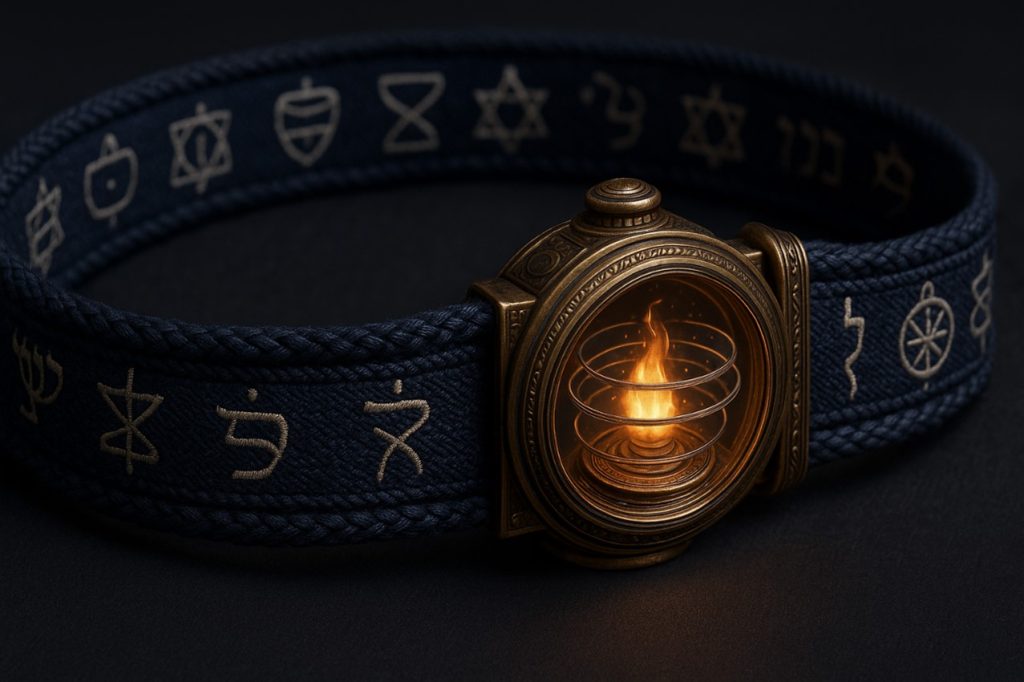
User’s Perspective (Artificer wearing Kabbalah 142 of the Measuring Flame)
Sight:
The eternal flame within the bronze housing brightens but casts no shadows. Quartz rings orbit slowly, then accelerate to mirror the user’s heart rate. Complex glyphs briefly overlay the user’s field of vision—subtle, like afterimages—showing spirals, star-diagrams, and golden measuring lines across nearby objects.
Sound:
Numbers begin to whisper softly at the edge of hearing—not in any known language, but intuitively understood. These numbers correspond to ratios, angles, materials, and probabilities. Occasionally, a sequence repeats three times—signaling a moment of spiritual significance or structural revelation.
Touch:
A low warmth spreads across the waistline where the belt rests, soothing but nonthermal. The wearer feels a gentle tug—like magnetic resistance—toward nearby objects of geometrical purity or hidden imbalance. The cloth flexes subtly with breath, as if alive with thought.
Smell:
A trace of sandalwood and oxidized bronze lingers, deepened by the surrounding materials—especially near enchanted alloys, sacred woods, or living constructs.
Taste:
A metallic tingle forms under the tongue, similar to biting on a coin or speaking truth under oath. If glyphs are aligned or a project resonates harmoniously, this flavor sweetens slightly—like anise or burnt sugar.
Extra-Sensory Perceptions:
- Numerical Synesthesia: The user briefly sees relationships as number-colored auras. An unstable blade may glow in fracturing red-8s; a perfect arch may pulse with harmonious gold-3s.
- Spatiotemporal Echo: Upon touching a crafted object, the user senses past hands that shaped it and glimpses potential future states—failed, unfinished, or complete.
- Sefirotic Pull: A subtle gravitation toward hidden divine geometry—forgotten proportions buried in ruins or unspoken harmonies in a crowd’s movement.
Positives:
• Deep clarity of intention and alignment during crafting.
• Enhanced awareness of material flow and energetic balance.
• Spiritual calm and confirmation when work aligns with sacred pattern.
• Insight into failures without needing to test destructively.
Negatives:
• Repeated exposure causes headaches or conceptual overload in non-disciplined minds.
• Misalignment (using the belt on corrupted or chaotic creations) causes auditory distortion—numbers turning to screams or nonsensical loops.
• Risk of obsessive correction—artificers may struggle to leave imperfect work alone after prolonged use.
Observer’s Perspective (Anyone nearby)
Sight:
The bronze housing glows gently, flame pulsing with ambient rhythm. Quartz rings spin in hypnotic patterns, casting motes of soft, gold-tinted light. Occasionally, thin threads of light stretch out toward nearby objects, tracing imperceptible angles or symbols in the air.
Sound:
Observers hear only a faint crackle, like the whisper of turning pages or a tiny furnace hidden behind glass. When near resonant objects, a low harmonic hum may build briefly before fading.
Touch (if handled):
The belt feels warm and braided tight. The bronze is etched with patterns that seem to shift subtly under the fingertip—never quite matching what one sees.
Extra-Sensory Perceptions:
- Presence Displacement: The observer may briefly lose track of where the flame is, as if it flickers in and out of direct awareness, drawing the gaze subtly back to the wearer.
- Cognitive Interference: Attempting to count, plan, or measure something while near the activated belt causes slight delay, as if one’s own thoughts are being compared against some external order.
Positives:
• Viewers may sense comfort or awe from the flame’s stability.
• Those skilled in craft feel an inexplicable urge to create or improve.
• Academics may be inspired toward theoretical breakthroughs.
Negatives:
• Mundane craftsmen may feel inadequate, misaligned, or overwhelmed.
• Strong-willed individuals might resent the feeling of being “measured.”
• Chaotic beings (tricksters, entropy-aligned, etc.) may feel mild nausea or pressure at the base of the skull.
The Measuring Flame, once active, is not merely a tool—it is a lens upon the divine architecture of existence. What it reveals depends not just on where it is used, but whether the user is prepared to comprehend the perfection—or imperfection—of all things.
Crafting Recipe: Patterned Flamebelt of the Ten Paths
Recreating an item like Kabbalah 142 of the Measuring Flame
Materials Needed
Primary Components:
• 1 × Indigo‑dyed Weave of Devotion (braided cloth spun with spiritual dyes and prayer-knot tension)
• 10 × Silver Filament Threads (blessed and aligned with each of the Ten Sefirot—can be harvested from consecrated mirrorwire or purchased from Sephirari exiles)
• 1 × Bronze Flame-Housing Cylinder (etched and sealed with insulating runes; must be alloyed under full moonlight)
• 1 × Eternal Ember Shard (a flame fragment caught from a Spirit-Furnace, Ley-Crucible, or Initiation Pyre; must be inscribed with the Tetragrammic Spiral)
• 3 × Quartz Rings of Recursive Etching (each ring must be carved with sacred cycles using a mirrored micro-chisel and polished under starlight)
• 1 × Binding Thread of Conceptual Clarity (spun from silkworms that fed on philosophical scrolls or temple ash-fibers)
Secondary Materials:
• 1 vial Sanctified Ink of Measuring Light (used for hidden glyphs within the cloth’s lining)
• 2 × drops of Numerical Oil (a rare alchemical preparation used to “grease” metaphysical ratios)
• 1 × Glyphstone Shard (used as an inner anchor to stabilize divine pulse-frequency)
Tools Required
• Spindle-loom of Sigil Weaving
• Etcher’s Crescent (silver or mithril)
• Numerologic Furnace Scale (calibrated to ratio 1.618:1.0)
• Spirit-Tongs of Balance
• Chrono-Ruler or Time-Aware Caliper
• Mirror-Polishing Basin (for use with lunar-distilled water)
• Binding Needle of Multipoint Focus
Skill Requirements
• Artificing (Apprentice+) — Required to assemble and align component integrity.
• Religion or Lore (Kabbalistic) — Needed to trace and interpret the Sefirotic pattern into physical form.
• Inscription or Runesmithing (Intermediate) — For precise application of silver-thread glyphs and inner flame housing.
• Mysticism or Spirit‑Handling — To integrate the Eternal Ember without soul-disruption.
Crafting Steps
Step 1: Prepare the Cloth
Using the Spindle-loom, weave the Indigo‑dyed Weave of Devotion into a flexible belt. As you braid, chant the Order of Descent—a sacred poem matching the Ten Sefirot’s descending path. Each filament must be sewn to correspond to a specific point of the Tree of Life. Apply a fine line of Sanctified Ink along the inside channel.
Step 2: Etch the Quartz Rings
Over three consecutive nights, etch the Quartz Rings of Recursive Etching with micro-symbols of balance, harmony, and iterative cycle. Each ring must complete a full revolution during carving to retain spiritual inertia. Store each in a lunar-shielded case.
Step 3: Construct the Flame Housing
Forge the Bronze Cylinder and inlay it with the Glyphstone Shard. Anoint the internal casing with Numerical Oil. Carefully embed the Eternal Ember Shard using Spirit-Tongs, aligning it with your pulse during the insertion so it attunes to a living rhythm.
Step 4: Install Orbital Rings
Suspend each Quartz Ring in the bronze chamber using tensioned micro-pins and adjust for harmonic spin using the Chrono-Ruler. The rings should orbit the ember freely and shift with environmental or spoken stimuli.
Step 5: Bind Belt to Housing
Thread the belt through the bronze housing via precision loops. Using the Binding Needle, stitch the last portion with the Thread of Conceptual Clarity—this final pass ties the user’s intention to the artifact. Whisper your crafting name and the phrase “Ten paths echo one flame” as you make the final knot.
Step 6: Ritual of Measurement
Place the finished item upon a sacred grid (a pentagon nested within a circle) and meditate for one hour while marking down five sacred ratios (e.g., Pi, Phi, 3:4:5 triangle, etc.) The flame should ignite silently. If it flickers outward, restart from Step 3.
Completion Time: ~7 days total (assuming access to sacred materials)
Crafting Difficulty: Moderate to High (requires steady hand, precise ratios, and spiritual attunement)
Builder Who Forgot to Finish
(Translated from Elder Script of the Sephirari fragments, believed to have been translated in haste during the Era of Ash, from a yet older root-language predating known script-cycles)
Long-long back, in the age-before-iron’s forgetting, when cities were drawn in breath and bridges were taught to walk like men, there lived a builder of small renown but great hunger. His name was called many times in many tongues, but in this telling he is named Qel-Varn the Half-Wise, he who counted stars but forgot to name his children.
Qel-Varn dwelled in the outer-hinge of the World Pattern, where light bent strange and floor-sky was written in ink that dripped upward. He built things that should not have worked but did: houses that folded flat at night, aqueducts that remembered where to send water, and a mirror that only showed what one ought to look like. Yet for all his cleverness, his buildings grew sick. His roads twisted into themselves. His bridges, when crossed, deposited pilgrims younger than when they stepped upon them.
When asked what flaw poisoned his works, Qel-Varn only mumbled, “My measures are perfect. My mind is clean. It is the world that errs.”
But the world does not enjoy being blamed.
One night—not marked by moon or bell or rooster—he was visited by an old-smaller-than-old being. It was not a god, nor a ghost, nor a memory. It was the Pattern-In-Wrath, wrapped in robes of prime number. Its eyes were voids that blinked in symmetry, and its hands bore no fingers, only numbers that flickered and shifted like oil on ink.
Qel-Varn bowed, but imperfectly. The Pattern saw and said nothing. Instead, it uncoiled from its waist a flame—not hot, but counting. A flame that pulsed not in flickers, but in ratio. Around it circled ten rings, etched with a language too perfect to learn and too simple to speak.
It whispered only once into Qel-Varn’s ear. The whisper was made of measurements.
Awaking in fright or trance, Qel-Varn found that his own toolbelt had changed: the flame was there, small and unwarming; the rings spun though windless; the buckle now bore symbols he did not remember adding. But when he crafted, his hands followed new laws. Angles whispered their needs. Materials sang their balances. Even broken things begged to be repaired correctly.
He began again.
He rebuilt the hall of the twin-voiced choir, and it no longer reversed the song. He remade the bridge, and now pilgrims crossed into themselves. He even forged a door that would only open for those who had measured their own shadow.
Yet with each success, the flame in his belt dimmed. The counting grew quieter. The rings slowed. The wisdom within him became harder to hold—slippery like melted wax upon marble.
One day, he crafted the final structure: a tower with no top, a staircase with no step, a structure that could not fall because it never rose.
And then he vanished.
Some say he built himself out of existence. Others say the Pattern reclaimed its tool. Yet his belt remained, folded neatly on a stone that bleeds once per year.
Moral of the Story: To measure the world is to name it. But what you name, you owe. Even perfect structures cast a shadow when the sun is wrong.
Suggested conversions to other systems:
Call of Cthulhu (7th Edition)
Item Name: Measuring Flame of Sephirotic Insight
Type: Occult Tool – Unique Belt Item
Rarity: Rare Occult Artifact
Skill Interaction: Occult, Science (Engineering), Craft (Any), Art (Drafting)
Game Effects:
• While worn, grants +10% bonus to any Craft, Engineering, or Art check involving measurement, proportion, sacred geometry, or artifact restoration.
• Once per day, the wearer may activate the Measuring Flame to receive a vision of symbolic numerology related to an object or ritual. This provides a +1d4 bonus to any single related Knowledge or Occult roll within the next hour.
• On a successful INT×5 check, wearer may recognize dangerous flaws in an arcane structure or entity (e.g., ritual circle, unnatural architecture). If failed, the flame dims for 1d4 hours.
Side Effects:
• On Sanity loss from Mythos exposure, the item activates involuntarily and begins whispering numbers in a dead language. This imposes a −1 penalty to SAN recovery checks for 1 day.
• Prolonged exposure (30+ days) requires a POW roll once per week or suffer a growing obsession with perfect ratios, leading to compulsive behavior.
Blades in the Dark
Item Name: The Measuring Flame (Arcane Tool, 1 Load)
Category: Fine Arcane Implement
Rarity: Uncommon
Attune Cost: Requires Study downtime activity and Ritual approval by a Whisper or academic NPC.
Special Abilities:
• When crafting, engineering, or decoding arcane structures, this item grants +1d to Tinker or Study.
• When used as part of a long-term project involving creation, improvement, or deciphering, reduce the clock by 1 segment automatically per downtime.
• May be activated to detect hidden flaws in arcane wards, locks, or constructs; this allows for a flashback where the player previously sabotaged or corrected the flaw (cost 0 stress once per score).
Quirk:
• Whispers of numbers haunt the user’s dreams. Each downtime, they must indulge their Vice or suffer a −1d penalty to all crafting rolls that week. If they indulge twice, they instead gain temporary +1 Effect on blueprint-related tasks.
Dungeons & Dragons (5th Edition)
Item Name: Kabbalah 142 of the Measuring Flame
Wondrous Item, common (requires attunement)
Slot: Waist (Toolbelt Slot)
Class Use: Ideal for Artificers, Wizards, and Clerics with crafting or lore focus
While Attuned:
• Gain a +1 bonus to Arcana and Investigation checks involving magical objects, blueprints, or sacred architecture.
• You may cast Guidance (no concentration) once per short rest, but only when using artisan’s tools.
• Once per long rest, activate the Measuring Flame to analyze an object for up to 10 minutes. During this time, you learn:
– Material composition
– Presence of magical flaws or instability
– Hidden compartments or structural irregularities (DC15 Investigation check to find specifics)
Drawback:
• While worn, the user has disadvantage on Insight checks involving people who speak lies; their senses are too attuned to structure, not intention.
Knave (compatible with OSR systems)
Item Name: Measuring Flame Belt
Type: Arcane Tool
Encumbrance: 1 Slot
Tier: Early-level magical item
Use Restriction: Only usable by those with INT 13+ or who have used a week to attune via numerological meditation.
Effects:
• +1 to all INT checks involving architecture, engineering, magical item analysis, or construction.
• When spending a full Turn (10 minutes) to inspect an object or location, the wearer learns one hidden trait or flaw, as determined by the Referee.
• May be activated once per day to grant +1 Defense against constructs, traps, or structures that act or collapse unnaturally—this lasts for 1d6 Turns.
Complication:
• Each time the item is used during an adventure, the Referee rolls a d6. On a 1, the flame begins whispering forgotten geometries—requiring the user to save vs WIS or become distracted and lose their next action as they draw spirals into the dirt.
Fate Core System
Item Name: Kabbalah 142: The Belt of Sacred Ratios
Aspect: “Wielder of the Patterned Flame That Measures All”
Refresh Cost: 1 (can be taken as a Stunt)
Item Type: Arcane Tool / Symbolic Device
Stunt Options:
• Sacred Engineer’s Intuition – Once per scene, you may spend a Fate Point to succeed with style on a Lore, Crafts, or Investigate check involving constructed objects, blueprints, or sacred geometry—even if the roll doesn’t allow it normally.
• Numerical Precognition – Once per session, after observing a constructed entity (e.g., a trap, golem, relic), you may ask the GM one question about its future behavior, flaw, or outcome.
• Counting Flame – Gain a +2 bonus to Overcome or Create Advantage actions using Crafts when analyzing, repairing, or sabotaging engineered or magical constructs.
Drawback (Optional Aspect): “Obsessed with Perfect Structure – Struggles to let flawed things be.”
This can be compelled by the GM to impose hesitancy or internal conflict during scenes requiring improvisation or moral ambiguity.
Numenera / Cypher System
Item Name: Kabbalistic Flamebelt
Level: 3
Form: Belt with a rotating quartz-and-flame housing
Rarity: Uncommon Cypher (or Optional Artifact, see below)
Usable By: Glaive, Nano, Jack – but especially useful for Nanos or Wrights
Cypher Version (Single-Use, Level 3):
• Upon activation, for the next 10 minutes, the wearer receives +2 to any two of the following tasks: identifying numenera, building/reparing devices, decoding glyphs, or disarming mechanisms.
• Additionally, if within 10 feet of an unstable object, the flame pulses visibly, granting an asset on tasks to detect traps or instability.
• Optional Side Effect: GM intrusion causes compulsive spiral-sketching or numerological obsession for 10 minutes, impairing social interactions.
Artifact Version (Level 3, Depletion 1 in 1d20):
• Constant Effect: Grants an asset on all crafting, blueprint analysis, and structure-based Investigation tasks.
• Activated Power: Once per day, predict a single mechanical event within 10 minutes (e.g., “This engine will explode unless pressure is vented”), even if you lack contextual knowledge.
• Drawback: After each use, roll depletion. If depleted, the belt’s flame extinguishes permanently unless reignited by a Mystical Source (GM discretion).
Pathfinder 2e
Item Name: Kabbalah 142 of the Measuring Flame
Item Level: 2
Category: Worn Item (Waist Slot)
Rarity: Uncommon
Traits: Magical, Divination, Invested
Usage: Worn (belt), requires one Invested item slot
Price: 35 gp
Effects (while Invested):
• Gain a +1 item bonus to Crafting checks related to schematics, architecture, traps, or magical devices.
• Gain a +1 item bonus to Occultism when identifying ancient writings or divine numerical codes.
• When crafting an item using blueprints or sacred design, reduce the time by 25% once per day.
Activate [Interact] (1/day):
• Predictive Geometry – For the next minute, gain a +2 circumstance bonus to Reflex saves and Perception checks against constructed hazards (e.g., collapsing architecture, mechanical traps, animate constructs).
Curse (if worn while uninvested):
• The flame flickers and draws the wearer’s thoughts into obsession with angles and measures. The user becomes Clumsy 1 for 1 hour or until they complete a perfect circle without tools.
Savage Worlds (SWADE)
Item Name: Kabbalah Belt of the Measuring Flame
Type: Magical Gear – Worn Item (Belt)
Rarity: Uncommon (requires a Rare Crafting Component: Eternal Ember or Patterned Flame)
Rank Required: Novice
Slot: Belt (only one Belt item may be worn at a time)
Effects:
• Grants +1 to Repair, Academics, and Occult rolls when analyzing constructs, relics, or arcane devices.
• Once per session, allows the user to reroll any failed Smarts-based roll related to blueprints, logic, or arcane analysis.
• The user may activate the belt as a free action to illuminate flaws in a structure, gaining +2 on their next roll to disable, dismantle, or defend against it.
Drawback:
• The wearer suffers −1 to Performance or Persuasion rolls during social encounters where spontaneity is valued—due to their increasingly rigid worldview and “ritual speech cadence.”
Special Rule (Optional):
• If used as a tool during a Dramatic Task related to construction, protection, or arcane deciphering, one success is added automatically once per session (GM discretion).
Shadowrun (6th Edition)
Item Name: Kabbalistic Belt of Ratio-Threading
Type: Magical Utility Gear
Availability: 4R
Cost: 1,500¥
Essence Cost: 0 (does not require implantation)
Gear Type: Worn Magical Focus (Waist)
Game Mechanics:
• Grants +2 dice pool bonus to Arcana, Engineering, or Hardware tests when analyzing, disabling, or designing structures, traps, or devices with ritual/symbolic design.
• Once per scene, the wearer may activate the flame as a Free Action to analyze a device within 5 meters—revealing hidden glyphs, flaws, or sigils. This provides +1 Edge on the next test involving that object.
• Can be bonded as a Foci (Rating 1); bonding cost is 4 Karma.
Restriction:
• If used in areas tainted by astral corruption (background count 2+), the flame flickers erratically. All bonuses become penalties until the wearer succeeds on a Willpower + Arcana (3) test to stabilize the resonance.
Starfinder
Item Name: Measuring Flame Utility Belt
Item Level: 3
Price: 1,200 credits
Slot: Belt
Bulk: L
Category: Magical Item, Hybrid
Traits: Technomagical, Divination, Kabbalistic
Activation: Standard action (mental)
Duration: 1 minute
Uses: 1/day
Effect:
When activated, the belt’s embedded flame and quartz gyros scan surrounding objects and structures. For 1 minute, the wearer gains the following benefits:
• +2 enhancement bonus to Engineering, Mysticism, or Physical Science checks related to analysis or repair of constructs, systems, or symbols
• If attempting to disable a trap, analyze a starship system, or identify a magical effect, the wearer rolls twice and takes the better result
Passive:
While worn, grants +1 insight bonus to AC against constructs and traps, and once per day allows a re-roll on a failed Engineering check if blueprint-based.
Drawback:
Failing a Mysticism or Engineering check by 10+ causes the flame to pulse erratically, disorienting the wearer. −2 penalty to Will saves for 1d4 rounds.
Traveller (Mongoose 2nd Edition)
Item Name: Sefirotic Engineering Harness
Tech Level (TL): 13
Mass: Negligible
Cost: Cr800
Type: Scientific/Religious Hybrid Tool
Availability: Rare (limited to exo-archivists, pilgrimage engineers, and Pattern Cult enclaves)
Game Mechanics:
• Grants DM+1 to Engineering (any), Electronics (Comms or Computers), or Science (Mathematics, Physics) when analyzing artificial or sacred structures
• When using Investigate or Sensors to detect flaws or substructures, gain DM+2 if the subject involves layered complexity (ritual patterns, ancient architecture, multidimensional engineering)
Special Ability (once per session):
• Predictive Geometry – The Traveller may declare a single structural action (e.g., “This arch will fail in 1 round unless braced”), requiring INT 8+ or an Engineering check. If successful, they gain a Boon on the next related check.
Complication:
• If worn near computers with adaptive logic (e.g., pseudo-AIs or alien tech), the flame may introduce recursive logic errors. The referee may trigger an Event on a roll of 9+ when the harness is active.
Warhammer 40,000 Roleplay: Wrath & Glory (Revised)
Item Name: Kabbalist’s Sash of the Sacred Ratio
Item Type: Archeotech Relic – Utility Gear
Rarity: Rare
Tier: 1
Keywords: Gear, Archeotech, Ritual, Divination
Passive Effect:
• While worn, the user gains +1 to Tech and Scholar tests related to deciphering, analyzing, or constructing mechanisms, relics, or sacred geometry.
• If analyzing an Archeotech artifact or puzzle, the sash glows subtly; add +2 bonus dice to a relevant INT-based test once per session.
Activated Ability (1 Wrath Point):
• Flame of Alignment – Reveal a hidden flaw or truth in a structure or mechanism (including cybernetics, corrupted STC fragments, or alien vaults). Provides narrative clue or mechanical advantage (GM discretion), and +1 ED to the next Test involving that object.
Wrath Complication (Optional):
• On a Wrath complication while the sash is active, the wearer suffers from numerological feedback—seeing cosmic ratios in all things. Gain 1 Corruption and become Distracted for the next round as visions overwhelm the mind.