
Lore: The first Keshf Eyepieces were crafted not by a grand artisan of a metropolis, but by a humble mystic named Halim the Glass-Grinder who resided in a small coastal sanctuary. Halim was a member of a lesser-known order that believed that every object, no matter how mundane, retained an echo of its creation and use. They taught that to truly understand the world, a seeker must first learn to see the truth hidden in the mundane. Halim spent years in meditation, contemplating the nature of light, glass, and perception itself. He developed a method of grinding crystal lenses while chanting specific verses of remembrance, embedding the concept of “unveiling” into the very structure of the glass. He created the eyepieces not as tools of commerce, but as training aids for apprentices of his order, teaching them to look past the surface and perceive the history and soul of the items they encountered. The design was simple and effective, and soon wandering members of the order spread the crafting technique across the islands, making the eyepiece a common, if specialized, tool for those whose path required a deeper sight.
Description: A simple, functional eyepiece constructed from beaten brass that has developed a muted patina. It is designed to be held up to the eye or affixed via a thin, adjustable leather strap. The frame holds a single, surprisingly clear lens ground from a shard of quartz sourced from a cave known for its faint magical echoes. Etched around the brass frame in a flowing, calligraphic script are the words, “The seen is a bridge to the Unseen.” The lens itself seems to shimmer at the edge of vision, as if light bends through it in a slightly unusual way.
Detailed Stats
- Focus: +1
- Slot: Head
Passive Magic
- Echoes of Resonance: When looking through the eyepiece, you perceive a faint, hazy aura around any object possessing magical qualities. The aura’s color and intensity provide a general, intuitive sense of the magic’s nature and power. Dormant items may have a soft, white glow, while items of potent magical force might have a deep, vibrant hue that seems to slowly pulse. This sense is instinctual and non-specific, offering a feeling rather than hard data.
- Sight of Detail: The lens grants the wearer an unnaturally keen eye for physical details on any object they examine closely. You can easily spot minute imperfections in craftsmanship, the faintest traces of a long-faded maker’s mark, subtle stress fractures in metal or wood, and the nearly invisible wear patterns that speak to an object’s history of use.
Activable Magic
- Whispers of History: By gently pressing the eyepiece’s frame against a non-living object and softly chanting a verse of remembrance for several seconds, you can open your “Mind’s Eye” to its past. You receive a single, fleeting sensory impression—a brief flash of an image, a faint sound, a ghost of a smell—connected to a moment of great significance or emotion in the object’s history. This could be the face of a long-dead owner, the clang of a sword it once blocked, or the scent of the sea from its time on a ship. The impression is uncontrolled and lasts but a moment.
- Contemplation of the Make: You may enter a state of light meditation (muraqaba) while observing a single crafted object through the eyepiece. After a minute of uninterrupted focus, the object’s physical composition is unveiled to your understanding. You learn the primary materials used in its construction and gain a clear sense of the crafter’s skill level (crude, standard, skilled, masterful). This practice reveals nothing of any magical enchantments, only the physical craftsmanship.
Tags: Appraisal, Divination, Vision, Head Slot, Mysticism, Common, Tier 1, Tool, Focus, Information, Psychic, Lore, Non-Combat, Wearable, Auditory
In the bustling trade cities and quiet sanctuaries of Saṃsāra, the Sufism 786 of The Keshf Eyepiece can be acquired through various channels, each with its own distinct atmosphere and pricing. As a common tool for those with a discerning eye, its availability is widespread, though the context of the transaction can greatly influence its cost.
- The Lodge of the Unveiling Path
- The Shop: These are not shops in the traditional sense, but the public-facing wings of the mystical order’s sanctuaries or lodges. Often found in quieter, more contemplative districts of a city or as standalone compounds in the wilderness, these spaces are serene and smell of old paper and incense. The sale of such items is handled by an acolyte or a lay-brother of the order, and the transaction is treated with a certain gravity. The seller will often ask about the buyer’s intentions for the eyepiece, wishing to ensure it is used for understanding and not merely for exploitation.
- The Transaction: The process is formal and haggling is not practiced. The order sees the dissemination of these tools as part of their spiritual duty to encourage clarity and introspection in the wider world. They may prioritize selling to students, scribes, and artisans over treasure hunters or speculators. In some cases, they may offer a lower price or even a trade if the buyer can provide a service to the lodge or offer rare materials, such as specific crystals or woods used in crafting their mystical tools.
- Cost: A fixed price of 15 Silver Pieces, considered a fair contribution for the craftsmanship and the spiritual labor invested.
- Artisan & Assayer Guild Suppliers
- The Shop: Located in the craft and trade districts, these shops are orderly, well-lit establishments that cater to professional artisans. The air is filled with the scent of metal, oil, and polishing compounds. The Keshf Eyepiece will be displayed in a glass case alongside jewelers’ loupes, steam-fitters’ gauges, and architects’ rulers. The shopkeeper is a knowledgeable professional who understands the tool’s practical application for detecting flaws and verifying quality, but has little interest in its mystical underpinnings.
- The Transaction: This is a straightforward commercial exchange. The price is set, and the quality is guaranteed. The shopkeeper can speak at length about the quality of the lens and the durability of the brass frame. They sell to professionals who need reliable tools and are willing to pay for them.
- Cost: 18 to 20 Silver Pieces. The price is firm, reflecting the shop’s rent in a prime district and the guarantee of quality they provide.
- The Dusty Shelf Curiosity Shop
- The Shop: Tucked away in a city’s older quarter or down a winding alley, these shops are cluttered dens filled with the forgotten treasures and strange trinkets of millennia. The proprietor is often an eccentric and shrewd individual with a vast, if eclectic, knowledge of history and artifacts. An eyepiece is both a tool of their trade and an item in their inventory. They might have several, of varying quality and history, mixed in with astrolabes, questionable maps, and petrified monster parts.
- The Transaction: This is a realm of negotiation and storytelling. When selling an eyepiece, the owner will highlight its mystical properties, perhaps spinning a tale about a famous historian who once owned it. They will start with a high price, fully expecting to haggle. When buying one, the same owner will dismiss it as a simple magnifier, pointing out every scratch and smudge to drive the price down. They might be more interested in trading the eyepiece for another unusual object with a story.
- Cost: When selling, the asking price is typically 25 Silver Pieces, though they can be talked down to 20 or even 18. When buying from an adventurer, they will offer as little as 8 Silver Pieces, feigning a lack of interest.
- The Last Chance Pawn Broker
- The Shop: Often found near the city gates, the docks, or in districts with a transient population, these shops are fortified places secured by heavy doors and metal grates. The pawnbroker is typically gruff, pragmatic, and interested in one thing: profit margin. They deal with the desperate and the down-on-their-luck. A Keshf Eyepiece found here was likely sold by an adventurer in need of quick coin.
- The Transaction: Transactions are swift and impersonal. The pawnbroker likely knows less about the item’s magical abilities than its material value—what the brass and lens might fetch if melted down and re-cut. They are open to haggling but will always maintain a significant advantage. They buy low and sell high, a simple formula they never deviate from.
- Cost: When selling, the price is usually a bargain, around 12 to 14 Silver Pieces, as they are focused on quick turnover. When buying, they will offer a rock-bottom price, perhaps 5 Silver Pieces, knowing the seller is likely in no position to refuse.
While the Keshf Eyepiece has no inherent capabilities for direct combat, a clever and perceptive user can leverage its unique informational abilities for potent defensive and offensive roleplaying in any environment. Its power lies not in projecting force, but in providing crucial knowledge that can turn the tide of a conflict before it even begins.
Urban Environments
In the tight alleys, opulent manors, and bustling markets of a metropolis, information is a weapon, and seeing the unseen is the ultimate advantage.
Defensive Roleplay To defend themselves, the user turns the eyepiece inward, focusing on their immediate surroundings to uncover hidden threats. When entering a tense negotiation in a tavern, they might perform a quick scan. Using the Echoes of Resonance passive, they might notice a faint magical aura on the chair offered to them, choosing to stand instead to avoid a potential glyph of weakness or truth. If a rival offers a sealed document, a quick glimpse with Sight of Detail could reveal that the wax seal has been expertly broken and reapplied, warning the user that the contents have been tampered with.
If they suspect they are being followed, they can duck into a doorway and use Whispers of History on the door handle, potentially catching a fleeting psychic glimpse of who has recently passed by, confirming the appearance of their pursuer. This allows them to change their route, set a false trail, or prepare for a confrontation on their own terms, turning a potential ambush into a controlled encounter.
Offensive Roleplay Offense in an urban setting is about leverage and sabotage. To ruin a corrupt merchant, the user could gain access to their warehouse and use Contemplation of the Make on their finest goods. The eyepiece might reveal that the “rare Ironwood” crates are actually common pine treated with a clever alchemical stain. This knowledge, discreetly passed to the merchant’s rivals or the city guard, can destroy their reputation and business.
To gain an upper hand on a political figure, the user might analyze a gift the target has received. Activating Whispers of History on the object could reveal a vision of the gift being handed over by a known enemy agent, providing instant blackmail material. This allows the user to offensively pressure the target, forcing them to divulge secrets, cancel plans, or become an unwilling ally, all without drawing a single weapon.
Dungeons and Ancient Ruins
Within the forgotten halls and crumbling ruins of the world, the environment itself is an enemy, and knowledge of its history is the key to survival and dominance.
Defensive Roleplay The eyepiece is a paramount tool for avoiding the latent dangers of a ruin. Upon entering a chamber, the Sight of Detail passive immediately draws the user’s eye to the faint, almost invisible seams of a pressure plate on the floor or the subtle discoloration of moss that indicates a poison gas vent. Looking down a long hall, the Echoes of Resonance passive will reveal the tell-tale shimmer of magical energy around the runes of a waiting trap.
If the party finds the remains of a less fortunate adventurer, using Whispers of History on their shattered shield might grant a vision of the crushing impact of a deadfall trap, warning the party to check the ceiling. Using Contemplation of the Make on a rickety rope bridge reveals its fibers are “critically frayed,” allowing the party to find another way across and avoid a fatal plunge.
Offensive Roleplay Offense in a dungeon is about turning the environment against its inhabitants. After using the eyepiece to identify a corridor filled with pressure-plate-activated dart traps, the user can strategically lure a pursuing band of monsters into it. They are not attacking directly but are using their superior knowledge offensively to eliminate threats.
When faced with a magically sealed door that blocks access to a boss chamber, the user can employ Contemplation of the Make to understand the door’s construction and weaknesses. The eyepiece might reveal the lock mechanism is made of a soft, easily corroded metal. This knowledge allows the party’s alchemist to apply the correct acid, bypassing the complex magical ward entirely. Against a powerful automaton or golem, Echoes of Resonance could pinpoint a specific gem on its chest as the glowing power source, turning a formidable foe into a puzzle with a clear, offensive solution: shatter the glowing stone.
The Wilderness
In the untamed wilds, from deep jungles to barren deserts, perception is the difference between being the hunter and the hunted.
Defensive Roleplay Survival in the wild depends on understanding its subtle dangers. When foraging for food, the user can scan unfamiliar plants with Echoes of Resonance. A bright, delicious-looking berry that gives off a faint magical aura is immediately suspect. A quick use of Whispers of History on a nearby animal bone might show a vision of that creature eating the same berry before convulsing, providing a definitive and life-saving warning.
When setting up camp, a scan with Sight of Detail can reveal non-native clay on the rocks, indicating the recent passage of others, or claw marks high up the entrance of a cave, warning that the shelter is already occupied by a large predator. This allows the party to avoid being ambushed while resting.
Offensive Roleplay The eyepiece turns a user into a master tracker and hunter. When pursuing a quarry, they can use Whispers of History on a discarded waterskin to get a psychic flash of a unique landmark the target just passed, confirming they are on the right trail. The Sight of Detail passive makes it trivial to follow the faintest of tracks, even over hard stone.
This knowledge can be used to set a perfect ambush. After analyzing the terrain, the user can identify a natural chokepoint. Using Contemplation of the Make on a large, dead tree perched precariously on a ledge above the path might reveal its core is “rotten and unstable.” This allows them to set a trap, waiting for their target to pass below before triggering a rockslide that brings the tree crashing down. By understanding and manipulating the environment, the user offensively seizes control of the engagement, using the wilderness itself as their weapon.
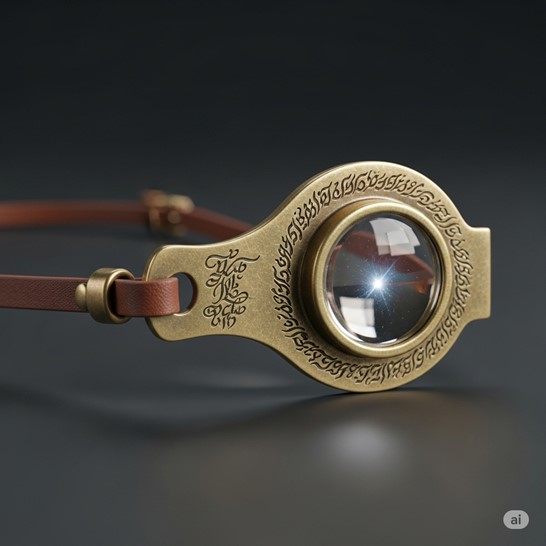
Perception of Activation:
Sight
- User’s Perspective: The world through the lens sharpens to an impossible degree of clarity. A soft, silvery luminescence emanates from the eyepiece, casting the object of focus in its own gentle light and causing the etched script on the frame to glow. Mundane colors appear deeper and more saturated, while the ambient flow of magic becomes visible as faint, shimmering currents in the air, like heat haze on a summer road.
- Observer’s Perspective: The user’s eye, when viewed through the lens, seems to vanish, replaced by a disc of soft, shimmering silver light. The calligraphic etchings on the brass frame emit a faint but distinct white glow. The user’s posture becomes intensely still, their gaze locked with an unnerving focus.
- Positives: This provides unparalleled visual detail for appraisal, revealing minute flaws and maker’s marks. The internal luminescence allows it to be used effectively even in complete darkness.
- Negatives: Prolonged use invariably leads to eye strain and headaches. The intense focus creates a profound tunnel vision, rendering the user almost completely oblivious to anything outside their narrow field of view, making them vulnerable to peripheral threats.
Sound
- User’s Perspective: Activating the eyepiece dampens the cacophony of the outside world, replacing it with a single, clear, resonant hum. This tone is almost subliminal, like the sound of a distant crystal singing bowl, and it actively cancels out distracting noises, creating a bubble of focused silence.
- Observer’s Perspective: From a few feet away, there is no discernible sound. An observer standing exceptionally close might just be able to perceive a high-frequency, electronic-like hum emanating from the device.
- Positives: The effect is highly conducive to concentration, allowing the user to enter a meditative state for appraisal even in a noisy environment like a busy market or a battlefield.
- Negatives: The cone of silence is a significant defensive liability. The user cannot hear approaching footsteps, a whispered warning, or the click of a triggered trap outside their immediate focus.
Touch
- User’s Perspective: The moment of activation sends a pleasant warmth spreading from the brass frame into the skin around the eye. This is accompanied by a subtle, steady, low-frequency vibration that can be felt in the bones of the skull, a feeling akin to a large cat’s purr.
- Observer’s Perspective: There is no visible or otherwise perceivable effect related to touch.
- Positives: The warmth and vibration are comforting and serve as unambiguous tactile confirmation that the item is active, allowing the user to trust their perceptions. The rhythmic pulse helps pace the user’s breathing for deeper contemplation.
- Negatives: If the eyepiece is used for an extended period, the pleasant warmth can build into an uncomfortable heat, leaving a red pressure ring on the user’s face. The constant vibration can become an irritant, contributing to headaches.
Smell
- User’s Perspective: A sharp, sterile scent instantly floods the user’s senses, clearing the sinuses. It is the clean smell of ozone after a lightning strike or the crisp, mineral scent of air in a deep cave. This scent is so pure that it seems to erase all other ambient odors.
- Observer’s Perspective: None.
- Positives: The scent cuts through distracting environmental smells—such as the stench of a sewer or the cloying perfume of a noble—helping to purify the mind and aid in focus.
- Negatives: This olfactory purity is a double-edged sword. It can completely mask important clues, such as the faint scent of a rare poison on a dagger or the specific aroma of alchemical residue on a document.
Taste
- User’s Perspective: A faint but distinct metallic taste forms at the back of the user’s tongue and on their palate. It is the mineral tang of touching a copper coin or drinking water from a mountain spring running over iron deposits.
- Observer’s Perspective: None.
- Positives: This provides another layer of sensory confirmation that the magic is working correctly, tying the user’s own physical senses to the device’s function.
- Negatives: The taste is unpleasant for some and can interfere with the enjoyment of food or drink while the eyepiece is active. It can be a constant, low-level distraction from the task at hand.
Extra-Sensory: Magical Sense
- User’s Perspective: The user can feel the presence and flow of magical energy as a physical sensation. Dormant magic feels like a pool of cool, still air. Active enchantments feel like a pressure change or a current of warm water flowing over the skin. Wild or chaotic magic feels like prickly static electricity, causing the hairs on one’s arms to stand on end.
- Observer’s Perspective: The user may appear distracted, tilting their head as if listening to something, or reaching out a hand to slowly trace an invisible shape in the air. Their eyes might dart around, tracking things that are not there.
- Positives: This grants an intuitive, three-dimensional understanding of the magical landscape, allowing the user to “feel” hidden traps, empowered items, or the presence of spellcasters.
- Negatives: In a location saturated with high levels of magic, this sense can be completely overwhelming, causing intense vertigo, nausea, and a “sensory blindness” where the sheer volume of magical noise makes it impossible to distinguish one aura from another.
Extra-Sensory: Psychic Echo
- User’s Perspective: The user’s mind becomes receptive to the residual emotional and psychic imprints left on objects. This is not a clean, detached viewing of history; it is an empathetic bleed-through. Touching a wedding ring might evoke a faint feeling of joy and hope. Holding a soldier’s helmet might impart a ghost of terror and grim determination.
- Observer’s Perspective: The user’s face can become a canvas of fleeting, unexplained emotions. An observer might see a flicker of a smile, a grimace of pain, or a widening of the eyes in fear, all while the user is simply looking at an inanimate object.
- Positives: This provides the deepest possible insight, revealing the context, intent, and emotional history of an item, offering clues that transcend mere physical or magical analysis.
- Negatives: This is the greatest danger of using the eyepiece. Without strong mental discipline, the user can be swamped by the residual emotions. Appraising a murderer’s weapon could inflict psychic trauma, and handling an item of great sorrow could plunge the user into a sudden, debilitating depression.
Artisan’s Guide: Halim’s Method for the Keshf Eyepiece
This guide outlines the intricate process of creating a Keshf Eyepiece, a tool for perceiving truths beyond the mundane. The creation is as much a spiritual meditation as it is an act of physical craftsmanship. The artisan’s state of mind is as crucial as the quality of their materials.
Materials Needed
- Primary Components:
- One ingot of high-purity, refined brass.
- One hand-sized, raw shard of Cave-Echo Quartz, sourced from a location with a palpable magical resonance. The shard must be unflawed to the naked eye.
- One strip of supple, treated leather, at least one foot in length.
- Consumables:
- A vial of mild alchemical etching acid.
- A small pot of jeweler’s polishing rouge.
- Three sticks of Sandalwood & Myrrh Contemplation Incense.
- Fine-spun silk thread for the strap’s stitching.
Tools Required
- Workshop Tools:
- Jeweler’s Anvil and a set of fine-tipped hammers.
- A selection of metal files, rasps, and calipers.
- A Lapidary’s Grinding Wheel, preferably one with a steady, consistent rotation (hand-cranked or steam-assisted).
- A standard leatherworker’s kit (awl, skiving knife, edger, needles).
- Mystical Implements:
- A calligrapher’s stylus with a non-reactive tip.
- An incense burner or censer, made of ceramic or brass.
- A personal meditation mat or cushion, placed in a quiet, dedicated crafting space.
Skill Requirements
An artisan must have trained in the following skills to attempt this creation with any hope of success. The quality of the final product is directly tied to the mastery of these skills.
- Artisan: Fine Metalsmithing: The ability to shape the delicate brass frame with precision.
- Artisan: Lapidary Arts: Knowledge of grinding and polishing crystals without fracturing them.
- Mysticism: Calligraphic Inscription: The skill to not merely write, but to inscribe words with focused magical intent.
- Mysticism: Rote Chanting: The ability to maintain a steady, resonant chant for an extended period to influence the materials.
- Mysticism: Focused Contemplation: The foundational skill of holding a deep, unwavering meditative state to imbue the item with its purpose.
Crafting Steps
Step 1: The Preparation of Space and Self Before any tool is lifted, the crafting space must be cleansed and ordered. All clutter must be removed. Light the first stick of Contemplation Incense and sit upon your meditation mat. Spend at least an hour in quiet contemplation, focusing on the concepts of sight, truth, and unveiling. You must purge your mind of greed, impatience, and doubt. The work cannot begin until your mind is a placid lake.
Step 2: The Grinding of the Lens This is the heart of the process. Secure the Cave-Echo Quartz and begin the slow process of grinding it into a perfect, convex lens on the Lapidary’s Wheel. As you begin, you must also begin a low, steady chant. The rhythm of your chant must harmonize with the whir of the wheel. With every rotation, you are not just removing material, but shaping the quartz’s magical resonance, teaching it how to see. This step is complete only when the lens is physically perfect and, when held to the light, seems to hold the light within itself for a moment longer than normal.
Step 3: The Forging of the Frame With the lens complete, you may now forge the frame. Heat the brass ingot and begin hammering it into the precise shape of the eyepiece on your anvil. This is a task of pure physical skill. Your focus must remain absolute. If you strike with anger or frustration, the metal will remember it, and the flaw will manifest in the final product. File and polish the frame until it is smooth and fits the lens perfectly, but do not yet set the lens.
Step 4: The Inscription of the Word Place the finished frame on a steady surface. Using the calligrapher’s stylus, carefully trace the words “The seen is a bridge to the Unseen” onto the brass. As you trace, meditate deeply on the meaning of this phrase. Once you are satisfied, apply the alchemical etching acid. This act must be done with reverence, as you are giving the eyepiece its core purpose. Neutralize the acid and clean the frame once the etching is deep and clear.
Step 5: Final Assembly The final physical steps are at hand. Carefully set the finished lens into the etched frame, ensuring a snug fit. Cut and stitch the leather strap, affixing it securely to the frame. Perform a final polish with the jeweler’s rouge until the brass gleams with a soft, muted light. The object is now physically complete, but it is still just an object. It lacks a soul.
Step 6: The Unveiling Place the assembled eyepiece in the censer. Light the remaining two sticks of incense and arrange them so the smoke washes over the lens. Return to your meditation mat. Gaze upon the eyepiece through the curling smoke and enter your deepest state of Focused Contemplation. Project your will and intent into the lens. Pour your understanding of sight, your desire for truth, and the core principles of the Unveiling Path into the quartz. You must hold this focus until the eyepiece responds. The first sign will be the hum of the chant you used in Step 2 echoing back from it. Then, the etched words will flash with a soft inner light. The ritual is complete when the lens itself shimmers for the first time, bending the light of the incense embers in an unnatural way. It has now awoken.
Tale of the Sultan’s Eye
And it came to pass in a time before numbering, there was a Sultan whose name was a heavy stone, and his kingdom was called the Land of All Things Seen. For this Sultan, it was his great hunger to possess all that was beautiful. His palace had rooms full of sky-colored gems, and carpets woven from the beards of silent mountain goats, and wooden chests that held the captured songs of birds. But the Sultan’s soul was a dry well, and looking upon his treasures gave him no water. He saw the color of the gem, but not its journey. He felt the softness of the carpet, but not the coldness of the mountain. His seeing was wide, but very thin.
In that same land, by the loud and repeating sea, there was a man of small matter. His name was Halim, which means the patient one, but people called him the Sand-Presser, for he would grind sand into glass. He possessed no things. His house was a lean-to of driftwood. His wealth was the feeling of the sun and the sound of the water’s argument with the shore. But his seeing was narrow, and very deep. It was said Halim could look at a piece of driftwood and know the name of the ship it came from. It was said he could look at a bent nail and feel the frustration of the carpenter who had struck it wrong. He saw the story inside the shape.
A word of this deep seeing traveled on the wind and found the ear of the Sultan. The Sultan, whose hunger was great, thought, this man possesses a type of sight that I do not own. This cannot be. So the Sultan sent his soldiers, whose armor was like the sun, to bring the man of small matter to the palace whose rooms were full of things.
Halim the Sand-Presser stood before the Sultan. The Sultan sat on a throne of polished black wood. The Sultan said, with a voice of command, “You are the man who sees what is not there. Show me my things. Show me my treasures with your eyes.”
Halim, who was empty of fear, looked at the Sultan’s throne. He said, “O great Sultan, this wood you sit upon was once the mast of a trading ship. It remembers the taste of salt and the panic of the storm that broke it. Its heart is full of drowned men’s whispers. It is a throne of sorrows.”
The Sultan’s face became a storm. He pointed a finger that wore a ring of fire. “You speak foolishness. It is wood. Now, tell me of my crown.”
Halim looked at the crown, which was heavy with gold and flashing stones. He said, “The gold is loud with the pride of the miners who found it. But the great red stone at its center, that stone weeps. It was the eye of a god’s statue in a foreign land, and it was stolen from the god’s face by a thief in the night. It remembers a face of stone and prayers it can no longer hear. It is a crown of tears.”
The Sultan stood up, and his voice was the sound of rocks falling. “Your sight is a disease! It finds only sadness in beauty. Your words are lies to make my things small. I command you, make for me a tool, an eye of glass, that I may have your deep seeing. You will make this for me before the moon is eaten and reborn. If you fail, your own eyes will be given to the crows.”
So Halim was put in a workshop in the palace, with all the tools of a master. He did not want to make the thing, for he knew the Sultan’s soul was a dry well, and a flood of truth would only turn it to mud. But he also did not want to feed the crows. He took a piece of quartz that was clear like captured moonlight. He began to grind it on a stone wheel. But he did not just grind the stone. He chanted a low song into it, a song with no words, the song of how a thing becomes a thing. He polished it with sand and sorrow. He forged a frame for it from brass, and into the brass he hammered his own patience. He made a strap from leather that he softened with his own respect for the beast it came from. When he was done, he held the First Truth-Glass. It was an object of great listening.
He was brought before the Sultan on the final day. The Sultan snatched the eyepiece from Halim’s hand. “Now,” the Sultan boomed, “I will have the final sight. I will see the truth of all my things, and my ownership will be complete.”
He put the eyepiece to his eye. He looked first at his most prized treasure, a diamond as large as a man’s heart, which lay on a silk pillow. But he did not just see the diamond’s many flat faces. He felt them. He felt the weight of the mountain crushing the carbon for a time beyond counting. He felt the explosion that brought it to the light. He felt the greed of the man who found it, the knife in the back of the man who bought it, the envy of the queen who wore it, the loneliness of the diamond itself, passed from hand to hand, a cold, hard piece of the earth’s great pressure. The Sultan screamed and threw the diamond away.
Then, a mistake. He looked at his own hand through the eyepiece. He did not see a hand of power that ruled the Land of All Things Seen. He saw a thing of thinning skin and thickening knuckles. He saw the blood moving slow inside it. He saw the bones that would one day be clean and dry. He saw its inevitable return to dust. He looked at his guards, and saw not loyalty, but fear and secret resentment. He looked at his palace, and saw not strength, but rot in the beams and cracks in the stone. He looked at all his collected things, and saw the truth of them: that they were all hollow, all empty of meaning without a soul to understand them.
The truth rushed into the dry well of the Sultan’s soul. It was a flood. It washed away his pride, his name, his hunger, his very self. He fell to the floor. His eyes were open, but no one was home inside them. He made small noises like a baby. He was emptied.
In the confusion of the court, Halim the Sand-Presser, the man of small matter, walked to the babbling man on the floor and gently took the eyepiece. He walked out of the palace, and no one stopped him. He went back to the loud and repeating sea, and he understood the great danger of his creation.
The Moral of the Story: A truth that can be seen without first being felt is not a gift, but a fire that consumes the house it is brought into.
Suggested conversions to other systems:
Call of Cthulhu, 7th Edition
The Khezr Lense
This strange artifact appears to be a simple brass eyepiece from the 18th or 19th century, with a finely ground quartz lens and a leather strap. Delicate, unknown script is etched into the frame. It was reportedly designed by a Near-East mystic to perceive the “truth” of an object, but like any tool that peels back the layers of reality, it reveals truths that the human mind was not meant to apprehend.
Game Mechanics:
- Passive Investigation: When looking through the lense, the Investigator gains one Bonus Die on all Appraise and Spot Hidden checks made to analyze a small object or a specific detail of a larger one.
- Psychometric Resonance (Active Use): The user can attempt to read the psychic impression of an object they are touching. This requires a successful POW x5 roll and takes one full minute of intense concentration.
- On a Regular success: The Investigator learns a single, significant fact about the object’s history (e.g., its purpose, a strong emotion of a previous owner, how it was damaged). This glimpse into the unforgiving nature of time costs 0/1d2 Sanity points.
- On a Hard success: The Investigator may ask the Keeper two of the following questions about the object: What was its original purpose? Who was its most significant owner? How did it arrive here? What strong emotion is tied to it? This deeper vision costs 1/1d3 Sanity points.
- On an Extreme success: The Investigator experiences a vivid, waking vision of a key moment in the object’s history, gaining a full, visceral understanding. This costs 1/1d4 Sanity points.
- On a Fumble: The lense reveals a horrifying, spiritually corrosive truth connected to the object, often one tied to the Cthulhu Mythos. The vision inflicts the maximum Sanity loss (e.g., 1d4 becomes 4) and the Investigator gains a new phobia or mania related to the vision.
- Mythos Resonance: When using Psychometric Resonance on an item of Mythos origin, the user must also make a Sanity roll. Failure results in an additional 1d4 Sanity loss as the lense transmits the alien consciousness or cosmic horror imbued within the artifact. Using the lense this way may also grant a +5% bonus to the Cthulhu Mythos skill, at the Keeper’s discretion.
Blades in the Dark
The Echo-Lens
A strange brass loupe, fitted with a lens ground from ghost-field quartz and strapped with worn leather. The metal is cold to the touch and etched with symbols that seem to shift when you’re not looking directly at them. Whisperwrights and Rail Jacks who’ve used one say it doesn’t show you what is, it shows you what was, letting you see the echoes of hands and the ghosts of intent left on an object.
Game Mechanics:
This is a piece of Occult Gear.
- Passive Use: When you Survey a scene or Study a person or object through the lens, you may ask one of the following questions in addition to the normal information gained:
- What’s the hidden story here?
- What detail is most important or out of place?
- What’s the item’s true purpose or origin?
- Active Use: You can Attune to the echo within an object. When you do, you enter a trance-like state and can ask the GM a single, direct question about the object’s direct history (e.g., “Who last held this key?” “What poison was in this vial?”). Doing so costs 1 Stress. If you want to push the vision further and ask a follow-up question, you may take an additional 2 Stress.
- Devil’s Bargain: The GM may offer you a Devil’s Bargain when you use the Echo-Lens. For example: “You can get a perfect, vivid vision of the Bluecoat forging his patrol route in this very ledger… but the ghost of his long-dead partner, who watches over it, will notice your psychic intrusion and take an interest in you.”
Dungeons & Dragons, 5th Edition
Loupe of Paramnesia Wondrous item, uncommon (requires attunement)
This brass eyepiece is fitted with a lens of flawless, polished quartz and a supple leather strap. Faint, elegant script is etched into the metal frame. While wearing it, you find your eye drawn to minute details, and you feel a subtle, psychic connection to the history of the objects you handle.
- While wearing this loupe, you have advantage on any Intelligence (Investigation) check made to discern an object’s origin, history, or physical properties.
- You can cast the Identify spell once per day, but it may only target an object you are touching. It recharges this ability daily at dawn.
- The loupe has 3 charges. You can expend 1 charge as an action to touch an object and activate one of the following properties:
- Object Reading: You gain a brief, fleeting vision of a significant moment in the object’s past. This may be a vision of its creator, a glimpse of a famous owner who wielded it, or the moment it was lost or damaged. The vision is uncontrolled by you and provides a single, potent clue about its history.
- Artisan’s Analysis: You instantly learn the mundane materials used to create the object, the general skill of its creator (crude, standard, or masterful), and whether it has any hidden physical compartments or mechanisms.
The loupe regains all expended charges daily at dawn.
Knave, 2nd Edition
Artificer’s Eye Item, 1 Slot
A brass eyepiece holding a lens of exceptionally clear quartz. It is used by master artisans, appraisers, and anyone who needs to know the truth of a crafted thing.
- Passive: When you take time to carefully examine an object through the lens, you can spot minute details that others would miss. You can identify expert forgeries, notice hairline cracks, discover hidden maker’s marks, and discern the quality of craftsmanship.
- Active: You can press the eye to an object and concentrate for one full Turn (10 minutes). When you do, ask the GM one question about the object’s physical nature or its direct past (e.g., “What is this made of?” “Who held this last?” “How was this broken?”). The GM will give you a single, truthful fact in response.
- Fragile Psyche: The eye is powered by a strange, internal resonance. It has a usage die of d4. Every time you use its active ability, roll the die. If the result is a 1 or 2, the die is downgraded to the next lowest value (d4 > d0). If you roll a 1 or 2 on a d0, the lens cracks and the item becomes useless until repaired by a master Artificer.
Fate Core System
The Eye of Seeing-What-Was
This is not a statted “item” in the traditional sense, but an Extra that grants the character a unique narrative permission and a specific Aspect. The GM and player should work together to ensure its presence is a core part of the character’s story.
Game Mechanics:
- Item Aspect:Lens of Inescapable Truth
- Invoke: You can invoke this Aspect to gain a +2 or a re-roll on an Investigate or Empathy Overcome action when you are physically examining an object or place to understand its history or purpose. This is you taking the time to use the eyepiece to perceive the echoes of the past.
- Compel: The GM can compel this Aspect to reveal a disturbing or inconvenient truth about an object or person. You might pick up a simple, elegant dagger and the lens reveals it was used in a horrifying, unjust murder, forcing you to deal with that unwelcome knowledge. You might look at a potential employer and get a flash of their secret cruelty, complicating a simple job. Accepting the compel grants you a Fate Point.
- Stunt: Glimpse of the Past
- Once per session, you may spend a Fate Point to use the eyepiece to have a direct, vivid vision of a single significant event in an object’s history. You don’t roll; you work with the GM to define the vision. This is not for a mechanical bonus, but to introduce a new, important story detail directly into the scene (e.g., “I use the eyepiece on the crown, and I want to see the moment the conspirators switched it with a fake.”).
Numenera & Cypher System
The Ocular of Latent Resonance
A brass, single-lens eyepiece attached to a leather strap. The lens is a sliver of quartz that seems to absorb and hold light. The metal of the frame is etched with script that is not of the Ninth World, and it hums with a faint energy when held. To the uninitiated, it’s a well-made magnifier; to those who can interface with the numenera, it is a window into the past.
Game Mechanics:
- Level: 4
- Form: Wearable eyepiece
- Effect: This artifact allows the user to perceive resonant echoes in objects.
- Passive: The difficulty of any task to identify an object, spot a forgery, or appraise the function of a device is decreased by one step.
- Active (Depletion): The user can concentrate on a single object they are holding or touching for one full round to activate the lens’s deeper function. They can then ask the GM a single, direct question about the object’s most recent history or its original purpose. The answer manifests as a flood of sensory information (a ghostly image, a faint sound, a phantom smell).
- Depletion: 1 in 1d20 (When a 1 is rolled on a d20 after an active use, the eyepiece’s delicate internal resonance is fried. It becomes a mundane magnifying glass until it can be repaired by a character with the appropriate skills and materials.)
Pathfinder, 2nd Edition
Appraiser’s Eyepiece Item 3+ Uncommon Divination Invested Magical Price 60 GP Usage worn eyepiece; Bulk —
This single-lens eyepiece is made of finely beaten brass and fitted with a crystal lens that seems unnaturally clear. To invest this item, you must wear it for 24 hours, during which time you experience fleeting, disorienting visions of the history of minor objects around you.
Activate [one-action] envision; Frequency once per hour; Effect You gaze at an object within 10 feet. You instantly learn its Crafting requirements (including the necessary materials and skills), and whether it is of shoddy, standard, or superior craftsmanship. This gives you a +1 circumstance bonus to any checks to Repair the item.
Activate [one-action] envision, concentrate; Frequency once per day; Effect You touch a single object and focus on its history. You gain a brief, symbolic vision of the last creature to hold the object within the past week. The vision is fleeting and reveals the creature’s appearance and general emotional state at the time but provides no other context. You can also attempt a Perception check or relevant Lore check against a DC set by the GM to recognize the individual if you have met them before.
Savage Worlds Adventure Edition (SWADE)
The Mystic’s Loupe
This is a personal Arcane Device that requires the user to have an Arcane Background to attune to it, or it can be a unique Magic Item found in the world. As a Magic Item, any character may use it.
Game Mechanics:
- Effect: This well-crafted brass eyepiece allows its user to perceive the history and nature of objects with unnatural clarity.
- Passive Bonus: A character using the loupe gains a +1 bonus to Notice or Repair rolls when the task involves examining an item for fine details, flaws, or hidden mechanisms.
- Psychometry Power: The loupe grants the user access to a unique power, Object Reading.
- OBJECT READING
- Power Points: 2
- Range: Touch
- Duration: Instant
- Trappings: The user enters a brief trance; the lens glows with a soft light; a faint humming sound.
- The user makes an arcane skill roll (Faith, Psionics, Spellcasting, etc.) while touching an object.
- Success: The user learns one key piece of information about the object’s past, such as its original purpose, a strong emotion associated with it, or a visual glimpse of its last owner.
- Raise: The user receives a more detailed vision, learning two key pieces of information or viewing a short, clear scene from the object’s history.
- OBJECT READING
Shadowrun, Sixth World (6th Edition)
Antique Azuchi Psychometry Lens
This appears to be an antique brass eyepiece from the late 20th century, a collector’s item from the early days of the Awakening. The lens is a carefully ground, untreated piece of Orichalcum-laced quartz. It’s an oddity because it functions as both a focus for Awakened characters and a piece of optical gear for the mundane, though its true potential is only unlocked through magic. It is highly sought after in certain antiquarian and magical circles.
Game Mechanics:
This is a Metamagic Focus (Psychometry) and a piece of Optical Gear.
- As Standard Gear:
- Capacity: 0
- Features: Provides Vision Magnification. A character using it for mundane purposes gains a +1 Edge on any Engineering or other technical skill test to appraise the quality or flaws of a device.
- As a Magical Focus:
- Focus Type: Metamagic (Psychometry)
- Force: 2
- Activation: A character with the Psychometry metamagic may activate this focus as part of the action to read an object’s history.
- Effect: When activated, the focus adds its Force (2) as a dice pool bonus to the character’s Assensing + Intuition test to read the object’s astral signature. Furthermore, it helps filter the psychic noise; on a Glitch, the GM may choose to describe the resulting confusing information as a fragmented vision rather than applying the standard glitch penalties.
- Astral Signature: When inactive, the focus has a faint, old, and very complex astral signature. When activated, it flares with a bright, pure divination aura.
Starfinder Roleplaying Game
Eyepiece of Forgotten Histories Magic Item Level 4 Price 2,100 credits Bulk L
DESCRIPTION This ornate brass eyepiece appears to be an archaic affectation, perhaps from a pre-Gap culture that blended technology and mysticism. The lens is a flawless crystal that seems to warp light in strange ways. While it can function as a simple magnifier, a user with mystic inclinations can coax it to reveal visions of an object’s past.
ABILITIES This eyepiece can be worn, occupying the eyes slot. It functions as a set of tech dataglasses, granting a +2 circumstance bonus to Engineering checks to identify technology and Culture checks to recall knowledge about ancient or historical items.
You can also activate the eyepiece to cast retroCsepsis as a spell-like ability once per day. When used in this way, you must touch the target object, and the spell only reveals information about a significant event or owner from the object’s history, rather than a creature’s recent memories.
Traveller (Mongoose 2nd Edition)
Customs Inspector’s Loupe (TL 8)
This device appears to be an old-fashioned, high-quality optical loupe, the kind used by jewelers or customs agents in a less advanced era. It is a brass eyepiece with a surprisingly high-resolution lens. What isn’t obvious is that the lens is laced with a psychoactive synthetic crystal that can be activated by a user with psionic talent, allowing them to read an object’s residual psychic imprint.
Game Mechanics:
- Standard Use: Provides a +1 DM bonus to any check involving the detailed appraisal of an object’s physical characteristics, such as detecting forgeries (Deception), identifying an item’s quality (Broker), or spotting flaws (Mechanic).
- Psionic Use: A Traveller with any Psionic talent may use this device to perform the Telepathy (specifically, the Psychometry application of the power) specialism, even if they do not normally possess it.
- When using the loupe to perform Psychometry, the user gains a +2 DM bonus on their Psionics check.
- Using the loupe in this way is mentally taxing. Each use requires the user to make a successful Stamina (DC 8) check or suffer 1d6 damage from psychic feedback, which cannot be healed by a medkit (it represents mental exhaustion).
Warhammer Fantasy Roleplay, 4th Edition
Witch-Sight Monocle Magical Artefact
Said to have been crafted by a reclusive Gold Order Magister with an obsession for history, this brass eyepiece appears to be little more than a nobleman’s affectation. The lens, however, is ground from a sliver of pure Aethyric Windstone, making it highly sensitive to the echoes of the past that cling to all things. The script etched on the frame is a spiraling Chamonite rune that means “What Was, Is.”
Game Mechanics:
- Passive Effect: The wearer may add a +10 bonus to any Evaluate Test. Furthermore, they can automatically tell if an object is a forgery or has been repaired, though not the specifics.
- Active Effect: Once per day, the user may press the monocle to their eye and gaze upon a single, non-magical object they are touching. They must then make a Channelling (Chamon) Test.
- If successful: The user is flooded with a single, potent vision from the object’s past, revealing a key piece of its history (e.g., the face of its previous owner, the moment a fatal flaw was introduced, the location where it lay hidden for years). For each +SL on the Channelling Test, the user may ask the GM one additional clarifying question about the vision.
- If a Critical is rolled: The vision is incredibly vivid and detailed, providing a complete narrative of a key event in the item’s history.
- If a Fumble is rolled: The user experiences a psychic backlash, suffering a Stunned Condition as they are overwhelmed by a chaotic torrent of meaningless sensory data. The monocle cannot be used again for 1d10 days.