
Lore: The Unveiling Eye was crafted during the late Renaissance of Saṃsāra by an eccentric guild master of the Diviners’ Society who obsessed over the flow of “Changing Lines” within material objects. This copper-rimmed monocle contains a thin, rotating lens etched with the eight primary trigrams. It is said that when the wearer peers through the glass, the chaotic magical weather of the world briefly aligns into a coherent hexagram, revealing the hidden history and structural integrity of whatever is being viewed. It is a prized tool for merchants and fledgling excavators in the 73 Island nations.
Stats
- Tier: 1
- Rarity: Common
- Armor Check (AC): 1
- Resilience: 10
- Item HP: 31 (Avatar Max HP + 10)
- Weight: 0.5 lbs
- Slot: Eye Slot
Passive Magic
- The Gentle Penetration (Sun): The wearer gains 1 training point toward the Appraisal skill while the monocle is attuned. This point is temporary and does not count toward the character’s training maximum.
- The Joyous Lake (Tui): When examining an item for the first time, the Mind’s Eye automatically highlights any physical cracks, wear, or structural damage, revealing the item’s current HP without requiring an active action.
Activable Magic
- Sequence of Changes (Normal Chant): By reciting the hexagram of “The Abyssal Water,” the wearer can focus on a single object within 10 feet. For the next minute, the user gains a 10% bonus to any Skill Check made to determine the historical origin or the specific island country where the item was manufactured.
- The Clinging Flame (Ritual Chant): By chanting for more than 6 seconds and tracing the trigrams on the lens, the wearer invokes “Identify.” This reveals all magical properties, Tier level, and current number of attuned users for a single touched object. This process draws significant attention and requires the focus of the Mind’s Eye.
Tags
Monocle, Divination, Appraisal, Eye Slot, Copper, Tier 1, Common, Yijing, Saṃsāra, Manual Focus, Mind’s Eye Compatible, Hexagram, Trigram, Oracle, Insight, Trade, Material, Lore, Artifact, Scholarly, Visual, Discovery
Acquisition of the Yijing 642 of the Unveiling Eye
This item is most commonly obtained by those who have established a relationship with the Diviners’ Society or the Merchant Guilds across the 74 island continents. It is often a “graduation gift” for apprentices who have shown a keen interest in the valuation of antiques or the restoration of ancient artifacts. In the wild, it can be found in the pockets of fallen traveling appraisers or tucked away in the “miscellaneous” bins of excavated ruins, often overlooked by those who do not possess the Mind’s Eye to see its soft copper glow.
Retail and Trade Locations
The Curiosity Shop and General Antiquarian In larger walled cities, where the safety level is “Somewhat Safe,” you will find specialized shops filled with glass cases and dust-covered shelves. These shopkeepers are usually Tier 2 or Tier 3 possessed individuals who understand the value of a solid Tier 1 tool.
- Buying: A brand-new or well-maintained Yijing 642 typically costs between 120 and 150 Silver. This is the “Medium” cost for a reliable Tier 1 magical tool in a stable market.
- Selling: A shopkeeper will rarely offer more than 60 to 75 Silver, citing the need to “re-calibrate the trigram lenses” or the common nature of the item.
The Open-Air Bazaar and Port Markets In the bustling hubs of the island nations, near the large sailing vessels, trade is faster and less predictable. Here, “Buyer Beware” is the law of the land.
- Buying: Prices here fluctuate wildly based on the local economy. You might find a desperate sailor selling one for as low as 80 Silver, or a predatory merchant charging up to 2 Gold (200 Silver) to an unsuspecting traveler who clearly needs to identify their gear.
- Selling: Traders in these areas are often looking for quick turnovers. They may offer 40 Silver or attempt to trade it for “10 days of rations and a fresh waterskin,” which is significantly below its actual value.
The Guild House and Faction Commissary If you hold membership in a relevant faction, such as the Seekers of the Lost or the Argent Trade Consortium, you can access the internal stores.
- Buying: Members often receive a “Favor” discount, bringing the cost down to a flat 100 Silver (1 Gold). This is considered the baseline manufacturing cost for the item.
- Selling: Factions rarely “buy” items back for coin; instead, they may offer 10 Renown Points or credit toward your monthly membership dues (Rank 1 cost is 1 Gold per month).
The World Bank Exchange While the World Bank primarily deals in currency and high-level commerce, their local branches occasionally hold auctions for abandoned safety deposit boxes or items seized for unpaid transaction fees.
- Acquisition: You might bid on a “Lot of Divination Tools” where the Yijing 642 is bundled with mundane magnifying glasses and scales. The winning bid for such a lot usually hovers around 180 Silver, making the individual cost of the monocle roughly 90 Silver if the other items are sold off.
Strategic Application of the Yijing 642 of the Unveiling Eye
In the diverse landscapes of Saṃsāra, the use of a divination monocle shifts dramatically depending on the ambient magical weather and the safety rating of the location. Roleplaying the use of this item requires an understanding of how the “Changing Lines” of the I Ching manifest as tactical data through the Mind’s Eye.
Defensive Roleplay and Utility
In Designated Safe Areas like a guarded inn or a capital city, the monocle is used defensively to prevent social or financial harm.
- Roleplay: The wearer adjusts the copper rim, peering through the trigram-etched glass to scan the “stats” of a contract or a high-priced magic crystal. By identifying the current HP and resilience of their own gear, the avatar ensures they are not walking into an ambush with broken equipment.
- Safe Environment Advantage: Because AC is tripled in these areas, the monocle’s modest 1 AC becomes a much more significant 3 AC, providing a subtle but firm protection against pickpockets or disgruntled merchants who might try to snatch the item from the eye slot.
In Unsafe or Deathly Areas, where AC is halved or entirely removed, the defensive roleplay shifts toward information gathering to avoid a hit entirely.
- Roleplay: The avatar uses the “Joyous Lake” passive to scan the environment for structural weaknesses in the floor or walls. Seeing the “Health Points” of a rotting bridge or a cracked cave ceiling allows the party to move defensively, avoiding environmental hazards that would otherwise ignore their diminished AC.
Offensive Roleplay and Combat
When combat begins and the game enters turn-based mode, the Yijing 642 transitions from a tool of appraisal to a tool of precision.
- Targeted Item Offense: As an action, the wearer uses the Mind’s Eye to focus on a foe’s specific worn item, such as a glowing wand or a reinforced shield. The roleplay involves the avatar calling out the “trigram of obstruction” as they identify the exact AC of the foe’s item (Avatar AC + Tier Level + Tier Die + Item AC). By pinpointing the structural flaws revealed by the monocle, the avatar directs the party’s attacks to deactivate (unattune) the enemy’s most dangerous gear.
- Tier Die Synergy: When close to the party, the avatar rolls their d20 plus the d4 tier die for the attack. The roleplay emphasizes how the “Unveiling Eye” guides the strike. For example, a Tier 1 character might describe seeing a “Changing Line” appear over an opponent’s leather strap just as they swing, utilizing the tier die result to ensure the hit exceeds the target’s threshold.
Roleplay in Magic Storms and Wild Magic
In areas of Wild Magic, where magic takes on a life of its own, using the monocle carries a sense of urgency and risk.
- Roleplay: The wearer might describe the trigrams on the lens spinning wildly or glowing with an erratic ultraviolet light. They use the “Sequence of Changes” chant to try and find a “stable hexagram” within the chaotic magical flow. If successful, they can identify the “origin” of the magic storm, giving the party a direction to flee or a focal point to disrupt.
- Conduit Focus: Since all magic requires a focus, the avatar roleplays the monocle as their primary conduit. They might tap the glass to settle their thoughts, manifesting the “power of thought” through the lens to stabilize their perception of the unfolding magical anomaly.
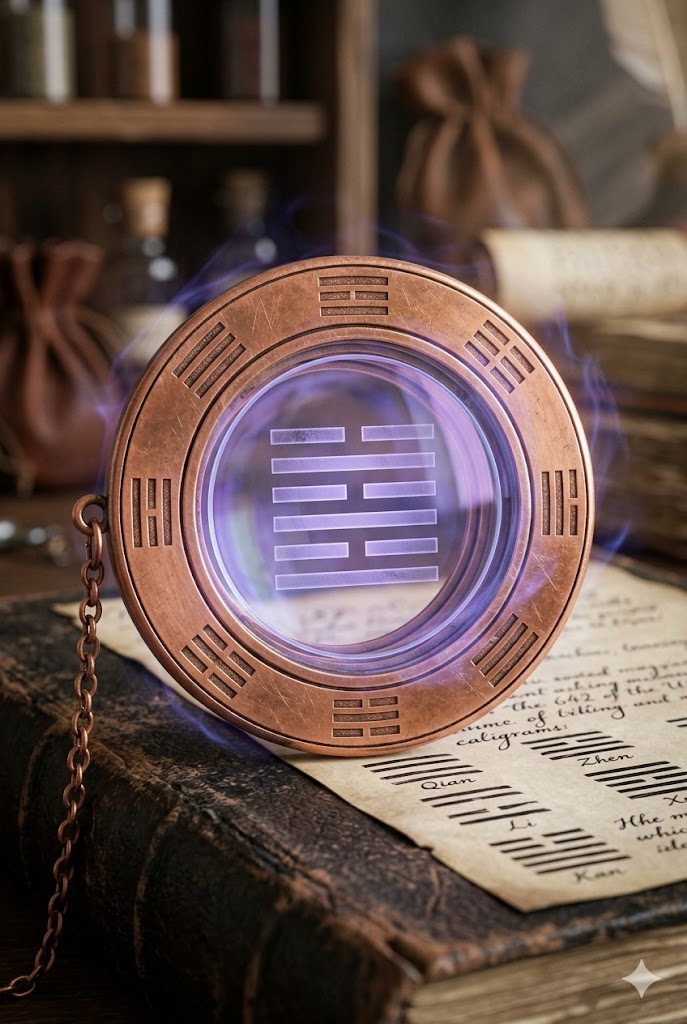
Perception of Activation:
User’s Perspective
- Visual: Upon the start of a chant, the etched trigrams on the copper rim began to glow with a soft, pulsing ultraviolet light. As the focus deepened, the world through the lens shifted from normal color to a high-contrast ultraviolet spectrum. The “Changing Lines” appeared as shimmering, translucent threads of light overlaid on objects, vibrating at different frequencies based on the item’s magical resonance.
- Auditory: A low-frequency hum, similar to the vibration of a distant steam engine’s boiler, resonated within the user’s inner ear. This sound harmonized with the rhythm of the user’s own thoughts as they directed their power through the conduit.
- Tactile: The copper rim grew noticeably warm to the touch, vibrating slightly against the cheek or brow. A faint sensation of static electricity prickled the skin around the eye slot, signifying the flow of magic from the avatar to the monocle.
- Extra-Sensory: The user experienced a sudden “mental expansion,” where the Mind’s Eye felt as though it had physically opened wider. They perceived a “weighted” feeling toward objects of higher quality or tiers, as if the monocle were a dowsing rod for value and history.
Observer’s Perspective
- Visual: Witnesses saw the monocle’s lens flare with a distinct purple luminescence that cast a small, hexagram-shaped shadow on the user’s face. During a Ritual Chant, the glow intensified, spilling out from the edges of the eye slot and illuminating the user’s iris in a vibrant violet hue.
- Auditory: Those standing within five feet heard a faint, metallic clicking sound, like the internal gears of a pocket watch, as the trigram rings magically aligned themselves without physical touch.
- Tactile: A slight drop in the immediate ambient temperature was felt by those nearby, as the item drew a small amount of heat from the surrounding air to fuel the initial activation of the “Clinging Flame.”
- Extra-Sensory: Other sentient beings with a Mind’s Eye perceived a “beacon” of Divination magic emanating from the user. It felt like a subtle, non-intrusive “ping” to their own magical senses, alerting them that someone was currently “identifying” or “appraising” in the vicinity.
Positives
- Clarity: The information provided by the Mind’s Eye became indisputable and crystalline, removing all doubt regarding the material or tier of the object being viewed.
- Intuition: The user felt a surge of confidence and “The Joyous Lake” sensation, a mental calm that allowed them to spot flaws and cracks in armor or walls that would be invisible to the naked eye.
- Connection: For the duration of the activation, the user felt perfectly synchronized with the industrial-magic weave of Saṃsāra, making the act of appraisal feel as natural as breathing.
Negatives
- Visual Fatigue: After the activation ended, the user’s normal sight felt “flat” and desaturated for several minutes. A mild dull headache, typical of Hyper Focus or Active Identification, lingered behind the eyes.
- Vulnerability: While the user was focused on the “Changing Lines” through the lens, their peripheral vision in the non-monocle eye became blurred, and their perception of threats from other directions was significantly reduced.
- Attention: The ultraviolet flare and the audible gear-clicks made stealth nearly impossible, acting as a “Banishment Mark” of sorts to any guards or foes who recognized the light of active divination.
Alchemical-Mechanical Schematic: Yijing Monocle Restoration
Materials Needed
- Tier 1 Magic Crystal: One coin-sized crystal, preferably harvested from a creature with innate Divination or “True Sight” abilities, to serve as the primary arcane battery.
- Refined Copper: 4 ounces of high-purity copper, smelted in a steam-powered furnace to ensure a consistent magical flow for the “Mind’s Eye” circuitry.
- Alchemical Glass: A single high-clarity lens treated with a solution of ground silver and crushed bioluminescent fungi to allow for ultraviolet spectrum shifting.
- Fine Copper Chain and Housing: Pre-fabricated mechanical components including gears, pulleys, and a mounting rim to house the rotating trigram plates.
- Etching Acid: A weak alchemical acid used for inscribing the sacred trigrams (Qian, Kun, Zhen, Xun, Kan, Li, Gen, and Dui) into the copper housing.
Tools Required
- Jeweler’s Steam-Lathe: A precision mechanical tool used to grind the lens and seat the rotating rings.
- Inscribing Stylus: A fine-tipped tool used to hand-carve the intricate hexagram patterns.
- Magic Circuit Solder: A small amount of lead-free magical alloy to connect the crystal battery to the lens housing.
- Calibrated Mind’s Eye Viewer: A stationary magnifying device to ensure the “Changing Lines” align with the physical etchings during the assembly.
Skill Requirements
- Trained Skill: Alchemical Crafting: Level 1 minimum. Required to treat the glass and stabilize the magic crystal within the copper frame.
- Trained Skill: Mechanical Engineering: Level 1 minimum. Required to assemble the rotating gear-work that allows the user to manually focus the “Sequence of Changes.”
- Trained Skill: Appraisal (or Divination Theory): Level 1 minimum. Necessary to properly calibrate the lens so the user sees accurate “stats” rather than distorted magical noise.
Crafting Steps
- Forging the Frame: Smelt the refined copper and cast the main monocle rim and the eight smaller, interlocking trigram rings. Once cooled, use the jeweler’s steam-lathe to ensure they rotate smoothly without friction.
- Inscribing the Trigrams: Using the stylus and etching acid, meticulously carve the eight primary trigrams into the outer rim. This step requires a “Medium” Skill Check; failure here results in “Misdirection” where the item shows false stats.
- Seating the Battery: Carve a small notch in the interior of the copper housing. Place the Tier 1 Magic Crystal inside and secure it with magic circuit solder. The crystal should emit a soft purple glow, indicating the circuit is closed.
- Lens Treatment: Submerge the alchemical glass in the silver-fungi solution for precisely three hours. Once dried, the glass should appear slightly tinted when viewed in normal daylight but clear when looking toward a magic source.
- Final Calibration: Fit the lens into the housing. While looking through the monocle using your own Mind’s Eye, adjust the internal gears until the “stats” of a nearby mundane object (like a coin) appear sharp and desaturated in the ultraviolet spectrum.
- Binding and Testing: Perform a one-minute “Simple Attunement” to the newly crafted item. Attempt a “Normal Chant” to trigger the “Sequence of Changes.” If the lens hums and the ultraviolet light pulses rhythmically, the item is ready for use or trade.
Eye which Unknits Shroud of 64 Changes
In the days when the star Helios was yet a young infant and the moon Saṃsāra was a garden of cooling stones, there walked a being of great seeing named Yi-Jing. It is said in the scrolls of the stuttering ink that Yi-Jing was a soul who fell from the high clouds of the multiverse before the nine thousand years were counted. He found the world to be a soup of magic where no thing was as it seemed to the eye of the flesh. The mountains were but sleeping beasts of the earth-element, and the rivers were the weeping veins of the water-spirits.
Yi-Jing was a man of the Mind’s Eye, yet his internal sight was as a mirror cracked by the frost of reincarnation. He could not tell the value of the stone from the value of the bread. He wandered the 73 Island countries, then but mere mud-clots in the endless ocean, seeking a focal point for his drifting thoughts. He found that without an object of wood or copper, his power of thought was like steam that escapes the boiler without turning the gears. It was a waste of the soul’s heat.
He traveled to the peak of the mountain known as the Vapor-Spire, where the gas giant planet hangs so large in the sky that it touches the breath of the climbers. There, he encountered a magic virus of the most ancient lineage. It did not make him sick of the lung, but sick of the sight. Crystalline cells began to grow within his own ocular orbit. These were the first Magic Crystalline Cells, pulsating with an ultraviolet hunger. Yi-Jing did not fear the pain, for he knew that the longer a being lives with the crystal, the more the crystal understands the weave.
With a stylus of rhodium and a hammer of elemental fire, Yi-Jing began to forge a housing for his suffering. He took the copper of the first mountains and beat it into a circle, for the circle is the shape of the moon and the shape of the star. He did not have the steam-engines of our industrial age, but he had the power of the “Changing Lines.” He carved into the copper the eight trigrams, which are the bones of the world: the Heaven, the Earth, the Thunder, the Wind, the Water, the Fire, the Mountain, and the Lake.
It is written that for seven weeks of seven days, he sat in the “Darkness” week of the month of Sharus, when the eclipse of VaporSphere makes the world cold and deathly. He chanted not with the “Normal” flourish, but with the “Ritual” shout that lasts longer than the breath of a mortal man. He sang the True Names of the copper and the crystal. Because he used the True Name of the world, Gaialilith, the damage of his magic was doubled, and the item became Bound to his very soul.
When the first monocle was finished, it was the Yijing 0. It was not “Common,” but a thing of “Legendary” weight. When Yi-Jing placed it to his eye, the “Transient Global Amnesia” of his birth was shattered. He looked at a feral beast and saw not a monster, but the Sentient Mind evolving within. He looked at the steam of the thermal vents and saw the “Mechanical Power Transmission” of the future. He could see the “Armor Check” of the very gods, and it was “Nearly Impossible” to hit.
But the story tells of a Great Error. Yi-Jing became obsessed with the “Appraisal” of all things. He would go to the markets of the first cities and tell the merchants that their gold was but copper with a “Misdirection” spell, or that their silk was but the hair of a “Feral Beast” dyed in “Wild Magic.” He used the “Sequence of Changes” to reveal the structural cracks in the walls of the Monarchy, and the Kings grew afraid.
An officer of the Royal Court, bearing a “Banishment Mark” of great power, sought to take the monocle. But Yi-Jing had the “Hearthstone” of the first hearth. As the guards approached in the “Evening” hour of 16:00, he whispered the command word. The monocle glowed with the “Purple Fire,” and he was transported to a “Bound Location” in the deep cave systems where the megacities now grow.
There, Yi-Jing realized that to see the “Stats” of everything is to lose the “Joyous Lake” of the heart. He saw the “Health Points” of his friends depleting with every tick of the sexagesimal clock. He saw the “Resilience” of his own house fading into “Broken” status. The pain of the “Divine Restriction” began to gnaw at him, for he was but a Tier 1 soul carrying a Tier 5 understanding. The “Irregular Intervals” of pain, defined by the d4 dice of the gods, began to drain his HP.
Before he vanished into a cloud of purple sparks, leaving behind his soul crystal, Yi-Jing duplicated his work. He made sixty-four times sixty-four copies, but he thinned the magic so that they would be “Common” and safe for the “First Avatar.” He gave them to the “World Bank,” commanded by the god of commerce, so that every “Reborn Soul” might eventually find a way to see the truth without being consumed by it.
The original Yijing 0 is said to be hidden in an “Extradimensional Storage Crypt” that weighs 200 tons, guarded by an “Attendant” who never sleeps and a “Group Powered Item” that can bombard any ship within 3000 miles. But the “Unveiling Eyes” we wear today are the children of that ancient sight, allowing us to see the “Base” and the “Tier” of the world of Saṃsāra.
The Moral of the Story He who seeks to know the price of every grain of sand shall soon find his own pockets too heavy to carry, for the truth of the Mind’s Eye is a gift that requires the balance of the heart to remain attuned.
Suggested conversions to other systems:
Call of Cthulhu (7th Edition)
Unique Name: The Glass of the Sixty-Four Hexagrams
- Item Type: Occult Artifact / Tool
- Skill Bonus: Grants a +10% bonus to Appraisal and Occult rolls when the user spends at least 1d6 minutes studying an object through the lens.
- Special Ability (The Changing Lines): The user may spend 1 Magic Point to “consult the trigrams.” For the next hour, they gain a Bonus Die on any Spot Hidden roll made to find structural weaknesses or hidden compartments in inanimate objects.
- Sanity Cost: Using the glass to view a creature or location touched by the Mythos requires a Sanity roll (0/1d2 loss). The lens reveals the “wrongness” of the object’s geometry, showing it as a desaturated, pulsing ultraviolet anomaly.
- Syntax: When peering through the Glass, the Investigator must succeed at an Appraisal or Occult roll to discern the object’s history. Failure indicates the Changing Lines are muddled and unreadable until the next sunrise.
Blades in the Dark
Unique Name: Spark-Craft Trigram Monocle
- Item Type: Rare / Fine Quality (1 Load)
- Tier: I
- Quality: Fine (+1 Tier for determining effect when investigating or appraising goods).
- Mechanic (Insight of the Lake): When you Study an object or a mechanical blueprint through the monocle, you may take 1 Stress to ask the GM one additional question from the following list (even on a 1-3 result):
- What is the most vulnerable part of this object?
- What is the approximate market value in Coin?
- Is there a hidden magical or alchemical “trap” within this item?
- Passive: The monocle functions as a Fine Tinker Tool for the purpose of identifying “Changing Lines” (flaws) in machinery or vaults.
- Syntax: The monocle pulses with a dim purple glow when active. If used in a high-background-spirit-energy area, the user may suffer 1 tick on a “Ghost-Mind Strain” clock.
Dungeons & Dragons (5th Edition)
Unique Name: Yijing Monocle of Identicality
- Item Type: Wondrous Item
- Rarity: Common
- Attunement: Required (Simple Attunement – 1 Minute)
- Properties:
- Passive (Appraiser’s Eye): While wearing this monocle, you have Advantage on Intelligence (Investigation) checks made to determine the value or authenticity of an object.
- Active (Ritual of the Clinging Flame): You can use an Action to cast the Identify spell from the monocle. This version of the spell is a Ritual and takes 10 minutes to perform. Once used, this property cannot be used again until the next dawn.
- Tier Damage Scaling: This item is Tier 1. If used as a focus for a damaging spell, it adds 1d4 to the damage total.
- Syntax: Requires a free hand to hold the copper rim. If the wearer is Tier 1, they may wear this without pain. If they attempt to use a higher-tier version, they suffer 1d4 damage at irregular intervals as per the Laws of Saṃsāra.
Knave (2nd Edition)
Unique Name: The Trigram Glass
- Item Type: Tool (1 Slot)
- Quality: 10 (Resilience)
- Armor: +1 AC (Limited to 3 per item level; this item provides +1 toward the user’s total AC).
- Mechanics: * Appraisal: Any PC using the glass to examine treasure or gear adds +2 to their Intelligence check to identify its properties or value.
- The Abyssal Water: Once per day, the user may “Read the Lines.” The GM reveals the current Hit Points and Quality of any inanimate object viewed through the lens.
- Saving Throws: If the user is targeted by a magical illusion while wearing the glass, they may roll their Wisdom Save with Advantage.
- Syntax: If the PC rolls a 1 on any check involving the glass, they must draw a Failure Card. If they roll a 20 (or the max of their Tier Die), they draw a Crit Card. The glass hums with ultraviolet light when a successful “read” is made.
Fate (Core / Condensed)
Unique Name: The Trigram Monocle of Shifting Truth
- Item Type: Stunt-Granting Extra
- Aspect: The Eye that Sees the Hexagram
- Stunt (Appraisal): Because I possess the Trigram Monocle, I get a +2 to Investigate or Lore actions when I am carefully examining an object to determine its value, history, or structural flaws.
- Active Ability (Sequence of Changes): Once per session, you may spend a Fate Point to “Read the Changing Lines.” This allows you to automatically discover one Hidden Aspect on a person or object related to its weaknesses or true nature, with one free invoke.
- Syntax: Using the monocle requires the user to be in a position to observe the target closely. If used in a high-stress situation, the GM may compel the item’s aspect to represent the “Tunnel Vision” or “Visual Fatigue” caused by the lens.
Numenera & Cypher System
Unique Name: The Octal Trigram Lens
- Item Type: Cypher (or Artifact for Tier 1 Avatars)
- Level: 1d6
- Form: A copper-rimmed lens that adheres to the eye or is held by a delicate chain.
- Effect (Identify): When activated, the lens grants the user an Asset on all tasks related to identifying the function, origin, or value of a piece of numenera or an unknown artifact.
- Passive (Structural Insight): The user gains an Asset on any task to find a physical weak point in an object, such as a lock, a door, or a mechanical construct.
- Depletion: 1 in 1d20 (If used as an Artifact). On depletion, the magic crystal shatters into shards.
- Syntax: The user must concentrate for at least one round to align the “Changing Lines.” If the item is higher than the user’s Tier, the user suffers 1 point of Intellect damage per hour of use due to mental strain.
Pathfinder (2nd Edition)
Unique Name: Yijing Eye of Discernment
- Item Type: Held or Worn (Eye Slot); Item 1
- Usage: Worn, Monocle; Bulk: L
- Traits: Divination, Magical, Invested
- Mechanic (Appraiser’s Insight): You gain a +1 item bonus to Perception checks to Search and to Society checks to Subsist or recall Knowledge regarding the value of items.
- Activate (Two Actions – Normal Chant): (Envision, Interact) You focus the lens on an object within 30 feet. You gain the effects of the Detect Magic cantrip, but it only detects magic within that specific object. Additionally, you learn the object’s current Hit Points and Hardness.
- Activate (10 Minutes – Ritual Chant): You cast the Identify spell.
- Syntax: The item bonus does not stack with other item bonuses. If the user is Tier 1, they roll 1d20 + 1d4 for any check made through the lens.
Savage Worlds (Adventure Edition)
Unique Name: Trigram Divination Glass
- Item Type: Gear (Enchanted)
- Rank: Novice
- Weight: 0.5 lbs
- Core Mechanic (Appraisal): The wearer gains a +2 bonus to Notice and Research rolls when examining objects for value, authenticity, or structural integrity.
- Power (The Abyssal Water): As a Limited Action, the user may spend 1 Power Point (sourced from their own mana or the item’s crystal) to gain the Object Reading power for 5 minutes, but only regarding the item’s physical history and current “Health” (Wounds/Toughness).
- Syntax: A roll of 1 on the user’s Skill Die (regardless of the Wild Die) triggers a “Failure” result, indicating the trigrams are misaligned. The user must roleplay the desaturated ultraviolet vision for the duration of the effect.
Shadowrun (6th World Edition)
Unique Name: The Hexagram Optical Tap
- Item Type: Optical Enhancement (Goggles or Cyber-eye Mount)
- Rating: 1
- Essence Cost: 0 (if worn) or 0.1 (if implanted)
- Capacity: 1
- Mechanic (Object Appraisal): The user receives a +1 dice pool bonus to Engineering or Electronics tests when identifying the structural integrity or manufacturing origin of a device.
- Active Ability (Astral Perception): By spending a Minor Action to cycle the “Changing Lines,” the user gains a limited form of Astral Perception that only detects the “Aura” of inanimate objects. This allows the user to see if an item is magically active or contains a “Slotted” spirit.
- Syntax: Using the Tap in a high-background-count area (Wild Magic) forces a D3 Resistance test against Nausea. The device’s ultraviolet flare is detectable by anyone with low-light or thermographic vision.
Starfinder (2nd Edition / Playtest)
Unique Name: Trigram Analysis Monocle
- Item Type: Technological Item (Eye Slot)
- Level: 1; Price: 125 Credits
- Bulk: L; Capacity: 20; Usage: 1/hour
- Passive (Structural Scan): While worn and active, the user gains a +1 circumstance bonus to Perception checks to find hidden doors, structural flaws, or traps in mechanical systems.
- Activate (Standard Action): You expend 1 charge to perform a “Hexagram Scan.” This functions as the Identify spell but is limited to technological or hybrid items. The monocle displays the item’s Hardness and Current HP in the user’s HUD.
- Syntax: The user must have a Mind’s Eye (or compatible digital interface) to process the data. If used on an item of a higher level than the user, the user is Sickened for 1 minute due to data-overflow.
Traveller (Mongoose 2nd Edition)
Unique Name: The TL-12 Trigram Scanner
- Item Type: Specialized Optics (Tech Level 12)
- Weight: —; Cost: Cr 1,500
- Skill Bonus: Provides a DM+1 to any Broker or Engineer check made to determine the quality, “Resilience,” or black-market value of a piece of equipment or trade cargo.
- The Abyssal Water (Active Scan): When connected to a handheld computer or a ship’s sensor array, the scanner can perform a “Deep Appraisal.” This requires an Average (8+) Electronics (Sensors) check. Success reveals the item’s exact remaining “Hull Points” (or equivalent durability) and any previous “Item Marks” (repairs or modifications).
- Syntax: The scanner operates in the ultraviolet and infrared spectrums. Use during a “Solar Eclipse” or in a vacuum provides a DM+2 to the check as the desaturated lines become clearer.
Warhammer (Fantasy Roleplay 4th Edition / Age of Sigmar: Soulbound)
Unique Name: The Eye of the Celestial Engineer
- Item Type: Arcane Tool / Prosthetic
- Availability: Rare
- Traits: Magical, Fragile (Resilience 10)
- Mechanic (The Joyous Lake): The bearer gains a +10 bonus to all Evaluate and Lore (Science) tests. If the user has the Second Sight talent, they can see the flow of the Winds of Magic within an item as “Changing Lines.”
- Activable (Normal Chant): The user may attempt a Channelling (Azyr) Test. Success reveals the “Tier” and any “Bound” status of a touched object. A Fumble on this test triggers a “Wild Magic” result (Minor Miscast), representing the erratic nature of the I Ching in a chaotic environment.
- Syntax: Requires the user to chant the Trigrams in Classical Classical or Guild-Tongue. The item is “Bound” to the user; if the user dies, the monocle shatters into purple glass shards.