
Lore: When the first souls began to appear on Saṃsāra, they found themselves in a world teeming with unfamiliar life. One small community, formed from individuals who had materialized on a string of volcanic islands rich with strange flora, struggled to adapt. Among them was a soul who carried memories of Huna from a life lived on a world called Hawaii. This soul taught that the mind, body, and spirit were not separate, but deeply interconnected, and that true change came from within through focused visualization. They believed that to survive, the people needed not to conquer the environment, but to connect with it and become part of its flow.
The community’s artisans, guided by these principles, began to work with the island’s unique woods. They did not simply carve; they meditated on the wood, visualizing its potential to change and adapt. They channeled the ambient magic of Saṃsāra into the fibers of the wood, creating simple items that could hold and reflect an avatar’s will. The Huna of Malleable Lei were some of the first and most common of these creations. They were given to the young and to newcomers to help them understand the fundamental principle of the world: that form is not fixed, and that with a clear mind and focused intent, one’s own body can become as fluid as the ocean tides. These simple leis are now found across the 73 Island countries, a common tool for messengers, spies, performers, or any avatar who understands the value of a fluid identity.
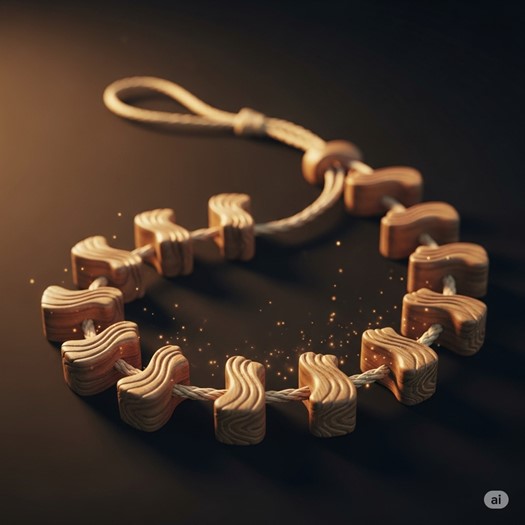
Description: The Malleable Lei is a deceptively simple item. It consists of a single, durable cord woven from the sun-bleached fibers of the Kaloa vine, a plant known for its resilience. Strung along the cord are a dozen small, smooth wooden charms, each no larger than a thumbnail. The charms are carved from Wiliwood, a type of tree that never truly stops growing and subtly alters its own grain patterns with the changing seasons. The wood is warm to the touch and feels strangely light. The carvings are abstract and non-representational, featuring gentle curves and flowing lines that seem to shift slightly when not directly observed. The entire lei emits a faint, almost imperceptible scent of salt and damp earth. It has no clasp, but the cord is mystically pliable and can be easily stretched over the head before it returns to its original size, settling comfortably around the neck.
Detailed Stats
- Mind’s Eye Focus: +1
- Social Subtlety: +2
- Durability: 15/15
Passive Magic
- Mind-Body Accord: The lei creates a constant, subtle flow of magic between the wearer’s mind and body. The avatar becomes more intuitively aware of their own physical state, posture, and non-verbal cues. This manifests as a deeper understanding of how their physical presence is perceived by others, allowing for minor, unconscious adjustments to their stance and bearing to appear more confident, unassuming, or approachable as needed. This connection makes it easier to fall into and maintain a physical persona.
- Spiritual Resonance: The wood of the lei is attuned to the flow of spiritual and emotional energy. It hums with a soft, nearly silent vibration when the wearer is in a location with a high concentration of ambient magic or near another being undergoing a significant spiritual or emotional event. This provides no specific information but serves as a gentle, instinctual warning or indicator of heightened metaphysical energy in the immediate vicinity.
Activable Magic
- Visualize the Form: By holding a clear and unwavering image within their Mind’s Eye, the avatar can channel their will through the lei to enact a minor, temporary physical change upon their own body. This requires several moments of intense, uninterrupted concentration to initiate. The changes are cosmetic and superficial. Examples include altering hair color, hair length, and hairstyle; changing eye color; creating or removing simple patterns on the skin like freckles or birthmarks; subtly shifting facial features such as the shape of the nose or the fullness of the lips; or making ears appear pointed. The transformation lasts as long as the avatar devotes a small portion of their focus to maintaining it. If their concentration is broken, or if they choose to release the magic, their form reverts to its natural state over the course of a few seconds. This ability cannot alter the avatar’s core physical structure, mass, or capabilities.
- Spirit’s Echo: The wearer can attune the lei to the sound of a voice they have recently heard. By focusing on the memory of that voice, the avatar can alter their own vocal cords to mimic its pitch, tone, and cadence. The imitation is not perfect and a discerning listener might detect subtle flaws, but it is sufficient to disguise the avatar’s natural voice. The effect can be maintained for several minutes at a time and requires minimal concentration once activated. The user can only hold one voice in the lei’s memory at a time; mimicking a new voice overwrites the previous one.
Slot: Neck
Tags: Magic, Huna, Shape-shifting, Roleplay, Common, Tier 1, Wearable, Wood, Attunement, Subtlety, Illusion, Social, Organic, Psychic, Island, Concentration, Adaptation, Disguise, Cosmetic
In the world of Saṃsāra, the Huna 42 of Malleable Lei is a common enough item that it can be found in a variety of commercial settings, from the humble stalls of its creators to the bustling markets of a metropolis. The method of its acquisition and its price vary significantly depending on the location.
- The Seaside Carver’s Stall
- This type of shop is found in the small, coastal villages and communities scattered across the more remote islands, often close to where the traditions that inspired the item’s creation are still practiced. The “shop” is typically an open-air stall, perhaps just a simple wooden table set up under an awning woven from broad leaves, situated within earshot of the rhythmic crashing of ocean waves. The air smells of salt, drying seaweed, and the fragrant Wiliwood shavings that litter the ground. These stalls are often run by the artisan who crafted the lei or their immediate family. They are not merchants by primary trade but craftspeople who sell their wares to supplement their livelihood.
- Buying an item here is an intimate and unhurried affair. The carver will likely want to talk with a potential buyer, to share the story of the wood, and to feel that the avatar purchasing the lei understands its purpose of adaptation and connection. Barter is very common in these communities. A traveler might trade a sack of exotic spices from a faraway land, a well-made tool, or even a compelling story of their travels for a Malleable Lei. For those paying with currency, the price is the lowest one can find. It is a direct transaction that supports the creator, without any intermediaries. Selling such an item back to the carver is often done at a minimal loss, as they value the return of their own work.
- Cost: 80 – 120 Vitae, or goods of equivalent value.
- The Metropolitan Grand Souk
- In the sprawling megacities, whether they float among the clouds, reside in the deep dark of the earth, or simply cover the land for miles, one can find a Grand Souk. This is a chaotic, vibrant, and endless bazaar where merchants from across the 73 island countries hawk their wares. Here, a Malleable Lei is just one of thousands of magical trinkets on display. It might be found hanging from a hook in a cramped stall overflowing with common-tier magic items, nestled between self-tying ropes and ever-warm soup bowls. The merchant is a professional, their voice a constant drone in the din of the market, their eyes sharp for discerning customers.
- The process of buying is impersonal and swift. The merchant likely knows the item’s function—”it changes your face, your voice, good for a quick disguise”—but nothing of its deeper lore or the principles of Huna. Haggling is not just common; it is expected. A price is named, a counter-offer is made, and a theatrical dance of negotiation ensues. Authenticity is confirmed with a perfunctory touch, or by using a small, magical device like a Truth-Stone that glows faintly in the presence of enchantment. Selling an item here involves a similar, though often more aggressive, negotiation, with the merchant aiming to buy as low as possible to maximize their profit margin.
- Cost: 150 – 200 Vitae, subject to the outcome of vigorous haggling.
- The Gilded Arcana
- For avatars of means and discernment, there are specialized magic shops. These establishments, with names like The Gilded Arcana or The Alchemist’s Repose, are found on the cleaner, quieter avenues of major trade hubs. The storefronts are elegant and understated, often featuring a single, perfect item displayed in a magically lit window. Inside, the air is still and cool, smelling of ancient paper, exotic incense, and the faint, crisp scent of contained magical energy. The proprietor is an expert, a scholar of magical artifacts who curates their collection with care.
- Here, a Malleable Lei would be presented on a velvet cushion inside a glass case. The shopkeeper can detail its provenance, the specific meaning of its abstract carvings, and the philosophical underpinnings of its Huna-based magic. The transaction is formal and educational. There is no haggling; the price is fixed and reflects the item’s authenticity, the knowledge of the proprietor, and the luxurious shopping experience. The item comes with a certificate of authenticity, written on vellum and sealed with magical wax. Selling an item to such a shop is possible, but only if it is in pristine condition, and the shopkeeper will offer a fair but firm price based on their own extensive knowledge of the market.
- Cost: 250 – 300 Vitae.
- The Back-Alley Broker
- In the shadows of every great city, there is an unregulated economy. A Malleable Lei can also be acquired from a back-alley broker who operates out of a hidden location—a damp cellar beneath a tavern, a secluded nook on the city’s under-docks, or a forgotten maintenance tunnel in a subterranean metropolis. These dealers trade in goods that are often stolen or acquired through questionable means.
- The transaction is defined by tension and expediency. The broker displays their wares on a dirty cloth, ready to be bundled up at a moment’s notice. They care little for the item’s history, only its utility and who might want it. Payment is demanded upfront, often in untraceable goods or currency. There are no guarantees. The lei might be flawed, its magic unstable, or it might carry the lingering psychic imprint of its former, unfortunate owner. A buyer must be wary, but for those in desperate need of a disguise with few questions asked, the back-alleys provide. The price is wildly unpredictable; a desperate broker might sell it for a pittance, while one who senses a buyer’s urgency might inflate the cost dramatically.
- Cost: Anywhere from 50 to 250 Vitae, depending entirely on the circumstances.
The Huna 42 of Malleable Lei is not an item of direct confrontation; its power in matters of offense and defense is rooted in subtlety, deception, and the manipulation of perception. Its use is a mental exercise, an act of will projected onto the self to influence the actions of others.
In a Bustling Metropolis
The towering cities of Saṃsāra, with their millions of souls, are environments of anonymity and constant motion. Here, being seen or unseen is a form of currency, and the Malleable Lei allows an avatar to control their visibility.
Defense:
Defensively, the lei is a tool of escape and evasion. An avatar being pursued by city watch members or enforcers from a disgruntled guild can use the chaos of the crowd as their shield. Ducking into a crowded marketplace or a steam-filled transit station, they can find a moment’s respite behind a cargo container or within a throng of travelers. In that moment, they focus their Mind’s Eye, channeling their will into the lei. The wearer pictures their own face, then visualizes the changes: the sharp line of their jaw softens, their distinctive black hair lightens to a common brown and shortens by several inches, and a prominent scar on their cheek fades into unblemished skin. Their Mind-Body Accord passive helps them instinctively shift their posture from a confident stride to an unremarkable shuffle. When they step back into the flow of the crowd, they are a different person. The pursuers, scanning for the avatar they were chasing, sweep their gaze right past the new, unremarkable face, allowing the avatar to melt away into the city’s depths.
Offense:
Offensively, the lei is used for infiltration. An avatar may need to access the private office of a trade magnate located within a heavily guarded corporate skyscraper. After days of observation, they identify a low-level clerk who routinely delivers documents to the target floor. The avatar follows this clerk, using Spirit’s Echo to attune the lei to the clerk’s voice as they greet a guard. Later, the avatar retreats to a safe place and uses Visualize the Form. They do not need a perfect copy, merely a passable resemblance. They alter their height perception by changing their posture, shift their hair to match the clerk’s style, and adjust their facial features to be close enough for a cursory glance. Approaching the guards, they keep their head slightly lowered, present a forged document, and murmur a simple greeting in the clerk’s mimicked voice. This act of social intrusion is the offensive maneuver, breaching the first layer of security not with force, but with carefully crafted deception.
In the Wilderness and Forgotten Ruins
The vast jungles, hidden grottos, and crumbling ruins between the great nations are home to territorial monsters, reclusive tribes, and suspicious explorers. In these lands, belonging is safety, and being an outsider is a threat.
Defense:
Here, defense is about pre-emptive assimilation to avoid conflict. Imagine an avatar stumbling upon the territory of a xenophobic tribe that lives within the ruins of an ancient city. Instead of announcing their presence, they observe from a concealed position. They study the tribe members’ general appearance—their common hairstyles, the specific patterns of their ritual scars or tattoos. Using the lei, the avatar replicates these features on their own body. They change their eye color to match the prevalent hue of the tribe and alter their facial structure to echo the tribe’s dominant features. When they finally choose to reveal themselves, they do not appear as a complete outsider, but as someone who could plausibly be a distant relative or a wanderer from a lost branch of their own people. This visual connection lowers initial hostility, transforming a potential violent confrontation into a cautious negotiation, defending the avatar’s life through cultural camouflage.
Offense:
Offense in the wilderness is often psychological. An avatar needs to clear out a group of bandits who have made their camp in a sacred cave system. Direct assault is risky, but the bandits are superstitious. The avatar researches local legends of the area, learning of a vengeful nature spirit said to haunt the caves. Under the cover of twilight, the avatar uses Visualize the Form to create an unsettling appearance: their skin takes on a pale, mossy tone, their hair lengthens and appears to drift as if underwater, and their eyes become solid, pupil-less orbs of white. Using Spirit’s Echo, they project a chorus of whispering, overlapping voices they heard earlier in the wind. By appearing at the edge of the firelight as this terrifying apparition, they are not attacking the bandits’ bodies, but their minds. This psychological assault can cause them to flee their camp in terror, achieving the goal without a single weapon being drawn.
In a Noble Court or Guild Hall
The political arenas of Saṃsāra are battlefields of whispers, alliances, and reputation. A misplaced word can be as deadly as a blade, and identity is both a shield and a weapon.
Defense:
In the high-stakes environment of a political gala, an avatar might inadvertently insult a powerful minister, drawing their ire and the dangerous attention of their personal guards. Escape must be immediate and absolute. The avatar can retreat towards the servant’s corridors, a place the nobles rarely look. There, they activate the lei. Their fine clothing is hastily covered by a stolen apron. Their face becomes plainer, more tired. Their posture, guided by Mind-Body Accord, hunches into one of deference and exhaustion. When the guards storm through the area looking for a confident, well-dressed individual, they ignore the humble servant wiping down a table, allowing the avatar to defend their social standing and physical freedom by becoming part of the scenery. The passive Spiritual Resonance might even give them a moment’s warning, humming as the guards’ focused, angry intent approaches.
Offense:
Offense in this setting is the art of sabotage. An avatar wishes to disrupt an alliance between two rival guilds that is being negotiated in a grand hall. The avatar has previously managed to hear the voice of a key aide to one of the guild masters. They find a quiet alcove and use the lei to alter their features to vaguely resemble this aide. The goal is not a perfect impersonation, but plausible deniability. The avatar then intercepts a junior member of the rival guild. Using the mimicked voice from Spirit’s Echo, they whisper a carefully crafted piece of disinformation—a supposed secret that suggests a double-cross is in motion. The avatar then slips away, reverting their features back to normal. The seed of mistrust is planted. The offensive act is the insertion of a single, corrosive idea, using a temporary, false identity provided by the lei to poison the well of trust between the two factions.
Perception of Activation:
SIGHT
- User’s Perspective: The initial activation does not produce an external flash of light. Instead, for a brief moment, the user’s peripheral vision seems to soften and swim, as if looking through heated air. The hard edges of the world lose their definition, replaced by a gentle, pulsing blur. The mental image of the desired change, held within the Mind’s Eye, becomes intensely sharp and vivid, overlaying the softened reality. As the change takes effect, their own reflection will show the features subtly flowing and resetting into the new configuration.
- Observer’s Perspective: To a casual observer, there is almost nothing to see. There is no tell-tale glow or magical sparkle. A highly attentive individual, staring directly at the user at the moment of activation, might catch a brief, watery shimmer in the air immediately around the user’s head, lasting less than a second. The primary and most noticeable visual effect is the physical transformation itself, which appears strangely natural, as if the person is simply settling their features into a different expression, albeit a new face entirely.
- Positives: The extreme visual subtlety is its greatest asset. It can be activated in a crowd or even under direct observation without giving away the magical nature of the change, as it can be masked by a cough, a sneeze, or the act of turning one’s head.
- Negatives: For an inexperienced user, the lack of strong visual feedback can be disconcerting, leading them to wonder if the activation was successful without looking at a reflection. The momentary blurring of peripheral vision can be disorienting if activated while moving.
TOUCH
- User’s Perspective: The moment the user’s will is channeled, the Wiliwood charms of the lei become distinctly warm against the skin of the neck and collarbone. It is not an unpleasant, burning heat, but a deep, comforting warmth like a sun-soaked stone. This warmth seems to spread inward, suffusing the user’s chest. Simultaneously, the user feels a strange sense of lightness and pliability in their own facial muscles and skin, as if they have become soft clay ready to be molded by their thoughts.
- Observer’s Perspective: There is no perceivable tactile effect for an observer. The user’s skin temperature does not change, and the air around them does not warm. Only through direct physical contact with the lei itself could the warmth be detected.
- Positives: The warmth is a clear, unambiguous physical confirmation that the item is active and channeling magic. This can be reassuring and helps the user maintain focus. The feeling of pliability makes the mental act of visualization feel more connected to the physical result.
- Negatives: The sudden warmth can be distracting, especially in a situation that requires cool-headedness. In a hot or humid climate, the additional heat, however minor, can be uncomfortable and might even cause a thin sheen of sweat to appear around the neck, creating a potential physical tell.
SOUND
- User’s Perspective: Activation is accompanied by a sound that is not truly heard with the ears but is perceived deep within the user’s skull. It is a very low-frequency, resonant hum, like a single, drawn-out note from a colossal singing bowl. It vibrates through the jawbone and the small bones of the inner ear, a constant, stable tone that persists for the few seconds of active transformation.
- Observer’s Perspective: The activation is completely silent. No sound is emitted from the lei or the user that could be detected by another person, regardless of their proximity.
- Positives: The sound is entirely personal and private, ensuring activation remains discreet. For a practiced user, the specific frequency of the hum can act as a meditative focus, helping them stabilize their mental image.
- Negatives: The internal sound can create a feeling of pressure in the ears and sinuses, similar to the initial stages of a headache. It can momentarily mask subtle, real-world sounds, making the user slightly less aware of their audible surroundings.
SMELL
- User’s Perspective: A phantom scent blooms in the user’s senses, a complex aroma that is both grounding and ethereal. It is primarily the smell of rich, damp earth and ozone, the scent of the air after a fierce but brief thunderstorm. Woven within this is the faint, clean smell of sea salt and the dry, warm fragrance of sun-baked, ancient wood. The scent is vivid for a moment, then vanishes completely once the transformation is stable.
- Observer’s Perspective: There is no smell associated with the activation that an observer could detect. The air around the user remains unchanged.
- Positives: The scent is deeply connected to the item’s origins (earth, wood, sea), acting as a thematic and psychological anchor for the user, reinforcing the idea of natural, flowing change.
- Negatives: A scent is a powerful trigger for memory. An unexpected activation could dredge up an unrelated and distracting memory associated with the smell of rain or the sea, potentially breaking the user’s concentration at a critical moment.
TASTE
- User’s Perspective: As magic flows from the item, the user experiences a sharp, metallic taste on the back of their tongue and palate. It is the distinct flavor of ozone and static electricity, akin to placing one’s tongue on a magical storage device. It is not overpowering but is certainly noticeable, fading as soon as the activation is complete.
- Observer’s Perspective: There is no taste perception for any observer.
- Positives: This sensory input serves as a final, definitive confirmation that a magical process has occurred, directly interacting with the user’s physiology.
- Negatives: The taste is mildly unpleasant. It can cause an involuntary grimace or a need to clear one’s throat, which could serve as an unintentional physical “tell” that something has just happened.
EXTRA-SENSORY: Mental Channeling
- User’s Perspective: The most profound sensation is the feeling of the Mind’s Eye focusing to a single, infinitesimally small point. All other thoughts and sensory inputs are muted, pushed to the periphery of consciousness. The user feels their will as a tangible force, a stream of focused intent being pushed from their mind, through the warm conduit of the lei, and into the very cells of their body. It feels like threading a needle in a purely mental space.
- Observer’s Perspective: An observer will see the user’s eyes momentarily lose focus, their gaze turning inward. They appear distracted, pensive, or lost in thought. There may be a brief pause in their breathing or a slight tension in the muscles around their eyes and temples, indicating intense concentration.
- Positives: This intense focus is what makes the magic possible, allowing the user to form a clear, unwavering mental blueprint for the desired physical change without being distracted by the outside world.
- Negatives: During the few seconds of activation, the user is almost completely detached from their physical surroundings. They would not notice an approaching person or an imminent danger, creating a brief window of extreme vulnerability.
EXTRA-SENSORY: Aura Fluctuation
- User’s Perspective: The user feels their own magical signature, their aura, become warm and fluid. There is a distinct sensation of this energy expanding slightly from their body, shimmering, and then being gently re-shaped by their will. It feels like being covered in a second skin of pliable energy that conforms to the new physical shape as it forms.
- Observer’s Perspective: To a mundane observer, nothing changes. However, an observer with the ability to perceive magical auras would see a dramatic effect. The user’s aura would suddenly brighten, then swirl chaotically as if stirred by an invisible spoon. The colors would momentarily mix and warp before forcefully settling into a new, stable pattern that overlays the user’s true, underlying aura. It looks like a skillfully applied coat of magical paint.
- Positives: For the user, this provides a deep, intuitive feedback loop, confirming that the change is not just skin deep but is being supported by their own magical energy.
- Negatives: This fluctuation is a massive beacon to any form of magical detection. It would instantly alert another magic-user who is actively observing auras, and could potentially trip magical wards designed to detect illusion or transmutation magic, revealing the deception.
Creation of a Malleable Lei
This document details the necessary components, skills, and processes for the creation of a magical lei capable of facilitating minor, temporary physical transformations. The process is as much a spiritual ritual as it is a physical craft, demanding focus and an understanding of the principles of Huna.
Materials Needed
- One Mature Kaloa Vine: At least three feet in length. The vine must be naturally sun-bleached to a pale, bone-white color, signifying it has absorbed ample solar energy. It should be harvested from a coastal area where it has been exposed to both sun and salt spray.
- One Branch of Living Wiliwood: The branch must be respectfully harvested from a living Wiliwood tree, ideally during the transitional period between seasons when the wood’s innate capacity for change is at its peak. The branch should be thick enough to yield twelve thumbnail-sized charms.
- Sacred Waters: Two separate containers of water are required. One must be fresh water collected from a place of natural tranquility, such as a silent forest spring or a mountaintop lake. The other must be salt water collected from the sea during a full moon, when tidal energies are strongest.
- Mana-Infused Polishing Dust: A small pouch of fine sand or ground crystal that has been left to steep in an area of high ambient magic for no less than one full cycle of the moon. This will be used to polish and charge the wooden charms.
- A Personal Focus (Optional, for Attunement): For crafting a lei intended for a specific individual, a small personal item that carries their biological or magical signature is recommended. A lock of hair, a vial with a few drops of blood, or a cherished, worn-out trinket are all suitable.
Tools Required
- A Set of Carver’s Knives: These do not need to be ornate, but they must be kept sharp and clean. The set should include at least one fine-bladed knife for detailed work and a small gouge for shaping curves.
- A Smooth Weaving Surface: A simple, clean wooden board or a dedicated weaver’s lap-desk used for braiding the Kaloa vine fibers into a cord.
- A Non-Metallic Attunement Bowl: A bowl made of stone, ceramic, or dark wood, large enough to hold the finished lei without it being cramped. Metal interferes with the subtle magical fields involved in the final imbuement.
- A Meditation Space: A quiet, secluded area where the crafter can work for several hours without interruption. The space should be cleansed of distracting items and energies before the crafting begins.
- Untreated Polishing Cloth: A soft, clean cloth made from natural fibers like cotton or wool, used with the polishing dust.
Skill Requirements
- Woodcarving (Novice): The physical act of shaping the charms does not require master-level skill. The crafter must be able to create smooth, simple, abstract forms without splintering the wood.
- Fiber Weaving (Novice): The ability to plait or braid the Kaloa vine fibers into a strong, uniform cord is necessary. The weave itself is simple, but it must be consistent.
- Huna Philosophy (Fundamental Knowledge): The crafter must understand the core principles of Huna, particularly the concepts of Ike (the world is what you think it is) and Makia (energy flows where attention goes), as these mental frameworks are essential for the enchantment.
- Ambient Mana Channeling: The crafter must be able to consciously draw the ever-present magic of Saṃsāra from their surroundings, through their own body, and into the object they are working on. This is a rudimentary form of enchantment.
- Focused Visualization: The ability to hold a singular, clear, and unwavering mental image for an extended period is paramount. This skill is more critical to the process than any physical dexterity.
Crafting Steps
- Preparation of Self and Space: The crafter must begin by finding a state of inner calm. This is typically achieved through several minutes of quiet meditation in the prepared workspace. The goal is to clear the mind of distracting thoughts and focus entirely on the intention: to create an object of harmonious, flowing change.
- Ritual Cleansing: The Wiliwood branch and Kaloa vine are placed in the attunement bowl. The crafter pours the fresh water over them while visualizing all mundane energies and impurities being washed away. Then, the salt water is poured over them while visualizing the infusion of primal, oceanic potential. The materials are then set aside to air dry on the weaving surface.
- Carving the Charms: The Wiliwood branch is carefully cut into twelve small, roughly equal pieces. The crafter then begins to carve each piece into a smooth, abstract charm with no sharp angles, focusing on gentle, flowing curves. Throughout the entire carving process, the crafter must meditate on the principle of Kala (there are no limits), seeing past the wood’s solid form to its limitless potential for transformation.
- Weaving the Cord of Intent: The dried Kaloa vine is painstakingly separated into fibers and woven into a single, durable cord. While braiding, the crafter focuses their will on the principle of Ike (the world is what you think it is). They must visualize the cord not as a simple rope, but as a conduit for thought, a physical representation of the connection between the mind and the body.
- Polishing and Assembly: Each carved charm is polished to a high sheen using the mana-infused dust and the soft cloth. During this repetitive, rhythmic action, the crafter channels ambient magic through their hands and into the charms, focusing on Makia (energy flows where attention goes). The energy being channeled should feel warm and pliable. Once all twelve charms are glowing with a faint, internal warmth, they are strung onto the woven cord.
- The Final Imbuement: The fully assembled lei is coiled neatly inside the attunement bowl. If a Personal Focus is being used, it is placed in the center of the coil. The crafter then places their hands on either side of the bowl, closes their eyes, and enters a deep state of focused visualization. They must project a powerful, clear mental image of the lei’s function—of faces subtly shifting, of voices changing pitch and tone, of identity becoming fluid. This mental projection is poured into the lei until the warmth of the charms intensifies and can be felt even without touching them. The process is complete when the lei gives a final, gentle pulse of warmth, signifying the enchantment has been accepted and has become stable.
Girl Who Wore the Ocean
In the first days, when Saṃsāra was a young world to the new souls, there was an island. This island was not on maps, for the maps were not yet made. People came to be on this island, but not by boat. They were there, and before they were not. And the people had fear. Great fear was had by them. They feared the deep woods that whispered. They feared the deep water that whispered. All things were new and held spirits, they thought.
Among these people was a girl. But she had no name that was spoken. In the telling of the story, she is the Girl-Without-A-Face. It was not that she lacked features. She had two eyes, a nose, a mouth, like all people. But her face was plain. It was like a stone, smoothed by water. No one looked at it for long. It held no interest. She was not feared, but she was not seen. And this was a great loneliness for her.
While the other people made fences against the woods and prayed to be safe from the water, the Girl-Instead-of-a-Face walked. She walked into the woods that whispered. The whispers were not of danger to her. They were of growing, and changing, and sleeping, and waking. She put her hand on a Wiliwood tree. The tree made feelings at her. A feeling of its bark changing with the sun. A feeling of its leaves changing with the wind. It was a tree that was never the same twice. And she understood this feeling.
Then she walked to the deep water. The people said monsters were in it. But she saw the water touch the sand. It whispered. The whispers were not of teeth, but of connection. How the water touched all shores. How it held the sky on its back. She saw a Kaloa vine, white from the sun, strong from holding to the rocks against the water. The vine made a thought at her. A thought of holding things together. And she understood this thought.
And so, she did a thing. She did not know why. A compulsion was on her. She took a branch from the Wiliwood tree. It was warm in her hand, like a living creature. She took the white Kaloa vine. It was strong in her hand, like a promise. She sat on the sand where the water touched the shore. She held a piece of the wood. She did not take a knife to it. She looked at the faces of the waves, how they were born and died and were born again. She looked at the faces of the clouds, always different, always moving. Her seeing-in-the-head, her strong thought, pushed at the wood. The wood changed. It became smooth and curved, like a wave held still. She did this twelve times. For the twelve moons of a year, maybe. It is not clear in the scroll.
Then she took the vine. She braided it. And while she braided, she thought of how the vine held the shore, and the shore held the island, and the island was held by the water, and the water held the sky. She thought of how all things are held together. Her thought went into the braid. When she was done, she put the twelve wood pieces on the braid. It was a lei. It was the first one of its kind.
She put the lei on her neck. It was warm. She went to a pool of water that was very still. She looked for her face. She saw the Girl-Without-A-Face. Plain like a stone. A sadness was on her. In her sadness, she remembered a forest bird, its feathers like jewels, its eyes sharp and proud. She wished she could be looked at like the bird was looked at. She wished for a face of pride.
And a warmth spread from the lei. A great warmth. A feeling of her skin becoming like soft clay was on her. She looked in the water. The face was not the stone. It was sharp, like the bird. Her eyes were proud. Her face held interest. Great surprise was on her. She touched the face. It was her face. But it was not.
So she learned the way of the lei. She wanted respect, so she thought of the great hunter of the village. And she wore his face, stern and strong. And the other hunters gave her the best meat. It was so. She wanted admiration, so she thought of the woman whose voice was like music. And she wore her face, beautiful and sad. And many came to hear her sing songs she did not write. It was so. She wanted to be wise, so she thought of the oldest elder. And she wore his face, full of lines and knowing. And people came to her for words that were not hers.
When she was the hunter, she was not the girl. When she was the singer, she was not the girl. When she was the elder, she was not the girl. She had many faces, and she was seen. But inside, she was the Girl-Without-A-Face, and the loneliness was now greater than before. She was a vessel for other people. A hollow thing.
Then a trouble came. From the deep water, a monster came. It was a thing of rage and many teeth and a shell that no spear could break. Great fear was had by the people. They ran and hid in the caves. The Girl, wearing the face of the wise elder, went to the caves too. The people cried out, “Wise one, what do we do?” But the face of the elder had no words. The wisdom was not hers. She was afraid. She took off the elder’s face and put on the strong hunter’s face. The people cried, “Brave one, fight for us!” But the face of the hunter had no strength. The courage was not hers. She was afraid.
She ran from the cave, to the still pool where she first saw the change. The monster was breaking the village. She saw her reflection. She wore no one’s face. Her face was plain, like a stone. The lei was warm around her neck. And she knew a truth. The lei gave her faces, but it did not give her substance. The faces were masks, and a mask cannot fight. A mask cannot think. A mask cannot be brave.
A new thought came to her. Her own thought. She looked at her own hands. She looked at her own plain face in the water. She was herself. And that was not nothing. That was everything.
She did not put on a new face. She wore her own. But she remembered what it felt like to be the elder. She took that feeling of wisdom. She remembered what it felt like to be the hunter. She took that feeling of courage. She remembered the songs of the singer. She took the memory of that powerful voice.
With her own plain face, she walked from the pool. She used the singer’s voice, but it was her own breath that pushed the sound, and she called to the monster. The monster turned. With the hunter’s courage, but it was her own feet that moved, she ran. She did not run away. She ran toward the cliffs where the rocks were sharp and the ground was weak. With the elder’s wisdom, but it was her own mind that saw the plan, she led the great monster onto a ledge over the deep water. The ledge, being weak, broke under the monster’s great weight. The monster fell into the sea, into a deep crack in the rock, and was trapped. And this was the way of it.
The people came out. They saw her. They saw her plain face, like a stone. But they saw the courage in her eyes. They heard the wisdom in her words. They saw her. For the first time, they saw the girl.
The Moral of the Story: A face that is not your own can make you seen, but only your own heart can make you strong.
Suggested conversions to other systems:
Call of Cthulhu
Lei of Whispering Sands
This appears to be a simple, woven garland of sun-bleached plant fibers and a dozen smooth, dark wooden charms. The wood is strangely warm. Investigators who have held it report a faint, unsettling feeling of their own face being somehow disconnected or fluid. Its origins are unknown, but its craftsmanship resembles that of certain isolated Polynesian communities known to practice cargo cults and worship deities of the sea and sand.
Game Mechanics:
An Investigator wishing to use the lei’s power must make a POW x 5 roll.
- On a Success: The Investigator may alter their facial features, hair style and color, eye color, and voice to match a person they have clearly observed or a new identity of their own creation. The change is purely physical, not affecting clothing or gear. While the effect is active, the Investigator gains one bonus die on all Disguise checks and on Charm or Fast Talk checks related to maintaining the false identity. The effect lasts for one hour or until the Investigator chooses to end it. Activating the lei costs the Investigator 1 Sanity point.
- On a Failure: The transformation fails. The Investigator’s face contorts momentarily into a hideous, inhuman configuration before snapping back to normal. This disturbing experience costs 1d2 Sanity points.
- On a Fumble (a roll of 96-100): The Investigator is overwhelmed by psychic forces. They still adopt the intended appearance, but they suffer from a temporary bout of madness (see Call of Cthulhu Keeper Rulebook) as they believe they truly are the person they are impersonating, losing all sense of their original identity for the duration. This costs 1d4 Sanity points.
The lei’s passive ability to resonate with spiritual energy may sometimes provide vague, unsettling impressions to the wearer when near potent magical artifacts or in locations tainted by the Mythos. The Keeper may call for an Idea roll or, for those with the skill, a Cthulhu Mythos roll to decipher these feelings, with the usual risks of gaining unwanted insight.
Blades in the Dark
Whisper-Thief’s Garland
A length of pale, tough vine strung with a dozen wooden beads, each carved with shifting, non-Euclidean lines. It hums with the energy of the ghost field, channeling echoes of identity and appearance. A favorite tool of Slides who need a new face for every con, and Whispers who wish to walk among their enemies unseen.
Game Mechanics:
This is a special item that can be selected when you choose your scoundrel’s load. It has a load value of 1.
- When you use the garland to create a disguise and you Sway someone to believe you are someone else, you get +1d to your action roll.
- You can activate the garland to perfectly mimic a voice you have studied. When you do, take 1 Stress. For the rest of the scene, your vocal imitation is flawless. When using this to fool someone, you can expect your Effect Level to be increased.
- The garland is sensitive to psychic resonance. When you Attune to the ghost field while wearing it, the spirits may show you echoes of faces and identities connected to the place you are in. You might ask the question: “What kind of person is not welcome here?” or “Whose presence here would go completely unnoticed?”
When you create a Long-Term Project to craft such an item, it might require tracking down rare Kaloa vines from the Dagger Isles, acquiring Wiliwood beads from a Sparkwright’s private collection, and performing a ritual to bind an echo of a forgotten god into the garland.
Dungeons & Dragons
Lei of Shifting Visage Wondrous item, common
This necklace consists of a dozen smooth, wooden charms strung on a simple, durable cord of woven fiber. The carvings on the charms are abstract and seem to slowly drift and change when you are not looking directly at them. The lei feels pleasantly warm to the touch.
As an action, you can expend one of this item’s charges to cast the disguise self spell. However, the spell’s effects are limited: it only alters your facial features, hair, and voice. It does not change your clothing, armor, equipment, or body type. The changes last for 1 hour and do not require concentration. The lei has a number of charges equal to your proficiency bonus, and it regains all expended charges daily at dawn.
Inherent Abilities:
- Vocal Mimicry. As an action, you can touch the lei and attune it to a voice you have heard within the last minute. For the next hour, you have advantage on all Charisma (Deception) checks made to imitate that specific voice.
- Actor’s Intuition. While wearing the lei, you have advantage on all Charisma (Performance) checks made to maintain a physical persona or impersonate another individual.
- Magical Resonance. The lei vibrates faintly when it is within 30 feet of an object or creature bearing a strong illusion or transmutation magical effect.
Knave
Face-Changer’s Lei
A necklace of 12 wooden charms on a woven cord. Takes up 1 inventory slot.
When you wear the lei, you can concentrate for one minute to change your face. You can alter your facial features, hair style and color, and eye color to appear as a completely different, mundane person you have seen or can imagine. The change is a physical illusion. Your voice also changes to match your new appearance. The effect lasts until you lose concentration, take damage, or choose to end it.
If you attempt to activate the lei while in a stressful situation (such as being pursued or watched closely), you must make a WIS save. If you fail, your features twist into a monstrous, half-formed caricature of your intended disguise for one round, immediately alerting any onlookers to your deception. After this round, your face returns to normal and the activation fails.
Fate
The Face I Choose to Wear
This item is an Extra, representing a physical object that grants new capabilities.
- High Concept Aspect: Woven Lei of Shifting Identities
Game Mechanics:
This lei is a powerful tool for those who rely on deception and social maneuvering. As an object with a core aspect, it can be invoked and compelled like any other aspect in the game.
- Invoke the Aspect: You can spend a Fate Point to invoke the Woven Lei of Shifting Identities aspect for a +2 bonus or a reroll on any Deceive Skill roll where you are attempting to pass yourself off as someone else. This applies to creating a disguise, blending into a crowd, or acting in a role.
- Create an Advantage: The primary function of the lei is to help you Create an Advantage. When you have a few moments of concentration, you can use the Deceive skill to create a situation aspect that reflects your new appearance. Examples include, but are not limited to:
- An Unremarkable Servant’s Face
- Looks Like One of the Thugs
- The spitting image of Captain Eva
- A Face You Can Trust
- Compel the Aspect: The Game Master can compel the Woven Lei of Shifting Identities aspect to introduce complications. For example, your disguise might falter at a critical moment, or you might accidentally adopt the face of someone who is currently wanted by the local authorities. You would receive a Fate Point as usual for accepting this complication.
The lei could also grant the following stunt to its owner:
- A Familiar Face: Because you wear The Face I Choose to Wear, you gain a +2 bonus to your Rapport skill rolls when you first meet someone, as you subtly shift your features to appear more familiar, trustworthy, or non-threatening to them.
Numenera & Cypher System
Visage Spooler
This artifact appears to be an organic, woven garland made of some pale, fibrous plant matter. A dozen smooth, dark nodules are strung along its length. The nodules are made of a type of wood that seems to absorb and retain heat, and they feel warm to the touch. They contain microscopic bio-kinetic filaments that can receive and project morphological data onto the user.
- Level: 1d6 + 2
- Form: A necklace of woven fiber and smooth wooden baubles.
- Effect: When the user concentrates for a full round, the Visage Spooler activates. It subtly remodels the user’s facial cartilage, skin pigmentation, hair follicles, and larynx based on a mental template. This provides the user with an asset to all tasks involving disguise, impersonation, and social interactions where the false identity is relevant. The effect lasts for one hour.
- Depletion: 1 in 1d20 (When a depletion roll is made, if the result is a 1, the bio-kinetic filaments burn out, and the artifact becomes a mundane, inert object).
GM Intrusion: A potential GM Intrusion could be that the artifact over-activates, perfectly replicating the face of a specific person. The complication is that this person is now standing right across the room, or is infamous and wanted by the organization the character is trying to infiltrate. Alternatively, the user’s own identity could begin to fray, requiring an Intellect-based task to recall personal details, with failure resulting in a temporary, disorienting amnesia.
Pathfinder
IMPERSONATOR’S GARLAND ITEM 2+ UNCOMMON DIVINATION ILLUSION INVESTED MAGICAL Price 30 gp Usage worn necklace; Bulk —
This simple-looking lei is made of a tough, pale vine, with twelve smoothly carved wooden charms hanging from it. The abstract carvings on the wood seem to swim and shift when not directly observed.
You must have this item invested to benefit from its passive bonuses, but you do not need to have it invested to Activate it.
Activate [Two-Actions] Interact; Frequency three times per day; Effect You touch the lei and focus on a new identity, casting a 1st-level illusory disguise. This effect lasts for 10 minutes. While this illusion is active, you gain a +1 item bonus to Deception checks to Impersonate and to Performance checks to pass as a different person.
Activate [One-Action] Interact; Frequency once per hour; Effect You alter your voice to perfectly mimic a voice you have heard within the last minute. This effect lasts for 10 minutes.
Passive The lei resonates with illusion magic. You gain a +1 item bonus to Perception checks to disbelieve an illusion.
Level 8 Version; Price 450 gp; The item bonus to checks is +2. When you activate the item to cast illusory disguise, the spell is heightened to 2nd level and lasts for 1 hour. Its frequency becomes once per hour.
Savage Worlds
The Many-Face Lei
This magical item is a woven necklace of tough, pale vines and a dozen dark, wooden charms. The user can channel their will through the lei, calling upon ancient spirits of change and deception to alter their form.
- Requirements: Novice, Smarts d6+, Occult d6+
- Power: Disguise
- Power Points: 2
- Action: 1 action
- Duration: 10 minutes
Game Mechanics:
To activate the lei, the wearer uses their Action and makes an Occult roll.
- Success: The wearer’s face, hair, and voice are altered as per the Disguise power. The change is convincing and lasts for 10 minutes. This provides a +2 bonus to Performance or Persuasion rolls when attempting to convince others of the false identity.
- Raise: On a raise, the effect is flawless. The bonus to Performance and Persuasion increases to +4, and the duration extends to one hour.
Inherent Abilities:
- Social Danger Sense: The lei is attuned to the flow of spiritual and emotional intent. The wearer gains a version of the Danger Sense Edge, but it only applies to social situations. The GM will give the player a moment’s warning before another character’s betrayal, social ambush, or sudden hostility, representing the lei’s subtle hum of warning. This does not work for physical ambushes or combat.
- Master of Disguise: When this item is worn by a character who has the Disguise power, they may spend 1 extra Power Point when activating the power to affect their clothing and body type as well, not just their face and voice.
Shadowrun
Koa Wood Identity Foci
This appears as a simple necklace of woven fibers and dark, polished wood beads, easily mistaken for tourist kitsch or a cultural affectation. To the Awakened, however, the foci hums with a quiet, subtle power tied to the Illusion domain. Originating from the Hualapai Nation and based on pre-contact magical traditions, these foci are favored by face-changers and social infiltrators who blend ancient magic with modern corporate espionage. The wood is specially harvested Koa, attuned to the user’s aura to create a more stable and believable magical mask.
- Type: Sustaining Focus (Illusion)
- Force: 2
- Availability: 8R
- Cost: 10,000 nuyen
Game Mechanics:
As a Sustaining Focus, this item’s primary purpose is to help a magic user sustain a spell without suffering the standard -2 dice pool penalty.
- Sustaining: The Koa Wood Identity Foci can sustain an Illusion spell with a Force up to its own rating (Force 2). It is almost exclusively used to sustain the Physical Mask spell. While the foci is sustaining the spell, the magician does not take the -2 dice pool penalty for sustaining.
- Sympathetic Resonance: The Huna tradition used to create the foci attunes it to the wearer’s subconscious expressions. When the foci is used to sustain a Physical Mask spell for the purpose of impersonation, the wearer gains a +1 dice pool bonus to all Con or Etiquette Social Tests made to convince others of their identity. The foci subtly shifts the illusion’s micro-expressions to better match the intended persona.
- Astral Signature: The foci has a subtle but distinct astral signature, appearing as a swirling mask of green and brown light. An individual examining it with Assensing may make a test to identify its purpose (Magic + Intuition [Astral]).
Starfinder
Adaptive Wiliwood Lei LEVEL 3 CATEGORY MAGIC ITEM PRICE 1,350 CREDITS BULK L
This length of tough, pale cord is strung with a dozen charms made of a dark, hardened wood native to a recently rediscovered planet in the Vast. The wood, known as Wiliwood, contains dormant, bio-organic nanites. When activated by the wearer’s mental command, these nanites temporarily re-sequence the user’s superficial epidermal and laryngeal cells to form a new identity.
Game Mechanics:
This is a Worn Magic Item that occupies the neck slot.
- Activation: Once per day, as a standard action, the wearer can command the lei to alter their form. This changes their facial features, apparent age, hair, and voice into that of a new persona. The effect lasts for 10 minutes.
- Effect: While the effect is active, the wearer gains a +4 circumstance bonus to Disguise checks. This does not alter the wearer’s clothing, armor, or equipment.
- Biometric Programming: The nanites within the lei can be programmed with a specific facial template. A user can connect the lei to a datapad (or other device displaying a clear image) and attempt a DC 15 Computers or Engineering check. This takes one minute. On a success, that specific face is stored within the lei’s organic memory. When the user activates the lei to assume that specific identity, the circumstance bonus to their Disguise check increases to +6. The lei can only store one such template at a time.
Traveller
Shaper’s Lei
This item is a product of high-technology psionics, most likely of Zhodani or a similarly advanced race’s design, though it is disguised as a primitive piece of jewelry. The “wooden” charms are actually sophisticated psychic resonance nodes, and the “vine” is a network of psycho-conductive filaments. The device reads the user’s surface thoughts and projects a powerful, low-level telepathic “mask” over their features that alters how they are perceived by others.
- Tech Level (TL): 13
- Cost: Cr 75,000
- Mass: 0.1 kg
Game Mechanics:
The Shaper’s Lei is a psionic device that does not require the user to have any inherent psionic talent.
- Activation: The user must concentrate for one minute, holding a clear mental image of the desired face and vocal patterns.
- Effect: The device projects a telepathic illusion. This is not a physical change and will not fool cameras, sensors, or automated systems. To any living being capable of being affected by telepathy, however, the user appears to have the face and voice they visualized. This grants the user DM+2 to all Deception, Persuade, and Steward checks related to impersonating another individual. The effect lasts for one hour or until the user dismisses it.
- Detection and Risks: An individual with Psionic talent may attempt a Difficult (10+) Psionics (Telepathy) check to see through the illusion. On a failure, they perceive the illusion as reality. On any failed Deception or Persuade check made by the wearer, the mental illusion may flicker, granting the target an opportunity to realize something is amiss. The Game Master might grant the target a bonus to their next check to see through the ruse.
Warhammer Fantasy Roleplay
The Trickster’s Garland
A strange and unsettling item, said to have originated from the far-off isles of Lustria, though its magical nature feels closer to home for those who understand the fickle nature of the Aethyr. The garland is woven from a pale, unnaturally resilient vine and adorned with twelve beads of a dark, oily wood. It is a potent tool for spies, charlatans, and those who serve the Changer of Ways.
- Encumbrance: 0
- Qualities: Magical, Unreliable, Blasphemous
Game Mechanics:
To use the garland, the wearer must put it on and spend a full round concentrating on a new face, then make an Average (+20) Cool Test to control the Winds of Magic flowing through the item.
- On a Success: The character’s face and voice are warped by illusionary magic into the desired form. This new identity lasts for a number of hours equal to the character’s Willpower Bonus plus the Success Levels of the Test. While disguised, the character gains a +20 bonus to Fellowship-based Tests where the disguise is relevant, such as Charm, Gossip, and Guile.
- On a Failure: The magic surges unpredictably. The character’s face twists into a horrifying, melted visage for a moment before returning to normal. The character gains 1 Fatigued Condition from the psychic backlash.
- Curse of Change: This item is subject to the whims of the Ruinous Powers. Any time the wearer makes a Test while disguised and rolls a Fumble (any roll of doubles in the tens and units, e.g., 11, 22, 33), the illusion collapses spectacularly. The wearer’s face melts into a swirling, raw embodiment of change, causing all who witness it to gain 1 Broken Condition and forcing them to make a Fear (1) Test. The user must remove the garland to end this horrifying display.