
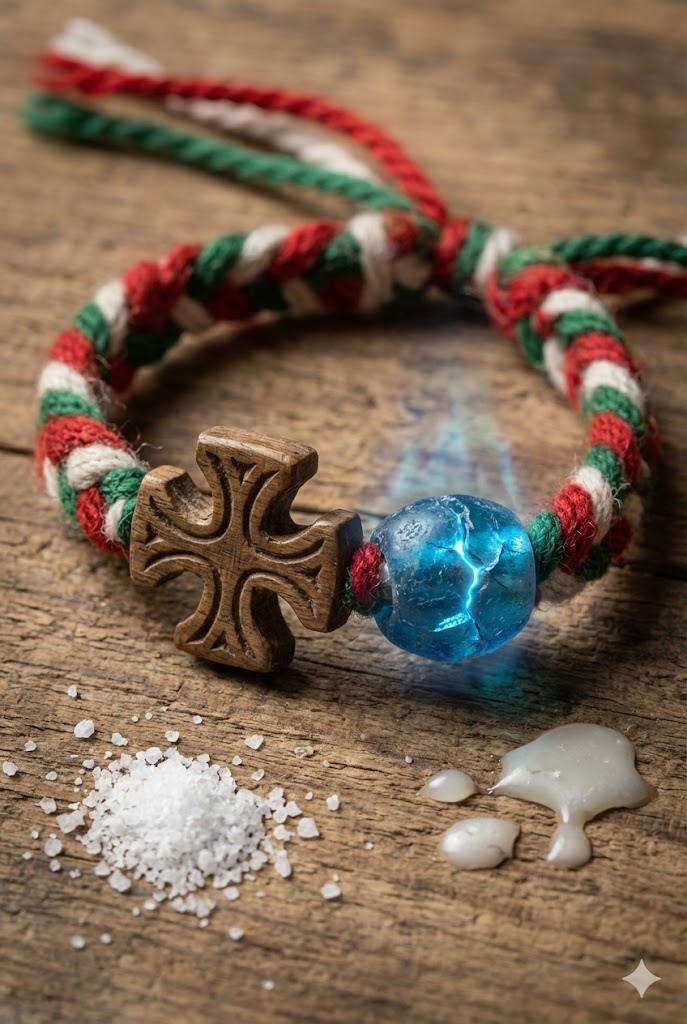
Lore: In the high-altitude villages of the Eastern Ranges of Saṃsāra, where the air is thin and the spirits of the mountains are fickle, survival depends on community and the rejection of the “Char Achk” (the Evil Eye). The Armenian Folk Healing 19 of Acceptable, commonly referred to by the locals as the “Tatik’s Narot” (Grandmother’s Cord), is a humble looking item woven from red, green, and white threads, adorned with a small, hand-carved wooden charm known as a daghdghan.
These items were originally crafted by the matriarchs of the hill tribes who understood that true healing is not just about fixing the body, but about making the individual “acceptable” again—acceptable to their community, acceptable to the spirits, and acceptable to themselves. A sick person is often isolated, and a cursed person is shunned. This charm bridges that gap. It is imbued with the ancient folk magic of the hearth, using simple rituals to banish the jealousy of others and the “fear” that lodges in the chest. It is said that wearing this cord tells the universe, “This soul belongs here; do not look at them with envy.” Traders and diplomats in the larger cities of Saṃsāra have begun to adopt them, not just for health, but to smooth over the awkward friction of social interactions, making their presence “acceptable” even in places where they are unwanted foreigners.
Detailed Stats
- Tier: 1
- Rarity: Common
- Slot: Wrist (A braided bracelet tied with a permanent knot)
- Weight: Negligible
- Value: 45 Silver (Often traded for favors or food rather than coin in its home region)
- Attunement: Required (The user must wear the cord for three days without taking it off, allowing it to absorb their scent and “humors”).
- Material: Woolen threads (dyed Red for health, Green for life, White for purity), a chip of sacred Hackberry wood (daghdghan), and a single blue glass bead.
Passive Magic
- Passive Activation – The Blue Ward: The specific geometry of the daghdghan and the color frequency of the blue bead create a low-level magical interference field against “The Evil Eye.”
- Effect: The wearer gains a magical resistance to social debuffs and curses based on envy, jealousy, or judgment. If an enemy attempts to use magic to charm, shame, or socially ostracize the wearer (making them “unacceptable”), the bead cracks slightly, absorbing the negative energy. The wearer feels a sudden warmth on their wrist, alerting them to the hostile intent.
- Passive Activation – Humoral Balance: The woven threads act as a filter for the wearer’s magical aura, constantly adjusting the “heat” and “dampness” of the spirit.
- Effect: The wearer gains a bonus to resisting ingested poisons or spoiled food. The magic convinces the body that the foreign substance is “acceptable,” allowing the digestive system to process it without violent rejection (vomiting or nausea) while the immune system quietly neutralizes it. The wearer can eat strange or slightly off-putting local cuisines without offending the host.
Activatable Magic
- Active Activation – The Wax Pouring (Mome Thaphle):
- Action: The user holds the wrist charm over a bowl of water and pours a drop of molten wax (or simply focuses their intent through the daghdghan if wax is unavailable) into the liquid.
- Effect: The magic reads the “fear” or affliction affecting a target person. The wax (or the image in the water) forms a shape revealing the source of the malady—whether it is a curse, a natural disease, or a haunting. This does not cure the ailment, but it provides the “diagnosis” required to treat it. It reveals if a sickness is physical or spiritual.
- Active Activation – The Salt Circle:
- Action: The user takes a pinch of salt (or dust) and rubs it against the charm before sprinkling it over a wound or an object.
- Effect: The target becomes “sanctified” and socially clean. If used on a wound, it stops infection (the “evil” entering the blood). If used on a person who has committed a faux pas or been disgraced, it magically “cleanses” their reputation for one hour, making them “acceptable” enough to speak to again without immediate hostility. It suppresses the social stigma of being an outsider.
Tags: Tier 1, Wrist, Healing, Social, Abjuration, Folk Magic, Ritual, Poison Resistance, Diagnosis, Common, Protection, Charm, Warding, Cleansing, Divination, Organic, Spirit, Community, Tradition, Resilience, Sanctity, Envy, Balance
In the diverse and magically saturated markets of Saṃsāra, the Armenian Folk Healing 19 of Acceptable is not sold in weapon smithies or high-end enchanter towers. It is an item of the people, found in places where superstition holds as much weight as steel. The acquisition of such an item is rarely a simple transaction of coin; it is often an interaction that tests the very social acceptance the item promises to grant.
The Hearth-Witches’ Looms (Eastern Mountain Ranges) In the rugged, high-altitude villages where this magic originated, there are no formal shops for such things. Instead, travelers must seek out the Tatiks (Grandmothers) who hold court by the communal fire pits or in the sun-drenched courtyards of stone dwellings. These women weave the cords while gossiping and watching the village children. To buy one here is to ask for entry into the community. The Tatik will stare at the buyer, looking for the “shadow” of the Evil Eye upon them. If the buyer is deemed rude, impatient, or spiritually “damp,” they will be refused service regardless of their wealth. The transaction is a ritual of hospitality. The buyer must sit, drink tea, and converse pleasantly. Only when the Tatik decides the buyer is “acceptable” will she pull a finished daghdghan from her apron pocket and tie it to their wrist herself, sealing the knot with a whisper.
- Cost: 45 Silver. In these regions, coin is often secondary to utility. The Tatiks frequently accept the equivalent value in high-quality wool, imported salt, or iron needles. If paid in coin, they prefer silver, as it is considered a pure metal that does not carry the taint of greed like gold.
The Apothecaries of the Lowland Ports (Andean Coastal Cities) In the bustling trade cities of the Andean nation, where the Faith of Intayra preaches the clarity of light, these folk charms are sold in the dusty, herb-scented shops of holistic healers and apothecaries. Here, the Armenian Folk Healing 19 is categorized as a “preventative medical device.” It hangs on hooks behind glass counters, nestled between jars of dried sage and vials of snake oil. The shopkeepers here are practical merchants who market the item to paranoid merchants and nervous diplomats. They sell the story of the item: “Going to a dinner with the Guild Masters? Afraid they’ll poison your wine or your reputation? Wear this.” The purchase is clinical and swift, stripped of the mountain rituals, but the item is guaranteed to be authentic, often sourced directly from the mountain traders.
- Cost: 6 Gold (60 Silver). The price is marked up significantly to account for the “import tax” and the shopkeeper’s assurance of quality. The extra cost is the price of convenience for city-dwellers who do not wish to trek up a mountain to find a grandmother.
The Drift-Market Corridors (Anuran Territory – Abbeville) The Anuran people, with their keen vibrational senses and caste-based society, have a unique appreciation for items that modulate social standing. In the damp, echoing corridors of the litho-formed cities, these charms are sold by “Social Architects”—merchants who specialize in items that help navigate the complex hierarchy of Anuran life. These shops are often located in the mid-levels of the city, carved directly into the basalt walls near the ventilation shafts where the air is fresh. The Anuran sellers view the “Acceptable” charm as a tool for vibrational harmony. They market it to those of lower castes (Slate or Granite) who need to do business with the High Priests (Marble) without causing offense. The sale involves a “tuning” process where the Anuran merchant taps the wooden daghdghan to ensure its resonance does not clash with the buyer’s natural skin-thrum.
- Cost: 5 Gold, 5 Silver (55 Silver). The Anuran merchants value the daghdghan wood, which is rare in their stone-heavy environment. They may also accept payment in rare minerals or explosive catalysts used in their mining operations.
The Hedge-Peddlers’ Wagons (The Free Roads) On the long, dangerous roads that connect the seventy-three island nations, wandering caravans often contain a Hedge-Peddler. These are itinerant mystics who sell luck, curses, and cures from the back of brightly painted steam-wagons or lizard-drawn carts. The Armenian Folk Healing 19 hangs from the ceiling of the wagon, swaying with the motion of the road alongside dried bats and dream-catchers. The Hedge-Peddler uses fear to sell the item. They will squint at a traveler and say, “You have the look of a man whom others envy. That envy will rot your gut unless you protect yourself.” They sell to adventurers who are about to enter a dungeon or a royal court, framing the item as essential survival gear against the spiritual dangers of the unknown.
- Cost: 3 Gold, 5 Silver (35 Silver). These versions are sometimes lower quality, perhaps using a pine chip instead of true Hackberry wood, or dyed cotton instead of wool. However, they are cheap and readily available to those desperate for a little luck. The Peddlers often haggle, and a shrewd buyer might get one for as low as 25 Silver if they can convince the Peddler that they are destitute.
The Souks of the Sunken Grottoes (Subterranean Megacities) In the vast, bioluminescent caverns where the sun never shines, the definition of “Acceptable” is a matter of life and death among the competing syndicates and drow-kin. Here, the charm is sold in shadowed alcoves by information brokers. It is seen as a tool of espionage—a way to blend in, to eat the strange fungi of the deep without retching, and to avoid the psychic prying of the cave-seers. The shops are quiet, dangerous places where silence is the currency. The charm is often blackened with soot or dyed dark blue to blend into the shadows, losing its festive red and green colors but retaining its magic.
- Cost: 8 Gold (80 Silver). The price is high because the item allows surface-dwellers to survive the toxic social and physical environment of the deep. It is sold as a “mask” for the soul, a necessary expense for any topsider hoping to leave the Grottoes alive.
Defense: The Ward of the Hearth
The Armenian Folk Healing 19 does not block attacks with a forcefield; it blocks them with validity. It defends the user by asserting that they belong in the space and cannot be rejected by the environment or the people within it.
In the Banquet Hall (Social Defense)
- The Poisoned Chalice: When a rival tries to poison the user (either with actual arsenic or with a reputation-destroying rumor), the “Humoral Balance” activates.
- Roleplay: The user drinks the tainted wine. The DM asks for a Constitution save. The user describes the red thread on their wrist pulsing. “My body does not fight the poison; it welcomes it, shakes its hand, and escorts it out.” The user does not vomit or turn pale. They simply smile at the assassin, wiping their mouth. The defense is the refusal to give the enemy the satisfaction of a reaction.
- The Evil Eye: When a noble attempts to use a charm spell or an intimidation check based on social standing.
- Roleplay: “The Baroness glares at me with pure envy. The blue bead on my wrist snaps with a loud crack. I don’t feel her magic. I just feel pity for her.” The user is immune to the shame the enemy tries to project.
In the Wilds (Environmental Defense)
- The Alien Ecosystem: When traveling through a fungal jungle or a toxic swamp where the pollen causes hives or sickness.
- Roleplay: The user rubs the daghdghan (wood charm). “The mountain accepts the traveler,” they chant. While the rest of the party is coughing or breaking out in rashes, the user appears immune. The local flora treats the user as if they are a native plant, not an intruder to be rejected.
Offense: The Aggressive Normalization
Offense with this item is subtle. It is the weaponization of “belonging.” It allows the user to walk into places they shouldn’t be and force the universe to accept their presence, or to strip away the supernatural defenses of an enemy by revealing them.
In Infiltration (The Salt Circle)
- Bypassing Guards: The user needs to enter a restricted library or a guarded warehouse.
- Roleplay: The user sprinkles salt on their shoulders before approaching the guard. They don’t sneak; they walk with absolute, Grandmotherly confidence. “I am meant to be here,” their posture says. The guard hesitates, confused. The user isn’t invisible, but they seem so acceptable, so mundane and non-threatening, that the guard’s instinct to stop them is dulled. The offense is “Social Stealth”—hiding in plain sight by being aggressively normal.
In Combat (The Diagnostic Gaze)
- The Wax Pouring: The party is fighting a beast that regenerates or takes no damage. The user uses their action not to attack, but to diagnose.
- Roleplay: “I pour the wax into the puddle of blood.” The user shouts to the party, “It’s not a beast! The wax shape is a chain! It’s a bound spirit! Break the amulets, don’t hit the flesh!” The offense is providing the crucial intel that turns a hopeless fight into a puzzle to be solved.
- Sanctifying the Ground: Fighting undead or spirits.
- Roleplay: The user aggressively creates a “Salt Circle” around the enemy leader. “You are not acceptable here!” This reverses the item’s logic. Instead of making the user fit in, it highlights that the enemy does not fit in. It acts as a targeted banishment or a way to break an enemy’s stealth or etherealness.
Universal Roleplay Mechanic: “The Grandmother’s Voice”
- Somatic Component: The user is constantly fidgeting with the bracelet, twisting the threads.
- The Attitude: The user treats danger like a misbehaving child. A bandit ambush isn’t a terrifying combat encounter; it is “rude.” A cursed trap isn’t a deadly device; it is “improper.” The user projects the aura of a stern matriarch who is disappointed in the world’s lack of manners, which strangely makes the world hesitate to hurt them.
Perception of Activation:
Visual Perception (Sight)
- User’s Perspective: When the charm wards off a curse or the “Evil Eye,” the single blue glass bead appears to dilate like a pupil, absorbing the incoming negative energy and turning a cloudy, milky white for a few seconds before clearing. During the “Wax Pouring” ritual, the user does not just see wax floating in water; the shapes manifest with glowing outlines in their mind’s eye, clearly resembling the face of the person who cursed them or the shape of the organ that is diseased.
- Observer’s Perspective: The bracelet seems to catch the light more often than it should. When the user is “sanctifying” a space with salt, the dust particles seem to hang in the air longer than gravity should allow, creating a faint, shimmering haze around the user that looks like heat rising from a hearth.
- Positives: The visual cues of the bead provide an immediate, silent warning system that allows the user to know they are being targeted by magic or envy without alerting the attacker.
- Negatives: The user might become paranoid, constantly checking the clarity of the bead or seeing omen-shapes in everyday things like spilled soup or cloud formations.
Auditory Perception (Sound)
- User’s Perspective: A soft, constant background noise of domestic comfort—the sound of a broom sweeping a floor, the crackle of a fireplace, or the distant, unintelligible murmuring of elderly women gossiping. When the “Blue Ward” triggers, this comfort sound is interrupted by a sharp, distinctive sound of a ceramic plate shattering, which only the user can hear.
- Observer’s Perspective: Very little, though when the user activates the charm, there is a rhythmic click-clack sound of the wooden daghdghan hitting the glass bead, which sounds like knitting needles working.
- Positives: The “hearth sounds” mask the noise of the outside world, helping the user stay calm in chaotic or loud environments.
- Negatives: The shattering sound can be startling, causing the user to flinch visibly during high-stakes social interactions, potentially revealing that they have detected a deception.
Tactile Perception (Touch & Somatic)
- User’s Perspective: The defining sensation is Temperature. When the user is safe and socially accepted, the wool threads feel warm and soft, like a blanket. When the user is poisoned or in a toxic environment, the bracelet becomes ice cold, numbing the wrist to dull the body’s reaction to the toxin. When the “Evil Eye” is directed at them, the blue bead burns hot against the pulse point, a physical sting of the envy directed at them.
- Observer’s Perspective: The user appears physically grounded. Even in a storm or on a rocking ship, they stand with the stability of someone standing in their own kitchen.
- Positives: The temperature changes allow the user to detect poisons in food simply by holding their hand over the plate and feeling the bracelet cool down.
- Negatives: The burning sensation of the ward can be painful, leaving temporary red marks on the wrist if the user is subjected to intense hatred or powerful curses.
Olfactory Perception (Smell)
- User’s Perspective: A sudden, overwhelming scent of Home. This varies by the user’s memories but often smells of baking bread, dried mint, beeswax, and frankincense. When diagnosing an illness, the scent changes to match the affliction: a rot-curse smells of sulfur, while a fever smells of burning hair.
- Observer’s Perspective: The user exudes a faint, pleasant smell of clean laundry, dried herbs, and old wood, regardless of how long they have been traveling in the wild.
- Positives: The scent acts as a powerful grounding anchor, preventing panic attacks or fear effects by reminding the user of a safe place.
- Negatives: The smell of specific diseases can be overpowering and nauseating to the user during the diagnosis process, potentially making it hard to concentrate on the cure.
Extra-Sensory Perception: The Weight of Eyes
- User’s Perspective: The user gains a distinct proprioceptive sense of Attention. They can physically feel when someone is staring at them, and more importantly, how they are staring. Admiration feels like a soft pressure on the shoulders; envy feels like a needle in the back; hatred feels like a constriction of the throat. This allows the user to navigate a crowded room and instantly identify who wishes them harm.
- Observer’s Perspective: Observers feel a subconscious “field of validity” around the user. It becomes mentally difficult to question the user’s presence. A guard might look at the user and think, “They don’t have a badge… but they look like they know where they are going,” and simply let them pass.
- Positives: Unmatched social intuition; the user knows exactly where they stand in the social hierarchy of any room they enter.
- Negatives: The constant awareness of others’ emotions can be exhausting. In a crowd of angry or jealous people, the user feels physically heavy and crushed by the “weight” of the negative attention.
Recipe: The Weaver’s Rite of the Daghdghan
Tier: 1 Category: Wondrous Item / Charm Time to Craft: 3 Days (Must be crafted while sitting by a hearth that has not gone cold for a full season). Success Chance: Difficulty Rating (DR) 10 (The DR increases to 15 if the crafter is currently keeping a secret from their family).
Materials Needed:
- 1x Skein of Red Wool: Dyed with madder root. Represents the blood and the health of the body.
- 1x Skein of Green Wool: Dyed with nettle or walnut leaf. Represents the sprouting life and the acceptance of the earth.
- 1x Skein of White Wool: Unbleached and undyed. Represents purity and the blank slate of a newborn soul.
- 1x Branch of Hackberry Wood: Must be harvested from a tree growing near a place of worship or a busy village square. This wood naturally absorbs social vibrations.
- 1x “Eye-Stone” (Blue Bead): A piece of blue glass or turquoise that has a natural imperfection resembling a pupil.
- 1x Pinch of “Borrowed Salt”: Salt that was given freely by a neighbor. You cannot use salt you bought yourself; it must be a gift of community.
Tools Required:
- Iron Paring Knife: Small, dull, and used only for household tasks (cutting fruit or bread). A weapon-knife is too aggressive for this magic.
- The Hearth: An active fire used for cooking. The smoke is the catalyst.
- Beeswax: To polish the wood and seal the knot.
Skill Requirements:
- Sleight of Hand (Weaving): To braid the intricate “Narot” pattern without breaking the tension.
- Woodcarving: To shape the daghdghan without splitting the sacred wood.
- Insight (Empathy): The crafter must focus on the feeling of belonging while working. If they feel lonely or bitter, the charm will fail.
Crafting Steps:
- The Shaping of the Guardian: Take the Hackberry Branch and the Iron Knife. You must carve the daghdghan (the wooden charm). It should not look like a creature; it must be a geometric shape (usually a triangle or a diamond) with patterns of holes punched through it. These holes are “traps” for the Evil Eye—confusing the gaze of the envious so it gets lost in the wood pattern before it hits the wearer.
- The Braid of Life: Sit by the Hearth. Tie the Red, Green, and White wool strands together. As you braid them, you must recite the names of people who love you (or the intended wearer). “Mother accepts me, the Baker accepts me, the Mountain accepts me.” You are weaving a social safety net into the physical cord.
- The Setting of the Eye: Thread the Blue Bead onto the braid exactly at the center point. Whisper to the bead: “See what I do not see. Eat the jealousy that is meant for my plate.” This wakes the glass, turning it into a passive sensor for negative intent.
- The Salt Baptism: Once the braid is finished and the wood charm is attached, dissolve the Borrowed Salt in a cup of water. Dip the bracelet into the brine. This signifies that the wearer is now “seasoned” and part of the community. It washes away the “stranger-scent.”
- The Smoke Seal: Hold the wet bracelet over the Hearth smoke until it is dry. Rub the wood with Beeswax while it is still warm. The wax locks in the smoke and the salt. The item is now ready to be gifted. (Tradition dictates it should be tied onto the wearer’s wrist by the crafter, never put on by the wearer themselves).
Parable of Broken Gaze
(Transcribed from the faded goat-skin scrolls found in the High Monasteries of the Eastern Range)
In the season when the frost wars with the bloom, a wanderer named Anahit came to the Village of the Stone-Heart. Anahit was not of the mountain; her skin was the color of river clay, and her songs were in a key the villagers did not know. She came bearing gifts of lowland fruit, but the people of the Stone-Heart did not look at her gifts. They looked at her with the Char Achk—the Evil Eye.
“Why does she sing so loudly?” asked the Baker, his heart sour with envy of her voice. “Why does she walk so tall?” whispered the Weaver, her hands shaking with jealousy of Anahit’s youth.
They did not strike her with stones. They struck her with silence. They struck her with the heavy, cold weight of their stares. And because the soul is soft and the eyes of a mob are hard, Anahit fell ill. Her breath grew shallow, for she felt she had no right to the air. Her stomach turned, for she felt the bread of the village was not meant for her. She lay dying, not of fever, but of un-belonging.
On the third night, the Old Mother of the Mountain came down. She was the Tatik, the one who remembered when the rocks were mud. She entered Anahit’s tent and saw the girl fading into the shadows.
“Child,” the Tatik said, “You are trying to shrink until you fit into the small spaces of their hearts. You will vanish before you fit there.”
“I only wish to be acceptable,” Anahit wept. “I am a stranger, and my presence is a poison to them.”
The Tatik shook her head. She took a branch of the sacred Hackberry tree, which grows crooked so the wind cannot break it. She carved a shape of diamonds and holes—a maze for the eye. She took wool: Red for the blood that warms us, Green for the life that sustains us, and White for the spirit that cleans us. She braided them tight, singing the old songs of the hearth. Finally, she tied a single blue bead of glass into the knot.
“This is the Narot,” the Tatik said, tying it to Anahit’s wrist. “It does not change you. It changes the way you are seen. The wood will catch their envy in its maze. The blue eye will drink their malice so you do not have to.”
Anahit rose. She walked to the village square where the elders sat in judgment. As she approached, the Baker looked up to scowl, but his eye was caught by the strange geometric carving on her wrist. He looked at the wood, and his mind wandered to the trees, and he forgot his anger. The Weaver looked up to sneer, but her gaze hit the blue bead. The bead flashed, and the Weaver felt her own jealousy reflect back at her, shaming her into silence.
Anahit stood before them, breathing deeply. She did not shrink. She did not apologize for her song.
The Elder looked at her. He did not see a stranger. He saw the Red, Green, and White—the colors of life, earth, and spirit. He saw the sacred wood. He saw a woman who stood in the protection of the mountain.
“Pass the salt,” the Elder said, pointing to the empty seat at the table.
And just like that, the sickness left Anahit. She sat, she ate, and she was whole. For she learned that the mountain does not ask the flower to explain its color; it simply gives it room to grow.
The Moral of the Story The sickness of the outcast is not caused by the stranger’s presence, but by the community’s blindness; true healing begins not when we change who we are, but when we force the world to look us in the eye and see a neighbor.
Suggested conversions to other systems:
Call of Cthulhu (7th Edition)
Name: The Tatik’s Narot (Folk Charm) Type: Artifact / Occult Item
Description: A braided bracelet of red, green, and white wool featuring a carved hackberry wood charm and a blue glass bead. It is used by hill tribes to ward off the “Evil Eye.”
Stats & Mechanics:
- Cost: N/A (Handmade/Gifted)
- Powers:
- The Blue Ward (Passive): The investigator gains a Bonus Die on Power (POW) or Psychology rolls to resist intimidation, social manipulation, or spells that induce fear or emotional distress. If a magic spell targets the user’s mind, the blue bead cracks, absorbing 1 Magic Point of the cost (reducing the effect or likelihood of success for the caster).
- Humoral Balance (Passive): The wearer gains a Bonus Die on Constitution (CON) rolls to resist the effects of ingested poisons, spoiled food, or alcohol.
- Wax Diagnosis (Active): By spending 3 Magic Points and 10 minutes performing a wax-pouring ritual, the user can determine the exact nature of a malady affecting a person (Physical Disease, Mental Trauma, or Mythos Curse). This grants an automatic success on a subsequent Medicine or First Aid roll to treat the patient.
- Sanctified Salt (Active): The user sprinkles salt to create a boundary. This costs 1d4 Sanity Points. For one hour, minor Mythos entities or spirits (with POW less than 50) cannot cross the line or touch the person salted, finding them “incompatible” with their corrupt nature.
Blades in the Dark
Name: Hearth-Cord (Daghdghan)
Description: A superstitious charm woven from colorful wool and sacred wood. Common among Skovlander refugees and those who fear the ghosts of the past.
Stats & Mechanics:
- Load: 0 (Worn as jewelry)
- Tier: I (Common)
Abilities:
- The Evil Eye (Resistance): You gain +1d to resistance rolls against social consequences involving humiliation, shunned status, or loss of reputation. The charm absorbs the social stigma.
- Iron Stomach (Passive): You can ingest questionable food, drugs, or mild poisons without suffering Level 1 Harm. The charm filters the “bad humors.”
- Ritual of Acceptance (Special): You can mark 1 Stress to sprinkle salt or perform a quick hand-sign before a social engagement. This creates a “glamour of belonging.” For the duration of the scene, NPCs will not treat you as an intruder or outsider unless you take a hostile action. You blend into the social fabric (Great Effect for Consort/Sway to gain entry).
- Diagnosis (Gather Information): When you study a cursed object or a sick person using the charm, you gain +1d to the roll to understand the source of the affliction.
Dungeons & Dragons (5th Edition / 2024 Rules)
Name: Bracelet of the Hearth-Keeper Wondrous Item, Common (Requires Attunement)
Description: A braided woolen cord with a wooden charm. The blue bead upon it stares back at those who look upon you with envy.
Mechanics:
- Warding the Evil Eye: While wearing this bracelet, you have Advantage on Wisdom and Charisma saving throws against being Charmed or Frightened. Additionally, if a creature attempts to use a feature to read your thoughts or emotions, they must succeed on a DC 13 Wisdom saving throw or take 1d4 psychic damage as the bead reflects their intrusion.
- Humoral Balance: You have Advantage on Constitution saving throws against ingested poisons and diseases.
- Ritual of the Wax (Magic Action): You can cast the Detect Poison and Disease spell as a Ritual. When cast this way, the spell manifests as images in a bowl of water rather than a general sense.
- Salt of Acceptance (Magic Action): Once per day, you can sprinkle salt on yourself or an ally. For the next hour, the target is under the effect of the Sanctuary spell (Save DC 13). This effect ends early if the target makes an attack or casts a spell that affects an enemy. The flavor of the spell is not a divine shield, but a social filter that causes enemies to ignore the target as “harmless” or “belonging to the background.”
Knave (2nd Edition)
Name: Narot Charm 19
Description: A wool bracelet with a blue eye-bead. Wards off envy and sickness.
Stats & Mechanics:
- Slots: 0 (Worn item)
- Durability: 3 (Wool frays over time)
Traits:
- Social Armor: When rolling for Reaction from NPCs, a result of “Hostile” is treated as “Unsure/Neutral.” The charm makes you seem acceptable and non-threatening.
- Gut-Check: You are immune to the negative effects of spoiled rations or minor food-based poisons.
- Diagnosis: If you spend a Turn pouring wax into water over a sick ally, the Referee must reveal if the sickness is magical, physical, or spiritual in nature.
- Salt Circle: You can spend a ration of salt to bar a doorway. Spirits and ethereal undead cannot cross this line for one Watch.
Fate (Core / Condensed)
Name: The Tatik’s Braid
Description: A red, green, and white wool bracelet with a geometric wooden charm and a blue bead. It carries the weight of ancestral approval, shielding the wearer from envy and sickness.
Aspects:
- High Concept: Woven Ward of the Mountain Hearth
- Trouble: Cracks Under the Weight of True Hate
Stunts & Mechanics:
- Ward of the Evil Eye: You gain +2 to Defend with Will when an opponent attempts to inflict mental stress or consequences using social attacks based on jealousy, shame, or intimidation.
- Humoral Balance: You can spend a Fate Point to ignore the effects of any ingested poison or spoiled food for one scene. The poison is neutralized by the charm.
- Rite of Acceptance: Once per session, you can create a Situation Aspect called Socially Valid on yourself with a free invoke. While this aspect is active, NPCs in the scene will treat you as a welcome guest regardless of your actual status or faction, provided you do not attack them.
- Wax Diagnosis: You can use Empathy or Lore to diagnose a curse or magical sickness. This functions as an Overcome action against the difficulty of the affliction. Success reveals the source and the cure.
Numenera & Cypher System
Name: Acceptance Node (Artifact)
Level: 3
Form: A bracelet of organic fibers (dyed wool) and a small wooden toggle engraved with geometric wards. A synth-glass bead acts as a sensor.
Effect:
- Passive: The wearer has an Asset on all Intellect defense tasks against fear, intimidation, or social manipulation. The bead pulses warm when such an attack is attempted.
- Passive: The wearer has an Asset on Might defense tasks against ingested poisons or biological diseases.
- Active (Intellect Cost 2): The wearer touches the charm to a creature or object. For the next hour, that creature or object is perceived as “harmless” and “belonging” to the current location. This reduces the difficulty of all social interaction tasks to avoid conflict by one step.
- Active (Intellect Cost 3): The user pours fluid through a hole in the wooden charm. The fluid forms a pattern that answers one question regarding the nature of a target’s affliction (e.g., “Is this curse magical or biological?”, “Who placed this hex?”).
Depletion: 1 in 1d20 (Check each time an Active ability is used).
Pathfinder (2nd Edition)
Name: Narot of the Hearth Item 3 Price: 50 gp Usage: Worn (Wrist); Bulk: – Traits: Common, Abjuration, Fortune, Magical, Mental
Description: This braided wool bracelet shields the wearer from the “Evil Eye” and makes them acceptable to strangers.
Passive Effect: You gain a +1 item bonus to Will saves against emotion effects and effects that would impose the Frightened or Stupefied conditions. You also gain a +2 circumstance bonus to Fortitude saves against ingested poisons.
Activate [>>] (Interact, Manipulate) The Salt Circle; Frequency once per day; Effect You sprinkle salt around yourself or an adjacent ally. For 1 minute, the target is under the effect of a Sanctuary spell (DC 17). This effect manifests as a social filter; enemies simply overlook the target as unworthy of aggression.
Activate [>>>] (Material, Manipulate) Wax Pouring; Frequency once per day; Cost A drop of wax and a bowl of water; Effect You attempt to diagnose a curse or disease affecting a creature. Make a Medicine or Occultism check against the DC of the affliction. On a success, you learn the name of the affliction, its level, and its origin (Magical, Curse, Poison, or Disease).
Savage Worlds (SWADE)
Name: Charm of the Valid Soul
Type: Enchanted Item (Amulet) Weight: – Cost: $350
Description: A folk charm that prevents the wearer from being shunned or sickened.
Mechanics:
- Averted Gaze: The wearer gains +2 to Spirit rolls to resist Intimidation, Taunt, or magical fear effects. The blue bead absorbs the hostility.
- Iron Gut: The wearer gains +2 to Vigor rolls to resist ingested poisons or food-borne illnesses.
- Acceptance: The wearer gains a +1 bonus to Persuasion rolls when interacting with strangers or hostile cultures. The charm subtly influences them to view the wearer as a “guest” rather than an “intruder.”
- Diagnosis Ritual: By spending a Benny and taking 10 minutes, the wearer can diagnose any ailment. This counts as a successful Healing roll for the purpose of identifying a disease, poison, or curse, providing detailed information on how to cure it.
Shadowrun (Sixth World / 6e)
Name: Narot Protection Focus Category: Magic Item (Enchanted Charm) Force: 3 Availability: 4R (Talisman) Cost: 1,500 Nuyen
Description: A braided wool bracelet containing a reactive reagent (a blue glass bead) and a wooden focus. It is popular among shamans and face specialists in the CAS and Tir Tairngire for its ability to deflect astral hostility and social stigma.
Game Mechanics:
- Astral Ward (Passive): The focus provides +2 dice to the wearer’s Defense Rating when resisting Mana spells or Critter Powers that target the mind (such as Fear or Confusion). The blue bead flares in astral space when this defense is successful.
- Humoral Filter (Passive): The wearer treats the Power of any Ingested Toxin as 2 lower than normal. The focus actively cleanses the user’s aura of biological impurities.
- Social Acceptance (Edge Action): By spending 1 Edge, the wearer can activate the “Acceptable” aura. For the next scene, the wearer does not suffer Social Modifiers from prejudice, low Loyalty, or being an outsider to the target’s culture. The target perceives the wearer as “neutral” rather than “hostile.”
- Diagnosis (Minor Action): The user can hold the charm over a sick individual and make an Assensing + Intuition (2) Test. Success reveals the nature of the illness (Magic, Toxin, or Disease) and provides a +2 dice pool bonus to the subsequent Biotech or Medicine test to treat it.
Starfinder (1st Edition)
Name: Daghdghan Lattice Level: 2 Price: 750 Credits Type: Hybrid Item (Magic/Bio-tech) Bulk: L Slot: Wrist
Description: A synthesis of ancient folk magic and modern psycho-reactive materials. This bracelet uses a blue crystal sensor to detect hostile intent and a pheromone-dampener to ease social friction.
Game Mechanics:
- Capacity: None.
- The Evil Eye (Passive): You gain a +2 insight bonus to Will saving throws against mind-affecting effects and Sense Motive checks to detect deception.
- Metabolic Filter (Passive): You gain a +2 insight bonus to Fortitude saving throws against ingested poisons and diseases.
- Sanctuary Protocol (Standard Action): Once per day, you can activate the lattice to generate a low-level SEP (Someone Else’s Problem) field. This functions as the Sanctuary spell (CL 2nd, Will Save DC 13), causing enemies to subconsciously ignore you unless you take aggressive action.
- Diagnostic Scan (Full Action): You can immerse the charm in water or pass it over a body to analyze an affliction. This functions as a Detect Affliction spell, but it only works on living creatures.
Traveller (Mongoose 2nd Edition)
Name: Psionic Integration Knot (Narot) TL: 10 (Psionic) Mass: – Cost: Cr 4,000
Description: A wrist-worn psychometric anchor disguised as a primitive woolen charm. It resonates with the wearer’s psyche to project an aura of harmlessness and belonging.
Game Mechanics:
- Requirement: PSI 1+ or Latent Talent.
- Social Camouflage: The wearer gains DM+1 to Diplomacy and Carouse checks when attempting to blend into a new culture or social group. The item creates a faint telepathic broadcast of “I belong here.”
- Toxin Rejection: If the wearer ingests poison, the item triggers an autonomic response to neutralize or reject it immediately. The wearer gains DM+2 to Endurance checks made to resist ingested toxins.
- Psionic Warding: If a telepath attempts to read the wearer’s mind or project negative emotions (Fear/Intimidation), the blue bead acts as a psychic heat-sink. The attacker suffers DM-1 to their Psi check.
- Diagnostic Resonance (Significant Action): The user can focus on a sick individual. Make a Psi (Awareness) check (8+). Success reveals the root cause of the illness (Pathogen, Poison, or Psionic Trauma). Cost: 1 Psi Point.
Warhammer Fantasy Roleplay (4th Edition)
Name: Hedge-Witch’s Narot Type: Talisman Encumbrance: 0 Availability: Common (Rural areas), Rare (Cities) Price: 12 Silver Shillings
Description: A charm made of knotted wool and hackberry wood, common among the hill folk of the Border Princes. It is said to turn aside the gaze of the Ruinous Powers and the envy of neighbors.
Game Mechanics:
- Ward of the Eye: The wearer gains a +10 bonus to Cool Tests to resist Psychology effects (such as Fear or Intimidation) and a +10 bonus to Willpower Tests to resist non-damaging magic that influences the mind (such as Beguile).
- Iron Gut: The wearer gains the Resistance (Poison) Talent, but only specifically regarding ingested poisons or spoiled food. If they already have this Talent, they gain a +10 bonus to the Test.
- The Salt Rite: By spending a Fortune Point and sprinkling salt on the ground, the user can create a barrier that Undead and Daemonic entities struggle to cross. These entities must pass a Hard (-20) Willpower Test to physically cross the salt line.
- Folk Diagnosis: When using the Heal skill, the user can use the charm to diagnose the patient. If the Heal test is successful, the user learns if the malady is natural or the result of corruption/magic.