
From: Aiptas Ouroborus 113
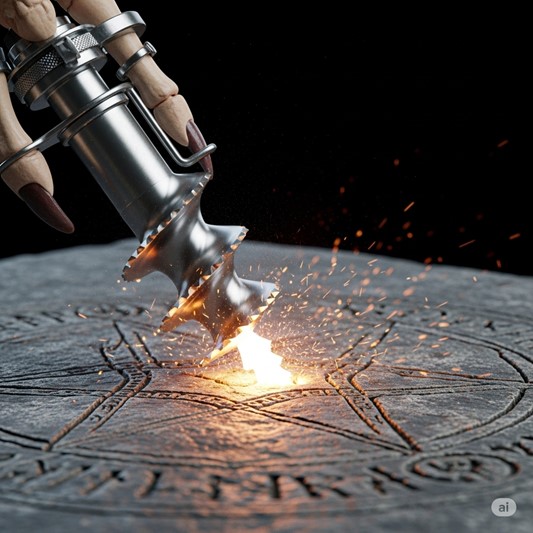
This tool is a direct augmentation for the creature’s unique, elongated finger. It consists of a short, hollow tube of magically hardened steel, with one end sharpened into a serrated, cylindrical drill bit. The tube is designed to fit snugly over the tip of the creature’s probing finger. After gnawing an initial hole into a surface, Kastor inserts its finger and uses a rotational motion of its entire limb to drill a clean, deep core sample out of the material. It can then retract its finger and use its powerful incisors to crush and taste the sample, allowing it to analyze the composition of a material deep within a wall or artifact without having to expend the time and energy to chew through the entire structure.
Lore This device is not a weapon or armor, but a high-precision scientific instrument from a bygone age. It was designed and fabricated by the Delvers’ Sodality, a scholarly guild of archaeo-engineers from the late Steam-Powered Age. The Sodality was dedicated to the study of ancient ruins, but their core tenet was non-destructive analysis. To this end, they built sophisticated automatons with delicate appendages to explore and analyze their findings. The Core Sampler was a standard tool fitted to the tip of their automaton’s primary probing finger. Its purpose was to extract a clean, tiny, and perfectly preserved sample from deep within an artifact or structure, which could then be taken back to a lab for alchemical and magical testing without damaging the larger find.
This specific unit, #227, was lost during a Sodality expedition into the deep ruins of the Silent Labyrinth. The automaton it was attached to was crushed in a rockfall, but the magically hardened steel of the sampler itself survived intact within the wreckage. Centuries later, the creature Kastor, crawling through the labyrinth, was drawn to the faint residual energy of the automaton’s steam-core. While gnawing on the compressed wreckage, it dislodged the thimble-like sampler. Driven by a scavenger’s curiosity, it probed the strange object with its own long, skeletal finger and discovered, by pure serendipity, that the ancient tool was a perfect, snug fit.
Slot: Finger/Digit Augmentation (Tool)
Requirements:
- The user must possess a single, elongated, and durable finger or similar probing appendage that can fit within the sampler’s tube.
- The user’s limb must be capable of performing a high-torque rotational motion to enable the drilling function.
Tier One Stats:
- Allows the user to bypass the hardness or armor of an object or structure to extract a sample of the material beneath.
- The extracted core sample is perfectly preserved and is considered an ideal specimen for any subsequent alchemical or magical analysis.
- The drilling process is unusually quiet, making it difficult to detect.
Skills Gained:
- Proficiency (Geological Analysis): Through repeated use, the user gains an intuitive and comprehensive understanding of different types of stone, metal, wood, and magical composites, able to identify them by the feel of the drilling alone.
- Proficiency (Non-Destructive Investigation): The user becomes an expert at learning the maximum amount of information about an object while causing the absolute minimum amount of damage to it.
Passive Magics:
- Adamant Edge: The serrated drill bit is enchanted with a permanent, low-level sharpening spell. It never dulls or chips, maintaining its cutting edge even after drilling through materials as hard as granite or raw magical alloys.
- Stasis Tube: The hollow interior of the sampler is lined with a faint preservation field. Any core sample extracted into the tube is immediately sealed in a state of stasis, protected from decay, oxidation, and magical degradation until it is removed.
- Vibration Nullification: The body of the sampler is inscribed with micro-runes that actively dampen the vibrations and noise of the drilling process. A user drilling into solid rock makes no more noise than a scribe writing on parchment.
Activatable Magics:
- Kinetic Bore: By channeling a small burst of magical or stamina-based energy into the sampler, the user can cause it to spin at supernatural speeds for several seconds. This allows it to drill through even the most resilient materials, such as cursed iron or a dragon’s scale, though the effort is physically taxing on the user.
- Selective Extraction: The user can concentrate and attune the sampler’s stasis field to the resonant frequency of a specific material they have previously sampled (e.g., gold, a particular gem, a type of cursed flesh). When drilling into a composite material, the sampler’s field will magically filter the core as it is being drilled, extracting only the desired substance and leaving the rest behind as dust.
- Pneumatic Ejection: With a simple mental command, the user can cause the sampler to release a jet of compressed air, cleanly and forcefully ejecting the stored core sample. This is typically used to deposit the sample into a container, but in an emergency, it can be fired as a tiny projectile, more of a stinging annoyance than a true weapon.
Tags: Magical, Tool, Tier One, Ancient, Engineering, Non-Combat, Utility, Analysis, Investigation, Precision, Artifact, Drill, Geological, Extractor, Stasis, Wearable, Archaeological, Automaton-Component
The Finger-Mounted Core Sampler 227 is a highly specialized tool of ancient design. It is not a weapon or a piece of armor, so its value is not recognized by warriors or common adventurers, but by a select group of scholars, engineers, and prospectors. The shops and markets where it might be found are therefore equally specialized. The fact that this particular unit is currently fused to a living creature would make any transaction exceptionally complicated, but a “clean,” unattached sampler would be traded in the following ways:
1. The High-End Prospector’s & Engineering Supplier
- Example Establishment: “Bedrock & Cog, Geological Outfitters,” a well-respected and heavily secured supplier located in a major mountain mining city. The clientele consists of powerful mining guilds, wealthy land barons, and master prospectors.
- Method of Sale: A Core Sampler would be the crown jewel of their collection of technical instruments, kept in a pressurized vault and shown only to their most esteemed clients. They would likely have acquired it through a high-risk salvage operation they funded themselves. The sale would be a formal business transaction to a buyer who needs its precise capabilities—to test the composition of a newly discovered meteor, for example, or to find the one pure vein of Adamantine in a mountain of worthless ore. The sale would be accompanied by a certificate of authenticity and a magically-binding contract.
- Cost: The price would be extremely high, reflecting the tool’s ability to generate immense future wealth and prevent catastrophic losses on failed mining ventures. Estimated Cost: 65,000 Gold Imperials. The price is firm, as its practical, industrial value is well-understood and quantifiable by the seller and buyer.
2. The University Department of Archaeology
- Example Establishment: “The College of Structural Antiquity” at a prestigious university. This is an academic department, not a commercial enterprise, and their primary goal is the acquisition and preservation of knowledge.
- Method of Sale: This department would be a buyer, not a seller. They would covet the Core Sampler as a genuine artifact from the Delvers’ Sodality—a group they study with religious reverence. If an adventuring party were to bring them a functional sampler, the university would leverage its considerable resources to acquire it. The transaction would be a complex negotiation. The university would offer a package of funding, access, and prestige that a simple merchant could not match. They would be less interested in its practical use and more in its historical and technological significance.
- Cost: The University would not offer a simple cash payout. Estimated “Cost”: A generous research grant of 40,000 Gold Imperials to fund the seller’s future expeditions (with the university getting first right of refusal on any future discoveries), a lifetime professorship with access to the university’s restricted archives, and the political cover of a university-sanctioned charter for archaeological exploration.
3. The Black Market Tinker’s Stall
- Example Establishment: A cluttered, chaotic stall in a sprawling underground black market, such as the “Gears & Grime Bazaar.” The stall is run by a “Tinker,” a scavenger who deals in broken, unidentified, or repurposed ancient technology.
- Method of Sale: This is where a knowledgeable buyer could find a treasure, or be utterly swindled. The Tinker might have salvaged the sampler from a ruin without fully understanding its purpose, advertising it simply as a “Self-Sharpening Finger-Drill” or a “Dwarven Lockpick.” The sale would be an “as-is” transaction conducted in secrecy, with haggling expected. The quality could range from a pristine, functional unit to one that is cracked and barely works. If one brought the creature Kastor here, the Tinker would offer to try to remove the sampler for a hefty fee and a cut of its final sale price, with a high chance of destroying the tool in the process.
- Cost: The price is wildly variable, based entirely on the Tinker’s awareness and the buyer’s ability to hide their own knowledge. Estimated Cost: Anywhere from 4,000 Gold Imperials (if the Tinker thinks it’s a simple tool) to 50,000 Gold Imperials (if the Tinker has consulted a scholar and knows its true worth). Payment would be demanded in untraceable currency, rare scrap metals, or other valuable and equally questionable artifacts.
The Finger-Mounted Core Sampler 227 is a tool of analysis and precision, not of overt violence. Its use in roleplay for “offense” and “defense” is therefore a matter of subtlety, sabotage, and circumvention, turning hostile situations into intricate puzzles to be solved with knowledge rather than force.
Environment 1: A Trapped and Locked Treasure Vault
In a high-security infiltration scenario, the Sampler becomes a master key, its defense being the avoidance of traps and its offense being the silent bypass of locks.
- Roleplay for Defense: The user is faced with a massive, magically-sealed vault door. “Knowing the door is likely trapped, the user forgoes the lock entirely. They press the Core Sampler to the stone wall beside the door frame. The Resonance Dampening passive ensures the drilling is nearly silent. A tiny, perfect cylinder of stone is extracted. Upon analysis, it reveals traces of magical wiring embedded within the wall, connected to an alarm rune. By knowing the trap is there, they have defended against it. They choose a different spot, take another sample, and find it is simple, unwarded stone. They have found a safe place to work.”
- Roleplay for Offense: The offense is the act of infiltration itself. “Having found a safe spot, the user’s ‘attack’ on the vault begins. They drill a series of deep, interlocking core samples into the mortar around a large stone block in the wall, weakening the structure from the inside out without making a sound. A single, firm push later, and the block topples inward, creating a quiet, custom-made entrance. Once inside, they face a steel strongbox. It is too thick to drill through. The user uses Selective Extraction, attuning the Sampler to the soft brass of the lock’s tumblers. They drill into the keyhole, and the Sampler’s magic extracts the pins as a fine metallic dust, leaving the rest of the mechanism untouched. The lock clicks open, its internal components destroyed. The vault is breached without triggering a single alarm.”
Environment 2: A Petrified, Hostile Jungle
In an environment where the flora itself is the enemy, the Sampler is used to manipulate the world and neutralize threats from a safe distance.
- Roleplay for Defense: The path is blocked by a field of “Shrieker Spores,” fungi that detonate with a deafening sonic blast if anything gets too close. “The user cannot pass without triggering them. They find a long, petrified branch. They use the Sampler to drill a small, lightweight core of petrified wood. Aiming carefully, they use the Pneumatic Ejection ability. The tiny wooden pellet shoots across the field, striking a spore-pod on the far side. The resulting sonic explosion triggers a chain reaction, clearing a safe path through the field. The user has defeated the obstacle with a tool designed for analysis.”
- Roleplay for Offense: The user needs to get past a giant, carnivorous plant whose thick hide is immune to their weapons. “Its only weakness is a specific nerve ganglion deep inside its trunk. The user makes a mad dash to the creature’s trunk. They activate Kinetic Bore. The Sampler on their finger whines, glowing with power. They press it against the plant’s tough, bark-like hide and drill directly into it. The high-speed bore pierces the hide, allowing the user to deposit a potent toxin directly into the creature’s nervous system, bypassing its armor entirely. The offense was not the Sampler itself, but its ability to create a path for the real weapon.”
Environment 3: Inside a Gargantuan, Living Creature
When swallowed by a colossal beast, the Sampler becomes a tool for survival and a means of unconventional escape.
- Roleplay for Defense: Inside the beast’s gizzard, the walls are muscular and grinding, and digestive fluids are rising. “The user needs immediate shelter. They use the Core Sampler on the gizzard walls, analyzing the samples. One area is soft muscle, another is tough cartilage. They identify a large, undigested iron meteorite the beast swallowed years ago. Activating Kinetic Bore, they drill into the meteorite, carving out a small, temporary shelter to defend themselves from the immediate threat of being ground to paste or dissolved by acid.”
- Roleplay for Offense: The offense is not to kill the beast, but to force an escape. “From their shelter, the user takes samples of the gizzard wall until they find a section that tastes and feels of rich neural energy—a major nerve cluster that controls gastric convulsions. They cannot cut it, but they can irritate it. They begin using the Kinetic Bore to drill near the nerve, not into it. The intense, high-frequency vibration is agonizing to the creature. To escalate the irritation, they use Pneumatic Ejection to repeatedly fire sharp, stony core samples at the nerve cluster. The ‘attack’ is not one of damage, but of pure, overwhelming agony. The colossal creature, unable to process the intense internal pain, retches violently, expelling the contents of its gizzard—including the user—back into the outside world.”
Perception of Activation:
(The following perceptions focus on the Sampler’s most energy-intensive ability: Kinetic Bore)
User’s Perspective
- Sight: For a sighted user, the effect is focused and intense. The serrated tip of the sampler blurs into a spinning, indistinct ring of metal. As it makes contact with a surface, the tip rapidly heats up from magical friction, glowing a brilliant white-hot and casting a small, focused beam of light. A shower of tiny, incandescent sparks and particles erupts from the bore-hole, illuminating the immediate area.
- Sound: The Resonance Dampening passive works overtime. Instead of a deafening mechanical scream, the user perceives a very high-pitched, penetrating whine, like a hornet trapped in a bottle. The primary sound is the material being worked—the sharp crack of stone giving way, the shearing groan of metal, or the wet tearing of petrified wood, all heard with perfect, intimate clarity.
- Smell: The scent of superheated steel fills the user’s senses, accompanied by the specific odor of whatever material is being pulverized—the dusty, chalky smell of granite, the acrid scent of cursed iron, or the sweet, resinous smell of ancient amber. A faint, clean smell of ozone is always present.
- Touch: The user feels a powerful, high-frequency vibration traveling up their finger and into their arm, but it is a smooth, controlled feeling, not a jarring one. There is a sensation of immense, focused power at their fingertip. The Sampler itself remains cool to the touch due to its enchantments, but the user can feel the intense heat radiating from the point of contact just beyond it.
- Taste: The air becomes thick with fine dust, leaving a gritty, mineral taste of hot rock and metal on the tongue.
- Extra-Sensory (Kinetic Sense): The user feels a direct channeling of their own physical or magical energy down their limb, through the finger, and into the sampler. It feels like focusing their entire body’s strength into a single, infinitesimally small point, a satisfying and efficient transfer of power.
- Extra-Sensory (Magical Sense): The user feels the dormant sharpening enchantment on the drill bit flare to life, and a powerful surge of kinetic magic being released from the tool’s internal matrix. It is a feeling of controlled, focused expenditure, like opening a valve on a high-pressure tank.
Observer’s Perspective
- Sight: The visual is striking but localized. An observer would see the tip of the tool, previously inert, suddenly blur with motion and then glow a brilliant, white-hot yellow. As it touches a surface, it looks like a miniature shooting star drilling into the object, throwing off a beautiful but dangerous-looking spray of tiny, glowing sparks. In the dark, it would be intensely and hypnotically bright.
- Sound: The sound is unnaturally quiet for the violence of the action. Instead of a loud drill, an observer hears a high-pitched, piercing whine, like a large insect’s wings beating at impossible speeds. This is accompanied by the sharp, localized sound of the material being destroyed—a sound of cracking, grinding, and shearing that seems strangely clear and distinct from the whine of the tool itself.
- Smell: The sharp, acrid smell of hot metal being worked at a forge and the dusty scent of the pulverized material would be noticeable from several feet away.
- Touch: The activation produces almost no ambient vibration. The ground does not shake. However, the air near the operation feels warm, and an observer might feel a very faint, high-frequency hum in their teeth if they are very close.
- Taste: The air close to the drilling would taste sharp and metallic.
- Extra-Sensory (Magical Sense): A magically-attuned observer would perceive a highly efficient and focused magical effect. They would sense a powerful Transmutation and Evocation enchantment being activated, but all the energy is directed to a single point with almost no leakage. It would feel less like a spell and more like a masterfully crafted magical machine—precise, powerful, and purpose-built.
Positives
- It allows for the rapid and relatively quiet penetration of extremely durable materials that would otherwise be impassable.
- Its precision allows for surgical sabotage, such as destroying the internal mechanism of a lock, a trap, or a machine without destroying the entire object.
- It can be used to create emergency handholds, spyholes, or escape routes through walls with minimal noise and structural damage.
- The process is much faster and quieter than using a mundane steam-drill or loudly blasting a hole with destructive magic.
Negatives
- The Kinetic Bore ability is a massive energy drain on the user or the item’s power source and can only be used in short, controlled bursts.
- The intense heat generated can have unforeseen consequences, such as igniting flammable materials on the other side of a wall or detonating unstable alchemical substances within an artifact.
- If the Sampler encounters an unexpected and overwhelmingly hard magical defense (like a high-level force field), the kinetic energy could be reflected back, causing a painful shock to the user’s limb or shattering the drill bit.
- While quiet, the brilliant glowing tip is a major visual giveaway in dark environments, potentially alerting any creature with eyes to the user’s exact position and activity.
Artificer’s Diagram: The Precision Core-Drill
This document details the highly specialized and delicate process for constructing a finger-mounted sampling tool based on the designs of the lost Delvers’ Sodality. This is not a task of blacksmithing, but of micro-engineering and focused enchanting, akin to crafting a magical watch. Precision is paramount; a single misplaced rune or cracked component will render the entire device useless.
Materials Needed
- Tool Body (1): A single, pure ingot of magically-treated tungsten steel. The metal must be free of any internal fractures or impurities.
- Drill Bit (1): The primary serrated tooth from a mature Purple Worm. The tooth must be extracted without chipping and kept hydrated in a saline solution until it is ready to be shaped.
- Preservation Matrix (1): The perfectly preserved crystalline lens from the eye of a freshly slain Basilisk.
- Dampening Medium (1 oz): The powdered silk from a Phase Spider’s egg sac, valued for its natural vibration-cancelling properties.
- Power Source (1): A single, lightning-fused Fulgurite, unearthed from a desert immediately after a powerful thunderstorm to ensure its magical charge is still potent.
Tools Required
- A High-Precision Magical Lathe: For the microscopic shaping and hollowing of the tungsten body and the grinding of the worm tooth into a drill bit.
- An Enchanter’s Runic Etching Set: A collection of magically-attuned needles and lenses for scribing micro-runes far too small for the naked eye to see.
- An Alchemical Grinder and Mortar: Made of diamond or a similar non-reactive material, used to pulverize the Basilisk lens and Phase Spider silk into usable enchanting powders.
- A Ley-Line Capacitor: A crucial device for safely drawing the raw, chaotic energy from the Fulgurite and channeling it into the tool’s power matrix without causing an explosive discharge.
- A Jeweler’s Loupe and Miniature Assembly Kit: For the final, delicate assembly of the components.
Skill Requirements
- Mastery of Artificing (Miniaturization): The ability to work with magical components on a microscopic level is the primary prerequisite.
- Expertise in Runic Scribing: The dampening runes are incredibly complex and must be inscribed perfectly to function.
- Expertise in Alchemy: Required to properly prepare the biological components without destroying their magical properties.
- Theoretical Knowledge: The crafter must possess a deep understanding of material hardness, magical capacitance, and stasis-field theory.
Crafting Steps
- Component Preparation: The Basilisk eye lens is carefully placed in the diamond mortar and ground into a fine, crystalline powder. In a separate process, the Phase Spider silk is pulverized and mixed with a binding agent to create a viscous, silvery ink.
- Fabrication and Shaping: The ingot of tungsten steel is mounted on the magical lathe. Over several days of painstaking work, the crafter hollows out the ingot and shapes it into the thimble-like body of the sampler. The Purple Worm tooth is then placed on the lathe, where its tip is ground and serrated into the cylindrical drill bit, designed to fit perfectly within the tool’s body.
- Dampening Inscription: This is the most mentally taxing step. Using the jeweler’s loupe and runic etching needles, the crafter must painstakingly inscribe hundreds of micro-runes for vibration nullification onto the interior and exterior of the steel body. The Phase Spider silk ink is used for this process. Each rune must be perfectly formed and spaced to create a harmonic field that cancels out sound.
- Stasis Field Creation: The powdered Basilisk eye is carefully applied as a thin, even coating to the hollow interior of the sampler’s tube. The enchanter must then perform a low-power petrification ritual, not to turn things to stone, but to transform the powder’s latent magic into a permanent, microscopic stasis field that will preserve any sample that enters it.
- Power Integration and Final Assembly: The finished drill bit is fitted into the body. The Fulgurite is carefully placed within the Ley-Line Capacitor. The device then begins the dangerous process of slowly bleeding the lightning-charge from the Fulgurite and channeling it into the tool’s runic matrix, powering the Kinetic Bore ability. Once the charge is complete, the Fulgurite turns to simple sand. The tool is now fully assembled, charged, and ready for use.
Fable of Thirsty Finger
(This telling is known from a single, damaged scroll recovered from a Sodality ruin. The dialect is late Steam-Age, but the grammar suggests it is a literal transcription of a much older, allegorical tale.)
In the age when the world was full of steam and turning gears, there lived a circle of Wise Men. It is said they did not read books made of paper, for paper forgets. They learned to read the stories that were written in very old stones and in sleeping iron.
But these Wise Men were sad. For they said, “To read the story of a stone wall, one must break the wall. To know the heart of an old statue, one must smash the statue. And then the story is finished, and the beautiful thing is gone.” They wished to drink the water of the story, they said, but without breaking the cup.
So they decided to make a servant. A servant who would be their hands. They built a man, but not from flesh and bone. They built him from polished brass and clicking wheels. They gave him strong legs to walk in dark and broken places. But they did not give him strong hands to break things. This was the law.
Instead, they gave him one arm, and on that arm, one very long finger. It was shaped like the finger of the Aye-aye beast, the one who taps on hollow trees to find his food. This finger was to be their taster.
But a finger of brass cannot taste a stone. So the Wise Men made a special tip for the finger, a magical thimble. A Thirsty Finger.
To make it, they took a tooth from the great Purple Worm who gnaws the roots of the world, and they sharpened it so it could bite stone. They took the unblinking eye of the Gray Lizard who turns men to statues, and they crushed it into a fine dust. They put this dust inside the finger, so that any taste it drank would turn to stone and not spoil. And they caught a lightning-strike from a great storm in a bottle of glass. And they poured the hot, angry buzz of the lightning inside the finger to make it spin with great strength.
And the Man of Brass was complete. The Wise Men sent him into the quiet, sleeping places of the world. And the Man of Brass would go. He would find a great sealed door. He would touch it with his Thirsty Finger. The finger would spin and drink a small, secret taste from the door. And it would bring the taste back to the Wise Men.
And the Wise Men would study the taste. And they would say, “Ah! This door is sad, for it is made of iron that was cursed.” Or they would say, “This door is happy, for behind it, there is much gold sleeping.” And the door was still whole. The cup was not broken. And the Wise Men were glad.
But the world is full of happenings. And one day, the Man of Brass was walking in a deep place, and the stone ceiling grew tired of holding up the sky. And it fell. And the Man of Brass, with his clicking wheels, was broken. His inner light went out. He slept a long sleep in the deep dark.
But his Thirsty Finger did not break. For it was made of a worm’s tooth and filled with a lightning-buzz. It was very strong.
And after a time so long that the Wise Men were dust, a new thing came. It was the Patient Hunger, the living ruin that eats the world. And it found the broken Man of Brass. And it began to eat him, for he was full of old and interesting tastes. And in its eating, it found the Thirsty Finger. And it looked at the finger with its own long, tapping finger. And it saw they were the same shape. And it put the Thirsty Finger on, as a man puts on a glove. And now, the Patient Hunger did not have to eat the whole story. Now, it too could drink the taste without breaking the cup.
Moral of the Story: It is wiser to taste the story than to eat the book.
Suggested conversions to other systems:
Dungeons & Dragons
Delver’s Core-Drill Wondrous item, rare
This thimble-like device of magically hardened steel fits over a single finger. Its tip is a serrated, cylindrical drill bit that hums with a faint, contained power. It was originally designed by a lost guild of archaeo-engineers for the non-destructive analysis of ancient structures.
- While wearing this device, you gain proficiency with mason’s tools and tinker’s tools. If you are already proficient with them, you double your proficiency bonus for any ability check you make that uses either of those proficiencies.
- Analyze Structure. As an action, you can spend 1 minute drilling a small core sample from an object or structure. After studying the sample, you learn its precise material composition, its approximate age, and one specific point of structural weakness (if any exists). The next time a creature hits that weak point with a weapon attack, the attack is an automatic critical hit.
- Kinetic Bore (1/Day). As an action, you can activate the drill’s high-speed function. You touch a solid object or surface, such as a stone wall or a locked chest. A perfectly clean, 1-inch diameter hole appears, running up to 3 feet deep through the object. If this hole is placed to intersect a lock’s mechanism, the lock is destroyed.
Call of Cthulhu
The Geologist’s Proboscis A strange, thimble-like device of polished steel with a serrated tip. It feels unnaturally heavy and cold to the touch. It was recovered from the effects of a Miskatonic University geological expedition that vanished in the ruins of a pre-human city.
System Mechanics:
- Material Analysis: Grants the user a bonus die (add one additional tens die) on any Geology or Archaeology roll made to analyze a physical sample.
- Core Sample: By spending 1 minute of quiet, uninterrupted work, the user can extract a perfect core sample from any non-living material (stone, metal, wood). Studying this sample can reveal information about the material that would otherwise require a successful Spot Hidden or Idea roll, such as its true age, whether it is hollow, or if it contains foreign bodies.
- Unsettling Composition: When used on an object of Mythos origin or one saturated with magical energy, the extracted sample may be profoundly disturbing to a human mind. The investigator must make a Sanity roll (0/1D2 loss) as they comprehend the non-Euclidean crystalline structure of the rock or realize the “stone” wall contains biological material. Fumbling this roll may lead to a Bout of Madness as the user is overwhelmed by the impossible truth of the material world.
Blades in the Dark
The Sodality’s Sampler A precision tool from before the cataclysm, a whirring drill bit that fits over a finger. It’s a coveted item among ruin-delvers and information brokers, as it allows for the quiet and subtle acquisition of secrets.
Special Abilities:
- This is a Fine tool, worth 1 Load.
- When you study an object or structure to understand its composition or weaknesses, you gain +1d to your action roll.
- When you attempt to disable a complex mechanical trap or lock by taking it apart or analyzing its internal structure, you get +1 Effect to your roll.
- You can push yourself to use the high-speed Kinetic Bore. When you do, you can silently and quickly drill a small, clean hole through almost any material (a standard brick wall, a safe door, a metal bulkhead), creating a new opportunity for yourself or your crew.
Knave
Geologist’s Finger-Drill Slots: 1 A hardened steel drill-bit thimble worn on one finger. It hums very quietly when held.
- Qualities: Tool, Precise
- Mechanics:
- You have advantage on all saving throws to notice or resist structural traps like pit traps or collapsing walls.
- By spending 10 minutes of uninterrupted work, you can create a small, silent hole through up to 3 feet of stone or 6 inches of solid metal.
- If you successfully take a sample from a creature or object, the GM will tell you its most significant material weakness or vulnerability (e.g., “brittle,” “flammable,” “dissolves in salt water,” “vulnerable to silver”).
Pathfinder
Sodality Sampler – Item 10 RARE, MAGICAL, INVESTED, DIVINATION Usage Worn; Bulk —
This thimble of hardened, dark steel has a serrated tip that whirls silently when brought near complex mechanisms or unusual materials. It is a tool of analysis, created by a lost guild of archaeo-engineers to non-destructively investigate ancient ruins.
When you invest this item, you gain a +2 item bonus to Crafting checks made to identify the properties of materials or to Perception checks to find structural flaws in an object or edifice.
Activate [one-action] manipulate
- Effect You touch a lock or a trap mechanism. The sampler takes a microscopic sample and analyzes its workings. You immediately learn the nature of the trap or the method to disable the lock. You gain a +2 circumstance bonus to your next Thievery check to Disable the Device.
Activate [one-minute] manipulate, divination
- Frequency once per hour
- Effect You drill a tiny, silent core sample from a wall, door, or other barrier up to 5 feet thick. You learn the thickness of the barrier and what is immediately on the other side (such as open space, solid earth, or the presence of a creature). For a moment, you can hear through the hole as if you had cast a 3rd-level Clairaudience spell centered on the other side of the barrier.
Numenera & Cypher System
The Core Sampler Level: 6 Form: A thimble-like steel drill bit that attaches to a finger, covered in microscopic glyphs. Effect: A diagnostic tool from a prior world, this device excels at non-destructive analysis.
- Passive: The user is considered trained in tasks involving geology, archaeology, and identifying the properties of unknown materials.
- Activation (1 minute): The user can drill a sample from any physical object. This is an Intellect-based task with a difficulty equal to the object’s level. On a success, the user learns the object’s material composition, one specific vulnerability or structural flaw (if any), and its approximate age.
- Activation (Action): The user can engage the high-speed kinetic bore. This automatically creates a small (1-inch diameter) hole through up to 1 foot of any material with a level lower than the artifact’s level (i.e., level 5 or less). Using this ability forces a depletion roll. Depletion: 1 in 1d100.
Fate
The Stone-Taster’s Thimble This artifact is an Extra that costs 1 Refresh. It is a subtle but potent tool for any character involved in investigation, infiltration, or archaeology. It is a small steel thimble with a sharpened, serrated tip that is worn on one finger.
ASPECTS: Whispers of the Earth, Precision Sodality Tool, A Key for Any Lock
STUNTS:
- Material Analysis: Because you can sample any material, you gain a +2 bonus when you Overcome an obstacle by understanding its physical properties (like a brittle wall or a corroded lock) or when you Create an Advantage related to a material’s weakness or composition.
- Surgical Breach: Because the sampler is perfectly precise and quiet, once per scene you can declare that you are drilling through a physical barrier (a non-magical wall, a safe door, a locked chest). You don’t need to roll; you simply succeed at creating a small, clean hole, bypassing the obstacle silently. You can describe how this creates a new opportunity or allows you to see/hear what is on the other side.
Savage Worlds
The Prospector’s Drill This is a strange but useful piece of ancient technology, a thimble-like drill bit made from an unknown alloy that fits over a finger.
Requirements: None, though its full potential is unlocked by those with technical skills. Mechanics:
- Analysis: A character using the drill gains a +2 bonus to any Research, Repair, or Occult roll made to analyze or understand a physical object or ancient mechanism they can take a sample from.
- Bypass: The drill can bore through most materials with enough time. It can penetrate 1 inch of steel or 6 inches of stone per minute of work.
- Find Weakness: As an action, the user can attempt to drill a sample from an opponent’s armor, a vehicle, or a structural barrier. This is a Repair roll at -2. On a success, they find a weak point. The next attack made against that specific target, striking that point, gains +4 Armor Piercing.
Shadowrun
Aztechnology “Geo-Probe” Finger Cyberware A highly specialized piece of cyberware, ostensibly marketed to corporate geologists and archae-technicians, but prized in the shadows for its infiltration capabilities. It consists of a retractable, diamond-laminate drill bit housed within a cybernetic finger, connected to a sophisticated material analysis suite.
- Type: Cyberware (Hand/Finger)
- Rating: 4
- Capacity Cost: [4]
- Essence Cost: 0.4
- Availability: 14R
- Cost: 45,000 Nuyen
- Mechanics:
- Passive: The user gains a +2 dice pool bonus to any Engineering, Demolitions, or Artisan test related to identifying or bypassing physical structures.
- Core Sample (Complex Action): The user can make an Engineering + Logic [Mental] (3, 1 minute) Extended Test to take a sample of a physical barrier. Success reveals its exact material composition, thickness, and any non-obvious structural weaknesses (such as a hidden power conduit or a brittle section).
- Silent Drill: The drill operates using ultrasonic vibrations. Any attempt to hear it being used from more than one meter away requires a Perception + Intuition (4) test.
Starfinder
Xeno-Archaeologist’s Sampler – Level 10 SLOT Hands; PRICE 18,500 credits; BULK L
This heavy glove has a reinforced, armored finger tipped with a retractable, micro-fusion drill bit. A series of sensor wires connect the tip to a small analysis computer on the back of the hand. It is a favored tool for members of the Starfinder Society who explore the ruins of lost alien civilizations.
- Mechanics:
- The wearer gains a +5 insight bonus to Engineering and Physical Science checks made to identify the properties of materials, analyze alien architecture, or understand unusual geological formations.
- Structural Analysis (1/hour): By spending 1 minute drilling into a barrier (a wall, door, or section of ship hull up to 5 feet thick), the wearer learns its exact thickness, Hardness, and total Hit Points.
- Bypass (Standard Action): The wearer can use the drill to disable a lock or mechanical trap. This allows them to make a Mechanics check in place of a Thievery check to perform the Disable Device action.
Traveller
Geological Survey Probe (TL-15) A standard, if expensive, piece of equipment for high-tech geological survey teams and prospectors. It is a hand-held device with a pistol grip, featuring a retractable, laser-sintered diamond drill bit connected to an internal micro-spectrometer.
- Tech Level (TL): 15
- Weight: 0.5 kg
- Power: Internal (1 week)
- Cost: Cr 95,000
- Mechanics:
- Passive: Grants DM+3 to any Engineer (prospecting) or Science (geology, archaeology) check made to analyze a physical sample taken with the device.
- Drill Function: The drill can silently penetrate 10cm of any TL14 or lower material per minute of continuous operation.
- Spectrometer Analysis: The device can analyze a sample taken with the drill. This requires an Average (8+) Electronics (sensors) check and one minute of time. A success provides a complete chemical and structural breakdown of the material, revealing its exact composition, purity, and any trace elements. An exceptional success may reveal the material’s age or origin.
Warhammer
The Engineer’s Gimlet A master-crafted tool of Dwarfen or Imperial Engineer design. It is a deceptively simple-looking, thimble-like device of blackened steel with a grimly functional, serrated tip that fits securely over a finger. Runes of analysis and silence are subtly etched along its length.
- Qualities: Fine, Practical, Precise
- Encumbrance: 0
- Mechanics:
- The wearer gains a +20 bonus to any Trade (Engineer) or Trade (Miner) Test made to assess the quality, integrity, or weak points of a structure, object, or suit of armour.
- Find Flaw (Action): By spending a Full Action to brace themselves and carefully drill a tiny, almost unnoticeable sample, the wearer can make a Challenging (+0) Perception Test. On a success, they discover a hidden structural flaw in a single target object (a breastplate, a shield, a section of wall, a locked chest, etc.). For the next round, that target’s Armour Points (or structural resilience) are considered to be halved against the next hit or action made by the wearer or their allies.
- Silent Bore: The Gimlet operates with uncanny quietness. Any Test to hear it being used from more than a few feet away is considered Very Hard (–30).