
Original Life Forms: Glass Anemone (Aiptasia sp.) Giant African Millipede (Archispirostreptus gigas) Aye-aye (Daubentonia madagascariensis) Armadillo Lizard (Ouroborus cataphractus)
Definition as a Tier One Species:
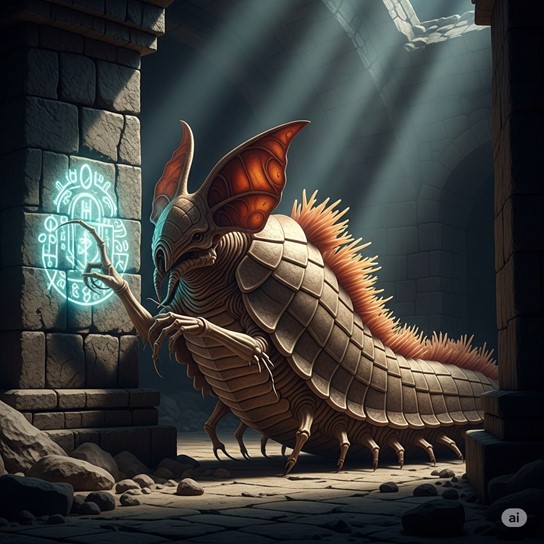
Appearance: The Aiptas Ouroborus is a truly bizarre creature, appearing as a fusion of geological and biological forms. Its body is long and low to the ground, with the segmented, multi-legged structure of a giant millipede, reaching lengths of up to ten feet. Instead of a smooth chitinous shell, each body segment is covered in thick, overlapping plates of bony armor, much like those of an armadillo lizard, giving it a rough, cobbled appearance. It possesses approximately two dozen short, stout legs that carry its heavy body with a slow, deliberate gait. The creature has no visible eyes. Its forward-most segment, or “head,” is dominated by a pair of enormous, leathery, bat-like ears that constantly swivel and pivot, tracking the faintest sounds. Below the ears is a mouth that contains two large, chisel-like incisors that grow continuously. One of its foremost limbs appears normal save for a single digit that is shockingly long, thin, skeletal, and hyper-articulated. The most unsettling feature is that its entire dorsal surface, particularly in the flexible joints between its armor plates, is covered in a dense carpet of short, anemone-like polyps that writhe with a slow, constant motion.
Size: This is a large but not massive Tier One creature. An adult typically reaches a length of 8 to 10 feet from its front segment to its rear. However, it is only about two feet tall and three feet wide, maintaining a low profile. Due to its incredibly dense armor plating, it is extremely heavy for its size, with adults weighing between 700 and 900 pounds.
Behavior: The Aiptas Ouroborus is a slow, methodical, and highly defensive magical detritivore. It is a scavenger of ruins and deep places, feeding on decaying magical energies, magically saturated wood, and the unique insectoid life that grows in such places. It is functionally blind, navigating and hunting by sound alone. It will remain motionless for hours, its large ears triangulating on the faintest sound—the hum of a decaying enchantment, the scuttling of a petrified beetle. Once it locates a source, it uses its powerful incisors to gnaw through stone, wood, or magical refuse. It then inserts its long, thin finger into the hole, tapping rapidly on the interior surfaces and listening to the resulting echoes to precisely locate its food, which it then extracts with the same finger. When threatened, it does not flee. Its immediate and only defense is to grab its tail segment in its mouth, curling its entire body into a nearly perfect, impenetrable sphere of spiky armor plates. Any creature attempting to bite or handle this defensive ball will be met with the painful, neurotoxic sting of the thousands of anemone polyps covering its back.
Emotions: This creature’s emotional spectrum is extremely limited and primitive, revolving entirely around states of foraging and defense. It demonstrates a state of “focused placidity” when listening or feeding, where its ears will swivel methodically but its body remains still. The only other observable emotion is a state of absolute, all-consuming “defensive panic.” This is not expressed as fear in a typical sense—there is no trembling or attempt to flee—but as the instantaneous and total commitment to its defensive posture. During this state, it is completely unresponsive to external stimuli beyond direct, physical threats. It lacks the capacity for social emotions and seems to exist in a perpetual, patient, and solitary state of being.
Environment where found: This species is a creature of darkness, decay, and forgotten history. It thrives in the deep, undisturbed places of the world. They are most commonly found in the crumbling, magically-saturated ruins of ancient civilizations, deep within extensive cave systems, and in the cavernous, unlit maintenance underlevels of massive cities. They are drawn to areas with high concentrations of residual magic and decaying organic or enchanted matter. They require a damp environment to keep the symbiotic anemone polyps on their backs hydrated, so they are often found near subterranean rivers or in perpetually humid, unventilated chambers.
Tags: Sentient, Creature, Magical, Detritivore, Tier One, Ruin, Cave, Armored, Defensive Curl, Symbiotic, Eyeless, Percussive Forager, Scavenger, Subterranean, Fauna, Myriapod, Osteoderm, Bio-toxic, Sonic Sense, Gnawer, Solitary, High-Defense
Personal Name Example: Kastor
Tier 1 Characteristics
Stat Modifiers:
- Might: +3
- Agility: -4
- Fortitude: +4
- Intellect: -2
- Awareness: +3
- Presence: -4
Skills:
- Perception (Hearing): This creature’s sense of hearing is its primary and most highly developed skill. It does not just hear sounds; it sees the world through them. It can discern the subtlest differences in vibration to identify the structural weaknesses in a stone wall, the hollow spaces where insects might be nesting, or the faint hum of residual magic in a centuries-old artifact. This skill allows it to create a detailed, three-dimensional acoustic map of its surroundings.
- Survival (Scavenging): The creature is a master of finding sustenance in places others would consider barren. This skill represents its trained ability to locate and identify edible sources of magical decay, specific mineral-rich molds, and petrified magical woods within ruins and deep caves. It can distinguish between inert and magically saturated materials by sound alone.
- Athletics (Gnawing): A highly specialized physical skill, this represents the creature’s incredible jaw strength and the effectiveness of its ever-growing incisors. It is proficient at the focused, laborious task of chewing through hard materials such as stone, petrified wood, and corroded magical metals to access the sustenance within.
- Defense (Armored Curl): This is not merely an instinct but a practiced and perfected skill. The creature is proficient in transitioning from its slow crawl to its defensive ball posture in a near-instantaneous motion. The skill includes orienting its body as it curls to present the thickest armor plates and most dense spine-clusters towards the most immediate threat.
- Investigation (Percussive Foraging): A skill that combines its unique anatomy and keen senses. It is trained in the use of its elongated, skeletal finger to perform a complex series of taps on a surface. By listening to the echoes and reverberations of these taps with its massive ears, it can precisely pinpoint the location of a food source hidden deep inside an object.
Age:
- Lifespan: The Aiptas Ouroborus has an exceptionally long lifespan, reflective of its slow metabolism and heavily defended nature.
- Juvenile Stage: From hatching until approximately 50 years of age, its armor plates are still hardening, and it learns the complex acoustic signatures of its environment.
- Adult Stage: From 51 to 400 years is its prime, where it actively forages and establishes a wide, labyrinthine territory.
- Elder Stage: From 401 years onward, the creature becomes increasingly sedentary. An elder may find a particularly rich source of decay and remain nearly motionless for decades, becoming encrusted with minerals and appearing as little more than a strange, living rock. They can live up to 700 years.
Height/Length:
- Length: An adult measures between 8 and 10 feet from its foremost segment to its tail.
- Height: It maintains a low profile, standing only about 2 feet off the ground.
Weight:
- Due to its extreme density and heavy osteoderm plating, an adult weighs between 700 and 900 pounds.
Speed:
- Ground Speed: 15 feet. Its movement is slow, powerful, and relentless crawl. It is incapable of bursts of speed (no sprint) and relies entirely on its defenses rather than evasion.
Weapon
- Ouroboros Ward 447 This device is less a conventional weapon and more a system of active, retaliatory defense. It consists of a series of engraved silver nodules that have been surgically embedded along the creature’s spine, deep within the joints between its primary armor plates and nestled amongst the stinging anemone polyps. These nodules are connected by a filament of conductive magical fiber that runs the length of the creature’s body, terminating in a contact plate on its tail segment and a receptor in its mouth. The system lies dormant during normal activity. However, when the creature bites its tail to curl into its defensive ball, the circuit is completed. This immediately activates the Ward, which begins to draw in and store ambient magical energy at a rapid rate. Any creature that maintains physical contact with the balled-up form for more than a moment receives a massive, debilitating discharge of raw, chaotic magic, inflicting intense pain and potential magical scarring. It is a system designed to punish predators who are persistent enough to try and crack its passive defenses.
Armor
- Acoustic Lenses 820 This piece of gear is designed to both protect and enhance the creature’s most vital sensory organs: its massive ears. The device is a pair of large, concave dishes fashioned from thinly shaved, acoustically resonant crystal, each held in a lightweight but durable frame of dark iron. This framework is mounted to the creature’s foremost armored segment, positioning the crystal dishes directly in front of its ears like giant sound-gathering funnels, without making physical contact with the delicate membranes. The Lenses serve two critical functions. First, they act as effective physical shields, deflecting falling rubble or warding off attacks that might target the ears. Second, and more importantly, they are magical amplifiers for sound, collecting and focusing even the faintest vibrations from the environment into the creature’s ears. This dramatically increases the range and fidelity of its hearing, allowing it to perceive sounds that would otherwise be lost to distance or obstruction.
- Myriapod Greaves 998 Addressing the vulnerability of the creature’s softer underbelly and its numerous legs, this armor is a masterful piece of articulated engineering. It is not a single plate but a thick, heavy curtain of interlocking hexagonal metal scales, forming a kind of metallic chainmail barding. This protective curtain is custom-fitted to the creature’s entire underside, suspended from its main dorsal plates by a series of heavy-duty leather straps. The design provides comprehensive protection from attacks originating from below, such as ground-erupting creatures or sharp, uneven terrain. The key to its design is its flexibility; the thousands of interlocking scales allow the armor to move with the creature’s slow, undulating gait and, most importantly, to compress without issue when the creature curls into its defensive ball.
Tools:
- Finger-Mounted Core Sampler 227 This tool is a direct augmentation for the creature’s unique, elongated finger. It consists of a short, hollow tube of magically hardened steel, with one end sharpened into a serrated, cylindrical drill bit. The tube is designed to fit snugly over the tip of the creature’s probing finger. After gnawing an initial hole into a surface, Kastor inserts its finger and uses a rotational motion of its entire limb to drill a clean, deep core sample out of the material. It can then retract its finger and use its powerful incisors to crush and taste the sample, allowing it to analyze the composition of a material deep within a wall or artifact without having to expend the time and energy to chew through the entire structure.
- Alchemical Litmus 358 This is a subtle, integrated tool that provides a chemical sense to a creature that otherwise relies on sound. One of the creature’s smaller, secondary teeth has been replaced with a porous, chalk-like prosthetic made from a magically reactive mineral composite. After exposing a new surface with its primary incisors, Kastor can deliberately scrape this special tooth against the material. The porous Litmus tooth absorbs trace particles, and a simple chemical and magical reaction occurs. A nutritive or beneficial substance will cause the tooth to generate a steady, low-frequency hum that the creature can hear and feel. A poisonous or cursed substance will cause the tooth to emit a high-pitched, discordant shriek, while inert matter produces no sound at all. It is a simple, go/no-go test for a scavenger in a hazardous environment.
- Piton Launcher 075 This is a heavy-duty utility tool designed for navigating difficult, vertical, or inverted surfaces. It is a compact, pneumatically-powered launcher mechanism that has been securely bolted to one of the creature’s central dorsal armor plates. The launcher holds a single, large, barbed piton which is attached to a twenty-foot coil of flexible, woven metal cable. The other end of the cable is anchored to a reinforced ring on the creature’s armor. If Kastor needs to work on a ceiling or a sheer wall, it can aim its body and fire the piton deep into the surface with a loud hiss of compressed air. Once anchored, it can safely perform its slow work without fear of falling. A series of strong, rhythmic tugs on the cable engages a release lever in the piton’s head, allowing the creature to retrieve it once its task is complete.
Archaeological Field Report: Specimen K-113
Designation: Kastor (Field Name), Species Aiptas Ouroborus 113 Estimated Age: 450-500 years, determined by osteoderm wear and integration of foreign artifacts into its carapace. Observed Locus: The Undercroft of the Silent Labyrinth, a ruin of the Third Epoch.
Primary Ecological Function:
- Magical Decomposer: Systematically seeks out and consumes decaying or unstable magical enchantments, cursed materials, and magically saturated organic matter, rendering them inert.
- Geomorphological Agent: Contributes to the structural degradation of ancient ruins through methodical excavation and gnawing, altering the landscape over geological time scales.
Documented Accomplishments:
- Successfully breached the sealed mausoleum of the last Pyromancer-King by consuming the magical mortar of the main gate over an estimated 25-year period.
- Observed using its Piton Launcher 075 to anchor itself to a cavern ceiling to spend approximately a decade consuming a cursed fungal colony.
- Survived the “Great Deluge of the Undercroft” by entering its defensive state and allowing itself to be buried in silt for what is estimated to be 12-15 years before re-emerging.
- Its symbiotic anemone polyps have assimilated the properties of several curses it has consumed, now producing a toxin that causes temporary magical paralysis.
Registered Equipment:
- Defensive System: Ouroboros Ward 447
- Sensory Apparatus: Acoustic Lenses 820
- Protective Plating: Myriapod Greaves 998
- Extraction Tool: Finger-Mounted Core Sampler 227
- Analysis Tool: Alchemical Litmus 358
- Utility Tool: Piton Launcher 075
Personal History of Kastor
The First Century: Learning the Language of Stone
Kastor’s life did not begin with a story, but with a sound. It hatched into the deep, resonant silence of a forgotten tomb, and its universe was defined by the echoes of dripping water and the faint, discordant hum of a failing ward. It did not learn the difference between predator and prey, but between the soft, hollow sound of rotten wood and the hard, ringing sound of stable granite. Its youth was a slow, hundred-year education in the language of decay. It learned to recognize the sweet, melodic hum of pure magical residue—its food—and to recoil from the jarring, static-filled buzz of a dangerously unstable curse. Its existence was, and is, a pilgrimage toward the most delicious and complex sounds of entropy.
The Middle Centuries: A Geological Journey
Kastor’s history is not measured in deeds, but in the dust it leaves behind. For centuries, it has crawled through the deep places of the world, a slow and silent agent of entropy. Its journey is a trail of perfectly round holes in impossibly thick walls and the notable silence in places where a cursed artifact once sang its malevolent tune. Its gear was not found or crafted, but absorbed. It encountered a petrified adventurer, a figure fused to a cavern wall. To Kastor, this was simply a complex new texture, a fascinating symphony of decaying bone, metal, and enchantment. Over the course of a decade, it consumed the magical rot from the fossil, and in the process, the strange crystal dishes over the skull—the Acoustic Lenses—and the articulated plates on the fossil’s underside—the Myriapod Greaves—became fused to its own form. Each piece of its equipment is a relic of something it has slowly, patiently, and completely consumed.
The Elder Epoch: Becoming the Ruin
Now deep into its elder centuries, Kastor’s journey has slowed almost to a halt. It has found a place of immense power and decay—the Silent Labyrinth—and has begun its life’s great work: to unmake it. It may spend fifty years in a single chamber, methodically gnawing at a cursed altar until it is nothing more than inert dust and a pleasant feeling of fullness. Its history is no longer its own; it has become the final chapter in the history of the Labyrinth itself. It does not think, it does not plot, it does not remember in any human sense of the word. It experiences time as a geological process. It is a living ruin, methodically digesting a dead one. Other beings have legacies of things they have built or conquered. Kastor’s legacy is the quiet, the stillness, and the simple, clean sound of a place where a great and terrible magic used to be.
The Aiptas Ouroborus known as Kastor does not form relationships; it establishes geological epochs. Its perception of the world is so alien and its timescale so vast that the very concepts of social connection are rendered meaningless. It is a creature of stone and silence, and its bonds are with concepts, not with other beings.
Relationship to Family: The notion of family is a silence that Kastor has never had cause to question. It did not experience the hatching of its clutch-mates as the arrival of siblings, but as a brief and unremarkable addition to the ambient vibrations of its birth-cavern. Their subsequent disappearances were not traumatic or educational; they were simply a return to the baseline quietude it considers to be the world’s natural state. Its only parent is the ruin itself. The stone that sheltered it was its cradle; the first decaying enchantment it tasted was its mother’s milk. It feels no connection to a biological lineage because its entire existence is defined by its connection to the deep, slow, and patient history of the rock it consumes.
Relationship to Friends: Kastor is incapable of friendship, as friendship requires a shared sense of time, and Kastor’s time is not shared by any other living thing. Other creatures are fleeting sounds, temporary interruptions in the great silence. They are either the sharp, jarring percussion of a threat, which prompts its defensive curl, or the soft, skittering sound of a potential meal to be investigated with its long finger. There is no middle ground for companionship. The only long-term, intimate relationship Kastor has ever had is with its current project. For fifty years, it may work on consuming a single, magically-infused statue. It learns the statue’s every acoustic property, every flaw in its composition, every sweet note of its magical decay. The statue is its companion for half a century. Its relationship is one of slow, methodical deconstruction. Its only “friend” is the thing it is in the process of unmaking.
Relationship to Community: Kastor does not have a relationship with the subterranean community; it is a relationship for the subterranean community. To the other denizens of the deep—the molds, the giant insects, the eyeless predators—Kastor is not another creature. It is a geological event. It is a landmark. A slow-moving mountain of impenetrable, stinging armor. Smaller, scavenger creatures learn to follow in its wake, feeding on the dust and magical chaff left behind by its gnawing. Larger predators learn after one painful attempt that it is an inedible and unrewarding target, and thereafter treat it as part of the cavern’s architecture. Kastor, for its part, is almost completely unaware of these other beings, perceiving them as little more than ambient noise, like the dripping of water or the shifting of stone. It does not compete with them, nor does it cooperate. It is a force of nature—an agent of slow erosion and entropy—and the community is simply the collection of smaller, faster things that live in the shadow of its slow, inevitable progress.
Comments
6 responses to “Aiptas Ouroborus 113”
[…] From: Aiptas Ouroborus 113 […]
[…] From: Aiptas Ouroborus 113 […]
[…] From: Aiptas Ouroborus 113 […]
[…] From: Aiptas Ouroborus 113 […]
[…] From: Aiptas Ouroborus 113 […]
[…] From: Aiptas Ouroborus 113 […]