
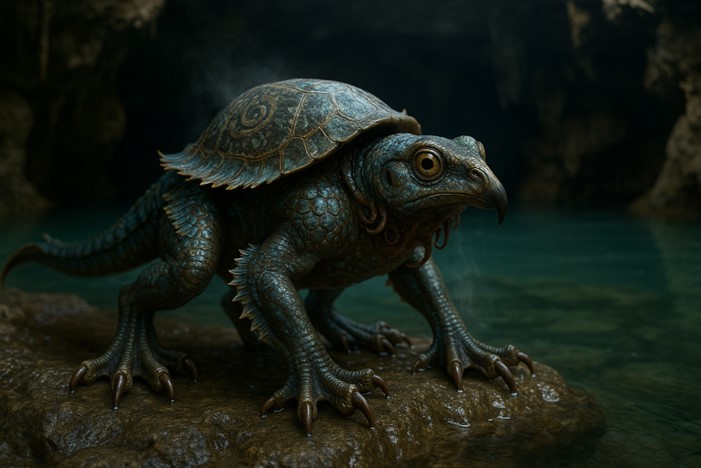
Appearance of the Aquiltestanura 728 features a compact body covered in a mosaic of hardened, iridescent scales that mimic turtle shells but flex like octopus skin, shifting colors from deep oceanic blues and greens to earthy browns for camouflage in varying magical weather, with embedded feather-like frills along the edges that flare during threat displays or flight bursts. Eight tentacle-like limbs protrude from the torso, each ending in webbed, clawed feet combining frog toes for gripping and eagle talons for slashing, allowing versatile movement across terrains. The head resembles a frog’s broad mouth with protruding eyes that rotate independently like an eagle’s for panoramic vision, topped by a beak curved for tearing and surrounded by suction-cupped tendrils from octopus influence that sense vibrations and taste the air. A retractable shell dome covers the back, etched with natural patterns resembling cephalopod ink swirls, which can eject magical residue as a defensive mist when magic circuits align with worn gear in nearby avatars. The overall form measures streamlined for agility, with bioluminescent veins pulsing along the limbs during high magic ebbs, glowing faintly to communicate with kin or deter predators in dark cave systems or underwater centers.
Size of the Aquiltestanura 728 averages medium for feral creatures in Saṃsāra, standing about three feet tall at the shoulder when crouched on its tentacles, with a body length of five feet including extended limbs, and weighing around 150 pounds due to the dense shell and muscular appendages, making it comparable to a large dog but with expandable reach up to ten feet when tentacles unfurl for grasping or leaping.
Speed of the Aquiltestanura 728 combines bursts of rapid movement from frog hops and eagle dives with steady crawling from turtle endurance and octopus slithering, achieving short sprints of 40 feet per round in combat scenarios through magical levitation aids drawn from ambient flow, while sustaining a base walking speed of 25 feet per round across land, with swimming at 35 feet per round in ocean waters or cave pools, and climbing at 20 feet per round on jungle vines or ruin walls.
Stat modifiers for the Aquiltestanura 728 include +2 to Dexterity for agile tentacle manipulations and leaps, +1 to Constitution for shell resilience against elemental fluctuations, -1 to Intelligence reflecting instinctive rather than calculated behaviors in a world without innate magics, +1 to Wisdom for enhanced sensory detection of magic ebbs, and no adjustments to Strength or Charisma, aligning with gear-dependent tier advancements where avatars might equip items to exploit these traits in encounters.
Skills of the Aquiltestanura 728 encompass proficiency in Stealth from color-shifting skin and silent slithering, Perception through rotating eyes and vibration-sensing tendrils, Athletics for powerful hops and climbs in labyrinthine terrains, and Survival for navigating magical weather patterns or foraging in arid coasts, with trained abilities in Acrobatics for evading monsters in racing-like chases through ruins, all requiring practice in feral packs to reach higher tiers without classes or spell slots.
Behavior of the Aquiltestanura 728 involves solitary hunting during low magic flows but forming loose packs in high ebbs to share telepathic pulses via bioluminescent signals, mimicking octopus communication blended with eagle territorial calls, where they ambush prey in jungles or coasts by coiling tentacles around victims while using shell domes for group defense against larger monsters reincarnating in cycles. They exhibit curiosity toward avatars’ gear, often approaching trade caravans on ships across the endless ocean to inspect embroidered mantles, sometimes bartering found artifacts from ruins for food through instinctive gestures, but retreating into camouflage when threatened, ejecting ink-like mists infused with disorienting magic residues to escape into underwater centers or floating city undersides. In mixed populations, they interact with beast-folk civilizations as kin, guarding irrigated farmlands from invasive creatures in exchange for scraps, and during political intrigue, they serve as unwitting scouts for Enwoven nobles, their behaviors adapting through reincarnation memories from multiverse souls bound into feral forms.
Diet of the Aquiltestanura 728 consists primarily of omnivorous foraging, consuming small monsters, fish from coastal bays, fruits from jungle vines, and algae in cave pools, using beak-tearing for flesh and suction cups to extract nutrients from plants, supplemented by magical essences absorbed from ambient flow during ebbs, allowing survival in arid peninsulas without frequent water intake, though they prefer protein-rich prey like evolving amphibians or cephalopods in underwater habitats to fuel their hybrid metabolisms.
Emotions of the Aquiltestanura 728 range from cautious wariness in unfamiliar magical weather, expressed through retracted shells and dimmed bioluminescence, to playful curiosity when encountering avatars’ steam-powered devices in factories, shown by tentacle probing and color flashes, with aggression surging during territorial disputes over ruins, marked by flared frills and eagle-like screeches, and contentment in pack rests amid floating cities, conveyed via harmonious pulsing lights that resonate with nearby magic circuits.
Environment where found includes the arid coastal peninsulas of Paracas with geoglyph-etched hillsides, dense jungles hiding forgotten ruins teeming with old civilizations’ remnants, subterranean cave systems linking to megacities where dark tunnels meet factory outputs, underwater population centers in bays sustained by elemental channels, and occasionally appearing smaller islands that vanish with magical shifts, thriving in high magic realms where ebb and flow like weather enhances their hybrid adaptations.
Tags for the Aquiltestanura 728 are: Hybrid Feral, Magic Resonant, Tentacle Climber, Shell Defender, Ambush Hunter, Omnivore Scavenger, Pack Communicator, Reincarnate Evolver, Jungle Coastal Dweller, Sensory Adaptor
Life cycle of the Aquiltestanura 728 begins in underwater clutches laid in coastal bays or cave pools influenced by magical ebbs that flow like weather across Paracas, where females deposit gelatinous egg sacs attached to submerged rocks or algae, each containing up to twenty embryos that absorb ambient magic circuits through porous membranes, hatching after two months into larval forms resembling tadpole-octopus hybrids with rudimentary tentacles and feather frills for propulsion. These larvae, mundane without magic until adulthood, feed on plankton and small aquatic life while evading predators in the high magic realms, undergoing metamorphosis over six months where they develop hardened scales and retractable shells, emerging as juveniles capable of amphibious movement to explore arid peninsulas and jungles. Juveniles, standing one foot tall, train instinctive skills in camouflage and hopping under the protection of adult packs, reincarnating souls from multiverse origins sometimes binding into these forms during cycles, granting fragmented memories that influence early behaviors like tentative telepathic pulses. Adulthood arrives when reproductive organs mature around two years, coinciding with the onset of magical resonances that allow color-shifting and mist ejection, though local cultural perspectives among beast-folk civilizations may adjust interactions with these now-magical beings. The adult phase spans decades, with individuals growing to full size through gear-like accumulations of environmental residues on their shells, etched by elemental exposures in steam-heavy factories or ruins, facilitating tier-like advancements in feral hierarchies where stronger specimens lead packs. Aging manifests as slowed tentacle reflexes and dimmed bioluminescence after thirty years, leading to a natural unraveling where the body decomposes into fibrous remnants that nourish the ecosystem, releasing the soul for reincarnation into other forms, potentially as avatars or monsters, aligning with Saṃsāra’s endless cycles where death feeds evolution in scattered communities mixing populations.
Mating among the Aquiltestanura 728 occurs seasonally during high magic ebbs that bubble forth like storms, drawing solitary individuals to communal sites in jungle clearings or coastal lagoons where bioluminescent veins pulse in synchronized displays blending eagle courtship dives with octopus color waves, males flaring feather frills and extending tentacles to encircle females in ritual coils that test compatibility through vibration-sensing tendrils tasting pheromones infused with elemental water residues. Females, larger by ten percent with thicker shells for egg protection, select mates based on the intensity of magical resonances amplified by ambient flow, leading to pairings where couples hop into secluded nests lined with algae and feathers scavenged from griffon roosts. Copulation involves interlocking suction cups on tentacles to transfer spermatophores, frog-like in external fertilization but turtle-enduring as eggs are guarded post-mating, with males departing after deposition while females remain vigilant against monsters in the uncharted islands that appear and disappear. Post-mating, packs form temporary alliances to protect clutches, using telepathic links to coordinate defenses, and reincarnated souls bound into the species may carry multiverse memories influencing mate choices, such as preferring partners with patterns echoing past lives from imagined realms. Offspring inherit blended traits, with variations in tentacle count or shell density depending on parental exposures to magic storage in nearby underwater centers or floating cities, ensuring diversity in the high population environments where beasts blend into civilizations.
Tactics employed by the Aquiltestanura 728 focus on ambush predation and evasion in the diverse terrains of Paracas, utilizing color-shifting scales to blend into arid sands or jungle foliage before launching frog-inspired hops combined with tentacle lashes for grappling prey, while the retractable shell provides cover during retreats into cave systems or ocean depths. In pack hunts amid labyrinthine ruins, they coordinate via bioluminescent signals and vibration pulses, encircling targets like small monsters or fish schools with octopus-like encirclement, then deploying eagle-taloned claws for precise strikes amplified by magical mist ejections that disorient foes during ebbs flowing like weather. Defensive tactics involve curling into shell domes to withstand elemental fire bursts from steam vents in factories, or slithering through narrow shafts in megacities to escape larger reincarnating creatures, with sensory tendrils detecting ambient magic circuits for timing levitation bursts to evade griffon dives or zeppelin shadows. Against avatars in trade caravans, they adopt curious probing with tentacles to assess gear, retreating if threatened but countering with ink mists infused with residues that mimic alchemical disorientation, aligning with the world’s perspective where monsters and beasts share civilizations, sometimes taming these creatures as scouts in political intrigue across the endless ocean.
Actions of the Aquiltestanura 728 include daily foraging hops across coastal peninsulas, using webbed feet to traverse irrigated farmlands while suction cups extract nutrients from plants or small prey, followed by shell-retracted rests in jungle thickets where bioluminescent communication maintains pack cohesion without vocalizations that might attract uncountable monsters. In high magic flows, they perform aerial glides blending eagle dives with levitation resonances drawn from ambient sources, scouting ruins for artifacts that beast-folk societies trade for protection services in underwater centers. Nocturnal actions involve slithering through dark cave systems linking to megacities, where tentacles manipulate pulley-like vines to access elevated nests, and during racing events roaring through labyrinths, they opportunistically ambush straggling griffons or balloons for scraps. Social actions encompass tentacle interlocks for sharing sensory data via telepathic pulses, fostering bonds in packs that mirror mixed populations of avatars, and exploratory ventures to appearing islands where they adapt shells to new magical weather, ejecting mists to claim territories from evolving competitors.
Other interesting information about the Aquiltestanura 728 reveals their role in Paracas ecosystems as pollinators and pest controllers, with tendrils dispersing spores from jungle plants while preying on invasive amphibians that disrupt irrigation channels, contributing to the cultural view among Enwoven artisans who weave motifs of these creatures into mantles for gear enhancements that mimic their camouflage. Reincarnated souls from multiverse origins, including those with memories akin to real life, sometimes manifest in these forms, leading to atypical behaviors like constructing miniature structures from scavenged gears in ruins, blending feral instincts with fragmented innovations forbidden by gods’ physics limits. Packs occasionally integrate with beast-folk civilizations in floating cities, serving as living alarms against disappearing islands by pulsing warnings through bioluminescence that resonates with magic storage in nearby factories, and their eggs, prized for alchemical properties in single-shot firearms, draw traders from 72 other island countries via ships, fostering economic ties amid political intrigue. Juveniles, mundane before adulthood, are protected fiercely, with killing them considered heinous in local societies that adjust rights based on reproductive maturity, aligning with compulsory education parallels where young avatars learn to interact with such ferals. In high population urban centers, these creatures navigate skyscrapers via climbing tentacles, scavenging from public parks funded by monarchy taxes, and their evolutionary cycles tie into the world’s old history, where over nine thousand years ago similar hybrids emerged from monster reincarnations before souls arrived, now evolving further through magical ebbs that allow rare individuals to achieve tier-like advancements by accumulating environmental residues on shells, akin to avatars’ gear dependencies without classes or innate abilities.
A party of adventurers might encounter or actively search for the Aquiltestanura 728 across the diverse landscapes of Paracas for a variety of compelling reasons rooted in the high magic realm of Saṃsāra, where their unique traits and ecological roles intersect with the goals, needs, and challenges faced by avatars seeking tier advancement, trade opportunities, or cultural preservation. One primary reason for an encounter arises during explorations of the island nation’s forgotten ruins in dense jungles or uncharted smaller islands that appear and disappear with magical weather ebbs, where these feral creatures serve as natural guardians or scavengers, their bioluminescent veins and vibration-sensing tendrils revealing hidden pathways or artifacts from old civilizations buried beneath polychrome textiles, drawing adventurers seeking gear enhancements or lore fragments to integrate into their embroidered mantles for higher tiers, especially since the creatures’ packs often barter such finds in exchange for food or protection from larger monsters reincarnating in cycles. Another scenario involves trade expeditions across the endless ocean, where ships laden with goods from underwater population centers or floating cities might cross paths with Aquiltestanura 728 packs probing cargo with curious tentacles, prompting adventurers to engage them for their prized eggs, valued for alchemical properties in crafting single-shot gunpowder-based firearms inscribed with block color designs, a quest lucrative for guilds in urban megacities where military funding from monarchy taxes demands innovative weaponry. Search efforts could also stem from quests paying avatars to relocate to racial enclaves emulating past lives, where beast-folk civilizations allied with these creatures request their presence as living alarms against disappearing islands, offering rewards in the form of magical residues ejected from their shells that can be woven into gear to amplify magic circuits, appealing to adventurers at tiers two or three aiming to ascend to level four or five through trained skills. Encounters might occur during racing events roaring through labyrinths on griffons or hot air balloons, where the creatures’ ambush tactics and mist ejections pose challenges to participants, prompting adventurers to hunt them for their adaptive camouflage scales to craft stealth-enhancing wraps, a pursuit driven by political intrigue in skyscraper metropolises where discreet movements benefit Enwoven nobles. Additionally, the creatures’ role as pollinators and pest controllers in irrigated farmlands sustains Paracas’ cotton fields and herds, leading agricultural communities to hire adventurers to protect juvenile clutches from predators, offering access to their telepathic pulse techniques that can be adapted into telepathic networks for diplomatic negotiations with the 72 other island countries. In subterranean cave systems linking to factories, adventurers might search for Aquiltestanura 728 to study their climbing abilities via tentacle manipulations, seeking to replicate pulley-like movements in mechanical power transmission systems, a task valuable for industrial progress funded by tax rents, while their integration with beast-folk societies in floating cities provides opportunities to tame them as scouts, enhancing exploration of dark environments where evolving monsters threaten trade routes. The potential for reincarnated souls from multiverse origins to manifest in these forms also draws adventurers to capture specimens for interrogation via linguistic skills, hoping to glean fragmented memories from past or future worlds that could inform strategies against political rivals or uncountable monsters, aligning with the cultural norm of viewing beasts as kin with civilizations, and the high magic setting where all adults openly use magic makes their magical residue a sought-after resource for gear-dependent advancements without innate abilities or spell slots.
Additional items or ingredients can be harvested:
- Iridescent scales from the Aquiltestanura 728’s mosaic-covered body, which flex like octopus skin while mimicking turtle hardness, can be harvested in sheets or individual plates after carefully peeling them from the corpse using sharpened tools to avoid damaging their color-shifting properties that respond to ambient magical weather ebbs flowing across Paracas’ arid coastal peninsulas or dense jungles hiding forgotten ruins. These scales serve as key components in crafting adaptive armor wraps for avatars, woven into mantles or belts that enhance camouflage during explorations of uncharted smaller islands appearing and disappearing amid the endless ocean, allowing wearers to blend into varying terrains like sandy dunes or vine-choked foliage in high magic realms where all things resonate with elemental forces combining water and fire for steam derivation. Alchemists in underwater population centers process the scales into inks for inscribing gear with patterns resembling cephalopod swirls, amplifying magic circuits to store residues that stabilize levitation during zeppelin travels or griffon flights through labyrinths roaring for days, and beast-folk civilizations allied with these creatures incorporate them into pulley systems for mechanical power transmission in factories, where the flexing quality transfers rotational energy without rigidity, aiding industrial progress funded by monarchy taxes in urban megacities within dark cave systems.
- Feather-like frills embedded along the edges of the Aquiltestanura 728’s body, flaring in threat displays or flight bursts influenced by eagle traits, yield lightweight plumes that detach easily from the corpse once the frills are sliced at their bases, preserving their iridescent sheen derived from high magic ebbs glowing faintly to communicate with kin or deter predators in subterranean environments linking to floating cities. These frills function as enhancers in embroidered textiles for hot air balloons or airships, sewn into sails that catch wind magic to increase speed during trade voyages connecting to the 72 other island countries, where their burst properties allow sudden altitude adjustments to evade monsters evolving through reincarnation cycles in the skies over irrigated farmlands sustained by elemental channels. Artisans among the Enwoven race, marginally predominant in Paracas, use the frills to craft amulets for tier advancement, binding them with threads to amplify vocal incantations in Parakasi suffixed for directionality, enabling telepathic links that extend across distances in political intrigue within skyscraper metropolises housing millions of souls mixing populations from multiverse origins.
- Tentacle-like limbs, eight in number protruding from the torso and ending in webbed clawed feet combining frog toes for gripping with eagle talons for slashing, provide harvestable sinews and suction-cupped segments when severed at the joints from the Aquiltestanura 728’s corpse, their muscular fibers retaining versatility for movement across terrains like arid peninsulas or jungle vines concealing old civilizations’ remnants. The sinews act as flexible chains or belts in mechanical systems, transferring rotational power through shafts and gears in steam-powered factories where elemental combinations generate environmentally friendly motion, essential for public works funded by tax rents under the monarchy’s ownership of all lands. Suction cups, preserved in alchemical solutions, integrate into gear for climbing aids, allowing avatars to scale cave walls or underwater structures in population centers without innate abilities, relying on trained skills to activate their grip enhanced by magic storage that aligns with the world’s prohibition on advanced technologies like electrical motors.
- Protruding eyes that rotate independently like an eagle’s for panoramic vision, set in the frog-like broad mouth of the Aquiltestanura 728’s head, can be extracted intact from the corpse sockets using precise incisions to retain their rotational mechanisms, which detect magical fluctuations in ebbs flowing like weather across high magic realms full of unique creatures living, dying, and reincarnating for untold times. These eyes serve as lenses in scrying devices woven into head wraps for the non-possessed with limited mind’s eye capabilities, enhancing perception of hidden paths in backwoods or ruins where forgotten areas hold artifacts from over nine thousand years ago when souls first arrived knowing nothing of Saṃsāra. In beast-folk societies blending with monster civilizations, the eyes are ground into powders for potions that grant temporary panoramic sight during explorations of appearing islands, aiding in taming evolving beasts through alignments with their cycles, and Enwoven nobles in the ruling family passed through female heredity incorporate them into diplomatic gear for detecting deceptions in telepathic exchanges during negotiations with merchants sailing goods across the endless ocean.
- Curved beak for tearing, topped on the head and surrounded by suction-cupped tendrils from octopus influence that sense vibrations and taste the air, yields a durable chitinous material when chiseled from the Aquiltestanura 728’s corpse after softening the surrounding tissues with elemental water infusions, preserving its sharpness honed by the creature’s omnivorous diet foraging in coastal bays or cave pools. This beak material crafts into blades or tools for alchemical single-shot firearms relying on chemical combustion allowed by the realm’s physics, inscribed with geometric motifs to invoke protective resonances against uncountable monsters in jungles or during racing events on griffons. Tendrils, harvested in bundles, function as sensory extensions in embroidered gloves or helmets, allowing avatars to taste magical residues in the air for tracking prey or detecting ebbs in underwater centers, where their vibration-sensing aids in navigating pressures amid populations mixing with isekai souls from past and future worlds.
- Retractable shell dome covering the back, etched with natural patterns resembling cephalopod ink swirls that eject magical residue as defensive mist, provides large segments of armored plating when cracked open from the Aquiltestanura 728’s corpse using steam-heated chisels to avoid shattering the internal structures aligned with magic circuits. These shell pieces reinforce frame slots in Enwoven bodies or craft into shields for avatars exploring dark cave systems linking to megacities, where the etchings store residues to release mists disorienting foes during ambushes by reincarnating creatures. In factories driving the industrial age with belts and pulleys, the plating integrates into machinery guards resistant to elemental fire bursts, and cult adherents of the Enshrouded Oracle weave shell fragments into mummy-like bundles for rituals preserving essences in reincarnation cycles, symbolizing the Oculate Weaver’s binding of souls.
- Bioluminescent veins pulsing along the limbs during high magic ebbs, glowing faintly for communication or deterrence in dark environments, can be drained of their fluid from the Aquiltestanura 728’s corpse veins using syringes crafted from bone lattices, yielding a viscous glow that retains properties for hours after extraction in the high magic setting where magic bubbles forth to illuminate paths in subterranean tunnels or underwater habitats. This fluid mixes into dyes for polychrome embroideries on mantles, creating glowing patterns that signal in telepathic networks during political councils or trade with floating cities, enhancing visibility in low-light explorations of ruins where old history and lore from small communities’ mixing over millennia await discovery. Alchemists process it into lamps for zeppelins or hot air balloons, providing light without forbidden electronics, and beast-folk use it in rituals taming similar hybrids, pulsing signals that align with their evolutionary behaviors in perspectives where the difference between people, beasts, and monsters blurs into shared civilizations across the island nation’s vast acreage.
Chronicle of the Shell-Winged Coiler
In epochs before the great bubbling of magic, when the world of Saṃsāra lay half-formed like a weave half-spun on a loom of shadows, there dwelled creatures born from the mingling of ancient essences, their forms twisted by the hands of unseen forces from realms beyond counting. The Aquiltestanura, numbered 728 in the scribes’ fragmented counts—though the numbering falters in the old scrolls, perhaps meaning seven hundred and twenty-eight cycles of rebirth or merely a mark of the translator’s quill—emerged from the depths where waters met sands, in the arid stretches of Paracas where the endless ocean lapped at cliffs etched with forgotten glyphs. The unknown tongue, older than the souls that fell from the multiverse, speaks of this beast as a guardian of thresholds, a merger of sky-soarer, shell-bearer, leap-dweller, and arm-twister, bound together by the ebb and flow of magic that weather-like surged across the island nation. But the translation stumbles here, repeating words like “bound” and “surged” as if the ancient speakers feared the loss of meaning in the retelling, their phrases looping like tentacles in a coil.
The tale begins in the mists of over nine thousand years past, when adventurers—souls newly arrived after deaths in other worlds, knowing naught of Saṃsāra’s mechanics—wandered the backwoods and jungles, seeking ruins of old civilizations where monsters had evolved through living, dying, and reincarnating for times untold. One such soul, a weaver from a realm of endless rains—though the scribes confuse it with “endless chains,” perhaps meaning mechanical bindings—stumbled upon a coastal bay where magical weather ebbed low, the air thick with residues from elemental fire and water combining into steam that powered nothing yet, for the industrial age slumbered like a seed in dry earth. In this bay, amid underwater population centers yet unbuilt, the weaver beheld an egg sac, gelatinous and pulsing with faint glows, attached to submerged rocks where algae swayed like forgotten threads.
From this sac hatched the first Aquiltestanura, or so the mangled words claim, its larval form a wriggling blend of tadpole and arm-waver, absorbing ambient magic circuits through porous skins that shimmered in the dim light of cave pools linking to future megacities. The creature grew, its body compacting into a mosaic of hardened scales that flexed and shifted colors—deep blues of oceans, greens of depths, browns of earths—camouflaging against the varying terrains where arid peninsulas met dense foliage concealing ancient remnants. Eight limbs, tentacle-like, protruded from the torso, ending in webbed claws that gripped like leap-dweller toes and slashed like sky-soarer talons, versatile for crawling across sands or climbing vines in labyrinths that would one day roar with races on griffons and balloons. The head, broad-mouthed as a pond-sitter, bore eyes that rotated independently for views panoramic, topped by a beak curved for tearing flesh or plants, surrounded by suction-cupped tendrils that tasted vibrations in the air, sensing the approach of uncountable monsters evolving in cycles.
The weaver, moved by the sight—or perhaps compelled by a fragmented memory from multiverse origins akin to real life beyond—named it Aquiltestanura, though the translation garbles it as “eagle-turtle-frog-arm,” with 728 appended like a ritual count of reincarnations. The creature, feral and instinctive, roamed the coastal bays, its retractable shell dome etched with swirls like ink from depth-dwellers, ejecting mists of magical residue when threatened, disorienting foes in the high magic realms where all things pulsed with elemental forces. It foraged omnivorously, consuming small beasts, fish from bays, fruits from vines, algae from pools, its diet fueling a metabolism that drew essences from ambient flows bubbling forth like storms.
As the creature matured, its bioluminescent veins along limbs glowed during high ebbs, communicating with kin that hatched from similar sacs, forming loose packs in jungles or caves where dark systems would later house cities. The packs hunted in ambushes, coiling tentacles around prey, hopping with frog-bursts blended to eagle-dives, slithering with arm-twister grace, enduring with shell-bearer resilience. But envy stirred among other monsters, uncountable in number, who had reincarnated for untold times before souls arrived, their forms evolving without the hybrid gifts of the Aquiltestanura. A great hybrid beast, part serpent-feline from the three worlds of earth, air, water—though the scribes repeat “three worlds” as if emphasizing the triad—lurked in the backwoods, guarding ruins where old civilizations left textiles buried, embroidered with motifs of flying shamans and trophy heads.
This beast, called Kuyak in the twisted tongue, desired the Aquiltestanura’s adaptability, for its own body decayed despite cycles, vulnerable to the magical physics limiting advanced contraptions. Kuyak ambushed the creature near a disappearing island, its fangs tearing at the flexible scales, seeking to unravel the shell dome and claim the bioluminescent veins for its own glow. The Aquiltestanura, vulnerable in low ebbs, felt its tentacles swell from moisture, but called upon its traits: eyes rotating to spot weaknesses, beak slashing at exposed flanks, frills flaring to deter with bursts of wind-resonant magic, mist ejecting to cloud the air with residues that mimicked disorienting incantations.
The battle raged through labyrinthine paths, echoing like future races with zeppelins and hot air balloons, the creature’s pack arriving via pulsing signals, encircling Kuyak with coordinated hops and coils, taming rather than slaying, for in Saṃsāra death fed the wheel. Kuyak, bound by tentacles aligned to its cycles, became a guardian of the bay, its power harnessed for pollination in farmlands that would sustain cotton fields and herds.
The Aquiltestanura continued its wanderings, exploring underwater centers where pressures tested its webbed feet, floating cities where levitation resonated with its bursts, megacities in caves where factory hums echoed its vein pulses. It encountered isekai souls mixing in communities, some from realms with memories of combustion forbidden by gods, sharing fragments that enriched the creature’s instinctive behaviors, like constructing nests from scavenged gears in ruins, blending feral ways with hints of innovation.
In time, the creature faced the Enwoven, the woven-soul avatars predominant in Paracas, their fibrous bodies echoing the Aquiltestanura’s layered scales, the ruling family claiming kinship through female lines of heredity. The Enwoven sought the creature for its eggs, prized in alchemy for firearms inscribed with geometric designs, but the Aquiltestanura evaded, retreating into camouflage, its packs protecting clutches with mists and slashes.
Yet a great magical storm, ebbing wildly, threatened to char the coasts, islands vanishing like illusions. The Aquiltestanura, with its hybrid endurance, led packs to shelter in caves, its eyes piercing the chaos, tendrils tasting safe paths, shell domes shielding the young. From this, beast-folk civilizations allied, viewing the creature as kin, not monster, their perspectives blurring lines in societies resembling middle-ages feudalism and renaissance crafts.
Through millennia, as populations swelled to millions in skyscrapers full of trade and intrigue, ships sailing goods, the story of the Aquiltestanura repeated in embroidered narratives, oral chants mangled by time, preserving lore from when small communities first mixed, over nine thousand years ago.
The moral of the story is that mergers of essences endure the ebbs, for isolation unravels, but binding strengths coils the wheel of cycles.
Suggested conversions to other systems:
Call of Cthulhu: Void-Tentacled Lurker
STR 70, CON 80, SIZ 60, INT 40, POW 60, DEX 90, APP –, EDU –, SAN –, HP 14, Move 8/10 swimming/6 climbing, Build 1, Damage Bonus +1D4, Magic Points 12.
Attacks: Tentacle Lash 50%, damage 1D6 + DB (grapple on hit, victim must succeed in opposed STR or be held and take automatic 1D4 crushing damage each round until free); Beak Bite 40%, damage 1D8 + half DB (ignores armor); Mist Ejection (special): spends 3 magic points to release a cloud of disorienting residue in a 10-yard radius, forcing all within to succeed in a Hard POW roll or suffer hallucinations causing -20% to all skills for 1D6 rounds.
Armor: 4-point flexible scales and shell; regenerates 1D3 HP per round until dead.
Sanity Loss: 0/1D6 to see the creature; 1/1D8 if witnessing its mist-induced visions revealing fragmented multiverse horrors.
Spells: None innate, but its presence amplifies ambient eldritch energies, potentially causing unintended Gate openings (1% chance per round in high-magic areas).
Special: Camouflage (Extreme Spot Hidden to detect when hidden); Panoramic Vision (never surprised from behind); Bioluminescent Pulse (spends 1 magic point to emit light, illuminating 20 yards or signaling allies silently).
Description: This abomination merges avian predation, reptilian endurance, amphibian agility, and cephalopod cunning into a sanity-eroding form, often encountered in drowned ruins or shadowed bays where it ambushes investigators probing forbidden lore. Balanced for mid-level play, it serves as a guardian of ancient secrets, its corpse yielding alchemical components that risk further Sanity loss if mishandled.
Blades in the Dark: Shadow-Coil Scuttler
Scale: Small (individual) or Crew (pack of 3-6, Magnitude 2).
Quality: 2 (resilient hide and adaptive camouflage).
Position/Effect: Risky/Standard against solitary targets; Desperate/Limited in open confrontations.
Harm: Tentacle Grasp (2 harm, grapples and crushes); Beak Rend (3 harm, pierces armor); Residue Fog (special: fills a room with disorienting mist, forcing a 4-segment clock “Hallucinations” that ticks on failed Resolve resists, causing desperate positions until cleared).
Edges: Adaptive Camouflage (starts hidden, +1d to Prowl or Survey in dim or cluttered environments); Multi-Limbed Agility (ignores terrain penalties, +potency to Hunt or Finesse in chases); Bioluminescent Lure (tempts curious marks into ambushes, starting engagements at controlled position).
Flaws: Magic-Dependent (in low-essence areas, reduce Quality to 1 and slow actions); Pack Instinct (solitary individuals flee at half harm, but packs escalate to desperate when one falls).
Special Actions: Coil Ambush (Hunt or Finesse: grapple multiple foes, starting a 6-segment clock “Entangled Prey”); Eject Mist (Attune: release fog to obscure vision, adding +effect to escape or confuse pursuers in heists through flooded basements or foggy alleys).
Description: In the shadowed underbelly of Doskvol-like isles, this scuttler lurks in flooded vaults or overgrown canals, ideal for crews seeking exotic components for tinctures or as distractions in scores against rival gangs. Balanced for Tier 1-2 play, its harvestable parts fuel weird science gadgets, but mishandling risks attracting spectral predators.
Dungeons & Dragons: Ebonfrill Octapod
Medium aberration, neutral
Armor Class 15 (natural armor)
Hit Points 65 (10d8 + 20)
Speed 25 ft., climb 20 ft., swim 35 ft.
STR 14 (+2) DEX 18 (+4) CON 15 (+2) INT 6 (-2) WIS 14 (+2) CHA 8 (-1)
Skills Acrobatics +6, Perception +4, Stealth +6, Survival +4
Senses darkvision 60 ft., passive Perception 14
Languages —
Challenge 3 (700 XP)
Amphibious. The octapod can breathe air and water.
Camouflage Shift. The octapod has advantage on Dexterity (Stealth) checks made to hide in natural terrain.
Panoramic Vision. The octapod can’t be surprised while conscious, and attackers don’t gain advantage on attack rolls against it from being unseen if within 30 feet.
Actions
Multiattack. The octapod makes two Tentacle Lash attacks or one Tentacle Lash and one Beak Bite.
Tentacle Lash. Melee Weapon Attack: +6 to hit, reach 10 ft., one target. Hit: 8 (1d8 + 4) bludgeoning damage. If the target is Medium or smaller, it is grappled (escape DC 12). Until this grapple ends, the target is restrained, and the octapod can’t lash another target with that tentacle.
Beak Bite. Melee Weapon Attack: +6 to hit, reach 5 ft., one target. Hit: 10 (1d12 + 4) piercing damage.
Residue Mist (Recharge 5–6). The octapod exhales a 15-foot cone of disorienting mist. Each creature in that area must succeed on a DC 12 Wisdom saving throw or be incapacitated until the end of its next turn, hallucinating fragmented visions.
Description: This chimeric lurker haunts coastal caves and jungle pools, a balanced foe for levels 3-5 parties seeking its parts for potions of water breathing or cloaks of elvenkind, its instincts making it a cunning ambusher in exploration-heavy campaigns.
Knave: Prismveil Crawler
HD 4, AC 14 (shell and scales), Atk +4 (tentacle lash 1d6+2 bludg/grapple or beak bite 1d8+2 pierc), MV double human (land/swim/climb), ML 7, XP 200.
Special: Camouflage (advantage on hide checks in natural environments); Multi-Limb Grapple (on hit with tentacle, target saves vs. STR or grappled, taking 1d4 auto damage/round); Mist Burst (once/short rest, 15′ cone, targets save vs. WIS or stunned 1 round); Bioluminescent Glow (illuminates 30′, or signals to attract/deter, reaction save vs. WIS to avoid distraction).
Description: A versatile predator for low-level delves into misty ruins or bay grottos, its corpse yields components for +1 stealth items or potions granting swim speed, balanced for Knave’s lethal playstyle where clever tactics exploit its hybrid mobility.
Fate: Shellwing Coiler
Aspects: High Concept: Hybrid Predator of Shell and Tentacle; Trouble: Vulnerable to Magical Overload; Other Aspects: Panoramic Hunter’s Gaze, Flexible Camouflage Scales, Bioluminescent Pack Communicator.
Skills: Great (+4) Athletics; Good (+3) Fight, Notice; Fair (+2) Physique, Stealth; Average (+1) Investigate, Will.
Stunts: Tentacle Grasp: Once per scene, when you succeed with style on a Fight attack using tentacles, you can reduce the shifts by one to create a Grappled aspect with a free invoke instead of dealing stress; Residue Mist: Spend a fate point to create a Disorienting Fog aspect on a zone, giving you a free invoke and hindering enemies’ Notice rolls; Adaptive Burst: +2 to Athletics when creating advantages involving sudden hops or dives in natural terrain.
Stress: Physical [1][2][3]; Mental [1][2].
Consequences: Mild, Moderate.
Description: This elusive feral merges avian vigilance, reptilian defense, amphibian agility, and cephalopod cunning into a medium predator suited for ambushes in coastal jungles or caves. Balanced for mid-tier play, it challenges groups with grapples and evasion, ideal for guarding ruins or as a tamed beast ally.
Numenera & Cypher System: Depthshell Hybrid
Aquiltestanura 728 4 (12)
Motive: Territory and foraging.
Environment: Coastal bays, jungles, or cave pools in packs of 3-6.
Health: 12
Damage Inflicted: 4 points
Armor: 2
Movement: Short; short when swimming or climbing.
Modifications: Stealth and perception as level 5; speed defense as level 3 due to shell retraction.
Combat: Attacks with tentacle lashes (grapple on success, inflicting 2 points automatic crushing damage per round until escaped with Might task); beak bite inflicts 5 points piercing; ejects mist (spends action, all in immediate area attempt Intellect defense or stunned one round).
Interaction: Curious toward shiny gear, may probe non-aggressively but flees or attacks if threatened; communicates via pulses with kin.
Use: Guards hidden cypher caches in ruins; tamed as scouts by explorers; larvae infest water sources, leading to investigations.
Loot: 1d6 shards of iridescent scale (odd cypher components); bioluminescent fluid (manifest cypher: glows for 1 hour, level 3 illumination).
GM Intrusion: Mist reveals a hidden pack ally; tentacle steals a cypher mid-combat.
Description: A chimeric feral blending flight bursts, armored endurance, leaps, and grasping limbs, this level 4 creature fits low-to-mid tier encounters, customizable with age variants for higher threats in Ninth World anomalies or prior-world ruins.
Pathfinder: Octavian Shellstalker
Aquiltestanura 728 creature 3
N Medium aberration amphibious
Perception +9; darkvision
Languages —
Skills Acrobatics +10, Athletics +8, Stealth +10, Survival +7
Str +3, Dex +4, Con +3, Int -2, Wis +2, Cha -1
AC 19; Fort +8, Ref +10, Will +7
HP 45
Weaknesses fire 5
Speed 25 feet, climb 20 feet, swim 35 feet
Melee [one-action] tentacle lash +10 (agile, reach 10 feet), Damage 1d8+3 bludgeoning plus Grab
Melee [one-action] beak bite +10, Damage 1d10+3 piercing
Residue Mist [two-actions] (manipulate) The creature exhales a 15-foot cone of disorienting mist. Creatures in the area attempt a DC 17 Will save or are stunned 1 (stunned 2 on critical failure). The mist lingers 1 round, providing concealment. (Recharge 1d4 rounds)
Constrict [one-action] 1d6+3 bludgeoning, DC 18
Camouflage Shift While in natural terrain, the creature can take the Hide action even without cover or concealment.
Description: This agile hybrid lurks in coastal or jungle environs, balanced for level 3-5 parties as an ambusher or guardian, its parts harvestable for potions granting swim speed or stealth bonuses.
Savage Worlds: Tentashell Prowler
Attributes: Agility d8, Smarts d6 (A), Spirit d6, Strength d8, Vigor d8
Skills: Athletics d8, Fighting d8, Notice d8, Stealth d10
Pace: 6; Parry: 6; Toughness: 8 (2)
Edges: —
Special Abilities: Armor +2 (flexible scales and shell); Aquatic (swim Pace 8); Bite (Str+d6); Camouflage (+2 Stealth in natural terrain); Climb (Pace 6 on rough surfaces); Low Light Vision (ignores Dim and Dark penalties); Mist Burst (once per encounter, Cone Template, targets roll Vigor or Shaken and -2 to actions for 1 round); Multi-Action Penalty ignored for tentacle attacks (up to two lashes); Tentacle Lash (Str+d4, reach 2, on raise grapples and deals Str damage next round); Size 0.
Description: A cunning feral blending predatory traits for ambushes in bays or ruins, balanced for Novice-Seasoned play as a pack hunter or tamed mount, yielding alchemical ingredients for stealth trappings or aquatic gear.
Shadowrun: Matrix-Tentacled Chimera
Bod 4, Agi 6, Rea 5, Str 4, Cha 2, Int 3, Log 2, Wil 4, Edg 3, Mag/Res —
Initiative 10 + 2d6 (physical), 8 + 1d6 (Astral if magically active via ambient resonance)
Movement 10/20/+2 (land), 15/30/+3 (swim), 8/16/+1 (climb)
Condition Monitor 10/10
Limits Physical 5, Mental 4, Social 4
Armor 8 (natural scales and shell)
Skills Athletics 5, Close Combat 4 (tentacles), Perception 6, Sneaking 5, Swimming 6
Qualities Amphibious, Camouflage (Rating 3, shifts colors for +3 dice to Sneaking in natural terrain), Low-Light Vision, Natural Weapon (Beak: DV 6P, AP -1), Natural Weapon (Tentacle Lash: DV 5S, AP –, Reach 1, grapple on hit with opposed Strength test)
Powers/Complex Forms: None innate, but ejects Residue Mist (as Chemical Seal toxin, Delivery: Inhalation, Speed: Immediate, Penetration: 0, Power: 8, Effect: Disorientation and Stun Damage for 3 turns unless resisted with Body + Willpower).
Gear: None, but corpse yields components for talismongering (e.g., scales for camouflage foci, Force 2-4).
Description: In the shadows of flooded sprawls or jungle corp enclaves, this chimera ambushes runners scavenging pre-Crash ruins, balanced for Street-level to Prime Runner games as a guard beast or escaped experiment, its parts alchemically refined for dermal plating mods or toxin grenades.
Starfinder: Voidfrill Aberrant
Aquiltestanura 728 CR 4
N Medium aberration
Init +4; Senses darkvision 60 ft., low-light vision; Perception +10
Defense HP 50 EAC 16; KAC 18
Fort +5; Ref +7; Will +4
Defensive Abilities shell retraction (gain cover +4 AC as move action)
Offense
Speed 25 ft., climb 20 ft., swim 40 ft.
Melee tentacle lash +10 (1d6+6 B; critical grapple [DC 14 escape]) or beak bite +10 (1d8+6 P)
Space 5 ft.; Reach 10 ft. (tentacle)
Offensive Abilities multiattack (two tentacles at -4), residue mist (1/day, 15-ft. cone, Fort DC 13 or blinded 1d4 rounds)
Statistics
Str +2; Dex +4; Con +3; Int -2; Wis +1; Cha -1
Skills Acrobatics +10, Athletics +8 (+16 swim), Stealth +10, Survival +7
Other Abilities camouflage (Stealth check to hide without cover in natural terrain), amphibious
Description: Lurking in alien jungles or flooded derelicts, this hybrid preys on explorers, balanced for Tier 1-2 parties as an environmental hazard or biotech experiment gone wild, lootable for biotech augmentations like adaptive skin (grants environmental protections) or mist grenades.
Traveller: Coilbeak Scavenger
Aquiltestanura 728 Animal 15kg Hits 10/5 Speed 6m (land)/8m (swim)/4m (climb)
Weapons: Tentacles (as Thrasher, Dmg 2D) or Beak (as Teeth, Dmg 1D+2)
Armor: Flexible Scales (as Cloth, Protection 3)
Traits: Amphibious (ignores water penalties), Camouflage (+2 DM to Recon/Stealth in natural settings), Grappler (successful tentacle hit allows free Athletics (grapple) check), Mist Burst (as Smoke Grenade, obscures 3 hexes for 1D rounds, once per short rest)
Instincts: Ambush Predator (attacks from hiding with +1 DM initiative), Pack Hunter (in groups of 3+, +1 DM to attacks if flanking)
Number Encountered: 1D (solitary) or 2D (pack)
Description: On fringe worlds with teeming bays or vine-choked ruins, this scavenger ambushes scouts, balanced for low-tech adventures as a wildlife threat or trainable mount, its parts craftable into survival gear like adaptive camo suits (Tech Level 8, Cr500) or toxin filters.
Warhammer: Warpfrilled Lurker
M 4, WS 40, BS –, S 35, T 40, W 12, I 50, A 2, Dex 45, Ld 30, Int 20, Cl 35, WP 30, Fel —
Traits: Amphibious, Armor (Scales/Shell 2 AP all locations), Bestial, Camouflage (+20% to Concealment tests in natural terrain), Climb (+20% to Scale Sheer Surface), Natural Weapons (Tentacle Lash: as Grappling, SB damage and entangle on hit; Beak Bite: SB+1 damage), Mist Ejection (as Breath Weapon, 4-yard template, test WP or suffer -10% to all tests for D3 rounds)
Special Rules: Panoramic Vision (immune to rear attacks, +10% Initiative), Multi-Limb (extra attack with tentacles)
Description: In the fetid swamps or ruined underhives of the Old World, this mutant beast stalks parties, balanced for Tier 1-2 careers as a chaos-tainted foe or beastman ally, harvestable for mutations like extra limbs (Corruption risk) or alchemical poisons.