
From: Lineage 7421 of the Wave Riders
Type: Curved blade with hooked aft crescent, usable both mounted and from surface stance
Description:
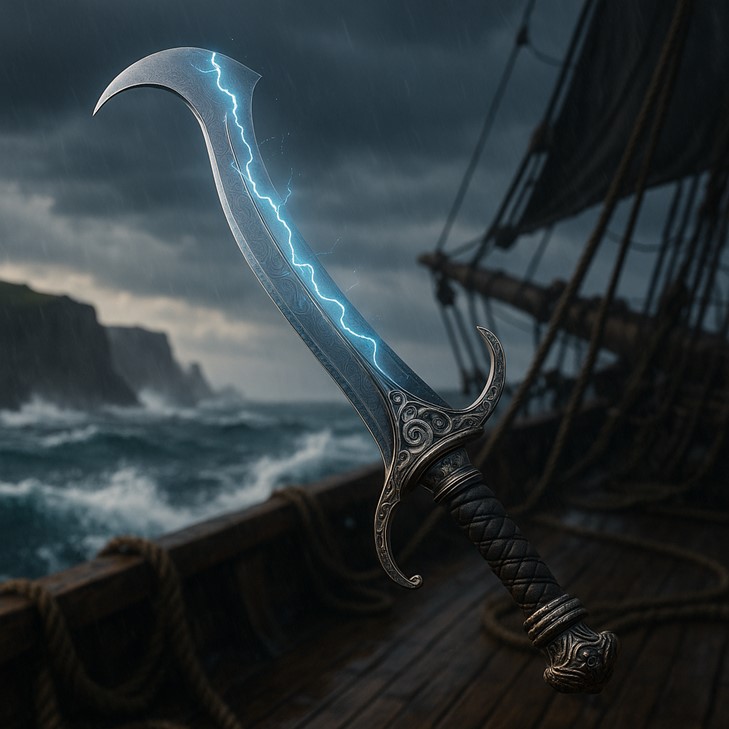
A broad, slender cutlass with a crescent-hook extension on the back edge, shaped intentionally to catch ropes, reins, or enemy limbs with fluid sweeps. The blade’s metal bears rippling wave patterns held in place by pressure-forged coral powder, reacting with a shimmering blue sheen under rain or seawater spray.
Combat Role: Ideal for deck combat, especially when cutting free tangled rigging, fighting pirates, or deflecting boarding hooks.
Minor Passive: When swung into wind or strong spray, the blade produces a whip-like lash of compressed air, giving it an extended reach for just a heartbeat—often enough to deflect a blow or catch an enemy by surprise.
Cultural Note: This style of blade is sworn upon during a guardian’s First Wave Oath—the vow taken when an Apsaran formally swears to stand between the sea and their people.
Lore:
This weapon traces its lineage back to the First Tide Guard, the earliest sworn protectors stationed at the floating city-ring of Tidehaven when it was still young and constantly harried by pirate fleets and rogue leviathan cults. In those days, the sea lanes were not protected by great steam-fortresses or tidal citadels—just a handful of Apsaran guardians armed with whatever blades they could forge from coral-steel and stolen iron.
The earliest records speak of a day known as the “First Boarding,” when the sea-scavenger clans attempted to storm Tidehaven’s levitating dock-pylons. The defenders—few, untested, and without a standing fleet—held the line using hook-blades that could pull enemies from gangplanks and sever boarding ropes before the enemy gained footing. It was after this battle that the First Tide Guard was founded, and the ritual oath was born:
“I stand where the water meets the iron. I cut not to kill, but to unmoor all threats.”
From this oath came the pattern of blades like Stormlash Cutlass-Scythe 3114, each inscribed with a spiraling wave-mark that only activates when rain, seawater, or sea-wind touches its surface. Unlike ordinary cutlasses, each of these weapons is scythe-curved on its reverse edge, allowing defenders to hook, disarm, and redirect rather than simply cleave. They became the symbol of true guardianship—not of conquest, but of disruption and control.
Tier One Mechanical Values
Base Damage Output (Tier 1):
• Melee Slash: Moderate cleave damage
• Hooking Motion: Reduces target stability and disarms light weaponry
Stat Modifiers (Tier 1 Attuned Apsaran):
• +1 Agility (fluidity of motion during sweeps)
• +1 Perception (blade’s air-ripple helps detect incoming strikes)
• –1 Resolve in dry or windless environments (weapon feels “dull” without wind or spray)
Skills Gained
• Hook-and-Sweep Combat Training – Grants proficiency in disarming, rope-cutting, or redirective blade work.
• Deckfoot Awareness – Trained footing on wet, unstable surfaces.
• Wind-Listen Reflex – User gains an intuitive sense of incoming arcs or whips of air displacement in close quarters.
Passive Magic Effects
- Spray-Sense Edge – When seawater or mist is in the air, edge glow increases perception of movement arcs (+ minor detection bonus).
- Deck-Grip Flow – Tiny vibration through the hilt warns of slippery or shifting surfaces, enhancing balance instinctively.
- Hooked Current Guidance – The blade slightly alters its angle mid-swing to catch cloth, rope, or sinew more effectively without added effort.
Activatable Magic Effects
- Stormlash Pulse (Short Activation) – A sudden whip of compressed air extends the blade’s reach momentarily beyond its natural length; can parry or catch a distant limb or rope.
- Cut the Mooring (Focused Sweep) – When invoked aloud with a brief Thal-Vox phrase, the blade gains razor focus for a single cut that ignores mundane tension or resistance (ideal for ropes, nets, restraints).
- Wavebreaker Redirect (Defensive Instinct) – Once per scene, the user can deflect an attack not by blocking, but by hooking it and guiding it harmlessly aside with a smooth arc.
Assigned Slot
• Weapon Slot – 1 Hand / Mounted or On-Foot Capable
(Counts as a curved blade with grappling properties; compatible with Apsaran mounted stance or humanoid upright stance.)
Tags: Storm-Forged Blade, Rope-Cutter, Hook-Sweep Form, Spray-Activated, First Tide Guard Pattern, Boarding-Defense Steel, Wave-Oath Blessed, Coral-Pattern Forged, Compressed Air Lash, Boarding-Sabre Grade, Wind-Shear Reactive, Lineage-Oath Forged, Reefguard Cutter, Tidehaven Issue, Leviathan-Hook Edge, Patrol-Sanctioned Blade
Where the Stormlash Cutlass-Scythe 3114 of the First Tide Guard Can Be Found and Acquired in Saṃsāra
This weapon is not commonly traded like typical blades. It is issued, commissioned, or earned, and the method of acquisition reflects whether one is a sworn guardian of the tides, a deck-sabreur of the Aegean fleets, or a privateer with connections in the smuggler’s underdecks.
1. Tidehaven’s First Wave Arsenal – The Oath-Forges
• Location: Within the levitating platforms of Tidehaven’s high docks, behind the Tidetower barracks.
• Access: Only accessible after performing or witnessing the First Wave Oath, the traditional vow sworn by new sentinels of Tidehaven’s sea-wall patrols.
• Transaction Type: Rite, not coin. One must present a token of service—typically a rope strand severed during a live patrol or a scrap taken from a pirate boarding hook.
• Cost (Symbolic, Not Market-Based): A single Silver Pearl or a polished coral token stamped with the lineage glyph of the First Tide Guard. These are rarely available outside Tidehaven’s inner circles.
2. Iron-Tide Shipwright Forges – Industrial Reproduction Models
• Location: The iron districts of Iron-Tide City, where steamforges produce naval supplies for the merchant fleets.
• Availability: Modified Version Only – identical in physical form but lacking the Stormlash Pulse enchantment and First Wave Oath markings.
• Cost:
• Base Model Cutlass (non-enchanted): 4 Gold
• Coral-Script Variant with minor wind-channel carving: 9 Gold
• Notable Note: These lack the pressure-reactive lash channeling and are often stamped with “For Deckcrew Use – Not an Oathblade” in shipyard Thal-Vox.
3. Port Aqua-Vel’s Saltforge Crescent Market – Private Sale
• Location: The western seawall markets beneath the lighthouse gates, known for selling retired or decommissioned Sentinels’ gear.
• Stock: Rarely, a full oath-carved Stormlash variant appears, typically sold on behalf of dead or retired guardians, but only after the collar seal is broken in ritual.
• Cost (True Variant with storm-channel intact): 12 Electrum or 30 Gold depending on lineage markings and if the Aque-Script filaments still respond to sea spray.
• Warning: Buying without observing the “Mooring Unbound” ritual is considered theft of a guardian’s legacy.
4. Smuggler Cove Underdecks – Blackrope Traders
• Location: Beneath Pearlwater’s kelp piers, accessible only via tidal grates at low tide.
• Stock: Seized or desecrated blades looted from forgotten wrecks or from fallen sentinels. Some still flicker with glimmering runes, but their loyalty is unstable.
• Cost: 4 to 6 Silver, or any blood-forged token of equal weight to the blade.
• Risk: These blades still remember old owners, and occasionally flare in rejection when wielded by those of unbound lineage.
Economic Summary by Region
| Forge/Source | Type of Blade | Cost Style | Typical Price Equivalent |
| — | — | — | — |
| Tidehaven Oath-Forges | True Oathblade | Service Token or Silver Pearl | Symbolic, not traded formally |
| Iron-Tide City Steamforges | Industrial Variant (No Magic) | Standard Coin Trade | 4–9 Gold |
| Port Aqua-Vel Salt Market | Full Enchanted Variant (Decommissioned) | High Coin or Electrum Barter | 12 Electrum (~30 Gold) |
| Smuggler Underdecks | Stolen or Curse-Flickering Variant | Silver + Blood Token | 4–6 Silver |
Use the Stormlash Cutlass-Scythe as a tool of control—it hooks, it severs, it redirects. Its power is the sudden, whip-like change in reach and the tactile knack for catching lines, limbs, and rigging. Below are scene-ready roleplay beats for defense and offense across the environments you’ll commonly face in Saṃsāra.
SHIP DECK — STORM, BOARDING, AND REPULSE
Defense: plant your feet, keep the blade low and the hooked aft ready. When an enemy surges across wet planks, the hook snags coats, ropes, or a wrist; pull while the deck slips beneath them. Let the compressed-air lash interrupt an incoming cut: a short whoosh, then the attacker’s blade misses by a hair.
Roleplay beat: “She swept low; the hook bit leather and the boarder’s footing betrayed him. Salt hissed from the blade like a reprimand.”
Offense: use sweeping arcs that finish with a hooked snap behind the foe’s knee or elbow—drag them off balance and follow with a close rip or thrust. Use the crescent hook to shear rigging mid-boarding, collapsing a ladder or dropping a grappler into the sea.
Tactical note: combine a sweep with a teammate’s shove for cinematic send-offs.
CORAL REEF PASSAGES & SHALLOW SURF
Defense: work the blade as a cutting tool more than a slashing weapon—slice kelp underfoot to remove a trap or hook a reef spire to hold position against current. The blade’s air-lash is stronger in spray; use it to stagger reef-ambushers.
Roleplay beat: “She danced the blade at the reef line; the spray made the edge sing and the ambusher’s lunge rang hollow.”
Offense: slip the hook into soft tissue, nets, or a creature’s fin and use short, violent tugs to expose vulnerable undersides. Underwater or waist-deep surf, the cutlass feels alive—describe water clinging to the hook like a living leash.
MOUNTED / APSARAN CHARGE (FRONT-TORSO USE)
Defense: brace the haft across your chest, using your mass to anchor against incoming spears. The hooked back edge stops grapples before they can seize the reins. Let the blade’s brief reach extension knock aside a polearm’s tip.
Roleplay beat: “Her chest became a prow, the hooked back catching a boarding spear and flinging its wielder into the tide.”
Offense: ride a sweeping arc—your momentum plus the crescent hook will wrench enemies from masts and platforms. Use the hook to snag a pursuer’s harness and pivot them off your flank.
LEVITATING PLATFORMS / SKY BRIDGES / AERIAL ENCOUNTERS
Defense: the blade’s compressed-air lash counters fast aerial strikes; hook wing-straps or grappling lines to unbalance gliding attackers. Keep low center of gravity—describe the blade tasting wind as it arcs.
Roleplay beat: “A gust filled the blade and it flared like a living whip; the glider faltered and spun from the sky.”
Offense: hook a sail or tether and yank to disturb flight paths—dramatic visuals when zeppelins or griffons must alter course. Use short, precise cuts to free lines from frozen pulleys.
DENSE MARKETS, ALLEYS, AND SOCIAL ARENAS
Defense: in crowds, the hook is for control—catch a sleeve, trip a pursuer, or cut ropes suspending crates to barricade a chase. The blade’s subtle chime in spray becomes a warning flick in crowded, humid stalls.
Roleplay beat: “She brushed past, the hook kissed his cloak and the man stumbled into spilled salt.”
Offense: one-handed jabs, hook-and-pull trips, and severing rope-bridges are your playbook—emphasize finesse over brute force.
TEMPLE HALLS, COURTYARDS, AND CEREMONIAL USE
Defense: use the weapon as a deterrent—draw it slowly, flashing the hooked crescent as a recognized symbol; many halt rather than strike a sworn blade. In sanctuaries, use the blade to cut bindings or ceremonial ropes cleanly, never spilling sacrificial liquids.
Roleplay beat: “She unsheathed without flourish and the hush that followed was the oath taking breath.”
Offense: rarely used within temples; if required, acts are surgical—disarm, disable, and retreat to uphold sanctity.
NARROW CORRIDORS, DUNGEONS, AND CLOSE QUARTERS
Defense: shorten your grip; use the butt and the inner curve to parry and trip. The sweep is limited—rely on the hook to snare wrists and knock swords aside.
Roleplay beat: “The corridor ate the swing; she flicked the hook and the intruder’s gauntlet flew as if cut by the sea.”
Offense: quick stabs, half-turns, and mechanical motions—describe compact movements that read as practiced rather than frantic.
RITUAL, MORALE, AND PSYCHOLOGICAL EFFECTS
- Drawing a Stormlash initiates respect: sworn guardians will fall silent; pirates and raiders may hesitate, recalling tales of the First Tide Guard.
- Laying the blade on the tide or touching its edge to seawater is ceremonial—roleplay this as a vow renewal or a mark of authority.
- The blade’s faint blue sheen under spray is an intimidation cue; use it to break enemy morale.
TEAM SYNERGIES & COMBOS
• Cutlass + Grappler: Hook the enemy, teammate secures them with a hold or trip.
• Cutlass + Sailmaster: Shear a key line to collapse an attack platform while allies advance.
• Cutlass + Hydromancer: Mage creates a spray current to amplify the blade’s air-lash and disorient foes.
LIMITATIONS & ROLEPLAY RISKS
• In absolutely still, arid spaces the lash fizzles; the weapon feels sluggish—portray micro-hesitation or a need to reorient.
• Tight stairwells blunt sweeping strikes; emphasize improvised tactics and the blade’s need for room.
• Overreliance on the hook may lead to entanglement—roleplay the real danger of being caught if you attempt to hold too many enemies with one pull.
• Lineage blades may react unpredictably in the hands of dishonored wielders—describe a flaring filament or a dissonant hum if the weapon rejects its bearer.
QUICK FLAVOR LINES TO DROP IN PLAY
- Defensive parry: “The hook answered the blade and the world slipped off balance.”
- Trip and pull: “A quick hook at the ankle—then salt and wood and the man was gone.”
- Sever rigging: “The rope parted with a scream, and the ladder became a memory.”
- Ritual draw: “She let the cutlass touch the water and the oath came back to her like a tide.”
Use sensory detail—salt spray on teeth, the blade’s blue sheen, the whisper of compressed air—so each swing reads as an extension of Apsaran culture, not just a weapon. The Stormlash excels where motion, wind, and rope meet; make those intersections the heart of your roleplay.
Perception of Activation:
User’s Perspective:
There is a sudden tension in the blade—not weight, but direction, as though the cutlass has found a current in the air to ride. The hilt warms slightly, not from heat but from frictionless motion, like a muscle stretching before movement. A faint pressure builds against the wielder’s wrist, aligning their grip and gently urging them to pivot, hook, or redirect rather than simply slash. In the lungs, a curious sensation: the breath seems to sharpen, tasting faintly of ozone and sea-salt even if no water is present. Just before the lash effect releases, the user feels a micro-shift in the surrounding air pressure, like the inhale before a storm-breaking gust. Instinct whispers: now—and the arm moves before thought can fully form.
Extra-Sensory Impressions:
The mind briefly senses wind as texture, not flow—each arc of movement maps itself in pressure lines around limbs and obstacles. The presence of tensioned rope or taut muscle generates a phantom tug in the wielder’s inner ear, as if the cutlass itself is aware of anchor points it might seize. In environments heavy with mist or sea spray, visual perception blends with tactile sensation: the air feels “solid” in arcs where the lash will travel.
Observer’s Perspective:
To onlookers, the activation is signaled by a sudden shimmer across the blade—like ripples traveling along its surface as though it were underwater. When the lash triggers, the air cracks but without sound, only a ripple visible in mist, dust, or salt droplets. The wielder’s movements appear unnervingly precise—it looks less like swinging a weapon and more like threading a needle through moving air. Hook motions seem guided, too smooth to be accidental.
Positives:
• Blade feels lighter and more responsive, guiding the wielder into optimal angles.
• Sudden reach extension through compressed air allows surprising parries and rope severing just beyond normal strike distance.
• Increased awareness of movement around the wielder grants an almost predictive sense of enemy motion.
• Rope, chain, or exposed limbs feel as though they “highlight” themselves in the wielder’s peripheral perception.
Negatives:
• In completely still, dry air, the activation feels strained—like pulling against dead water. The blade responds, but sluggishly, creating a sense of discomfort in wrist and breath.
• Overuse of the lash in crowded or chaotic airflow environments (rift winds, collapsing rigging, dense combat) can cause momentary sensory overload, making the wielder hesitate or blink.
• The weapon develops a subtle hunger for motion; if held idle too long, it begins to hum irritably, causing unease or tension in the arm.
Recipe Title: Forging the Stormlash Cutlass-Scythe 3114 of the First Tide Guard
Materials Needed
• 1 Luminwood Spine-Bar – steam-cured in sea mist for no less than three tidal cycles to retain flexibility without warping.
• Coral-Powdered Ironsteel Ingot – forged under pressure, never open flame, to imprint wave-pattern memory into the metal.
• 1 Crescent Coral-Hook Fragment – harvested from an anchor-beast shell or deep-reef shellback, used to carve the hooked aft edge.
• Silver Thread Braid (Wind-Bound Alloy) – must be braided while standing in active wind; if braided indoors or in still air, the lash effect never awakens.
• Aque-Script Filament Ink – made from fine reef-pigment resin, powdered pearl ash, and a single drop of seawater collected at dawn.
• Tidewater Sample from Tidehaven’s Guardian Wall – represents the sea’s official authority; not just any seawater suffices.
• Optional Ritual Token: A piece of cut rope taken from a defeated boarding attempt or a fragment of a broken oar—used to bind the weapon’s guardianship nature.
Tools Required
• Steam-Pressure Forge with Airflow Regulators (must simulate wind during quenching)
• Coral-Edge Grinder for shaping the hooked crescent without fracturing it
• Aque-Scribing Needle for embedding runic channels into the blade spine
• Directional Wind Basin – a shallow trough for testing lash activation in moving air or spray
• Rigging Stand or Rope Anchor Frame for tension-testing the hook function
• Two-Person Blade Binding Rig to twist silver thread around the spine without breaking tension
Skill Requirements
• Maritime Bladecraft Knowledge – experience with curved weapons intended for boarding combat
• Aque-Script Engraving at Ritual Proficiency – incorrect glyph order causes backlash ripple and dead lash channels
• Wind-Sense Artisan Training – must know how to feel air tension in metal during forging
• Rope Combat Familiarity – crafter must understand how boarding lines move and tension, or the hook edges will be useless
• Breath-Set Oath Recitation – the First Wave Oath must be spoken either by the crafter or someone present who has sworn it before
Crafting Steps
Step 1 – Spine & Edge Binding
Heat the coral-powdered ironsteel ingot in a steam forge, not over flame. Lay the Luminwood spine-bar alongside it. When the steam causes both materials to “breathe” in unison (wood pulses, metal ripples), press them together and bind with silver thread under wind, not still air.
Step 2 – Hook Shaping
Carve the aft crescent edge using the coral-hook fragment. This must be done in a single continuous draw along the blade curve. If the tool is lifted, the edge loses its catching memory and must be reforged.
Step 3 – Lash Channel Carving
Using the Aque-Scribing Needle, inscribe shallow runic grooves along the blade’s front ridge. Then, flip the blade and carve three parallel lash lines on the spine. These regulate compressed airflow — failure to keep them equidistant causes violent kickback when activated.
Step 4 – Rope Tension Trial
Mount the blade on the rigging frame and sweep it against a tensioned rope under wind or water spray. The blade must not cut the rope entirely but catch and displace it. Only after showing controlled displacement can the edge be honed to lethal sharpness.
Step 5 – Lash Activation Proof
Hold the blade over the Directional Wind Basin. Allow a breeze or steam-current to pass over it. If properly forged, a faint blue shimmer will coil along the blade edge. A slight tug in the wrist signals the lash has accepted activation flow.
Step 6 – Oath Binding (Finalization)
Dip the blade tip into Tidehaven’s guardian-wall tidewater sample while reciting the oath:
“I stand where rope meets wind, I cut only that which moors threat to my kin.”
If an optional rope or oar fragment is present, circle it once with the blade. If the water around the edge ripples outward instead of inward, the weapon is considered accepted.
Once crafted, the blade should be taken onto a ship deck within one day. If left inland or unused, its lash channels stiffen, and the blade becomes just a cutlass—never again a Stormlash.
Blade That Listened Before It Cut
Hear now, in broken recollection, copied from water-stained bark pages said to be taken from a drowning scribe’s satchel, that there once was a blade not made to kill, but to interrupt the moment between intent and harm.
The tale speaks of Aryn-of-the-First-Wall, though in older tongues her name is rendered Aru-Inn, Airen, or simply She-Who-Stood-Where-Rope-Turns-to-Steel. She was no champion in the old records—some say she was not even a sworn guardian then, only a rope-runner and deck girl for the early Tidehaven fleet.
In those days, pirates of the Black Reef would creep at night and hurl hooked chains at the floating docks. One such night, when the moon was a thin scar and the wind held its breath, a chain soared through the mist and caught a mooring post. The defenders rushed forward with heavy blades, but they cut too late or too hard—snapping rigging that held their own ships in place. In trying to defend, they unmoored themselves.
But Aryn did not swing like the others. She watched how the wind moved through the chain, how tension formed before slack released. She stepped into that space between motion and strike, and with a blade she had shaped from scrap coral-steel and old sailbone, she hooked rather than severed. She caught the chain in its swing and redirected it, sending the pirates’ own boarding hook back into their hull.
Some say that moment invented the Tide Guard style, born not from killing blows but interference strikes—turning force sideways, slashing only what connects threat to its victim.
It is written in poor script: “She not cut the men. She cut the trying.” A phrase many historians have puzzled over, but sailors still murmur it when training:
“Do not strike the foe. Strike the intent.”
The blade she forged was refined later into what would be named Stormlash Cutlass-Scythe 3114 in the forges, but old sentries still call it “The Listening Blade,” for it seems to align itself not with muscle, but with the very moment before impact, as if it hears what is about to happen through the fabric of air.
In one fragment, likely mistranslated, it says:
“She cut the wind. The rope followed.”
Whether poetry or literal truth, it is from this incident that the First Tide Guard ritual was born: before a blade is sworn, it must be held against the wind before it is held against flesh.
Those who do not pass this rite find that the blade does not shimmer when spray touches it. It remains quiet. And a quiet blade is just metal.
Moral of the Story: A true guardian does not cut enemies. A true guardian cuts the moment an enemy becomes a threat.
Suggested conversions to other systems:
CALL OF CTHULHU (Latest Edition)
Item Name: Stormlash Cutlass-Scythe 3114 of the First Tide Guard
Type: Curved Sword with Hooked Back Edge (boarding pattern)
• Base Skill: Sword (Scimitar/Cutlass) or Keeper-approved Specialty
• Damage: 1D8 + DB (slashing); Parry as normal
• Special—Stormlash: When the wielder swings into strong wind, sea spray, or mist, gain +10% to the attack (or to a Parry made that round), representing the momentary reach of compressed air.
• Hook & Redirect: On a successful attack, wielder may forgo bonus damage to attempt a Disarm or Trip as a Fighting Maneuver with +1 bonus level of success if ropes, chains, or limb-bindings are the target.
• Cut the Mooring: Attacks against taut rope/rigging auto-succeed unless the material is reinforced; Keeper may call for STR vs STR if the rope is massive/enchanted.
• Vigil Oath Echo: Once per scene, after a successful Parry, the wielder may “guide” the attacker’s weapon aside—reduce incoming damage to 0 and create an opening (advantage to the wielder’s next attack against that foe).
• Complication—Still Air: In perfectly still, dry air the blade “drags”; apply –10% to attacks and Fighting Maneuvers until conditions change.
BLADES IN THE DARK
Item Name: Stormlash Cutlass-Scythe (First Tide Guard Pattern)
Load: 1 (Fine weapon); 0 for crews with a maritime ability that covers boarding gear
Tags: Fine, Hooking, Versatile, Boarding
• Potency at Sea: Gain improved effect when Skirmishing on wet decks, in mist, or amid rigging.
• Stormlash Reach (1 stress): On a swing into wind/spray, treat your next Skirmish as having increased reach; count your position one step safer (e.g., Risky→Controlled) for a disarm/redirect action.
• Hook & Sever: On a success with effect, you may choose to disarm, trip, or sever a line instead of dealing harm; on a critical, do two of those.
• Survey/Hunt Synergy: When reading airflow or line tension (to predict boarders, falling spars, or a foe’s angle), gain potency.
• Quiet Air Consequence: In sealed, still spaces the GM may apply reduced effect on Stormlash actions or tick an “unstable stance” clock on a 4/5.
DUNGEONS & DRAGONS (Latest Edition)
Item Name: Stormlash Cutlass-Scythe 3114 of the First Tide Guard
Weapon (scimitar-class), requires attunement by a creature proficient with scimitars or martial swords
Damage/Properties: 1d6 slashing, Finesse, Light
Features:
• Stormlash: If you make an attack while you or your target is in wind, heavy mist, rain, surf, or ship spray, the attack deals an extra +1 slashing damage and your reach for that single attack increases by 5 feet.
• Hooking Crescent: When you hit a creature, you may forgo damage to attempt to Disarm it (target Strength or Dexterity saving throw, DC = 8 + your proficiency bonus + your Strength or Dexterity modifier). On a failure, the object is dropped at the target’s feet; if you’re adjacent and the item is light, you may hook it into your space.
• Cut the Mooring: You have advantage on checks and attacks to sever nonmagical ropes, nets, chains, or manacles; your attacks against such objects ignore disadvantage from cover imposed by movement or sway.
• Wavebreaker Redirect (1/Short Rest): When a creature you can see hits you with a melee attack, you can use your reaction to impose disadvantage on the attack roll and move the attacker 5 feet sideways (your choice) without provoking opportunity attacks (representing a hooked redirection).
• Still-Air Drag: In dead-still, arid air (DM’s discretion), your attack rolls with this weapon suffer a –1 penalty.
KNAVE (Latest Edition)
Item Name: Stormlash Cutlass-Scythe
Type: One-handed curved blade; can be used mounted or on foot
Damage: d6
Traits: Hooking, Rope-Cutter
Rules:
• Stormlash: In wind, rain, mist, or sea spray, your attacks with this weapon have Advantage. Once per rest, you may make one attack at Reach (one zone farther) as the lash snaps outward.
• Hook & Redirect: On a hit you may choose to deal no damage; the target must Save vs STR or drop a held item or be tripped/prone (your choice).
• Cut the Mooring: You automatically sever normal ropes/nets with an attack; reinforced or magical restraints require a Save or an extra action at the GM’s call.
• Still-Air Drag: In perfectly dry, still conditions, make a Dexterity save after your first attack each fight; on a failure, you lose your next movement as you recover your stance.
FATE (Latest Edition – Core/Accelerated)
Item Name: Stormlash Cutlass-Scythe 3114
Aspect: “Hook the Rope, Turn the Blow”
Stunts/Extras:
• Stormlash Reach: When wind, rain, mist, or sea spray is present, gain +2 to Fight when you create an Advantage or defend by parrying at reach with the cutlass-scythe.
• Cut the Mooring: Once per scene, spend 1 Fate Point to automatically succeed (at a cost if fictionally warranted) at severing or unseating a key tether (rigging, grapnel, belt, sling) in a way that meaningfully alters the scene.
• Hook and Redirect: When you succeed with style on a melee defense using the blade, forgo the boost to place the situation Aspect “Dragged Off-Balance” on the attacker with one free invoke.
Compel: In perfectly still, arid air, the blade feels sluggish; the GM may compel the Item Aspect to force a –2 penalty on a single attack or defense using the cutlass-scythe.
NUMENERA & CYPHER SYSTEM (Latest Edition)
Item Name: Stormlash Cutlass-Scythe (Artifact, Level 5)
Form: Curved blade with hooked crescent spine; one-handed.
Effect:
• Attacks deal 5 damage (melee). In windy, misty, or aquatic conditions, the wielder gains an Asset on attacks or Speed defense using the weapon.
• Hook and Haul: On a hit, the wielder may spend 2 Might to attempt to disarm, trip, or pull the target an immediate distance (target resists with Speed defense).
• Cut the Mooring: Attacks against ropes, nets, lines, or grapnels ignore up to 2 points of object Armor and are treated as having an Asset.
• Stormlash Burst: Once per encounter, extend reach for a single attack (treat as one step easier) to parry or strike a target just beyond normal range.
Depletion: 1 in 1d20 (when depleted, the compressed-air lash channels go inert; it remains a quality curved blade).
PATHFINDER (Second Edition)
Item Name: Stormlash Cutlass-Scythe 3114 of the First Tide Guard
Item Level: 5 • Price: 150 gp • Rarity: Uncommon • Traits: Martial, Agile, Finesse, Versatile P, Water, Wind, Magical
Hands: 1 • Damage: 1d6 slashing (versatile piercing)
Activate—Stormlash (one action) Frequency once per 10 minutes; Effect You swing into moving air, rain, mist, or sea spray. Your next Strike with this weapon before the end of your turn gains reach 10 feet and a +1 status bonus to the attack roll.
Hook & Redirect On a successful Strike, you can forgo damage to attempt either a Disarm or Trip using the blade; you gain a +1 item bonus to that Athletics check. If you critically succeed, you may also Step 5 feet as part of the same action.
Cut the Mooring You gain a +2 item bonus to checks to sever or disable ropes, nets, lines, or grapnels; your Strikes against such objects deal full damage regardless of hardness up to 8.
Still-Air Drag In areas with dead-still, arid air, you take a –1 circumstance penalty to attack rolls with this weapon.
Crafting Requirements Silver-thread channeling, coral powder steel, and inscription in Aque-Script; must be sanctified with coastal water during crafting.
SAVAGE WORLDS (Adventure Edition)
Item Name: Stormlash Cutlass-Scythe (Relic, One-Handed, Exotic)
Damage: Str+d6 • Parry: +1 when used to Defend (see below) • AP 1
Edges/Effects Granted while Wielded:
• Stormlash Reach: When wind, mist, rain, or sea spray is present, you gain +1 to Fighting rolls with this weapon and may treat one melee attack per round as Reach 1 (adjacent-to-one”).
• Hook & Redirect: On a Fighting raise, you may forego the extra damage to attempt a Disarm or Trip as a free action; opposed Athletics vs Athletics/Strength. On success, the foe drops the item or is Prone (your choice).
• Cut the Mooring: Attacks against ropes, nets, grapnels, or rigging gain +2 to the roll and ignore 2 points of Armor/Hardness; with a raise, they also impose Distracted on a foe relying on that tether.
• Wavebreaker Parry: Once per combat as a free action when targeted by a melee attack, impose –2 on the attack and move the attacker 1” to either side (no free attacks triggered).
Hindrance—Still Air: In perfectly dry, still conditions, suffer –1 to Fighting and Athletics rolls using the blade until conditions change.
SHADOWRUN (Latest Edition – Sixth World)
Item Name: Stormlash Cutlass-Scythe 3114 (First Tide Guard Pattern)
Category: Exotic Melee Weapon (Hooked Cutlass) • Availability: 8R • Cost: ¥2,800
Damage: 4P • AP: –1 • Accuracy: 6 • Reach: +1
Special Rules:
• Stormlash: When attacking or defending in wind, mist, rain, sea spray, or aboard a moving vessel, gain +1 die on the test (melee or Parry).
• Hook & Redirect: If you score 2+ net hits on a melee attack, you may forgo +2 DV to instead force a Disarm (Opposed Agility + Close Combat vs Agility + Close Combat). On success, the target drops one held item; on 4+ net hits, you may also move the target 1 meter to either side.
• Cut the Mooring: Attacks against ropes, nets, grapnels, or taut lines gain +2 dice and ignore 2 points of Barrier rating.
• Still-Air Drag: In perfectly still, dry environments, apply –1 die to attacks with this weapon until conditions change.
STARFINDER (Latest Edition)
Item Name: Stormlash Cutlass-Scythe (First Tide Guard)
Level: 4 • Price: 3,100 credits • Bulk: 1 • Slot: Hand (one-handed melee)
Damage: 1d6 S • Critical: Bleed 1
Special: Analog, Agile, Disarm, Trip
Properties & Abilities:
• Stormlash (Move Action; 1/short rest): If there is wind, mist, rain, or spray, your next melee attack with this weapon before end of turn gains reach (5 feet beyond your normal reach) and a +1 insight bonus to the attack roll.
• Hooking Crescent: When you hit, you may forgo damage to attempt a disarm or trip combat maneuver with a +2 circumstance bonus.
• Cut the Mooring: You gain a +2 circumstance bonus to attacks and checks to sever ropes, nets, grapnels, or cables; your attacks against such objects ignore Hardness 2.
• Still-Air Penalty: In airless or dead-still zones, you take a –1 penalty to attack rolls with this weapon.
TRAVELLER (Mongoose 2e, Latest Edition)
Item Name: Stormlash Cutlass-Scythe 3114
TL: 8 (pressure-forged coral-steel pattern) • Mass: 1 kg • Cost: Cr1,200
Damage: 3D6 (melee)
Traits: Defensive (DM+1 to Parry when declared), Hooked, Balanced-at-Sea
Rules:
• Stormlash: In windy, misty, shipboard, or surf conditions, gain DM+1 to Melee (Blade) checks with this weapon (attack or Parry).
• Hook & Redirect: On an attack Effect of 4+, you may forgo +1D damage to force the target to make an Athletics (Dex) or suffer Disarm (drops one held item) or be shifted 1 metre to either side (your choice).
• Cut the Mooring: Attacks against ropes, nets, lines, or grapnels gain DM+2 and ignore 2 points of Armor/structure for the purpose of severing.
• Still-Air Drag: In sealed, perfectly still air, suffer DM–1 to your first attack each encounter with this weapon.
WARHAMMER
Fantasy Roleplay (Latest Edition)
Item Name: Stormlash Cutlass-Scythe (First Tide Guard Pattern)
Group: Fencing/Parrying Blades • Encumbrance: Low • Availability: Rare
Damage: SB+3 • Qualities: Defensive, Precise, Snare (Hooked), Pummelling (hilt)
Talents/Rules:
• Stormlash: When fighting in wind, rain, mist, or aboard ships, gain +10 to Weapon Skill Tests to Parry or to perform a Disarm/Trip (GM: opposed WS/Ag tests as appropriate).
• Hook & Redirect: On a successful opposed test to Parry, you may impose the Entangled Condition (Snare) or force the attacker to drop a weapon on SL 2+.
• Cut the Mooring: Tests to sever ropes, nets, or rigging gain +20 and ignore up to 2 AP/Hardness from materials.
• Still-Air Drag: In dry, still interiors, suffer –10 to your first WS Test with this weapon each encounter.
Warhammer 40,000 (Narrative/Crunch Adaptation)
Item Name: Stormlash Pattern Boarding Cutlass
Type: Melee • Damage: User S +1 • AP: – • Traits: Defensive, Disarm, Boarding
Rules:
• Stormlash: In environments with active airflow (open decks, storm, vented corridors), gain +1 to hit or +1 to your opposed test to Parry/Disarm once per Round.
• Hooking Edge: On a successful hit, you may forgo extra damage to attempt a Disarm; on success, the foe drops one held item, or is moved 1 metre to the side if unarmed.
• Cut the Mooring: Against ropes, cables, or grapnels, attacks auto-hit at GM’s discretion; armored cabling requires a normal roll but ignores 1 point of Armour.
• Still-Air: In sealed void or dead-still atmospheres, apply –1 to your first hit roll with this weapon each combat.