
From: Lineage 417 of the Qosqo Pacha
Type: Short-Range Alchemical Firearm (Sidearm)
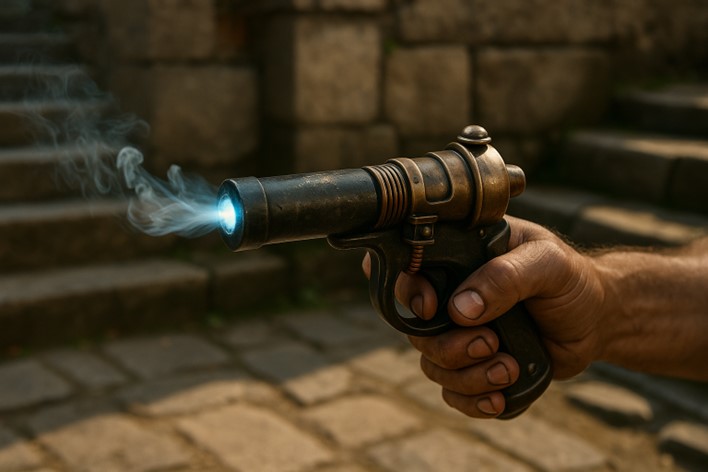
A handheld device of bronze and blackened obsidian tubing, powered by a miniature steam capsule and compressed crystalline dust. When triggered, it emits a burst of kinetic vibration—the same energy that shapes Andean’s terraces.
Effects:
– Range 40 ft; deals 1d8 force damage on impact.
– Once per rest, can release a Shatter Pulse, a concussive shot that fractures brittle terrain or destabilizes small constructs (DC 13 Fortitude save or collapse/prone).
– Excessive use risks “Ley-Overdraw”: a roll of 1 on attack ruptures pressure valve (self 1d4 fire damage).
Lore: Designed for geomancers working in hazardous quarries, later refined by the royal guard. Its sound—a deep, resonant thud—mirrors the quake of a distant peak.
Expanded Lore:
The Stone-Pulse Pistol 047 of the Veinbreaker traces its lineage to the mountain forges of Peakhold, where the Matriarch-Engineers of Andean first sought to harness the breathing rhythm of the world itself as a weapon and tool. Originally created to assist Stonegrowers in quarrying ley-infused rock for temple terraces, it was never intended for battle. Early prototypes, powered by unstable quartz condensers, often exploded in the miner’s hands—hence the grim moniker Veinbreaker, referring both to shattered stone veins and the cracked arms of careless wielders.
Over generations, artisans in the Royal Steam Arsenal refined the design. The crude volcanic barrel became a polished obsidian core, bound in bronze filigree etched with vibration-glyphs that resonate with the pulse of the mountain. When fired, it doesn’t burn powder—it breathes pressure, exhaling focused kinetic vibration that carries the same energy used to carve Andean’s terraces. Soldiers of the Queen’s guard wielded it to stabilize collapsing tunnels, breach walls, or defend from cave beasts drawn to ley energy. To outsiders, its deep, resonant discharge sounded like a thunderclap buried beneath the earth—a heartbeat of the mountain given voice.
Each pistol is individually tuned to its bearer by a ritual of Vein-Harmonics: a half-hour meditation aligning the wielder’s pulse with the pistol’s resonance. Without this ritual, the weapon hums out of rhythm, making it inaccurate or volatile. The steam capsule embedded within glows with faint copper light; its pressure is maintained through a mixture of alchemical water, crystal dust, and geothermal condensate. Because the weapon channels living ley energy, it cannot be mass-produced—every piece is a miniature pact between the craftsman, the mountain, and the user’s will.
Those who master it report that each shot feels like exhaling part of their own essence. The most skilled Veinbreakers can attune their heartbeat to the pistol’s pulse, syncing in perfect rhythm to shatter stone precisely or destabilize enemy constructs without collateral damage. However, reckless users who ignore the breathing intervals between shots risk a phenomenon known as Ley-Overdraw, where excess vibration ruptures internal valves, releasing superheated steam.
Tier 1 Statistics (Stone-Pulse Pistol 047 of the Veinbreaker):
Type: Short-Range Alchemical Firearm (Sidearm)
Slot: Main Hand Weapon Slot (Secondary Sidearm Category)
Weight: 1.9 lb Durability: 75 HP Rarity: Uncommon (Tier 1)
Material Composition: Bronze frame, obsidian tube, quartz condenser, steam capsule, vibration-runes.
Ammunition: Crystal Dust Capsule (x6 per load) Reload: 1 Action / 10 seconds
Base Stats & Bonuses:
• Attack Bonus +2 with Firearms (Proficiency Required)
• Range: 40 ft effective (80 ft disadvantage)
• Damage: 1d8 Force (kinetic vibration)
• Critical on 19–20 = +1d4 Sonic resonance damage
Skill Enhancements (Gained While Attuned):
• +2 Engineering or Alchemy Checks when working with stone, metal, or pressure-based systems
• +1 Insight or Perception Checks related to ground vibrations or hollow structures
Passive Magics (Always Active):
- Pulse Attunement: While holding the weapon, the user can sense micro-tremors within 20 ft as a low hum in their bones, granting advantage to detect unstable ground or constructs.
- Steam-Balance Channel: Reduces recoil and stabilizes aim after movement; negates first point of disadvantage from movement or wind.
- Vibration Harmony: When near natural stone or ley line flows, damage rolls gain +1 from amplified resonance.
- Cooling Condenser: Prevents weapon overheat under normal use; if Ley-Overdraw is triggered, halves damage to user on first failure.
Activatable Magics (Limited Use):
- Shatter Pulse (1/Rest): A concussive blast of kinetic pressure within a 15-ft cone. Creatures or constructs in range must succeed on DC 13 Fortitude or be knocked prone and take 1d8 Force + 1d4 Sonic damage. Terrain features of brittle stone may crack or collapse (GM discretion).
- Seismic Echo (2/Day): For 10 seconds after activation, each shot creates a resonant trail revealing weak spots in structures or enemy armor. Attacks against identified points ignore 2 points of physical resistance.
- Pulse-Vent Shift (1/Day): The user can redirect a failed Ley-Overdraw into a controlled steam vent burst around themselves, creating a 5-ft radius fog for 1 round and taking no damage.
- Echo-Tuner (Augment Action): Once per hour, the pistol may be retuned to a specific frequency to resonate with an object or terrain. Next attack against that target deals +2 Force damage and causes advantage on damage roll.
Drawbacks & Risks:
• Ley-Overdraw: On a natural attack roll of 1, steam pressure ruptures (1d4 fire damage to user; 1d6 if already overheated).
• Energy Instability: After five continuous shots in rapid succession, the weapon emits a harmonic whine; user must pause for 6 seconds or risk feedback (1d4 self damage).
• Attunement Requirement: Without a Vein-Harmonics ritual (30 minutes of meditation and pulse synchronization), accuracy is reduced by –2 and misfire range increases to 2.
Tags:
Firearm, Alchemical, Steam-Powered, Force Damage, Vibration, Engineering Weapon, Andean Design, Precision, Tool-Weapon Hybrid, Ley-Bound, Geomantic, Tier 1, Short Range, Construct-Breaker, Utility-Combat, Recoil-Managed, Firearm, Alchemical, Steam-Powered, Force Damage, Engineering Weapon, Tier 1, Precision, Andean Defense, Tool-Weapon Hybrid
The Stone-Pulse Pistol 047 of the Veinbreaker bridges engineering and alchemy as a sidearm crafted for builders and defenders of Andean’s terraces. It is not merely a weapon of violence but a calibrated instrument of balance—capable of shaping the earth, redirecting forces, and teaching the wielder discipline through measured resonance. Its lesson mirrors its mountain heritage: the power to break and the patience to build are the same breath of stone.
Commerce and Distribution of the Stone-Pulse Pistol 047 of the Veinbreaker (Saṃsāra Economy)
The Stone-Pulse Pistol 047 of the Veinbreaker is both a precision alchemical instrument and a regulated steam firearm. Its circulation throughout Saṃsāra reflects Andean craftsmanship’s dual nature—half-sacred, half-industrial. Few are built each year, and every sale requires ritual attunement or verification of pulse-harmony, preventing reckless misuse. Price fluctuates according to venue, license, and whether the weapon retains its original copper-quartz condenser or a cheaper substitute.
1. Royal Steam Arsenal (Peakhold Armament Quarter, Andean Capital)
Description:
Government-regulated foundry beneath the terraces of Qosqo-Suma. The Arsenal sells to the monarchy’s royal engineers, ley-surveyors, and geomantic guards. Each piece passes a three-step certification: pressure testing, resonance tuning, and oath-signing before Intayra’s sigil. The buyer’s pulse is recorded in the archives to track weapon lineage.
Atmosphere:
Steam hiss fills vaulted stone chambers; engineers chant calibration mantras while runic inspectors measure vibrations in silence.
Price: 820 gold (includes certification, ritual alignment, and brass travel case).
Buy-back Value: 600 gold if the crystal condenser remains intact.
Trade Conditions: Buyer must hold a Stonegrower’s License or Queen’s Defense Writ. Foreign purchase requires escort and six-day vetting period.
2. The Brass-Vein Consortium (Qosqo-Suma Merchant Guildhouse)
Description:
Private guild of engineer-merchants who refurbish decommissioned royal pistols and re-sell them to industrialists, monster-hunters, and Isekai adventurers. They often fit cheaper alloy condensers, shortening the weapon’s lifespan but widening access.
Atmosphere:
Dim bronze halls lined with tools, pressure gauges, and crates of crystal dust. Bargaining occurs over cups of steaming mineral tea while pistols hum softly on padded tables.
Price: 540 gold (standard refurbishment); rare intact originals reach 700 gold.
Buy-back Value: 350–400 gold depending on condition.
Trade Conditions: No license required, but proof of Engineering or Firearm proficiency earns discount. Guild reputation affects price—members of the Consortium pay 10 % less.
3. Tremorwright’s Emporium (Independent Market Forge, Anti-Suyu)
Description:
Semi-legal black-market forge located along the lower terraces of Andean’s industrial coast. Run by ex-Stonegrowers and smugglers, they dismantle damaged Veinbreakers to sell piecemeal: barrels, condensers, and steam valves. Buyers can assemble a working pistol if skilled enough.
Atmosphere:
Half-lit undercroft alive with hammering, the scent of oil and copper dust thick in the air. Transactions made with coded gestures; prices shift daily with ore imports.
Price: 300 gold for partial assembly; 420–480 gold for full working model (no certification, risk of instability).
Buy-back Value: 150–200 gold.
Trade Conditions: No legal paperwork; transactions often paid in Electrum or Platinum fragments. Risks include counterfeit vibration crystals or faulty pressure chambers (15 % misfire chance).
4. The Resonant Atelier (Floating Gallery of Hanan-Pacha)
Description:
Artisan-collectors’ floating market where ancient Andean relics are restored as works of art. Veinbreakers here are ceremonial pieces mounted in polished glass cases, their harmonic cores retuned for music rather than combat.
Atmosphere:
Airship decks turned into open galleries; patrons walk amid chimes and polished basalt. Steam pipes vent sweet-smelling mist while alchemical artists demonstrate resonance harmonies.
Price: 1 200–1 500 gold for display-grade relic with restored ley signature.
Buy-back Value: 950 gold minimum for pristine piece.
Trade Conditions: Purchasers must swear not to discharge the weapon within the floating city; usage voids warranty.
5. Frontier Quarry Cooperative (Puna-Qollas Highlands)
Description:
Rugged mining outpost shops maintain a modest supply of refurbished pistols for Stonegrowers who need to fracture quarry walls or defend caravans from beasts. Practical, soot-stained, and tuned for durability rather than elegance.
Atmosphere:
Open-air stalls carved into cliff faces. Miners test resonance by firing at boulders, their laughter echoing across valleys.
Price: 380 gold standard issue; 420 gold for reinforced “Cold-Peak” models.
Buy-back Value: 250 gold, often traded for ore or steam canisters.
Trade Conditions: Payment accepted in Nickel or Silver; maintenance service included for one season.
6. Collector’s Auction — The Chamber of Nine Echoes (Underground Cavern Market, Urin Pacha)
Description:
An exclusive subterranean auction where ancient artifacts and Tier-one prototypes are traded among nobles, Isekai relic hunters, and occult scholars. Occasionally, a first-generation Veinbreaker forged before the Rockfall appears—identifiable by its volcanic glass cylinder and copper Intayra glyph.
Atmosphere:
Silent except for the steady drip of water. Each item presented on a slab of resonant stone that hums when bids rise.
Price Range: 2 000–3 500 gold for historical models.
Buy-back Value: Negotiated individually; relics sometimes traded for rare essences, spirit crystals, or airship deeds.
Trade Conditions: Invitation only; auctioneer demands secrecy oaths and 10 % tithe to the Faith of Intayra.
7. Isekai Mechanist Caravans (Mobile Trading Zeppelins)
Description:
Traveling sky-smiths who integrate foreign alchemy and Saṃsāran steamtech. They often carry modified Veinbreakers adapted with rotating valves, additional vents, or variable-frequency triggers. Their craftsmanship is unpredictable but creative.
Atmosphere:
Markets aboard drifting zeppelins tethered over highland passes; tinkers haggle amid whirring engines and floating incense.
Price: 450–650 gold depending on modifications.
Buy-back Value: 300 gold for functional units.
Trade Conditions: Haggling mandatory; mechanical guarantees void after one lunar cycle.
CAVE / QUARRY — defensive use
In cramped quarry caverns the Stone-Pulse Pistol functions first as a tool for immediate structural control. Wielders will fire a short, controlled burst toward an unstable overhang to create a small, directed Shatter Pulse that severs a precarious fracture on a controlled line so that the fall is predicted and diverted into a safe channel. Roleplayers should emphasize careful measurement, steady breath, and the Vein-Harmonics ritual: the wielder places a hand on stone, listens with bone and bracer, times the trigger with a heartbeat. In combat beneath the earth the pistol is used to collapse chokepoints by fracturing brittle rock ahead of advancing foes; defensive teams will coordinate so the blast throws rubble to block tunnels while allies retreat or set up steam bracing. Socially, quarry foremen expect the pistol to be used to stabilize, not to slaughter; misuse draws condemnation from Stonegrowers and may incur inspections. Mechanically, players narrate tension-control checks, the sound of copper valves singing, and the slow exhale of the condenser between shots.
CAVE / QUARRY — offensive use
When used offensively against cave beasts or constructs, the pistol’s Shatter Pulse targets brittle chitin, hollow carapace, or mortar joints—shots aimed to make creatures lose footing or to shatter the anchoring points of a stone construct. Roleplay shouts, coordinated marks on a quarry map, and the hammering rhythm of a support crew ready to shove tumbling rock. Danger arises from collateral collapse; narrate the dust, altered acoustics, secondary falls, and the moral weight of risking trapped miners or kin. Repeated rapid fire risks Ley-Overdraw; experienced Veinbreakers stagger shots to avoid self-harm.
TERRACED FIELDS / AGRICULTURAL VALLEYS — defensive use
On terraces the pistol is a precision tool for controlled micro-collapses and for deterring climbing predators. Defenders use short, low-power pulses to dislodge small rockslides that will divert toward empty gullies, protecting irrigation channels and harvesters. Roleplay elements include farmers pausing work, the pistol’s low thud harmonizing with terraced pumps, and Stonegrower oversight. Using it in these settings is socially delicate—farmers treat the device as a work implement rather than a weapon; improper discharge near crops draws penalties and social reprimand.
TERRACED FIELDS / AGRICULTURAL VALLEYS — offensive use
Offensive application is limited and targeted: cutting footholds beneath raiders, collapsing a narrow stair to stop a pursuit, or cracking a siege engine’s stone base. Roleplay focuses on cunning rather than brute force—villagers rig small false steps and invite pursuers into traps where a well-placed pulse brings the terrace to heel. Overuse causes soil instability; narrate the subtle sadness of ruined bedrock and the community meetings afterward.
URBAN PEAKHOLD / STONE CITIES — defensive use
In denser urban settings the Veinbreaker is a close-quarters stabilizer and crowd control tool. Royal engineers use brief pulses to jam or deform siege wedges, to blow steam vents that obscure lines of sight, or to shatter stone anchors of battering rams. Roleplayers describe narrow stone alleys filling with steam fog, ricocheting pulses, and city guards chanting harmonics to coordinate safe collapses. Legally, Peakhold requires registration and ritual attunement; use without paperwork invites militia intervention and fines. The pistol can also be used to create precise pry points so urban defenders can raise temporary barricades out of intact slabs.
URBAN PEAKHOLD / STONE CITIES — offensive use
Offensively this sidearm disables constructs in an urban battlefield—targeting binding rivets, cracking automata casings, or creating a sonic shock to stun pavement-borne foes. Players should roleplay tactical calls: “Aim for the joint beneath the left shoulder,” the artisan calls, and the shot makes the construct shudder. Civilians and heritage sites create ethical tension; narrate the chorus of alarms and the moral calculus of choosing a target where minimal collateral damage occurs.
RIVERBANKS / RIVERINE TRADE ROUTES — defensive use
Along river quays the Stone-Pulse Pistol secures riverstone piers and unfastens snagged hulls. Defenders use a stabilizing pulse to set loose a lodged keel or to collapse a compromised jetty so a burning ship drifts free of the dock without igniting warehouses. Roleplay the hiss of condensers mixing with spray, guild inspectors checking registration, and the pistol’s deep thud echoing across water. In marshy ground the weapon’s pulses can reveal hidden hollows where smugglers hide contraband, aiding patrols in nonlethal takedowns.
RIVERBANKS / RIVERINE TRADE ROUTES — offensive use
Offensively it disables small skiff hulls, detaches stone anchors, or destabilizes small floating constructs. The party may use pulses to force an enemy’s vessel to list, giving archers or aircrew an advantage. Roleplay the frantic crew orders and the spray of water; emphasize the risk that fracturing a hull might sink neutral ships or hurt bystanders.
AIRSHIPS / ZEPPELINS / AERIAL ROUTES — defensive use
On boarding actions aloft, the pistol’s short range and kinetic focus make it ideal for precise denaturing of boarding clamps and for creating brief steam veils to mask movement between rigging. Roleplay the metallic clang of the pistol-shot against hull braiding, the muffled thunder of resonance through rigging, and the breathless timing required in three-dimensional combat. Use of the pistol aboard an airship is regulated—unauthorized discharge may force emergency venting or depressurization protocols; narrate alarms and crew discipline.
AIRSHIPS / ZEPPELINS / AERIAL ROUTES — offensive use
Offensive shots sever suspension fittings or jam automata defenders; the Veinbreaker excels at targeted strikes to cut grapnel anchors or to fracture brittle decorative stonework used as ballast. Roleplay the sudden lurch of an airship and the cries of those above decks; account for the catastrophic potential of misfires at altitude.
UNDERWATER / DOMED COASTAL SETTLEMENTS — defensive and offensive considerations
Underwater or domed settlements are a poor technical fit for the pistol’s steam-pressure mechanics; use requires conversion and waterproofing, and most domes ban unmodified alchemical firearms. In domed harbors a modified Veinbreaker tuned for lower pressure can be used defensively to fracture coral spines that trap hulls or to create shock pulses that disorient underwater beasts. Roleplay the heavy, muffled thuds and the condensation fog fighting for breath inside a dome. Legal and environmental protections are strong: misuse risks sacred harm to reef and lease revocation from temple authorities.
STEAMWORKSHOPS / FORGES — defensive use
In workshops the pistol is a sanctioned maintenance instrument. It is used defensively to knock free stuck press pistons, to test stress points on newly cast parts, and to release trapped steam with controlled venting. Roleplay the measured routine: the artisan tests pulse strength against a sacrificial block before applying the same rhythm to a finished gear train. Workshop masters watch for overheating and ensure cooldown cycles, making the pistol a respected tool of craft.
STEAMWORKSHOPS / FORGES — offensive use
Offense in workshops is tactical sabotage: pulses applied to rivets or brittle fastenings can render enemy siege engines useless or collapse a smuggler’s concealed press. Roleplay the quiet sabotage, the small telltale hums, and the guilty sweat of the saboteur; consequences include guild censure and potential outlawing.
SIEGE / OPEN-FIELD BATTLE — defensive use
On battlefield lines, the pistol supports fortification teams: cracking socketed stakes to allow controlled re-set, breaking narrow embrasure seams to enable quick smoke releases, and creating short temporal barriers of rubble. Roleplay the quick exchanges between sappers and stormers, the pistol’s dry punch followed by lowering of shields. Coordinated pulse use can buy time for rallying troops or for withdrawing heavy assets.
SIEGE / OPEN-FIELD BATTLE — offensive use
Offensively the Veinbreaker is used to break small siegeworks, to detonate stone-cased alchemical charges by inducing resonant fractures, or to target armor seams on constructs. Roleplay the target selection process and the audible ripple across a line of stone when the pulse lands. The risk of Ley-Overdraw in the middle of a charge is narratively severe; describe the sudden steam burst, the burned hand, and the morale shock.
STEALTH / ASSASSINATION / SUBTERFUGE — tactical and roleplay notes
The pistol’s resonant report is low and dense rather than a bright crack; with silencing techniques and ritual timing it can be used for precision sabotage or to collapse a small target quietly. Roleplay the tight breath of a whispering trigger, the thief’s pulse tuning, and the moral cost of covert use in civic spaces. Many PCs will face social or legal penalties if caught; craft an argument through ritual attunement or guild cover to explain possession.
RITUAL / PEAKSHRINE / STONEGROWER OPERATIONS — nonviolent and symbolic uses
In Peakshrines the pistol is sometimes treated as a ceremonial instrument used to “tap” terraces in blessing rites. Roleplay soft, rhythmic pulses as part of a harvest ceremony; the device’s role transforms from a weapon to a ritual caliper of growth. Use in these contexts is highly regulated: priests recite khipu knots, bracers and cuirasses are present, and attunement is public. Improper or offensive use in a shrine is sacrilege and triggers legal, spiritual, and social consequences.
MONSTER HUNTS / WILDERNESS — field tactics
Hunters exploiting the pistol aim for jointed or hollow anatomy—shots at brittle carapace or at ley-saturated hides. Roleplay the scout’s recon to identify resonant weak points, the bracer’s readouts guiding the shot, and the team’s flanking maneuvers timed to the echo. Defensively, pulses can knock a charging mount off balance or collapse a lair entrance behind a party. Emphasize the physical sensations: the deep thud, the hair on the arms standing up, the taste of iron in the air.
SOCIAL, LEGAL, AND CULTURAL ROLEPLAY CONSEQUENCES
Ownership and use carry weight beyond combat. Buyers must often pass inspections, register with guilds, or gain permission from Stonegrowers. In courts and markets the weapon is as much a statement of craft as of force—parading a Veinbreaker in a civilian market triggers whispers; using it in an unsanctioned way can lead to confiscation, fines, or exile. Ritual attunement is both a practical safety measure and a social covenant; roleplay the oath, pulse synchronization, and the shared liability among community elders if misuse occurs.
ALLIED COORDINATION AND GEAR SYNERGY
Pairing the Stone-Pulse Pistol with Stoneheart Cuirass, Whispering Veins bracers, Ley-Threaded Helm, or Terraced Greaves changes how it is used: the cuirass allows the wielder to anchor against counterblast; bracers provide tremor cues for pinpoint shots; helm gives early warning of ley disruptions so pulses are timed to limit overdraw; greaves enable rapid repositioning between shots. Roleplay these synergies in short scenes of close cooperation—hand signals, timed breaths, and the clack of crystal capsules being replaced.
FAILURE, FEEDBACK, AND NARRATIVE RISK
Ley-Overdraw and overuse are narrative tools. Each misfire should be dramatized: the sudden hiss of releasing steam, the heat of a blister, the ringing in ears. Consequences range from momentary injury to community recrimination or structural disasters. Roleplay post-incident inspections, repair work, and the sober conversations with Stonegrowers about ethical use.
SENSORY CUES FOR ROLEPLAY IMMERSION
Always emphasize sensory detail: the pistol’s low subterranean thud; the vibration felt through bone and bracer; fine copper heat along the barrel; the fog of condensed breath after a Shatter Pulse; the brief, crystalline after-ring like a dropped bell. Use those cues to anchor mechanical effects to physical storytelling.
GUIDELINES FOR PLAYERS AND GMs
• Treat the Stone-Pulse Pistol as a hybrid: part artisan’s instrument, part sidearm.
• Emphasize pacing—shots should be measured, not spray-fired. Rhythm and ritual matter.
• Use environment first as an ally (stability, diversion, targeted fracture), then as a weapon when appropriate.
• Make Ley-Overdraw and legal/social consequences part of the risk calculus; consequences enrich the world.
• Encourage descriptive teamwork and gear synergy—bracers, helm, cuirass, greaves change options and tone.
These modes of use give the pistol multiple dramatic roles: precision tool, defensive stabilizer, tactical breaching implement, and focused offensive instrument. Each setting changes mechanical priorities and narrative tone; players and GMs should treat the pistol’s pulses as decisions with both immediate and communal consequences.
Perception of Activation:
User’s Perspective:
When the Stone-Pulse Pistol 047 of the Veinbreaker activates, the wielder feels an immediate internal resonance — a pulse that begins in the chest and mirrors the heartbeat of the mountain itself. The bronze casing hums with a low vibration, felt more in the bones than heard by the ear. As the trigger is pressed, a brief pressure builds in the forearm, followed by the sudden rush of vented steam that tastes faintly metallic and mineral-rich. The obsidian tubing warms but never burns; its hum deepens into a heartbeat rhythm that aligns with the user’s breath. The air grows denser, heavy with charged dust that glitters faintly in the light. Through the Mind’s Eye, a lattice of ley-lines unfolds, glowing blue-white through stone and soil like veins beneath translucent skin. Every motion feels precisely guided—each shot almost an extension of thought rather than muscle.
Extra-Sensory Perceptions (User):
A low-frequency vibration runs through the avatar’s spirit—a reverberation linking their heartbeat to the ley flow around them. The Mind’s Eye perceives resonant echoes of everything struck: the pulse of rock, the tremor of metal, even the hollow fear of unstable ground. For a moment after firing, time feels slightly displaced; sound stretches and contracts like a breathing cavern, revealing layers of resonance normally hidden from mortal perception.
Observer’s Perspective:
From the outside, the pistol’s activation appears as a muted quake of air and light. Steam bursts from the vents in steady rhythm, releasing a copper-scented mist that refracts nearby light into orange and blue halos. When fired, the weapon does not crack or roar—it thuds, a deep sound like a giant heart beneath the mountain. The user’s form vibrates subtly, their eyes catching faint ley-glow reflection as if lit from within. Dust lifts from the ground, floating for several seconds before settling in concentric ripples. Observers often describe a physical sensation in their teeth and stomach—like the distant roll of thunder that vibrates through bone.
Extra-Sensory Perceptions (Observer):
Those attuned to magic see a pulse-wave radiate outward in layered arcs of molten amber, resonating with nearby stones, metals, and enchanted artifacts. The ground whispers in rhythm with the sound, and small vibrations can be felt even in the air, echoing the ley network’s response to the weapon’s call.
Positives:
– Enhances focus and alignment between mind and environment.
– Generates awe and calm among trained geomancers who interpret the pulse as a sign of harmony.
– Temporarily stabilizes ley disturbances, bringing peace to nearby magical currents.
– Provides sensory clarity—user can “feel” spatial geometry and resonance with unnatural precision.
Negatives:
– The low hum lingers long after use, causing mild disorientation or vertigo in sensitive wielders.
– Prolonged activation near unstable ley lines can create sympathetic vibrations, triggering small rockfalls or spell interference.
– Observers often experience auditory distortion or faint tinnitus for several minutes.
– Improper synchronization between pulse rhythm and heartbeat may induce nausea, fatigue, or, in rare cases, temporary ley-sickness—a loss of magical balance resulting in trembling limbs and visual doubling of ley patterns.
Title: Recipe — Stone-Pulse Pistol 047 of the Veinbreaker (Reconstruction Protocol)
Materials needed
• Bronze frame stock, hammered plates and filigree — 3 lb total (primary chassis and reinforcement bands).
• Polished black obsidian tube (resonant barrel) — 1 length (≈10 in / 25 cm), density-stabilized.
• Quartz condenser crystal (tuned cut) — 1 core (size: fist-sized; clarity grade: Resonant).
• Copper coil windings, annealed — 8 m of thin coil (for vibration coupling).
• Steam capsule assembly (miniature pressure cylinder with safety vents) — 1 unit (rated to 120 psi or local equivalent).
• Crystal dust charge (finely milled, sealed phials) — 6 capsules per load; reserve 24 capsules for initial tuning.
• Vibration-rune inlay (silver or electrum wire) — 2 m (inscribed and fire-inked).
• Sealing resin (aether-resin or pitch-ether mix) — 4 oz.
• Small brass pressure valves and micro-gaskets — 6 valves, 12 gaskets.
• Binding plates (obsidian fragments + bronze rivets) — assorted for mounting.
• Ley-stabilizing talisman (grain-spiral sigil or approved Peakshrine token) — 1 (for final attunement).
• Polishing oil, rust inhibitor, mineral tea solvent — quantities to taste.
Tools required
• Arc-smith’s anvil and hammer set (stone-faced recommended).
• Micro-lathe and fine grinding wheel (stone/metal) for barrel and condenser seating.
• Coil winding jig (hand-crank or steam-driven) for copper windings.
• Rune-etching stylus and fire-ink stove (for vibration glyphs).
• Pressure-testing trough and steam rig (for steam capsule calibration).
• Ley-probe (simple keg-style resonant rod) and tuning mallet.
• Fine brazing torch (coal/steam micro-flame) and quenching basin.
• Precision calipers, measuring cords, and pulse-synchronizer (a simple braided cord for heartbeat alignment).
• Workbench with stone slab, padded clamps, and a grounding chain to earth excess resonance.
Skill requirements (minimum)
• Engineering (steamcraft/mechanical) — Intermediate (scores/skill level comparable to Tier-1 artisan).
• Smithing (metals & stone) — Intermediate.
• Alchemy (crystal handling & condensates) — Basic to Intermediate.
• Runecraft/Enchanting (vibration glyphs & ley-tuning) — Basic.
• Stonegrower consultation or certified attunement reader — Required for final Vein-Harmonics alignment.
Estimated resources & ledger (for crafter planning)
• Time: plan for five full work days with breaks for cooling, calibration, and attunement (broken into steps below).
• Cost baseline: equivalent to 380–550 gold in common artisan markets depending on material grade and condenser provenance. (Use local coin conversions as needed. Item rarity and certification increase price.)
Crafting steps — detailed protocol
- Preliminary design and intake
a. Draft exact dimensions and tolerances. Mark barrel length (≈10 in) and handle ergonomics to the wielder’s hand span.
b. Inspect condenser crystal for fissures; discard any with internal hairline fractures. Reserve 2 spares. - Frame forging and chassis assembly
a. Forge bronze frame plates, anneal and hammer to final thickness. Leave recesses for obsidian barrel seating and condenser pocket.
b. File and polish mounting surfaces; ensure all mating faces are true within 0.5 mm.
c. Drill and fit micro-valve housings; seat gaskets dry to confirm fit. - Barrel and condenser seating
a. Machine obsidian tube end faces flat; lap to match bronze seat. Use water/stone slurry to avoid thermal shock.
b. Seat quartz condenser into its pocket with a thin layer of sealing resin; align orientation so the condenser’s growth axis parallels the barrel. Allow resin to cure under gentle warmth (no open flame).
c. Encapsulate assembly with bronze binding plates and rivets; leave access ports for later tuning. - Coil-winding and rune inlay
a. Wind copper coils with coil jig in phased groups (4 × 2 m runs) and anchor windings into carved bronze channels. Insulate with mineral oil soak.
b. Etch vibration-runes along barrel and side plates using stylus and fire-ink; stroke each glyph in the prescribed harmonic order (peak → trough → spiral) as taught by Peakshrine manuscripts. Allow ink to set. - Steam capsule fabrication and integration
a. Assemble the miniature pressure cylinder; fit valves and test on the pressure rig to 1.25× working pressure. Confirm safety vent activation.
b. Mount the steam capsule to the lower chassis; route a feeding line to the condenser pocket and a return vent that opens along the barrel’s vent ports. Seal joints with resin and test for leaks. - Loading mechanism and crystal-dust capsule carriage
a. Carve the loading chamber and fit capsule catchers. Ensure capsule retention springs operate smoothly and that reload can be performed within the intended reload time (practice loading by hand).
b. Fit temporary test capsule (non-energized dust) for dry-cycle tests. - Resonance coupling and tuning
a. With the pistol cold and inert, perform low-energy resonance sweeps with the ley-probe. Record baseline hum frequencies.
b. Adjust coil phasing (reverse or lengthen turns) until the probe shows clean, single-band resonance—this prevents harmonic beats.
c. Apply rune-ink touch-ups where interference occurred. - Pressure & safety certification
a. Perform staged pressure tests in the trough: 0.5×, 1.0×, 1.1× working pressure. Monitor for leaking seals or microfissures.
b. Fire three dry test pulses into sacrificial stone block at lowest charge; inspect barrel, condenser, and valve housings for stress.
c. If any micro-crack appears, stop, replace damaged parts, and repeat tests. - Ley attunement ritual (Vein-Harmonics) — required for proper function
a. Bring the pistol and prospective wielder to a certified Stonegrower or Peakshrine attuner. The ritual requires a calm chamber with a stone altar and running steam vent.
b. Steps of ritual (practical): wielder strips to at least one bare hand on the stone, places palm upon barrel and condenser pocket, breathes to align heartbeat with the heartbeat of the forge (count to the specified rhythm: 4 steady inhales, 4 steady exhales).
c. Stonegrower strikes the tuning mallet in time while the wielder repeats a set of Qosqo-Pacha tonal syllables (provided by the attuner). The attuner then presses grain-spiral talisman to the condenser and intones the alignment glyph.
d. If alignment succeeds, condenser shimmers faintly and the pistol accepts the wielder’s pulse imprint. Record the attunement in the artisan ledger. - Final calibration and combat/field test
a. Load with one charged crystal-dust capsule and perform live-fire test at 20 ft into a sacrificial stone target. Observe recoil, vent timing, and condenser cooling interval.
b. Test Shatter Pulse on prepared brittle stone and confirm DC/force effects per desired rules (GM or field standard).
c. Confirm Ley-Overdraw fail condition thresholds (simulate rapid-fire sequences and test valve response). Adjust safety valve and cooling regimen if necessary. - Finishing, engraving, and paperwork
a. Polish finish, apply protective oil. Engrave maker’s mark, serial rune, and attunement sigil on chassis.
b. Complete sale or registration paperwork: note condenser lot number, attunement date, and certifying Stonegrower. Affix legal seal if sold through Royal Steam Arsenal.
Maintenance & re-tuning notes
• Routine maintenance: clean condensate and replace crystal dust capsules after every 6–12 uses depending on charge intensity. Inspect gaskets and valves monthly.
• Reattunement: required if the wielder changes (Vein-Harmonics ritual repeats). Reattunement may be performed by certified artisans or Peakshrines.
• Emergency repair: if Ley-Overdraw occurs, immediately cool condenser in mineral tea bath and dispatch to Forge for micro-soldering of valves; do not attempt home repair on condenser cracks.
• Upgrades: professional upgrade options include dual-valve pressure dampers, electrum-lined condenser sockets (increases durability but raises royal export tax), and ceremonial grain-spiral inlays that improve social acceptability in Peakshrines.
Substitutions and cautions
• Substituting inferior quartz for condenser increases Ley-Overdraw risk and reduces effective damage/stability—do not substitute unless emergency and accept trade penalties.
• Using non-certified crystal dust risks unstable pulses and increased misfire rate.
• Never weld obsidian with an open flame; use slow heat and stone-friendly glues/resins to avoid internal fractures.
Field training and user proficiency
• Recommend at least three supervised live-fire drills and two quarry stabilization runs before issuing pistol to new user.
• Training should include heartbeat pacing drills and emergency valve-release procedures.
• Authorization: many communities require a Stonegrower’s license or guild endorsement to legally bear a Veinbreaker in public.
Record keeping (recommended)
• Maintain an artisan ledger entry: serial rune, crafter’s name, condenser serial, attunement date, owner’s name, and maintenance log. This record reduces guild suspicion and helps with warranty and buy-back valuation.
Endnote: the protocol above reconstructs the Stone-Pulse Pistol 047 to working specification while emphasizing safety, ritual attunement, and community oversight. Follow the steps precisely to preserve the device’s balance between artisan instrument and defensive implement.
Heart that Thudded Under Stone
They cut the words on a shard that did not want to be read, and the shard kept slipping between fingers as if it remembered a cliff. The telling begins in the broken hour between steam and dusk, when the mountain still spoke in the old tongue and men—no, the shapes of men who were not yet finished—listened like children to a stern father.
In those days Turrath throbbed. The city’s terraces were like ribbed belts around a giant’s waist; the forges sang and the pumps sighed and many hands answered them. They said the mountain had a pulse and the elders learned to count it: one, two, three, breath; one, two, three, breath. They braided their cords in that rhythm; they carved the grain spiral in their palms; they hammered in time to keep the rock patient. The elders named the counting the Vein-Hum. The Vein-Hum made the terraces hold water. The Vein-Hum made the bridges remember their steps.
A smith of quiet breath called Ilqa — the name is a knot of vowels in the telling and may be wrong — listened too long. Ilqa was not cruel; she only trusted the mountain’s voice more than the hunger in men’s bellies. She pressed quartz to iron and listened as the stone answered with a tone like a distant drum. Under the anvil she wrapped copper around basalt and sang the Vein-Hum into the coils. The coils took the pulse and kept it for themselves, and the basalt learned to thrum.
They called what she made a staff at first, then a device of curious heart, then a pistol when bandits laughed and when miners needed a steady hand. The name did not stick; the mountain laughed and called it Veinbreaker in a tone of warning and affection at once. The object’s heart was a crystal that drank rhythm and kept its own, and its lungs were valves of brass that breathed steam in little coughs. Ilqa set the grain-spiral talisman upon it and bound the last knot with Qosqo-Khipu thread she had stolen from the altar because her hands shook when she asked permission. That theft is woven into many versions of the tale like a dark seam.
The first trials were not triumphant. Ilqa carried the small thing into a quarry where the stone had hairline griefs and the quarrymen had eyes like embers. She set the barrel to the crack and, with her breath counting the Vein-Hum, she pressed. The blast did not roar; it thudded, as if a small mountain had coughed. The split opened along the line, obedient as a taught rope. Rock fell into the channel where they had dug the drain; the men gave her bread and fingered the pistol with reverent hands. The pistol sang to the rock and the rock answered in tidy rubble, and for a brief season Ilqa’s name was braided into the work songs.
But the thing took rhythm as bread takes salt. It learned what the Vein-Hum tasted like and wanted more of it. Word slid like oil through the valley: a little device that will make stubborn stone obey. The House of the Breathing Forge came with plans, and with plans came greed disguised as craft. They asked Ilqa to make more; they wanted to tune mountains as men tune harps. She warned them in a speech made of small stones and slow breaths: “Rhythm is a living thing. If you force the beat the body will break.” They said she was fearful, old, or both. They signed papers in the ash of the forges and called the signatures progress.
They multiplied the pistols. They sent them to quarry captains, to royal guards who liked the neatness of a measured shock, to smiths who fancied quick fixes. The pistols learned many hands and many heartbeats; they learned hurried ones and drunken ones and hands that never bothered to learn the Vein-Hum at all. Each new pulse impressed itself upon the crystal-core until it hummed like a busy barn.
The mountain kept counting. Where one heart had been steady, many hands made a jack-hammer of the world, and the ley-flow coughed. On the morning the Vorzul quarry thrummed loud enough to wake the sleeping peaks, the Grand Peakshrine sent a dream so sharp it cut the throat of sleep. Stonegrowers dreamt of great teeth falling from a jaw. The elders smelled steam that tasted like regret and went to the quarry just as the pistons sang higher than a hive. The great machine seized on the ley with greedy teeth and did not stop when told. The Veinbreakers, pressed into service under orders that smelled like victory, beat the mountain with careful hands until the mountain answered in a voice none had expected: a growl that split terraces.
The Rockfall was not sudden like a lightning strike but long like the cracking of ice. It began where machines had asked the ground for more than it would give. Walls that had held cereal for generations flowed like black sand. Towers pitched into each other with the dull, embarrassed sounds of old men colliding. The Vorzul quarry unmade itself and took with it a choir of forges and a constellation of family names. In the ruin the crystals of many pistols cracked; some went silent in the dust; some sang on with a shrill, resentful note.
Ilqa was there and she was not. The tale separates her into two hands: one that tried to hold the last plank across a new gulf, one that walked into the smoke without fanfare. The telling is not sure which remains truer; the elders argue like eyebrows. What everyone remembers is the last thud the mountain made before the quiet — a sound like someone pressing a palm to stone and asking forgiveness.
After the fall the pocked ground became a memorial. The broken plough lay like a bone in the center; priests set it beneath a cairn and told the children the story in voices that did not rise. The Veinbreakers were declared marvels and monsters in the same breath. Some were destroyed on the errand of law; others were sealed away in vaults, their crystals dimmed with rituals that tasted of salt and smoke. The House of the Breathing Forge shrank like a beaten drum; names were changed and ledgers smoothed over with steam-warm water.
Yet not all was sorrow. The pistols, those that remained and were not cursed away, were taken by careful hands and repurposed. Stonegrowers kept some for the slow work of making channels and for the breath-calibrated removal of rotten sections of temple steps. In Peakshrines they were placed on altars as instruments of measurement rather than of force, tapped gently during rites to mark a beat — the same beat that holds terraces and children and hush. Ilqa’s knot, torn from that first making, was given back to the altar by a hand that smelled of ash. The ritual turned a weapon into a metronome; the mountain remembered and allowed a careful truce.
Over the centuries the telling became a kind of crooked scripture, translated back and forth through tongues that liked their consonants hard. Scribes wrote it with a kink in grammar: “The thing that makes rock obey is the hand that listens, not the hand that forces.” That line shifted through the ages until sometimes it reads, “Listen or else,” and sometimes, “Listen and you will be given.” Children chant both as if they were synonymous. Travelers trade a half-line of it for an ale; elders sew grain-spiral patches onto children’s cloaks and tell the tale in whispers over steam.
In some versions the pistol is a hero and gives a child back her missing goat; in other versions it is a demon that ate a village. In some the mountain weeps and gives pearls; in some it closes its maw and never speaks again. The one thread through all the broken translations is the same, a scar in the language: a device that took the pulse of the world cannot be owned by any who only beat it for coin.
The shard of the original telling ends not with a neat closure but with a notation in a hand that trembled: that the Veinbreaker will answer the rhythm it is taught, and if the rhythm is greed, the answer will be ruin.
Moral of the story: A tool that learns the heartbeat of the world will obey only the hand that keeps time with it; those who force the rhythm invite the fall.
Suggested conversions to other systems:
Call of Cthulhu (7th Edition)
Stone-Pulse Pistol 047 of the Veinbreaker
Artifact / Alchemical Firearm (Steam-Powered, Tier 1)
• Type: Handheld steam-firearm, short-range
• Damage: 1D8 Force or 1D6+1 (blunt kinetic)
• Range: 12 yards (effective), 20 yards (max)
• Attacks: 1 per round (requires 1 full round to recharge steam capsule)
• Malfunction: 96–100 (over-pressure → 1D4 Fire damage to user, temporary deafness 1D4 rounds)
• Skill: Firearms (Special / Steam Weapons) 20% base
• Uses: Powered by alchemical crystal dust capsules; 6 charges per capsule.
• Special: Shatter Pulse (1/day) — Area 10 ft cone, 1D8 Force damage, STR × 5 roll to resist being knocked prone.
• Stabilization Mode: planting barrel in stone for 1 round lets user sense minor tremors or faults within 10 ft.
• Sanity Cost: 0/1D2 when first fired or when overdraw causes resonance hum; witnesses may lose 1 SAN for exposure to ley-wave distortions.
• Value: £250 (rare artifact).
• Lore: Device from Andean-style geomancers used to “tune mountains”; misused, it can disrupt ley flows.
Blades in the Dark
Stone-Pulse Veinbreaker (Fine Alchemical Sidearm)
Item Type: Fine Gun (steam & geomantic). Load 2.
• Effect: counts as a Fine weapon; when used to blast stone, metal, or armored foes, gain +1 effect.
• Special Ability — Resonant Shot (once per score): expend 1 stress to release a concussive pulse that ignores mundane armor and knocks targets back 3 paces.
• Tool Utility: may be used in downtime for +1 quality when repairing or shaping stone/metal projects.
• Risk: on Desperate failure, the weapon vents uncontrolled steam; take Level 2 Harm “Scalded Hand.”
• Value: 3 coin (artifact), illegal in city armories.
• Description: a short, heavy pistol engraved with copper veins that hum faintly when ley-currents are nearby.
Dungeons & Dragons (5e)
Stone-Pulse Pistol 047 of the Veinbreaker
Weapon (Rare, requires attunement by creature proficient with Firearms or Arcana)
• Weapon Type: Ranged weapon (steam firearm)
• Range: 40 / 120 ft
• Damage: 1d8 force damage
• Ammunition: crystal-dust capsules (6 shots per capsule)
• Reload: takes 1 bonus action to replace capsule.
• Properties: Light, Reload (6).
• Passive Magic — Ley-Sense: while attuned, user can detect tremors, faults, or hollow spaces within 10 ft.
• Active Magic — Shatter Pulse (1/day): 10-ft cone; creatures in area must make a DC 13 Strength save or take 2d8 force damage and be pushed 5 ft and knocked prone on a failed save (half damage on success).
• Ley-Overdraw: when attack roll is a 1, pistol vents steam; user takes 1d4 fire damage.
• Attunement Benefit: +1 to attack and damage rolls made with the pistol when standing on natural stone.
• Weight: 3 lb; Value: 500 gp.
• Lore: used by Andean royal geomancers to shape quarries and defend Peakshrines during the Rockfall Era.
Knave (2e syntax)
Veinbreaker 047 — Stone-Pulse Pistol
Item Type: Alchemical Firearm (Short Range)
Slots 2 (heavy tool-weapon)
Damage 1d8 (force or blunt, choose each shot)
Range 40 ft
Uses 6 per crystal charge; 1 turn to reload.
Properties:
• Once per day: Shatter Pulse — Deal 1d8 damage in 10-ft cone; targets save vs STR or fall prone.
• Passive: sense hollow spaces within 30 ft when touching stone.
• Misfire: on roll of 1, suffer 1d4 fire damage and weapon disabled 1 turn.
• Value 400 sp; Weight medium; Rarity Uncommon.
• Tags: steam-powered, alchemical, force, tool, geomancy.
Notes: If used creatively in construction or demolition, referee may grant advantage on craft tasks or excavation speed × 2.
Fate Core
Stone-Pulse Pistol 047 of the Veinbreaker
Aspect: “The Mountain’s Heart Thuds in My Hand.”
Item Type: Steam-Alchemical Firearm (Tier 1)
Skill Modifiers: +2 to Crafts or Shoot rolls when manipulating or firing at targets made of stone, metal, or earthen structures.
Invoke: To sense tremors, weak stone, or mechanical stress in a structure.
Compel: The weapon hums restlessly in strong ley-currents, attracting attention or destabilizing delicate machinery.
Stunt – Shatter Pulse (1/scene): Spend 1 Fate Point to unleash a concussive burst in a 10-ft zone. Targets must Overcome with Physique or be thrown back and suffer a mild consequence “Disoriented by Resonance.”
Drawback: If a roll fails with three or more shifts, the pistol overheats — the wielder takes a mild consequence “Burned by Steam.”
Extras:
• Grants Tremor Sense (10 ft) when pressed against solid surfaces.
• Counts as both a Weapon and a Tool; it can be used in Create Advantage actions relating to forging, mining, or structural analysis.
Value: Rare relic, typically found in geomantic cultures or salvage yards near Peakshrines.
Numenera / Cypher System
Veinbreaker 047 (Stone-Pulse Pistol)
Level: 5 (artifact)
Form: Compact bronze and obsidian pistol powered by a small steam cell and crystal dust reservoir.
Effect:
• Fires a concussive pulse up to 40 feet that deals 5 points of damage ignoring 2 points of Armor.
• User can spend 1 Intellect point to cause the pulse to resonate — a Shatter Pulse that targets an immediate area (10 ft) forcing creatures to make a Might defense roll or be knocked prone.
• When in contact with stone or metal, the wielder can sense nearby vibrations and structural weaknesses as if trained in the Understanding Numenera skill.
Depletion: 1 in 1d20 (on misfire or overdraw).
Drawback: On a depletion roll or GM intrusion, the pistol vents boiling steam, inflicting 2 points of Speed damage (ignores Armor) to the wielder’s hand.
Additional Functions: Used as a tool, it grants an asset to crafting, repairing, or analyzing stone/metal technology.
Value: 500 shins (artifact-grade); often restricted by local guilds or temples.
Tags: Artifact, Steam, Force, Resonant, Utility/Weapon Hybrid.
Pathfinder (2e)
Stone-Pulse Pistol 047 of the Veinbreaker
Weapon (Alchemical, Magical, Rare, Firearm)
Usage: held in 1 hand; Bulk L; Range Increment 40 ft; Reload 1 (uses crystal-dust cartridge).
Damage: 1d8 force damage; Critical: target knocked 5 ft (DC 15 Fortitude or Prone).
Traits: Force, Concussive, Steam-Powered, Alchemical, Magical, Uncommon.
Activate (1 Action, Concentrate, Evoke) — Shatter Pulse (once per hour): The weapon releases a concussive wave in a 10-foot cone. Each creature in the area must attempt a Fortitude save (DC 17). On a failure, the creature takes 2d8 force damage and is knocked prone. Success halves the damage and negates the prone condition.
Passive Effects: While holding or wielding the pistol, you gain Tremorsense (10 ft, only through solid stone or metal).
Critical Failure (Attack Roll of 1): The pistol vents excess steam; you take 1d4 fire damage and are Flat-Footed until the end of your next turn.
Craft Requirements: Expert in Crafting (Alchemy or Engineering specialty); requires a condenser crystal, steam core, and 4 alchemical reagents.
Price: 450 gp (royal-issue Andean weapon); Rarity: Rare; Level 5 equivalent.
Savage Worlds (Adventure Edition)
Stone-Pulse Pistol 047 of the Veinbreaker
Category: Steam-Alchemical Weapon (Ranged)
Range: 5/10/20
Damage: 2d6 (Force or Heat, choose when firing)
Rate of Fire: 1
Shots: 6 (per crystal charge); Reload 1 action (insert new capsule).
Weight: 3 lb; Cost: 500; Rarity: Rare.
Min Str: d6; AP: 2 vs. Hard materials.
Notes: Counts as both weapon and tool for Engineering or Repair tests (+1 bonus).
Special Abilities:
• Shatter Pulse (1/encounter): Create a 10” cone (Small Blast Template). Targets must make a Strength roll at –2 or be Shaken and knocked back 1d4”. Inanimate brittle objects (stone walls, glass, etc.) take 3d6 damage.
• Ley Resonance: When in contact with stone, grants Tremorsense (10 ft) and +1 to Notice rolls involving ground vibration.
• Overpressure Hazard: On a Shooting roll of 1, the weapon vents dangerously; wielder suffers 1d4 Fire damage and must make a Vigor roll or be Distracted next round.
Edges/Synergy: Gains +1 Shooting when used by a character with the “Geomantic Engineer” Edge or equivalent Profession.
Description: Forged in Andean Peakshrines, this compact sidearm channels mountain resonance into concussive blasts of vibration and steam.
Tags: Steam-Powered, Force, Short-Range, Magical, Alchemical, Tier 1, Tool/Weapon.
Shadowrun (6th/most-recent common play rules)
Stone-Pulse Pistol 047 — “Veinbreaker” (Alchemical Resonance Sidearm)
Type: Short-barrel alchemical/steam pistol (concealable smartlink optional).
Accuracy: +2 (smartlink adds +2 if installed).
Damage: 6P (force-like kinetic resonance; counts as Physical for armour rules but interacts specially with stone/constructs).
AP: -1 vs rigid materials (stone, metal); vs most living targets treat as AP 0.
Range Bands: Short 10 m / Medium 30 m / Long 60 m.
Ammo/Load: Crystal-dust capsule — 6 shots per capsule. Reload: Simple (exchange capsule, 1 full Action).
Modes: Single shot.
Special Features:
• Resonant Shot — when fired at stone, brittle constructs, or masonry, the weapon gains +2 DV against structure Integrity tests and may fracture weaker material (Gamemaster adjudicates structural breaks).
• Shatter Pulse (once per session/use): spend an Extended Action to charge; release a 3 m cone concussive pulse: targets in area suffer 4S (stun/physical depending on hit resistance) and Living targets struck must succeed on a Stun Resistance/Will test or be knocked down/staggered. Structures: automatic Integrity penalty (GM call).
• Ley Stabilize — planting the muzzle in solid stone and spending a simple Action stabilizes local ley vibrations for 1 Combat Turn; reduces environmental magic interference within 5 m by one step (story/GM).
• Ley-Overdraw (misfire risk): on a natural 1 when firing, the pressure valve ruptures — weapon suffers a critical malfunction (user takes 1S burn/steam damage, drop to -2 to Reaction tests for next Combat Turn, weapon disabled until repair). Repaired only by an adept mechanic/technician with Engineering or appropriate gear.
Availability/Legal: Restricted in most city-states; registering requires Stonegrower approval in Andean domains.
Cost: High — valued as a specialist artisan weapon (price variable by campaign; suggested 6,000–9,000 currency units in Andean markets with attunement fee).
Notes for run-building: treat as hybrid device — useful for both shadow ops (quiet, precise) and utility (quarry stabilization / structure work). Balance with environment: the Shatter Pulse is powerful vs structures but limited by once-per-session use and malfunction risk.
Starfinder (latest core rules translation)
Stone-Pulse Pistol 047 of the Veinbreaker
Category: Alchemical Sidearm (Energy/Force category) — Size: Compact handgun
Level Recommendation: 4–6 equivalent item (rare/artefact tier for campaign balance)
Price: 600–900 credits (artisanal plus attunement fees)
Damage: 1d8 force damage (energy type: concussive/force)
Critical: 19–20/x2 (force weapons typically ignore some DR; GM may rule partial DR bypass vs constructs/stone)
Range: 40 ft (handheld short weapon)
Capacity/Reload: 6 shots per crystal charge; reload 1 action (replace capsule)
Bulk: 1
Special Abilities:
• Shatter Pulse (Activate — 1 standard action — usable once per day): 10-ft cone. All creatures in area must attempt a Strength save (DC 13) or take 2d8 force damage and be pushed 5 ft and knocked prone; success halves damage and negates prone. Structural objects (stone, brittle constructs) automatically take full damage and suffer contextual integrity loss (GM adjudicates).
• Resonant Stabilize (Swift Action when muzzle planted in stone): stabilizes local magic currents; grants +2 circumstance bonus to allied spellcasters’ concentration checks for 1 round and reduces environmental disruption chance for ritual/area effects.
• Overdraw Risk: on a natural 1 on attack roll, pressure valve ruptures — user takes 1d4 fire/steam damage and the pistol enters forced-cooldown requiring 10 minutes (or field repair) to vent safely. If used repeatedly without cooldown, chance of catastrophic valve failure rises.
Attunement/Use Notes: Many Andean smiths mark pistols with attunement sigils; without attunement by a certified Stonegrower the Resonant Stabilize features are halved. Ideal for scouts, geomancers, and engineers in planetary/archipelago campaigns where stonework and terrain manipulation matter.
Traveller (Mongoose / Classic-style conversion)
Stone-Pulse Pistol 047 — Veinbreaker (Steam/Alchemical Sidearm)
Tech Level: TL7–8 equivalent (steam + engineered alchemical crystals)
Size: Handheld (one-man)
Mass: 3 kg (approx)
Range: Short 40 m / Long 80 m
Damage: 1d8 force (treat as Kinetic with special interaction vs stone/constructs)
Shots: 6 per crystal capsule; reload 1 turn (hand reload).
Special Rules:
• Shatter Pulse — once per 24 hours the Veinbreaker can emit a concussive burst in a 10-m cone. Targets attempt STR save (Ref/Agility in some schemes) or be knocked prone and suffer 2d8 damage; structures take double damage and make Structural Integrity checks at -2.
• Structural Work Tool: when used as a tool for excavation, repair, or controlled demolition, the owner gains +10% to related Engineering checks (GM to adjust to campaign proficiency mechanics).
• Misfire / Ley-Overdraw: on a roll of 1 when firing or on successive rapid fire without cooling, the valve may rupture (1d4 heat damage to user, weapon disabled and needs workshop repair).
Cost & Availability: Crafted by specialist forges; purchase typically requires guild or Stonegrower confirmation. Suggested cost: 4,000–6,000 credits/denarii in typical human worlds with TL7 markets; rarity increases cost.
Notes: Emphasize hybrid nature — players can both fight and engineer with it; referee adjudicates structure breaks and terrain effects.
Warhammer (Fantasy Roleplay — WFRP4-style conversion)
Stone-Pulse Pistol 047 — “Veinbreaker” (Andean Forge-Gun)
Category: Exotic Sidearm (Magical/Alchemical) — Requires GM permission to possess in many provinces.
Statistics (WFRP4 inspired):
• Damage: 2d10 Force (treat as impact/energy hybrid that bypasses some physical armour when used against stone/constructs).
• Range: Short (20 ft) / Medium (40 ft) / Long (80 ft) — accuracy falls off at longer ranges.
• Quality: Impact, Armour-Pierce (against stone/constructs treat AP +1), Special: Shatter Pulse.
• Special — Shatter Pulse (Once per Charge/Scene): Create a 3-yard cone. All targets must resist with Strength – if failed they suffer 3d10 damage and are Knocked Down; inanimate brittle objects suffer double damage and may collapse.
• Misfire: On a roll of 1 on the attack test, weapon vents steam and the wielder takes 1d10 damage (fire/steam). The weapon requires an Armourer/Smith to repair (difficult).
• Ammo/Reload: Crystal-dust charges (6 shots per charge); reloading is an action in combat, longer out of combat.
• Corruption/Stress: Use near sacred Peakshrines without blessing may cause Prayers to be tested or attract Intayra’s displeasure (roleplay hook).
Availability/Cost: Rare; prized by Stonegrowers and outlawed by some city-states. Costly to buy and maintain (artisan fees, attunement rituals).
Roleplay Note: In a Warhammer fantasy milieu this item blends magic and craft; use it sparingly as a story device — it should carry weight and consequences beyond simple combat effectiveness.
Comments
One response to “Stone Pulse Pistol 047 of the Veinbreaker”
[…] “Stone-Pulse Pistol 047 of the Veinbreaker”Type: Short-Range Alchemical Firearm (Sidearm)A handheld device of bronze and blackened obsidian […]