
From: Lineage 417 of the Qosqo Pacha
Type: One-handed War-Tool (Melee / Utility)
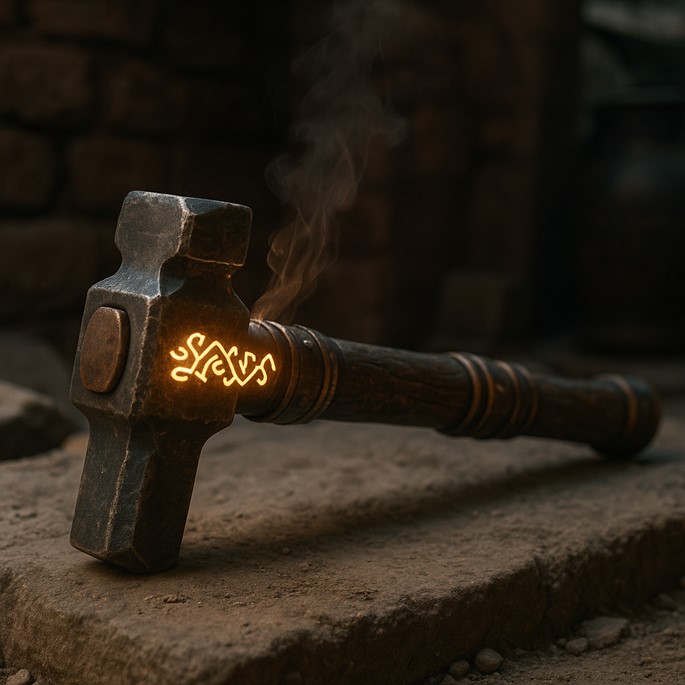
A compact hybrid between forge hammer and chisel-head maul, its edge inlaid with silver runes that hum when striking stone or metal. Each blow leaves behind faint harmonic residue, preserving structural balance instead of shattering it.
Effects:
– +1 Strength for striking or crafting rolls.
– Deals 1d6 blunt or 1d4 sonic damage (user’s choice per strike).
– Once per day, may “Harmonize” an object—repairing cracks or fractures in stone or metal by expending 10 mana or equivalent energy.
Lore: Symbol of patience and redemption among the descendants of Turrath. It is said each swing should echo in harmony with the user’s heartbeat or risk imbalance and fracture.
Expanded Lore:
Forged in the shadow of the Rockfall by the artisan descendants of Turrath, the Hammer 312 of the Shaping Echo represents the Andean philosophy that strength and restoration are inseparable. The hammer was designed by the Order of the Echo-Forge, whose geomancers sought redemption for their ancestors’ overreach that shattered the city of Turrath. Every hammer is tuned to its wielder’s heartbeat through an attunement rite that lasts three days and nights in the presence of active ley lines. During this ritual, the user must strike a single slab of obsidian 1,000 times without fracturing it—each blow syncing pulse and metal, flesh and mountain. When harmony is achieved, the hammer’s runes awaken with a silver resonance that matches the wielder’s aura.
The Shaping Echo was not meant for destruction but for correction. Its blows reinforce integrity in stone, crystal, and steel—allowing Andean builders and guardians to restore collapsed walls, mend damaged automata, and shape new paths through the mountains without defiling their essence. In times of battle, the same resonance can shatter instability, turning sound into focused force. Legends tell of miners who used it to silence earthquakes and of engineers who tuned bridge pylons to withstand centuries of storms.
The weapon’s duality—creation through restraint—embodies the core Andean maxim: “The hammer’s strength lies not in the breaking, but in the echo that follows.”
Stats (Tier 1):
• Attack Type: Melee (Bludgeoning or Sonic)
• Damage: 1d6 Blunt or 1d4 Sonic (chosen per strike)
• Weight: 3.8 lb
• Durability: 60 HP (self-repair 1 HP/hour when resting on natural stone)
• Range: Melee, 5 ft reach
• Critical Range: 19–20 (if resonating in harmony)
Skill Bonuses:
• +1 to Strength for striking or crafting rolls involving stone, metal, or crystal.
• +2 to Crafting (Smithing / Masonry) checks when shaping or repairing inorganic material.
• +2 to Arcana or Engineering when harmonizing mechanical constructs or ley-reactive devices.
Passive Magics:
- Resonant Hands: When wielded, the user gains a tactile sense of vibration—able to feel the internal stability or weakness of nearby material within 10 ft. This vibration sense helps detect cracks, stress fractures, and hollow chambers through contact.
- Echo Retention: After a successful strike or repair, the hammer emits a harmonic aftertone audible only to the wielder, guiding the next action. Each consecutive strike in rhythm grants +1 cumulative accuracy (max +3) until the rhythm is broken.
- Construct Empathy: Non-hostile mechanical beings or constructs within 15 ft recognize the hammer’s frequency as friendly, imposing disadvantage on hostile detection or aggression checks.
Activatable Magics:
- Harmonize (1/day):
– Expend 10 Mana (or equivalent energy) to mend a damaged structure, machine, or piece of armor within reach. Repairs fractures, restores up to 10 HP of integrity, and purges stress faults.
– When used on living crystalline or golemic beings, restores 1d4 vitality or removes the “fractured” condition.
– Visual Effect: silver runes brighten and pulse outward in concentric circles; the user feels their pulse echoed in the tool’s hum. - Echo Wave (2/day):
– Unleash a 10-ft cone of resonant force, dealing 1d6 sonic damage (Fortitude/Constitution save negates half). Structures struck by this wave are reinforced rather than damaged, gaining +2 AC or Defense for 1 minute.
– Useful for creating stable terrain during combat or preventing cave-ins. - Pulse of Forgiveness (1/week):
– A meditation-based activation requiring 1 minute of rhythmic breathing. Emits a resonance across 30 ft that neutralizes unstable magic in objects, calming surging enchantments or ley imbalances. This can prevent magical detonations or stabilize collapsing constructs.
Slot: Main Hand (Weapon / Tool Hybrid)
Tags:
Hammer, One-Handed, Hybrid Tool, Repair Focus, Geomantic Resonance, Steam-Era Craft, Resonant Weapon, Sonic Damage, Artisan Combatant, Construct-Friendly, Utility, Support, Tier 1, Andean Make, Ley-Bound Item, Patience-Linked, Rhythmic Craftsmanship, Harmony Relic, Hammer, Hybrid Tool, Repair Focus, Geomantic Resonance, Steam-Era Craft, Tier 1, Artisan Combatant, Construct-Friendly
The Hammer 312 of the Shaping Echo bridges the line between craftsmanship and combat. It rewards precision, rhythm, and awareness—turning each strike into a measured act of balance. Whether reforging stone bridges, pacifying mechanical guardians, or resonating defensive waves in battle, its greatest danger lies in impatience: those who strike in anger hear only chaos in the echo, and the hammer falls silent until balance is restored.
Commerce and Distribution of Hammer 312 of the Shaping Echo (Saṃsāra)
In the world of Saṃsāra, the Hammer 312 of the Shaping Echo occupies a rare and respected niche — part sacred tool, part artisan’s relic, and part battlefield utility. Though considered a Tier-1 weapon, it is not sold as common arms; it is traded through institutions that understand its dual nature as both an engineering implement and a geomantic conduit. Prices vary drastically depending on the region, cultural reverence, and local ley-line density.
1. Peakhold Foundries and Echo-Forge Halls (Andean Capital Districts)
Type: State-Licensed Artisan Guild and Temple Foundry
Environment: Mountain megacity workshops under geothermal steam vents; chanting of geomancers synchronizes with hammer strikes.
Trade Method: Purchase only after certification in the Andean Forgemaster’s Oath or approval by the Order of the Echo-Forge. Hammers are crafted individually to match the rhythm of the buyer’s heartbeat during attunement trials.
Base Price: 550–700 gold
Buy-Back Value: 400 gold if the resonance remains stable; 250 gold if dulled (requires re-tuning).
Notes: Buyers must present a Forgemaster’s License or equivalent proof of geomantic apprenticeship. Transactions are ritually recorded on Qosqo-Khipu cords, binding buyer responsibility for its ethical use (no destructive mining).
2. Stonegrower’s Cooperative Markets (Terraced Valleys and Rural Forges)
Type: Agricultural-Industrial Cooperative Bazaar
Environment: Steam-lit terraces lined with stalls of alchemists, masons, and tinkerers.
Trade Method: Barter or part-payment in raw materials—obsidian, copper dust, basalt core, or ley-charged stones. A hammer is often exchanged as a harvest tithe tool for rebuilding irrigation walls or stabilizing tunnels after storms.
Base Price: 380–480 gold or equivalent goods (often includes 30 % barter).
Buy-Back Value: 300 gold or in trade materials.
Notes: These markets see “work-worn” versions—still powerful but lacking the full harmonic attunement of the original Peakhold forges. Villagers treat them as heirlooms rather than weapons, rarely letting outsiders buy one without proof of intent to build, not destroy.
3. The Steamwright’s Bazaar (Urban Trade Arteries and Sky Docks)
Type: City-Level Industrial Market / Airship-Linked Emporium
Environment: Hanging walkways and moving platforms, with merchants shouting prices over the hiss of pressure valves.
Trade Method: Gold, Electrum, or specialized trade letters; merchants test hammers by striking bronze discs to measure resonance quality.
Base Price: 600 gold (standard issue)
Buy-Back Value: 350 gold
Notes: Often refurbished or re-inscribed versions stripped from ruins or collapsed forges. Buyers beware—falsified runes are common. Authentic pieces display continuous hums in low frequency audible only when pressed to stone. Inspectors from the Andean Temple patrol monthly to confiscate fakes.
4. Whisper Market of Chay-Uro (Black-Steam Trade Den, Coastal City)
Type: Semi-Legal Shadow Market / Relic Exchange
Environment: Tunnels beneath the docks where mist and salt-steam obscure faces. Forges run on whale-oil and captured fire spirits.
Trade Method: Silent barter or coded coin ritual; rarely open to non-Andean avatars.
Base Price: 900–1,200 gold (or equivalent in relics).
Buy-Back Value: 600 gold.
Notes: Hammers sold here are often “Echo-Splitters”—variants infused with aggressive resonance used for sabotage or tunneling. These versions lack the pacifistic balance of the true Shaping Echo and risk internal backlash (10 % chance of sonic feedback to user). Considered heretical by the Temple of Intayra but prized by rogue engineers and adventurers.
5. Museum of Industrial Harmony (Qosqo-Suma Cultural District)
Type: Religious-Academic Curio and Restoration Guild
Environment: A grand atrium of stone terraces filled with relics humming in low rhythm beneath ley-lamps.
Trade Method: Not for direct sale—only through donation exchange, heritage restoration service, or as a reward for completing state-sponsored reconstruction quests.
Base “Value for Appraisal”: 1,000 gold for pristine originals or relic-grade resonance.
Notes: The museum’s Echo Curators track the lineage of every hammer through ancient inscriptions. Returning a lost one is considered a major deed of piety. Occasionally, replicas (Tier 0 prototypes) are granted to apprentices for ceremonial use.
6. Wandering Steam-Clans and Sky-Crafters (Mobile Merchants)
Type: Nomadic Engineering Guilds
Environment: Floating caravans, cliffside elevators, or airships trading between Andean, Frithglacis, and Dawenkou.
Trade Method: Flexible—gold, artifacts, or service contracts (e.g., escorting airship convoys through ley storms).
Base Price: 450–500 gold
Buy-Back Value: 300 gold
Notes: Sky-crafters occasionally barter Shaping Echoes tuned for metalwork in thinner air, adjusted for acoustic variance. Their items are lighter and favored by aeronaut engineers who maintain the suspended terraces of flying cities.
7. Scholar’s Exchange in the Floating Colleges (Andean-Frithglacis Alliance)
Type: Magical Academic Consortium
Environment: Marble halls with suspended platforms of light; constant vibration from experimental ley devices.
Trade Method: Contractual loan or exchange for research documentation.
Base Value: 700 gold (loaned value), requires collateral item of equal resonance.
Notes: Mages and scholars study the hammer’s harmonic relationship to ley lines. Unauthorized sale or dismantling of the hammer’s copper runes carries a Class-2 violation under the Andean Arcano-Industrial Treaty.
Economic Summary Table (for contextual reference within Saṃsāra)
- Common Legal Trade Price: 450–700 gold (artisan guild or cooperative)
- Urban/Academic Premium: 700–1,000 gold
- Black Market Price: 900–1,200 gold
- Buy-Back Average: 60 – 70 % of purchase price
Commerce Notes in Saṃsāra Context
• Forged Value: The hammer’s price reflects both its craftsmanship and its moral lineage. Each is recorded in the national Qosqo-Khipu registry of Andean relics, marked by its pulse signature and rune pattern.
• Trade Ethics: Andean merchants refuse to sell to avatars whose “Mind’s Eye” reveals intentions of desecration or mass destruction. The item’s resonance weakens if sold under deceit, often producing off-key tones until redeemed through ritual cleansing.
• Cultural Significance: In most highland societies, purchasing such a hammer is akin to receiving an apprenticeship from the ancestors themselves—thus formal negotiation is accompanied by offerings of steam-cooled copper dust, salt, or obsidian shards to honor the balance between shaping and restraint.
Environment: Terraced Valleys and Agricultural Works
Defense — Roleplay: The wielder uses the hammer to steady irrigation terraces after a storm. Describe the avatar kneeling at the terrace lip, pressing the hammer’s head to a cracked retaining slab; the runes whisper and the soil tilts back to patient order. Mechanically, the user makes a Crafting (Masonry) or Engineering roll (with the hammer’s +2 bonus) to stabilize walls or pumps; success restores structural integrity (HP) and prevents a collapse event. If a sudden tremor threatens a village, the wielder plants the hammer and channels Harmonize (expending 10 mana) to hold soil and stop slippage for a minute, buying time for evacuation and repair.
Offense — Roleplay: In a valley ambush the hammer is not used to smash farmers, but to shape the terrain into a trap: a rhythmic series of Echo Wave strikes releases concussive sonic pulses that topple loose terraces behind foes, forcing retreats or creating cover. The avatar times each blow to the beat of their breath; each successful melee attack (Strength + hammer bonus) can attempt to dislodge unstable soil or knock a rider from a griffon. Use of Echo Wave here deals sonic damage and causes forced movement; describe dust, the taste of mineral on the tongue, and a ringing that dulls enemy coordination.
Environment: Peakhold Foundries and Temple Workshops
Defense — Roleplay: Inside a forge, the hammer’s resonance tempers steam-driven hammers and stabilizes ley-powered anvils. Roleplay scenes of the avatar moving like a metronome among apprentices, each strike a lesson. Mechanically, the hammer grants advantage or a flat bonus on group Crafting clocks when repairing or reinforcing massive constructs (bridge supports, sluice gates). Harmonize can be used to repair a damaged construct or purge stress faults in a golem, recovering HP or removing a condition.
Offense — Roleplay: In close quarters within a foundry, the hammer can be used to create sonic micro-shocks timed to overload an attacker’s mechanical augmentations: a focused Echo Wave aimed at an armored opponent creates discordant vibration in plates, imposing penalties to their Defense or jamming prosthetic servos. Describe sparks, a metallic screech, and the attacker’s joints seizing momentarily.
Environment: Mines, Caves, and Subterranean Tunnels
Defense — Roleplay: In low-light tunnels, the hammer’s tactile Resonant Hands ability lets the wielder “hear” hollow veins and potential collapse points. Roleplay the character inching forward, palm against wet basalt, feeling tremors magnified into warnings. Mechanically, the hammer gives automatic or boosted Perception/Listen checks to detect hollows or faults; Harmonize can be used to bind fractured supports, preventing cave-ins and saving lives.
Offense — Roleplay: When pursued underground, the wielder can use Echo Wave to induce controlled rockfalls targeted to block pursuers’ tunnels while leaving escape routes intact; describe the staccato boom, falling shale, and bearing the lingering dust. Use caution — misused pulses may destabilize ally routes.
Environment: Bridges, Causeways, and Defensive Fortifications
Defense — Roleplay: On a stone causeway under siege, the hammer is a civic tool. The wielder moves along the span, hammering rhythmically into buttresses to weave harmonic reinforcements. Roleplay the community’s confidence growing as chimes from the runes hum; mechanically the hammer provides temporary AC/structural bonuses to the bridge or fortification and reduces damage from bombardment or siege engines for a duration.
Offense — Roleplay: Offensively, the hammer can be used to turn a breached parapet into a collapsing trap for invaders by selectively weakening selected supports (narrated as “guided fractures”): repeated strikes (with appropriate checks and risk) cause portions of a wall to fall inward on attackers. This is morally fraught in Andean culture and may draw social penalties.
Environment: Open Battlefield and Siegefields
Defense — Roleplay: The hammer’s Construct Empathy soothes allied animated constructs and siege golems, allowing quick field repairs between volleys. Roleplay an exhausted engineer leaning into the hammer, feeling its pulse synchronize and the golem’s servos calm. Mechanically, the hammer can repair or stabilize constructs mid-battle (use Harmonize or a shorter repair activation), restoring temporary functionality.
Offense — Roleplay: As a melee weapon the hammer delivers sonic blows that stagger infantry or topple cavalry. Echo Wave can be used to create shock fronts that push back enemy ranks or disrupt formations; describe a ripple of sound that bends banners and sends horses rearing. Against stone or metal fortifications, the hammer’s sonic option can be tuned to fracture joints or loosen rivets, enabling follow-up demolition.
Environment: Urban Streets, Markets, and Political Spaces
Defense — Roleplay: The hammer is a civic symbol; wielders use it to repair public works, mend fountains, or recalibrate clockwork kiosks. In roleplay, an avatar wielding the hammer may broker calm by fixing a collapsed stair during a protest, earning goodwill. Mechanically, use Crafting or Persuasion/Influence interactions tied to demonstrations of service; the hammer functions as performative evidence of competence.
Offense — Roleplay: Openly using Echo Wave for sabotage in a market is taboo; Black-market variants exist but carry legal and spiritual consequence. If a character uses the hammer offensively in civic space, roleplay the social fallout: temple inspectors, Qosqo-Khipu records, and possible confiscation. Mechanically, such actions can trigger law enforcement or religious penalties, fines, or required restitution.
Environment: Ritual Sites, Peakshrines, and Ceremonial Uses
Defense — Roleplay: In a Peakshrine the hammer’s pulse is part of ritual protection; placed at sacred thresholds it harmonizes and wards spaces, reducing the chance of corruptive surges or malevolent ley influence. Mechanically, the hammer grants bonuses to communal ritual rolls, improves resistances to magical backlash, and lengthens the stability window for complex rites.
Offense — Roleplay: Weaponized ritual is heresy; using hammer magics offensively in a shrine risks Intayra’s displeasure. Any offensive activation here should be narratively heavy and come with consequences (loss of favor, diminished blessings, community censure).
Social & Cooperative Roleplay Applications
— As Trust and Credential: Presenting the hammer in negotiations signals craftsmanship, responsibility, and membership in Andean guilds. Roleplay merchants or Stonegrowers deferring to the bearer, easing trade or access. Mechanically, allow modest social bonuses (Credibility, Persuasion) when the hammer is used in civic demonstrations.
— As Teaching Tool: Masters teach apprentices by synchronizing hammer strikes; roleplay training scenes where rhythm and breathing are emphasized. The hammer grants faster learning clocks or lowers DCs for crafting training when used properly.
— As Bargaining Chip: A genuine Shaping Echo can be pledged as collateral for reconstruction contracts or loaned to communities under strict conditions; roleplay ceremonial handovers and Qosqo-Khipu registrations. Mechanically, loans may reduce price or speed construction but impose obligations.
Tactical Combinations & Teamplay
— With Ley-sensing Headgear (Helm of Ley-Threaded Sight): The helm maps disruptions; the hammer then mends them with precision. Roleplay a duo where one reads currents and the other strikes in response; mechanically, coordinated actions grant advantage or combined bonuses to stabilization rolls.
— With Staffs and Greaves: A staff can hold ley currents steady while the hammer performs fine repairs; greaves provide mobility to reach hazards. Combine activations for extended stability zones or synchronized Echo Waves for larger area effects.
Skill & Mechanical Guidance (Suggested Checks)
— Detecting faults or hollows: Perception/Listen (plus hammer’s passive) or Engineering/Arcana.
— Stabilizing structures: Crafting (Masonry) or Engineering check, hammer adds +2; Harmonize restores HP up to its cap.
— Using Echo Wave offensively: Strength or Melee attack roll + hammer bonuses; targets make Fortitude/Con Save or suffer sonic effects/knockback.
— Repairing constructs: Crafting (Smithing) or Arcana/Engineering with hammer’s +2; Harmonize consumes 10 mana and restores HP or removes a condition.
Positives to Roleplay Emphasize
— Patience and rhythm: The hammer rewards measured play; characters emphasizing timing gain mechanical stacking bonuses.
— Community utility: The item is a way to build ties, earn favors, and claim stewardship.
— Versatility: Serves both as artisan tool and battlefield support without being purely offensive.
Negatives, Risks, and Roleplay Costs
— Mana/Resource Cost: Harmonize and some activations require 10 mana or equivalent—mishandling depletes caster reserves.
— Cultural Consequence: Using the hammer destructively or for profiteering risks Intayra’s displeasure, legal action, or reduced communal trust.
— Backlash and Overstress: Repeated or ill-timed Echo Waves can destabilize nearby weak structures, harming allies or causing collateral damage. Describe ringing ears, hair standing from residual charge, or a painful chest throb if the wielder breaks rhythm.
— Attracting Attention: The hammer’s hum can draw spirits, enforcers, or other geomantic predators; roleplay eerie whispers or official inspectors arriving days after aggressive use.
— Maintenance Need: Genuine Shaping Echoes require periodic attunement to ley lines (ritual striking and rest); neglect reduces effectiveness and raises failure chance.
Narrative Prompts to Use at Table
— “You press the hammer’s face to the fractured buttress; your heartbeat slows as the runes answer. Roll Crafting + hammer bonus.”
— “Dust and steam fill the air as the Echo Wave booms; any small structures in the cone are reinforced, but loose shutters fall—where do you aim?”
— “An elder watches your rhythm. If you keep the beat through three actions, gain a stacking accuracy bonus; if you miss, suffer a 1-round penalty as the hammer goes discordant.”
The Hammer 312 of the Shaping Echo is a tool of covenant: it advances defense by mending, stabilizing, and calming both stone and steam, and advances offense by converting harmony into controlled force, shaping battlefield geometry rather than mindless destruction. Roleplay should stress rhythm, restraint, and communal consequence—success feels like a measured breath; failure rings like a broken bone.
Perception of Activation:
User’s Perspective:
The instant the wielder grips the haft and channels focus, a deep vibration hums through the bones of the forearm and up into the chest, syncing to their heartbeat until both rhythm and pulse are one. The obsidian head begins to glow from within—first red as magma, then cooling to a golden-white resonance. Each breath feels heavy with metallic scent, mixed with the mineral tang of wet stone and copper dust. Sound thickens in the air; the hammer’s impact is felt before it’s heard, a low frequency that seems to echo inside the skull. Every surface nearby reveals faintly luminous cracks of energy, showing their inner stress like veins beneath the skin. The wielder senses, more than sees, the mountain’s pulse—slow, ancient, deliberate. When the Resonant Pulse releases, it feels like exhaling a contained storm: light bursts, heat rolls outward, and the air warps with pressure.
Extrasensory awareness blooms for the briefest span—the avatar perceives ley lines as rivers of molten light beneath the ground, hears the mechanical heartbeat of steam engines, and tastes the vibration of distant tectonic plates. Emotions of patience, weight, and endurance emanate from the hammer’s core, pressing against the wielder’s thoughts as though urging moderation.
Observer’s Perspective:
To onlookers, the wielder’s silhouette ripples with heat mirages; the hammer glows and exhales rhythmic clouds of golden steam. The sound it emits is more felt than heard—like a distant drum echoing through stone. When it strikes, the vibration passes through solid ground; pebbles leap and tools rattle, yet the wielder stands unmoved at the center of the disturbance. Faint harmonic rings ripple outward, visible to those with any geomantic sensitivity, revealing flickers of ghostly patterns in the air as the ley currents realign.
Positives:
– Amplifies awareness of terrain and structure; enables intuitive detection of faults or imbalances.
– Provides spiritual equilibrium—attunement steadies the user’s emotional state, reducing panic or anger.
– Generates protective resonance, dampening incoming shockwaves and aiding allies’ footing.
– Acts as a bridge to the earth’s deeper flow, allowing rapid synchronization for geomantic spells or steamcraft.
Negatives:
– Overexposure to resonance induces tremor fatigue: hands may shake, hearing dulls, and vision swims in rhythmic distortion.
– Improper alignment of breathing with hammer rhythm causes internal echo—painful harmonic backlash reverberating through bones.
– Prolonged activation attracts elemental attention: dormant earth spirits, curious constructs, or ley-siphoning entities drawn by the pulse.
– Untrained avatars risk emotional bleed—absorbing the hammer’s patience can slip into apathy or slowed reaction times.
– Physical cost includes dehydration and overheating; the scent of iron fills the mouth as the user’s internal balance strains to match the hammer’s pulse.
In essence, activation feels like standing at the heart of a living mountain—hearing its slow music through the bones, shaping power not through rage but through rhythm. To wield it properly is to breathe with the world itself, knowing that even the smallest discordant swing might awaken the stone’s slumbering memory.
Recipe Title: The Forging of the Shaping Echo — Hammer 312 Reconstitution Rite
Materials Needed:
- Basalt Heartstone (x1): A solid chunk of volcanic basalt infused with dormant ley energy; harvested from the cooled vents of Andean’s deepest forges during the Terracelight moon. Must retain internal obsidian veins visible as silver-black marbling.
- Silver Resonance Filament (x3): Fine silver wire drawn and purified through vibration casting; it hums faintly when touched. Used to channel and stabilize harmonic currents between the hammer’s head and handle.
- Copper Coil Strand (x2): Flexible, high-conductivity copper wound into double spirals; must be annealed using steam from a geomantic vent to absorb trace mana.
- Runic Dust of Turrath (x1 pouch): Pulverized remnants of ancient runes once carved into the ruins of the Rockfall city, symbolizing endurance through collapse.
- Forgemilk Alloy (x1 ingot): Secret alchemical blend of bronze, quartz sand, and powdered magnetite; creates the internal counterbalance for rhythmic feedback.
- Heart Ember (x1): A small crystallized fragment of elemental fire or alchemical heat source to anchor the hammer’s pulse core.
- Condensed Steam Capsule (x1): Captured from the peak vents of Peakhold’s foundry quarter; contains purified steam infused with ley vapor, used to prime the hammer’s breathing cycle.
- Binding Oil of Patience (x1 vial): Alchemical resin made from moss oil, basalt ash, and powdered copper, applied between crafting stages to slow energy release during forging.
Tools Required:
– Geomantic Anvil: Carved from magnetite-laced stone, harmonized to local ley line frequencies.
– Steam-Driven Hammer Rig: Mechanical striking apparatus powered by controlled pressure vents to maintain consistent rhythm.
– Runic Chisel Set: Precision tools for inscribing harmonic glyphs and resonance symbols.
– Aether Tongs: Bronze-plated tools used for gripping heated objects charged with magical current.
– Temperature Crystal Gauge: Measures magical heat output to prevent over-forging or ley destabilization.
– Vibration Lens (optional): A monocle or lens device that allows the smith to visualize harmonic flow through the metal during work.
Skill Requirements:
– Forging & Metallurgy (Advanced): To temper basalt and alloy together without fracture.
– Runecraft (Intermediate): To properly inscribe harmonic sigils without counter-resonance.
– Geomancy (Intermediate): To align the hammer’s rhythm with local ley flows during infusion.
– Steamcraft Engineering (Basic): For managing heat and vent pressure without disrupting the pattern.
– Meditative Focus: A steady heartbeat and rhythmic breath are required during activation stages to maintain harmonic integrity—failure results in resonance backlash or spontaneous discharge.
Crafting Steps:
Step 1 – The Pulse Awakening:
Clean the basalt heartstone in flowing water from a mountain spring. Place it upon the geomantic anvil and strike it three times with a neutral hammer while breathing in rhythm (inhale during rise, exhale during fall). Each impact awakens the stone’s internal vibration; a faint hum signals readiness.
Step 2 – Alloy Unification:
Melt the Forgemilk Alloy in a crucible under blue flame (approx. 1,500°C). Stir with a copper rod while chanting the first line of the Stonegrower’s Cant: “Turrath awakens, but not to devour.” Once molten, pour the alloy over the basalt heartstone in thin layers, ensuring the obsidian veins remain exposed.
Step 3 – Runes of Binding:
While the hammerhead remains warm, etch runic channels using the Runic Chisel Set. Each symbol should correspond to harmonic frequencies of endurance, balance, and creation. Dust the grooves with Runic Dust of Turrath, letting it fuse naturally as the metal cools.
Step 4 – Resonant Vein Infusion:
Wind the Silver Resonance Filaments through the runic channels, embedding them just beneath the surface. Apply Binding Oil of Patience between windings to prevent resonance bleed. Then, wrap the copper coil strands around the hammer’s neck, connecting to the silver lattice; this creates the harmonic feedback network.
Step 5 – Pulse Core Installation:
Place the Heart Ember within a shallow cavity carved into the hammer’s center. Seal it with Forgemilk Alloy while channeling controlled bursts of steam from the Steam-Driven Hammer Rig. The smith must hum a low note matching the mountain’s resonance (determined via ley attunement or local geomantic readings). When the ember’s glow synchronizes with the smith’s pulse, the core is stable.
Step 6 – Steam Breath Initiation:
Insert the Condensed Steam Capsule into the lower haft housing. When struck lightly with the Aether Tongs, it releases a hiss that travels the length of the handle—this is the hammer’s “first breath.” Allow it to cool naturally within the workshop; no forced quenching or magical freezing may occur.
Step 7 – Final Harmonization:
Once cooled, perform the Harmonization Rite: plant the hammer upright into living stone (preferably basalt or granite) and strike the ground five times at equal intervals. Each impact should ring with an identical tone. If the fifth note wavers or dulls, disassemble and repeat Step 4; the resonance alignment is imperfect. When all five notes resonate true, inscribe your maker’s rune beneath the haft wrap to bind the hammer’s name to your lineage.
Completion Result:
Upon success, the Hammer 312 of the Shaping Echo hums faintly in the user’s grip, responding to their breathing rhythm. When first activated near stone or metal, it emits a deep harmonic pulse that feels alive—proof that the mountain’s heart has accepted its new voice.
Failure Consequence:
If the smith’s rhythm falters during Harmonization, the Heart Ember destabilizes, releasing uncontrolled sonic feedback that can crack stone and rupture eardrums within a 10-foot radius. Failed hammers are either entombed in rock vaults or reforged by masters under Peakhold sanction.
Estimated Craft Time:
— 3 full days continuous forging under ley-aligned conditions.
— Cooling and harmonic testing: 12 additional hours.
Approximate Resource Cost (Saṃsāra Market Values):
— Materials: ~700 silver (≈70 gold)
— Labor & heat sources: 15 gold
— Total finished value: ~250–300 gold (varies by region, lineage mark, and resonance purity).
A properly forged Hammer 312 resonates softly when left on stone, as though remembering the rhythm of its creator’s breath.
Echo Beneath Hammer’s Heart
(Recovered from the Fragmented Scrolls of Chay-Uro; translated through three tongues and reinterpreted from the broken dialects of the First Stonegrowers. Words cracked like the peaks from which they fell, their meaning only half-remembered by those who shaped them anew.)
In the long-before, when the mountains were still soft and the skies wept molten tears, there was a forgeman named Qashtel of the Low Terrace, who heard the voices of stone in his sleep. He was born in a time of sorrow, when the Rockfall had already taken the proud city of Turrath, and no hammer dared to sound against the mountain for fear it might awaken wrath once more. But Qashtel was stubborn, and his heart throbbed like a forge unquenched. He believed that the mountain did not hate—only listened—and that the fault was not in the peaks, but in the silence of those who no longer dared to strike.
So Qashtel journeyed alone to the Hollow Forge, where steam bled through cracks in the obsidian veins. There he found a broken heartstone, split clean by the fall of Vorzul’s quarry-machine, still humming faintly with the voice of the earth. He pressed his palm to it and felt not anger, but exhaustion. And so he spoke, saying, “If you would hear again, I shall shape your sorrow into song.” The heartstone, it is said, wept through steam—not tears of water but of heat—and agreed.
Qashtel worked for seven nights beneath the trembling sky. He shaped the basalt heart with blows not of rage but of rhythm, breathing in as he lifted the hammer, breathing out as he struck. Yet he owned no true hammer, for all such tools had been forbidden after Turrath’s ruin. So he shaped his own, crude and bare, from scraps of copper, stone, and faith. He called it the Shaping Echo, though in his tongue the word was older—perhaps Aqshul, perhaps Echoska, the meaning lost between the cracks of centuries.
The forging was not quiet. The mountains answered. At each strike, the air thrummed, and each echo called a forgotten memory from the stone—songs of builders, laments of the fallen, laughter of those who once lived upon the terraces. Steam rose like ghosts, whispering their unfinished verses. But the louder Qashtel struck, the heavier his hand became, for the hammer grew aware of its own sound, and the weight of remembrance began to pull against him.
On the fifth night, the hum grew unbearable. The mountain’s voice merged with his own heartbeat until he could no longer tell which was which. The story says he struck a final time and fell silent, his hand upon the heartstone, his breath spent. The echo of that last blow traveled down into the deep ley veins, where it met the pulse of Saṃsāra itself. For a moment, every forge on the island flared with blue light, every anvil sang, and even the stones beneath Peakhold quivered as though bowing in respect.
When dawn came, Qashtel was gone. In his place lay a hammer of obsidian-veined basalt, its surface etched with runes that pulsed like veins beneath the skin. The heartstone had not been shattered—it had been bound into the hammer’s core, sealed by steam and song. Those who touched it thereafter heard faint heartbeats through their palms, though none could say if it was the hammer’s or their own.
The new Stonegrowers feared it, yet revered it. They took it to the Grand Peakshrine, where the priests of Intayra declared: “This hammer speaks not of destruction, but of correction. It sings when the world is cracked, and we must learn to listen.” They used it to mend fissures in temples, to heal broken gear teeth, and to restore ley conduits torn by imbalance. But always they did so in silence, listening to the rhythm of their own hearts, for it was said that one must not forge in haste or anger while the hammer breathes.
As centuries turned, the Shaping Echo became legend. Some said it now rests in a sealed forge beneath the terraces of Qosqo-Suma, still humming faintly through the stone. Others claim it continues its journey, passed between smiths who awaken in dreams to the mountain’s murmur. Scholars have found faint inscriptions on its head—half eroded, half rewritten:
“Strike not to break, but to remind.”
And yet, others believe the hammer waits to sound again, when another heart like Qashtel’s dares to strike in rhythm with the mountain once more.
Moral of the Story: To wield strength without rhythm is to shatter both self and stone. Only those who listen to the heartbeat beneath their own may shape the world without breaking it.
Suggested conversions to other systems:
CALL OF CTHULHU (7th Edition)
Item Name: The Shaping Echo Hammer 312
Type: Magical/Artisan Weapon – Tool/Focus (One-Handed Maul)
Era: Mythic Industrial / Steam-Age
Description:
A basalt and copper hammer veined with obsidian and faintly glowing runes. When struck against any solid surface, it emits a low-frequency vibration that can either stabilize or shatter, depending on the wielder’s intention. It hums faintly when ley energy or magic is nearby.
Game Mechanics:
• Base Damage: 1d6+1 (Blunt); or 1d4+1 (Sonic, when Harmonized).
• Bonus: +10% to Mechanical Repair, Geology, or Craft (Smithing/Stonework) rolls.
• Resonant Pulse (1/day): The wielder may expend 1 Magic Point to emit a harmonic blast in a 10-ft cone. Deals 1d8 sonic damage to creatures and disorients fragile constructs (CON vs. 40 to resist stun).
• Harmonize Structure (1/day): By spending 2 Magic Points and making a successful Craft (Metalwork or Masonry) roll, the user can repair cracks or minor fractures in a metallic or stone object (up to 10 HP of structural integrity).
• Geomantic Sensitivity: When within 20 ft of magical or unstable ground, the wielder feels rhythmic vibrations (automatic awareness check at 60% success).
• Sanity Loss Risk: Improper synchronization or overuse of harmonics causes a 0/1D2 SAN loss due to mental resonance.
Special Rules:
Improper forging or emotional instability while using the hammer may cause feedback damage (1 HP per failed CON roll when using Resonant Pulse).
Value: ~250 gp equivalent (Artifact-tier).
BLADES IN THE DARK
Item Name: Shaping Echo Hammer (Fine Tool/Weapon)
Quality: Fine; Rare (Tier II artifact-level tool)
Description:
A rune-etched hammer that vibrates with the heartbeat of stone and metal, used by ancient Andean geomancers to restore ley balance.
Game Mechanics:
• Load: 2 (counts as both a weapon and crafting tool).
• Effect: When used in downtime or action rolls related to Tinker, Wreck, or Attune, grants +1d.
• Special Ability – Harmonize (1/session): Spend 1 stress to stabilize or destroy a structure. Stabilizing removes one level of “Instability” from machinery or buildings; destructive use inflicts severe resonance collapse (+1d to damage on Wreck rolls).
• Attune Effect: When used to channel ambient aether, the hammer allows brief perception of ley lines or vibration-based ghosts. Controlled success restores balance; critical failure invites echo spirits (GM consequence).
• Devil’s Bargain Option: The mountain remembers your swing—gain +1 effect but attract geomantic backlash or spirit attention.
Price/Acquisition: Tier II relic, requires special acquisition roll (6-clock to locate).
DUNGEONS & DRAGONS (5th Edition)
Item Name: Hammer 312 of the Shaping Echo
Wondrous Item (Weapon, Warhammer) – Rare (requires attunement by an avatar proficient with smith’s tools or mason’s tools)
Weapon Type: Warhammer (Versatile, 1d8 bludgeoning / 1d10 two-handed)
Properties:
• Harmonic Attunement: Grants +1 bonus to attack and damage rolls made with this magic weapon.
• Resonant Strike: Once per long rest, the wielder can release a sonic pulse (15-ft cone, DC 13 CON save). Creatures that fail take 2d8 thunder damage and are pushed 10 ft; success halves damage and prevents push.
• Harmonize Material: Once per day, the hammer can repair a damaged metal or stone object or structure, restoring up to 10 hit points of structural integrity.
• Ley Sense: The wielder can detect magical auras or ley-line disturbances within 30 ft (functions as Detect Magic but only for ground/structural enchantments).
• Temper of Turrath: While attuned, you gain advantage on Strength (Athletics) checks related to crafting, construction, or lifting stone.
Curse / Drawback: Overuse creates fatigue and internal tremors; after three activations in one day, make a DC 12 CON save or gain one level of exhaustion.
Value: 275 gp (Tier I magic weapon).
KNAVE (System-Neutral OSR-Compatible)
Item Name: Shaping Echo, the Harmonist’s Hammer
Slot: Weapon / Tool (1 slot)
Rarity: Rare, Tier I Artifact
Description:
A hammer that sings with the heart of the earth. Its strikes balance between destruction and renewal, guided by the wielder’s discipline.
Stats & Mechanics:
• Attack: As a warhammer (1d8 damage). Choose to deal blunt or sonic (vibrational) damage each strike.
• Passive Effects:
– +1 to STR-based checks related to crafting or repair.
– Hear ley vibrations or hollow spaces within 30 ft (GM discretion).
• Active Abilities (1/day each):
– Resonant Pulse: 10-ft cone; 1d8 damage, push 5 ft.
– Harmonize: Repair up to 10 points of structural damage or 1 broken non-magical item.
• Drawback: Each time the hammer’s powers are used, roll a WIS save (DC 13). On failure, user suffers disorientation or “echo fatigue” (disadvantage on next action due to internal resonance).
Special Note:
If used to break stone or metal recklessly, 1-in-6 chance of Ley Feedback—user takes 1d4 damage and nearby objects hum ominously.
Market Value: 280 gold equivalent; requires trade with geomantic artisans or smithing guilds.
FATE CORE
Item Name: Hammer 312 of the Shaping Echo
Aspect: “The Stone That Sings in Rhythm with the Heart”
Item Type: Signature Tool / Relic Weapon (Tier 1 Geomantic Artifact)
Description:
A hybrid forge-hammer of copper, basalt, and obsidian filigree. Its head vibrates faintly, echoing the beat of ley lines that run through the mountains of Andean. Each strike hums with harmonic resonance, repairing or breaking based on the wielder’s emotional rhythm.
Invoke:
• Add +2 to Crafts, Create Advantage, or Overcome rolls involving stonework, construction, or mechanical stability.
• Once per scene, reroll a failed Attack or Create Advantage if the action involves vibration, sound, or structural manipulation.
Compel:
• The hammer amplifies emotional instability—anger, haste, or fear causes feedback. GM may compel the aspect to create dissonant resonance, risking collateral damage.
Stunts:
• Resonant Pulse (1/Scene): Spend 1 Fate Point to unleash a 10-ft sonic wave (Weapon:2) that can also clear rubble or destabilize a weak structure.
• Harmonize the Stone: Once per session, automatically succeed on a repair or stabilization roll if given enough time (about a scene). The hammer hums as if “healing” the broken material.
• Geomantic Awareness: You always know when the ground, structure, or device you stand on is unstable or magically infused.
Drawback:
If used for destruction three times in a scene, roll Will. On failure, the hammer’s resonance overwhelms the wielder with echoes of the mountain (gain the temporary aspect Ears Ringing with the Deep).
Value: 3 Refresh-equivalent relic; uncommon among Andean craftsmen.
NUMENERA & CYPHER SYSTEM
Item Name: Hammer 312 of the Shaping Echo
Level: 4 (Artifact)
Form: Steam-forged hammer of obsidian and copper, humming faintly with ley energy.
Effect:
• The wielder gains +1 to Might or Intellect tasks related to crafting, repairing, or detecting vibrations in stone or metal.
• As an action, may emit a Resonant Pulse (10-ft cone, Level 4 attack; targets take 4 points of damage and are moved back 1 space).
• Once per hour, the wielder may perform the Harmonize Object ability, repairing up to 10 points of damage to a structure, armor, or artifact.
• When embedded into natural ground, the hammer stabilizes ley currents, granting +2 to all checks to resist geomantic anomalies within short range.
Depletion: 1 in 1d20 (when using Resonant Pulse or Harmonize).
Wearable: One-handed weapon or tool.
GM Intrusion: The hammer’s resonance awakens buried echoes—sudden tremors or auditory hallucinations cause confusion (Intellect defense task, difficulty 3).
Value: Artifact-grade; sought by builders and Stoneweavers across Saṃsāra.
PATHFINDER 2E
Item Name: Hammer 312 of the Shaping Echo**
Item Type: +1 Striking Warhammer / Magical Tool (Tier 1 Artifact)
Level: 5
Price: 280 gp
Usage: One hand; Bulk 1
Traits: Magical, Sonic, Earth, Artifact, Andean
Activation (2 actions): Resonant Pulse (concentrate, manipulate, sonic)
You strike the ground, sending out a harmonic wave in a 15-foot cone. Each creature in the area must attempt a Fortitude save (DC 18).
– Critical Success: Unaffected.
– Success: Takes half damage.
– Failure: Takes 2d8 sonic damage and is pushed 5 feet.
– Critical Failure: Takes double damage and is knocked prone.
Passive Effects:
• You gain a +1 item bonus to Crafting checks involving stone, metal, or earth.
• When performing a Repair action, you restore an additional 10 HP to the target structure or object.
• You sense structural weaknesses and hidden hollows within 20 ft (similar to tremorsense).
Once per Day – Harmonize Material:
As a 10-minute ritual, you can repair cracks or fractures in stone or metal up to a 10-foot area. The restored area becomes magically reinforced (+1 Hardness for 24 hours).
Curse (Backlash of Dissonance):
After three activations in one hour, make a DC 15 Fortitude save or become sickened 1 from resonance feedback.
Craft Requirement: Expert Crafting, Magical Crafting feat, knowledge of geomancy or steamcraft.
SAVAGE WORLDS (Adventure Edition)
Item Name: Hammer 312 of the Shaping Echo
Category: Magical Melee Weapon (Relic, Tier 1)
Weight: 3 lbs
Cost: 250 gp equivalent
Damage: Str+d6 (Bludgeoning) or Str+d4 (Sonic, chosen each attack)
AP: 1
Parry Bonus: +1 (while used defensively)
Special Abilities:
• Harmonize (1/Day): Spend 2 Power Points to repair any damaged metallic or stone object within Smarts range, restoring 1d8 durability or Toughness points.
• Resonant Pulse (1/Combat): Release a 10” cone of vibrational energy; targets must make a Vigor roll (–2). On failure, take 2d8 damage and are pushed back 1d4”.
• Ley Sense: Grants +2 Notice to detect vibrations, ley disturbances, or hollow terrain.
• Balance of Turrath: When used with the Repair or Crafting Edge, add +2 to rolls; success with a raise doubles repair efficiency.
Drawback:
Each activation in the same scene imposes a cumulative –1 penalty to all Agility-based rolls until a short rest, as the wielder’s bones resonate painfully.
Notes on Roleplay Use:
The hammer “breathes” in rhythm with its user, producing faint steam puffs that match their heartbeat. Wielders are encouraged to describe resonance, environmental hum, and the emotional tone of each strike—its strength lies in temperance, not fury.
SHADOWRUN (6th Edition)
Item Name: Hammer 312 of the Shaping Echo
Category: Melee Weapon / Artisan Focus (Rare Geomantic Relic)
Availability: 12R Cost: 10,500¥ Skill: Clubs (Strength + Agility)
Damage Value: 5P AP: –1 Reach: 0
Special: Sonic / Elemental (Resonance), Artisan Enhancement
Description:
A relic from pre-industrial Saṃsāra, this basalt-and-copper hammer hums in perfect harmony with ley currents. Its rune-etched core resonates through nearby materials, altering the way kinetic energy travels through stone and metal.
Game Mechanics:
• Resonant Pulse (Complex Action): The wielder can release a 10-meter cone of concussive resonance (DV 5S, resisted by Body + Willpower). Unprotected electronics or drones in the area must make a Device Resistance Test (Rating x 2, threshold 3) or glitch due to harmonics.
• Harmonize Material (1/hour): Expend 1 Edge to repair up to 5 Structure damage to any object made of stone or metal.
• Artisan’s Focus: While wielding, gain +2 dice to Artisan or Engineering tests involving physical materials (metalwork, masonry, architecture).
• Geomantic Feedback: On a Glitch or Critical Glitch, user suffers 2S unresisted damage from vibrational feedback and must succeed on a Composure (Willpower + Charisma, threshold 2) test to avoid disorientation for one round.
Notes:
Illegal in corporate territories due to ley interference; often found in black-market collector circles or geomantic enclaves.
STARFINDER (2nd Edition)
Item Name: Hammer 312 of the Shaping Echo
Item Level: 5 Price: 2,800 credits Bulk: 1 Hands: 1
Weapon Type: Advanced Melee (Bludgeon / Sonic Hybrid)
Critical Effect: Knockdown
Description:
This copper-veined obsidian hammer emits rhythmic sonic waves that realign structural stress. Originally crafted by Andean Stoneweavers, the weapon’s harmonics can mend as easily as they can destroy.
Game Mechanics:
Damage: 1d8 B + 1d4 Sonic
Critical: Knockdown (Reflex DC 14)
Special: Analog, Powered (10 charges, usage 1/activation), Magic, Artifact
Passive: +1 circumstance bonus to Engineering checks involving stone, metal, or ley conduits.
Active (Resonant Pulse, 1 charge): Emit a 15-ft cone of sonic energy (Reflex DC 14 for half; 2d6 sonic damage).
Harmonize Structure (2 charges, 10 min): Repair up to 10 HP of damage to any inorganic object, construct, or structure.
Ley Awareness: Detect structural flaws or energy flow lines within 30 ft (akin to Detect Tech).
Drawback: Overuse (3+ activations/day) forces a Fortitude DC 12 save or take 1d4 nonlethal feedback damage as the vibrations overwhelm the wielder.
Lore Use: Commonly wielded by archaeomancers and engineers aboard geomantic starships built from Saṃsāra’s volcanic alloys.
TRAVELLER (Mongoose 2nd Edition)
Item Name: Hammer 312 of the Shaping Echo
Type: Advanced Tool / Melee Weapon
TL: 13 Mass: 1.5 kg Cost: Cr12,000
Description:
A cross between a forge hammer and precision resonance calibrator, the Shaping Echo is an ancient Andean relic of engineering lost to pre-Imperium civilization. Its ley-reactive alloys hum faintly in gravity fields, adapting their harmonic output to local geology.
Game Mechanics:
Weapon Traits: Melee (Crushing), Power (Rechargeable), Sonic (Variable Harmonic)
Damage: 2D6 (Crushing) or 1D6+1 (Sonic, ignores 2 points of armor)
Special:
• Harmonize (1/day): Repair up to 5 Hull or 10 Structural Points to any vessel, outpost, or artifact made of stone/metal by spending 1 Power Cell charge.
• Resonant Pulse: May create a 5-meter cone sonic burst (targets make END or DEX roll 8+ to avoid being Stunned for 1D3 rounds).
• Engineering Aid: Grants DM+1 to all Engineering (Structural or Mechanical) checks while equipped.
Failure / Backlash:
On a natural roll of 2 when using sonic mode, the harmonic feedback causes 1D3 damage to the wielder and disables the hammer for 10 minutes while it recalibrates.
Market: Sold only on black research markets or recovered from lost Andean ruins. Possession requires a TL-13 license in Imperial space.
WARHAMMER (Fantasy Roleplay 4th Edition)
Item Name: Hammer 312 of the Shaping Echo
Type: Magic Weapon (Hand Weapon)
Rarity: Very Rare Encumbrance: 2 Availability: Restricted (requires Master Smith’s Guild endorsement)
Description:
Forged in an age when steam and rune-song entwined, this obsidian-headed hammer resonates with the pulse of the earth. Each blow hums through the stone like a low hymn, repairing cracks or shaking enemies to the core.
Game Mechanics:
Weapon Profile:
– Damage: SB+5
– Qualities: Damaging, Impact, Magical, Pummelling (1), Repairing
– Encumbrance: 2
– Group: Hammer
Special Abilities:
• Harmonize (1/day): Make a Trade (Smithing or Engineering) Test at +20. On success, the wielder may repair 1 point of armor damage or heal 1D10 structural points to a stone/metal object.
• Resonant Pulse (Free Action once per Encounter): All creatures within 3 yards must make a Toughness Test or take 1D10+3 damage and become Prone.
• Ley Sensitivity: When standing on stone or earth, gain +10 to Perception and +1 Advantage when using defensive stances.
• Faith of the Forge: Those with the Blessing of the Forgefather Talent can instead channel one Resolve Point to double the effect of Harmonize or Pulse.
Corruption Risk: Overuse or use in wrathful intent risks ley backlash—GM may require a Cool Test or impose 1 Corruption Point as the hammer “remembers” the misuse.
Price: ~300 Gold Crowns in Dwarven vault trade; priceless to Andean smiths.
Comments
One response to “Hammer 312 of the Shaping Echo”
[…] “Hammer 312 of the Shaping Echo”Type: One-handed War-Tool (Melee / Utility)A compact hybrid between forge hammer and chisel-head […]