
From: Lineage 4172 of Akkad Kuri
- Slot: Foot (left and right, one item)
- Rank: Tier 1, Common
- Armor Check: +2
- Attunement: Simple, one minute
- Weight: 2 pounds
- Item health points: Resilience 10
- Description: Soft-soled boots of dark leather, scuffed at the toes, with a small wedge mark pressed into each heel. The soles are layered felt and thin cork treated with alchemical resin.
- Abilities:
- Quiet Step: While attuned, the wearer’s footsteps make no sound on stone, tile, or packed earth when moving at half speed or slower.
- Sure Footing: The wearer has advantage on saves against falling prone on wet clay, loose gravel, or ash-covered ground.
- Suggested value: 30 silver
Lore
The archive hall of Balawat keeps two rules about feet. The first is that no one runs. The second is that no one walks unheard and unrecorded at once. The boots exist because of the tension between those two rules, and they are older than the mantles and almost as old as the hall.
In the first centuries of the hall, the lower vaults held shelves of unfired tablets, drafts and working copies that had not yet earned the kiln. Unfired clay is fragile. The keepers found that hard-soled boots on stone sent a tremble through the shelving, and that after a busy day fine cracks appeared in drafts that no one had touched. The bench-mothers ordered soft soles for everyone who went below. A family of cobblers on the lower street, the Enkiru household, took the commission and has held it ever since. They layered felt over thin cork and sealed it with an alchemical resin that kept the damp out and the sound in. The vaults fell quiet, and the cracking stopped.
The quiet brought a new trouble. Within a generation, tablets began to go missing from the lower shelves. A scribe who makes no sound can stand behind a keeper’s back and not be noticed, and several did. The keeper of that time, whose name the hall records only as the Grey Aunt, did not ask for louder boots. She asked the Enkiru cobblers to press a small wedge into each heel, a different arrangement for each wearer, deep enough to leave its shape in dust. She then stopped sweeping the lower vaults. From that day the floors kept their own register. Any keeper with a lamp could read who had walked to which shelf, and in what order, since the last sweeping.
The thefts ended. The custom did not. To this day the lower vaults are swept only on the first day of each month, by the senior keeper alone, after she has read the floor. Scribes of the hall say that a Keeper of the Wedge signs her work twice, once with her stylus and once with her heels. A scribe who wishes to move without leaving her mark must go barefoot, and bare feet on vault stone are their own confession.
The wedge in a heel is assigned by the vault keeper and entered in a ledger that never leaves the hall. Nin-Tuppi’s mark is two wedges set point to point, given to her by Iltani when she was a runner. The same mark has been pressed into every pair she has worn since. This pair is her fourth. The scuffing at the toes comes from the quarry paths above the town, where she still walks to visit the faces her grandfather tallied. The Enkiru cobblers have offered twice to replace them, and she has declined.
Some later pairs carry a refinement that the cobblers do not advertise. A wearer who knows the trick can still the mark in her heels for a short time and leave clean dust behind her. The Enkiru household says this was added for scribes who carry sealed decrees and must not be followed. The keepers say it was added because someone paid for it. Both accounts agree that a keeper who finds a gap in the floor’s record knows exactly what kind of boots made it.
Assigned Values
- Specific slot: Foot (left and right together count as one item and fill both foot slots)
- Tier one stats:
- Armor Check: +2
- Agility: +1 while attuned
- Speed: +5 feet per turn on stone, tile, or packed earth
- Item health points: 10 plus the wearer’s maximum health points
- Charges: 2, regaining 1 at each Helios up
- Skills gained while openly worn:
- Stealth: +1 temporary skill point
- Balance and Climbing: +1 temporary skill point
- Tracking (reading footprints and floor dust): +1 temporary skill point
Passive Magics
- Quiet Step: While attuned, the wearer’s footsteps make no sound on stone, tile, or packed earth when moving at half speed or slower.
- Sure Footing: The wearer has advantage on saves against falling prone on wet clay, loose gravel, or ash-covered ground.
- Signed Tread: Each step on dust, ash, soft clay, or damp earth leaves a clear print of the wearer’s personal wedge mark. The wearer recognizes her own prints at a glance and can tell how old they are to within an hour.
- Still Shelves: The wearer’s steps send no tremor through floors, shelving, or stairs. Creatures that sense by vibration through the ground have disadvantage on checks to notice her while she moves at half speed or slower.
- Warm Felt: The soles keep out cold and damp from stone floors. The wearer does not suffer the Fatigued condition from standing or walking on stone for a full working day.
Activatable Magics
- Blank Heel (action, 1 charge): For 10 minutes the wearer leaves no footprints of any kind, and Signed Tread is suppressed. The dust behind her lies undisturbed.
- Runner’s Stair (action, 1 charge): For one minute the wearer moves at full speed on stairs, ramps, ladders, and steep slopes without a check and keeps the benefit of Quiet Step at any speed.
- Read the Floor (action, no charge, once per hour): The wearer crouches and touches the ground. For one minute, all footprints left within 30 feet during the past day show to her as faint outlines, including those since swept or scuffed away. Prints made by wedge-marked boots show their marks clearly.
- Heel Strike (free action, no charge): The wearer stamps once and the boots give a single sharp knock like a stylus rapped on a bench, loud enough to carry through a vault. This is the hall’s signal for “come at once.”
Tags
Foot Armor, Tier 1, Common, Boots, Dark Leather, Felt and Cork, Silent Movement, Wedge Mark, Archive Hall, Balawat, Enkiru Cobblers, Soft-Soled, Stealth, Tracking, Sure Footing, Signed Tread, Trackless, Stair Runner, Charged Item, Tremor Dampening, Assyria, Renaissance
Obtaining, Buying, and Selling the Vault-Walker Boots 5519
How the item might be obtained
- Issued by the archive hall: Every scribe, runner, and keeper who works in the lower vaults of Balawat is fitted for a pair by the Enkiru cobblers at the hall’s expense. The vault keeper assigns the heel mark and enters it in the hall’s ledger.
- Replacement by the cobblers: A wearer whose pair has worn out receives a new pair with the same heel mark. The old pair is supposed to be returned and its heels cut out, though worn pairs sometimes go missing.
- Quest reward: The vault keeper may have a pair made for an outsider hired to trace a theft, follow a trail through the lower vaults, or carry a sealed decree without being followed.
- Possession of an avatar: A character who possesses a scribe, runner, or keeper of the hall acquires the boots along with the avatar’s other belongings, including the heel mark already on record.
- Combat or salvage: A pair may be taken from a fallen wearer, found in a thief’s cache, or recovered from the belongings of a scribe who left the hall.
- Commission: A cobbler with the right resin can make a pair to order. Only a pair whose mark is entered in the hall’s ledger is recognized by the keepers. A pair with an unrecorded mark draws immediate attention in the lower vaults.
Shops where the item might be bought and sold
All prices are suggested amounts based on a value of 30 silver. Sellers set their own prices, and the amounts change with distance from Balawat and with what the buyer appears willing to pay.
- Enkiru cobblers’ shop in Balawat:
- What it is: A family workshop on the lower street below the archive hall, with a single bench, a resin pot kept warm on a brazier, and lasts for every regular customer hanging from the rafters.
- Buying: A new pair with a private mark of the buyer’s choosing costs about 30 silver and takes four days. A member of the local guild pays about 27 silver. A pair with the Blank Heel refinement is not offered openly and costs about 45 silver when the cobblers agree to make it.
- Selling: The shop pays about 15 to 18 silver for a sound used pair and cuts out the heels before reselling. It will not buy a pair with a mark from the hall’s ledger and will tell the vault keeper who offered it.
- How: Coin or World Bank transfer. The family keeps its own record of every mark it has pressed.
- General cobbler in a Kalhu market town:
- What it is: A small shop making work boots for miners, carters, and farmers.
- Buying: About 28 to 34 silver for a secondhand pair when one turns up. The cobbler can resole a pair for about 6 silver but cannot renew the resin.
- Selling: About 14 to 17 silver. The owner values the leather and regards the soft soles as impractical for quarry work.
- How: Coin is usual. Haggling of around 10% either way is expected.
- Guildhall quartermaster in Balawat:
- What it is: The supply counter in the town’s guildhall, stocked with gear that members have turned in or traded.
- Buying: About 27 silver for a guild member and 30 silver for a non-member.
- Selling: About 18 silver. The quartermaster logs the seller’s name and notes the heel mark.
- How: World Bank transfer, with the 1% bank fee paid by the account holder.
- Outfitter for house staff and couriers in the capital:
- What it is: A family shop in a residential district that supplies quiet footwear to servants of noble households, night clerks, and message carriers.
- Buying: About 36 to 42 silver, which includes the 3% tax on goods sold in the city. Servants of large houses buy them so as not to wake their employers.
- Selling: About 17 to 20 silver. The shop removes any existing heel mark before resale.
- How: World Bank transfer preferred.
- Black-market dealer in Nimrod Quay:
- What it is: A back room behind a wine merchant’s cellar, supplying thieves, spies, and those who follow rich travelers.
- Buying: About 40 to 60 silver for an ordinary pair. A pair with the Blank Heel refinement runs 1 to 2 gold. A pair bearing a mark still listed in the hall’s ledger can reach 3 gold, since its prints in the vault dust will be read as belonging to someone else.
- Selling: About 15 silver for an ordinary pair and up to 1 gold and 5 silver for a pair with a live ledger mark.
- How: Coin only, with no World Bank transfer and no record kept.
- Import stall on another island nation:
- What it is: A dockside family stall selling foreign clothing and footwear.
- Buying: About 35 to 60 silver. The alchemical resin is not made outside Kalhu, and the seller prices the boots as specialty goods.
- Selling: About 20 to 30 silver, depending on whether the stall keeper understands what the soles do.
- How: Local coinage or World Bank transfer. Assyrian citizens pay double the local taxes and fees as foreigners.
Roleplay of the Vault-Walker Boots 5519 in Defense and Offense
Archive vaults and underground passages
- Defense:
- Nin-Tuppi moves at half speed along the shelving and makes no sound through Quiet Step. A searcher must find her by sight or by her prints, and she spends a charge on Blank Heel when she cannot afford to be followed.
- She uses Read the Floor before entering a vault to learn who is ahead of her and where they are standing.
- Heel Strike calls the keepers. She stamps once and waits with her back to a shelf.
- In a guarded archive, a designated safe area, the boots’ Armor Check of 2 counts as 6.
- Offense:
- She circles behind an intruder in silence and uses the Wedge-Stylus to leave a Marking Wedge, then withdraws and tracks the mark through the walls.
- She uses Runner’s Stair to reach the top of a vault stair before a fleeing thief and holds the narrow landing against them.
- She leaves her Signed Tread deliberately down one aisle, activates Blank Heel, and doubles back along another to come at a pursuer from the side.
Quarries and mountain paths of Kalhu
- Defense:
- Sure Footing keeps her upright on loose gravel and scree where others slide. She retreats uphill across broken ground and lets pursuers lose their feet.
- The soft soles give less protection on sharp rubble, and she describes feeling every stone. A quarry is a normal area, so the Armor Check stands at 2.
- Offense:
- With Runner’s Stair she climbs a quarry ramp or ladder at full speed to gain the height above an opponent, then uses the Decree Tablet from the ledge.
- Read the Floor shows her where bandits have waited beside the road during the past day.
City streets and markets
- Defense:
- Inside a walled town, a somewhat safe area, the Armor Check counts as 4. She slips out of a crowd without the sound of footsteps to mark her leaving.
- On dry paved streets Signed Tread leaves nothing, so she does not need to spend a charge to avoid being trailed.
- Offense:
- She follows a suspect at half speed without being heard and learns where they go.
- Read the Floor in a dusty warehouse or alley shows her how many people entered and which way they left.
Forge halls and ash fields
- Defense:
- Ash-covered ground is where Sure Footing serves best. She keeps her feet on drifts that send others sprawling.
- Ash also takes a perfect print. She watches her own Signed Tread forming behind her and uses Blank Heel if she is being hunted.
- Offense:
- She reads an enemy’s trail across fresh ash with the Tracking point the boots provide and chooses where to meet them.
- The noise of forges covers any sound she might make at full speed, and she describes moving quickly between the anvils to strike and step away.
Wetlands, rain, and river travel
- Defense:
- Sure Footing applies on wet clay banks. The felt soles grow heavy when soaked, and Quiet Step does not work in standing water or on wooden walkways.
- Mud holds her Signed Tread for days. She treats this as a danger and stays on planks or stone where she can.
- Offense:
- The boots add little here. Read the Floor works well on mud and shows clear trails to follow.
Places watched by creatures that sense vibration
- Defense:
- Still Shelves makes her hard to notice for burrowing creatures and others with tremorsense. She crosses their ground at half speed and describes placing each foot flat and slow.
- Offense:
- She approaches such a creature from the side it is not facing and strikes first, or she uses Heel Strike at a distance to draw it toward the sound and away from her allies.
Low-magic and dangerous places
- Defense:
- In an unsafe area the Armor Check is halved to 1, and in a deathly area it gives none. She relies on silence and Blank Heel to avoid being found at all.
- Offense:
- She does not attack. She uses Runner’s Stair to leave by the fastest slope or stair available.
Social encounters
- Defense:
- In Balawat the boots mark her as someone with leave to walk the lower vaults. A keeper who checks her heels and finds the ledger mark asks no more questions.
- Offense:
- She can prove where someone else has walked. Reading the floor in front of a magistrate or bench-mother and naming the marks she sees is a serious accusation in the archive hall.
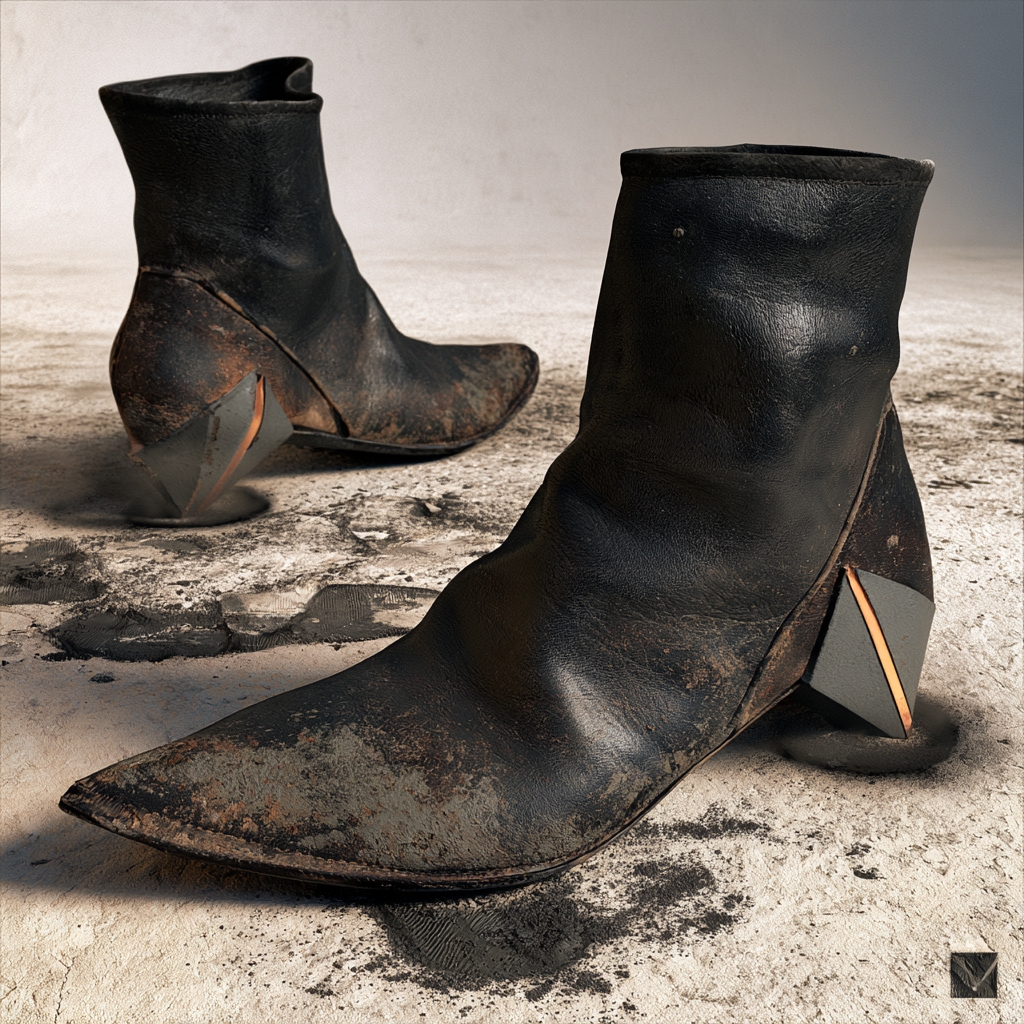
Perception of Activation:
User’s Perspective
- Sight: Looking down, the wearer sees the copper line along her soles during Runner’s Stair and the haze around her feet during Blank Heel. With Read the Floor, pale outlines of footprints spread across the ground in front of her, the newest ones brightest.
- Sound: Her own footsteps are absent. She hears her breathing, the rustle of her robe, and the room around her more clearly than usual. Heel Strike is a single hard knock that she feels in her teeth.
- Touch: The felt soles grow slightly warm and seem to thicken underfoot. During Blank Heel the ground feels smooth and faintly slick, like polished tile. During Runner’s Stair each step seems to rise to meet her foot.
- Smell: Warm resin and old leather, with a trace of cork.
- Taste: A faint bitterness of resin at the back of the tongue when a charge is spent.
- Extra-sensory perceptions:
- Aetheric Scrutiny: She tastes the boots’ magic as thin and quiet, closer to still air than to fire. Blank Heel tastes of nothing at all, a small gap in the flavor of the room.
- Print sense: Through Signed Tread she is aware of her own trail behind her as a line of small pressures, and she knows roughly how old each print is.
- Floor sense: During Read the Floor she feels each revealed footprint as a light touch on the soles of her own feet, heavier for a heavier walker.
- Mind’s Eye: She knows how many charges remain and is aware of her heel mark as entered in the hall ledger.
- Stillness sense: At half speed she feels the floor as undisturbed beneath her, and she notices at once when someone else’s step sends a tremor through it.
Observer’s Perspective
- Sight: An observer sees a scribe walking and hears nothing. During Runner’s Stair brief copper footprints appear and fade on each tread. During Blank Heel the dust behind her lies unbroken. Read the Floor shows as a ripple of grey light and then a bare floor.
- Sound: Silence where footsteps should be, which many find unsettling in a quiet vault. Heel Strike carries through a hall and down its stairs.
- Touch: Someone standing on the same floor feels no vibration from her steps. A hand placed on a shelf she passes feels nothing.
- Smell: A slight scent of warm resin near her feet.
- Taste: None.
- Extra-sensory perceptions:
- True sight: The heel marks give off a small, steady ultraviolet glow. Blank Heel shows as the glow going out and a dim haze around the soles. Runner’s Stair shows as a bright edge along each boot.
- Tremorsense: The wearer is very hard to detect at half speed. Heel Strike registers as one sharp pulse that gives her exact position.
- Blind sight: Her shape still returns an echo when other sounds strike it, though her movement adds no sound of its own.
- Aetheric Scrutiny (other Akkad-Kuri): Nearby Akkad-Kuri notice a faint, flavorless patch of magic moving through the room and may sense Blank Heel as a small absence.
- Mind’s Eye: An observer who examines the boots sees their name, the Enkiru maker’s mark, and the heel mark. During Blank Heel the heel mark entry appears blank.
Positives
- The wearer hears her surroundings better because her own steps add no noise.
- She always knows where her own trail lies and how old it is.
- Read the Floor is visible in its detail only to her, so others cannot read what she reads.
- The stillness sense warns her of another person’s approach across the same floor.
- Creatures that sense by vibration have difficulty finding her.
- Heel Strike gives a clear signal to allies who know its meaning.
Negatives
- The complete lack of footfall is itself noticeable in quiet places and can alarm those nearby.
- The copper footprints of Runner’s Stair and the ripple of Read the Floor are plainly visible to anyone watching.
- Signed Tread leaves an identifying trail on dust, ash, mud, and damp earth unless a charge is spent.
- A gap in a dusty floor’s record tells a trained keeper that Blank Heel was used.
- The blank entry seen through the Mind’s Eye during Blank Heel shows that the wearer is concealing her mark.
- Quiet Step fails in water, on wooden walkways, and at more than half speed without Runner’s Stair, and the wearer may forget this after long use.
- Heel Strike reveals her exact position to everything that hears or feels it.
Recipe: Soft-Soled Boots in the Manner of the Balawat Vault-Walkers
Materials Needed
- Leather and thread:
- 1 hide of dark, supple calf or goat leather for the uppers
- 1 piece of firm leather for the heel counters and insoles
- 1 spool of waxed linen thread
- 2 leather laces
- Soles:
- 4 sheets of dense wool felt, each large enough for a pair of soles
- 2 sheets of thin cork
- Enough for three layers of felt and one of cork in each sole, with one felt sheet spare
- Magical components:
- 2 tier 1 magic crystals, each about the size of a coin, as catalysts (one for each charge, one set in each heel)
- 1 vial of pine or cedar sap drawn with a fluid collector, as the base of the resin
- 1 measure of beeswax
- 1 pinch of fine ash from a floor that has not been swept for a month
- 1 pinch of powdered pumice
- Finishing:
- 1 small pot of neatsfoot oil or dubbin for the uppers
Tools Required
- A pair of wooden lasts cut to the wearer’s feet
- A cobbler’s knife, awl, and two stitching needles
- A lasting hammer and pincers
- A small resin pot and a brazier to keep it warm
- A flat pressing board and weights for bonding the soles
- A wedge stylus or small die for pressing the heel mark
- A soft brush for applying resin
- A reading lens or other identification focus for checking the finished work through the Mind’s Eye
Skill Requirements
- Cobbling: 4 or higher
- Alchemical Crafting: 2 or higher, for cooking the resin
- Rune Cutting: 2 or higher, for pressing the heel mark so that it holds its magic
- Stealth: 1 or higher, since the crafter must test the soles by walking in them
- Two crafters may share the work, provided each required skill is met by the one performing that step.
- Time: About 4 days of downtime.
- Standing: A heel mark is recognized in the archive hall of Balawat only if the vault keeper enters it in the hall’s ledger. A crafter working elsewhere chooses a private mark, and the boots function the same.
Crafting Steps
- Measure and cut:
- Trace the wearer’s feet, fit the lasts, and cut the uppers, heel counters, and insoles from the leather.
- Cook the resin:
- Warm the sap in the resin pot over the brazier and melt the beeswax into it. Stir in the powdered pumice, then the pinch of unswept ash. Keep the resin warm and never let it boil, or it will turn brittle.
- Build the soles:
- Brush resin between three layers of felt and one layer of cork for each sole, with the cork second from the bottom. Lay the soles on the pressing board under weights for one full day.
- Sew the uppers:
- Stitch the uppers and heel counters over the lasts with waxed thread. Hammer the seams flat so that nothing inside the boot can creak.
- Seat the crystals:
- Cut a shallow pocket inside each heel, beneath the insole. Seat one tier 1 crystal in each pocket and seal it with a drop of warm resin.
- Join sole to upper:
- Stitch each sole to its upper through the felt edge only, leaving the cork untouched. Brush a thin coat of resin over the stitching and the whole underside.
- Press the heel mark:
- While the resin on the heel is still warm, press the wearer’s wedge mark into each heel with the stylus or die. Press once, cleanly. A mark pressed twice will blur and will not hold.
- Cure:
- Leave the boots on their lasts for one day and one night in a cool room, away from the brazier.
- Oil the uppers:
- Work oil or dubbin into the leather and fit the laces.
- Walk them quiet:
- The crafter or the intended wearer puts on the boots and walks slowly back and forth across a stone floor for a ritual of at least 10 minutes, placing each foot flat and listening. The footfalls fade to silence if the work is sound.
- Roll for the result:
- The crafter rolls a d20. On a 1 the resin cracks, the soles separate, the crystals shatter into shards, and the materials are lost. On a 20 the boots gain one extra capability chosen by the GM, such as a third charge. Any other result produces a working pair.
- Check and attune:
- Examine the boots through the identification focus to confirm their abilities. The wearer attunes over one minute and then steps once in dust to see the mark.
Grey Aunt Who Put Away Her Broom, and of Heels That Speak
This is set down from the keepers of the rooms-below at Balawat. They had it from the keepers before, and those from a tongue that was spoken when the stairs were new and is spoken now by no one. He who first carried it across into the old writing did not have all the words, and he has put small marks where he guessed. I have kept his marks. A guess honestly marked is better than a certainty that lies.
In the early days of the hall of tablets, the clay-daughters wore upon their feet the boots of the mountain, which have soles of hard hide and nails of iron, for the town is steep. And they went down into the rooms-below in these boots, and their going was like a small army. And in the rooms-below, on shelves of wood, lay the soft tablets, the ones not yet given to the fire: the first-thoughts, and the half-copies, and the drafts of decrees that waited for the Queen’s yes or the Queen’s no.
Now soft clay is like a sleeping child. It can be woken by a footstep in another room. The keepers found small cracks in the tablets, fine as a hair, and none could say who had made them, for no hand had touched them. The mothers of the benches blamed the damp, and then the cold, and then each other. It was a cobbler who found it. Her name was Enkiru, and she had come down to measure a keeper’s foot, and she stood by a shelf while a runner went past in iron nails. And she laid her palm on the wood and said: “Your shelf is flinching.” The translator marks this word. He writes: “It may be ‘trembling.’ But I think she said flinching, as of a thing that expects a blow.”
So the mothers gave the order of soft soles, and Enkiru made them. She laid wool upon wool, and the bark of the cork-tree between, and she bound it with a tree-blood that she cooked herself and would not explain. The clay-daughters put on the new boots, and the rooms-below went silent. One could stand in the fourth room and hear a lamp burn. The cracking stopped, and the mothers were pleased, and Enkiru was paid.
Here the account turns, as a stair turns.
The keeper of the rooms-below in that time was an old woman of the marked people, grey in the hair and grey in the patterns of her skin, for she was past three hundred winters. Her name is not kept. She is called only the Grey Aunt, because every daughter of the hall had been scolded by her as by an aunt. She had a broom, and she swept the rooms-below each morning before the lamps were lit, every stair and every aisle, and she was proud that a dropped bead of clay could be found on her floors by its shadow.
In the second year of the soft boots, a tablet was gone from the third shelf of the fourth room. It was a small thing, a draft of a quarry charter. The Grey Aunt thought it mislaid. Then another was gone. Then three in one month, and one of these was the first-thought of a decree, in the Queen’s own speaking, which no eye outside the hall should see. And it came to be known in the town that a certain house knew what the Queen would say before the Queen had said it.
The Grey Aunt did what keepers do. She sat up in the dark with a covered lamp and she listened. She had caught thieves so before, in the days of iron nails, for a thief must walk, and a walker is heard. But she sat nine nights and heard nothing but the lamp burn. And on the tenth morning another tablet was gone, from a shelf six paces from her chair.
The translator writes here: “The next part I do not fully understand, but I give it as it stands. It says: ‘She was angry at the silence, and then she was angry at the broom.’”
For on that tenth morning she rose, stiff, and took her broom as she had every morning for two hundred years, and she swept the aisle. And she stopped. She looked at the floor before the broom, and at the floor behind it. Before the broom lay the dust of one night, thin as breath, and in it, plain as writing, the print of a soft sole going to the third shelf and coming away. Behind the broom lay nothing. And she understood that every morning of her life she had destroyed the only witness in the room.
She set the broom against the wall. The keepers say it stood there until it rotted, and that the stain of it is on the wall yet.
But a print in dust says only that someone walked. All the soft boots were alike, for Enkiru cut them from one pattern, and forty daughters wore them. So the Grey Aunt climbed the sixty and three stairs, which she did not like to do, and she went to the cobbler’s bench, and she said: “You have made my daughters silent. Now make them sign.” And Enkiru did not understand, and the Grey Aunt took up a stylus from her own belt, and pressed its corner into a scrap of sole-leather, and made the wedge. “In the heel,” she said. “A different one for each. Deep. And you will tell no one which is whose but me.”
So it was done. In one week every boot in the hall was called back for mending, on a pretext of bad stitching, and returned with a small mark in each heel, and the daughters thought it was the cobbler’s vanity. And the Grey Aunt wrote the marks in a book, each beside a name, and she locked the book in a chest and sat upon the chest. And she did not sweep.
Now the account tells the reading of the floor, and the keepers tell it slowly.
On the first morning of the new month, the Grey Aunt went down alone with a lamp held low, so that the light lay along the floor and every print cast its small shadow. And she read. She read the runners going and coming, in a hurry, their marks blurred at the toe. She read the bench-mothers, who walked in the middle of the aisle and never turned aside. And she read her own mark, one wedge alone, going round and round the room in the night, for she had been walking her watch and had not known how often. The translator writes: “It says she was ‘ashamed and comforted’ to see her own feet. I do not know why both.”
And at the third shelf of the fourth room she read a mark that came in the deep of night, and stood, and went away with a heavier tread than it had come. Three wedges in a row, like teeth. She did not need the book. She had chosen that mark herself, with some care, because it belonged to the daughter she loved best: her sister’s granddaughter, Nin-Edara, quick and laughing, whom she had taught to read and meant to make keeper after her.
The account does not say what the Grey Aunt felt. It says she sat down on the floor, which at her age was not a small thing, and that she stayed there until the lamp needed oil.
Then she rose, and she did this. She did not go to the bench-mothers. She took a tablet of soft clay, blank, and set it on the third shelf where the others had been taken. And in the night she did not sit in her chair. She went up to her bed. In the morning the blank tablet was gone, and the three wedges had come and gone in the dust. And the next night she set another, and on it she had pressed four words. The keepers give the words as: “The floor has read you.”
In the morning that tablet was not gone. It lay on the shelf. And before the shelf, in the dust, were the three wedges, coming, and then two round marks side by side where knees had pressed. No going away. And Nin-Edara was sitting at the foot of the stair with her boots in her lap, waiting to be found.
She had sold the tablets to a timber house, for a debt that was her father’s. So says the account, and it does not excuse her. She was put from the hall, and her name was cut from the bench, and she went to the quarries and kept tally there until she died. But the Grey Aunt went up the mountain to see her on the first day of each month, after the reading of the floor, for as long as her legs would carry her. And it is said Nin-Edara asked her once, “Why did you not sit in your chair and catch me by the arm?” And the Grey Aunt said: “Because then you would have been caught. I wanted you to have stopped.”
From that time the rooms-below are swept but once a month, and by the keeper only, and only after she has read. And each daughter who is given the soft boots is told three things by the keeper who gives them. She is told: “You will not be heard.” She is told: “You will be read.” And she is told: “The first mark I look for every month is my own.”
The moral of the story is that silence is a gift that must be paid for with a record, and whoever is given the power to pass unheard should be the first to consent to being seen. The keepers add: look to your own footprints before you read another’s.
Suggested conversions to other systems:
Call of Cthulhu (7th Edition)
The Keeper’s Signed Soles
- Type: Enchanted footwear (artifact)
- Origin: Soft-soled boots of dark leather from the archive hall of Balawat in Assyria, on the world of Saṃsāra. The soles are layered felt and cork sealed with resin, and two small wedge marks are pressed point to point into each heel.
- Armor: None
- Weight: 2 lb
- Bonding: The wearer walks slowly across a stone floor for one minute and makes a POW roll. On a success the boots are bonded and their powers can be used.
- Passive effects while bonded:
- Bonus die on Stealth rolls when walking at a slow pace on stone, tile, or packed earth.
- Bonus die on DEX or Climb rolls to keep one’s footing on wet clay, gravel, or ash.
- Each step on dust, ash, or damp earth leaves a print showing the wearer’s wedge mark. Anyone making a Track roll to follow those prints gains a bonus die.
- The wearer’s steps cause no vibration in floors or shelving.
- Powers (the boots draw on the wearer’s magic points):
- Blank Heel: Cost 2 magic points. For 10 minutes the wearer leaves no footprints of any kind. Track rolls to follow the wearer automatically fail unless aided by unnatural means.
- Runner’s Stair: Cost 2 magic points. For one minute the wearer moves at full MOV on stairs, ladders, and steep slopes without a roll, and keeps the Stealth bonus die at any pace.
- Read the Floor: Cost 1 magic point. The wearer crouches and touches the ground. For one minute, footprints left within 10 yards during the past day appear to the wearer as pale outlines, including those swept away. Track rolls made with this information gain a bonus die.
- Sanity:
- First use of Read the Floor: 0/1 Sanity points, as the floor fills with the outlines of people no longer present.
- Realizing one’s own trail has been recorded in every dusty room for weeks: 0/1 Sanity points, at the Keeper’s discretion.
- Investigation:
- A Spot Hidden roll notices the wedge marks in the heels and the matching marks in the wearer’s prints.
- An Occult roll suggests the boots are a watchman’s charm for moving unheard.
- Cthulhu Mythos: None gained. The boots are not of the Mythos.
Blades in the Dark (current edition)
The Grey Aunt’s Quiet Heels
- Type: Fine arcane footwear (unique item)
- Load: 1
- Quality: 2
- Origin: Soft-soled boots of dark leather with felt-and-cork soles, from the archive hall of Balawat in Assyria on the world of Saṃsāra. A small wedge mark is pressed into each heel.
- Features:
- Quiet Step: When you Prowl across stone, tile, or packed earth at a careful pace, gain +1 effect.
- Sure Footing: You do not slip on wet, loose, or ash-covered ground. Consequences that would knock you down on such ground are reduced by one level.
- Blank Heel: Take 1 stress. For the rest of the score you leave no tracks of any kind and cannot be followed by your trail.
- Runner’s Stair: When you push yourself to move quickly on stairs, ladders, slopes, or rooftops, take 1 stress instead of 2.
- Read the Floor: When you gather information by examining the ground, gain +1 effect and ask one extra question about who passed, how many, or which way they went.
- Drawbacks:
- Signed Tread: Your wedge mark shows in every print you leave on dust, mud, or ash. If you cross such ground during a score without using Blank Heel, take +1 heat at the end of it.
- Telling Silence: In a quiet place, the absence of footsteps is noticed. Anyone alert who sees you walking and hears nothing knows your boots are not ordinary.
- Crafting a copy: Invent the formula as a long-term project, then Tinker during downtime. Arcane, minimum quality 2, with the Signed Tread drawback. Requires felt, cork, and a resin cooked with dust from an unswept floor.
Dungeons & Dragons (2024 rules)
Boots of the Signed Tread
- Wondrous Item, Uncommon (Requires Attunement)
- Weight: 2 lb.
- Description: These soft-soled boots of dark leather come from the archive hall of Balawat in Assyria, on the world of Saṃsāra. Their soles are layered felt and cork sealed with alchemical resin, and a small wedge mark is pressed into each heel.
- Quiet Step: While you wear these boots and move no more than half your Speed on your turn, your steps make no sound on stone, tile, or packed earth, and you have Advantage on Dexterity (Stealth) checks that rely on moving silently.
- Sure Footing: You have Advantage on saving throws made to avoid the Prone condition caused by slippery or loose ground.
- Signed Tread: Your footprints in dust, ash, mud, or similar surfaces show a mark unique to you. Creatures have Advantage on Wisdom (Survival) checks to follow those prints.
- Still Shelves: Creatures that rely on Tremorsense can’t detect you while you move no more than half your Speed on your turn.
- Charges: The boots have 2 charges and regain 1 expended charge daily at dawn.
- Blank Heel (1 charge): As a Magic action, you leave no footprints for 10 minutes, and Signed Tread is suppressed. You can’t be tracked by nonmagical means during that time.
- Runner’s Stair (1 charge): As a Bonus Action, for 1 minute you ignore Difficult Terrain caused by stairs, rubble, and slopes, and Quiet Step applies at any Speed.
- Read the Floor: As a Magic action, you touch the ground. For 1 minute you see every footprint left within 30 feet of you during the past 24 hours, including those that have been swept or scuffed away, and you have Advantage on Wisdom (Survival) checks to follow them. Once you use this property, you can’t use it again until you finish a Short or Long Rest.
- Heel Strike: Without using an action, you can stamp once to produce a sharp knock audible out to 300 feet.
Knave (Second Edition)
Vault-Keeper’s Marked Boots
- Type: Relic, worn on the feet
- Slots: 1
- Armor: None
- Value: Seldom for sale. Copies fetch whatever a buyer will pay.
- Description: Soft-soled boots of dark leather with felt-and-cork soles, from Balawat in Assyria on the world of Saṃsāra. A small wedge mark is pressed into each heel.
- Always in effect while worn:
- DEX checks to move silently on stone, tile, or packed earth are made with advantage (+5) when moving carefully.
- Checks to keep footing on wet, loose, or ash-covered ground are made with advantage (+5).
- Footprints left in dust, mud, or ash show the wearer’s mark. Anyone tracking those prints does so with advantage (+5).
- Creatures that sense by vibration through the ground do not notice the wearer while she moves carefully.
- Charges: 2. One charge returns each morning.
- Blank Heel (1 charge): For one turn (10 minutes) the wearer leaves no footprints and cannot be tracked by ordinary means.
- Runner’s Stair (1 charge): For the rest of the current combat or chase, the wearer moves at full speed on stairs, ladders, and slopes without a check and stays silent while doing so.
- Read the Floor: Once per watch, touch the ground. For the rest of the turn the wearer sees every footprint left within 30 feet during the past day, including those swept away.
- Limit: If the wearer takes a wound that fills this item’s slot, the resin cracks. The boots become ordinary until a cobbler spends three days rebuilding the soles.
Fate (Fate Condensed)
The Boots That Are Not Heard but Are Read
- Type: Extra (service footwear)
- Origin: Soft-soled boots of dark leather with felt-and-cork soles, from the archive hall of Balawat in Assyria on the world of Saṃsāra. A small wedge mark is pressed into each heel.
- Permission: A character aspect showing leave to walk the lower vaults of an archive, or a heel mark entered in a keeper’s ledger.
- Cost: 2 refresh
- Item aspect: Silent Soles, Signed Heels
- Invoke: To move unheard, to keep your feet on bad ground, or to prove where you have and have not walked.
- Compel: Your mark is in every dusty print you leave, the silence of your step unsettles those who notice it, and the soles fail in water and on creaking boards.
- Stunts granted while worn:
- Quiet Step: +2 to Stealth when moving carefully across stone, tile, or packed earth.
- Blank Heel: Once per session, declare that you leave no trail for the rest of the scene. Place the aspect No Trail at All on yourself with one free invoke. Attempts to track you by your footprints fail outright.
- Runner’s Stair: +2 to Athletics when overcoming obstacles made of stairs, ladders, slopes, or rubble, and you may still use Quiet Step while doing so.
- Read the Floor: Once per scene, when you crouch and touch the ground, create an advantage with Notice without rolling. Place one aspect such as Three Sets of Prints Toward the Cellar with a free invoke.
Numenera and Cypher System (Numenera Discovery and the Cypher System Rulebook)
Treads of the Unswept Vault
- Type: Artifact
- Level: 1d6
- Form: A pair of soft-soled boots of dark leather, from Balawat in Assyria on the world of Saṃsāra. The soles are layered felt and cork sealed with resin, and each heel is pressed with a small wedge mark.
- Effect:
- The wearer has an asset on stealth tasks when moving at a careful pace across stone, tile, or packed earth.
- The wearer has an asset on tasks to keep balance on wet, loose, or ash-covered ground.
- The wearer’s prints in dust, mud, or ash show a mark unique to that wearer. Tasks to track those prints are eased.
- Creatures that sense by vibration through the ground do not perceive the wearer while they move carefully.
- Blank Heel (action): For ten minutes the wearer leaves no footprints of any kind, and tasks to track them by ordinary means automatically fail. Roll for depletion.
- Runner’s Stair (action): For one minute the wearer moves on stairs, ladders, and steep slopes as if on level ground, and the stealth asset applies at any pace. Roll for depletion.
- Read the Floor (action): The wearer touches the ground. For one minute they see every footprint left within short range during the past day, including those swept away, and tracking tasks using them are eased. This can be used once per hour and requires no depletion roll.
- Depletion: 1 in 1d20. Depleted boots keep the balance asset and lose all other effects.
Pathfinder (Second Edition, Remaster)
Ledger-Marked Vault Boots — Item 3
- Traits: Invested, Magical
- Price: 55 gp
- Usage: worn shoes
- Bulk: L
- Description: These soft-soled boots of dark leather come from the archive hall of Balawat in Assyria, on the world of Saṃsāra. Their soles are layered felt and cork sealed with alchemical resin, and a small wedge mark is pressed into each heel. While invested, you gain a +1 item bonus to Stealth checks to Sneak across stone, tile, or packed earth, and a +1 item bonus to Acrobatics checks to Balance on wet, loose, or ash-covered ground. Your footprints in dust, mud, or ash bear a mark unique to you, and creatures gain a +2 circumstance bonus to Survival checks to Track you by those prints. Creatures using tremorsense can’t detect you while you Sneak.
- Activate—Blank Heel [two-actions] (manipulate)
- Frequency: once per day
- Effect: For 10 minutes, you leave no footprints of any kind. Creatures can’t Track you by nonmagical means during this time.
- Activate—Runner’s Stair [one-action] (manipulate)
- Frequency: once per day
- Effect: For 1 minute, you ignore difficult terrain caused by stairs, rubble, and slopes, and you can Sneak at your full Speed.
- Activate—Read the Floor [two-actions] (concentrate, manipulate)
- Frequency: once per hour
- Effect: You touch the ground. For 1 minute, you see every footprint left within 30 feet during the past 24 hours, including those swept or scuffed away, and you gain a +2 item bonus to Survival checks to Track using them.
Savage Worlds (Adventure Edition)
The Cobbler’s Silent Witness
- Type: Arcane device (footwear)
- Armor: None
- Minimum Strength: d4
- Weight: 2
- Cost: Seldom for sale. Copies sell for whatever the market bears.
- Description: Soft-soled boots of dark leather with felt-and-cork soles, from Balawat in Assyria on the world of Saṃsāra. A small wedge mark is pressed into each heel.
- Passive effects while worn:
- +1 to Stealth rolls when moving at half Pace or less on stone, tile, or packed earth.
- +2 to Agility rolls to keep footing on wet, loose, or ash-covered ground.
- The wearer’s prints in dust, mud, or ash show a unique mark. Survival rolls to track those prints are made at +2.
- Creatures that sense by ground vibration suffer −2 to Notice the wearer while she moves at half Pace or less.
- Power Points: 4. The boots regain 2 Power Points each dawn and cannot be recharged by other means.
- Activation: No roll is needed. The wearer spends the Power Points listed.
- Blank Heel (2 Power Points, action): For 10 minutes the wearer leaves no footprints and cannot be tracked by ordinary means.
- Runner’s Stair (2 Power Points, free action): For 10 rounds the wearer ignores Difficult Ground caused by stairs, rubble, and slopes, and the Stealth bonus applies at any Pace, including when running.
- Read the Floor (no cost, action, once per hour): The wearer touches the ground. For one minute she sees every footprint left within 5″ (10 yards) during the past day, including those swept away, and gains +2 to Survival rolls to track them.
Shadowrun (Sixth World Edition)
Wedge-Heel Quiet Runners
- Type: Footwear and bonded focus
- Defense Rating: +0
- Capacity: —
- Force: 1
- Bonding cost: 2 Karma
- Availability: 4(L)
- Cost: 4,000¥ for a copy. The original is seldom for sale.
- Description: Soft-soled boots of dark leather with felt-and-cork soles sealed in resin, from the archive hall of Balawat in Assyria on the world of Saṃsāra. A small wedge mark is pressed into each heel. They contain no electronics and have no wireless bonus.
- Passive effects while bonded and worn:
- +1 die on Stealth tests when moving at a walk across stone, tile, concrete, or packed earth.
- +1 die on tests to keep footing on wet, loose, or ash-covered ground.
- The wearer’s prints in dust, mud, or ash show a unique mark. Tests to track those prints gain +2 dice.
- Seismic and vibration sensors, and critters that sense ground vibration, suffer −2 dice to detect the wearer while she moves at a walk.
- An Assensing test with 2 hits reveals a quiet, air-aspected enchantment and the notation “entered in the hall ledger.”
- Charges: 2. One charge returns at each sunrise.
- Blank Heel (1 charge, Major Action): For 10 minutes the wearer leaves no footprints and cannot be tracked by physical trail. This does not affect cameras, astral tracking, or scent.
- Runner’s Stair (1 charge, Minor Action): For one minute the wearer ignores movement penalties from stairs, rubble, and slopes, and the Stealth bonus applies while running.
- Read the Floor (no charge, Major Action, once per hour): The wearer touches the ground. For one minute she sees every footprint left within 10 meters during the past 24 hours, including those swept away, and adds +2 dice to tests to track them.
- Astral signature: Each activation leaves a faint signature that lasts for Force hours.
Starfinder (Second Edition)
Archive-Ledger Soft Treads — Item 3
- Traits: Invested, Magical
- Price: 550 credits
- Usage: worn shoes
- Bulk: L
- Description: These soft-soled boots of dark leather come from the archive hall of Balawat in Assyria, on the world of Saṃsāra. Their soles are layered felt and cork sealed with alchemical resin, and a small wedge mark is pressed into each heel. While invested, you gain a +1 item bonus to Stealth checks to Sneak across stone, tile, deck plating, or packed earth, and a +1 item bonus to Acrobatics checks to Balance on wet, loose, or ash-covered ground. Your footprints in dust, mud, or ash bear a mark unique to you, and creatures gain a +2 circumstance bonus to Survival checks to Track you by those prints. Creatures using tremorsense can’t detect you while you Sneak.
- Activate—Blank Heel [two-actions] (manipulate)
- Frequency: once per day
- Effect: For 10 minutes, you leave no footprints of any kind. Creatures can’t Track you by your physical trail during this time. Recorded sensor data is unaffected.
- Activate—Runner’s Stair [one-action] (manipulate)
- Frequency: once per day
- Effect: For 1 minute, you ignore difficult terrain caused by stairs, rubble, and slopes, and you can Sneak at your full Speed.
- Activate—Read the Floor [two-actions] (concentrate, manipulate)
- Frequency: once per hour
- Effect: You touch the ground. For 1 minute, you see every footprint left within 30 feet during the past 24 hours, including those swept or scuffed away, and you gain a +2 item bonus to Survival checks to Track using them.
Traveller (Mongoose Second Edition, 2022 Update)
Relic Vault Boots of Balawat
- Item Type: Relic footwear (anomalous artefact)
- Protection: +0
- TL: 2 in manufacture. Its effects cannot be reproduced at any known TL.
- Rad: —
- Kg: 1
- Cost: Seldom for sale. A collector might pay Cr2500 or more.
- Required Skill: None
- Description: Soft-soled boots of dark leather with felt-and-cork soles sealed in resin, from the archive hall of Balawat in Assyria on the world of Saṃsāra. A small wedge mark is pressed into each heel.
- Passive effects while worn:
- DM+1 to Stealth checks when walking across stone, tile, deck plating, or packed earth.
- DM+2 to DEX or Athletics (dexterity) checks to keep footing on wet, loose, or ash-covered ground.
- The wearer’s prints in dust, mud, or ash show a unique mark. Recon or Survival checks to follow those prints gain DM+2.
- Seismic sensors and creatures that sense ground vibration suffer DM−2 to detect the wearer while she is walking.
- Charges: 2. One charge returns each local dawn.
- Blank Heel (1 charge, Significant Action): For 10 minutes the wearer leaves no footprints and cannot be tracked by physical trail.
- Runner’s Stair (1 charge, Minor Action): For one minute the wearer moves at full speed on stairs, ladders, and slopes without a check, and the Stealth DM applies while running.
- Read the Floor (no charge, Significant Action, once per hour): The wearer touches the ground. For one minute she sees every footprint left within 10 metres during the past day, including those swept away, and gains a Boon on Recon or Survival checks to follow them.
- Analysis: Sensors detect only leather, felt, cork, and plant resin. A Science check (Formidable 14+) finds no mechanism for its effects.
Warhammer (Warhammer Fantasy Roleplay, Fourth Edition)
The Unheard Clerk’s Boots
- Type: Magical clothing (footwear)
- Price: N/A
- Encumbrance: 0 while worn
- Availability: Unique
- Armour Points: 0
- Description: Soft-soled boots of dark leather with felt-and-cork soles sealed in resin, from the archive hall of Balawat in Assyria on the world of Saṃsāra. A small wedge mark is pressed into each heel. To those with the Second Sight Talent, the heels hold a thin grey shimmer.
- Passive effects while worn:
- +10 to Stealth Tests when walking across stone, tile, or packed earth.
- +10 to Athletics Tests to keep footing on wet, loose, or ash-covered ground.
- The wearer’s prints in dust, mud, or ash show a unique mark. Track Tests to follow those prints gain +20.
- Creatures that sense by vibration through the ground suffer −20 to Perception Tests to notice the wearer while she walks.
- Charges: 2. One charge returns at each sunrise.
- Blank Heel (1 charge, Action): For 10 minutes the wearer leaves no footprints and cannot be followed by Track Tests.
- Runner’s Stair (1 charge, Free Action): For one minute the wearer moves on stairs, ladders, and slopes as if on level ground, and the Stealth bonus applies while running.
- Read the Floor (no charge, Action, once per hour): The wearer touches the ground. For one minute she sees every footprint left within 10 yards during the past day, including those swept away, and gains +20 to Track Tests to follow them.
- Notice: A person who walks without sound and leaves marked prints may be taken for a thief, a spy, or something worse by those who witness it.