
• The item originates among traveling groups and frontier workshops near the edges of island nations where conditions change quickly between coastal damp, inland heat, ridge winds, and brief cold snaps. Artisans in small family settings collect shed plumage during the Warming and Dimming weeks, choosing feathers whose natural layering can flex and resettle. These are bound over a light frame of mixed plant fibers treated with sap and fine dust from varied soils. The covering is intended for avatars who possess a Feathers slot and who must adjust posture, pace, or exposure as surroundings shift. It appears in stalls that also supply basic travel gear because the work uses no large crystals and can be completed in one day by a single maker.
• Slot is Feathers. The covering is worn on or over the avatar’s existing feathers and occupies only that specialized slot. It functions while openly visible and is suppressed if fully covered by other garments. Minor shifts or removal count as a free action outside of direct pressure.
• Skills gained when openly worn consist of a temporary +2 to the Survival skill. These points are supplied by the item and do not count against the maximum trained skill level of 5 plus tier. The bonus applies to checks involving adjustment to changing weather, terrain, or immediate conditions, reading environmental cues, or modifying movement and rest to match what is present. When the item is covered or removed the temporary points cease.
• Color is a mottled mix of muted olive, warm tan, and soft gray that can appear slightly different under changing light, with tips holding a faint dull silver sheen that stays low and steady. The pattern remains readable at ordinary distances in daylight or under overcast skies.
• Passive magic includes a continuous subtle resettling of the feather layers that grants advantage on Survival checks made to adapt posture or pace to sudden shifts in wind, footing, or temperature. A second passive causes the mottled tones to blend more readily with nearby natural surfaces, aiding brief concealment or reduced notice during transitions between areas. A third passive provides light, responsive insulation that eases the first moments of exposure to warmer or cooler air, supporting quicker recovery of comfort without full protection.
• Active magic includes the ability, once per long rest, to flare the feathers as an action and briefly align them to a new prevailing condition, adding the tier-1 die result to one Survival check made to adjust to an immediate environmental change such as a gust, a wet surface, or a temperature drop. A second active permits the wearer, as a free action, to set the feathers into a slow adaptive sweep lasting up to ten minutes that grants advantage on a series of related minor adjustment checks during that period. A third active, usable once between long rests, allows a single controlled snap that produces a soft settling sound, marking a completed shift in stance or pace and granting advantage on one immediate check to maintain the new balance or direction. Each active uses only ambient magic present in the feathers.
• Tags are Feathers, Survival, Adaptation, Common, Tier1, Worn, Magical, Balance, Shift, Environment, Flexible, Transition, Footing, Wind-Adjust, Temperature-Ease, Blend, Pace-Shift, Cue-Reading, Frontier, Resettle, Mottled, Recovery-Start
• Additional information states that the item fits any avatar with a Feathers slot and can be adjusted by hand in minutes. Weight is negligible. Near travel routes and frontier gatherings it is found in small shops and exchanged according to local availability of mixed feathers and the price agreed after haggling. The effects hold under ordinary magic flow without requiring attunement, though attunement is possible if a slot remains open. In reduced flow the active uses continue while the passive advantage on adjustment checks becomes an ordinary roll. Ordinary wear from flexing can be repaired by artisans familiar with travel gear without changing the listed properties.
Acquisition and Trade of Feathers 8915 of the Shifting Balance
• The item may be obtained when an avatar is successfully possessed if the previous host already wore or carried the covering among gear used for travel or changing conditions. It may also appear as a reward from a completed task for a frontier guide, a road patrol, or a local official who values those able to adjust quickly to shifting weather or terrain. Confrontation with other travelers or scouts carrying similar pieces can leave the covering among dropped items after a search. An artisan with the proper skills and access to mixed shed plumage can craft a new example using varied plant fibers, sap, and soil dust rather than crystals.
• Shops that handle the item are almost always small family workshops or single-proprietor stalls near travel routes, frontier gatherings, or the edges of coastal and inland towns. These establishments specialize in gear for movement and adjustment, often neighboring makers of basic packs, cords, and weather cloaks. Owners change what they produce as demand from guides or seasonal travelers shifts. They employ a few workers for gathering feathers in the Warming and Dimming weeks and for stitching, while the flexible binding pattern remains with the family. No large stores keep many identical examples; each holds only recent work.
• Purchase occurs through face-to-face exchange in the shop or at a roadside stall. The buyer examines the mottled olive, tan, and gray under ordinary light, tests the resettling flex, and haggles. An NPC merchant starts near the local suggested value and adjusts by about 10 percent times the buyer’s tier. Membership in a relevant travelers’ circle or guild grants a matching reduction. Payment uses gold or equivalent local coinage; the merchant may bank the sum or retain coin. Short notes tied to a completed journey are sometimes accepted. Black-market stalls sell at full value or higher for physical gold only and keep no open record of prior holders.
• Sale follows the reverse. The owner offers the item and the merchant haggles downward by roughly 10 percent times the seller’s tier, depositing the gold in the World Bank. Black-market buyers may match the merchant price or double it for urgent need, always in physical gold. Quasi-logs are kept and may be reviewed by officials later.
• Cost is never fixed. Near active travel routes with several workshops and ready mixed feathers the piece may pass for silver equal to a few days’ labor. Where varied plumage must be carried from farther areas the same item may require several gold because of access cost and fewer makers familiar with the flex pattern. During seasons of frequent weather shifts buyers pay more; after arrivals of similar coverings or in low flow sellers accept less. The figure is whatever is agreed after haggling. City, state, or local taxes on the sale are handled by the merchant before the buyer departs with the item.
Roleplay Applications of Feathers 8915 of the Shifting Balance in Defense and Offense Across Environments
• On coastal roads or harbor edges where wind and spray shift quickly the wearer keeps the feathers in a loose mottled set. When a gust or sudden wet patch threatens balance the free-action adaptive sweep grants advantage on a series of minor adjustment checks, letting the wearer resettle footing and pace to stay upright while an opponent overcommits. This defends by maintaining position on slick stone or decking and can turn offensive by timing a closing step once the wearer’s own stance has adapted and the other’s has not. The passive resettling supports the first moments of the change without a full action.
• In inland markets or city streets that move from sunlit open areas to shaded alleys the mottled tones and blend passive reduce notice during the transition. A flared alignment as an action adds the tier die to a Survival check that adjusts posture and speed to the new light and footing, either slipping aside from a reaching grasp in defense or closing a short gap before the opponent’s eyes fully adjust. The controlled snap marks the completed shift, granting advantage on the immediate check to hold the new direction or to press the advantage of the adapted pace.
• Along ridge paths or volcanic slopes where temperature and wind change with elevation the light insulation eases the first exposure while the wearer assesses the next stretch. Starting the sweep before a series of moves grants advantage on related checks for pace and footing, defending against a slip that would leave the wearer exposed or offensively choosing a line that uses the wind rather than fighting it. In reduced magic flow the passive advantage becomes an ordinary roll, so the wearer relies more on the audible settling snap and deliberate pauses to achieve the same separation or closing.
• In forested clearings or among reef rocks at low water the blend passive and mottled pattern aid brief concealment while conditions are read. Flaring to align with a new prevailing breeze or damp surface adds the die to an adjustment check that either keeps the wearer low and stable against an incoming charge or allows a sudden pace increase once the surface has been matched. The snap confirms the new balance, supporting a defensive brace or an offensive lunge timed to the opponent’s slower adaptation. Temperature ease helps maintain comfort and therefore timing whether the air is warming or cooling.
• Aboard vessels or near floating structures where roll and gusts are constant the feathers’ resettling passive keeps small corrections available. An active flare aligns them to a stronger shift in the deck or air, adding the die to the Survival check that preserves stance while others lose it, defending against being thrown off balance or offensively using the recovered footing to move first. The sweep can cover multiple related adjustments across a longer exchange. Across all settings the benefits require the feathers to remain openly displayed; once covered the wearer returns to unaided checks until the covering is revealed again. Actives remain usable in low flow while passives adjust, prompting combination with ordinary observation and movement.
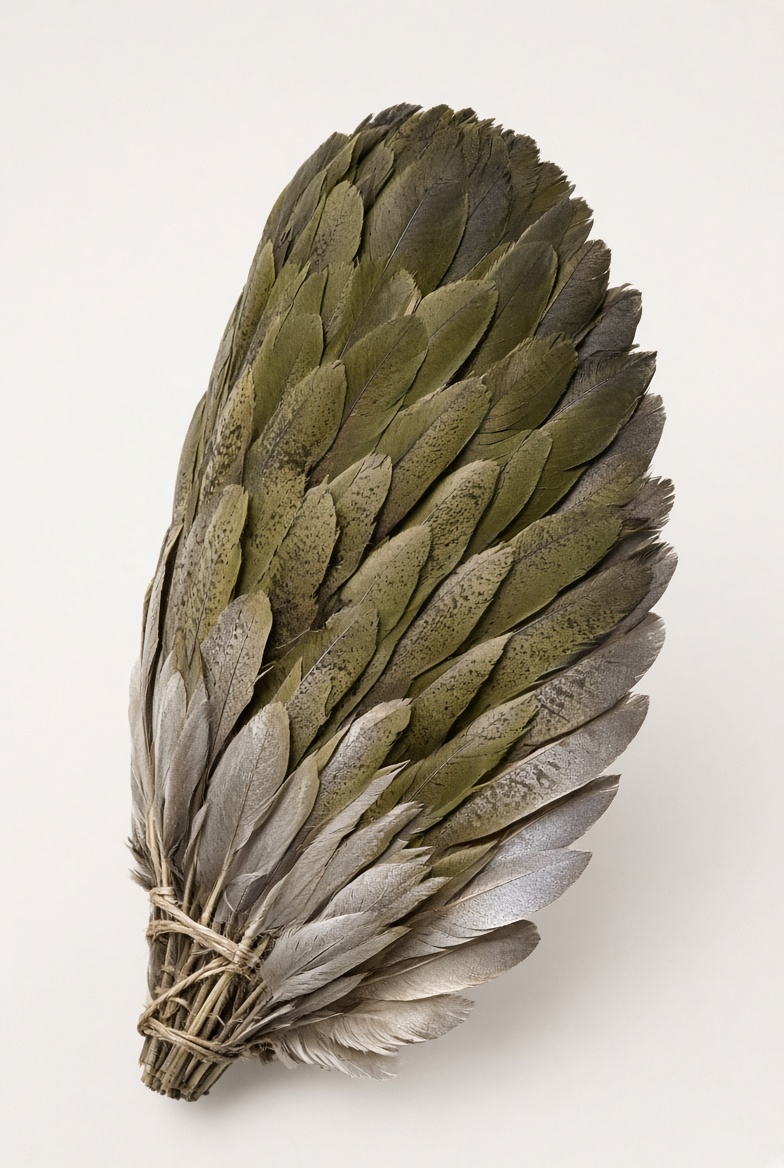
Perception of Activation:
• Normal sight registers the mottled olive, tan, and gray layers flexing and resettling into a new alignment as they flare or sweep, the faint dull silver sheen staying low and even at the tips. The description is a controlled shift of the covering that briefly matches or contrasts with the immediate surroundings before settling, lasting only through the active. Positives include a clear visual cue that the adjustment has begun and an immediate sense of how the new set relates to wind, light, or surface. Negatives include a short period where the changing pattern can draw the eye if the blend is incomplete and a slight delay in reading fine distant detail while the layers move.
• Touch registers a series of light, yielding tensions as the feathers resettle, followed by small adaptive shifts during a sweep and a soft even release on the snap. The description is a sequence of flexible give-and-take along the frame that matches the pace of the environmental change and then steadies. Positives include a tactile confirmation that the covering has accepted the new condition and a responsive feel that supports quick posture corrections. Negatives include a brief sense of looseness if the flare is abrupt and a residual awareness of the flexing edges during the first moments after settling.
• Hearing registers a soft, irregular-then-even rustle that becomes a measured adaptive cadence or resolves into one muted settling sound on the snap, quieter than wind but distinct in its controlled quality. The description is a brief cascade of yielding contacts or a single low punctuation from the layers finding their new place. Positives include an auditory marker for the timing of a completed shift and a sound low enough to serve as a personal cue outdoors. Negatives include the chance that the rustle blends with actual wind and masks other soft sounds, or that the snap signals the change to nearby listeners.
• Darkvision registers the activation as a softening and re-forming of gray-scale edges into a new mottled pattern, the varied tones appearing as shifting mid-grays while the silver sheen stays nearly flat. The description is a rapid reorganization of outline and texture that holds through the sweep. Positives include continued ability to track the covering’s new set in low light. Negatives include reduced distinction of the subtle color mottling that normally aids blend judgments.
• True sight registers a faint, steady ultraviolet trace along the resettling edges that moves with the flex and holds evenly once aligned. The description is a thin shifting outline that follows the adaptation and fades when the active ends. Positives include confirmation that ambient flow has been shaped to the new condition and a clear boundary for the adjusted spread. Negatives include a mild after-trace that can overlap other environmental magical cues and a short pause before ordinary texture fully returns.
• Blindsight registers a temporary broadening then tightening of echo returns as the layers flex and resettle, producing a more even cluster once the new alignment holds. The description is a brief change in the near acoustic field matching the shift in surface and then stabilizing. Positives include an accurate sense of the covering’s new outline without sight and early notice if the flex meets resistance. Negatives include a short reduction in the clarity of irregular distant returns while the layers are moving.
• Soul sight registers a gentle stabilization and slight shift in the personal aura along the feather edges, tones moving toward the muted environmental hues without sharp change. The description is a soft easing or realignment that follows the activation and returns toward baseline. Positives include an internal marker that the item has accepted the directed adaptation. Negatives include a fleeting sense of exposed adjustment if others with soul sight are present and a minor draw on focus during the sweep.
• Mind’s Eye perception registers a brief overlay of the item’s properties—slot, temporary Survival bonus, and remaining uses—across the flexing feathers at activation, sometimes with a faint cue tied to the current condition. The description is a translucent set of values that appears and recedes, lingering lightly if the sweep continues. Positives include immediate verification that the active supports the intended adjustment. Negatives include a momentary split in attention while reading both the overlay and the environment and a brief delay in full external focus once it clears.
Recipe for Feathers 8915 of the Shifting Balance
• Materials needed consist of twelve primary feathers shed by hybrid beasts during the Warming or Dimming weeks, each showing natural variation in muted olive, warm tan, or soft gray that can be combined for a mottled effect with tips able to hold a faint dull silver sheen. Four lengths of mixed flexible plant fiber harvested from stalks grown in varied soils near travel routes or frontier edges. A small quantity of clear tree sap collected with a fluid collector from a living tree within the past three days. One measure of fine mineral dust taken from several different local soils or path surfaces. No magic crystals are required; ambient weave in the feathers and sap supplies the binding for the adaptive effects.
• Tools required include a fluid collector for the sap, a pair of fine needles for stitching that allows flex, a flat work surface large enough for overlapping layers, a shallow bowl for mixing sap and mixed dust, a soft brush for light application, ordinary cord for temporary alignment that permits later movement, and a simple weight or clip to test resettling. All are mundane tools common to workshops near travel paths.
• Skill requirements call for a trained level of at least 3 in crafting focused on flexible or travel gear, plus at least 2 in binding or alchemy skill to apply the mixture without stiffening the layers. Familiarity with Survival items is needed to test the resettling flare, adaptive sweep, and settling snap. Levels may be met through downtime training or temporary points from openly worn badges.
• Crafting steps begin with sorting and gentle cleaning of the feathers to preserve their varied tones and structure, followed by arranging them in two overlapping layers that mix the olive, tan, and gray so the mottled pattern can shift with light and movement. The mixed fibers are soaked in the sap-and-dust mixture until pliable, then laid as a light internal frame and stitched with a pattern that permits flex and resettling rather than rigid hold. Remaining mixture is brushed lightly along edges and tips to encourage the low silver sheen, then dried under ordinary or changing light for one After Noon period. The covering is tested by hand for smooth flare into new alignments, even sweep response, soft settling snap, and basic blend under different light; any stiffness is loosened before completion. The process consumes the listed materials and takes most of one day in a frontier or roadside workshop. The result matches the original slot, temporary skill bonus, passives, and actives when worn openly on an avatar with a Feathers slot.
Feathers That Changed With the Wind
In the time before the paths were marked with stones there lived among the people who walked between the shores and the ridges those who had to meet whatever the air and the ground brought that day. These ones gathered the fallen feathers of the mixed beasts when the warming began and when the light grew less. They bound the feathers with the mixed threads of the plants that grew in different soils and with the sap of the trees and the dust of many paths so that the feathers would resettle when the wearer needed a new way to stand or to move.
One among them was called by a name that the later tongues could not hold and so is spoken only as the One Who Shifted. This one desired that the sudden gust or the change from dry stone to wet earth would not throw the body down and that the pace could alter before the next step was lost. The One Who Shifted took feathers that held the colors of the olive leaf and the tan soil and the gray rock and bound them so that when the thought was given the layers would flex and find a new set. The binding was done in a small shelter near a place where three paths met. When the work was finished the feathers lay close until the wearer called them and then they moved and settled again in a different way.
The first time the feathers resettled the One Who Shifted stood on a slope where the wind came first from the water and then from the high ground. The body leaned and the feathers flexed and the new alignment let the feet stay where they were while others slid. Those who watched said the feathers had taken the change in the air and given it back as a steadier place to stand. The One Who Shifted tried the feathers again when the path turned from sun-warmed dust to the cool shade of trees and the adaptive sweep marked each small correction until the pace matched the new ground. The people began to ask for the same feathers so that their own walkers could hold their balance when the conditions alone would not stay the same.
Yet the feathers did not always bring the steadiness that was wanted. When the unseen flow grew thin the resettling still happened but the flex was slower and some who trusted it on a steep place still lost their footing. When the flow grew strong the feathers shifted farther than the wearer intended and the body was carried a step beyond the chosen spot. The One Who Shifted saw this and spoke to the people that the feathers remembered only the changes the beasts had met when they lived and that the wearer must also remember what the new condition asked and what it did not. The people did not all hear. Some wore the feathers and called the shift for every small breeze so that the constant moving tired the body and the true changes were met with less care. Others wore them only when they wished to seem ready and the alignment that followed did not match the ground that was actually there.
In the years that followed the feathers were made again and again in the small shelters near the meeting of paths. Each maker used the shed feathers of the mixed beasts and the sap and the dust of different soils and each covering was a little different in the way it flexed. Some coverings let the wearer resettle more quickly on wet stone. Some let the wearer blend the mottled colors longer while moving from open light into shade. The stories that were told of these coverings grew long. One story said that a wearer had crossed a ridge where the wind changed three times and the feathers had aligned anew with each change so that the pack was never dropped. Another story said that a wearer had used the soft snap of the feathers to mark the end of a shift in pace and that the sound alone had let companions know the new speed was set. These stories were repeated until the words changed and the names of the wearers were lost.
The One Who Shifted grew old and the feathers that had been made first began to lose some of their varied tones at the edges. New feathers were added and the binding was renewed with fresh sap. The people asked whether the first feathers still held the memory of the changes or whether only the new feathers answered. The One Who Shifted answered that all the feathers held what they had been given when they grew and that the binding only let the wearer speak to that memory through the flexing of the layers. When the One Who Shifted no longer walked the outer paths the coverings continued to be made. The small shelters kept the way of the work and the travelers who came from other islands carried the coverings away and brought back tales of how the feathers had resettled on the decks of ships and along the high roads when the air or the ground would not stay as it had been.
In one season when the rains came earlier than expected a wearer stood at the edge of a flooded path while others hesitated. The feathers flexed and the new set let the feet find the firmer places beneath the water so that the crossing was made before the flow rose higher. In another season a wearer used the adaptive sweep while moving from the heat of the open shore into the cooler dark of a cave mouth and the added adjustments kept the pace even until the eyes and the body had both changed. The people who kept the outer roads began to look for those who wore such feathers when a group needed to meet a shift in weather without stopping.
Not every use brought the desired hold. A wearer once called the resettling on ground that was still changing and the feathers aligned to a condition that had already passed so that the next step was wrong. Another wearer trusted the flex when the flow was thin and the layers moved too little to match a strong gust and the body was turned aside. The covering was later brought back to a small shelter and new feathers were set in the place of those that had stiffened and the sap was applied again. The covering worked once more but the wearer chose the moments of calling the shift with greater care. The stories that were told after these happenings said that the feathers gave the resettling only when the wearer also chose which change was the true one and that the feathers alone could not decide the next place to put the foot.
Long after the first binding the coverings were still found in the stalls near the meeting paths. Travelers asked the makers how the layers were kept able to flex and how the snap was made soft and the makers answered with the steps that had been used since the early days. Some buyers paid with the small coins of silver and some paid with the larger coins of gold when the feathers had come from many different places. The makers did not set one price for all days. When many feathers of mixed tones lay ready the covering left the stall for less. When few could be gathered the covering stayed until more was offered. The people who bought them carried them to other islands and the way of making them spread though each new maker changed a small part of the binding to suit the changes common to that land.
In the time when more people moved between the islands a wearer stood on a deck while the wind turned from the side to the front. The feathers snapped once in a soft sequence and the sound marked the completed shift in stance so that the next movement could begin without loss of place. Other times were told in which the feathers resettled too soon and matched a gust that faded or resettled too late and the moment for the new pace was already gone. In each telling the feathers themselves remained as they had been made: layers that flexed when called, that found a new set for the air or the ground that was present, and that settled again when the change had been met. The people who wore them learned that the resettling gave the chance to meet the new condition but did not choose the condition or the response for them.
Thus the tale was carried from the outer paths to the inland roads and from the inland roads back to the shores. Each telling added a new shift or a new miss and the words changed as they passed through different tongues. The feathers themselves remained as they had been made. The people who wore them learned that the flexing layers and the soft sound could help the body find a new balance yet the reading of what had changed and the choice of how to meet it were still the wearer’s own.
Moral of the story: The feathers resettle when the wearer asks and the layers flex as they have always flexed, yet the balance that holds is still the balance the wearer must choose to find and to keep.
Suggested conversions to other systems:
Call of Cthulhu Seventh Edition Adaptation of the Covering Known as Plumage of the Changing Ground
• Layered mottled olive, tan, and gray feathers with dull silver tips on a light frame. Worn openly, minor magical artifact, common.
• When worn openly grants a bonus die on all Survival and relevant Navigate or Spot Hidden rolls involving adaptation to weather, terrain shifts, or environmental cues. Lost if covered.
• Once per day action to flare and align to a new condition, adding a bonus die to one Survival roll for immediate adjustment to wind, footing, or temperature change.
• Free action to start an adaptive sweep lasting up to ten minutes granting a bonus die on a series of related minor adjustment rolls. Once between rests.
• Settling snap grants a bonus die on one immediate roll to maintain new balance or direction.
• Minor reduction to initial penalties from temperature shifts.
• 8 hit points. Below half benefits cease until repaired.
Blades in the Dark Adaptation of the Covering Known as Shift-Vane
• Fine wearable, mottled olive-tan-gray feathers, worn openly, one load.
• While worn potency on all Prowl or Survey actions for adapting to changing conditions, reading cues, or adjusting pace and footing.
• Once per score push to flare gaining increased effect on one adaptation or balance roll in shifting environment.
• Free action spend 1 stress for adaptive sweep granting potency on a series of related adjustment rolls for several minutes.
• Snap as part of action for potency on one roll to hold the new stance or direction.
• Standard quality. Impaired loses benefits until downtime repair.
• Aids positioning and recovery in variable conditions.
Dungeons and Dragons Fifth Edition Adaptation of the Covering Known as Feathers of the Adjusted Step
• Wondrous item, common. Mottled olive, tan, and gray feathers with silver sheen. Worn openly, attunement required.
• While attuned +2 bonus to Wisdom (Survival) checks for environmental adaptation or cue reading. Lost if covered.
• Once per long rest action to flare adding 1d4 to one Survival check for adjusting to an immediate change in conditions.
• Bonus action once per long rest for sweep granting advantage on up to three related minor adjustment checks over ten minutes.
• Snap for advantage on one Acrobatics or Survival check to maintain new balance.
• Advantage on the initial save against extreme temperature for the first minute of exposure.
• AC 11, 15 HP. Below half suppresses until repaired.
Knave Second Edition Adaptation of the Covering Known as Bound Plumes of the Resettle
• Worn gear, mottled olive-tan-gray, one slot, openly worn.
• While worn +2 to Survival checks for adaptation, footing, or environmental adjustment. Lost if covered.
• Once per day action to flare adding extra d4 to one adaptation check.
• Free action for sweep granting advantage on a short series of adjustment checks for ten minutes. Once between rests.
• Snap for advantage on one check to hold new balance or pace.
• +1 to saves against the first effects of temperature shift.
• 10 item HP. Below half benefits cease until repaired. Zero destroys.
Fate Core Adaptation of the Covering Known as Aspect of the Met Change
• Wearable extra, mottled olive-tan-gray feathers with silver tips, worn openly. Aspect “Feathers That Meet the Shift.”
• While active +2 to Overcome or Create Advantage with Survival-related skills for adapting to conditions or reading cues. Unavailable if covered.
• Once per session free invoke to flare adding +2 to one adjustment roll, or to snap and hold new balance.
• Spend fate point for adaptive sweep granting +2 to a series of related adjustment rolls in the scene.
• Can Create Advantage “Settled Stance” on self or scene.
• Gear consequence makes aspect unavailable until recovered.
• Supports variable environment scenes.
Numenera and the Cypher System Adaptation of the Covering Known as Shift-Plume Binding
• Cypher-level artifact, common. Mottled olive-tan-gray feathers. One slot, worn openly. Depletes on 1 on 1d20 after use.
• While worn reduces difficulty of Intellect or Speed tasks for environmental adaptation, footing adjustment, or cue reading by one step. Ends if covered.
• Action to flare reducing difficulty of one adaptation task by one step. Risks depletion.
• Spend 1 Intellect free action for sweep granting asset on series of adjustment tasks for ten minutes. Once per rest.
• Snap for asset on one balance or pace task.
• Asset on the initial task to resist temperature shift.
• Inert until difficulty 3 repair on depletion.
Pathfinder Second Edition Adaptation of the Covering Known as Plumage of the Flexed Ground
• Item 1, common, magical, invested. Mottled olive, tan, and gray feathers. Worn openly.
• While invested +1 item bonus to Survival checks for adaptation or environmental reading. Suppressed if covered.
• Once per day Interact to flare adding 1d4 to one Survival check for immediate condition adjustment.
• Free action once per day for sweep granting +1 circumstance to up to three related adjustment checks over ten minutes.
• Snap for +1 circumstance on one Acrobatics check to maintain balance.
• +1 circumstance to the initial save against temperature extremes.
• Hardness 2, 8 HP. Below half suppresses until repaired.
Savage Worlds Adventure Edition Adaptation of the Covering Known as Resettle Plumes
• Worn gear, magical. Mottled olive-tan-gray. Back slot, openly worn.
• While worn +1 to all Survival rolls for adaptation or cue reading. Lost if concealed.
• Once per session free action to flare adding +1 to one adjustment roll.
• Action or Benny for sweep granting +1 to a short series of related rolls.
• Snap for +1 on one balance or pace roll.
• +1 to the first Vigor roll against temperature shift.
• Toughness 4. Wound suppresses until repaired; second destroys.
Shadowrun Sixth World Adaptation of the Covering Known as Shift-Plume Focus
• Wearable Force 1 sustaining focus, Availability 4R. Mottled olive-tan-gray feathers with silver tips. Worn openly.
• While active +2 dice pool to Survival or Outdoors tests for adapting to conditions, reading cues, or adjusting footing and pace. Lost if covered.
• Once per day Simple Action to flare adding 2 dice to one immediate adaptation test.
• Free Action for adaptive sweep adding 2 dice to a series of related adjustment tests for up to ten minutes. Once between rests.
• Settling snap for +2 dice on one test to maintain new balance or direction.
• Minor aid against the initial effects of temperature shift.
• Barrier Rating 2, 6 Condition Boxes. Half or more filled suppresses benefits until repaired.
Starfinder Adaptation of the Covering Known as Adaptive-Vane
• Worn magic item, level 1. Mottled olive, tan, and gray feathers. Shoulders, openly worn, invested.
• While invested +2 enhancement to Survival checks for environmental adaptation. Suppressed if covered.
• Once per day standard action to flare adding 1d4 to one Survival check for condition adjustment.
• Bonus action once per day for sweep granting +2 on up to three related adjustment checks over ten minutes.
• Snap for +2 on one Acrobatics check to maintain balance.
• +1 circumstance to the initial save against temperature extremes.
• Hardness 2, 10 HP. Below half suppresses until repaired.
Traveller Mongoose Second Edition Adaptation of the Covering Known as Resettle Harness
• Personal equipment. Mottled olive-tan-gray feathers. Worn openly, negligible weight. Cost varies.
• While worn DM+1 on all Survival checks for adaptation or environmental cues. Lost if concealed.
• Once per day significant action to flare adding DM+1 to one adjustment check.
• Free action for sweep adding DM+1 to a series of related checks for ten minutes. Once between rests.
• Snap for DM+1 on one check to hold new balance or pace.
• DM+1 on the first Endurance check against temperature shift.
• Damaged like clothing; torn removes benefits until repaired.
Warhammer Fantasy Roleplay Fourth Edition Adaptation of the Covering Known as Mantle of the Shifting Ground
• Worn magical garment, common. Mottled olive, tan, and gray feathers. Back location, Encumbrance 0, openly worn.
• While worn +10 to all Outdoor Survival Tests for adaptation or cue reading. Lost if covered.
• Once per day Action to flare adding +1 SL to one Survival Test for immediate adjustment.
• Free Action once per day for sweep granting +10 to a short series of related Tests over ten minutes.
• Snap for +10 on one Athletics Test to maintain balance.
• +10 to the initial Endurance Test against temperature shift.
• 4 Wounds. At 2 or fewer benefits suppressed until repaired; at 0 destroyed.