
Lore:
- Conceived by the agricultural engineer-monks of the Cloud-Terrace Shrines on Saṃsāra, this braided cordage was developed to manage fragile hillside ecologies subject to severe seasonal monsoons and topsoil erosion.
- Rather than carving away mountainsides with brute stonework, the environmental yamabushi practiced the doctrine of mutual living with mountain kami, utilizing consecrated plant fibers to guide runoff channels and weave root systems together.
- Stamped with the forest-warden seal “842” at the High Valley Irrigation Lodge, this ceremonial cord was issued to itinerant forestry surveyors tasked with remediating landslide gullies, anchoring slope topsoils, and purifying silt-clogged mountain runoff.
- The cord is hand-plaited from alpine dwarf bamboo fiber and sun-bleached river rushes, soaked in purified snowmelt infused with volcanic ash and pine gall tannins to create an active biological conductor.
- By laying the cord along agricultural terraces or across seasonal drainage fissures, ascetic land-menders align the natural flow of water (Sui) with root growth (Moku), transforming barren runoff ruts into self-sustaining vegetative revetments.
Description:
- A fifteen-foot coil of stiff, tightly braided ceremonial mizuhiki cord, alternating in three interwoven plies: pale bone-white river rush, celadon-green mountain bamboo fiber, and an ultra-thin strand of burnished copper thread.
- Both terminal ends are capped with cast bell-bronze ferrules shaped like unfurling lotus pods, each bored through with three weep holes to aerate and channel vital runoff fluids.
- Interspersed along the entire length at three-foot intervals are five small, flat talismans of carved juniper wood, each branded with the Shinto-Buddhist seed syllables for Water, Wind, and Living Wood.
- When wet, the cord exhales a rich aroma of damp riverbed moss and crushed pine bark, and its pale fibers subtly take on a vibrant forest-green hue.
- The cord remains light and flexible enough to be worn coiled over one shoulder as a climber’s sash, yet it stiffens to the tensile strength of cured timber when anchored into living soil.
Detailed Stats:
- Item Tier: Tier 1
- Rarity: Common
- Armor Check (AC) Contribution: +0 AC (Serves as utility cordage, surveying line, or improvised binding tether)
- Item Health Points: Maximum Avatar Health Points plus 10 (Resilience 10 multiplied by Tier 1)
- Resilience: 10
- Weight: 1.5 pounds
- Bound Status: Unbound
- Required Attunement: Simple attunement (10 minutes of submerging the cord in flowing natural water while reciting the Water-Purifying Sutra of the Dragon King)
- Component Requirements: Consumes no fuel; draws upon ambient moisture, organic ground matter, and the ascetic focus of the bearer. Periodic washing in fresh mountain water prevents dry-rot in arid microclimates.
Passive Magics:
- Ecological Hydrology Sense: While holding the uncoiled cord against bare earth or a watercourse, the bearer passively detects groundwater seepage, underground aquifer depth, natural drainage lines, and toxic mineral runoff within a 40-foot radius. The avatar gains a +2 bonus on all skill checks related to hydrology, forestry, agriculture, environmental engineering, and natural hazard appraisal.
- Topsoil Cohesion: While the cord is laid across exposed soil, scree, or an earthen embankment, the ground within 10 feet of the cord becomes immune to natural washouts, rain erosion, and localized micro-landslides, gripping plant roots firmly.
- Bio-Filtering Weep: Any turbid, silty, or organically tainted water that trickles directly over the braided fibers is passively filtered, settling out sediment and agricultural toxins to produce clean, potable outflow at the terminal bronze pods.
Activable Magics:
- Living Terrace Suture: As an action, the user anchors both bronze ferrules into an exposed soil gully, eroding terrace bank, or raw hillside wound and recites an environmental growth verse. The copper and plant plies stimulate rapid micro-vegetation in the soil within a 15-foot line along the cord; wild grass and tough fibrous moss sprout to full matting within 1 minute, binding loose mud and preventing slope failure for 24 hours. This ability can be used twice per short or long rest.
- Aquifer Diversion Siphon: As an action, the user pins one end of the cord into a pooling water source, mudflow, or flooded trench and lays the length toward a drainage zone. The cord acts as an enchanted capillary siphon, rapidly draining up to 100 gallons of standing water per minute and channeling it through the terminal bronze weep holes into targeted irrigation trenches or barrels up to 15 feet away. This channeling lasts up to 10 minutes and can be used twice per long rest.
- Root-Weave Entanglement Strike: As an action in combat or perimeter control, the user casts one end of the cord across wild terrain (tall grass, brush, or soft soil) and speaks a grounding kiai. Plant roots and tough tendrils beneath the surface violently erupt along a 15-foot line between the cord’s wooden talismans. Up to two hostile creatures in that area must make a DC 12 Dexterity saving throw or be restrained by creeping roots for 1 minute (a restrained target can use an action to break free with a DC 12 Strength check). Once used, this ability cannot be used again until finishing a long rest.
Specific Slot:
- Belt / Sash Slot (Worn coiled across the chest, wrapped as an obi sash around the waist, or slung from an engineer’s surveyor pack)
Tags: Shugendo, Mizuhiki, Cord, Tier 1, Common, Belt Slot, Environmental Engineering, Hydrology, Agriculture, Forestry, Water, Wood, Erosion-Control, Attuned, Revetment, Siphon, Filtration, Bioremediation, Riparian, Watershed, Capillary, Soil-Binding, Drainage, Irrigation, Vegetative-Cover
Acquisition and Exchange of the Terrace-Weaving Mizuhiki in Saṃsāra
- High-Valley Terraced Agrarian Cloisters and Botanical Sanctuaries:
- Located along mist-covered mountain valleys, step-terrace paddies, and hillside orchard monasteries, these shrines are operated by monk-husbandmen and irrigation mystics.
- The mizuhiki coils hang neatly from fragrant cedar pegs inside humid, greenhouse-like drying halls, suspended above shallow stone flumes flowing with consecrated meltwater alongside bundles of medicinal herbs, grafting knives, and clay seed jars.
- Wandering land-menders, pilgrim cultivators, and visiting avatars can buy an unbonded cord for an offering of 80 silver to 105 silver, while ordained yamabushi of agricultural sects, temple foresters, and licensed terrace-keepers receive a subsidized guild rate of 70 silver to 90 silver.
- Selling a clean, mold-free cord back to an agrarian cloister fetches 48 silver to 65 silver in verified World Bank credit chits, or equitable barter in dried mountain tea, bags of nitrogen-rich compost, grafting saplings, or rolls of mountain-reed matting.
- Municipal Watershed Guildhalls and Canal Conservancy Depots:
- Situated in urban riverfront districts, reservoir dams, and aqueduct locks of major lowland settlements, these offices manage civic drainage, stormwater runoff, and municipal canal siltation.
- Cords are stored in moisture-sealed cypress lockers alongside brass flow-meters, surveyor water levels, and dredged-silt filter strainers, demonstrated by an inspector who dips the bronze pod into a tub of muddy canal water to show instant clarification.
- Private agricultural contractors, estate bailiffs, and unaffiliated adventurers pay a standard commercial retail price of 95 silver to 130 silver, whereas certified municipal engineers, canal ditchers, and reservoir wardens receive a civil service price of 85 silver to 110 silver.
- Selling a functional, unfrayed cord to a watershed guild yields 60 silver to 80 silver deposited into a registered bank account, provided the copper thread retains conductivity and the juniper talismans are intact.
- Frontier Timber Camps and Log-Flume Pioneer Stations:
- Stationed at torrential mountain flumes, river log-booms, and clear-cut logging ridges, these rough-hewn log outposts equip frontier conservation teams and forestry crews working to prevent catastrophic gully erosion.
- Master loggers and river wardens issue the cord to trail crews to anchor freshly cleared switchbacks, stabilize creek banks, and drain sudden mud pooling along high-traffic ox haul roads.
- Because functional erosion-control implements are essential to prevent logging camps from washing away in monsoon seasons, retail costs are high at 110 silver to 140 silver, while contracted slope-stabilizers and pioneer ditchers can obtain one for a bonded requisition of 98 silver to 125 silver.
- Selling a field-worn cord to a timber station brings 65 silver to 88 silver in frontier scrip, cured rawhide harness traces, timber-cutting axes, or hard silver coin.
- Reclamation Pawn Vaults and Flooded Lowland Salterns:
- Found along brackish coastal mudflats, abandoned irrigation schemes, and lower canal pawn dens, these damp shops trade in salvaged agricultural surplus, water-lifting gear, and surplus civil equipment.
- Dealers sell the cord to ditch-runners, salt marsh foragers, and contraband tunnel-jacks who prize an item capable of siphoning flooded excavations or filtering drinkable water out of brackish estuary runoff.
- Pricing fluctuates wildly based on the weather cycle: a dry cord with faded braiding can be haggled down to 70 silver during peaceful dry seasons, but spikes to 125 silver during monsoon surges and seasonal levee breaches.
- Brokers purchase unraveled or weathered cords with no formal documentation for 40 silver to 58 silver in raw copper ingots, unrefined salt cakes, or trade tokens to avoid official World Bank tracking.
Tactical and Environmental Field Operations of the Terrace-Weaving Mizuhiki
- Alpine Mountain Passes, Scree Gullies, and Monsoon Switchbacks:
- Defensive Roleplay:
- When torrential rains threaten to scour away a narrow mountain path under an advancing pack-train, the avatar uncoils the mizuhiki along the failing outer edge and activates Living Terrace Suture, causing an immediate web of alpine dwarf grass to bind the shearing mud and gravel before the ledge gives way.
- If sudden storm-water surges cascade down a rocky couloir toward a bivouac, the avatar pegs the upper lotus-pod ferrule into the torrent and strings the cord sideways, using Aquifer Diversion Siphon to steer hundreds of gallons of destructive runoff away into a dead-end stone gulley.
- Standing upon loose talus or a steep scree cone, the avatar lays the cord across their boots; Topsoil Cohesion locks the sliding stones into place beneath their stance, granting sure-footed security while bracing against gale-force gusts.
- Offensive Roleplay:
- Pursued up a slick mountain switchback by high-altitude brigands, the avatar loops the cord across a natural dirt bottleneck and invokes Root-Weave Entanglement Strike, causing tough juniper roots to rip through the trail crust and ensnare the front ranks of pursuers on the edge of the cliff.
- By identifying an unstable water pocket banked behind a perched talus slope with Ecological Hydrology Sense, the avatar wedges the bronze ferrule into the natural hydraulic dam, rapidly siphoning out the lubricating layer of groundwater to trigger a controlled, localized rockslide down onto an enemy supply camp.
- Defensive Roleplay:
- Subterranean Drainage Adits, Flooded Mine Vaults, and Sump Basins:
- Defensive Roleplay:
- Navigating old, flooded extraction shafts where water rises toward the ceiling, the user fixes the cord to a high drainage vent and submerges the intake ferrule, activating Aquifer Diversion Siphon to lower the water level by a hundred gallons a minute and preserve breathable airspace for the party.
- If an underground excavation breaches a toxic, mineral-heavy stagnant pocket, the bearer lays the cord across the spill; Bio-Filtering Weep draws the contaminated seepage through its fibers, dropping out heavy metal sediments and providing clean, emergency drinking water from the lower weep holes.
- In rotting timbered galleries where saturated silt threatens to breach the lagging planks, pinning the cord across the wooden cribbing uses Topsoil Cohesion to stop the wet silt from liquefying and blowing out the mine walls.
- Offensive Roleplay:
- When cornered in a damp, root-choked cavern by subterranean horrors, the avatar casts the mizuhiki across the cavern floor and triggers Root-Weave Entanglement Strike, binding predatory burrowers in thick, knotted mycorrhizal tendrils while the party retreats through a narrow adit.
- Facing enemies holed up in a dry, lower gallery beneath an active drainage ditch, the user routes the siphon cord into their chamber, deliberately drowning their barricades in diverted mud and forcing them into the open.
- Defensive Roleplay:
- Agricultural Terraces, Silt-Clogged Canals, and Rice Paddies:
- Defensive Roleplay:
- During a breach in a vital irrigation dike or canal embankment, the avatar drops into the breach, stakes the bronze ferrules across the ruptured bank, and calls upon Living Terrace Suture to rapidly mend the gap with an interlocking mat of fibrous river-reed roots, preserving the season’s crops.
- While traversing stagnant, leech-infested canal ditches, the avatar holds the uncoiled cord into the water to trace hidden agricultural outflows, using Ecological Hydrology Sense to navigate past hidden irrigation sluices, deep mud holes, and submerged stake traps.
- If an enemy attempts to flood an allied field outpost by opening a weir, the user anchors the cord to redirect the deluge harmlessly into dry irrigation retention ponds.
- Offensive Roleplay:
- In shallow paddy water or boggy ground, the user snaps the cord like a surveyor’s line along an enemy charge path, activating Root-Weave Entanglement Strike to snatch the boots and stirrups of advancing cavalry with submerged rice roots and thick marsh grass.
- The avatar utilizes the cord’s capillary siphon to rapidly drain an enemy garrison’s moat or localized defensive water ditch, exposing hidden underwater obstacles and permitting dry-foot assault teams to rush the stockade.
- Defensive Roleplay:
- River Deltas, Estuary Silt Flats, and Quicksand Marshes:
- Defensive Roleplay:
- When an ally sinks into deceptive tidal quicksand or deep river silt, the user casts one end of the cord out; the moment the fibers touch the wet silt, Topsoil Cohesion firms the treacherous sand into cohesive, clay-like earth, giving the trapped companion solid footing to climb out.
- While camped on low delta bars vulnerable to high-tide bores, stringing the cord perimeter along the tide-line utilizes Living Terrace Suture to instantly sprout an artificial vegetative revetment that breaks the incoming wave force.
- The cord filters foul, brackish estuary water into pure fresh water, keeping the party hydrated when stranded in coastal salt flats where fresh springs are absent.
- Offensive Roleplay:
- When pursued through muddy wetlands, the avatar crosses a narrow spit of dry ground, then turns and drives the siphon cord into the embankment, rapidly channeling water from a high estuary channel into the spit behind them to collapse the earth under the pursuers’ boots.
- In thick mangrove swamps, the user lashes the cord between two ancient stilt-roots, activating Root-Weave Entanglement Strike to cause mangrove cables to lash out and whip across the water, capsizing hostile skiffs and binding amphibious ambushers beneath the surface.
- Defensive Roleplay:
- Urban Aqueducts, Municipal Reservoirs, and Flooded Slums:
- Defensive Roleplay:
- If saboteurs breach a municipal water tower or arched urban aqueduct, the avatar lays the braided cord across the fracture line; the copper thread and plant fibers stitch the masonry seams together using Living Terrace Suture while siphoning excess pressure away through the bronze weep pods to prevent a catastrophic blowout.
- In flooded tenement basements or waterlogged sewer junctions, the avatar deploys Aquifer Diversion Siphon to bail out critical access points, clearing drowned valve wheels and opening escape hatches for trapped city dwellers.
- Detecting hidden sewage leaks or poison introduced into the city main, the user uses Ecological Hydrology Sense to pinpoint the exact pipe section being contaminated by tracing chemical plumes through the water table.
- Offensive Roleplay:
- Fighting among city canals or rain-slicked cobblestone gutters, the avatar sweeps the cord across moss-covered stone seams, using Root-Weave Entanglement Strike to force urban ivy and sewer weeds to rip through pavement cracks, ensnaring city enforcers or bounty hunters in an inescapable tangle of vegetative wire.
- The avatar hooks the bronze lotus ferrule into an elevated water flume, using the siphon power to unleash a high-pressure jet of channeled stormwater straight into the face of a fortified barricade or enemy watchtower, sweeping defenders from their perches.
- Defensive Roleplay:
Perception of Activation:
- Visual Perception:
- User’s Perspective:
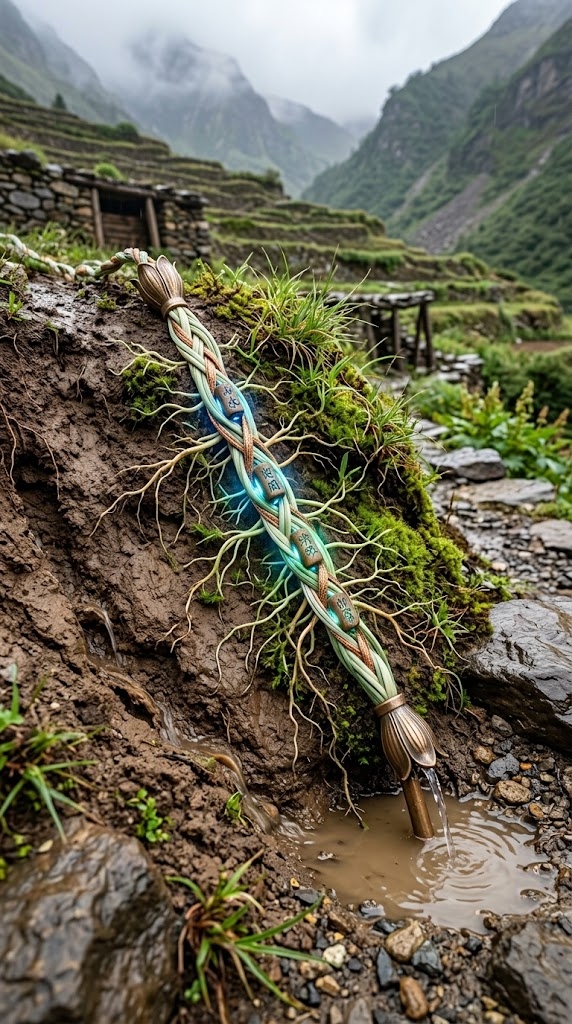
- When the bronze lotus-pod ferrules bite into raw soil or muddy water, the pale bone-white rush fibers deepen into an intense viridian hue, while the woven copper wire flares with a faint, steady electric-teal pulse.
- The five carved juniper talismans ignite from within, projecting sharp cyan-tinted kanji for Water (Sui), Wind (Fū), and Living Wood (Moku) onto the surrounding mud and stones.
- Spidery, glowing tendrils of emerald light branch outward from the cord’s braid into the earth, knitting together soil fissures and illuminating underground root meshes and water channels like illuminated capillary vessels.
- Crystal-clear streams of water visibly issue from the three perforated weep holes of the lower bronze ferrule, contrasting sharply with the brown slurry entering the intake.
- Observer’s Perspective:
- Observers watch the coiled braided cord tighten and stiffen like living bamboo the moment the user pins it to the slope.
- A sudden flush of verdant moss, tiny pale rootlets, and thick mountain fescue shoots out along the line of the cord, knitting the mudbank into a stable, green-carpeted berm within moments.
- The small wooden tokens emit a soft, humid glow, illuminating swirling eddies of water that appear to be pulled neatly into the braided fiber without splashing.
- Positives:
- Clearly illuminates groundwater seepage lines, soil fissures, and hidden drainage paths in dark tunnels, muddy ravines, or during heavy night storms.
- Gives clear, glowing visual feedback marking where the soil has been successfully bound against erosion.
- Negatives:
- The luminous teal and emerald glow makes stealth operations along riverbanks or dark paddy fields impossible.
- The intense bio-luminescence can reflect off wet mud and stagnant pools, creating distracting glare for the user.
- User’s Perspective:
- Auditory Perception:
- User’s Perspective:
- The user hears a faint, rhythmic siphoning whisper—like a straw drawing liquid from a deep cup—interwoven with the gentle, crackling hiss of thousands of micro-roots bursting through compacted earth.
- The chaotic roar of rushing floodwaters or grinding mudflows drops into a disciplined, bubbling trickle as water enters the weave.
- Holding the cord close to the ear reveals a subtle, high-pitched chime produced by the copper thread vibrating against the rush fibers, sounding like wind through wet reeds.
- Observer’s Perspective:
- Bystanders hear an abrupt settling sound—a soft, wet crunch as the soil draws in on itself and locks firm.
- A steady, clean babbling sound emerges from the terminal bronze lotus pod as purified water pours out over the rocks, replacing the sloshing churn of mud.
- Positives:
- Drowns out erratic, disorienting stormwater noises with a calm, rhythmic watercourse cadence.
- The distinctive siphoning whistle alerts allies that the drainage line is active and working at capacity.
- Negatives:
- The high-pitched capillary hum can draw curious marsh predators or subterranean vermin that track flowing water.
- In quiet caverns or enclosed cellars, the sound of gushing outflow echoes loudly against masonry walls.
- User’s Perspective:
- Olfactory Perception:
- User’s Perspective:
- The moment activation occurs, the air fills with an intense, rich aroma of damp riverbed moss, crushed pine needles, petrichor, and fresh green bamboo shoots.
- As the siphon filters stagnant water, foul sulfurous odors, stagnant canal rot, and swamp gasses are rapidly replaced by the crisp, ozone-like freshness of an alpine waterfall.
- Observer’s Perspective:
- Those standing downwind catch a sweet, earthy scent reminiscent of a mountain meadow after a spring rain, with subtle undertones of steeped green tea and clean mountain stone.
- Positives:
- Neutralizes toxic swamp fumes, sewer reek, and putrid mud gas in stagnant tunnels or flooded foundations.
- Serves as an olfactory indicator that the water passing through the filter is purified and safe to drink.
- Negatives:
- The sudden release of strong botanical aromas can alert tracking beasts or hounds hunting by scent.
- Highly concentrated pollen and pine terpenes released by rapid vegetation growth can irritate users prone to plant allergies.
- User’s Perspective:
- Gustatory Perception:
- User’s Perspective:
- The wielder experiences a clean, cool sensation across the palate, reminiscent of cold snowmelt filtered through cedar roots, with a slight, sweet mineral astringency.
- Breathing in the humid mist generated by the siphon leaves a faint trace of clover and raw bamboo on the tongue.
- Observer’s Perspective:
- Anyone tasting the water flowing from the terminal lotus pod notes a crisp, sweet, spring-like taste completely devoid of silt, sulfur, or mud.
- Positives:
- Cleanses the mouth of bitter dust, stagnant water taste, or foul canal spray during emergency operations.
- Negatives:
- Leaves a lingering, slightly dry tannin coating on the back of the throat after extended exposure to the misty outflow.
- User’s Perspective:
- Tactile Perception:
- User’s Perspective:
- The cord turns cold, slick, and heavy in the hands, pulsing with a firm, rhythmic hydraulic heartbeat as fluid surges through its core plies.
- The soil beneath the user’s boots changes from slippery, unstable slime to a firm, sponge-like carpet of dense root matter that holds firm without shifting.
- A cool, refreshing vibration hums through the wielder’s fingers, relieving heat and hand cramps.
- Observer’s Perspective:
- Observers stepping onto the treated area feel the ground spring back under their weight rather than give way, as though walking over an ancient, dense forest floor.
- Touching the cord reveals it to be as rigid as a carved cedar pole while active, yet icy cold to the touch.
- Positives:
- Prevents slips, falls, and loss of footing along treacherous, rain-slick mudbanks and muddy slopes.
- The cord acts as a rigid, load-bearing handrail or safety line once pegged into the earth.
- Negatives:
- Handling the ice-cold, vibrating cord with bare hands in winter or freezing mountain rain can cause rapid finger numbness and loss of manual dexterity.
- The sudden eruption of fibrous roots can snag trouser cuffs or shoelaces if the user stands directly on the stitching line.
- User’s Perspective:
- Extra-Sensory Perceptions:
- Mind’s Eye Perception:
- User’s Perspective: Looking inward through the Mind’s Eye, the surrounding landscape becomes a fluid, luminous network of blue moisture vectors and emerald growth lines; subterranean aquifers glow like deep veins, and hydrostatic pressure pockets appear as bulging azure knots that gently untie as the cord siphons them away.
- Observer’s Perspective: Psychics or meditating ascetics see the user surrounded by a translucent mandala of weaving water currents and budding lotus leaves, with the cord acting as a glowing green umbilical tether anchoring the avatar directly into the regional water table.
- Positives: Allows precise, non-invasive surveying of hidden groundwater, identifying safe well-digging sites, sinkhole hazards, and clogged underground pipes without excavation.
- Negatives: The overwhelming influx of hydrological data and fluid-dynamics vectors can cause brief sensory disorientation when transitioning back to normal vision.
- True Sight (Ultraviolet Spectrum):
- User’s Perspective: Under ultraviolet inspection, the braided fibers reveal a dense lattice of spiraling violet energy that draws free environmental mana from groundwater, while the bronze lotus pods emit soft, coronal flares of indigo light that neutralize microbial contamination.
- Observer’s Perspective: True Sight shows a shimmering cage of ultraviolet light settling over the treated slope, forming a protective barrier that seals in the soil kami and repels destructive erosion spirits.
- Positives: Clearly distinguishes between natural organic water flow and tainted, chemically contaminated runoff by the color shift in the auroral discharge.
- Negatives: The brilliant violet flare of the active ferrules can briefly blind sensitive night-vision lenses or thermal-imaging gear.
- Soul Sense / Spiritual Attunement:
- User’s Perspective: The soul harmonizes with the restorative aspect of the Water-Dragon Kami; the avatar feels a tranquil, nurturing stewardship over the soil, experiencing the quiet relief of the hillside as its tearing gullies are stitched together and healed.
- Observer’s Perspective: Those nearby feel an overwhelming sense of freshness, stability, and pastoral calm, as if standing in an ancient mountain shrine secluded from the chaos of the storm.
- Positives: Provides absolute immunity to environmental panic, despair, or claustrophobia during flash floods, levee collapses, or subterranean inundations.
- Negatives: Generates an intense reluctance to abandon cultivated land or see natural waterways deliberately poisoned, potentially complicating cold-blooded mercenary decisions.
- Mind’s Eye Perception:
Crafting Recipe: Shugendo 842 of the Terrace-Weaving Mizuhiki
Materials Needed:
- Alpine Dwarf Bamboo Bast Fiber (1 pound, processed) – Tough, flexible inner bark fibers harvested from high-elevation bamboo stands, degummed and combed into fine spinning hanks.
- Sun-Bleached River Rush Stems (1 pound, dried) – Harvested from braided mountain stream margins, sun-cured until chalk-white and split into uniform ribbon-like plies.
- Annealed Conductive Copper Wire (45 feet, 26-gauge) – Fine, ultra-flexible single-strand copper wire drawn to conduct bio-electrical and moisture currents throughout the weave.
- Bell Bronze Ingot (1.5 pounds) – High-copper acoustic casting bronze for pouring the hollow lotus-pod terminal ferrules.
- Mountain Juniper Heartwood (5 small blocks, 1.5 x 1 x 0.5 inches each) – Dense, aromatic cedar/juniper wood seasoned with mountain smoke to carve the talismanic slider toggles.
- Tier 1 Magic Crystals (2 units, small coin-sized) – Water- or Wood-attuned resonant crystals harvested from Tier 1 riparian spirits or elemental springs, used as catalytic growth and filtration cores.
- Pine Gall Tannin & Volcanic Ash Wash (1 pint) – A traditional alchemical mordant blend used to temper, waterproof, and bio-charge the woven fibers.
- Consecrated Snowmelt Water (1 gallon) – Collected from high-peak glacial runoffs to quench metals and soak the finished cord during attunement.
Tools Required:
- Braiding Stand (Marudai or Takadai) and Bobbins – Traditional weighted wooden braiding apparatus for plaiting multi-ply complex cordage under uniform tension.
- Small Charcoal Melting Furnace, Crucible, and Pouring Tongs – For melting and casting the bronze ferrules.
- Fine Woodcarving Knives and Micro-Gouges – For detailing the juniper talismans and slicing precise wire channels.
- High-Heat Branding Stylus (Pyrography Tool) – For burning the sacred seed syllables into the wooden toggles.
- Agate Mortar and Pestle – For crushing catalytic crystals into fine mineral powder.
- Precision Hand Drill and Micro-Bits (1mm and 2mm) – For boring the ferrule weep holes and drilling cord passages through the juniper blocks.
Skill Requirements:
- Fiber Arts / Cordage Weaving: Level 5 or higher – For spinning, plaiting, and braiding a three-ply compound mizuhiki cord with embedded wire under consistent tension.
- Metal Casting and Jewelry Crafting: Level 6 or higher (Minimum level 5 required for fine metallurgical casting, plus 1 additional level to achieve the Tier 1 item outcome) – For casting the hollow lotus-pod ferrules, boring weep holes, and crimp-anchoring terminal ends.
- Woodcarving / Talisman Inscription: Level 2 or higher – For carving, drilling, and branding the five juniper wooden tokens with exact seed syllables.
- Hydrological Engineering / Alchemical Rites: Level 1 or higher – For balancing the ash-tannin bath, charging the internal catalytic chambers, and performing the harmonic water attunement.
Crafting Steps:
- Preparing the fiber plies and wire core:
- Comb the dwarf bamboo bast fibers and split river rush stems into long, clean slivers of equal width.
- Divide the materials into three balanced working groups: one ply of pure bleached rush (white), one ply of mountain bamboo fiber (pale green), and one composite ply blending fine bamboo fibers twisted tightly with the 26-gauge annealed copper wire.
- Soak the vegetative fibers in the warm pine-gall and volcanic-ash wash for six hours, then pull them through clean linen rags to dry until damp, pliable, and pliable enough to resist snapping during tensioning.
- Carving and branding the juniper talismans:
- Cut five uniform rectangular toggles from the seasoned mountain juniper heartwood, rounding all exterior edges to prevent snagging along soil or gear.
- Drill a central channel through each block wide enough to accommodate the compressed fifteen-foot cord.
- Using the fine micro-gouges and the heated branding stylus, burn the sacred Shinto-Buddhist seed syllables for Water (Sui), Wind (Fū), and Living Wood (Moku) deeply into both faces of every toggle.
- Polish the blocks with raw mountain pine oil to seal the grain against waterlogging and splitting.
- Plaiting the multi-ply mizuhiki cord:
- Set up the three prepared ply groups onto the weighted braiding stand (marudai), maintaining crisp, symmetrical tension across each counterweight bobbin.
- Braid the fibers into a tight, stiff, flat-spiral cord measuring fifteen feet in length, threading the unbraided lead through the five juniper talismans at exact three-foot intervals as the weave progresses.
- Ensure the thin copper wire wraps consistently along the outer ridge of the green bamboo ply, leaving the metallic trace exposed to make direct contact with wet ground and runoff.
- Secure both ends with tight, temporary whipped bindings of waxed linen cord.
- Casting, boring, and mounting the lotus-pod ferrules:
- Carve a two-piece investment mold depicting an unfurling lotus seed-pod with an open hollow collar at the base and a flared terminal snout.
- Melt the bell bronze in the crucible and pour two identical pod castings; once cooled, break the molds and clean the surfaces with fine wire brushes and files.
- Drill three precise 2mm weep holes through the flared snout of each pod casting to allow fluid aeration, filtration, and capillary outflow.
- Crush one small Tier 1 magic crystal into micro-fine dust using the agate mortar and pestle, blending it with tree resin to coat the hollow interior chamber of both bronze ferrules.
- Place the second intact Tier 1 crystal into the primary intake ferrule’s seat, then insert the whipped ends of the braided cord into the bronze collars.
- Crimp and pin the collars securely using hidden bronze pins, permanently locking the vegetative and copper fibers against the catalytic crystal beds.
- Hydrological consecration and capillary awakening:
- Submerge the complete, assembled mizuhiki coil in a shallow basin of consecrated glacial snowmelt water.
- The artisan places both hands over the submerged bronze pods and chants the Water-Purifying Sutra of the Dragon King for one exploration turn (10 minutes).
- As the catalytic crystal dissolves into the internal bronze alloy, a faint, rhythmic siphoning whisper arises from the water, and the pale rush fibers deepen into an intense forest viridian while the copper thread pulses with a faint teal light.
- Test the completed cord by anchoring both ferrules into a tray of saturated mud and gravel: confirm that clear, filtered water immediately trickles from the lower weep holes, the juniper talismans glow with soft cyan kanji, and the surrounding loose mud knits together with living micro-roots into an erosion-proof vegetative mat within 1 minute.
Braided Mountain-Grass String of Cloud-Terrace That Weaves Water-Wound 842
In the season when the great sky-kettle boiled over and the high clouds did not know when to shut their broad gray mouths, the mountain had three thousand tears in its red belly. The rain came down not like small peas, but like fat wet sheep falling out of the cloud-hole for forty nights, until the high terrace-gardens became very soft and greasy like the rotten belly of an old dead fish.
The digging-people who lived upon the stepped shelves had great weeping in their throats. They had made twelve flat steps of red dirt upon the steep mountain-rib to plant their sweet yellow grain and their small white mountain-radishes. But because the rain-water ran straight and had no eyes, it tore long, ugly trenches through the soft dirt, three cubits deep and wide enough to swallow a fat pregnant goat. The red mud came sliding down like boiling porridge, filling the stone well-holes with sour yellow slime and washing ninety wicker hampers of ripe melon-seeds down into the black abyss where only the blind water-eels crawl.
The Master of the Mountain-Paddy, whose belly was broad and who wore six braided reed hats against the wet, ran to the edge of the great tear with twenty-and-four ditch-men carrying heavy wooden shovels and bundles of dry wicker-wattles. He beat his chest with his fat knuckles and shouted at the running water: “O you blind gray runoff from the snow-tooth, why do you eat the bread out of my children’s bowls? We have driven eighty ashwood stakes into your road and piled thirty baskets of river-pebbles against your teeth!” But the blind water only laughed with a bubbling noise like a pig in a ditch; it picked up the eighty ashwood stakes, threw them over the rock-edge like broken toothpick-slivers, and drowned the Master’s second-best reed shoes in yellow mud.
Now there lived upon the very high cloud-ledge where the dwarf bamboo grows flat against the rock a small, dry ascetic monk whose hair was green like river-moss and whose skin was wrinkled like a dried winter-plum. His name in the crooked scratched marks was The Man Who Sews Up the Torn Mountain. He wore no deer-skin coat and no straw cape; he sat naked upon a wet flat stone where the clouds drag their bellies, drinking only the cold sweat of the bamboo-leaves and chewing three raw pine-nuts every morning when the sun woke the crows.
He looked down through the gray fog and saw the people of the terraces rolling in the mud, trying to catch the sliding mountain with their naked fingers and weeping because their radish-terraces were turning into empty stone ribs. The hermit shook the cold rain out of his nose and spoke to a little green tree-frog that was sitting upon his thumb: “The people of the low ditches have minds like heavy iron wedges. When the mountain-sky weeps, they try to build a tall wooden wall to slap the water in the face, and the water only grows heavy and breaks their wall into floating rubbish. Water cannot be punched with a fist; it must be led by the hand like a blind child, and the torn earth cannot be healed with dry timber, but must be stitched together with living hair.”
Then the old hermit stood upon his calloused heels and walked into the high dwarf-bamboo brake where the cold mist hangs like wool. He cut forty stalks of the tough mountain-reed that bends under ten men’s weight without snapping its spine. He peeled away the outer yellow skin with his sharp finger-nail and combed the inner white hair until it became as fine and long as the silk-thread of an empress.
Then he went down to the edge of the foaming river where the chalk-white river-rushes grow in the boiling spray. He pulled up sixty handfuls of the sun-bleached stems, split them into three ribbons with a sharp flint-flake, and laid them in a flat stone pot filled with the bitter water of boiled pine-galls and the black ash scraped from the chimney of the mountain-dragon.
He climbed down into the secret red crevice where the cold earth-copper runs out like red honey between two granite slabs. He drew out a thin wire of the shining metal, hammered it upon a flat river-boulder with a round pebble until it was as thin as the whisker of a mountain-cat, and wound it together with the green bamboo-threads.
Taking a three-legged wooden stool with a round hole in the middle, the hermit weighted the ends of the three plies with six smooth river-stones and began to plait the threads together, singing the old water-words that teach the grass-roots how to hold hands under the dark earth. As he braided the fifteen cubits of cord, he slipped five small square beads of mountain-juniper wood over the strands. On each wood-face he burned with a red-hot iron needle the holy marks: the mark of the Running Water (Sui), the mark of the High Cloud-Wind (Fū), and the mark of the Green Wood That Does Not Die (Moku).
At the two heads of the braided rope he fixed two hollow tubes of beaten bell-bronze, shaped like the seed-caps of the holy river-lotus, and through the snout of each bronze cap he bored three weeping-holes like the eyelets in a leather shoe. He smeared the inner throats of the bronze pods with the gray flour of two small shining river-crystals, and he dropped the entire braided snake into a trough of cold snowmelt until the white rush-fibers drank their fill and turned deep, dark green like the belly of a sleeping carp.
Then the hermit threw the coiled cord over his left shoulder like an ox-rope and walked down through the fog to the great terrace-dike that was about to tumble into the roaring valley.
The Master of the Mountain-Paddy was sitting in the mud with his six reed hats floating in a ditch, wailing: “The great red dike of the third shelf has broken its ribs! Sixty cartloads of black topsoil are falling into the gorge, and the winter-radishes will rot before they see the sun!”
“Get away from the ditch, you fat pig of the mud-holes,” said the hermit, his voice like the rustling of dry bamboo in an autumn draft. “Your shovels are like children’s spoons trying to carry away a fallen cliff. Move your knees aside and let the living grass do the work that your wooden heads cannot think of.”
The hermit took the coiled cord from his shoulder. He did not build a timber fence, nor did he fetch sixty bags of river-gravel. He uncoiled the fifteen cubits of the braided string along the very lip of the weeping mud-wound where the red dirt was shearing away from the granite bedrock.
He knelt upon his bare knees in the cold soup of the runoff, took the first bronze lotus-pod, and drove its snout deep into the loose mud at the top of the gully. Then he walked along the lip of the chasm, pulling the cord taut until it hummed like a bow-string, and planted the second bronze pod into the firm clay of the terrace-floor fifteen cubits away.
He placed his two calloused palms flat upon the five juniper beads and uttered a single, sharp word from the middle of his belly—a sound like the popping of a dry seed-pod in the hot sun.
From the two bronze lotus-pods there burst forth a strange, cool light, the color of pond-water when the moon is full behind thin reeds. The copper wire running through the braid began to shine with an electric blue vein, and the five wooden talismans glowed like blue tallow-candles in the mud.
Then a sound came forth from the braided cord—not a loud roar, but a deep, rhythmic sucking whisper, like an old horse drinking from a deep stone bucket. The brown, swirling runoff that was tearing the terrace to pieces was not thrown back; it was pulled into the pale rush-plies as though the rope were a hungry snake.
The red mud-soup went into the upper weave, but from the three weep-holes of the lower bronze lotus-pod, there ran out a stream of water as clear as morning dew, completely clean of sand, silt, and sour red dirt, babbling quietly down into the irrigation ditch like a friendly brook.
Even more strange to the eyes of the twenty-and-four ditch-men, who fell upon their stomachs in the mire: from the edges of the braided cord, thousands of tiny white threads began to shoot out into the red mud. They were not woven hemp, but the living roots of wild alpine fescue, green mountain-moss, and creeping water-clover.
The roots ran through the loose mud like little white fingers, grabbing each grain of silt and pulling it tight against the next. The two torn lips of the great gully were pulled together by the green fibers, stitching the mud-wound closed just as a village grandmother stitches the torn sleeve of a winter-smock.
In the space of twenty breaths, the fifteen cubits of sliding, collapsing mud along the terrace-lip became a dense, springy, emerald-green mat of living roots and thick turf. The red ditch-men stood upon the bank; the ground did not yield under their heavy wooden boots, but held them up like a floor of dried cedar-planks. The sixty cartloads of black topsoil remained sitting upon the mountain’s ribs, and the sweet radish-shoots shook the mud from their small leaves and turned their faces up to the sky.
The Master of the Mountain-Paddy rubbed his round eyes with the back of his muddy sleeve, his mouth opening so wide that two horse-flies flew in and out again without touching his teeth.
“This is no rope of grass,” he cried, his fat knees knocking together in the ditch. “This is the green dragon’s hair! He has stitched the mountain’s torn skin back onto its ribs without driving a single wooden nail or hauling a single load of mortar!”
He reached into his leather purse and pulled out twenty strings of bright copper money and a jar of pickled fish-bellies, offering them to the naked ascetic. “O Great Master of the Cloud-Rushes, take our coins and stay in our ditch! We will build you a house of dry pine-logs and bring you twelve fat chickens every full moon!”
The old hermit did not look at the copper coins, nor did he put his nose over the pickled fish-jar. He stood up from his knees, his hands smelling of crushed bamboo-shoots and wet river-moss, and wiped the cold mist from his forehead with his knuckle.
“Keep your little metal disks to buy dry radish-seed, you foolish man,” spoke the hermit, his voice gentle like water falling into a deep fern-pot. “The mountain does not sell its bones for round pieces of copper, and the running water does not stop for a bowl of boiled bird-meat.
“When you build your houses, you think only of how tall your timbers stand against the sky, but you forget that the mountain lives by what crawls underneath its skin. If you scrape away the green hair of the earth and put down only dry wood and dead stones, the rain will look upon your works as rubbish and sweep them into the ditch. You must learn to weave your paths with the roots of the grass, and let the water run through your fingers instead of trying to catch it in a broken pot. He who learns to sew the earth together will always have a floor beneath his feet, while he who only builds high walls will spend his old age digging his grain-bags out of the river-silt.”
The old hermit did not wait for the ditch-men to fry their melon-seeds. He picked up his staff of twisted willow and walked back up the steep stone path toward the high cloud-pass, disappearing into the white mist like a gray bird flying into the reeds.
When the morning sun came over the snow-crag, the ditch-people returned to the terrace with baskets of sweet-grass to lay upon the green suture. The hermit was nowhere to be seen, but the braided mizuhiki cord remained firmly rooted into the red bank, pulsing with a gentle, cool cyan light, while clear, sweet water continued to sing through the bronze lotus-pod, feeding the green radish-fields through fifty years of storms without a single grain of dirt ever falling into the abyss again.
Moral of the Story: He who attempts to master the raging elements by force and rigid walls will only see his labors broken and washed away, but he who understands the yielding strength of the root and guides the water through gentle harmony will knit the very earth together, turning catastrophe into a flourishing garden that endures for generations.
Suggested conversions to other systems:
Call of Cthulhu (7th Edition)
Braided Cord of the Hillside Suture
- Item Classification: Arcane Artifact / Taoist-Shugendo Environmental Focus
- Weight: 1.5 lbs
- Sanity Loss: 0 to wear or deploy as utility cord. Witnessing spontaneous, explosive root-knitting that transforms a shearing mudslide or quicksand into dry, blooming turf within seconds costs 0/1 Sanity.
Game Mechanics:
- Hydrological Intuition (Passive): Holding the uncoiled cord against raw soil or a watercourse grants a bonus die (+1D) to Geology, Natural World, Survival, and Science (Hydrology/Botany) rolls made to evaluate soil saturation, track hidden groundwater tables, locate potable water, or forecast landslides.
- Bio-Filtering Weep (Passive): Turbid, brackish, or tainted natural water channeled through the cord is filtered into clean, potable water at the lower bronze ferrule, neutralizing non-magical waterborne toxins, heavy metal sediments, and microbial parasites.
- Living Terrace Suture (Active): The investigator expends 2 Magic Points and anchors both bronze lotus ferrules across an eroding slope, mudslide gully, or unstable soil bank. Over the course of 1 round, a dense network of mountain fescue and moss sprouts along a 5-yard line, binding the soil into a stable, dry vegetative mat for 24 hours. The area cannot collapse, erode, or slide during this time.
- Aquifer Diversion Siphon (Active): By submerging one ferrule in pooled water, a flooded trench, or a slurry pocket and spending 2 Magic Points, the cord siphons up to 100 gallons per minute toward the outflow ferrule for up to 10 minutes, lowering flood levels or draining flooded chambers up to 5 yards away.
- Root-Weave Entanglement (Active): As an attack action in wild or soft-ground terrain, the user spends 3 Magic Points and snaps the cord along the earth toward up to two targets within 5 yards. Subterranean rootlets violently lash outward; each target must succeed on an Extreme DEX or Hard STR roll or become Immobilized. An immobilized victim may attempt a Hard STR roll on subsequent turns to break free.
Blades in the Dark
The Terrace-Weaving Mizuhiki
- Classification: Arcane Implement / Ecological Drainage & Suture Cord
- Load: 1 Load (Worn as an obi sash, coiled bandolier, or utility line)
- Quality: Tier I fine item
Item Features:
- Fine Craftsmanship: A fifteen-foot braided cord of bleached mountain rushes, green bamboo fiber, and fine copper wire, fitted with perforated bell-bronze lotus ferrules and five carved juniper talismans.
- Hydrological Conduit: Channels moisture, anchors topsoils, and draws vegetative growth to seal collapsing terrain.
Game Mechanics:
- Environmental Surveying (Passive): You gain Potency when using Study or Survey to evaluate canal water tables, drainage faults, subterranean water seepage, levee stability, or bog navigation.
- Water Filtration (Passive): Any fouled, stagnant, or silty canal runoff filtered through the cord’s weep holes becomes pure and drinkable, mitigating environmental sickness or water poisoning without requiring an alchemical check.
- Soil Suture (Active): Spend 1 Stress to anchor the cord across an eroding mudbank, collapsing ditch, or sliding roof garden. The earth along the cord knits together with living micro-roots, granting Potency to any immediate action to prevent structural slope failure or safely traverse collapsing mud.
- Aquifer Siphon (Active): Spend 1 Stress to deploy the cord into a flooded basement, canal lock, or excavation trench. The siphon clears standing water rapidly, improving your Position from Desperate to Risky (or Risky to Controlled) when clearing flooded hazards or racing against drowning hazards.
- Root-Weave Snare (Active): Spend 1 Stress and snap the cord across vegetative or soft soil to trip and ensnare an advancing threat. Make a Survey, Skirmish, or Finesse roll with Potency; on a success, up to two targets are entangled by surging root tendrils, suffering the Restrained obstacle.
Dungeons & Dragons (5th Edition)
Terrace-Weaving Mizuhiki
- Wondrous Item, common (requires attunement)
- Item Category: Worn (waist or shoulder) or held in 1 hand
- Weight: 1.5 lbs
Item Properties:
- Ecological Hydrology Sense: While holding the uncoiled cord against unworked earth or a watercourse, you gain advantage on Wisdom (Survival) and Intelligence (Nature) checks made to locate underground aquifers, assess soil stability, predict mudslides, or track contaminated drainage.
- Topsoil Cohesion: While the cord is laid across exposed soil, sand, or gravel, ground within a 10-foot radius of the cord cannot be displaced by non-magical rain, erosion, or sudden water runoff, and creatures traversing this area ignore difficult terrain caused by mud or loose scree.
- Bio-Filtering Weep: Up to 1 gallon of murky, silty, or foul water poured through the upper ferrule each minute emerges from the lower weep holes as clean, purified drinking water, free of non-magical diseases and poisons.
Active Properties:
- Living Terrace Suture: As an action, you anchor both bronze ferrules into an exposed dirt gully, muddy slope, or unstable embankment. A 15-foot line of thick roots and mountain fescue sprouts instantly from the soil along the cord, solidifying the ground into stable, load-bearing terrain for 24 hours. You can use this property twice, regaining all expended uses after a short or long rest.
- Aquifer Diversion Siphon: As an action, you place the intake ferrule into a body of standing water, flooded trench, or slurry pool and direct the outflow ferrule up to 15 feet away. The cord magically siphons up to 100 gallons of water per minute for up to 10 minutes. You can use this property twice, regaining all expended uses after a long rest.
- Root-Weave Entanglement Strike: As an action, you snap the cord across soil, mud, or vegetative ground toward enemies within 15 feet. Creeping roots burst from the earth; up to two creatures of your choice in that area must succeed on a DC 12 Dexterity saving throw or be restrained for 1 minute. A creature restrained by the roots can use an action to make a DC 12 Strength check, freeing itself on a success. Once used, this property cannot be used again until you finish a long rest.
Knave (Second Edition)
Ascetic’s Drainage Suture
- Item Slots: 1 Slot (Worn as a sash or carried in a pack)
- Item Quality: 3/3 Durability
- Base Value: 110 copper coins
Item Mechanics:
- Water Finding (Passive): You gain a +2 bonus to Wisdom checks to detect hidden aquifers, find fresh spring water, and evaluate whether mudbanks or mine floors will collapse under weight.
- Safe Water (Passive): Water siphoned or drained through the bronze lotus ferrules is automatically cleansed of dirt, parasites, and non-magical stagnant fouling, making any marsh or ditch water safe to drink.
- Slope Suture (Active): Once per day, you may stake both bronze ends into a collapsing hillside, mud gully, or failing trench. The cord sprouts an immediate webbing of tough roots, binding a 15-foot strip of unstable muck into solid, stable ground for 24 hours.
- Trench Siphon (Active): Once per day, you can plant the cord into a flooded hole, cellar, or pit to siphon out standing water at high speed, completely draining a waterlogged area up to 15 feet wide in 10 minutes.
- Root-Weave Snare (Action): Once per day, whip the cord across dirt or grassy ground to entangle up to two targets within 15 feet. Each target must make a Strength or Dexterity saving throw or become trapped in place by sudden root growth for 3 combat rounds. If both targets fail their saves, make an Item Save for the cord (d20, target 11+); on a failure, the copper braiding strains and snaps in one segment, reducing the cord’s Quality by 1.
Fate Core
Ascetic’s Mizuhiki of the Living Revetment
- Aspect: Braided Rush and Copper Terrace-Suture
- Aspect: Capillary Flow of the Cloud-Terrace Shrines
- Aspect: Juniper Talismans of Water and Living Wood
Stunts:
- Hydrological Surveying: Because you carry the attuned drainage sash, you gain a +2 bonus to Notice or Crafts when assessing groundwater movement, predicting mudslides, locating underground aquifers, or inspecting irrigation revetments.
- Living Terrace Suture: Once per scene, as an action, you may anchor the cord’s bronze ferrules into an eroding hillside, failing ditch, or washed-out bank. Spend a Fate Point to immediately remove any environmental aspects representing collapsing or difficult mud, replacing them with the situational aspect Root-Bound Earth Revetment with one free invoke.
- Bio-Filtering Siphon: Once per scene, you can place the intake ferrule into a flooded area, muddy pool, or toxic runoff ditch. Use Crafts or Physique with a +2 bonus to create an advantage representing drainage or water purification, placing the aspect Drained Footing or Purified Water Reserve with two free invokes on a success.
- Root-Weave Entanglement: Once per conflict, you may whip the cord across raw soil or vegetation as an action to create an advantage against up to two targets in your zone using Crafts or Athletics with a +2 bonus. On a success, you place the aspect Snared by Mountain Roots on both targets with one free invoke to share.
Cypher System / Numenera (Discovery & Destiny)
Terrace-Weaving Mizuhiki
- Level: 2
- Form: A fifteen-foot braided sash woven from bleached mountain rushes, green dwarf bamboo, and thin copper wire, fitted with perforated bronze lotus pods and five inscribed juniper beads.
- Kind: Artifact (Depletion: 1 in 1d20, checked when activating Living Terrace Suture, Aquifer Diversion Siphon, or Root-Weave Entanglement Strike)
Game Mechanics:
- Hydrological Intuition (Passive): While holding the cord against soil or natural watercourses, tasks related to evaluating soil saturation, locating fresh water tables, navigating wetlands, and civil/environmental engineering are eased by one step.
- Natural Filtration (Passive): Any fouled, silty, or organically tainted water passing through the cord emerges purified from the lower lotus pod, automatically neutralizing non-magical contaminants and waterborne pathogens.
- Living Terrace Suture (Action): The bearer stakes both bronze ends into collapsing mud, loose scree, or an eroding bank. A 15-foot line of thick roots and mountain fescue instantly knits the ground together into stable, solid terrain for 24 hours, removing all movement hindrances. Roll for Depletion.
- Aquifer Diversion Siphon (Action): Submerging the intake pod in standing water or a flooded trench rapidly drains up to 100 gallons per minute toward the outflow end (up to an immediate distance away) for 10 minutes. Roll for Depletion.
- Root-Weave Entanglement Strike (Action): Snapping the cord across soil or vegetation causes roots to erupt along a 15-foot line. Up to two targets in the area are hindered on all actions and cannot move from their positions for 1 round unless they succeed on a Might defense roll. Roll for Depletion.
Pathfinder (Second Edition)
Terrace-Weaving Mizuhiki – Item 2
- Traits: Uncommon, Abjuration, Plant, Primal, Invested
- Price: 35 gp
- Usage: worn (belt or sash) or held in 1 hand; Bulk: L
Description:
- Woven from dwarf bamboo, bleached river rush, and ductile copper wire, this 15-foot braided cord features five juniper-wood talismans branded with primal runes and is capped at both ends by cast-bronze lotus-pod ferrules drilled with drainage weep holes.
Passives:
- Hydrologist’s Insight: While invested, you gain a +1 item bonus to Nature checks to locate potable water, survey irrigation channels, and predict landslides, as well as to Survival checks to navigate swamps and mudflats.
- Topsoil Cohesion: While the cord is laid along the ground, soil and gravel within 10 feet cannot be eroded or washed away by non-magical rain or runoff, and allies in the area treat mud-based difficult terrain as normal terrain.
- Water Purification: Up to 1 gallon per minute of murky or brackish water passed through the braided cord emerges from the weep holes completely purified, neutralizing non-magical diseases and poisons.
Activate:
- Living Terrace Suture (Two Actions – Concentrate, Manipulate): Frequency: Twice per day. Effect: You anchor both bronze pods into exposed earth or a mud gully. A 15-foot line of dense vegetative roots and alpine fescue erupts along the cord, solidifying the terrain into packed, stable ground for 24 hours.
- Aquifer Diversion Siphon (Two Actions – Concentrate, Manipulate): Frequency: Twice per day. Effect: You place the intake pod into pooled water or a flooded trench and direct the output pod up to 15 feet away. The cord siphons water at a rate of 100 gallons per minute for up to 10 minutes, lowering local water levels and clearing flooded paths.
- Root-Weave Entanglement Strike (Two Actions – Concentrate, Manipulate): Frequency: Once per day. Effect: You sweep the cord across natural soil or vegetation. Roots burst from the ground along a 15-foot line. Up to two targets of your choice in the area must attempt a DC 16 Reflex save.
- Critical Success: The target is unaffected.
- Success: The target is clumsy 1 for 1 round.
- Failure: The target is immobilized by roots for 1 round (Escape DC 16).
- Critical Failure: The target is restrained by roots for 1 minute (Escape DC 16).
Savage Worlds (Adventure Edition)
Terrace-Weaving Mizuhiki
- Type: Minor Arcane / Environmental Relic
- Weight: 1.5 lbs
- Cost: $250 (highly valued by foresters, terrace farmers, and canal ditch-runners)
Special Abilities:
- Hydrological Lore: The wearer gains a +1 bonus on Common Knowledge, Notice, and Survival rolls made to locate underground aquifers, inspect irrigation dikes, evaluate slope stability, or filter field water.
- Clean Draw: Any tainted, stagnant, or mud-laden natural water siphoned through the cord is instantly filtered into clean, potable drinking water, granting immunity to waterborne hazards.
- Living Terrace Suture: Twice per encounter, the user spends an Action to anchor both bronze ferrules along an eroding gully, mudslide, or washed-out bank. A Medium Blast Template centered along the cord becomes immediately bound by thick mountain turf and roots for 24 hours, removing all Difficult Ground penalties caused by mud, sand, or scree.
- Aquifer Diversion Siphon: Twice per day, the user may place the cord to siphon water from a flooded area, trench, or cellar into an adjacent lower zone up to 3 inches (6 yards) away, clearing roughly 100 gallons per minute for up to 10 minutes.
- Root-Weave Entanglement Strike: Once per encounter, as an Action, the user snaps the cord across natural earth or grassy terrain. Up to two targets within a Medium Blast Template must succeed on an Agility roll at -2 or become Entangled by erupting roots (Bound with a critical failure). A bound victim may break free on their turn with a Strength or Agility check at -2.
Shadowrun (Sixth World Edition)
Yamabushi Terrace-Weaving Mizuhiki (Force 2 Qi / Environmental Focus)
- Item Classification: Enchanted Qi Focus / Ecological Tether
- Force: 2
- Karma Cost to Bind: 6 Karma
- Availability: 3 (L)
- Cost: 7,500 Nuyen
- Form: A fifteen-foot braided cord made of bleached mountain rushes, green bamboo bast fibers, and fine copper wire, fitted with perforated bell-bronze lotus-pod ferrules and five carved juniper talismans. Worn wrapped as an obi sash around the waist, coiled over one shoulder as a bandolier, or tied to a field surveyor’s gear rig.
Game Mechanics:
- Hydrological Surveying (Passive): While attuned and worn, the bearer gains a +2 dice pool bonus on Outdoors and Engineering (Civil/Environmental) Tests made to analyze soil saturation, trace municipal or wild drainage networks, locate potable water tables, and identify imminent mudslides or embankment breaches.
- Bio-Filtration Weep (Passive): Up to 1 liter per minute of contaminated, brackish, or turbid water drawn through the intake ferrule is purged of common pollutants, silt, and non-magical waterborne toxins, exiting the lower weep holes as clean drinking water.
- Living Terrace Suture (Active): The bearer spends a Minor Action to peg both bronze ferrules into an eroding slope, muddy embankment, or compromised civil earthwork. Over 1 Combat Round, a dense mesh of micro-roots and moss erupts across a 5-meter line, stabilizing the soil into a resilient vegetative revetment for 24 hours. The treated terrain ignores collapse thresholds and negates difficult terrain penalties for pedestrians.
- Aquifer Diversion Siphon (Active): The user spends a Major Action to submerge the intake ferrule into flooded trenches, sump basins, or standing pools, directing the outlet up to 5 meters away. The cord siphons away standing liquid at a rate of roughly 400 liters per minute for up to 10 minutes, lowering flood obstacles and uncovering submerged infrastructure.
- Root-Weave Entanglement (Active): Once per day, the user spends a Major Action to whip the cord across natural earth or overgrown ground toward up to two targets within Near range (up to 5 meters). Underground roots lash upward; each target must pass an Agility + Athletics Test (Threshold 2) or gain the Immobilized status. An affected target may spend a Major Action on subsequent turns to break free by succeeding on a Strength + Athletics Test (Threshold 2).
Starfinder (Second Edition)
Terrace-Weaving Mizuhiki – Item 2
- Traits: Tech, Magical, Primal, Plant, Water
- Price: 75 credits
- Bulk: L
- Hands: 1 (or worn on the belt/sash slot)
- Form: A fifteen-foot multi-ply cord combining cured bamboo fibers, bleached river rush, and ductile copper wiring, capped with cast-bronze lotus pods drilled with aerating weep holes and threaded through five runic juniper tokens.
Game Mechanics:
- Hydrologist’s Gauge (Passive): While worn or held in one hand, you gain a +1 item bonus to Survival checks made to find clean water, navigate bogs, or forecast soil collapses, as well as to Nature checks regarding riparian ecosystems and agricultural water control.
- Topsoil Cohesion (Passive): When laid along unworked earth, mud, or scree, the ground within a 10-foot radius becomes immune to natural hydraulic washouts, and allies in the zone ignore difficult terrain caused by mud or loose sediment.
- Micro-Purification Weep (Passive): Tainted, brackish, or sediment-choked water poured into the intake ferrule is actively filtered, yielding clear, drinkable water at a rate of 1 gallon per minute free of non-magical poisons and pathogens.
- Living Terrace Suture (Two Actions – Concentrate, Manipulate): Frequency: Twice per day. Effect: You stake both bronze pods into exposed dirt, a washed-out road shoulder, or a mud gully. A 15-foot line of thick roots and mountain grasses sprouts along the cord, solidifying the terrain into packed, stable ground for 24 hours.
- Aquifer Diversion Siphon (Two Actions – Concentrate, Manipulate): Frequency: Twice per day. Effect: You set the intake ferrule into standing water or flooded trenches and run the outlet pod up to 15 feet away. The cord siphons out 100 gallons per minute for up to 10 minutes, clearing flooded terrain and lowering water tables.
- Root-Weave Entanglement Strike (Two Actions – Concentrate, Manipulate): Frequency: Once per day. Effect: You sweep the cord across natural soil or brush toward up to two hostile targets within 15 feet. Creeping roots erupt along the line; each chosen target must attempt a DC 16 Reflex save.
- Critical Success: The target is unaffected.
- Success: The target is clumsy 1 for 1 round.
- Failure: The target is immobilized for 1 round (Escape DC 16).
- Critical Failure: The target is restrained for 1 minute (Escape DC 16).
Traveller (Mongoose 2nd Edition)
Bio-Conductive Drainage Mizuhiki
- Tech Level: TL 4 (Primitive Bio-Capillary Soil Stabilizer)
- Equipment Type: Field Engineering / Environmental Gear
- Weight: 0.75 kg
- Cost: Cr 350 (standard issue among frontier terraforming crews, agricultural scouts, and marshland survey teams)
- Description: A 4.5-meter woven utility cord constructed from high-tensile alpine rush, treated bamboo bast, and braided copper wire. It features twin cast-bronze terminal ferrules with multi-port weeping snouts and five aromatic wooden slider beads inscribed with geomantic symbols.
Game Mechanics:
- Riparian Analysis (Passive): Wearing or deploying the cord grants DM+1 on all Survival, Science (Life or Earth Sciences), and Engineer (Civil) checks made to evaluate groundwater depth, detect hazardous drainage runoff, locate potable springs, or assess mudslide risks.
- Gravity-Feed Bio-Filter (Passive): Contaminated, silty, or stagnant surface water routed through the cord’s intake ferrule is filtered of particulate toxins, bacteria, and grit, providing clean drinking water at a continuous flow of 4 liters per minute.
- Living Suture Deployment: Twice per day, an operator may spend a Significant Action to stake the cord along an eroding slope, collapsed berm, or flooded mud trench. The embedded copper and botanical strands trigger rapid root matting along a 4.5-meter line, hardening the mud into stable, load-bearing turf within 1 minute. The suture holds for 24 hours, allowing heavy gear or light vehicles to pass without bogging down.
- High-Flow Capillary Siphon: Twice per day, the user may submerge one ferrule into a flooded airlock, trench, or mud pool and set the outflow lower down. The cord siphons up to 400 liters of liquid per minute for 10 minutes, lowering local fluid hazards by up to 4.5 meters in radius.
- Botanical Snare (Action): Once per day, the user can lash the cord across overgrown or soft ground to entangle up to two pursuing targets within 4.5 meters. The targets must succeed on an Athletics (DEX) check (Difficulty 8+) or suffer the Entangled state, requiring an Athletics (STR) check (Difficulty 8+) to break free.
Warhammer Fantasy Roleplay (Fourth Edition)
Mizuhiki of the Living Riverbank
- Item Category: Magical Artefact / Trappings
- Availability: Exotic (sought after by Imperial engineers, river wardens, and jade wizards)
- Encumbrance: 1
- Cost: 4 GC (or exchanged for surveyor charts, rare mountain draughts, and flood-retaining materials)
- Form: A fifteen-foot braided sash woven from green bamboo, mountain rushes, and copper filament, capped with perforated bell-bronze lotus finials and five carved juniper amulets.
Item Properties:
- Water-Warden’s Eye: While worn or held, the user gains a +10% bonus to Outdoor Survival Tests to locate fresh water or forecast flash floods, as well as to Trade (Engineer or Herbalist) Tests made to inspect dikes, sluices, and hillside drainage channels.
- Purifying Stream: Tainted, turbid river-slurry or marsh water that passes through the cord is filtered into drinkable water, neutralizing common parasites, rot-gut impurities, and non-magical swamp contagions.
- Living Terrace Suture: Twice per day, the bearer may spend an Action to anchor both bronze pods across an eroding hillside, mud gully, or compromised dike. The cord immediately stimulates a dense network of tough mountain fescue and moss along a 5-yard line, binding the soil into a secure, stable revetment for 24 hours and negating mud-based movement penalties.
- Siphon of the Sump Basin: Twice per day, the bearer may place the intake pod into flooded cellars, trenches, or standing mire. The cord siphons off roughly 400 liters of water per minute for up to 10 minutes toward the outlet up to 5 yards away, clearing submerged hazards.
- Root-Weave Entanglement: Once per day, the bearer may spend an Action to flick the cord across soft earth or vegetation toward up to two adversaries within 5 yards. Creeping roots violently snatch at their legs; each target must pass an Athletics Test (+0) or gain the Entangled Condition (with a Strength of 35 to break free).