
Lore: Crafted during the early consolidation of the coastal trade routes along the shores of Aterian, this implement was developed by an elder clan shaman who served as the community’s intermediary with both local river spirits and travelling merchant convoys. Recognizing that unseen entities hold territorial dominion over valuable fishing grounds, mineral-rich mudflats, and deep forest groves, the shaman sought an instrument that could treat spiritual appeasement as an ongoing contract rather than a series of uncertain desperate pleas. By binding dried spirit-grass twine, polished river shells, and resonant ironwood rods, the maker established a method to balance spiritual debts and commercial offerings with mathematical precision. In current practice, market navigators, caravan overseers, and barter mediators carry copies of this ledger-frame to appease local nature spirits before setting exchange outposts, ensuring fair unseen transactions and warding against spiritual extortion when extracting worldly materials from untamed territories.
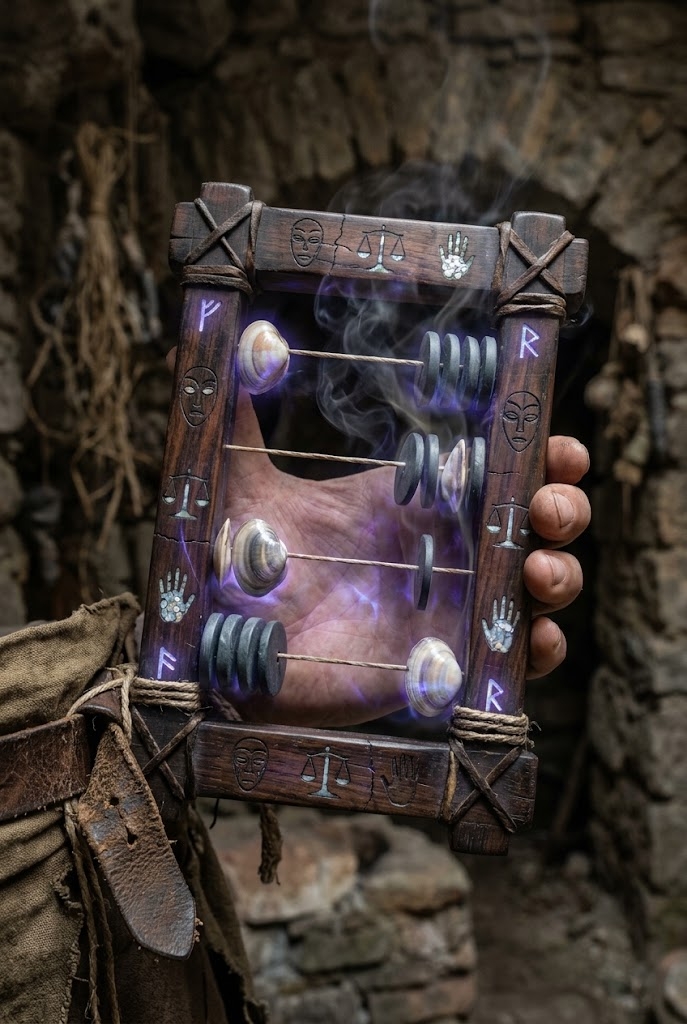
Description: The item is a compact, handheld calculating frame measuring ten inches in length and four inches across, bound within an open sleeve of cured rawhide that permits it to be tied directly to a belt or sash. The rectangular outer border is carved from dense, oily marsh-ironwood that resists rot, salt water, and dry desert winds. Spanning the frame are four tightly strung sinew wires made from the gut of coastal beasts, each strung with carved discs fashioned from river clam shells and smoothed spirit-slate. Across the top bar of the frame, intricate pictograms of masks, coins, balance scales, and open palms are scored into the wood and inlaid with crushed river pearl. When the shell counters are shifted along the wires during calculation, they emit a rhythmic, hollow clicking sound reminiscent of shamanic percussion stones, occasionally catching the light to reveal faint ultraviolet runes that only reveal themselves through the wearer’s sight.
Detailed Stats:
- Item Name: Shamanism 734 of the Spirit Ledger’s Abacus
- Item Rank: Tier 1 (Common)
- Item Armor Check (AC): 0
- Item Health Points (HP): Avatar Maximum Health Points plus 10 (Resilience 10 multiplied by Tier 1)
- Range: Simple (10 feet for directional sensory effects)
- Resonance Requirement: Simple attunement of one minute; requires the bearer to openly declare their commercial venture to the surrounding air while running the counters once.
- Extradimensional Interaction: Deactivates and immediately unattunes when placed within personal extradimensional pouches, bags, or faction vaults, returning all accumulated tallies to neutral baseline.
Specific Slot:
- Waist Slot (Secured as an auxiliary accessory item tied via rawhide thongs to a standard belt loop or belt strap).
Passives Magic:
- Tithe Sight: While this item is openly worn at the waist, the avatar’s Mind’s Eye reveals the unseen spiritual tariff of natural resources within thirty feet, detailing whether harvesting plants, dredging mud, or felling timber will offend local minor spirits, along with the specific mundane trade token, incense, or metal coin denomination required to placate them.
- Spiritual Arbitrage: When negotiating trade transactions, boundary tolls, or ferry crossings with sentient beasts, monster shamans, or nature-aligned humanoids, the avatar gains a +2 bonus to social negotiation and trade checks through an instinctual grasp of the spiritual value placed on exchanged items.
- Weight of the Unseen Ledger: Whenever the avatar carries non-metal regional coinage or raw barter materials such as pelts, amber, or dried herbs, the ambient spirits of the trade lighten the burden slightly, reducing the apparent encumbrance of those trade goods by 5 pounds.
Activable Magics:
- Counting the Tithe (Action Cost: 1 Action): The avatar spends an action to slide the slate discs along the sinew string, whispering the true or local designation of the area’s governing spirits. This action casts a minor divination dome extending in a 10-foot radius that lasts for 10 minutes. Within this circle, any creature attempting to conceal coins, hidden trade goods, or falsified transaction records experiences an itch across their palms, granting all allies within the radius advantage on checks made to detect economic deception or smuggling.
- Pacification Offering (Action Cost: 1 Action): The user expends an action to consume a single copper coin, silver piece, or an equal-value pinch of dried incense, grinding it against the slate counters of the abacus. The item channels the monetary value into a small puff of fragrant white vapor that pacifies one non-hostile, feral, or minor spirit creature within 10 feet. For one hour, the targeted entity will refrain from disrupting commercial trade, disturbing pack animals, or demanding territorial tolls.
- Debt Clamour (Action Cost: 1 Action): By violently flicking the shell counters across all four rungs, the avatar generates a rhythmic shamanic clatter that translates the unresolved financial or material greed of an enemy into psychic feedback. The target creature within 20 feet must make a saving throw against DC 11. On a failure, the target suffers mental disorientation from the phantom murmurs of unpaid debts and spirits of commerce, inflicting the Shaken condition for one round. If the target is an individual actively demanding a bribe, tax, or unfair price markup, the damage dealt is 1d4 psychic damage plus the bearer’s tier die.
Tags:
- waist, accessory, focus, shamanism, divination, commerce, currency, spirit, negotiation, utility, tier-1, abacus, reckoning, barter, pact, merchant, ritual, toll, tithe
Acquisition and Exchange Venues of the Spirit Ledger’s Abacus
River Wharf Factorages and Maritime Trading Posts
- These establishments operate out of bustling coastal docks, inland river wharfs, and harbor warehouses where merchant fleets berth after traversing the westward ocean currents. Managed by multi-generational merchant families or guild-licensed factors, these drafty wooden waterfront depots cater directly to river pilots, cargo brokers, and expeditions preparing to navigate uncharted waterways or marshlands. The abacuses sold here are often treated as vital navigation apparatus, hung beside sounding lines, ledger parchments, and tidal tables, frequently smeared with waterproof fish tallow or resin to endure brine spray.
- Procurement: To purchase the item from a wharf factor, a buyer must interact across heavy cypress barter counters amidst the din of stevedores loading flatboats. If the purchaser holds verified status within the local maritime transport guild or merchant faction, a discount equal to 10% times the character’s tier level applies to the asking rate. In these legitimate commercial settings, transactions are cleanly noted in the merchant’s quasi-logs for local tax inspection, and payment may be drawn directly against the buyer’s account at the world bank or settled in standardized silver coinage. The standard purchase price in these coastal hubs typically ranges between 80 silver to 120 silver, though scarcity, incoming fleet volume, or local dock tariffs can drive the requested sum higher due to the regional seller’s market dynamics.
- Liquidation: When selling the abacus to an established wharf merchant, the vendor actively haggles downward, adjusting the offer by roughly 10% of the item’s perceived value multiplied by the tier level of the individual offering the goods. A character transacting with a reputable factor will receive between 40 silver to 60 silver, with the proceeds transferred directly into their ledger at the world bank. The factor records the seller’s physical description and apparent guild affiliations in their registry, creating an official paper trail that may later be scrutinized by city gatekeepers or state tax assessors.
Wayside Spirit Outposts and Rural Caravan Stations
- Situated far from coastal wharfs, these shops take the form of fortified stone trading posts, crossroads way-stations, and yurt compounds positioned along overland wagon routes where state-patrolled roads end and untamed wilderness begins. Operated by autonomous wilderness traders, retired monster trappers, or frontier families, these dusty mercantile posts carry survival provisions, beast harnesses, fluid collectors, and odd occult paraphernalia discarded by passing travelers. The ledger frames in these establishments are often displayed hanging from exposed rafters beside bundles of cured pelts, dried marsh reeds, and spirit-ward charms.
- Procurement: Acquiring the implement at a frontier station requires direct negotiation with an isolated proprietor who is keenly aware of how dangerous the surrounding lands are. Because frontier supply lines are tenuous and these posts stand near unmapped pockets or monster migration routes, the price fluctuates heavily based on immediate availability and immediate threat levels. In these remote territories, the seller demands physical coinage or raw trade barter rather than bank transfers, as access to official financial branches is unavailable. The item generally commands a purchase price of 12 gold to 18 gold (or between 24 electrum to 36 electrum), with no discounts honored unless the buyer carries explicit clan affiliation or faction credentials recognized by the border folk.
- Liquidation: Frontier proprietors purchase such items primarily for resale to incoming explorers or because local guides constantly request spiritual focus tools to pacify wilderness entities. When an avatar sells the abacus here, the shopkeeper relies on strict cash settlement, paying out in physically weighed local non-metal tokens, polished river clams, or copper and silver coin bags rather than bank drafts. The character can expect to receive 5 gold to 8 gold, or equivalent weight in barter goods like dried alchemical resins, beast fats, or unworked spirit-grass cordage, entirely free from the scrutiny of municipal tax officials since rural areas fall outside state tax boundaries.
Underground Warrens and Black-Market Fences
- Hidden within subterranean city sewers, hollowed foundation crypts beneath skyscraper tenements, or shadowed alleyways behind large city guildhalls, these clandestine dens operate outside royal oversight and municipal tax jurisdictions. Run by syndicates, exiled shamans, or rogue smugglers, these covert rooms are dimly lit by alchemical lamps or phosphorescent moss. The abacuses found in these illicit stockrooms are almost exclusively looted gear, stripped from fallen avatars on the frontier or salvaged after an expedition vanished beyond city boundaries, often showing carved-off marks or hastily re-inlaid slate tiles to obscure their origins.
- Procurement: Transactions here take place behind barred entryways and iron grates, with armed lookouts monitoring for palace infiltrators. Faction and guild discounts do not apply under any circumstances; buyers pay full cost or an inflated premium based on desperation. Electronic records, checks, or world bank transfers are strictly forbidden in favor of untraceable physical wealth. A buyer seeking this item on the black market must pay entirely in gold coins, raw platinum nuggets, or precious metal ingots, with asking prices sitting between 15 gold to 25 gold. The fence provides zero guarantees regarding previous blood curses, lingering astral taint, or incomplete item health points, leaving the buyer entirely responsible under the rule of buyer beware.
- Liquidation: Selling the abacus to a clandestine fence yields immediate payment with total confidentiality, as the buyer asks no questions regarding whose avatar was slain or which guild storehouse was emptied to acquire the piece. If the broker possesses an urgent client demand or an illicit smuggling contract requiring immediate pacification of subterranean sewer beasts, they will pay a significant premium, sometimes shelling out between 10 gold to 16 gold in hard coin—double the payout of a traditional law-abiding merchant. The payment is handed over directly in physical coin purses, completely untracked by the world bank or the crown’s hereditary revenue collectors.
Operational Roleplay of the Spirit Ledger’s Abacus Across Diverse Environments
Wetland Marshes and River Delta Mangroves
- Offense: While navigating reed beds or wading through muddy tidal estuaries, an avatar holding the frame positions it as a weapon against aggressive amphibious predators, bog stalkers, or territorial aquatic monsters. In this environment, the user flicks the clam-shell counters in sharp, syncopated snaps, reciting the forgotten clan grievances and spiritual unpaid ransoms of the mire. By invoking the Debt Clamour feature, the rhythmic rattle resonates over the stagnant water, projecting mental pressure into the mind of an encroaching beast. The sensory overload from the clicking river shells manifests as psychic feedback, causing the creature to stagger, miss its footing in the deep silt, and suffer disorientation from phantom whispers of long-drowned traders, dealing psychic damage combined with the user’s tier die to halt a forward charge.
- Defense: When setting an outpost in a marsh thicket or preparing to harvest rare peat resins, the avatar unhooks the abacus from their belt sash and plants its ironwood edge into the damp shoreline. Sliding three slate discs into alignment, the character performs the Pacification Offering, pressing a single copper coin or a ball of dried river reed into the frame until it dissolves into sweet-smelling marsh steam. The avatar addresses the unseen water sprites and mud spirits directly, roleplaying an explicit boundary lease for the campsite. This transaction pacifies nearby minor spirits, preventing them from souring drinking water, sinking moored canoes, or guiding predatory beasts into the party’s perimeter while the company rests.
Walled City Thoroughfares and Crowded Commercial Bazaars
- Offense: Within the cobblestone plazas of major metropolitan trade centers or bustling seaport arcades, open physical violence triggers immediate city guard response or royal garrison intervention. The avatar employs the abacus for subtle, non-lethal confrontation against rival guild agitators, extortionists, or cutpurses attempting an ambush in crowded alleys. Stepping forward, the character rapidly runs the smooth counters along the sinew wires, speaking the target’s known alias or perceived lineage in a low, resonant cadence. The psychic rattle of the Debt Clamour targets the aggressor’s immediate material malice, causing their balance to fail and clouding their vision with phantom ledgers of personal debt. The inflicted Shaken condition causes the assailant to stumble backward against market stalls or drop drawn blades, neutralizing the physical threat before palace peacekeepers are alerted.
- Defense: When moving through trade districts infested with pickpockets, illicit counterfeiters, or corrupt gate wardens demanding illegal transit fees, the avatar holds the abacus aloft at chest height to activate Counting the Tithe. As the shell discs slide into place, a subtle shimmering boundary extends outward in a ten-foot circle, visible only as an ultraviolet sheen. The player roleplays holding court over the path, watching for pedestrians whose fingers begin to itch and twitch involuntarily from hidden contraband or forged transaction permits. This defensive screen exposes covert pickpockets reaching for the avatar’s belt pouches, unmasks fraudulent merchants attempting short-change scams, and discourages street thieves from approaching within striking distance.
Subterranean Cavern Depths and Abandoned Mines
- Offense: In lightless stone tunnels, underground fungal forests, or deep mining galleries where sound travels along rocky strata, the abacus becomes an acoustic striking tool against subterranean burrowers, troglodytes, or rogue constructs guarding lost caches. The avatar raises the ironwood implement, striking the frame with their knuckle while dragging the slate beads from end to end, mimicking the sound of collapsing mine timbers and unreturned prospector loans. This targeted clatter projects through the stone, shocking the sensitive hearing and minds of darkness-dwelling enemies. The psychic feedback breaks their predatory focus, stripping away their offensive momentum and penalizing their attack precision as the echoing clatter drowns out their ambient senses.
- Defense: Deep subterranean caverns frequently house ancient regional spirits that view mineral extraction and passage through their deep chambers as unpermitted theft. To avoid sudden tremors, cave-ins, or ambushes by stone elementals, the avatar halts the party at narrow chokepoints and utilizes the Tithe Sight passive. By peering through the open slots between the abacus wires, the character scans the tunnel walls for the spiritual cost of traversing the cavern. The avatar then enacts a Pacification Offering, grinding a silver piece against the central wooden divider to release a fragrant mineral vapor that binds the cavern spirits to a truce, securing stable footing, preventing rockslides, and ensuring tunnel safety while the group moves through dangerous territory.
High-Altitude Sky Docks and Airborne Vessels
- Offense: Aboard the open wooden decks of zeppelins, dirigibles, or tethered floating sky platforms where winds howl and physical footing is hazardous, conventional ranged strikes are easily blown off course. When hostile aerial riders, feral griffons, or sky pirates board the rigging, the avatar anchors one hand to the vessel’s safety cables and uses the abacus to project force against the intruders. The user violently rattles the river-clam beads across the sinew lines, shouting an accusation of unauthorized boarding and unpaid airspace passage. The Debt Clamour acts directly across the gusting winds, delivering immediate psychic disruption into the rider or mount’s mind, causing flying beasts to falter in their wingbeats and forcing riders to cling to their reins rather than executing dive attacks.
- Defense: When docking at a floating cloud metropolis or traversing atmospheric wind lanes where aerial elementals demand toll payments in ambient power, the avatar grips the abacus tightly against their chest to steady its components against the updrafts. Utilizing Counting the Tithe, the character projects a protective barrier across the helm or passenger deck, screening the crew against unseen wind-striders or saboteurs carrying concealed enchanted gear designed to puncture gas bladders. Furthermore, by burning a tiny offering of aromatic mountain herb along the slate groove, the avatar pacifies the territorial air spirits that ride the surface wind currents, smoothing out localized turbulence, preventing airship rigging from snapping, and securing safe passage through high-altitude passages.
Perception of Activation:
Sight
- User’s Perspective: The instant an action is expended to shift the abacus counters, the physical world dims slightly around the edges of vision while the four sinew strings ignite with an ultraviolet brilliance. Faint, ethereal tally marks manifest across the air directly over living creatures and trade packs within the activation field, resembling glowing purple scratches that rise like warm air from their bodies. The etched runes on the wooden frame flare with a bright violet pulse, tracing lines of light that branch out along the user’s forearms to illuminate the veins under the skin.
- Observer’s Perspective: Onlookers see the shell discs and slate rings on the abacus catch a sharp, luminescent purple glint that cannot be explained by ambient sunlight or torch glow. As the bearer’s fingers strike the beads, thin ribbons of violet luminescence drift from the abacus frame, swirling around the user’s hand before dissolving into thin air.
- Positives: The heightened visual illumination allows the user to immediately identify concealed wealth, hidden pouches, and the active spiritual conduits of nearby creatures even through heavy cloth or dim illumination.
- Negatives: The bright ultraviolet flash ruins low-light accommodation for several moments, making pitch-black shadows beyond the ten-foot activation perimeter appear deeper and harder to penetrate with ordinary sight.
Sound
- User’s Perspective: The physical sliding of the clam shells transforms into a resonant, rhythmic clattering that sounds like heavy river stones tumbling within a cavernous underground bank vault. Each click reverberates directly within the inner ear, accompanied by a layered, echoing chorus of countless distant voices murmuring ledgers, prices, debts, and contracts across a dozen dead languages.
- Observer’s Perspective: Bystanders hear a dry, unnatural clatter that cuts sharply through surrounding environmental noise, sounding far heavier and more percussive than small shells on sinew. The sound possesses a strange acoustic weight, seeming to originate simultaneously from the frame and from the ground beneath everyone’s feet, dying off abruptly as soon as the counters settle.
- Positives: The sharp acoustic discharge breaks the concentration of adversaries preparing spells or ranged attacks, drawing immediate focus away from vulnerable allies.
- Negatives: The distinct clacking echo travels cleanly through corridors, stone chambers, or forest clearings, instantly alerting nearby guards, wild beasts, or rival parties to the user’s exact coordinates.
Smell
- User’s Perspective: The user is enveloped by the rich, distinct scent of wet river clay, cured marsh grass, dried frankincense, and the metallic tang of newly struck copper coins being rubbed between calloused palms. Underneath this aroma lies the cold, ozonic scent of clean mountain air following a rapid storm.
- Observer’s Perspective: Individuals standing within ten feet suddenly catch a faint, sweet drift of burning resin, dried reeds, and mineral dust, as though an incense brazier had just been carried past them in an enclosed room.
- Positives: The pungent rush of incense and mineral clay clears the user’s nasal passages of localized toxins, swamp rot, or stagnant cavern odors, reducing nausea.
- Negatives: Predators tracking by scent easily detect the sudden plume of burning resins and mineral deposits against the natural wild backdrop.
Taste
- User’s Perspective: A sharp, metallic bitterness floods the back of the user’s tongue, tasting identically to holding an ancient, unwashed bronze or silver coin between one’s teeth. This is quickly followed by a faint sweetness reminiscent of dried sugarcane and river well-water.
- Observer’s Perspective: Observers do not taste the magic directly, but they may notice the bearer instinctively swallowing hard or smacking their lips as the metallic charge grounds through their jawline.
- Positives: The intense metallic taste triggers immediate adrenaline and mental lucidity, keeping the avatar sharp during tense social confrontations or combat encounters.
- Negatives: The lingering dry, copper taste parches the throat, demanding water consumption soon after multiple activations to avoid dry mouth and vocal irritation.
Touch
- User’s Perspective: A biting, electric chill rushes through the fingers holding the abacus, feeling like hand-dredged river ice before flashing into a pleasant, steady warmth that settles into the palm. The sinew strings vibrate with enough force to make the user’s fingertips tingle with a slight numbness, while the air within three feet feels briefly dense, heavy, and pressurized like the atmosphere before a flash flood.
- Observer’s Perspective: Witnesses see the user’s grip tighten visibly as the wood settles against their hand, while nearby light fabrics, loose hair, or dust on the ground twitch slightly outward as an invisible pneumatic ripple pulses from the frame.
- Positives: The steady warmth radiates up the avatar’s arm, soothing joint stiffness and steadying hand tremors for steady physical handling.
- Negatives: The tingling vibration leaves the user’s primary handling fingers mildly desensitized to fine, delicate touch for several seconds after the activation completes.
Extra-Sensory Perceptions
- User’s Perspective (Mind’s Eye Statistic Bleed): Through the Mind’s Eye, the user experiences an immediate, floating ledger projection that quantifies the approximate material worth of all loose gear within reach, translating spiritual obligations into clear numerical values that display like ghosted figures directly above targets.
- User’s Perspective (Anima-Pressure Sensation): The avatar feels an internal magnetic pull in their chest, sensing the exact direction and weight of the nearest substantial deposit of precious metal or concentrated magical crystals within thirty feet, as if an invisible thread were tugging toward it.
- Observer’s Perspective (Psychic Unease): Sentient beings in the immediate vicinity feel a sudden prickling sensation at the back of their necks, accompanied by a brief, irrational wave of guilt or an instinctual urge to check their pockets and coin purses to ensure their possessions are intact.
- Observer’s Perspective (Spectral Weight): Nearby avatars carrying heavy debts, illicit contraband, or unpaid faction dues experience a momentary heaviness in their limbs, feeling as though the room’s gravity had momentarily doubled.
- Positives: The extra-sensory awareness prevents the user from being deceived regarding an item’s authenticity, reveals hidden treasure or crystal deposits behind false panels, and alerts them immediately if a nearby negotiator intends to renege on an agreement.
- Negatives: The sudden influx of raw valuation data and spiritual weight can strain the user’s cognitive focus, inducing a dull ache behind the temples if the environment is densely cluttered with hundreds of distinct trade goods or overlapping crystal frequencies.
Recipe: Construction of the Spirit Ledger’s Abacus
Materials Needed
- One billet of seasoned marsh-ironwood (at least twelve inches in length and six inches in width, free of rot and dry-cracks)
- Four strands of treated beast-gut sinew (harvested from river or marshland predators, cured in brine, each measuring at least fourteen inches)
- Twelve smoothed discs of river clam shell (centrally bored with a narrow drill-hole for mounting)
- Twelve smoothed discs of natural spirit-slate (quarried from riverbeds or bog strata, shaped and bored to match the shell discs)
- One fluid ounce of harvested sap or distilled organic binder (extracted via fluid collector from weeping marsh-willows or iron-bark trees)
- Two grams of crushed river pearl powder (used for rune inlay and pictorial scoring)
- One Tier 1 Magic Crystal (size and weight of a coin, used as the essential arcane catalyst to permanently hold the weave and power the item’s functions)
- One scrap strip of cured beast-hide rawhide (measuring twenty inches, used for the rear securing loop and waist attachments)
Tools Required
- Woodcarver’s gouges and fine detailing chisels
- Hand-crank drill with a fine bone or hardened iron bit
- Fluid collector (syringe with needle for drawing and applying binding saps)
- Slate-smoothing river abrasive stones
- Mortar and pestle for pulverizing pearl dust
- Small brass or bone tweezers for setting inlay work
Skill Requirements
- Woodcarving / Carpentry (Trained Level 2 minimum)
- Tinkering / Fine Assembly (Trained Level 1 minimum)
- Alchemical or Magical Crafting (Trained Level 2 minimum)
- Shamanic Lore / Spirit Pact Understanding (Trained Level 1 minimum)
Crafting Steps
- Frame Preparation and Mortising: Carve the marsh-ironwood billet into four rectangular frame pieces consisting of two ten-inch vertical side rails and two four-inch horizontal crossbars. Cut interlocking lap joints at each corner so the frame seats together flush without the use of metal nails.
- Pictorial Engraving: Using the fine chisels, etch the traditional iconography into the front face of the upper and lower crossbars. Inscribe the pictograms of the open palm, the balance scales, the ancestral face-mask, and the merchant’s coin disc.
- Bore Sinew Channels: Measure four equidistant points along the interior faces of the two vertical side rails. Drill four neat guide holes straight through each side rail to anchor and thread the four beast-gut sinew lines.
- Counter Fabrication: Shape twelve river-clam shell discs and twelve spirit-slate discs by grinding them against wet riverstones until they are uniform in thickness. Bore a center hole through each disc wide enough to slide smoothly along the sinew cords without catching or snagging.
- Pearl Inlay and Binding: Mix the crushed river pearl dust with the weeping-willow sap drawn via fluid collector. Pack the luminous white paste into the scored pictorial grooves on the wood frame. Allow the binder to cure until the runes and figures become flush with the wood surface.
- Stringing and Tensioning: Thread the four cured sinew cords through the drilled holes of the left side rail, securing each end with an overhand knot. Slide three clam-shell discs and three spirit-slate discs onto each line in alternating patterns. Pull the cords firmly through the corresponding holes in the right rail, maintaining high tension so the cords resonate when plucked, then knot and trim the excess sinew.
- Joining and Catalyst Infusion: Seat the corner lap joints using the remaining tree sap adhesive, then wrap the corners with rawhide cord to lock the frame. Embed the Tier 1 Magic Crystal into a hollowed recess carved into the interior spine of the top bar. The crafter must channel their arcane focus through the crystal, transferring its latent reservoir into the frame until the engraved pearl inlay and shell beads flash with a faint, permanent ultraviolet resonance.
- Attachment Loop Fitting: Affix the cured beast-hide rawhide strip across the rear face of the frame, securing it firmly so the completed abacus can be worn openly on a belt or sash slot.
Four-String Frame Which Weighed Salt and River-Breath
In the very far season when the high water was not yet named water and the soil of the island was raw under the great sun Helios, there walked an elder man-person named Kaelo who did speak words into the empty air where the spirits did chew. In those cycles the earth-creatures had great teeth and did not give up the marsh paths without much biting and many drownings. The boats of the merchants who came from the far saltwater were full of dried grasses and hammered copper knives, but they could not cross the great river because the water-ghost who slept beneath the mud-bar demanded a heavy feeding. When the boat-drivers did throw their sheep and their grain-sacks into the current to make the ghost sleep, the ghost only made the waves larger and did break their wood rafts into small splinters.
Then Kaelo did sit down in the wet clay where the great river does meet the sea-belly. He had no sword and he had no iron coat upon his chest, but he did carry in his brain the memories of a life that did happen under a different sky before the falling down of stars. He did know in his secret thoughts that even the great unseen things of the world do love a count and do not like to be cheated of their portion. He took from the swamp an ironwood branch that was very hard like an ox-bone and would not go soft in the green water. With an oyster knife he did cut the wood into four corners and did bind them with the dried guts of an old river-fish that had stopped swimming.
Upon the guts he did place twelve round pieces of white shell from the river-bottom and twelve flat stones of black slate that he did dig from the cold mud. The white shells were for the breath of the living men who wished to carry goods across the water, and the black stones were for the silent dead who did own the silt since the great shaking of the moon-crust. When he did push the first white shell along the fish-string, the string did make a small sharp music, like a cricket singing inside an iron kettle. The water-ghost who lived under the mud-bar heard the music and lifted its wet head above the yellow foam. The ghost had eyes like cold green soup and its beard was made of tangled weeds and drowned birds.
“Why do you rattle the bones of the mud before my mouth?” said the water-ghost with a voice that was full of coughing and wet gravel. “I am the master of this crossing, and if the men with the wood rafts do not drop fifty sheep into my throat, I shall swallow their wagons and turn their bones into white gravel for the small crabs to scrape.”
Kaelo did not tremble and he did not drop his chin upon his breast. He moved two black stones across the frame and one white shell to meet them in the center of the fish-gut. “O great throat of the shallows,” said Kaelo, speaking in the low words that are used when a man buys a donkey in a town full of thieves, “you ask for fifty sheep because your fingers cannot make numbers and your ears do not know the weight of a copper coin. If you eat fifty sheep today, the merchants will go back over the high rocks and will bring no more rafts to your bank. Then tomorrow you will have an empty stomach and you will have to chew upon old driftwood and water-beetles. Let us make a ledger of the river-rent so that you are paid for every plank that floats and the men do not run away into the hills.”
The water-ghost had never seen an abacus and thought it was a small cage for catching its own shadow. It blew a cold river-mist against the frame, but Kaelo had rubbed the wood with the sticky juice of the weeping tree, and the mist could not wash the marks away. Kaelo then pushed three white shells to the left side and three black stones to the right side, showing the ghost that for every raft of timber that crossed the current, the drivers must burn one small finger of dried reed-resin and drop two round tokens of red copper into the deep pool where the ghost laid its belly. If they did not drop the copper, the black stones on the frame would become heavy like great anchors and would pull the thief down into the silt until his lungs were full of weeds.
The ghost smelled the copper that Kaelo held out upon his hand. In that ancient time the spirits were very hungry for the work of men because the elements cannot dig into the rock nor can they smelt the red metal from the earth. The ghost licked the copper piece with a tongue like an eel and found that the taste was sharp and sweet. Then the ghost agreed to the count of the four strings, and it laid its wide chin upon the river-bank while Kaelo called the merchants to come forward with their heavy wagons.
For many moons the merchants did cross the river without a single plank being cracked by the waves. Each wagon-man came before Kaelo and did watch his fingers slide the white shells and the black stones along the gut lines. When the frame clicked, the wagon-man paid his small bit of metal or his handful of salt, and the great ghost under the water made the current smooth like animal grease so the boats could pass to the other shore. The town of Aterian grew fat upon the trade, and the people did build many stone storehouses along the wharf where the ships rested.
But in the third year there came a fat trader named Mor-Drak who had seven wagons laden with yellow gold, silver arm-bands, and pots of sweet lard. Mor-Drak was a man whose belly was large like a beer-cask and whose heart was like a dry turnip. When he saw Kaelo sitting upon the dock with the small ironwood frame, he spat upon the grass and laughed through his yellow teeth.
“Why should I give my good metal to an old beggar who plays with children’s pebbles upon a string?” shouted Mor-Drak so all the stevedores could hear his words. “The water belongs to no king and the sky has no gate. My horses are strong and my drivers have long spears. We will cross the mud-bar without paying a single copper token to this hollow box.”
Kaelo warned the fat merchant and told him that the shells upon the frame were tied to the breath of the spirits who hold the world in their mouths. “The ledger does not forget the balance,” Kaelo whispered as he held the frame between his two palms. “If you cross the water without putting the tithe into the count, the fourth string will snap and your profit will be weighed in the black silt.”
Mor-Drak would not hear the counsel. He whipped his eight great horses and drove his first gold wagon straight into the shallows where the water was yellow and foamy. At first the horses moved easily and the wood wheels turned upon the sand. But on the shore Kaelo did slide all four black stones violently across the gut string until they struck the wood rail with a noise like a war-drum. In that very second the ambient air turned violet and the invisible marks of unpaid debt did flare upon the fat trader’s forehead like hot iron brands.
The water-ghost beneath the mud-bar awoke with a great roar that sounded like a breaking dam. It saw the four black stones sitting upon the wrong side of the frame, showing that a great balance was broken and its food was being stolen by the fat wagons. A great whirlpool opened in the middle of the river like a black eye. The first wagon tipped sideways, spilling its heavy chests of yellow gold into the foam, and the horses were dragged down by cold green hands that reached out from the weeds. Mor-Drak screamed and leaped from his seat, splashing in the mud and trying to grasp his floating sacks of silver, but the weight of his own greed pulled him into the deep hole where the river-bed had no bottom.
The remaining six wagons stood trembling upon the river-bank, and the drivers dropped their whips and fell upon their knees before the elder shaman. Kaelo took a single coin from the mud, ground its edge against the top stone of the frame until a small white incense smoke rose into the air, and did reset the white shells to their proper resting places. The boiling whirlpool ceased its spinning, the surface of the river became flat once more, and the drowned merchant’s gold was swallowed forever into the belly of the silt.
From that sunrise until the great cities were built high into the clouds, the shamans of the coast have made copies of the four-string frame from ironwood, river-shells, and the slate of the deep currents. They carry the ledger upon their hips so that when they walk into strange marshes, dark caverns, or the noisy bazaars of the kings, they may always show the spirits and the men that every step upon the earth has a price, and that the account must be cleared before the crossing is made.
Moral of the Story: He who attempts to cross the waters of the world without paying the unseen debt of the land will find that his own greed becomes the stone that pulls him into the deep silt, for the balance of the ledger cannot be cheated by wealth or weapons.
Suggested conversions to other systems:
Call of Cthulhu (7th Edition)
Item: The Ledger of the Deep Shallows
Description: A rectangular counting frame ten inches in length constructed of petrified bog-wood, strung with four coarse sinew cords holding twenty-four hand-carved discs made of smoothed river slate and pale freshwater clam shell. It smells faintly of brackish silt, river clay, and dried herbs.
Sanity Loss:
- 1/1d4 Sanity points upon successfully activating the device or comprehending the true nature of the voices whispering from its beads.
Arcane Mechanics and Properties:
- Spiritual Accounting (Passive): The bearer receives a bonus die on Appraise rolls when assessing the value of unworked natural resources, trade barbs, or occult relics pulled from aquatic or wetland sites.
- Tithe of the Marsh Entity (Active): By burning incense or a valuable personal trinket against the slate frame and succeeding on an Occult or Credit Rating roll, the investigator temporarily appeases local environmental entities or aquatic mythos spawn for 1d4 hours. During this period, the entities will ignore the user’s passage provided no offensive action is initiated.
- Debt Clamour (Spell Cost: 5 Magic Points, 1d3 Sanity points): The user violently rattles the shell counters in an unnatural, syncopated rhythm. The caster selects a targeted individual within 10 yards and initiates an opposed roll pitting the user’s POW against the target’s POW. If the caster wins, the victim’s mind is flooded with auditory hallucinations of ancient ledgers and screaming, unpaid creditors, suffering an involuntary fit of disorientation: the target loses their next action and suffers a penalty die on all skill checks for 1d6 rounds.
- Suggested Skill Interaction: Occult, Appraise, Credit Rating, Art/Craft (Woodcarving).
Blades in the Dark
Item: Spirit Ledger Abacus
Load:
- 1 Load (Equipped on a belt loop or sash, counts toward loadout as an unusual implement).
Mechanics and Usage:
- Tier & Quality: Quality equal to the Crew Tier +1 for purposes of assessing spiritual debts, negotiating tolls, or interacting with the supernatural entities of the canals and ghost field.
- Passive – Spiritual Arbitrage: When you make a Consort or Sway roll to negotiate passage, pay boundary tolls, or strike bargains with ghosts, deathlands monstrosities, or corrupt dock masters, you gain +1d to your action roll.
- Active – Ghostly Tithe: You may burn an offering or spend 1 Coin to push your roll or enhance the effect level (from Standard to Great) when attempting to placate a spirit, ward off a ghost-field manifestation, or secure passage across haunted canal waterways.
- Active – Debt Clamour (Cost: 2 Stress): You rapidly clatter the shell beads along the four sinew lines to project psychic dissonance into the ghost field. You make an Attune roll to unleash a wave of spectral feedback at a nearby target within close range. On a success, the target is overwhelmed with mental vertigo, losing their initiative or composure and granting an ally improved position or effect on an immediate follow-up action.
- Complications: If an Attune roll involving the abacus results in a 1-3 or a devil’s bargain is taken, the clatter draws unwanted attention from the Spirit Wardens or attracts a predatory hollow from the local canal.
Dungeons & Dragons (5th Edition)
Item: Spirit Ledger’s Abacus Wondrous Item, common (requires attunement)
Properties:
- The abacus weighs 1 pound and occupies a belt or sash slot without imposing encumbrance penalties.
- Tithe Sight (Passive): While wearing this abacus attuned, you can cast the Detect Poison and Disease spell as a ritual, but the spell manifests by revealing the presence of environmental spirits, tainted bog waters, and natural hazards rather than standard disease.
- Spiritual Arbitrage (Passive): You have advantage on Charisma (Persuasion) checks made to negotiate prices, river crossing tolls, and trade goods with beasts, fey, or monstrosities that possess an Intelligence score of 4 or higher.
- Pacification Offering (1 Charge): The abacus has 3 charges and regains 1d3 expended charges daily at dawn. As an action, you can expend 1 charge and sacrifice 1 sp worth of coinage or incense, grinding it against the slate counters. A non-hostile beast or elemental within 30 feet that can see or hear you must succeed on a DC 13 Wisdom saving throw or become indifferent to your presence for 1 hour. The effect ends if you or your companions harm the creature.
- Debt Clamour: As an action, you rattle the shell and slate counters against one creature within 30 feet that can hear you. The target must succeed on a DC 12 Wisdom saving throw or take 1d4 psychic damage and have disadvantage on its next attack roll made before the end of its next turn.
Knave (Second Edition)
Item: Shaman’s Tithe Abacus
Item Slots:
- 1 Item Slot (Carried on belt, harness, or in pack).
Durability:
- 3 Quality / Durability (Can absorb up to 3 points of item damage before breaking; repair requires replacement bone/wood and slate work).
System Adaptations:
- Spiritual Bargain (Passive): When attempting to parley with wilderness spirits, wild monsters, or river sentinels, the bearer adds +1 to reaction rolls if a gift or coin offering is displayed upon the abacus.
- Appraise Hazard: When examining an unworked dungeon room, cavern pool, or ancient burial vault, the user may spend 1 turn sliding the beads to test the spiritual weight of the area. The referee will reveal whether the area contains active magical traps, hidden wealth, or restless undead.
- Clamour Strike: Once per exploration turn or in combat, the bearer can shake the abacus violently at an enemy within 30 feet. The target must make a Wisdom saving throw (adding their relevant attribute bonus against a standard DC 15 save). On a failed check, the target is stunned for 1 round as phantom voices dispute its debts. On a successful save, the target is unaffected, and the abacus loses 1 point of Durability from the physical shock of the clatter.
Fate (Fate Condensed / Core)
Item: The Spirit Ledger of the Shallows
Aspects:
- Function Aspect: Four-String Shamanic Counting Frame
- Flaw Aspect: Echoes of Unpaid Spiritual Debts
Stunts:
- Spiritual Arbitrage: Because you possess this tuned ritual reckoning frame, you gain a +2 bonus to Create an Advantage using Rapport or Empathy when assessing or negotiating boundaries, passage tolls, and material exchanges with non-human nature spirits, wild creatures, or supernatural entities.
- Pacification Offering: Once per session, when you offer a material sacrifice of value (such as coin, precious resin, or fine incense) and slide the counters in formal appeasement, you may place a situation aspect of Pacified Spirit on an environmental hazard, territorial creature, or minor spirit without rolling, with one free invoke.
- Debt Clamour: When you forcefully clatter the slate and shell beads to confront an opponent attempting extortion, theft, or assault, you can use Provoke to make an attack against a target within your zone who can hear the sound. If you succeed, you inflict mental stress equal to the shifts achieved; on a tie, the target takes no stress but you gain a boost representing their momentary disorientation.
Numenera & Cypher System
Item: Resonant Biomass Abacus
Level: 2 Form: A rectangular handheld frame carved from dense bio-synthetic wood, fitted with four braided sinew cables bearing discs of polished river shell and data-slate. Kind: Artifact Depletion: 1 in 1d10 (check upon activating Debt Clamour or completing a major pacification cycle)
Effect:
- Data Perception (Passive): While worn openly or carried, the artifact’s subtle bio-frequencies interface with the user’s sensory organs, easing the assessment of wild resources, organic toxins, and energy currents. The bearer gains an asset to any Intellect task to perceive hidden natural assets or evaluate the trade value of harvested biological items.
- Organic Pacification (Action): The user crushes a small piece of organic matter, currency token, or energy unit against the slate counters. A wild creature or low-level automaton (Level 2 or lower) within short range ceases hostile positioning and ignores the user’s presence for ten minutes. The user makes an Intellect roll against the creature’s level; success secures temporary neutrality.
- Debt Clamour (Action, Cost 1 Intellect Point): The user vigorously rattles the counters along the sinew lines, broadcasting an acoustic-psychic dissonance. One target within short range must resist an Intellect-based attack equal to the artifact’s level. On a failure, the victim suffers 2 points of Intellect damage (ignoring physical armor) and is dazed for one round, increasing the difficulty of all their actions by one step.
Pathfinder (Second Edition)
Item: Spirit Ledger’s Abacus Item 2 | Rare | Divination | Occult | Magical Price: 30 gp Usage: worn belt; Bulk: L
A compact counting apparatus fashioned from marsh-ironwood and strung with sinew cords holding river-clam shells and spirit-slate counters. It softly vibrates when nearing contested territorial boundaries or forgotten burial strata.
Properties:
- Tithe Sight (Passive): You gain a +1 item bonus to Perception checks made to Sense Motive during commercial negotiations, as well as to Nature and Occultism checks made to recall knowledge regarding local wilderness spirits or water guardians.
- Pacification Offering [two-actions] (Concentrate, Manipulate); Frequency: once per hour; Effect: You grind an offering worth at least 1 sp (such as incense, dried herbs, or a silver piece) against the spirit-slate counters. You cast an innate occult version of Sanctuary (DC 16) that lasts for 1 minute, but the protection applies only against beasts, fey, and environmental elementals. If you make a hostile action toward any creature, the effect ends immediately.
- Debt Clamour [one-action] (Auditory, Concentrate, Emotion, Mental); Frequency: once per 10 minutes; Effect: You snap the clam-shell discs rhythmically against the wooden frame. Target one creature within 30 feet that can hear you. The target must attempt a DC 16 Will save.
- Critical Success: The creature is unaffected and is temporarily immune to Debt Clamour for 24 hours.
- Success: The creature takes 1 mental damage and is flat-footed until the end of its next turn.
- Failure: The creature takes 1d4 mental damage and becomes Frightened 1.
- Critical Failure: The creature takes 2d4 mental damage and becomes Frightened 2.
Savage Worlds (Adventure Edition)
Item: Shaman’s Ledger Frame
Major Super Science / Arcane Artifact (Occult) Weight: 1 lb.
Description: A rugged, wood-framed counting device carved with ancestral trade symbols, strung with four sinew lines bearing carved slate and river shells.
Abilities:
- Spiritual Broker (Passive): The wielder receives a +1 bonus to Persuasion rolls when negotiating trade, safe passage, or bartered agreements with wild beasts, indigenous nature spirits, or monstrous beings capable of basic interaction.
- Spirit Tithe (Power): The item can cast Relief with the Minor Offering limitation. By burning incense, tobacco, or destroying a coin valued at $5 or more against the frame, the user activates the power using an innate d8 arcane skill. This effect can remove a level of Fatigue caused by environmental travel or stress.
- Debt Clamour: Once per combat encounter, the user may rattle the frame as an action. This mimics the effects of the Havoc power in a Small Blast Template centered up to 6 inches (12 yards) away, affecting only targets with minds. Victims who fail a Spirit roll at -1 are Distracted and shaken by phantom voices detailing their mortal debts, with no knockback applied.
Shadowrun (Sixth World Edition)
Item: Ghost-Tithe Focus Frame Item Classification: Qi Focus (Force 2) / Enchanted Tool Availability: 4 (Forbidden) Cost: 8,000 Nuyen
Description: A rugged, hand-carved calculation frame constructed from petrified bog oak, strung with synthetic sinew and natural river-harvested materials. Scored with shamanic motifs representing market barter and spirit pacts, it functions as an acoustic and astral grounding device for hermetic brokers and wilderness talismongers operating in toxic or contested terrain.
Game Mechanics:
- Focus Attunement: Must be bonded using Karma equal to twice its Force (4 Karma). Once bonded, it grants its Force as a dice pool bonus to Conjuring and Banishing tests when dealing with domain spirits, swamp entities, or elemental manifestors native to wilderness or river sectors.
- Astral Appraisal (Passive): While openly worn on a belt strap, the bearer gains a +1 dice pool modifier to Assensing tests focused on gauging the essence, intent, or material desires of awakened critters, parazoological entities, and spirits.
- Tithe of the Soil (Active): By burning a small chemical offering, natural herbs, or credstick scrip equivalent to 50 nuyen against the slate beads (Simple Action), the user projects an aura of appeasement. Wild spirits or guard critters within 10 meters must achieve more hits on a Willpower + Intuition test than the focus’s Force x 2 to initiate unprovoked hostility for one hour.
- Debt Clamour (Major Action): The wielder violently slides the bone and shell discs across the sinew cords. The user rolls Magic + Sorcery (or Conjuring) versus the target’s Logic + Willpower for an individual within 10 meters. If the user scores net hits, the victim experiences a burst of dissonant, auditory sensory static reciting debts and broken pacts, inflicting 2 boxes of Stun damage (resisted by Willpower alone, ignoring physical armor) and the Dazed status for one combat round.
Starfinder (Second Edition)
Item: Shamanic Biometrics Ledger Item 2 | Rare | Divination | Magical | Tech Price: 350 Credits Usage: Worn (belt or harness); Bulk: L
Description: An archaic-looking, hybrid calculating frame incorporating treated synthetic bio-wood, high-tensile poly-filaments, and biomineral river shell counters infused with piezoelectric circuitry. Designed for frontier prospecting, planetary trade expeditions, and xenological negotiations on frontier outpost worlds.
Game Mechanics:
- Ecological Arbitrage (Passive): The bearer gains a +1 item bonus to Survival checks made to locate biological resources or track indigenous fauna, as well as to Diplomacy checks made to negotiate terms, passage rights, or bartered resources with non-humanoid alien species.
- Biome Placation [two-actions] (Concentrate, Manipulate): Frequency: Once per hour. The user feeds a small charge of raw biomass, battery energy (1 charge), or a commercial trade token into the frame’s slate capacitor. A non-hostile creature of the beast or aberration type within 30 feet must succeed on a DC 16 Will save or become indifferent to the party’s presence for 10 minutes, ending immediately if the user or their companions make an aggressive movement.
- Debt Clamour [one-action] (Auditory, Mental, Sonic): Frequency: Once per 10 minutes. The user violently rattles the mineral counters along the wires. Target one creature within 30 feet that has a mind and can hear the acoustic emission. The target must attempt a DC 16 Will save.
- Critical Success: The target is unaffected and immune to this item’s Debt Clamour for 24 hours.
- Success: The target takes 1 point of mental damage and is flat-footed until the end of its next turn.
- Failure: The target takes 1d4 mental damage and is Frightened 1.
- Critical Failure: The target takes 2d4 mental damage and is Frightened 2.
Traveller (Mongoose 2nd Edition)
Item: Anagathic Spirit Tally Tech Level: TL 3 (Anomalous Bio-Mechanical Relic) Weight: 0.5 kg Base Cost: Cr 1,200
Description: A four-wire counting board crafted from dense, off-world ironwood and strung with biological sinew carrying shaped shell and mineral tokens. Discovered among low-tech, pre-stellar communities practicing ritual trade with native megafauna, the device emits sub-harmonic acoustic frequencies that register on sensory apparatus and animal nervous systems alike.
Game Mechanics:
- Frontier Barter (Passive): When attempting Broker or Persuade checks involving primitive planetary inhabitants, alien pastoralists, or border-world black marketeers who distrust automated banking networks, the bearer gains a +1 DM on the skill check.
- Sub-Harmonic Appeasement (Active): By burning a measure of organic aromatic compound or expending Cr 10 worth of raw mineral trade goods across the slate rail (taking 1 round), the operator produces a calming tactile resonance. Local planetary fauna with an Animal score of 6 or less within Medium range must make an Instinct check (8+) to maintain aggression. Failure causes the animal to avoid approaching or charging the user for 10 minutes.
- Acoustic Clamour (Active): In combat, the user can spend a Significant Action to cycle all counters with high force. One organic target with hearing within Short range must make an End check (8+). If the target fails, the disorienting acoustic rattle causes mental vertigo, imposing a -2 DM on all attack and physical checks made by the target until the end of the next combat round.
Warhammer 40,000 Roleplay (Wrath & Glory)
Item: The Tithe-Master’s Bone Frame Tier: 1 Rarity: Rare Keywords: IMPERIUM, ADEPTUS ADMINISTRATUM, PSYKER, OCCULT Cost: 8 Value (3 Influence)
Description: A sacred or heretical calculation frame fashioned from cured ossuary wood, sinew plucked from grox hides, and twenty-four carved counters made from the bones of departed scribes and sanctified river shale. Originally used by backwater planetary tithe-collectors who maintained communion with local feral populations, the device channels the crushing weight of the Lex Imperialis and forgotten debts into the material plane.
Game Mechanics:
- Accounting of the Scribes (Passive): The wielder gains +1 bonus die to Awareness (Int) tests when auditing inventories, assessing contraband, or appraising salvage, and +1 bonus die to Fellowship (Fel) tests when bargaining with outcasts, abhumans, or planetary militia.
- Pacification Tithe (Active): The character expends an Action and sacrifices a small wealth offering (a spent cartridge casing, a ration wafer, or a planetary scrip token) to invoke the machine-spirit and local echoes. Any non-Chaos beast or unaligned feral creature within 15 meters must succeed on a Willpower Test (DN 3) or become pacified, refusing to attack the wielder for the remainder of the scene unless provoked.
- Clamour of the Unpaid Tithe (Active): As a Combat Action, the user vigorously runs the bone beads along the sinew. The user makes an opposed test using Willpower (Wil) or Psychic Mastery (Wil) against the target’s Willpower for one enemy within 10 meters who possesses a mind. If the user achieves more Icons than the target, the victim is wracked with visions of grinding bureaucratic damnation and unpaid planetary tithes, suffering 1d3 Mortal Wounds and gaining the Hindered condition until the end of their next turn.