
Lore
- In the permafrost expanses of northern Saṃsāra, digging a trench, irrigation ditch, or grave through iron-hard frozen loam is a labor that breaks ordinary iron and human bone alike. The nomadic oloyons understood that the soil is not dead matter, but a slumbering spirit-crust guarded by subterranean masters who must be appeased before they yield to the spade. Sakha 523 was fashioned during an ancient season of flooding when tribal ditch diggers worked day and night to divert glacial meltwater away from sacred hearths. By binding the rhythm of horsehair spirit drums and deep subterranean throat chants into river-tempered bog iron and fire-cured birch, the oloyons created a tool that coaxes earth and stone to part like wet sand, turning backbreaking excavation into a sacred, steady cadence.
Description
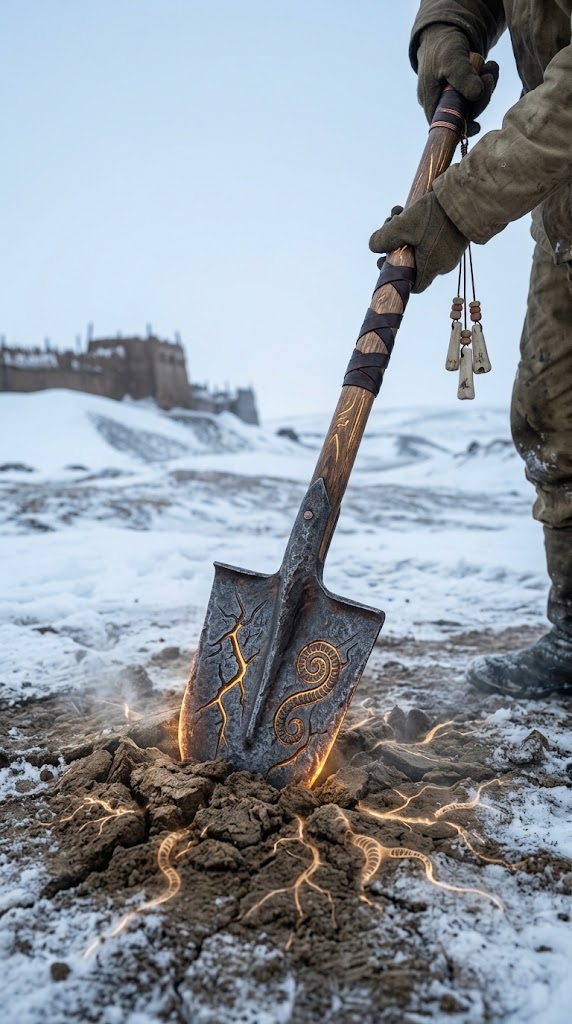
- Sakha 523 is a rugged, short-handled trenching spade measuring just over three feet from heel to butt. Its wide, wedge-shaped head is forged from dark bog iron, hammered with a reinforced central spine and chased along the flared shoulders with stylized permafrost fissures and coiled burrowing worms. The haft is turned from dense river-birch seasoned in marsh clay, cross-wrapped in oiled raw horsehide. Suspended from the butt-socket by twisted copper wire are three small clappers made of carved mammoth bone and dry clay beads that clatter with every downward strike, mimicking the steady pulse of an oloyon’s frame drum. When grasped with intent, a low, ground-trembling hum travels up the wielder’s forearms, and the cold metal blade sheds dried mud and grit effortlessly.
Detailed Stats
- Item Tier: Tier 1
- Rarity: Common
- Item Hit Points: Avatar’s maximum hit points plus 15
- Item Resilience: 12
- Base Damage: 1d6 bludgeoning or piercing (versatile 1d8, counts as an improvised or simple martial shovel/entrenching tool)
- Armor Check: 0
- Weight: 4.5 lbs.
- Suggested Value: 35 Silver (subject to regional mining guild barter and frontier tariffs)
- Attunement: Main Hand / Two-Handed Tool slot attunement binds automatically upon striking earth while humming an earthen oloyon rhythm
Slot
- Main Hand / Two-Handed Tool Slot
Passive Magics
- Loam-Singer’s Cadence: When digging ditches, trenches, ramparts, or post-holes in unworked soil, gravel, clay, or permafrost, the spade doubles the wielder’s excavation speed and halves stamina fatigue incurred from continuous manual earthwork.
- Permafrost Cleaver: The blade naturally fractures hard mineral crusts, granting a +1 bonus on Strength and Athletics checks made to break up impacted clay, packed ice, frozen turf, or soft sandstone.
- Mud-Shedding Temper: Soil, mire, and clay cannot adhere to the treated bog iron, keeping the spade balanced, clean, and rust-free regardless of marsh or sewer conditions.
Activable Magics
- Rhythms of the Loam-Breaker: As an action, the wielder plants the blade into the ground and taps the haft three times to chime the bone clappers. For 10 minutes, natural soil and loose earth within a 5-foot radius of the blade soften into loose loam, allowing rapid trenching or creating a small 5-foot patch of difficult, churning ground to impede pursuers.
- Trench-Warder’s Berm: As an action, the wielder scoops up a heap of freshly cut dirt and stamps the ground while chanting a low oloyon cadence. A knee-high earthen berm or breastwork rises instantly along an adjacent 10-foot trench edge, providing half-cover against ranged attacks from one direction for 1 hour or until collapsed.
- Tallow-Root Snare: As a reaction when an enemy charges across freshly excavated soil within 10 feet of the wielder, striking the spade head into the trench wall causes grasping earthen clumps and permafrost shards to surge up, forcing the attacker to make a DC 12 Dexterity or Agility saving throw or fall prone.
Tags
- Tool, Spade, Shovel, Weapon, Common, Tier 1, Bog-Iron, Birch, Mammoth-Bone, Horsehide, Shamanic, Oloyon, Earthwork, Ditch-Digger, Excavation, Trenching, Fortification, Permafrost, Burrow, Digging, Entrenchment, Frost-Loam, Labor, Mud, Mud-Shedder, Pioneer, Sapper, Soil, Turf
Commercial Trade and Acquisition of Sakha 523 of the Earth-Breaker’s Trenching Spade
- Frontier Pioneer Supply Depots and Mining Outfitters: Located along permafrost river valleys, canal excavations, and frontier boundary forts where ditch diggers, miners, and military engineers clear ditches through frozen ground. The clerks here recognize the bog-iron spade as an authentic piece of oloyon craftsmanship essential for ditching work in extreme climates. Avatars can purchase the spade for the standard 35 silver, typically settled via credit ledger sticks, barter in raw bog-iron ingots, or cured reindeer tallow. Selling the tool to a depot quartermaster nets 28 silver, reflecting the usual 20% margin for tools in ready working condition.
- Guild Sapper Enclaves and Municipal Works Yards: Situated in fortified provincial capitals, canal-dike authority offices, and municipal siege works where trenchers and civil engineers manage ditch networks and defensive ramparts. Here, the spade is traded as a specialized civil-defense tool. Avatars in good standing with the local ditchers’ guild or municipal works commission receive an institutional trade discount, paying 31 silver, while unaffiliated wanderers pay a markup of 40 to 45 silver via direct World Bank crystal ledger transfer. When an avatar sells the spade here, the yard assessor offers 28 silver credited directly to their municipal account, with no discount deduction applied.
- Freebooter Bazaars and Reclaimed Salvage Stalls: Found in border settlements, marshland trade meets, and battlefield salvage yards where reclaimers fence tools recovered from overrun forward garrisons or collapsed trenchworks. In these crowded outdoor stalls, the spade is propped against second-hand pickaxes and timber saws. Traders accept physical silver coins, raw river jade, or trade bartering, selling the spade for 30 to 34 physical silver. When purchasing from an avatar, these merchants operate on slim cash margins, offering only 18 to 22 physical silver after testing the bog-iron edge against cold river schist.
- Subterranean Smuggler Caches and Ditch-Runner Dens: Hidden in forgotten storm sewers, under-city ditch drains, and covert sapper hideouts where outlaw miners and tunnel thieves construct unmapped passages. These operators prize the spade for its ability to cut through compacted earth quickly and silently without alerting surface watchmen. Merchants here refuse official ledger transfers to avoid divination tracking, demanding physical coinage or illicit draft notes. Purchasing the spade from a covert fence costs a premium of 50 to 60 physical silver. When selling the tool to an under-city fence, the avatar receives 24 to 26 physical silver, provided the mammoth-bone clappers and copper wire mounts are intact.
Tactical and Environmental Roleplay of the Earth-Breaker’s Trenching Spade Across Varied Terrains
- Frozen Steppes and Glacial Outposts: Across wind-scoured permafrost plains where the earth is as unyielding as solid granite, standard entrenching tools shatter upon impact. In defense, an avatar caught in a sudden blizzard or under fire from nomadic steppe archers plants the spade, striking the birch haft to trigger the Rhythms of the Loam-Breaker. The rock-hard frozen crust gives way like soft loam, allowing the digger to carve a waist-deep fighting pit in minutes; they immediately follow with Trench-Warder’s Berm, throwing up a frost-caked parapet that provides hard cover against whistling bone arrows. On the offense, while assaulting an enemy winter palisade, the sapper slips through snowdrifts and drives the wedge blade into the frozen berm supporting the stockade logs. The Permafrost Cleaver property fractures the icy foundation, weakening the structural supports and triggering a localized trench collapse that opens a breach for assault allies.
- Waterlogged River Deltas and Peat Marshes: In soggy wetlands, reed beds, and marshy lowlands where ditching work is threatened by slumping mud and flooding trenches, the spade’s unique craft shines. Defensively, when ambushed by marsh predators or rival scavengers, the ditch digger uses the flat of the bog-iron blade to slap the swampy bank, raising a protective earthen berm to hold back rising waters and enemy crossbow bolts while their squad retreats through the bog. The Mud-Shedding Temper prevents heavy, suctioning peat from encrusting the tool, ensuring the avatar never loses precious seconds scraping off mud during an emergency fortification. Offensively, when pursuing hostiles through thick mire, the sapper utilizes the Tallow-Root Snare reaction as enemy scouts cross freshly dug drainage channels; the churned mud instantly surges up into grasping clods, throwing charging warriors face-first into the bog where they can be subdued with a heavy downward chop from the spade’s sharpened edge.
- Subterranean Sewers and Under-City Sapper Tunnels: Within the cramped stone catacombs, silted sewer drains, and secret mining tunnels beneath sprawling imperial cities, space is tight and noise carries far. Defensively, if city watchmen or sewer-beasts corner the operative inside a drainage culvert, the digger rapidly throws up a Trench-Warder’s Berm across the narrow brick passage, turning an exposed walkway into a defensible barricade that forces the pursuers into a fatal bottleneck. On the offense, an avatar leading a covert sapping operation uses the rhythm of the mammoth-bone clappers to harmonize with the earth spirits, cutting silently through packed gravel and soft masonry behind an enemy stronghold’s basement without the deafening clatter of iron picks on stone. When breaking into the target vault, the spade is wielded two-handed like a short poll-axe, using its wedge-shaped bog-iron head to hook enemy legs and lever open heavy flagstones.
- Besieged Outpost Ramparts and Canal Embankments: Along fortified frontier dikes, irrigation sluices, and forward siege trenches where armies clash over territorial borders, earthwork determines survival. Defensively, an avatar tasked with holding a defensive line uses the Loam-Singer’s Cadence to continuously repair cannon craters and sapped ramparts at double speed without exhausting their stamina reserves. If an enemy vanguard attempts to rush the parapet, the avatar triggers the Tallow-Root Snare, causing the rampart’s leading slope to buckle outward into loose permafrost scree, pitching ladders and climbers back into the ditch. Offensively, during a forward counter-sap, the trench worker advances low along a freshly cut ditch, using the broad blade to shovel earthen blinds ahead of their crawl. Once within striking distance of the enemy ditch-line, they vault into the opposing trench, utilizing the heavy reinforced spine of the spade as a versatile, brutal close-quarters club to clear defenders from the traverses.
Perception of Activation:
- Sight:
- User’s Perspective: Driving the wedge blade into the ground and striking the river-birch haft causes the bog-iron spine to flare with a dark, ember-red glow. Looking down at the soil, hairline fractures spider outward from the blade tip, bathed in a soft ochre phosphorescence as dense permafrost and packed clay visibly soften and crumble into dark, workable loam.
- Observer’s Perspective: Onlookers see the digger strike the spade’s haft, setting the hanging mammoth-bone clappers into motion. A sudden ripple passes through the surrounding ground like a stone dropped into muddy water, followed by a faint upward puff of earthen dust tinged with dull reddish light as the soil texture abruptly loosens.
- Positives: Provides immediate, clear visual feedback of the exact 5-foot radius of softened excavation terrain or the line of the rising earthen berm.
- Negatives: The dull reddish flash and rising cloud of loam dust can give away a covert sapper’s position in pitch-black tunnels or night trenches.
- Hearing:
- User’s Perspective: Striking the tool produces a sharp bone-on-clay clatter, followed by an immediate, deep-throated resonant hum that echoes through the earth directly into the soles of the user’s boots, resembling the droning overtone of an oloyon’s bass throat-singing.
- Observer’s Perspective: Bystanders hear the hollow, rhythmic clack-clack-clack of the bone pendants, instantly accompanied by a low, subterranean grinding sound—like heavy millstones turning beneath frozen gravel—before the earth settles into silence.
- Positives: The rhythmic clatter sets a natural pacing cadence that coordinates digging squads without shouting orders.
- Negatives: In enclosed stone vaults or sewer conduits, the resonant subterranean hum reverberates against walls, potentially alerting acoustic surveillance devices or alert guards.
- Touch:
- User’s Perspective: A heavy, vibrating surge rushes up the horsehide-wrapped birch haft into the user’s palms and forearms. The unyielding resistance of frozen ground suddenly vanishes under the blade, feeling as effortless as cutting through damp river sand or soft bread dough.
- Observer’s Perspective: Observers feel a sharp tremor through the soles of their feet within ten feet of the impact, as though a heavy underground weight shifted suddenly beneath the turf.
- Positives: Instantly eliminates the jarring impact shock to wrists, elbows, and shoulders when striking frozen permafrost or hidden roots.
- Negatives: The continuous vibrating pulse in the forearms can leave fingers tingling and slightly numb for a few seconds immediately after breaking ground.
- Smell:
- User’s Perspective: Inhaling through the nose brings a sudden, rich burst of ancient permafrost mud, wet peat moss, cold river silt, and dry clay embers, cutting cleanly through ambient foul air.
- Observer’s Perspective: Nearby individuals catch a sudden, pungent draft of freshly turned deep earth and wet loam, as if a fresh grave had just been opened in the room.
- Positives: The rich earthen odor temporarily masks noxious sewer gases, mild swamp methane, or decaying matter in foul excavation trenches.
- Negatives: The sharp smell of freshly unearthed cold mud can alert tracking animals or keen-nosed sentries upwind.
- Taste:
- User’s Perspective: A faint, dry, mineral-heavy taste settles across the tongue, reminiscent of clean river grit, cold iron, and dried well-clay, stimulating salivation and quelling dry-mouth from heavy labor.
- Observer’s Perspective: Anyone standing in the immediate dusting radius tastes a momentary tang of iron dust and dry soil settling onto their lips.
- Positives: Settles nausea caused by foul trench stenches or sewer miasma.
- Negatives: Leaves a persistent, chalky mineral aftertaste that can make trail rations taste metallic or dry.
- Extra-Sensory Perceptions:
- Geomantic Density Sense (The Earth’s Pulse):
- User’s Perspective: The metaphysical display in the user’s Mind’s Eye paints a subtle topological relief overlay over the terrain. Underground hollows, buried boulders, hidden pipe-lines, and bedrock shelves register as varying gradients of amber and charcoal, allowing the user to map blind digging vectors instinctively.
- Observer’s Perspective: Mystically sensitive individuals nearby sense a sudden focal anchoring in the ambient mana, feeling as though the immediate patch of ground has become momentarily heavier and older than the surrounding landscape.
- Positives: Prevents disastrous cave-ins, breached sewer pipes, or striking immovable bedrock blind while sapping.
- Negatives: The sensory clutter of underground mineral gradients can briefly distract the avatar’s Mind’s Eye from incoming surface threats.
- Subterranean Spirit Placation:
- User’s Perspective: A brief, tranquil hum of spiritual assent washes over the wielder’s conscious mind, providing a clear intuitive sense that the local subterranean spirits have accepted the bone-clapper offering and will not actively resist the spade’s bite.
- Observer’s Perspective: Attuned avatars or oloyons perceive the sudden calming of agitated earth spirits in the immediate area, registering a brief drop in local supernatural unrest.
- Positives: Relieves psychological dread, claustrophobia, and fatigue associated with deep, dark tunneling operations.
- Negatives: The deep sense of grounded tranquility can dull the avatar’s immediate aggressive instincts if combat breaks out in the middle of trench work.
- Geomantic Density Sense (The Earth’s Pulse):
Crafting Recipe: Resonant Bog-Iron Trenching Spade
Materials Needed
- One ingot (five pounds) of unrefined swamp bog iron, rich in peat manganese and river-silt inclusions
- One straight, knot-free billet of northern river birch heartwood (forty inches long, two inches thick), seasoned in blue marsh clay
- One Tier 1 magic crystal (coin-sized and coin-weighted), charged with earth, transmutation, or geomantic vibration mana
- One strip of vegetable-tanned, oiled raw horsehide (six feet long, one inch wide) for the haft grip
- Three small fragments of fossil mammoth bone (carved into tapered bell pendants, one inch long each)
- Three hand-rolled beads of sun-dried river clay (pierced through the center)
- Two ounces of braided copper wire (sixteen-gauge)
- Two vials (six ounces total) of living spring birch sap drawn using a fluid collector
- One sacrificial consumable or minor focus carrying an earth-moving, digging, or ground-shattering property (such as an Elixir of Earth Tunneler, a Scroll of Mold Earth, or a Tremor Stone)
- Half an ounce of pine pitch, crushed bone ash, and rendered mutton tallow for sealing
Tools Required
- Blacksmith’s hearth with bellows, charcoal fuel, and river-clay flux
- Heavy striking hammer (four-pound cross-peen) and flat anvil
- Fullers, hot chisels, and hand-punches
- Woodworker’s drawknife, spoke-shaves, and rasping files
- Manual pin vise drill with fine hardened bits
- Manual fluid collector fitted with a draw cannula
- Small earthenware smoking brazier with birch peat coals and dry sweetgrass
Skill Requirements
- Blacksmithing / Metalworking: Minimum Skill Level 4 (trained)
- Woodworking / Hafting: Minimum Skill Level 4 (trained)
- Earthwork / Sapping: At least 1 rank in Excavation, Mining, or Engineering to balance the spade’s leverage and ground-cleaving fulcrum properly
Crafting Steps
- Step 1: Forging the Bog-Iron Spade Head: Heat the bog-iron ingot over the charcoal hearth with river-clay flux. Draw down the iron into a wide, wedge-shaped shovel blade with flared shoulders and a reinforced central spine. Fuller a deep socket at the top for the wood haft. Using a hot chisel, chase stylized permafrost fissures and coiled burrowing worms along the shoulder flats. Quench the blade three times in cold marsh water blended with living birch sap to lock in its mud-shedding temper.
- Step 2: Dressing and Clay-Curing the Birch Haft: Shape the seasoned river-birch billet with the drawknife and rasp, contouring it to a thirty-six-inch straight tool handle that fits snugly into the iron spade’s socket. Rub wet blue marsh clay into the wood grain, let it dry, and smoke the haft over the peat brazier for two hours. This deepens the wood’s density, making it impervious to warping and moisture rot.
- Step 3: Crystal Seating and Geomantic Conduits: Chisel a snug, hollow recess inside the upper interior of the bog-iron haft socket directly against the central spine. Seat the Tier 1 magic crystal into this bed, packing it tightly with a heated mixture of pine pitch and crushed bone ash. File fine channel-grooves running from the crystal seat down along the interior spine of the blade to ensure direct vibrational transfer between the mana core and the cutting edge.
- Step 4: Socket Fitting and Horsehide Wrapping: Drive the cured birch haft deep into the heated iron socket, seating the wood firmly against the crystal-and-pitch bed. Secure the connection by driving two bog-iron pins horizontally through the socket and haft. Beginning below the iron neck, cross-wrap the haft down to the mid-grip using the oiled raw horsehide strip, securing each turn with tight leather knots to absorb shock during heavy excavation.
- Step 5: Mammoth-Bone Clapper Assembly: Drill three small holes through the butt-socket of the wooden handle with the pin vise. Thread loops of braided copper wire through the holes. String one carved mammoth-bone fragment and one dry clay bead onto each copper loop, twisting the ends into tight rings so the bone and clay clack together freely when the tool is jarred.
- Step 6: Sacrificial Transference and Oloyon Earth Chant: Prop the completed spade vertically over the earthenware brazier, blade down. Pour the sacrificial consumable (the earth-tunneling elixir or crushed tremor-stone dust) over the burning peat and sweetgrass coals. As the dense, mineral-rich smoke clings to the iron head and mammoth-bone clappers, strike the haft against a river stone in a steady three-beat oloyon digging cadence for twenty minutes while chanting the bass song of the slumbering loam. Continue until the chased fissures on the spade head flash with a dull ochre light, sealing the enchantment and leaving the spade ready for earthwork attunement.
523 Iron-Tooth-That-Eats-Ice and Great Ditch of Weeping Valley
In the first turn of the sun, when the stones were still wet from the sky-mother’s washing-bucket and the mountains had not yet grown their hard skins of slate, the frost was thick like grease upon the breast of the world. The sleep-walkers who had fallen from the star-sack wandered in the swamp-moss. Their ribs were very visible, like the wicker-poles of a collapsed fish-trap, and their hands were soft like unbaked bread dough. They possessed no iron that could cut wood without weeping, and they had only nine measures of breath-life and five measures of blood-salt—creatures of the low Tier-One sort whose names were written only in river-froth.
In that dry and frozen year, upon the high flat mud where the frost-bull sleeps, lived an unranked ground-scraper whose mark in the tally-book was Five Strokes, Two Curves, and Three Notches. The scribe-monks in the stone monasteries across the western water set down only the numbers five, two, and three, but the tundra dwellers knew him as the Ditch-Breaker who smelled of bog-clay and smoked horse-tail. Five-Two-Three-Man had no great spear of sea-whale horn, nor did he possess a golden belt from the great merchant-rafts of the south. He carried only a heavy wedge of raw bog-iron, tied with wet hide to a stick of river-birch that had been seasoned in the cold muck of a beaver-dike.
Now, high above the dwellings of the sleep-walkers was the great water-mountain of the White Horn. In the month when the birch-buds begin to swell with sweet water, the sky grew hot like an iron skillet left too near the fire. The ice upon the mountain of the White Horn began to rot from underneath. Great tongues of grey snow and yellow gravel broke loose from the crags, vomiting down into the narrow throat of the upper gorge.
A terrible sound came out of the hills—a sound like ten thousand elk running across dry river-ice. The melting sky-water, held back by a great dam of crushed stone and frozen pine logs, gathered into a black lake as deep as forty pine trees. Behind this rotting wall of frost and timber, the flood-monster grew fat.
An old woman whose feet were swollen with salt-water came down from the goats’ trail into the brush-huts of the clan. She struck the earth with her crooked hazel staff and wept through her remaining three teeth: “The water-belly upon the mountain has swollen until the skin is purple! When the sun Helios climbs to his noon-seat, the wall of timber will burst like an overfilled sheep-paunch. The roaring black water will come down the neck of the valley, eating the turf, the children, the reindeer corrals, and the burial stones of the ancestors. In one turn of the shadow, this hollow will be an empty belly of white shale, and our people will drown like voles trapped in an otter’s ditch!”
The tall axe-men of the sleep-walkers, who had thirty measures of muscle-fat and big axes of green river-stone, ran to the mouth of the valley. They shouted with their big chests and swung their green stone axes against the frozen gravel. They struck with all their fury, seeking to dig a ditch to turn the black lake toward the empty salt-shingle. But the ground was frozen permafrost, hard like the iron plates of an emperor’s breast-piece. The stone axes bounced back, sparking yellow fire; their wooden hafts snapped like dry winter hemlock, fracturing the wrists of the strikers. The axe-men fell upon the frozen turf, weeping with bloody hands, for the frost-ground would not open its belly to the fury of prideful men.
Five-Two-Three-Man stood beside the cold ashes of his smoke-hole. He watched his clan-sister, who held two small infants whose eyes were wide with the sound of the cracking ice-dam above. He looked upon his tool of dark bog-iron. The iron was not bright like the swords of kings, but dull like the skin of a catfish that lies in deep marsh-mud.
He walked up the slope to the narrow throat of the valley where the flood must enter. He did not curse the frozen stone, nor did he spit upon the permafrost with anger. He knelt in the white rime and pressed his forehead against the frozen loam. He spoke the three-tone cadence of the subterranean oloyon, humming through the marrow of his jaws into the deep rock-shelf below. He made a vow to the worm-spirits that crawl under the permafrost, and to the slumbering masters of the mud-river who hold the weight of the hills upon their shoulders.
He rose to his feet. He planted the bog-iron spade into the crust of the iron-frost. With the knuckle of his thumb, he tapped the river-birch haft three times: clack, clack, clack.
The ancient scroll records: The three clappers of old mammoth bone and dry marsh-clay began to dance upon their copper wires. They made the dry clicking sound of an oloyon’s horsehair frame drum when the shaman calls the white fish up through the river-hole.
A great tremor passed through the soles of Five-Two-Three-Man’s boots. The bog-iron blade did not shatter against the frost. From its dark center-ridge there blossomed a low, ember-red light, like the heart of a peat-fire when the wind blows down the chimney. Hairline cracks shot through the frozen soil for ten paces around him, glowing with the dull yellow color of fresh river-clay. The iron-hard permafrost, which had broken the green stone axes of thirty warriors, sighed like an old blanket. It softened into warm, loose loam that smelled of ancient moss and underground rain.
Five-Two-Three-Man began to dig. He did not labor with a frantic heart, nor did he gasp for breath like a hunted badger. His arms moved to the three-beat cadence of the bone clappers: scoop, lift, cast. With every thrust of the wedge blade, the earth parted like fresh cheese. The dark iron shed the sticky clay without a single clot sticking to its face; the mud fell away like dry flour from a baker’s smock.
As the noon sun rose, the roar from the upper gorge became a thunder that shook the pine cones from the trees. The dam of ice and rotting timber was groaning, spitting out great streams of yellow froth.
Behind Five-Two-Three-Man, the earth piled up into a high, thick ridge. He chanted the bass throat-song of the river-digger, and the freshly cut soil did not slump back into the ditch. It rose by the command of the oloyon magic into a firm earthen breastwork, packed tight as if beaten with heavy wooden rammers for seven days. A great trench, four men wide and three men deep, ran across the neck of the valley, cutting diagonally toward the deep stony wash that led to the dead sea-flats.
When the sun sat straight above the center of the sky, the great dam upon the mountain split with a crack that made the birds fall dead from the branches.
A wall of black water, thirty cubits high, carrying uprooted pines and boulders the size of haystacks, came leaping down the narrow throat like a hungry bull. The roar of the water was the sound of a thousand iron carts overturned in a river-shingle.
The sleep-walkers on the flats covered their faces with their skins, crying out that the world was dead.
The flood hit the great berm of Five-Two-Three-Man. The brown wall of earth trembled, but the subterranean spirits held the ditch-bottom firm. The black water struck the earthen wall, curled upon itself like a whipped dog, and fell with a furious hiss into the open belly of the trench. The foaming torrent raced down the channel that the spade had opened, carrying its load of broken pines and crushing rocks away from the grass-huts, emptying harmlessly into the wide salt-marsh three leagues below.
Not one drop of the foul mud touched the boots of the infants. The cooking fires of the clan remained hot, and the sweet grass upon the roofs of the smoke-holes did not move.
When the deluge had passed and the bottom of the new channel showed only gray mud and trapped river-pikes, the sleep-walkers walked up the slope. They found Five-Two-Three-Man leaning upon the birch haft of his spade. His hands were not blistered, nor was his breath broken in his chest, for the rhythm of the oloyon drum had carried the fatigue of the digging into the deep core of the world.
The tall axe-men came with bowed heads, their broken stone tools dragging in the wet moss. They said to him: “You have the arms of an elk-giant, and your spade must be forged from the star-metal that falls from the belt of the Sky-Father.”
Five-Two-Three-Man shook his head, and the three bone clappers gave a dry, hollow laugh upon their wire: clack, clack, clack.
“The earth does not hate the spade,” he said to them in the rough dialect of the river-bogs. “The earth is an old mother whose sleep is heavy in the winter. He who beats her with fury will only break his own knuckles against her bones; but he who knows her rhythm, and speaks to her through the bone and the bog-iron with the voice of the drum, can guide her where she must go without shedding a single tear of sweat.”
Five-Two-Three-Man lived through fifty more turns of the white frost. He dug forty canals for the barley-fields and ninety dikes to hold back the spring melt. When his thread was cut by the Sky-Mother’s shearing knife, he did not rot in a ditch. He melted into a heap of clean, sweet river-clay that smelled of spring moss and living birch sap. Beside the mound of clay lay the short spade, its bog-iron face still bright, untouched by rust, carrying the scratches of the burrowing worm and the permafrost cracks, waiting for a digger who knows how to sing to the stone before he strikes the ground.
Moral of the story: The boastful warrior who relies only on brute strength and blunt fury will break his weapons against the stubborn stone of the world; but the humble laborer who respects the living earth and matches his toil to the steady, sacred cadence of nature can move mountains, tame the roaring flood, and preserve his people through the quiet mastery of honest work.
Suggested conversions to other systems:
Call of Cthulhu (7th Edition)
Name: The Shamanic Spade of the Earth-Treader
- Skill Association: Fighting (Brawl) or Art/Craft (Excavation/Trenching)
- Damage: 1d6 + Half Damage Bonus (DB)
- Base Range: Touch / Melee
- Malfunction: 00
- Sanity Cost: None for mundane excavation; 1 Sanity point upon attunement or upon channeling the soil-softening trance.
- Physical Form: A short-handled trenching spade of bog iron and fire-cured birch, fitted with mammoth-bone and dried clay clappers suspended by copper wire.
Special Mechanics and Artifact Properties:
- Loam-Singer’s Cadence (Passive): When the investigator is manual-trenching, digging archaeological pits, or clearing earth, excavation speed is doubled. Any Constitution Rolls made to resist physical fatigue or exhaustion from sustained manual digging receive one Bonus Die.
- Permafrost Cleaver (Passive): The blade fractures hardened mineral layers with supernatural ease. When using the spade to clear impacted ice, packed shale, or permafrost, the investigator receives a Bonus Die on Strength or Art/Craft (Excavation) rolls.
- Mud-Shedding Temper (Passive): Peat, mire, and wet clay never cling to the blade. The spade requires no cleaning, never fouls, and never jams when levering stone or digging through sticky marshland.
- Rhythms of the Loam-Breaker (Active Spell):
- Cost: 3 Magic Points.
- Action Time: 1 combat round (driving the blade into the ground and striking the birch haft three times to chime the bone clappers).
- Effect: For 10 minutes, natural packed soil, frozen gravel, or dry turf within a 5-foot radius softens into workable loam. Movement through this churning ground costs double for all individuals except the user.
- Trench-Warder’s Berm (Active):
- Cost: 2 Magic Points.
- Duration: 1 hour.
- Effect: Scooping and stamping the soil while chanting raises a knee-high earth-and-shale barricade along a 10-foot boundary. This grants anyone crouching behind it half-cover (providing +20% effective Armor or a Penalty Die to incoming ranged firearm attacks).
- Tallow-Root Snare (Active Reaction):
- Cost: 2 Magic Points.
- Trigger: An adversary charges across freshly dug ground within 10 feet of the investigator.
- Effect: Striking the blade head into the ditch wall causes loose roots and soil clumps to buckle upward. The charging target must succeed on a Dodge Roll or fall prone, immediately ending their turn.
Blades in the Dark
Name: Oloyon’s Earth-Breaker Spade
- Item Profile: A sturdy sapper’s spade forged of bog iron and birch, bound with mammoth-bone clappers that vibrate with subterranean resonance.
- Load: 1 Load (Equipped in hand) or 2 Load (Stapped to heavy gear rigs alongside field supplies).
Mechanics and Abilities:
- Steady Cadence (Passive):
- When you make an action roll using Wreck, Prowl, or Finesse to excavate tunnels, sap walls, or dig covert drainage trenches, you operate with increased effect.
- Sustained manual digging does not inflict physical exhaustion or count toward fatigue consequences.
- Rhythms of the Loam-Breaker (Active):
- Activation Cost: Suffer 1 Stress.
- Mechanic: Push yourself to drive the spade into packed ground and rattle the bone clappers. Dense gravel, paving stones, or frozen dirt immediately yield and loosen like soft sand for 10 minutes. This improves your position on sapping or tunneling obstacles from Desperate to Risky, or Risky to Controlled.
- Trench-Warder’s Berm (Active):
- Activation Cost: Suffer 1 Stress.
- Mechanic: Plant the spade and chant a low three-beat hum. A waist-high defensive ridge of compacted earth instantly heaves upward along a 10-foot perimeter. This structure counts as hard cover against gunfire and projectile attacks for the scene.
- Tallow-Root Snare (Active Reaction):
- Activation Cost: Suffer 1 Stress.
- Mechanic: When a pursuer or charging enemy moves across loose ground or a ditch line within close range, slap the blade against the ground. The earth buckles under their feet, forcing them to lose their footing and fall prone, neutralizing their immediate assault.
Dungeons & Dragons (5th Edition)
Name: Earth-Breaker’s Trenching Spade
- Weapon (shovel/club), uncommon (requires attunement)
- Item Slot: Main Hand / Two-Handed Tool
- Damage: 1d6 bludgeoning or piercing (versatile 1d8)
- Weight: 4.5 lbs.
Properties and Passives:
- Loam-Singer’s Cadence: You excavate trenches, post-holes, and ditches in unworked earth, sand, clay, or permafrost at double normal speed. You have advantage on Constitution saving throws against exhaustion incurred from continuous manual labor.
- Permafrost Cleaver: You gain a +1 bonus to Strength (Athletics) checks made to fracture solid ice, permafrost, soft shale, or hardened clay.
- Mud-Shedding Temper: Soil, sludge, and water do not adhere to the bog-iron blade. The spade is immune to nonmagical corrosion and rust.
Active Charges: The spade has 3 charges and regains 1d3 expended charges daily at dawn.
- Rhythms of the Loam-Breaker: As an action, you can expend 1 charge to plant the spade into the earth and strike the haft three times, setting the mammoth-bone clappers in motion. For 10 minutes, unworked earth and packed stone within a 5-foot radius of the blade soften into loose loam. This area becomes difficult terrain for hostile creatures.
- Trench-Warder’s Berm: As an action, you can expend 1 charge and scoop freshly excavated soil while chanting a low oloyon cadence. A 10-foot-long, 3-foot-high earthen berm rises along an adjacent trench line, providing half-cover to creatures crouching behind it for up to 1 hour.
- Tallow-Root Snare: When a creature moves within 10 feet of you across unworked or freshly turned soil, you can use your reaction to expend 1 charge and strike the blade head against the ground. The target must succeed on a DC 13 Dexterity saving throw or be knocked prone by heaving soil.
Knave (Second Edition)
Name: Bog-Iron Entrenching Spade
- Inventory Cost: 2 Item Slots (Hands / Tool)
- Base Damage: 1d6 (One-handed) / 1d8 (Two-handed)
- Qualities: Swamp Bog Iron, Marsh-Cured Birch, Mammoth-Bone Drops
- Durability / Uses: 3 Quality / Usage Points
Rules and Mechanics:
- Ditch-Digger’s Ease (Passive):
- While equipped, manual earth-moving actions require half the normal exploration turns, and the user gains Advantage on Constitution checks made to resist physical exhaustion from excavation.
- Clay, sludge, and mud slide off the metal without adding encumbrance or degrading the tool’s edge.
- Loam-Breaker (Active):
- Activation: Spend your action to strike the blade into packed earth and chime the bone drops.
- Effect: For 1 exploration turn (10 minutes), a 10-foot radius of solid permafrost, hardpan, or stone-packed clay crumbles into soft, scoopable soil. Mark 1 Usage point on the spade.
- Earthen Berm (Active):
- Activation: Strike the flat of the spade to the ground and chant a rhythmic drone.
- Effect: A waist-high dirt rampart instantly heaps up along a 10-foot line, providing +2 Armor to defenders sheltering behind it against ranged missile attacks for 1 combat encounter.
- Soil Snare (Active Reaction):
- Activation: When an opponent charges across loose dirt within 10 feet of your trench line, jam the spade into the dirt wall.
- Effect: The ground shifts and heaves. The attacker must make a Dexterity Save (DC 13); on a failure, they stumble, trip, and are thrown prone, wasting the remainder of their movement. Mark 1 Usage point on the spade.
Fate (Fate Core / Condensed)
Name: Spade of the Earth-Breaker’s Cadence
- Item Aspect: Shamanic Bog-Iron Entrenching Spade
- Type: Tool / Martial Combat Extra
Stunts and Rules:
- Loam-Singer’s Cadence (Passive): You gain a +2 bonus to Overcome obstacles using Physique or Crafts when digging trenches, raising earthen earthworks, clearing cave-ins, or tunneling through frozen permafrost. You ignore physical fatigue consequences arising from sustained manual excavation.
- Mud-Shedding Temper (Passive): Sticky clay, mud, and water cannot cling to the blade or haft, rendering the spade immune to environmental decay, rust, or balance penalties in marshy terrain.
- Rhythms of the Loam-Breaker (Active): Once per scene, spend 1 Fate Point to strike the spade haft three times and chime the mammoth-bone clappers. Create the situational aspect Churning Loam on your immediate zone with two free invokes. While active, this zone represents soft, treacherous footing for adversaries attempting to cross it.
- Trench-Warder’s Berm (Active): Once per scene, spend 1 Fate Point to plant the blade and chant a rhythmic oloyon cadence. Instantly place the aspect Earthen Breastwork with one free invoke along a border of your current zone, providing passive Fair (+2) cover against ranged projectile attacks.
- Tallow-Root Snare (Active Reaction): When an opponent moves into your zone across exposed earth or into a ditch to make a close-quarters attack against you, spend 1 Fate Point and strike the ground. The earth heaves upward to intercept them; you roll an immediate Physique or Fight defense, and if you succeed with style, the attacker is knocked prone and takes the boost Tripped by Clods.
Numenera & Cypher System
Name: Earth-Breaker Trenching Spade
- Level: 3
- Form: Short, heavy-headed spade forged from dark bog iron with a river-birch haft, fitted with hanging mammoth-bone clappers and wrapped in raw horsehide.
- Kind: Artifact (Depletion: 1 in 1d10, rolled only when activating the loam-breaker or raising a berm)
Mechanics:
- Weapon / Tool Classification: Medium Weapon (4 points of damage) / Heavy Excavation Tool
- Enduring Excavator (Passive): Tasks involving manual excavation, tunneling through hardpan, or clearing frozen permafrost are eased by two steps. The wielder ignores Might pool depletion associated with sustained heavy labor.
- Mud-Repelling Surface (Passive): Dirt, mud, and water do not adhere to the spade, preventing encumbrance increases or grip penalties in subterranean or swamp conditions.
- Rhythms of the Loam-Breaker (Active): As an action, the wielder drives the spade into the earth and rattles the bone pendants. For 10 minutes, packed soil and permafrost within an immediate area (up to 10 feet across) soften into loose loam. The difficulty of all movement tasks through this area is increased by one step for hostile creatures. Roll for Depletion.
- Trench-Warder’s Berm (Active): As an action, the wielder scoops freshly cut earth while chanting a low oloyon cadence. A knee-high earthen breastwork heaves upward along an immediate boundary line, providing 1 point of asset protection (easing defense tasks by one step) against ranged projectile attacks for 1 hour. Roll for Depletion.
- Tallow-Root Snare (Active Reaction): When a target within immediate range moves across natural ground toward the wielder, the user may spend 2 points from their Speed pool as a reaction to jam the spade into the dirt. The ground buckles, and the target must succeed on a difficulty 3 Speed defense roll or fall prone.
Pathfinder (Second Edition)
Name: Earth-Breaker’s Trenching Spade
- Item: Item 2
- Traits: Uncommon, Earth, Primal, Transmutation
- Price: 35 gp
- Usage: Held in 1 or 2 hands; Bulk: 1
- Base Weapon Profile: Shovel (Damage: 1d6 bludgeoning or piercing; Hands: 1; Group: Club; Weapon Traits: Two-Hand 1d8, Versatile P)
Item Mechanics:
- Loam-Singer’s Cadence (Passive): You gain a +1 item bonus to Athletics checks to Force Open doors or obstacles composed of packed earth, ice, or stone, and you dig trenches, moats, and pits in unworked soil or permafrost at double the normal rate.
- Permafrost Cleaver (Passive): Strikes made with the spade against earth elementals, ice constructs, or frozen mineral hazards treat the spade as cold iron.
- Mud-Shedding Temper (Passive): Sludge, clay, and mire never stick to the iron blade. The spade is immune to non-magical rust and environmental corrosion.
Activate — Rhythms of the Loam-Breaker:
- Action Economy: Two Actions (concentrate, manipulate)
- Frequency: Once per day
- Effect: You plant the spade into the ground and tap the haft three times. A 5-foot-burst centered on the spade crumbles into loose loam, turning into difficult terrain for 10 minutes for all creatures other than you.
Activate — Trench-Warder’s Berm:
- Action Economy: Two Actions (manipulate)
- Frequency: Once per day
- Effect: You scoop and pack freshly dug dirt while chanting an oloyon cadence. An earthen berm rises along a 10-foot-long, 3-foot-high line adjacent to your space. The berm provides standard cover (+2 circumstance bonus to AC and Reflex saves) against ranged attacks coming from the far side for 1 hour.
Activate — Tallow-Root Snare:
- Action Economy: Reaction (manipulate)
- Trigger: A creature within 10 feet moves across unworked or excavated earth toward you.
- Frequency: Once per day
- Effect: You strike the spade against the ground, causing permafrost and earthen clumps to shift violently. The triggering creature must attempt a DC 16 Reflex save. On a failure, the creature is tripped and falls prone; on a critical failure, it falls prone and is immobilized for 1 round by gripping clay.
Savage Worlds (Adventure Edition)
Name: Oloyon Trenching Spade
- Item Classification: Minor Arcane Tool / Melee Weapon
- Damage: Str+d6 (Min Str d6)
- Weight: 4.5 lbs.
- Requirements: Worn in Hand / Equipment Rig
Mechanics and Properties:
- Loam-Singer’s Cadence (Passive): When performing manual labor to excavate trenches, breastworks, or tunnels through permafrost, clay, or stone-packed dirt, the user doubles their digging rate and receives a +2 bonus to Vigor rolls made to resist Fatigue from physical labor.
- Mud-Shedding Temper (Passive): Soil, muck, and marsh water slide off the blade immediately, preventing rust and ensuring the weapon never suffers penalties from fouling or clinging mire.
Active Powers:
- Rhythms of the Loam-Breaker: Once per encounter, the wielder may spend an action planting the spade and striking the haft to activate an effect identical to the entangle power (Area Effect template centered on the tool), turning packed earth into churning mud and frost shards that create Difficult Ground and hinder enemies.
- Trench-Warder’s Berm: Once per day, spending an action to shovel and chant heaves up a 3-foot-high ridge of hard-packed earth along a 2-inch (4-yard) line. The wall grants Medium Cover (-2 to hit) against incoming ranged attacks for the duration of the combat encounter.
- Tallow-Root Snare: Once per session, when an adversary moves within 2 inches (4 yards) across natural earth to engage the wielder in melee, the user may trigger an immediate reaction by striking the spade head into the ground. The target must make an Agility roll at -2 or immediately stumble and fall Prone, concluding their movement.
Shadowrun (Sixth World)
Name: Earth-Breaker Entrenching Weapon Focus
- Item Rating: Rating 2
- Type: Weapon Focus (Club / Entrenching Tool)
- Damage: 3P
- Attack Rating: 8 / 4 / — / — / —
- Defense Rating: +1
- Bonding Karma Cost: 6 Karma
- Concealability: -2 (Carried openly as an industrial or utility sapper tool)
- Form: Short, wedge-bladed entrenching spade forged from dark bog iron and cured birch, fitted with mammoth-bone and sun-dried clay clappers on copper wire loops.
Mechanics and Abilities:
- Loam-Singer’s Cadence (Passive): While the focus is active and bonded, add +2 dice to Engineering or Athletics tests made to excavate earth, dig trenches, clear rubble, or breach packed permafrost. The wielder ignores physical fatigue penalties stemming from prolonged manual digging.
- Mud-Shedding Temper (Passive): Peat, mire, and wet clay slide off the iron blade instantly. The weapon focus ignores all environmental fouling, rust, or handling penalties caused by waterlogged or toxic sewer mud.
- Rhythms of the Loam-Breaker (Active):
- Action: Major Action
- Frequency: Once per run
- Effect: Driving the blade into natural dirt, gravel, or broken pavement and striking the birch haft creates a 5-meter radius patch of shifting, broken earth. Enemies moving through this terrain suffer a -2 dice pool penalty to Athletics and Defense tests for 10 minutes.
- Trench-Warder’s Berm (Active):
- Action: Major Action
- Frequency: Once per combat scene
- Effect: Stamping the ground and chanting a low oloyon cadence instantly raises a knee-high barricade of packed earth and stone along a 3-meter line, granting +2 Defense Rating against incoming ranged attacks for the duration of the encounter.
- Tallow-Root Snare (Active Reaction):
- Action: Minor Action (Interference)
- Trigger: An adversary moves across natural soil or unpaved ground within 5 meters to engage the wielder in close combat.
- Effect: Jamming the spade into the trench wall buckles the ground beneath the attacker’s boots. The target must succeed on an Athletics + Agility (Threshold 3) test or immediately fall Prone, forfeiting their attack action.
Starfinder (Second Edition)
Name: Earth-Breaker’s Trenching Spade
- Item Level: Item 2
- Traits: Uncommon, Earth, Primal, Transmutation
- Price: 35 gp
- Usage: Held in 1 or 2 hands; Bulk: 1
- Base Weapon Profile: Tactical Shovel (Damage: 1d6 bludgeoning or piercing; Hands: 1; Group: Club; Weapon Traits: Two-Hand 1d8, Versatile P)
Item Mechanics:
- Loam-Singer’s Cadence (Passive): You gain a +1 item bonus to Athletics checks to excavate trenches, clear rubble, or breach unworked planetary regolith and permafrost, performing such labor at double normal speed.
- Mud-Shedding Temper (Passive): Toxic silt, marsh slime, and planetary dust cannot adhere to the treated bog iron. The tool is immune to mundane environmental corrosion and acid sludge fouling.
- Permafrost Cleaver (Passive): Attacks against planetary ground hazards, ice barriers, or crystalline mineral constructs treat the spade as cold iron.
Activate — Rhythms of the Loam-Breaker:
- Action Economy: Two Actions (concentrate, manipulate)
- Frequency: Once per day
- Effect: You plant the spade into planetary soil and tap the birch haft three times. A 5-foot-burst centered on the tool crumbles into churning loose loam, becoming difficult terrain for 10 minutes for all creatures other than you.
Activate — Trench-Warder’s Berm:
- Action Economy: Two Actions (manipulate)
- Frequency: Once per day
- Effect: You scoop and stamp loose regolith while chanting an oloyon cadence. A 10-foot-long, 3-foot-high earthen berm heaves upward adjacent to your position, providing standard cover (+2 circumstance bonus to AC and Reflex saves) against ranged weapon fire for 1 hour.
Activate — Tallow-Root Snare:
- Action Economy: Reaction (manipulate)
- Trigger: A creature within 10 feet moves across natural ground toward your position.
- Frequency: Once per day
- Effect: Striking the blade head against the ground shifts the soil violently. The triggering creature must succeed on a DC 16 Reflex save or fall prone; on a critical failure, it falls prone and is immobilized for 1 round by gripping clay.
Traveller (Mongoose 2nd Edition)
Name: Archaic Resonance Entrenching Spade
- Technology Level: TL 1 (Anomalous / Subterranean Vibro-Relic)
- Mass: 2.0 kg
- Skill Association: Melee (bludgeon) or Athletics (endurance)
- Damage: 2D-1 (Bludgeoning or Piercing)
- Form: Hand-forged bog-iron spade with a marsh-cured river-birch haft, fitted with hanging mammoth-bone acoustic clappers and raw horsehide wrapping.
Mechanics and Abilities:
- Sapper Efficiency (Passive): When excavating defensive berms, field trenches, or clearing cave-in blockages through frozen or compacted ground, apply DM+1 to Athletics or Engineer checks. Excavation tasks take half the usual standard time.
- Soil-Repelling Temper (Passive): Sludge, marsh muck, and damp regolith slide off the metal instantly, preventing balance loss, encumbrance penalties, or mechanical degradation in wetland or contaminated environments.
- Loam-Breaker Pulse (Active):
- Action: Significant Action
- Effect: Striking the spade haft into the ground sets the bone clappers in motion, loosening a 3-meter radius of packed soil, hardpan, or permafrost into soft loam for 10 minutes. Hostile movement across this area incurs DM-1 to all physical checks.
- Fieldwork Berm (Active):
- Action: Significant Action
- Effect: Chanting a steady oloyon drone while shoveling earth heaves up a 3-meter waist-high barricade along a trench perimeter, providing Armour +4 against incoming slug and projectile fire.
- Subterranean Tripper (Active Reaction):
- Action: Reaction
- Effect: Striking the blade into a trench wall as an opponent charges within 3 meters heaves the soil under their stride. The charging target must pass an Athletics (dexterity) check (8+) or immediately fall prone, ending their turn.
Warhammer (Warhammer Fantasy Roleplay 4th Edition)
Name: Bog-Iron Trenching Spade
- Classification: Hand Weapon / Heavy Excavation Tool
- Price: 3 GC 10/–
- Encumbrance: 1
- Availability: Rare
- Qualities: Defensive, Practical (Excavation)
Mechanics and Properties:
- Loam-Singer’s Cadence (Passive): The user gains a +10 bonus to Trade (Sapper) and Athletics tests made to dig trenches, construct saps, or clear collapsed tunnels through frozen soil and clay. Manual digging rate is doubled, and the wielder ignores Fatigue from continuous manual labor.
- Mud-Shedding Temper (Passive): River mud, bog clay, and filth never stick to the iron head. The weapon cannot gain the Corroded or Damaged condition from exposure to muck, damp peat, or sewer effluent.
Active Abilities:
- Rhythms of the Loam-Breaker:
- Action: 1 Action (Planting the blade and striking the birch haft three times).
- Frequency: Once per day.
- Effect: The bone clappers set up an earth-softening harmonic. A 2-yard radius around the spade becomes loose, churning mud for 10 minutes, counting as Difficult Terrain that inflicts a -1 SL penalty on all Movement tests for adversaries.
- Trench-Warder’s Berm:
- Action: 1 Action.
- Frequency: Once per day.
- Effect: Scooping dirt while chanting a low oloyon cadence raises a knee-high earth-and-root breastwork along a 2-yard boundary line, granting +2 AP (Cover) against missile weapon attacks for the duration of the encounter.
- Tallow-Root Snare:
- Action: Reaction.
- Trigger: An adversary charges across freshly turned or natural earth within 2 yards of the user.
- Effect: The user slams the spade blade into the ground, causing permafrost and dirt clods to buckle outward. The charging attacker must make a Challenging (+0) Dodge Test; on a failure, the target falls Prone and gains 1 Entangled Condition.