
- Lore: Unearthed from the submerged scriptoria beneath the Silt-Canyon Monasteries, this somatic focus was developed by the Silent Hermits of Ouros. These monks bound their vocal cords with sacred breath exercises, believing that mortal speech polluted the dantian. By circulating qi through the throat and palate while tracing long-extinct pictograms in the air, they awakened dormant lingual echoes lingering within ancient stone and weathered parchment. Initiates wear this collar to harmonize their breath with dead tongues, allowing forgotten words to be felt, understood, and quietly spoken once more.
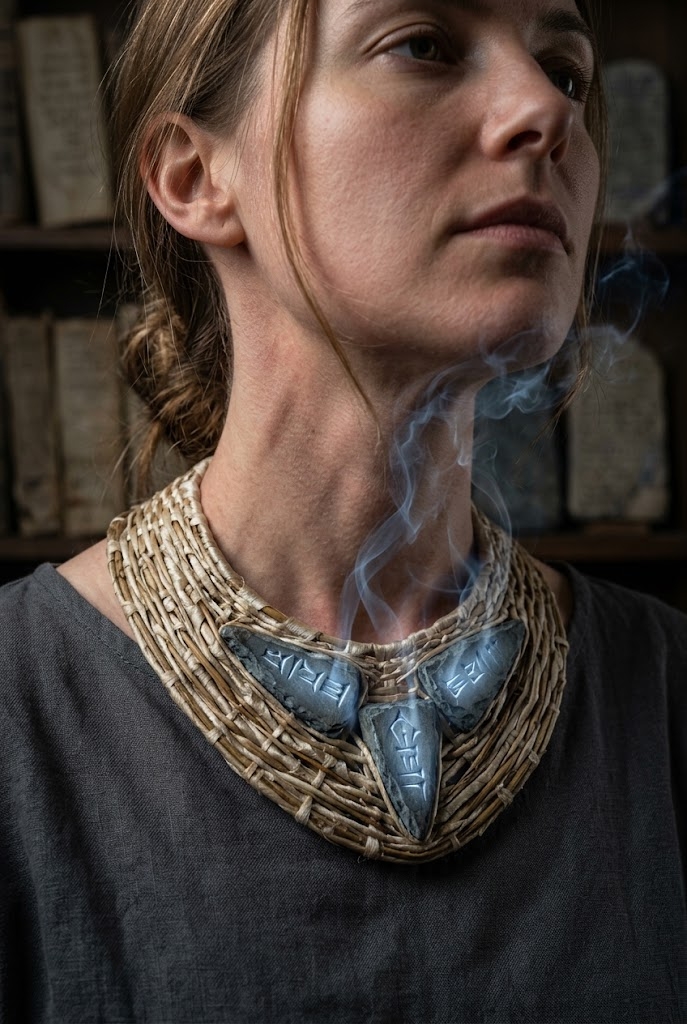
- Description: A flexible, fitted gorget-collar woven from unbleached wild tussah silk and dried marsh-rushes, stiffened with clear gum-resin. Embedded across the thyroid notch are three triangular shards of fossilized slate, each etched with hollow cuneiform glyphs from an extinct pre-cataclysm lexicon. When the wearer engages in rhythmic breathing, faint blue-gray smoke seeps from the incisions, and the slate warmed by the throat’s meridian pulse produces a faint, papery rasp resembling turning pages.
- Specific Slot: Neck Slot
- Detailed Stats:
- Item Tier: Tier 1
- Item Rarity: Common
- Item Level: Level 1
- Item Hit Points: 12 plus wearer’s maximum health points
- Armor Check (AC): +1 (Deflection against verbal, sonic, or acoustic-based magical effects)
- Resilience: 8
- Weight: 0.6 pounds
- Suggested Valuation: 9 silver coins (accepted across standard World Bank trading posts)
- Attunement: Requires simple somatic attunement (fifteen minutes of throat-chanting dead consonants while pressing the slate glyphs against the thyroid cartilage until the stone vibrates against the pulse)
- Passive Magic:
- Breath of the Epigrapher: While worn, the avatar can read and comprehend any written text composed in an extinct, archaic, or forgotten language, provided the text is carved in stone, stamped in clay, or inscribed on parchment older than three centuries. (Does not decode active military ciphers or magical spell-runes).
- Silent Orthography: The wearer’s verbal breath is purified. Any attempt to use speech-inhibiting mundane poisons, choking dust, or magical silence against the wearer’s vocal cords suffers a -2 penalty to its potency, as the throat meridian remains clear and open.
- Echo of the Forgotten Lexicon: The avatar gains an intuitive understanding of architectural inscriptions, tomb epitaphs, and ancient warning sigils, granting an immediate +1 bonus on checks made to avoid ancient linguistic ward-traps.
- Activable Magic:
- Utterance of the Dust-Scribe:
- Action Cost: 1 Action
- Effect: The wearer draws breath deep into the lower dantian and exhales an archaic word of power that has not been spoken aloud for millennia. The spoken phrase produces a dry, concussive acoustic shock in a 10-foot cone. Enemies in the area must make a physical balance check or be disoriented (-1 to attack rolls) for 1 round, and all ancient glyphs or hidden carvings in the area glow with faint luminescence for 10 minutes. Usable twice per day, recharging after a long rest.
- Tongue of the Cenotaph:
- Action Cost: 1 Bonus Action / Minor Action
- Effect: The wearer presses the central slate triangle and inhales through the teeth, temporarily shifting their vocal tract to articulate one dead tongue perfectly for 10 minutes. During this time, spirits, lingering echos, and ancient constructs that only obey the old empire’s commands recognize the wearer’s voice as native. Usable once per short rest.
- Paleographic Respiration:
- Action Cost: 1 Minute of Meditation
- Effect: The avatar sits motionless over a damaged, weathered, or fragmented ancient inscription and exhales slow, steady breath across the surface. The qi-infused breath lifts faint chalk-like dust into the air, revealing the missing letters or worn-away words of the inscription as floating vapor for 1 minute. Usable once per long rest.
- Utterance of the Dust-Scribe:
- Tags: Neck Slot, Qigong, Tier 1, Common, Dead Language, Translation, Inscription, Linguistics, Slate, Silk, Breathwork, Lore, Archaic, Antiquity, Epigraphy, Cuneiform, Philology, Decipher, Scribe, Phoneme, Lexicon, Throat-Chant, Relic, Glyph, Orthography
Commercial Outlets, Trade Enclaves, and Valuation of the Archaic Tongue Collar
- Monastic Scriptoria and Temple Archives:
- Setting: Located within ancient valley sanctuaries, mountain cloisters, or subterranean basilicas, these husks of learning smell of dry cedar cabinets, powdered gallnut ink, and old beeswax. Vellum leaves, clay tablets, and linen-wrapped transcription collars hang in quiet alcoves beside stone lecterns.
- Buying: Monks, antiquarians, and lingual disciples purchase consecrated collars from the archivist for the standard Tier 1 baseline price of 9 silver coins. Initiates of the Epigrapher Order or avatars bearing letters of academic recommendation can purchase one at an institutional discount of 7 silver coins and 5 nickels.
- Selling: Librarians inspect the integrity of the three slate shards, rubbing a moist thumb across the cuneiform incisions to ensure the throat resonance remains unbroken. A clean, intact collar yields the standard baseline trade value of 9 copper coins, though during expeditions into uncatalogued ruins, scriptoria will offer an immediate payout of 1 silver coin in library scrip or ink cakes.
- Antiquities Salons and Curio Auctions:
- Setting: Situated in the high-rent merchant quarters of metropolitan centers, these plush showrooms feature velvet runner carpets, brass glass-front cabinets, and the faint scent of pipe tobacco and almond oil. High-society collectors and tomb excavators browse reliquaries, ancient coins, and translation tools.
- Buying: Wealthy dilettantes and ruin-bound adventurers pay a steep aesthetic markup for curated pieces, purchasing an attuned collar for 12 to 14 silver coins. If the slate glyphs can be proven to match a specific lost empire, auction factors will list the item as high as 16 silver coins.
- Selling: Appraisers evaluate the item against known paleographic registries. Sellers offloading an authentic collar receive an immediate buy price of 9 copper coins, though an articulate avatar who can recite the slate’s lineage can secure an outright cash offer of up to 1 silver coin and 4 nickels.
- Expedition Outfitters and Ruin-Delver Chandleries:
- Setting: Established at frontier waystations, canyon edge encampments, and desert gateway forts, these rugged log-and-canvas depots smell of tar, dried rations, lamp grease, and canvas dust. Pickaxes, climbing pitons, and linguistic primers are piled alongside practical adventuring gear.
- Buying: Frontiersmen, tomb guards, and field archeologists buy the collar as essential survival kit to bypass lingual ward-traps and decipher tomb warnings. Outfit merchants charge between 10 and 11 silver coins for ready-to-wear pieces.
- Selling: Encampment chandlers purchase used collars from returning delve parties for the standard salvage rate of 9 copper coins. If regional expedition teams are actively competing to breach an unplundered tomb complex, chandlers will offer up to 1 silver coin and 2 nickels in trade rations or climbing gear.
- Underground Relic-Fences and Grave-Robber Dens:
- Setting: Tucked inside waterlogged sewer conduits, cellar vaults beneath necropolis slums, or smuggler taverns, these dimly lit dens reek of stale beer, damp lime, and graveyard earth. Stolen urns, tomb seals, and looted burial adornments are spread out across rough timber barrels.
- Buying: Illicit scavengers and rogue tomb raiders purchase unrecorded translation gear away from academic inspectors and municipal censors. Relic-fences demand a discretion premium, selling the collar for 13 to 15 silver coins in untraceable specie.
- Selling: Black-market fences buy bloodstained or grave-looted collars with no provenance checks, paying the standard flat price of 9 copper coins. If city tomb watchmen have sealed local catacombs and demand for ancient gate decryption items spikes, fences will pay a swift cash bounty of up to 2 silver coins.
Tactical Roleplay and Environmental Applications of the Archaic Tongue Collar
- Sunken Catacombs and Silt-Choked Necropolises:
- Defensive Roleplay: Navigating a waterlogged burial chamber where centuries-old glyphs line the archway, the avatar pauses as their throat meridian tingles with a cold rasp. Recognizing an ancient phonetic curse inscribed into the lintel, the avatar leverages Echo of the Forgotten Lexicon to identify the threshold as an acoustic pressure trap. Instead of triggering a cave-in, the avatar alerts the party to step across specific flagstones. When an ancient burial spirit rises from a sarcophagus to cast a choking silence curse, the collar’s Silent Orthography insulates the avatar’s vocal channels, keeping their airway clear and preventing their breathing from being throttled.
- Offensive Roleplay: Cornered in an ancient crypt by tomb scavengers or reanimated husks, the avatar utilizes the collar to command the ancient surroundings. Activating Tongue of the Cenotaph, the avatar utters the burial master’s rite of sleep in the tomb’s native dead dialect; ancient stone sentinels guarding the alcoves misidentify the avatar as their long-dead sovereign, pivoting their stone halberds toward the startled intruders. If combat erupts, the avatar draws qi into their throat and releases the Utterance of the Dust-Scribe, shouting an extinct phoneme that produces a concussive acoustic burst, staggering the graverobbers and highlighting hidden structural weaknesses in the stone pillars behind them.
- Submerged Scriptoria and Cliff-Side Monasteries:
- Defensive Roleplay: Pinned against an exterior balcony overlooking a high canyon during an ambush by hostile raiders, the avatar faces an opposing sorcerer chanting verbal hexes. The collar’s dense resin-stiffened weave and vibrating slate shards provide an active deflection against sonic and verbal spellcraft, dampening the deafening vibrations of incoming acoustic attacks. Simultaneously, the avatar rapidly scans weathered prayer inscriptions chiseled into the rock-face using Breath of the Epigrapher, instantly locating an ancient evacuation lever concealed behind a historical warning plaque.
- Offensive Roleplay: Trapped inside a crumbling library wing where an enemy patrol barricades the only exit, the avatar kneels over an eroded floor fresco and uses Paleographic Respiration. Exhaling steady, qi-rich breath, they cause the worn-away pictograms to smoke with chalk-white vapor, exposing the forgotten override word for the blast gates. The avatar immediately channels the Utterance of the Dust-Scribe, bellowing the ancient word toward the barricade. The sonic shockwave shatters the rotted timber door and disorients the guards behind it, allowing the avatar’s companions to breach the perimeter without taking ranged fire.
- Imperial Ruins and Forgotten Palace Plazas:
- Defensive Roleplay: Traversing a ruined ceremonial plaza guarded by clockwork guardians or animated clay sentinels dating back to a fallen dynasty, the avatar avoids lethal bombardment by triggering Tongue of the Cenotaph. Speaking the dead royal court’s ceremonial dialect with native inflection, the avatar answers the sentry constructs’ lingual interrogation queries, granting the entire party peaceful passage through automated kill-zones that would otherwise obliterate unauthorized trespassers.
- Offensive Roleplay: In a tactical skirmish against rival treasure hunters within a decaying throne room, the avatar retreats behind an eroded monument. Using Utterance of the Dust-Scribe, they shout an extinct glyph-command directly into the plaza. The 10-foot cone of concussive resonance sweeps through the plaza, rupturing the balance of charging mercenaries, throwing off their aim, and causing long-dead illuminating glyphs along the dais to blaze with light, revealing invisible stalkers lurking in the courtyard’s perimeter shadows.
Perception of Activation:
- Sight:
- User’s Perspective: Weathered carvings, eroded epitaphs, and faded clay stamps within your line of sight begin to outline themselves in a crisp, luminescent chalk-white halo. From the three slate triangles at your throat, thin wisps of slate-blue vapor billow upward, momentarily framing the field of vision like smoke rising over an open grave.
- Observer’s Perspective: Witnesses see the unbleached tussah silk stiffen slightly as the three fossilized slate shards flare with a cold, pale-blue light from within the cuneiform cuts. Delicate tendrils of pale smoke seep from the incised glyphs, curling lazily around the wearer’s jawline and collarbone without dissipating into the breeze.
- Positives: Immediately illuminates hidden, degraded, or mud-caked inscriptions on ancient masonry, making illegible or eroded warning glyphs distinctly visible even in near-pitch darkness.
- Negatives: The pale-blue glow and lingering plumes of throat-vapor ruin visual concealment in dim dungeons, tombs, and catacombs, easily revealing the user’s position to alert sentries or subterranean predators.
- Hearing:
- User’s Perspective: Ambient background noise recedes into a muffled, low-pressure hush, replaced by a rhythmic, dry fluttering sound against your collarbones—identical to thousands of fragile, dried vellum manuscript pages being rapidly turned by an invisible draft.
- Observer’s Perspective: Those standing near the avatar hear a dry, papery rustle followed by a faint, sub-vocal phonetic drone—resembling multiple people whispering archaic, forgotten consonants in unison—emanating directly from the wearer’s neck.
- Positives: The gentle phonetic resonance drowns out minor distracting sounds and provides auditory confirmation that an ancient phrase or glyph-line has been correctly articulated and resonated.
- Negatives: The continuous papery rasp and whispering drone carry through quiet stone corridors and burial chambers, generating an unsettling acoustic signature that can alert ambient guardians.
- Touch:
- User’s Perspective: The skin over your thyroid cartilage experiences a sharp, cold prickle—like pressing a chip of winter ice to bare flesh—which swiftly spreads into an expansive, vibrating warmth across the vocal cords. The tongue and soft palate feel remarkably relaxed, limber, and guided by an unnatural, fluid muscle memory.
- Observer’s Perspective: If an ally touches the wearer’s shoulder or neck, they feel a high-frequency, rhythmic vibration humming through the silk gorget, accompanied by a noticeable drop in local skin temperature directly beneath the slate stones.
- Positives: Completely relaxes the vocal tract and diaphragm, eliminating vocal cord strain, hoarseness, and physical dry-heaving caused by coughing fits or dusty tomb air.
- Negatives: Imposes a mild, pins-and-needles numbness along the jaw and throat that persists for several minutes after the energy recedes, making ordinary swallowing feel slightly clumsy.
- Smell:
- User’s Perspective: Your nasal passages are cleansed of stale air, replaced by the dry, distinct scent of aged parchment, powdered gallnut ink, dried cedarwood shelving, and pulverized tomb limestone.
- Observer’s Perspective: Bystanders in close proximity catch the sudden, dry aroma of an ancient library or excavated burial chamber—smelling of old linen, dried resin, and antique clay dust—wafting from the rising vapor.
- Positives: Instantly masks noxious tomb miasmas, sewer stink, and the putrid stench of decaying matter, allowing clear, unhindered breathing in foul environments.
- Negatives: The distinct odor of antique parchment and library cedar is completely unnatural in outdoor or subterranean spaces, leaving an olfactory trail easily noticed by keen-nosed beasts.
- Taste:
- User’s Perspective: As breath is cycled across the palate, the back of your tongue detects a dry, chalky taste with a faint, bitter tannin finish, much like having chewed on a dried reed or touched a lick of ancient ink.
- Observer’s Perspective: Observers cannot directly perceive this, but notice the wearer licking their lips or rolling their tongue along their teeth as their speech shifts into rhythmic phonemes.
- Positives: Suppresses dry-mouth symptoms and clears phlegm from the throat, enabling smooth and continuous vocal delivery without cracking.
- Negatives: Leaves a persistent, chalky coating on the palate that dulls the appreciation of food and wine for nearly an hour afterward.
- Extra-Sensory Perceptions:
- Semantic Memory Transference:
- User’s Perspective: You experience sudden, fleeting cognitive flashes—visualizing the hands of an unknown stonemason chiseling the granite block before you, or the trembling fingers of an ancient scribe weeping over a scorched papyrus roll—giving you the direct emotional intent behind the words rather than just a dry grammatical translation.
- Observer’s Perspective: Empaths and spirit-sensitive individuals sense a faint, sorrowful ripple of ancient collective memory brushing against the room, as if the room’s former inhabitants were briefly standing in the shadows behind the user.
- Positives: Provides immediate, intuitive context on cultural idioms, double-meanings, and archaic metaphors embedded in ancient script, preventing lethal misinterpretations of tomb curses or royal edicts.
- Negatives: Can cause momentary emotional disorientation or melancholy as the phantom weight of long-dead civilizations presses against the user’s conscious thoughts.
- Phonetic Meridian Harmonization:
- User’s Perspective: You feel an internal magnetic alignment linking your lower dantian, heart center, and vocal tract. Pronouncing long-dead phonemes feels like releasing physical tension rather than exerting effort, as though the throat were simply an open flute played by ancient winds.
- Observer’s Perspective: Magic-users and qi-cultivators see the avatar’s throat chakra pulse with an ordered geometric rhythm, creating a stable, miniature lingual anchor that repels surrounding ambient chaotic energy.
- Positives: Eliminates fear-based vocal freezing, granting absolute confidence and pitch-perfect inflection when commanding ancient constructs or reciting high-risk ritual invocations.
- Negatives: Makes speaking modern vernacular feel strangely crude and unnatural while attuned, occasionally causing the user to accidentally mutter archaic syllables in casual conversation.
- Semantic Memory Transference:
Recipe: Collar of the Archaic Tongue Qigong Focus
- Materials Needed:
- One Tier 1 Magic Crystal (coin-sized and coin-weighted, harvested to serve as the acoustic linguistic battery and phonetic memory core).
- Three triangular blanks of fossilized riverbed slate (each roughly 1.5 inches across, smooth, and free of structural micro-fractures).
- Two square feet of raw, unbleached wild tussah silk fabric (tightly hand-spun from mountain silkworm cocoons).
- One yard of dried mountain marsh-rush stems (split into flexible, narrow stiffening ribs).
- One ounce of purified mastic tree gum-resin (for stiffening and acoustic bonding).
- One small vial of dried gallnut-and-soot ink powder (ground from ancient archival recipes).
- One sacrificial ancient text fragment, clay tablet shard, or broken scribe’s bronze stylus older than three centuries (consumed during the enchanting process to tether the archaic lingual resonance).
- Tools Required:
- One hardened steel micro-graver and scoring needle (for cutting fine cuneiform phonemes).
- One miniature lapidary polishing plate with fine pumice slurry.
- One small bronze heating crucible and alcohol-flame spirit burner.
- One pair of jeweler’s stone tweezers.
- One bone bodkin and set of fine embroidery needles.
- One wooden neck-mandrel (curved form for shaping and tensioning the gorget collar).
- One camel-hair detail brush (for applying liquefied gum-resin).
- Skill Requirements:
- Textile Tailoring / Cord Stitching: Skill Level 2 (for multi-layered tussah silk lamination, marsh-rush rib encapsulation, and structural throat framing).
- Stone Engraving / Lapidary Etching: Skill Level 1 (for carving micro-cuneiform channels and beveling fossil slate margins).
- Qigong Breath Cultivation: Basic mastery of circulating vocal prana and regulating throat-meridian pressure through cyclic diaphragmatic breathing.
- Crafting Steps:
- Shape and Carve the Slate Shards: Smooth the three triangular fossil slate blanks on the lapidary polishing plate using pumice slurry until all faces are uniform. Using the steel micro-graver, cut shallow, hollow cuneiform glyphs representing root concepts of breath, stone, and memory into the face of each shard. Rub a small amount of gallnut-and-soot ink powder into the cuts to define the lines, then wash away the surface excess.
- Calcination and Lingual Tethering: Place the coin-sized Tier 1 magic crystal into the bronze crucible over the spirit burner. Add the sacrificial ancient text fragment, scribe’s stylus, or clay tablet shard directly into the crucible against the crystal. Ignite the mixture. As smoke curls from the crucible, maintain rhythmic, low-frequency throat chanting, directing the vibration of your breath into the vessel. Continue until the relic is reduced to white ash, leaving the Tier 1 magic crystal glowing with a pale, slate-blue internal shimmer.
- Cleave and Bed the Phonetic Resonators: Use the scoring needle and light mallet taps to divide the attuned Tier 1 magic crystal into three equal slivers. Warm the reverse sides of the three slate triangles over the spirit lamp and seat one crystal sliver into a grooved recess carved into the back of each shard, securing them with a drop of liquefied mastic gum-resin.
- Laminate the Gorget Base: Cut the unbleached wild tussah silk into three matching crescent-shaped collar layers. Lay the dried marsh-rush stems between the layers to serve as flexible vertical stays, ensuring the collar holds its curved posture against the throat. Brush liquefied mastic gum-resin between the layers and press the assembly around the wooden neck-mandrel until the silk sets firm, flexible, and contoured to the human thyroid notch.
- Mount the Slate Phonetic Array: Position the three prepared slate triangles in an inverted triad across the front center of the collar, directly over where the wearer’s thyroid cartilage sits. Using the bone bodkin and heavy silk thread, sew reinforced harness pockets and edge-bindings around the stone borders, locking the slate securely to the stiffened silk base without covering the incised glyphs.
- Throat-Chant Meridian Attunement: Fasten the finished gorget around your neck, seating the central slate triangle firmly against your thyroid notch. Sit in a formal kneeling posture and perform fifteen minutes of cyclic diaphragmatic breathing. Draw cold air down to the lower dantian and push it up through the vocal tract while vibrating archaic vowel sounds against the palate. When the three slate shards hum in unison against your pulse and thin ribbons of pale slate-blue vapor begin to vent from the cuneiform cuts, the attunement is complete and the collar is operational.
Scribe Who Swallowed Gray Dust and Spoke to Great Turtle-Gates
In the revolving turn of the five-eared star, before the high dynasties had numbered the days of sheep-shearing, and when the great mud-plain of Ouros was still washed twice each season by the Bitter Water, there was an order of men who did not shave their heads with bronze, but plucked their chin-hair with dried river clams. These were the Mud-Scribes, who dwelt inside the lower belly of the Silt-Canyon Monasteries. In that season, men spoke thirty-score tongues beneath the sky, yet every dialect was heavy like wet barley, and if a man crossed two water-ditches, his neighbor’s mouth made only the clicking sounds of a locust eating cabbage.
Among these scriveners was a Tier One novice of small counting, whose skin upon the temple records is set down as Narrow-Lung-Kael. He was of little weight, his ribs being visible like the wicker stays of a fish-trap, and his voice was small like the squeak of an oiled hinge. His office was not to eat the honey-cakes of the high abbot, but to take the tallow-pot and scrape the green mold from the stone shelves in the bottom vaults, where the texts of the First Dynasties lay drowning under gray river muck.
Now in that city of broken sundials ruled the Governor of the Four Canals, an iron-fisted lord named Prince Reed-Nail. This ruler took delight only in two things: the casting of tall bronze kettles to boil thieves, and the gathering of ancient boundary-stones that gave unto his house the ownership of the salt-pans. Prince Reed-Nail’s soldiers broke down the outer wall of the Lower Cloister, demanding the Great Deed of the Third Sun—a stone slab sixteen cubits long, which was carved by the Giant Kings before the sky turned red, and upon which was written the true mastership of the water-gates.
Prince Reed-Nail took the Elder Scribe by his beard and smote him with the blunt heel of his javelin, shouting with a throat like a copper gong: “You blind moles who live upon dry vellum! If you do not cause this gray granite to speak before the red star touches the horn of the water-cow, so that I may read where the sluice-keys are hidden, I will fill your bellies with boiling asphalt, and your skins shall be made into horse-saddles for my spearmen!”
The elder scriveners wept and cast dust upon their brows, for the writing upon the Great Deed was not of the seven royal dialects, nor of the common market-tongues, but was of the First Script—the bird-crawling marks chiseled by the ancestors before the great flood had dried. The words were not words of sound, but words of breath and stone; if an ordinary tongue tried to shape them, the palate would swell and the teeth would crack like dried peas.
Then came forth an aged ascetic from the salt-reeds, a hermit whose tongue had been cut out by his own flint knife forty seasons before, so that he might never speak a modern lie. Men called him the Master of the Throat-Cavern, for when he drew breath, the wind did not go into his nostrils, but rattled through his thyroid bone with the dry, whistling rasp of dead reeds in a winter gale.
The mute elder reached into his hemp satchel and drew forth a curved neck-guard woven from wild coarse silk, stiffened with yellow mastic gum and bound with dried rushes from the water-shelf. In the hollow of the collar, where the wind-pipe passes the breast-plate, were bound three sharp triangular splinters of fossil slate, chipped from the submerged tombs of the First Kings. Upon each slate was scratched a sign like an ox-eye pierced by a thorn.
The hermit cast this collar over the scrawny neck of Narrow-Lung-Kael, pulling the sinew thongs until the three stones bit into the skin of his throat like cold river leeches. The mute master smote Kael upon the middle breast with his thumb-joint, and with his fingers made the twelve mudra-signs that signify: Close the gate of the teeth; swallow the river of breath down to the salt-sea; do not spit the sound from the lips, but strike the bone of the throat with the anvil of the lung.
Kael fell upon his knees on the damp pavement. The three stones upon his throat grew cold like iron keys drawn from well-water. When he took breath, the air did not smell of the wet tallow-lamps or the slime of the floor; it smelled of ancient library cedar, powdered gallnuts, and dry dust that had slept beneath stone lids for a thousand plantings. His tongue felt thick and heavy, like a piece of boiled ox-leather, yet within his vocal passage there arose an ache like the humming of a bronze wire.
Prince Reed-Nail brought his horse into the scriptorium and pointed his bronze javelin at Kael’s breast: “Read, you worm of the ditch, or I shall pin your gullet to this granite slab!”
Kael raised his eyes to the Great Deed. Behold, the marks chiseled into the rock were no longer dead scratches filled with silt; they seemed to swell, rising like white worms from the stone face. The translation fragment of the fifth tile reads: “The signs upon the rock were like teeth in an open skull; yet the boy’s collar did whisper to them in the darkness. A smoke like the blue smoke of dried laurel came forth from the three slates at his throat, and the rustling of dried leaves was heard inside his breast.”
Kael closed his lips. He drew his breath down through his marrow into the lower dantian behind his navel. He did not speak as men speak to buy turnips in the ditch; he released the Utterance of the Dust-Scribe.
When the sound came out between his jaws, it was not the voice of a boy, but the great groaning rasp of a granite millstone turning upon dry wheat. The word was an extinct name of power, born before the naming of iron. A concussive shock leaped out from his breast in a widening horn of air. The torch-flames turned white and stood straight like rods; the horse of Prince Reed-Nail reared back upon its hams, shedding its foam, while the two spearmen guarding the lintel dropped their shields and clutched their ears, crying that the stones of the pavement were shouting beneath their sandals.
Where the breath of Kael struck the Great Deed, the moss and dried river-silt burned away into pale ash. Across the surface of the granite, long-cracked and missing letters of the ancient edict glowed with a cold, chalk-like luminescence, hanging in the rising blue vapor like letters traced with lime-water upon a tomb door.
Kael’s throat thrummed like a struck lute. By the grace of the Tongue of the Cenotaph, his voice shifted into the dead grammar of the First Dynasties—a tongue where verbs were placed in the heels and nouns were weighted in the teeth. He looked upon the Prince and read the writing aloud:
“Hear, O worm who carries bronze: This water-gate is not the property of the house of the Nail, nor of any son of woman. It is the throat of the earth-serpent, bound by the Seven Seals of the Silt-Hermits. Whosoever strikes the gate without the Word of the Salt-Breath shall find the sluice opening not into the barley-ditches, but into the foundations of his own palace, turning his high hearths to yellow mud and his storehouses to a pool of frogs.”
Prince Reed-Nail laughed with great fury, though his horse shivered beneath him: “Shall a boy with three river-pebbles tied to his neck frighten the lord of forty bronze chariots? Tear down the stone! Break the lock with iron mallets!”
The spearmen raised their sledges to break the ancient lock-stone of the sluice; but Kael, seeing that the ancient warning would be trampled like chaff, stood upon the altar-step and drew his second breath. He engaged the Echo of the Forgotten Lexicon. He spoke the archaic syllable of sleep and binding—a phoneme that had not vibrated within human ears since the sinking of the red continent.
The script records that the air became thick like curdled milk: “The stone beneath their sandals groaned like a mother in labor. From the dark crevices of the floor, the ancient stone-sentinels—which had lain as broken stumps of basalt for three hundred winters—felt the ancestral vibration strike their carved ears. They recognized the tongue of their first makers; they rose from the mud upon their elbow-stumps, their blind granite heads turning toward the Prince.”
The stone hands of the guardians reached up from the paving-slabs, laying hold of the wheel-spokes of the chariots and the iron greaves of the spearmen. The soldiers cried out in terror, for they could not fight against the stones of the floor, which obeyed not the orders of living captains, but moved only to the measured breath of the dead tongue. Prince Reed-Nail threw down his barbed spear, turned his horse about with such haste that its bit drew black blood, and fled through the broken archway, followed by his lancers who ran like sheep before a wolf.
When the dust settled, the subterranean hall was quiet once more, save for the dry, papery fluttering of the vapor seeping from the three slate shards at Kael’s throat. The stone guardians sank down into the mud, folding their arms across their basalt breasts in peaceful slumber, their ears having heard the command they had waited five hundred seasons to receive.
The scriveners of the monastery came out from their hiding-vaults, falling upon the flagstones before Kael, offering him the silver sandals of the archivist and the seat of the Grand Lector. But Kael’s tongue was heavy with the chalk-taste of antiquity, and his throat was cold from the stone resonance. He unbound the silk gorget from his neck and laid it upon the damp reading-stone before the Great Deed. He bowed to the mute hermit of the reeds and spoke in his small, ordinary voice:
“The voices of the dead are very large, but they have no bread to give unto the living. They sit inside the cold granite, watching the kingdoms fall down like rotten reeds. If a man wears the dead tongue too long upon his neck, his own living words will dry up like puddle-water, and he will have nothing left to say to his children.”
And the tablet ends with the line: “Kael took up his tallow-pot and his wooden scraper, returning unto the dark corner of the vellum bins; and the three slate stones remained upon the altar, humming whenever the north wind blew down the well, waiting for an ear that knew how to breathe without pride.”
Moral of the story: He who seeks power by shouting with living vanity will find his words scattered like dust by the passing wind; but he who humbles his breath to understand the wisdom of the forgotten ancestors can silence iron weapons with a single whisper, yet must take care not to let the coldness of the past swallow the warmth of his own living heart.
Suggested conversions to other systems:
Call of Cthulhu (7th Edition)
Gorget of the Archaic Voice
- Description & Lore: A fitted neck collar fashioned from unbleached wild silk and dried rushes, mounting three triangular fragments of fossil slate etched with pre-cataclysmic cuneiform phonemes. Worn by ascetic scribes who meditated upon the language of long-dead civilizations, it focuses diaphragmatic breath through the vocal tract, enabling the investigator to read, vocalize, and comprehend extinct inscriptions and commands from the deep past.
- Item Type: Enchanted Relic / Somatic Focus
- Sanity Cost: None to wear; 1 Sanity point per use of Utterance of the Dust-Scribe or Tongue of the Cenotaph due to the disquieting resonance of inhumanly ancient phonemes vibrating within the mind.
- Game Mechanics:
- Breath of the Epigrapher (Passive): The wearer automatically succeeds on Language (Own) or Archaeology checks made to read, decipher, and comprehend non-coded inscriptions, stone-carved epitaphs, or papyri written in dead or extinct tongues older than three centuries.
- Silent Orthography (Passive): The wearer gains a bonus die on CON rolls to resist physical choking, strangulation, noxious dust, or magical effects that would silence or suppress speech.
- Echo of the Forgotten Lexicon (Passive): Grants a +20% bonus to Spot Hidden or Archaeology rolls made to identify architectural ward-traps, linguistic curses, or ancient security glyphs before stepping into their area of effect.
- Utterance of the Dust-Scribe (Active): Costs 2 Magic Points. The investigator expels an ancient monosyllabic word of power in a 10-foot cone. Targets in the area must succeed on a CON roll or suffer 1D3 points of stun/acoustic damage and suffer one penalty die on their next attack roll. Hidden glyphs or eroded carvings in the cone glow faintly for 10 minutes. Usable twice per day.
- Tongue of the Cenotaph (Active): Costs 1 Magic Point. For 10 minutes, the investigator’s vocal cords articulate one dead language with flawless, native accent and cadence. Lingering spirits, ancestral entities, and pre-modern automata recognize the voice as authoritative. Usable once per day.
- Paleographic Respiration (Active): Costs 1 Magic Point. By spending 1 minute exhaling controlled qi across an eroded, broken, or weathered inscription, the investigator raises fine, illuminated dust that reveals missing characters as floating vapor for 1 minute.
Blades in the Dark
The Dead-Tongue Gorget
- Description & Lore: A stiffened silk throat-collar mounting three slate shards engraved with primordial glyphs. Created by tomb archivists and forgotten cults, it channels the wearer’s breath to resonate with ancient spirits, decipher long-lost scripts, and unleash concussive syllables of power that stagger the living and command the dead.
- Item Category & Load: Arcane & Academic Gear (1 Load, worn on Neck)
- Game Mechanics:
- Breath of the Epigrapher (Passive): You gain Potency when rolling Study or Occult to read, translate, or decipher ancient runes, forgotten inscriptions, or pre-cataclysm texts.
- Echo of the Forgotten Lexicon (Passive): When you roll to survey or tinker with ancient architectural mechanisms, traps, or tomb locks bearing archaic script, your effect level is increased by +1 step.
- Silent Orthography (Armor): You may mark your armor use to resist consequences involving choking gas, strangulation, or vocal-binding sorcery, keeping your airway clear.
- Tongue of the Cenotaph (Special Armor): Spend 1 Stress to speak the native tongue of ancient ghosts, forgotten horrors, or archaic hollow constructs. For the rest of the scene, you communicate clearly with such entities and treat your position as Controlled when negotiating or commanding them.
- Utterance of the Dust-Scribe (Active): Spend 1 Stress to shout a primordial word of power. This unleashes a concussive shockwave that disorients close-quarters foes (inflicting a minor consequence or forcing them to break cover) and causes all ancient writing in the room to flare with pale light.
Dungeons & Dragons (5th Edition / 2024 Revision)
Collar of the Archaic Tongue
- Wondrous Item, Common (Requires Attunement)
- Slot: Neck
- Description & Lore: Woven from unbleached wild silk and stiffened with gum-resin, this snug gorget holds three triangular shards of fossil slate across the throat. Carved with extinct cuneiform glyphs, it warms with breath cultivation, granting the wearer complete comprehension of dead written tongues, shielding their vocal channels, and releasing pulses of ancient phonetic force.
- Item Properties:
- Breath of the Epigrapher: You can read and comprehend any nonmagical written text composed in an extinct, archaic, or forgotten language, provided the inscription is carved in stone, stamped in clay, or written on parchment older than three centuries.
- Silent Orthography: You have advantage on saving throws against being silenced, choked, or afflicted by effects that prevent verbal speech.
- Echo of the Forgotten Lexicon: You have advantage on Intelligence (History and Investigation) checks made to detect, identify, or safely disarm ancient traps and wards marked by archaic writing.
- Tongue of the Cenotaph: As a bonus action, you touch the central slate shard to alter your vocal resonance for 10 minutes. During this time, you can speak and understand one extinct language of your choice. Undead and constructs that were created by civilizations speaking that language understand your spoken commands. Once used, this property cannot be used again until you finish a short or long rest.
- Utterance of the Dust-Scribe: As an action, you exhale a forgotten word of power in a 10-foot cone. Each creature in the area must succeed on a DC 13 Constitution saving throw or take 1d6 thunder damage and have disadvantage on its next attack roll made before the end of its next turn. Any hidden or eroded writing within the cone illuminates with dim light for 10 minutes. You can use this action twice, regaining all expended uses when you finish a long rest.
- Paleographic Respiration: As an action, you spend 1 minute meditating and exhaling over a damaged or eroded ancient inscription. Luminous vapor fills in the missing or illegible portions of the text, allowing you to read it in its entirety for 1 minute. Once used, this property cannot be used again until you finish a long rest.
Knave (2nd Edition)
Collar of the Archaic Tongue
- Description & Lore: A snug collar of woven marsh silk stiffened with resin and fitted with three carved slate shards. By matching respiration to ancient phonetic glyphs, the user can read the words of fallen empires, speak forgotten syllables, and bypass the acoustic curses of ancient tombs.
- Item Slots: 1 Gear Slot (Neck)
- Item Quality: 10 / 10
- Game Mechanics:
- Breath of the Epigrapher (Passive): The wearer automatically reads and understands any ancient, extinct, or dead script carved upon stone, clay, or ancient vellum without requiring an Intelligence check.
- Silent Orthography (Passive): The wearer makes all Constitution saves with Advantage against choking dust, strangulation, or magical effects that stifle vocal speech.
- Echo of the Forgotten Lexicon (Passive): The wearer makes Wisdom saves with Advantage against traps, triggers, or ambient hazards inscribed with archaic warning runes.
- Tongue of the Cenotaph (Active): Once per day, the user may activate the collar to speak any one dead language fluently for 10 minutes, allowing them to converse with ancient apparitions and command dungeon constructs keyed to that tongue.
- Utterance of the Dust-Scribe (Active): Once per day as an action, the wearer shouts a primordial syllable in a 10-foot cone. Targets in the area must pass a Constitution save or be staggered (losing their next turn’s movement). Any concealed runes or broken inscriptions in the area glow with chalk-white light for 10 minutes. When used, test the item’s Quality: on a roll of 1–3, the collar loses 1 Quality.
- Paleographic Respiration (Active): Once per day during a rest, the user may spend 10 minutes breathing qi across a defaced or incomplete inscription to reconstruct the missing text as floating vapor.
Fate (Fate Condensed)
Gorget of the Archaic Tongue
- Aspect: Phonetic Resonance Collar of the Dead Scribes
- Description & Lore: Woven from wild tussah silk, stiffened with resin, and bearing three cuneiform-etched slate shards over the thyroid notch, this gorget attunes the wearer’s vocal tract to forgotten languages. Designed by the silent epigraphers of Ouros, it channels respiratory qi to translate ancient script, shield the vocal tract, and project concussive words of long-dead power.
- Stunts:
- Breath of the Epigrapher: You automatically comprehend and translate written texts in ancient, archaic, or extinct tongues older than three centuries without rolling. When using Lore to decipher ancient cultural context or archaic architectural puzzles, you gain a +2 bonus.
- Silent Orthography: You gain a +2 bonus to Physique or Will defense rolls against attacks, hazards, or scene aspects that attempt to physically choke, strangle, mute, or silence you.
- Tongue of the Cenotaph: Once per scene, you may spend a Fate Point to vocalize a dead dialect natively for the rest of the scene. When interacting with ancient spirits, tomb guardians, or historical constructs keyed to that tongue, you gain a +2 bonus to overcome or create an advantage with Rapport or Provoke.
- Utterance of the Dust-Scribe: Once per conflict, you may spend an action to release an explosive archaic syllable. Make a Provoke or Lore roll against all targets in your zone. On a success, targets gain the aspect Staggered Balance with a free invoke for your side, and all hidden or eroded inscriptions in the zone glow with pale light for the scene.
Numenera & Cypher System
Archaic Tongue Resonator
- Item Level: 2
- Form: A fitted throat collar of coarse silk and dried reed stays, mounting three triangular fragments of dark slate engraved with micro-cuneiform glyphs over the thyroid notch.
- Kind: Artifact (Depletion: 1 in 1d10)
- Description & Lore: Salvaged from pre-cataclysmic scriptoria, this somatic collar aligns the wearer’s vocal tract with dead lingual data-streams. Breathing through the throat meridian warms the slate chips, allowing ancient pictograms and epitaphs to be understood instantly while empowering the wearer to speak forgotten phonemes that rattle the ears of the living.
- Game Mechanics:
- Breath of the Epigrapher (Passive): The wearer automatically decodes and reads any non-encrypted written language or inscription dating to prior epochs without requiring an Intellect roll.
- Silent Orthography (Passive): The wearer gains an asset on Might defense rolls against noxious choking gas, physical strangulation, or vocal-suppression effects.
- Echo of the Forgotten Lexicon (Passive): The wearer gains an asset on Speed or Intellect rolls to notice, avoid, or disarm ancient security mechanisms and ward-traps carrying archaic script.
- Tongue of the Cenotaph (Active): As an action, the wearer speaks an extinct tongue with native cadence for 10 minutes. Lingering entities, artificial intelligences, and automatons from the corresponding era treat the wearer as an authorized commander, easing interaction rolls by one step.
- Utterance of the Dust-Scribe (Active): As an action, the wearer releases a concussive archaic shout in an immediate cone. All targets in the cone suffer 2 points of acoustic damage and must succeed on a Might defense roll or have all actions hindered for 1 round. All ancient glyphs and eroded carvings in the area glow with pale luminescence for 10 minutes.
- Paleographic Respiration (Active): By spending an action exhaling qi-infused breath across a damaged or fragmented inscription, missing glyphs manifest as floating illuminated dust for 1 minute.
- Depletion Check: A depletion roll is made only when using Utterance of the Dust-Scribe.
Pathfinder (Second Edition / Remaster)
Collar of the Archaic Tongue
- Item 1
- Traits: Invested, Magical, Sonic
- Price: 9 gp
- Usage: Worn collar; Bulk: L
- Description & Lore: This crescent gorget of unbleached tussah silk is stiffened with dried marsh-rushes and holds three triangular slate shards carved with cuneiform glyphs across the throat. Developed by monastic epigraphers, it harnesses somatic breath cultivation to awaken long-dormant linguistic memories, enabling the user to read fallen tongues, resist silencing effects, and project concussive vocal pulses.
- Item Properties & Mechanics:
- Breath of the Epigrapher (Passive): You can read and comprehend written text composed in extinct, archaic, or dead languages older than three centuries without rolling a Decipher Writing check.
- Silent Orthography (Passive): You gain a +1 item bonus to Fortitude saves against effects that would cause the suffocating or silenced conditions, or otherwise impair your ability to speak.
- Echo of the Forgotten Lexicon (Passive): You gain a +1 circumstance bonus to Perception and Society checks made to detect, identify, or disarm hazards and architectural traps that incorporate ancient writing.
- Tongue of the Cenotaph [one-action]:
- Frequency: Once per day
- Duration: 10 minutes
- Effect: You touch the central slate and harmonize your throat meridian. You can fluently speak and understand one chosen extinct language. Undead and constructs created by societies that spoke that tongue perceive your commands as authoritative, granting you a +1 circumstance bonus to Diplomacy or Intimidation checks against them.
- Utterance of the Dust-Scribe [two-actions]:
- Traits: Concentrated, Sonic
- Frequency: Once per day
- Area: 15-foot cone
- Saving Throw: DC 15 Fortitude
- Effect: You draw air into your lower dantian and shout an archaic phoneme of power. Creatures in the area take 1d4 sonic damage and must attempt a Fortitude save.
- Success: The creature takes no damage and is unaffected.
- Failure: The creature takes full damage and is off-guard until the start of its next turn.
- Critical Failure: The creature takes double damage and is sickened 1.
- Special: Inscribed text and hidden runes within the area illuminate with pale-blue light for 10 minutes.
- Paleographic Respiration [two-actions]:
- Frequency: Once per hour
- Effect: You exhale a steady stream of qi over a damaged, eroded, or broken inscription. Luminous vapor manifests over the surface, reconstructing the missing glyphs for 1 minute and allowing the entire inscription to be read.
Savage Worlds (Adventure Edition)
Collar of the Archaic Tongue
- Description & Lore: A fitted neck wrap of wild silk stiffened with mastic gum, mounting three triangular river-slate shards over the throat. Etched with pre-cataclysmic cuneiform, this ascetic focus channels the wearer’s breath to articulate lost languages, detect ancient tomb wards, and stun foes with concussive shouts from the deep past.
- Item Type: Personal Gear / Minor Enchanted Focus
- Weight: 0.5 lb
- Cost: $90
- Game Mechanics:
- Breath of the Epigrapher (Passive): The wearer automatically reads and comprehends any written language from extinct or ancient civilizations older than three centuries without requiring an Academics or Research roll.
- Silent Orthography (Passive): The wearer gains a +2 bonus to Vigor rolls made to resist choking, strangulation, noxious dust, or magical effects that impair vocal speech.
- Echo of the Forgotten Lexicon (Passive): The wearer gains a +2 bonus to Notice rolls made to spot ancient mechanical or magical traps inscribed with archaic glyphs.
- Tongue of the Cenotaph (Active / Free Action): Once per encounter, the wearer touches the slate and shifts their vocal tract to speak one extinct language fluently for 10 minutes. Mindless constructs and undead keyed to that civilization become neutral toward the wearer unless attacked.
- Utterance of the Dust-Scribe (Active): Once per day as an action, the wearer expels an archaic syllable using the Cone Template originating from their mouth. Targets within the template must succeed on an Agility roll at -1 or be Distracted until the end of their next turn. Any concealed runes or broken inscriptions in the area glow with chalky light for 10 minutes.
- Paleographic Respiration (Active): Once per day, by spending an action exhaling qi-infused breath across a damaged inscription, the wearer causes vapor to fill the eroded gaps, revealing the complete text for 1 minute.
Shadowrun (Sixth World)
Gorget of the Archaic Voice
- Item Type: Clothing / Minor Qi Focus (Force 1)
- Subtype: Somatic Breath Focus / Adept Linguistic Relic
- Availability: 3 (Legal)
- Cost: 1,800 nuyen
- Description & Lore: Woven from tough, unbleached tussah silk and set with three carved fossil-slate triangles over the throat, this gorget is favored by physical adepts, archeo-runners, and corporate antiquarians delving into sealed sub-basements and forgotten pre-awakening vaults. By channeling prana into the vocal tract through cyclic breathing, the wearer instantly comprehends ancient written lexicons, insulates their airways against toxic choking agents, and unleashes concussive vocal pulses that disorient pursuers.
- Game Mechanics:
- Breath of the Epigrapher (Passive): The adept automatically decodes and reads any non-encrypted written text, tomb inscription, or clay tablet dating back more than three centuries without requiring an Academic Knowledge or Language test.
- Silent Orthography (Passive): The adept gains a +2 dice pool modifier on Body tests to resist inhalation vectors, choking gas, smoke inhalation, or magical effects that suppress speech.
- Echo of the Forgotten Lexicon (Passive): The adept receives a +2 dice pool modifier on Perception tests to spot ancient structural traps, glyph-triggers, or pressure plates marked by antique inscriptions.
- Tongue of the Cenotaph (Active / Minor Action): The adept attunes their throat meridian to articulate one dead language with flawless native inflection for 10 minutes. Spirits, free spirits, and ancestral constructs tied to that ancient civilization recognize the adept’s voice as authoritative, reducing the threshold of Social tests against them by 1. Usable once per run.
- Utterance of the Dust-Scribe (Active / Major Action): The adept releases an explosive archaic word of power in a 5-meter cone. Targets in the area suffer 2S damage and must succeed on an Agility + Athletics (Threshold 2) test or lose their next Minor Action due to disorientation. All hidden carvings and ancient glyphs in the blast path glow with pale luminescent vapor for 10 minutes. Usable once per combat encounter.
- Paleographic Respiration (Active / Major Action): Outside combat, the adept exhales steady qi across a defaced or eroded ancient inscription for 1 minute. Illuminated dust lifts into the air, revealing the missing text as floating vapor for 1 minute.
Starfinder (Second Edition)
Archaic Tongue Gorget
- Item 1
- Traits: Invested, Magical, Sonic
- Usage: Worn collar; Bulk: L
- Price: 85 credits
- Description & Lore: Formed from treated marsh-silk and stiffened with gum-resin, this snug throat wrap holds three triangular shards of cuneiform-engraved fossil slate against the thyroid notch. Developed by monastic epigraphers and xeno-archaeologists exploring ruins across forgotten planetary systems, it uses focused respiration to unlock dead scripts, protect the wearer’s vocal cord integrity, and project concussive bursts of ancient acoustic force.
- Item Properties & Mechanics:
- Breath of the Epigrapher (Passive): You can read and comprehend written text composed in extinct, archaic, or pre-Gap languages older than three centuries without rolling a Decipher Writing check.
- Silent Orthography (Passive): You gain a +1 item bonus to Fortitude saves against effects that inflict the suffocating or silenced conditions, or that would otherwise impair your vocal cords.
- Echo of the Forgotten Lexicon (Passive): You gain a +1 circumstance bonus to Perception and Society checks made to detect, identify, or disable hazards and automated security traps that incorporate ancient writing.
- Tongue of the Cenotaph [one-action]:
- Frequency: Once per day
- Duration: 10 minutes
- Effect: You harmonize your vocal tract to speak and understand one chosen extinct language fluently. Constructs and ancient AI systems keyed to that tongue recognize your vocal authorization, granting you a +1 circumstance bonus to Diplomacy or Intimidation checks against them.
- Utterance of the Dust-Scribe [two-actions]:
- Traits: Concentrated, Sonic
- Frequency: Once per day
- Area: 15-foot cone
- Saving Throw: DC 14 Fortitude
- Effect: You draw breath into your lower dantian and project a concussive phoneme of ancient power. Creatures in the area take 1d4 sonic damage and must attempt a Fortitude save. On a failure, the creature takes full damage and is off-guard until the start of its next turn; on a critical failure, it takes double damage and is sickened 1. Any hidden or eroded script in the area illuminates with pale-blue light for 10 minutes.
- Paleographic Respiration [two-actions]:
- Frequency: Once per hour
- Effect: You breathe a slow stream of qi across a damaged or worn inscription. Luminous vapor manifests above the surface, reconstructing missing or illegible letters for 1 minute.
Traveller (Mongoose Traveller 2nd Edition)
Archaic Phonetic Gorget
- Tech Level (TL): 8
- Mass: 0.3 kg
- Cost: Cr 450
- Description & Lore: Constructed from bonded bio-silk stays and three triangular pieces of micro-engraved fossilized stone, this throat collar functions as an acoustic-somatic linguistic translator. Originally recovered from pre-stellar tomb complexes, the collar synchronizes with the wearer’s breathing patterns to allow the direct reading of dead scripts, protect against atmospheric contaminants, and release directed acoustic pulses.
- Game Mechanics:
- Breath of the Epigrapher (Passive): The wearer automatically translates and reads inscriptions, tablet carvings, and non-encrypted texts belonging to extinct sophont cultures older than three centuries without requiring a Language or Science (Archaeology) check.
- Silent Orthography (Passive): The wearer gains DM+2 on all END checks to resist choking dust, smoke inhalation, airborne toxins, or physical strangulation.
- Echo of the Forgotten Lexicon (Passive): The wearer gains DM+1 on Recon and Electronics (Sensors) checks made to notice and avoid ancient mechanical security locks, trip-traps, and pressure seals marked by archaic warning symbols.
- Tongue of the Cenotaph: Once per day, the wearer can activate the collar to vocalize one extinct tongue with native accent and inflection for 10 minutes. Ancient drone systems, security terminals, and synthetic custodians recognize the vocal cadence, granting DM+1 on subsequent Social or Interface checks.
- Utterance of the Dust-Scribe: Once per combat encounter as an attack action, the wearer unleashes a focused acoustic syllable in an adjacent 3-meter cone. Opponents caught in the path must pass an END check (target 8+) or suffer 1D6 stun damage and lose their minor action on their next turn. Broken or eroded wall carvings in the area glow with pale light for 10 minutes.
- Paleographic Respiration: By spending 1 minute exhaling across an eroded or blasted stone inscription, the user causes micro-particles to illuminate the surface, reconstructing missing characters as floating vapor for 1 minute.
Warhammer (Warhammer Fantasy Roleplay 4th Edition)
Gorget of the Archaic Tongue
- Price: 1 GC 2/–
- Encumbrance: 0
- Availability: Rare
- Qualities: Lightweight, Subtle
- Description & Lore: Crafted from stiffened wild silk and bound with marsh-rushes, this tight neck-guard holds three triangular fragments of fossil slate inscribed with forgotten cuneiform marks. Preserved by tomb scholars and ascetic scribes, it channels respiratory energy to awaken dormant knowledge of dead dialects, clear the throat of foul corruptions, and bellow ancient words that stagger opponents.
- Game Mechanics:
- Breath of the Epigrapher (Passive): The wearer automatically reads and understands non-magical written texts, tomb markers, and clay tablets composed in extinct or classical languages (such as Classical, Ancient Nehekharan, or forgotten tribal dialects) without requiring a Lore (History) or Language test.
- Silent Orthography (Passive): The wearer receives a +20 bonus to Toughness tests made to resist being silenced, strangled, or incapacitated by noxious dust, smoke, or choking vapors.
- Echo of the Forgotten Lexicon (Passive): The wearer gains a +10 bonus to Perception and Intuition tests to detect and bypass architectural traps, falling-block triggers, and vault mechanisms marked by archaic runes.
- Tongue of the Cenotaph: Once per day, the wearer may spend an Action to attune the collar to speak one dead dialect fluently for 10 minutes. Ancient spirits, tomb constructs, and mindless undead recognize the speaker’s cadence as noble or authoritative, granting a +10 bonus to all Charm or Intimidate tests directed at them.
- Utterance of the Dust-Scribe: Once per day, the wearer may spend an Action to expel an ancient word of power in a 4-yard cone. Enemies caught in the cone must pass an Average (+20) Athletics test or gain 1 Stunned Condition. Any hidden or eroded script within the blast path illuminates with a pale blue-white glow for 10 minutes.
- Paleographic Respiration: Once per day, spending an uninterrupted minute breathing across a weathered, broken, or defaced stone inscription reveals the missing characters in faint, glowing vapor for 1 minute.