
Lore
- In the dust-choked scriptoriums and sunken vaults of ancient Saṃsāra, countless dynasties rose and fell, leaving behind stone tablets, clay seals, and scrolls written in dead, forgotten tongues that defy standard study.
- Scribes of the Silent Archives sought a mnemonic talisman that could bridge the gulf between archaic pictograms and the modern mind without draining the bearer’s vitality.
- An archivist gathered the unhatched egg of an owl that nested inside a ruined library, inscribing it with continuous wax bands depicting open scrolls, stylized phonetic mouths, spiraling quill lines, and ancestral phonetic root-glyphs using melted beeswax mixed with soot from burned lexicon leaves.
- Plunged through dye crocks of dried oak-gall sepia, parchment ivory, and lapis lazuli ink, the hollowed shell was charged with pulverized Tier 1 magic crystal mixed with pulverized fossilized chalk and capped with a pitted bronze collar bearing engraved consonant marks.
- Translators, ruin explorers, and archaeological couriers carry this egg to decipher crumbling stele inscriptions, unlock ancient linguistic wards, and speak long-dead dialects without attracting malevolent tomb spirits.
Description
- A small, eggshell-smooth ovoid measuring approximately two and a half inches in length, protected by a hard, dry-matte mineral glaze.
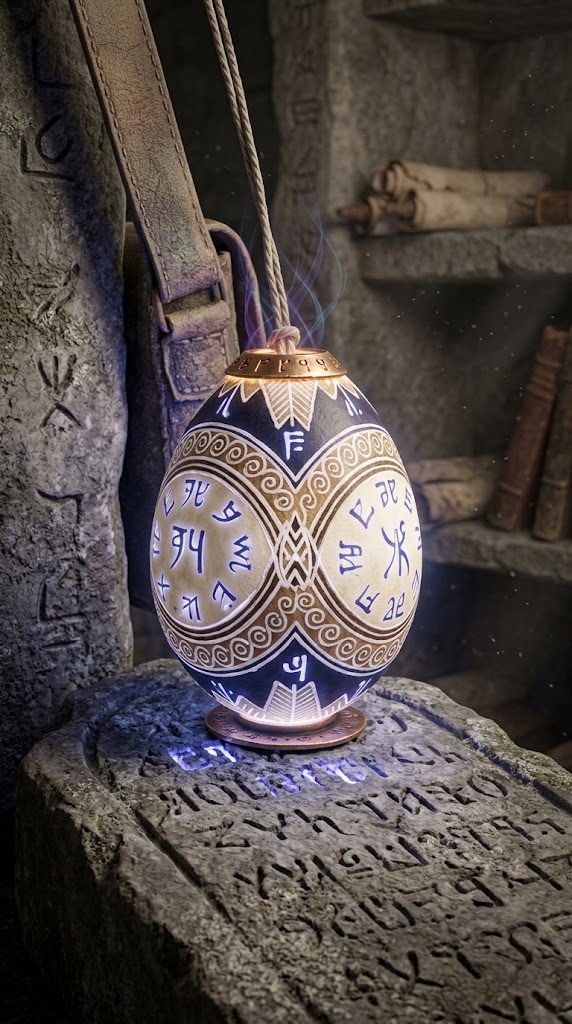
- The exterior displays delicate white and sepia wax-resist bands outlining ancient phonetic syllables, interlocking tongue-and-feather sigils, and concentric open-scroll borders over alternating quadrants of aged parchment-cream, oak-gall umber, and deep indigo ink.
- The pointed apex is secured by a thin, ring-punched bronze collar inscribed with archaic phonetic vowels, while the rounded base is reinforced with a flat bronze rosette washer.
- When held near ancient inscriptions or weathered chiseling, the bronze collar vibrates with a faint, warm harmonic hum and the shell emits a dry, papery rustle.
- The egg smells distinctly of dry library parchment, aged gum arabic, powdered chalk, and old bookbinder’s leather.
Detailed Stats
- Item Tier: Tier 1 (Common)
- Gear Slot: Neck, Belt Sash, or Scholarly Satchel Strap (suspended via a braided raw-linen thread)
- Item Hit Points: Avatar’s maximum Hit Points plus 10 (Resilience 10 multiplied by Tier 1)
- Armor Check: 0
- Weight: 0.3 pounds
- Attunement: Simple attunement (requires reciting an alphabet or grammar table aloud while tracing the wax glyphs with a charcoal-stained finger).
Passive Magic
- Epigrapher’s Lens: While worn against the chest or collar, the talisman sharpens the bearer’s analytical perception, granting a +1 passive bonus (or advantage) on checks made to analyze historical carvings, study faded scripts, or determine the origin and era of any ancient writing.
- Vocal Resonance of Antiquity: The phonetic runes ease the vocal tract when pronouncing forgotten tongues, granting a +1 passive bonus on checks made to enunciate dead languages correctly, read ancient ritual scrolls aloud without stuttering, or avoid mispronouncing archaic command words.
- Inscriptive Clarity: The faint harmonic vibrations emitted by the base rosette stabilize the bearer’s hand, granting a +1 passive bonus on tools or checks used to transcribe, rub, or sketch damaged runes from weathered surfaces without losing fine details.
Activable Magic
- Whisper of the Lost Tongue: As an action, the bearer brings the perforated bronze collar to their lips and speaks a sentence. The talisman translates the spoken words into a chosen dead dialect, projecting them in a clear, resonant ancestral cadence that can be understood by ancient guardians or lingering spirits for 10 minutes. This ability can be used twice per day.
- Decipher the Weathered Glyph: As an action, the bearer touches the flat base rosette to a line of illegible, eroded, or archaic text (up to 50 words). The indigo wax glyphs flare with pale ivory light, mentally imparting the direct literal translation and context of the writing into the bearer’s mind. This ability can be used twice per day.
- Lingual Lock-Shatter: As an action, the bearer aims the bronze collar at a door, chest, or mechanism sealed by an ancient vocal password or linguistic rune-lock. Squeezing the shell causes it to hum a resonant harmonic chord that mimics the harmonic frequency of the password, granting a sudden surge of comprehension that grants advantage (or a significant bonus) on the next check made to bypass or speak past the linguistic ward. This ability can be used once per day.
Tags
- Wondrous Item, Tier 1, Common, Dead Language, Translation, Linguistics, Lore, Scholarly, Wax-Resist, Epigraphy, Neck Slot, Satchel Slot, Antiquity, Decipher, Scriptorium, Cryptography, Parchment, Epigraph, Phonetics, Dialect, Archival, Glyphs, Runesmith
Commerce and Acquisition of Pysanky 408 of the Cryptic Lexicon
- University Book-Stalls and Scriptorium Commissaries
- Located in the academic quarters of major cities or within the cloistered walls of great libraries, these stalls cater to linguistics students, historian apprentices, and paleography professors.
- Displayed on velvet-lined trays beneath glass cases to protect the delicate shells from ink-stained fingers, they are sold as vital aids for translation practicums or thesis research in the sunken archives.
- The retail price sits at a stable 25 to 30 silver coins, with registered university students and faculty receiving a 10% concession to purchase it for 22 to 27 silver coins.
- Selling a well-maintained ovoid back to the book-stall involves the archivist checking the clarity of the sepia wax lines, yielding 12 to 15 silver coins credited to the seller.
- Lower-City Antiquarian Shops and Rare Scroll Dealers
- Tucked away in narrow, dust-choked alleys near historical districts or forgotten tombs, these dimly lit shops serve artifact collectors, ruin-delvers, and black-market translators.
- Often kept behind the main counter, nestled between tarnished bronze magnifying lenses, cracked inkwells, and bundles of brittle parchment maps, the egg is sought by those attempting to decode tomb-curses or claim ancestral artifacts.
- The typical asking price runs between 28 to 35 silver coins (or barter of equivalent value in rare pigments, historical maps, or salvaged stone rubbing), with return customers receiving an informal discount down to 25 to 32 silver coins.
- Selling to an antiquarian brings a payout of 13 to 17 silver coins in loose silver cuttings, obsolete currency, or immediate store credit.
- Upper-City Curio Auctions and Estate Sales
- Held in upscale, marble-floored galleries or within the manor houses of deceased nobility, these events attract wealthy dilettantes, historical societies, and agents of foreign museums.
- Presented with great ceremony atop mahogany plinths with detailed provenance documents detailing the specific library or ruin the egg originated from, it is purchased as a display piece or a novelty tool for occult parlors.
- These are high-volume, competitive sales where the price is driven by desire and perceived history, frequently hammering at 35 to 45 silver coins, often bundled into a lot with ancient, albeit illegible, texts.
- Selling the egg at auction requires submitting it for appraisal and consignment, yielding 15 to 20 silver coins to the owner, minus the auction house commission.
- Frontier Expeditionary Hubs and Archaeological Salvage Posts
- Found at the edge of active excavation sites, desert trading posts, or fortified borders, these raw-timber outposts supply trappers, explorers, and authorized historical expeditions.
- Hung from rafter hooks alongside coil ropes, piton hammers, and canvas tents, the item is purchased by field linguists who need to identify safety runes or translate eroded temple commands in real-time.
- Because long-range provisions and specialized gear are scarce on the frontier, outfitters charge a steeper 30 to 40 silver coins (or roughly 3 to 4 gold coins).
- Selling the egg to a frontier factor returns 10 to 14 silver coins in hard coin or provisions and salvaged artifacts.
Tactical and Environmental Roleplay: Offensive and Defensive Deployments of Pysanky 408
- Sunken Crypts and Ancient Mausoleums
- Defensive Utilization: Traversing a catacomb lined with decaying sarcophagi, the bearer uses Decipher the Weathered Glyph to quickly scan eroded warnings chiseled into the flagstones, identifying an ancient necrotic ward before the party steps into its trigger perimeter. When a vengeful crypt phantom rises to defend the tomb, the bearer activates Whisper of the Lost Tongue to speak formal burial appeasements in the entity’s native, dead dialect, de-escalating hostility and convincing the spirit that the intruders are respectful emissaries rather than common grave-robbers.
- Offensive Utilization: Confronting an archaic guardian golem bound by ancient command runes, the scholar uses Epigrapher’s Lens to spot the master control glyph carved into the construct’s chest plate. Channeling Whisper of the Lost Tongue, the bearer barks the forgotten command word for “cease” or “yield” directly into the bronze collar, shocking the construct’s animating magic and forcing it to stand down, leaving its core vulnerable to an immediate strike from allies.
- Forgotten Scriptoriums and Sunken Archives
- Defensive Utilization: Trapped in a subterranean library filling with toxic swamp gas or rising floodwaters, the party faces a massive stone portal sealed by an ancestral riddle. The scholar brings the base rosette to the door, triggering Lingual Lock-Shatter; the resonant harmonic frequencies rattle the linguistic ward, instantly revealing the missing archaic vowel needed to speak the passage open and escape the suffocating chamber.
- Offensive Utilization: Competing against a rival band of plunderers inside a ruined archive for the location of an ancient reliquary, the bearer uses Inscriptive Clarity to rapidly take a flawless charcoal rubbing of a damaged stele while simultaneously using Decipher the Weathered Glyph to extract the coordinates. Squeezing the bronze collar, the scholar utters a misleading sentence via Whisper of the Lost Tongue, tricking the rival party’s translation instruments into sending them into an ancient pit trap on the opposite wing.
- Desert Ruins and Eroded Megalithic Temples
- Defensive Utilization: Pinned down by desert raiders outside a wind-scoured sandstone shrine, the party seeks shelter behind an ancient basalt gate secured by phonetic locks. While under arrow fire, the bearer utilizes Vocal Resonance of Antiquity to read the weathered protective hymns aloud without a single vocal misstep, harmonizing with the temple’s defensive wards to seal the gate shut and lock the attackers out in the sandstorm.
- Offensive Utilization: While infiltrating a sun-temple stronghold occupied by cultists worshiping a forgotten sun deity, the bearer uses Whisper of the Lost Tongue to mimic the sacred ancestral voice of the god itself from the shadows. The booming, archaic cadence echoes through the stone pillars, causing the cultists to drop their weapons in terrified supplication and allowing the party to ambush the bewildered leadership without triggering a general alarm.
- Urban Antiquities Markets and Scholarly Academies
- Defensive Utilization: Cornered in an academic hall by corrupt city inquisitors accusing the party of trafficking forbidden heretical tomes, the scholar leverages Epigrapher’s Lens to quickly analyze the disputed parchment, publicly identifying it as a harmless agricultural census from the Third Dynasty, thereby discrediting the inquisitor’s authority and turning the assembled scholars in their favor.
- Offensive Utilization: During a tense auction negotiation with an illicit antiquities broker hoarding a vital historical map, the bearer uses Decipher the Weathered Glyph to secretly read the hidden marginal notes across the room while pretending to examine mundane coins. Armed with the true secret location written in the margins, the party bids on a cheap decoy item, breaks off the negotiation, and outmaneuvers the broker to the prize before he ever realizes the text was cracked.
Perception of Activation:
- The Five Senses: User’s Perspective
- Sight: The sepia and white wax bands pulse with a muted, parchment-gold glow, while the surrounding eroded stone carvings briefly trace themselves in lines of luminescent ivory light.
- Sound: A faint, dry rustle like turning brittle papyrus fills the ears, accompanied by a low, rhythmic harmonic chord vibrating from the bronze apex ring.
- Smell: A rich, dusty scent of ancient library vellum, gum arabic, crushed gall-ink, and sweet beeswax floods the nasal passages with every breath.
- Taste: The tongue registers a faint, chalky mineral dryness, reminiscent of tasting ancient stone dust or chewing on a fresh reed stylus.
- Touch: A soothing, steady warmth radiates into the fingers holding the shell, sending gentle micro-pulses up the forearm that relax the throat and tongue muscles.
- The Five Senses: Observer’s Perspective
- Sight: Observers see the intricate phonetic glyphs on the shell ignite with a soft, lantern-like luminescence, casting faint circular shadows on the user’s hands and chest.
- Sound: A resonant, layered chord hums into the room, sounding like several distant scholars whispering a single ancient syllable in unison.
- Smell: A sudden whiff of aged paper, old leather book bindings, and dried cedar shavings cuts through the ambient dust of the room.
- Taste: Those in close proximity notice a fleeting dry tang in the back of their throats, like entering a sealed archive that has not seen fresh air in centuries.
- Touch: Anyone standing within arm’s reach feels a subtle, rhythmic vibration in the floorboards or flagstones, syncing with the hum of the bronze collar.
- Extra-Sensory Perceptions
- Linguistic Synesthesia: The user mentally perceives translated words as colored tactile impressions; ancient vowels feel smooth like polished river glass, while harsh archaic consonants register as sharp, crystalline facets.
- Mnemonic Clairvoyance: The user experiences brief mental flashes of the ancient scribes who first chiseled the words, seeing ghost-like hands holding stone mallets or bronze styluses over fresh plaster.
- Echo-Aura: Mystically sensitive witnesses perceive an ephemeral, translucent halo of floating glyphs drifting outward from the bronze rosette, encircling the user’s head like an ancient crown of letters.
- Positives
- Provides instantaneous, context-rich comprehension of lost idioms, historical syntax, and eroded inscriptions without requiring hours of painstaking lexical cross-referencing.
- Eliminates vocal distortion, stammering, and dialect errors, allowing the bearer to invoke linguistic command keys and speak to ancient entities with native precision.
- Bypasses the danger of misinterpreting dangerous curses or booby-trap triggers hidden within archaic script.
- Negatives
- The harmonic hum and glowing script eliminate stealth in dark or silent ruins, immediately alerting nearby guardians or scavengers.
- Rapid conceptual downloads of dead languages can leave the user with a dull, throbbing headache behind the temples after the effect subsides.
- Speaking with ancestral cadence can temporarily distort the user’s natural voice, making modern speech sound strange, archaic, and formal for several minutes afterward.
Crafting Recipe: Pysanky 408 of the Cryptic Lexicon
Materials Needed
- 1 Wild Owl Egg (harvested from abandoned stone libraries, intact and uniform in shape).
- 1 Tier 1 Magic Crystal (crushed into an ultra-fine, pale-luminescent resonance dust).
- 1 Ounce of Pulverized Fossilized Chalk (sifted through silk mesh to hold linguistic memory).
- 2 Ounces of Filtered Steppe Beeswax (melted with a pinch of lamp-soot scraped from burnt lexicon leaves).
- 2 Fl. Oz. of Aged Oak-Gall Sepia Dye (fermented with iron filings and vinegar for deep umber tones).
- 2 Fl. Oz. of Parchment-Ivory Dye Bath (steeped from dry vellum trimmings, bone meal, and river alum).
- 2 Fl. Oz. of Lapis Lazuli Mineral Ink (ground fine with gum arabic for vibrant indigo panels).
- 1 Lathe-Turned Bronze Collar (punched with phonetic vowel slits around its circumference).
- 1 Flat Bronze Rosette Washer (to anchor the base and transfer harmonic vibration).
- 2 Oiled Vellum Washers (to cushion the shell and prevent structural stress fractures).
- 1 Fl. Oz. of Dry-Matte Mineral Glaze (copal varnish cut with powdered talc).
- 1 Braided Raw-Linen Thread (18 inches in length, triple-twisted for durability).
Tools Required
- 1 Extra-Fine Brass Kistka Stylus (0.2mm aperture for applying delicate phonetic glyphs and scrollwork).
- 1 Hand-Cranked Bone Trephine Drill (fitted with a 1.5mm hardened bronze bit).
- 1 Low-Smoke Alcohol Spirit Lamp (for precise, soot-free wax melting).
- 3 Chilled Clay Dye Vessels (kept cool to prevent thermal cracking of the delicate eggshell).
- 1 Brass Micro-Syringe Blower (for cleaning the shell interior and injecting charged powder).
- 1 Set of Fine-Point Bronze Tweezers and Setting Pliers.
- 1 Agate Mortar and Pestle (for cold-grinding the crystal and chalk).
Skill Requirements
- Crafting (Wax-Resist / Calligraphic Scribing): Minimum Level 2 (for inscribing unbroken phonetic characters, spiral borders, and vowel marks).
- Tinkering / Metalworking: Minimum Level 1 (for punching acoustic vowel slits and seating bronze endplates).
- Ancient Lore / Linguistics: Minimum Level 1 (to bind authentic ancestral idioms into the wax matrix during inscription).
Crafting Steps
- Shell Evacuation and Interior Desiccation
- Mount the owl egg upright in a padded felt cradle; use the bone trephine drill to bore a 1.5mm hole in the pointed apex and a matching hole in the base.
- Insert the brass syringe to draw out the albumen and yolk, washing the interior with a lukewarm vinegar-and-salt wash until completely clean.
- Allow the hollow shell to dry on a bed of dry cedar shavings for 12 hours until free of all organic moisture.
- Wax Application and Pigment Immersion
- Heat the soot-darkened beeswax over the spirit lamp, drawing the wax into the 0.2mm kistka.
- Inscribe the primary white wax lines directly onto the raw shell: interlocking scroll borders, open-feather sigils, and ancestral consonant marks.
- Dip the egg into the parchment-ivory bath for 15 minutes; remove, pat dry with unbleached cotton, and wax over the sections meant to retain the cream tone.
- Submerge the ovoid into the oak-gall sepia vat for 20 minutes; dry thoroughly, then apply wax over the newly stained umber panels to shield them.
- Lower the shell into the lapis lazuli ink crock for 25 minutes, staining the exposed background panels a deep, archival indigo.
- Dewaxing and Matte Protective Glazing
- Warm the egg beside the spirit lamp, gently wiping away the melting wax with soft linen to expose the intricate, multi-layered phonetic characters.
- Brush a thin, even coat of dry-matte mineral glaze across the entire shell, letting it cure for 6 hours to protect the dye from sweat, oils, and moisture.
- Resonance Core Infusion
- In the agate mortar, grind the Tier 1 magic crystal into dust, blending it evenly with the pulverized fossilized chalk.
- Feed the powder through the base aperture using the brass syringe until the internal cavity is coated.
- Hold the shell close to the lips and whisper three ancient phonetic grammar tables through the apex aperture, charging the interior dust until the shell produces a soft, harmonic hum.
- Final Fitting and Attunement Stringing
- Place an oiled vellum washer over the top hole and seat the punched bronze collar over it, securing the ring with waterproof copal resin.
- Align the second vellum washer and the bronze rosette washer over the bottom hole, crimping it snug with setting pliers to establish solid acoustic contact.
- Knot the braided raw-linen thread through the collar loops to form a suspension lanyard, verifying that breathing through the collar vents emits a faint, papery vibration.
Great Tongue-Bone and Scribe Who Sat Upon Dry Vault
Now it is copied down by the seventh under-copyist of the Water-Gate Archive, who worked with a split reed upon the skins of mountain goats that were already green with damp. This is taken from the broken cylinders of black stone that were fished out of the dry canal before the city of Seven Terraces was burned by the men who ate raw millet. It tells of the days when the words of the first grandfathers had fallen into the dirt, and no man knew whether the markings upon the tomb-doors were curses or receipts for onions.
In those years, King Mur-Dagan ruled in the low brick country where the river grows sluggish like tallow. He was a prince who loved the sound of bronze bells and the count of sheep, but in his head there was a great hunger to read the stone poles that stood out in the salt-flats. Upon those poles were carved the deeds of the Kings of the Morning, who walked the earth when the sun was still red and small like a pomegranate. But between the Kings of the Morning and the house of Mur-Dagan, four great silences had fallen upon the earth—silences wherein whole tribes forgot how to twist their mouths to say water, and said only hiss, and forgot how to say give to me, and said only strike.
Mur-Dagan gathered seventy wise men who wore hats of rolled felt. He set them in a courtyard of white plaster and brought them loaves of barley and small salted fish. He pointed his iron staff toward the high salt-hills where the Old Vault of the Scribes lay buried under three spear-lengths of yellow sand.
The King said: The old kings wrote upon the basalt door how much gold they put into the dark room under the mountain. Go therefore, take ink of sheep-bile and strips of linen, and bring back the number of the talents. If you bring the number, you shall each have a copper earring and a jar of sweet beer. But if you bring only lies, your tongue-strings shall be cut with a flint knife and dried upon the palisade.
Among the seventy was an under-turner of tablets whose name was Kepha. He was not a great man of the court; he possessed only one tunic of gray nettle-cloth and a single bronze needle for cleaning mud out of the grooves of old bricks. When the other seventy took their mules and their water-skins and argued about the names of the ancient gods, Kepha walked behind them on foot, carrying only a wicker basket containing three dried figs and an egg he had found in the fallen chimney of the Scribes’ temple.
It was an egg of the great horned owl that hunts only when the moon is like a bent rib. It was thick and heavy, not like the thin water-eggs of the river ducks, and inside it was dry and quiet, as if the bird had decided not to be born because the world had too many noisy men in it.
The company came to the foot of the salt-hill on the twelfth day, when the wind was throwing hot dust into their beards. The great gate of the vault was there, chiseled out of black stone that was oily to the touch. Upon the lintel were three rows of signs shaped like tongues, open quills, and little circles with teeth, such as the ancient ones used when they wished to bind a secret so it could not walk abroad.
The chief scribe, whose name was Bel-Shumu, approached the stone with his magnifying crystal of green glass. He spit upon his sleeve and rubbed the sign of the quill. He said: This first mark means oxen, for it has two points like horns. And the second mark means slaughter, for it is crooked like a scythe. Therefore the king who is buried here killed forty thousand oxen to make grease for his chariots.
Then the second scribe stepped up and said: You are a fool who eats weeds; it does not mean oxen, it means ships, for the line is curved like the ribs of a cedar boat.
And the seventy fell upon one another with their bronze styluses, scratching each other’s cheeks and tearing their felt hats, until the white plaster dust of their coats blew like smoke across the salt.
Kepha sat upon a fallen milestone apart from the brawling. He took from his bag the owl-egg. He had with him a little pot of black wax that the temple-keepers use to seal the cracks in the grain-bins, mixed with the soot from the lamps that burn before the statue of the God of Measuring. With his small bronze needle, he began to draw upon the shell. He did not draw oxen, nor did he draw ships, for he knew that the ancient ones did not speak of such base things upon the thresholds of their graves. He drew the shapes of the throat when it makes the low sound AH, which is the sound of a man entering a dark room; and the shape of the teeth when they make the sound SH, which is the sound of sand pouring through a reed sieve.
He dipped the egg into a flask of sour wine wherein he had soaked the crushed blue earth that the women of the hills use to paint their eyelids. Then he marked it again with lines like the ribs of a dried leaf, and dipped it into the bitter water of the gall-nuts that grow on the scrub-oaks.
When the sun sat down upon the ridge of the salt-mountain, the egg had three skins of color: the skin of parchment that has lain near an oven, the skin of iron-rust, and the skin of the deep sky before the stars are lighted.
He took his needle and struck the top of the egg. A little white tooth of shell fell inward. He struck the bottom, and with a dried grass-straw he blew through the chamber. Out came a pinch of yellow dust that had been the bird’s heart, and it smelled of old cedar beams and the oil that was made before the Great Drowning. Into the hollow space he put three pinches of the white earth that is found only inside the hollows of petrified trees, where the wood has turned to stone but still remembers the shape of leaves.
He bound the top with a strip of copper torn from his sandal-buckle, and through the hole he blew the warm breath of his own chest, saying: O you who knew how to speak before the iron was dug up, open the path of the ear.
The copper ring began to sing. It did not sing like a bird, nor like a flute; it made a sound like the grinding of a millstone when there is no grain between the stones, dry and rhythmic: KH-RRR, KH-RRR, KH-RRR.
The seventy scribes were lying upon the salt, their tunics torn, their faces bloody from their styluses, weeping because they could not read the first word and the King’s horsemen were already riding from the horizon with the iron ropes and the tongue-knives.
Kepha rose. He took the egg by its linen cord and held it against the black stone lintel. The lower washer of bronze touched the carved tongue-mark.
At once, the air about his ears ceased to be the air of the dry salt-flat. It became cool and damp, like the air inside an underground cistern where cold water has slept for forty winters. The blue lines upon the shell began to run with pale light, not like fire that burns, but like the wet moss that shines on the timbers of deep wells.
The stone did not speak with words of the marketplace. But in Kepha’s ears there fell a voice that sounded like many old women chanting in an empty barn. The voice said: I am not a box of gold, O little worm of the dust. I am the well wherein the seed of the great speech was laid down so that the sun might not burn it up when the sky went dry. He who seeks here for silver shall have his teeth filled with gravel; but he who brings an open ear may take the key that turns the mouths of the stone gates.
Kepha saw then that the mark which the chief scribe had called an ox was the sign of the throat when it is shut against a lie; and the mark which the second had called a ship was the sign of the tongue when it is laid flat to receive the truth.
He turned to the horsemen of the King who had just drawn their reins at the foot of the mound, their swords drawn, their iron collars rattling upon their saddles. The captain cried out: Where is the count of the talents? For Mur-Dagan has made his sacks ready and the donkeys are standing at the palace steps!
Kepha spoke. But when his mouth opened, it was not the thin, squeaking voice of an under-scribe that came forth. It was the voice of the hollow basalt cylinder when the south wind blows through its throat. The syllables fell from him like square blocks of dressed hewn stone: heavy, cold, and square at the corners.
The horses of the riders sat back upon their haunches and screamed, for they thought a lion of the mountains was roaring from the black rock. The iron swords of the guards turned soft in their hands like wet bread, because the ancient speech was the speech that had commanded the iron when it was still red in the belly of the earth, and the iron remembered the command.
The riders turned and fled across the salt-plain, leaving their saddle-cloths behind them, and the seventy scribes crawled into the thorn bushes on their hands and knees, hiding their faces because they thought the sky was falling down upon their necks.
Kepha went down from the mountain alone. He did not go back to the city of brick, nor did he ask for the copper earring, nor the sweet beer of the King. He walked toward the north, where the ancient libraries lie under the ice, carrying the small painted shell at his throat. And whenever he came to a boundary-stone where the name of the ancient lord had been scrubbed away by the wind, he touched the bronze rosette to the rock, and the dead stone would whisper to him who had died there, and who had wept for him, and what words they had spoken before the great silence fell upon the ground.
It is said in the low country that the egg was kept for nine generations in a box of horn, and that when any man held it to his ear, he could not tell a lie for three days, because his tongue would stick to the roof of his mouth like dry felt, remembering the heavy speech of the Kings of the Morning.
Moral of the Story: He who looks upon the ancient marks with greed in his belly sees only gold and oxen, and falls into brawling over the shadow of his own ignorance; but he who approaches the silence of the fathers with a clean ear and a patient hand finds that the true treasure was never the silver in the tomb, but the voice that gave a name to the world before the darkness took it.
Suggested conversions to other systems:
Dungeons & Dragons (5th Edition)
Pysanky 408 of the Cryptic Lexicon
Wondrous Item, Common (Requires Attunement)
- Item Profile: A smooth, lacquered owl eggshell decorated with white and sepia wax-resist bands depicting ancient phonetic syllables, scrollwork, and interlocking tongue motifs over panels of parchment-cream, oak-gall umber, and lapis ink. It is capped at the pointed apex with a perforated bronze collar punched with vowel slits and anchored at the base by a flat bronze rosette washer. It hums with faint harmonic resonance and smells of old vellum, powdered chalk, and bookbinder’s leather.
- Epigrapher’s Lens (Passive): While worn around your neck or hanging from a satchel strap, you gain advantage on Intelligence (History) and Intelligence (Investigation) checks made to study archaic carvings, decipher eroded inscriptions, or determine the origin and historical era of ancient writing.
- Vocal Resonance of Antiquity (Passive): The phonetic runes guide your enunciation. You gain a +1 bonus to Charisma checks when communicating with ancient entities or deciphering command words, and you have advantage on checks made to read archaic or ritual scrolls aloud without vocal stumble or mispronunciation.
- Inscriptive Clarity (Passive): The subtle harmonic hum stabilizes your hands. You gain advantage on ability checks using Calligrapher’s Supplies, Painter’s Supplies, or Mason’s Tools to transcribe, sketch, or take rubbings of damaged or weathered runes.
- Whisper of the Lost Tongue: As an action, you bring the perforated bronze collar to your lips and speak a message. The talisman translates your words into a dead or archaic language of your choice, projecting them in an ancient, resonant cadence audible up to 60 feet. Ancient undead, constructs, spirits, or beings keyed to that language understand your speech for 10 minutes. This property can be used twice per dawn.
- Decipher the Weathered Glyph: As an action, you touch the flat bronze rosette to a section of eroded, archaic, or non-magical dead text (up to 50 words). The glyphs flare with pale ivory light, mentally imparting the direct literal translation, idiom context, and grammatical intent into your mind. This property can be used twice per dawn.
- Lingual Lock-Shatter: Once per dawn as an action, you direct the bronze collar toward a door, chest, or mechanism sealed by an ancient vocal password or linguistic rune-lock. Squeezing the shell causes it to hum a resonant harmonic chord that mimics the password’s harmonic frequencies, granting you advantage and a +5 bonus on your next check made to bypass, disarm, or correctly speak past the linguistic ward.
Call of Cthulhu (7th Edition)
The Scriptorium Ovoid of Kepha
Minor Hypergeometric Focus / Linguistic Talisman
- Physical Description: An owl eggshell sealed in a dry mineral glaze, marked with wax-resist phonetic sigils in sepia, cream, and deep lapis indigo. It features a ring-punched bronze collar and a base rosette washer. When brought near pre-human glyphs or archaic hieroglyphs, it hums with dry, harmonic vibration and emits the scent of decaying library paper and cedar dust.
- Epigrapher’s Lens (Passive): When worn, the investigator receives a bonus die on Archaeology, History, or Language (Other) rolls made to identify the origin, era, or cultural context of weathered inscriptions or extinct scripts.
- Vocal Resonance of Antiquity (Passive): The talisman aligns the investigator’s vocal tract to forgotten phonetic scales, reducing the risk of magical mispronunciation. When reading aloud from archaic texts or invoking ritual phrases, any Fumble result is treated as a regular Failure instead.
- Inscriptive Clarity (Passive): The harmonic stabilization grants a +10% bonus to Art/Craft (Calligraphy, Drawing, or Rubbing) rolls made to preserve or duplicate damaged or crumbling carved runes.
- Whisper of the Lost Tongue: By expending 1 Magic Point, the investigator can speak into the bronze collar. For 10 minutes, their spoken words are projected in a chosen extinct dialect (such as Old Aramaic, Classical Sumerian, or Aklo), allowing intelligible two-way communication with lingering entities, mummies, or ancient constructs that comprehend that tongue. Usable twice per day.
- Decipher the Weathered Glyph: By expending 1 Magic Point and pressing the base rosette to an eroded or unknown archaic passage (up to a single inscription or paragraph), the user instantly gains the literal meaning without requiring a skill roll, bypassing up to 20% of an archaic document’s translation time. Usable twice per day.
- Lingual Lock-Shatter: By expending 2 Magic Points while touching a puzzle lock, sealed sarcophagus, or crypt gate keyed to an ancient linguistic passphrase, the ovoid vibrates violently, granting a bonus die and a temporary +20% bonus to the investigator’s Archaeology or Language (Other) roll to solve or bypass the inscription. Usable once per day.
- Sanity Cost: 0 Sanity cost to possess or use for historical dead languages. Translating forbidden mythos texts or communicating with alien pre-human entities via this item still prompts the standard Sanity check associated with the text or creature.
Blades in the Dark
The Antiquarian’s Lexicon Ovoid
Curio, Arcane Implement (0 Load)
- Item Profile: An intricate owl eggshell etched with wax-resist geometric vowel-teeth and scroll borders over indigo, umber, and vellum tones. Finished with an ancient bronze collar that rustles like brittle papyrus when shaken, and suspended by an unbleached linen cord. Smells of old ink, damp parchment, and ancient tomb dust.
- Epigrapher’s Lens (Passive): You gain Potency when taking action with Study to examine, authenticate, or translate ancient architectural carvings, dead scripts, or forgotten ritual texts found in the deathlands or sunken vaults.
- Vocal Resonance of Antiquity (Passive): The spirit resonance assists your enunciation. When attempting to command, parley with, or placate ancient ghosts or hollowed horrors using dead dialects, your position is improved by one step (e.g., from Risky to Controlled).
- Inscriptive Clarity (Passive): Whenever you take action to quickly sketch, rub, or preserve decaying occult symbols during a score, you suffer no penalty for working in darkness or under time pressure.
- Whisper of the Lost Tongue: Push yourself (spend 2 Stress) or expend 1 charge of this item to speak into the bronze collar. Your voice booms with the resonant cadence of the Old Empire or Forgotten Dynasties for several minutes, allowing you to treat an interaction with ancient spirits, guardians, or ancestral automatons as Standard Effect even without prior knowledge of their language. Usable twice per score.
- Decipher the Weathered Glyph: Spend 1 Stress to touch the base rosette to an indecipherable or weathered runic inscription. You instantly glean the core intent, hidden meaning, or secret warning of the text, bypassing a Study clock by 2 ticks. Usable twice per score.
- Lingual Lock-Shatter: Spend 1 Stress to align the humming collar with a portal or vault sealed by an ancient vocal password or runic cipher. The harmonic resonance vibrates through the locking wards, yielding an immediate critical effect on your next Tinker or Study action to bypass the barrier. Usable once per score.
Knave (2nd Edition)
Pysanky 408 of the Cryptic Lexicon
Item, 1 Slot
- Item Profile: An aerodynamic owl eggshell painted with white wax-resist characters, scroll spirals, and feather runes over sepia and lapis panels. Bound with a punched bronze collar and base washer, it smells of old libraries, chalk, and gum arabic.
- Item Quality: 2 Quality. (If subjected to a direct bludgeoning strike, heavy crush, or catastrophic fall, the delicate shell fractures and loses all magical potency).
- Epigrapher’s Lens (Passive): The bearer gains advantage on all Intelligence checks made to analyze, date, or read historical inscriptions, ruined monuments, and forgotten writing.
- Vocal Resonance of Antiquity (Passive): The bearer gains advantage on Charisma checks made to negotiate with ancient undead, tomb spirits, or dungeon guardians when attempting to speak to them in their historic forms of address.
- Inscriptive Clarity (Passive): The bearer never fails checks or wastes time when making rubbings, sketches, or transcriptions of damaged dungeon runes or stele faces, producing clear records even under torchlight.
- Whisper of the Lost Tongue: Twice per day as an action, the bearer speaks into the bronze collar. For 10 minutes, their voice resonates with ancient authority, translating their speech into any chosen extinct language so that ancient guardians, ghosts, or dungeon constructs understand them clearly.
- Decipher the Weathered Glyph: Twice per day as an action, the bearer presses the flat base of the egg against an eroded, obscured, or forgotten inscription (up to 50 words). The ivory lines light up, mentally revealing the true meaning, context, and any warning contained in the text.
- Lingual Lock-Shatter: Once per day as an action, the bearer holds the ovoid against a door, chest, or mechanism sealed by an ancient riddle or linguistic password. The egg hums a resonant chord, revealing the correct phonetic vowel or word and granting advantage on any check to open or bypass the lock.
Fate (Fate Condensed)
Pysanky 408 of the Cryptic Lexicon
Item Stunt / Aspect-Bearing Extra
- Item Aspect: Vessel of the Scribe’s Forgotten Tongue
- Flavor Profile: An ancient owl egg decorated in white and sepia wax-resist bands detailing forgotten phonetic marks, interlocking tongue sigils, and scrollwork over panels of parchment-ivory, oak-gall umber, and lapis ink. Capped at the apex with a perforated bronze collar punched with vowel slits and anchored below by a flat bronze rosette, it hangs from a raw-linen cord and smells of dried vellum, gum arabic, and ancient tomb dust.
- Epigrapher’s Lens (Passive): You gain +2 on overcome rolls with Lore to examine, date, or decipher archaic inscriptions, tomb stele, and dead dialects.
- Vocal Resonance of Antiquity (Passive): You gain +2 on Rapport or Provoke rolls when attempting to communicate with, appease, or command ancient spirits, undead, or constructs keyed to historic civilizations.
- Inscriptive Clarity (Passive): Whenever you make an overcome roll with Crafts or Lore to take rapid rubbings, sketches, or field copies of crumbling or damaged ancient scripts, you treat any tie as a full success with no minor cost.
- Whisper of the Lost Tongue (Stunt): Twice per session, you can invoke your Vessel of the Scribe’s Forgotten Tongue aspect without spending a Fate point to speak fluently in an extinct language for the duration of a scene, allowing clear two-way communication with entities that speak only that dialect.
- Decipher the Weathered Glyph (Stunt): Twice per session, by touching the base rosette to an eroded or illegible inscription, you automatically succeed on a Lore roll to decipher up to a paragraph of text without rolling, immediately discovering any hidden warnings or context.
- Lingual Lock-Shatter (Stunt): Once per session, when attempting an overcome roll with Lore or Burglary to bypass an ancient puzzle lock, vault door, or ward keyed to a linguistic password or phonetic passphrase, you gain a +2 bonus and create the boost Resonant Word-Key on a success.
Cypher System / Numenera
Ovoid of the Lost Dialect
Artifact (Level 2)
- Form: An owl egg sealed in a matte mineral glaze, etched with wax-resist phonetic sigils in sepia, vellum, and indigo, bound with a pierced bronze ring collar and base rosette washer.
- Depletion: 1 in 1d20 (checked only when an active property is triggered).
- Passive Effect (Epigrapher’s Lens): The bearer gains an asset on all tasks involving the identification, analysis, or translation of ancient ruins, archaic texts, and forgotten pictograms.
- Passive Effect (Vocal Resonance of Antiquity): The bearer gains an asset on interaction and persuasion tasks directed at ancient mechanical intelligences, tomb sentinels, or ancient apparitions when attempting to address them in ancestral cadence.
- Passive Effect (Inscriptive Clarity): Faint harmonic vibrations steady the bearer’s hand, granting an asset on any crafting or fine-motor task used to accurately sketch, copy, or preserve deteriorating carved symbols.
- Effect (Whisper of the Lost Tongue): As an action, the user speaks into the perforated collar. For 10 minutes, their spoken words are translated into a specified dead or archaic dialect with crystalline clarity, enabling full communication with creatures or relics programmed in that tongue.
- Effect (Decipher the Weathered Glyph): As an action, the user presses the base rosette to an eroded or unreadable ancient passage (up to 50 words). The glyphs flare with pale ivory luminescence, mentally imparting the true translation and grammatical context directly into the user’s mind.
- Effect (Lingual Lock-Shatter): As an action, the user aligns the collar with an ancient barrier, vault, or cipher keyed to a linguistic command. The egg hums a resonant chord that vibrates against the ward, easing the task of picking, hacking, or vocalizing through the lock by two steps.
Pathfinder (Second Edition)
Pysanky of the Cryptic Lexicon
Item 1 | Uncommon, Consumable (Talisman), Divination, Linguistic, Magical
- Price: 15 gp
- Usage: worn (neck, belt, or satchel strap); Bulk: L
- Item Profile: An intricate owl eggshell finished in matte lacquer, bearing white wax-resist phonetic syllables, open-scroll borders, and stylized feathers over parchment-cream, umber, and indigo panels. A ring-punched bronze collar seals the apex, and a flat bronze rosette caps the base.
- Epigrapher’s Lens (Passive): While worn, you gain a +1 item bonus to Recall Knowledge checks made with Society, Arcana, or Occultism to identify, date, or translate archaic writing, ancient historical carvings, or dead tongues.
- Vocal Resonance of Antiquity (Passive): You gain a +1 item bonus to Diplomacy or Intimidation checks when addressing ancient undead, constructs, or lingering spirits in their native dead language.
- Inscriptive Clarity (Passive): You gain a +1 item bonus to Crafting checks made to transcribe, sketch, or take rubbings of damaged or weathered runic stones.
- Activate—Whisper of the Lost Tongue: (Single Action; Concentrate, Linguistic) Frequency twice per day; Effect You bring the bronze collar to your lips and speak. For 10 minutes, your voice projects in a chosen dead or extinct language. Creatures that understand this language can converse with you freely, and your words carry a resonant ancestral weight.
- Activate—Decipher the Weathered Glyph: (Single Action; Concentrate, Manipulate) Frequency twice per day; Effect You touch the flat bronze rosette to a passage of eroded, obscured, or archaic writing (up to 50 words). You instantly comprehend the literal meaning, context, and grammatical intent of the text, ignoring gaps caused by physical weathering.
- Activate—Lingual Lock-Shatter: (Single Action; Manipulate) Frequency once per day; Effect You hold the ovoid against a door, coffer, or ward sealed by a linguistic passphrase or ancient rune-lock. The egg emits a resonant harmonic vibration that reveals the missing phonetic element; you gain a +2 circumstance bonus to your next Thievery, Society, or spellcasting check made to bypass or speak past the barrier.
Savage Worlds (Adventure Edition)
Cryptic Lexicon Pysanky
Minor Arcane Device
- Item Profile: A small, delicate owl egg treated with dry copal glaze, displaying intricate white wax-resist phonetic characters, scroll designs, and feather motifs over ivory, oak-gall sepia, and indigo fields. Fitted with a perforated bronze collar and base rosette washer, it hangs from a braided linen cord and smells of vellum and aged ink.
- Weight: 0.25 lbs.
- Epigrapher’s Lens (Passive): The wearer gains a +2 bonus on Academics or Research rolls made to decipher, date, or authenticate ancient carvings, inscriptions, or dead languages.
- Vocal Resonance of Antiquity (Passive): The wearer gains a +1 bonus on Persuasion or Intimidation rolls made against ancient entities, mummies, or archaic constructs when conversing in historical tongues.
- Inscriptive Clarity (Passive): The user receives a +2 bonus on Repair or relevant trade rolls made to create accurate charcoal rubbings, sketches, or transcriptions of decaying runes under difficult conditions.
- Whisper of the Lost Tongue: Twice per day as an action, the wearer speaks into the bronze collar. For 10 minutes, their voice resonates with ancient cadence, automatically translating their speech into a chosen extinct language and allowing two-way dialogue with beings that comprehend it.
- Decipher the Weathered Glyph: Twice per day as an action, the user presses the base rosette to an eroded or unfamiliar archaic script (up to a brief paragraph). The script flares with pale ivory light, granting an immediate and complete understanding of the text’s meaning and context without requiring a roll.
- Lingual Lock-Shatter: Once per day as an action, the user touches the device to a lock, vault, or mechanism sealed by an ancient vocal password or linguistic puzzle. The device hums a harmonic chord, granting a +2 bonus and an additional d6 Wild Die on the character’s next Thievery or Academics roll to bypass the ward.
Shadowrun (Sixth World)
Focus of the Cryptic Lexicon
Force 2 Qi Focus / Linguistic Divination Talisman
- Item Profile: A delicate wild owl egg treated with a matte copal glaze, featuring raised white and sepia wax-resist phonetic sigils, tongue glyphs, and open-scroll motifs across parchment-cream, oak-gall umber, and lapis lazuli indigo quadrants. The apex is capped with a punched bronze collar etched with archaic phonetic vowels, while the base is seated in a flat bronze rosette washer. It hangs from a braided raw-linen thread, smelling of dried vellum, gum arabic, and ancient archive dust.
- Item Properties:
- Karma Cost to Attune: 4 Karma
- Availability: 3 (Legal / Antiquarian Dealers, University Commissaries, Curio Auctions)
- Cost: 3,500 Nuyen
- Epigrapher’s Lens (Passive): While worn against the chest or satchel strap, the focus clarifies linguistic patterns. The user gains a +2 dice pool bonus on Memory, Academic Knowledge, or Perception tests made to identify, date, or analyze archaic inscriptions, forgotten runes, or eroded pictograms.
- Vocal Resonance of Antiquity (Passive): The focus stabilizes the vocal cords when enunciating archaic command phrases or historical dialects. The user gains a +1 dice pool bonus on Social tests directed at ancient spirits, free spirits, or ancestral watcher entities when addressing them in dead tongues.
- Inscriptive Clarity (Passive): Subtle harmonic vibrations emitted by the base rosette steady the hands, granting a +2 dice pool bonus on physical or technical tests made to accurately sketch, transcribe, or take carbon rubbings of damaged or fragile script.
- Active Ability—Whisper of the Lost Tongue: As a Minor Action, the user raises the bronze collar to their lips and speaks. For 10 minutes, the focus projects their spoken words in an extinct or dead language of their choice in a resonant ancestral cadence, allowing two-way communication with beings or magical constructs keyed to that tongue. Usable twice per 24-hour cycle.
- Active Ability—Decipher the Weathered Glyph: As a Major Action, the user presses the base rosette against a line of damaged, eroded, or unreadable ancient text (up to 50 words). The indigo wax glyphs flare with pale ivory light, mentally imparting the literal translation, idiomatic context, and grammatical intent directly to the user. Usable twice per day.
- Active Ability—Lingual Lock-Shatter: As a Major Action, the user touches the bronze collar to a magelock, vault door, or barrier keyed to an archaic vocal password or linguistic rune. The egg emits a harmonic resonance that reveals the vocal frequency, granting a +3 dice pool bonus on the user’s next test to bypass, hack, or vocalize past the linguistic ward. Usable once per day.
Starfinder (Second Edition)
Pysanky of the Cryptic Lexicon
Item 1 | Consumable (Talisman), Divination, Linguistic, Magical
- Price: 15 credits
- Usage: worn (neck, belt, or satchel strap); Bulk: Light
- Item Profile: An owl eggshell coated in a dry mineral glaze, decorated with white wax-resist phonetic characters, scroll designs, and feather motifs over ivory, oak-gall umber, and lapis panels. Fitted with a perforated bronze whistling collar and a base rosette washer, it smells of old books and dried ink, vibrating with faint harmonic warmth.
- Epigrapher’s Lens (Passive): While worn, you gain a +1 item bonus to Recall Knowledge checks using Arcana, Occultism, or Society to identify, date, or translate dead alien scripts, archaic temple carvings, or extinct dialects.
- Vocal Resonance of Antiquity (Passive): You gain a +1 item bonus to Diplomacy or Intimidation checks when attempting to communicate with ancient spirits, alien crypt intelligences, or pre-Gap automatons using their native historical tongues.
- Inscriptive Clarity (Passive): You gain a +1 item bonus to Crafting checks made to record, scan, or transcribe crumbling ruins and fragile hieroglyphic panels without data loss.
- Activate—Whisper of the Lost Tongue: (Single Action; Concentrate, Linguistic) Frequency twice per day; Effect You speak into the bronze collar. For 10 minutes, your voice is translated into a chosen dead, forgotten, or pre-Gap language, projecting with an ancient, authoritative cadence that allows entities keyed to that dialect to converse with you.
- Activate—Decipher the Weathered Glyph: (Single Action; Concentrate, Manipulate) Frequency twice per day; Effect You press the flat bronze rosette to a section of eroded, scratched, or extinct text (up to 50 words). The ivory wax lines glow, instantly granting you full comprehension of the text’s literal meaning and underlying context.
- Activate—Lingual Lock-Shatter: (Single Action; Manipulate) Frequency once per day; Effect You hold the ovoid against a security door, datapad, or relic console locked by an ancient verbal passphrase or linguistic cipher. The egg emits a harmonic chord that reveals the passphrase’s harmonic structure, granting a +2 circumstance bonus to your next Computers or Thievery check to bypass or correctly vocalize the password.
Traveller (Mongoose 2nd Edition)
Cryptic Lexicon Acoustic Deciphering Ovoid
TL 10 / Specialized Archeological Translation Focus
- Physical Characteristics: A preserved avian egg encased in a matte mineral matrix, displaying micro-etched phonetic sigils and scroll geometries across cream, umber, and indigo quadrants. The apex features a ring-punched bronze acoustic receiver with directional vowel slits, and the base is anchored by a bronze rosette contact plate. Suspended by a braided linen lanyard. Mass: 0.15 kg.
- Epigraphic Analysis (Passive): When worn at the collar or utility strap, the device’s micro-sensors and mnemonic field enhance cognitive recognition. The user gains a +2 DM on Education-based checks, Science (linguistics), or Science (history) checks made to classify, date, or analyze extinct languages, planetary runes, or eroded monument carvings.
- Vocal Resonance of Antiquity (Passive): The acoustic receiver provides pitch-alignment cues, granting a +1 DM on Diplomat or Persuade checks when attempting to vocalize ancestral terms of address or communicate with primitive or ancient machine-intelligences.
- Inscriptive Clarity (Passive): The harmonic base stabilizes the operator’s hands, granting a +2 DM on checks made to take field rubbings, charcoal traces, or mechanical surface sketches of brittle, deteriorating inscriptions.
- Whisper of the Lost Tongue: Twice per standard day as a minor action, the user vocalizes into the acoustic collar. For 10 minutes, the ovoid modulates and projects the user’s speech in a specified extinct dialect, enabling direct communication with automated archival guardians or remnants programmed in that language.
- Decipher the Weathered Glyph: Twice per standard day as a significant action, the user presses the base rosette against an eroded, defaced, or archaic inscription (up to 50 words). The device processes the structural frequency of the carving, directly transmitting the literal translation and idiomatic context to the user’s comm-link or neuro-interface.
- Lingual Lock-Shatter: Once per standard day as a significant action, the user places the device against a mechanical or electronic barrier sealed by a vocal password or linguistic lock. The ovoid resonates with the locking frequency, granting a +2 DM on the user’s next Electronics (sensors or security) check to crack the vocal gate.
Warhammer Fantasy Roleplay (4th Edition)
Pysanky of the Silent Scriptorium
Magical Curio / Antiquarian Talisman (Common Rarity)
- Item Profile: An owl eggshell coated in a pale, matte resin glaze, detailed with delicate white wax-resist phonetic characters, open scrolls, and stylized feathers over panels of parchment-ivory, oak-gall umber, and lapis lazuli ink. The pointed apex is secured with a punched bronze collar with vowel slits, while the rounded base is capped with a bronze rosette. It smells of dried vellum, crushed iron-gall, and old leather.
- Encumbrance: 0
- Availability: Common (Found among university scriptoriums, antiquarian dealers, and ruin-delvers)
- Epigrapher’s Lens (Passive): While worn at the neck or on a satchel strap, the bearer gains a +10% bonus to Lore (History, Antiquities, or Folklore) and Research Tests made to identify, translate, or date eroded tomb carvings, ancient stone tablets, and forgotten dialects.
- Vocal Resonance of Antiquity (Passive): The phonetic resonance guides the voice. The bearer gains a +10% bonus to Charm or Intimidate Tests when negotiating with or commanding ancient undead, tomb guardians, or spirits keyed to historical civilizations.
- Inscriptive Clarity (Passive): The subtle harmonic vibration steadies the scribe’s hand, granting a +10% bonus to Art (Writing or Cartography) Tests made to take field rubbings, transcribe crumbling script, or sketch runes without error.
- Whisper of the Lost Tongue: Twice per day as a Free Action on their turn, the bearer speaks into the bronze collar. For 10 minutes, their voice resonates with ancient authority, translating their words into a chosen extinct language (such as Classical, Ancient Nehekharan, or Archaic Guild Tongue) so that creatures or constructs understanding that speech can converse freely.
- Decipher the Weathered Glyph: Twice per day as an Action, the bearer presses the bronze base against an eroded or unfamiliar archaic script (up to a brief passage). The ivory wax lines flare with pale light, instantly imparting the text’s literal meaning and historical context without requiring a Research Test.
- Lingual Lock-Shatter: Once per day as an Action, the bearer holds the ovoid to a tomb door, vault, or chest sealed by an ancient vocal password or runic cipher. The egg hums a harmonic chord that disrupts the linguistic ward, granting a +20% bonus and +1 SL to the next Pick Lock or Lore Test made to bypass or speak past the mechanism.