
- Lore:
- In the scholastic medicine halls of Saṃsāra, where ancient Persian natural philosophy intersects with advanced microscopic alchemy, healing-priests sought to understand the smallest seeds of the living form. Sacred texts held that the mythical Simurgh nested within the Tree of All Seeds, possessing knowledge of every cure and every microscopic grain of creation. Drawing upon this tradition, cytological apothecaries crafted compact diagnostic oculars set with layered rock crystal and framed in spun electrum. Persian 318 of the Simurgh’s Cellular Ocular was forged to assist Tier 1 chirurgeons, diagnosticians, and field researchers in peering past visible flesh into the cellular corpuscles, enabling the study of diseased blood, venoms, cellular mitosis, and micro-parasitic blights without requiring cumbersome, stationary lab fixtures.
- Description:
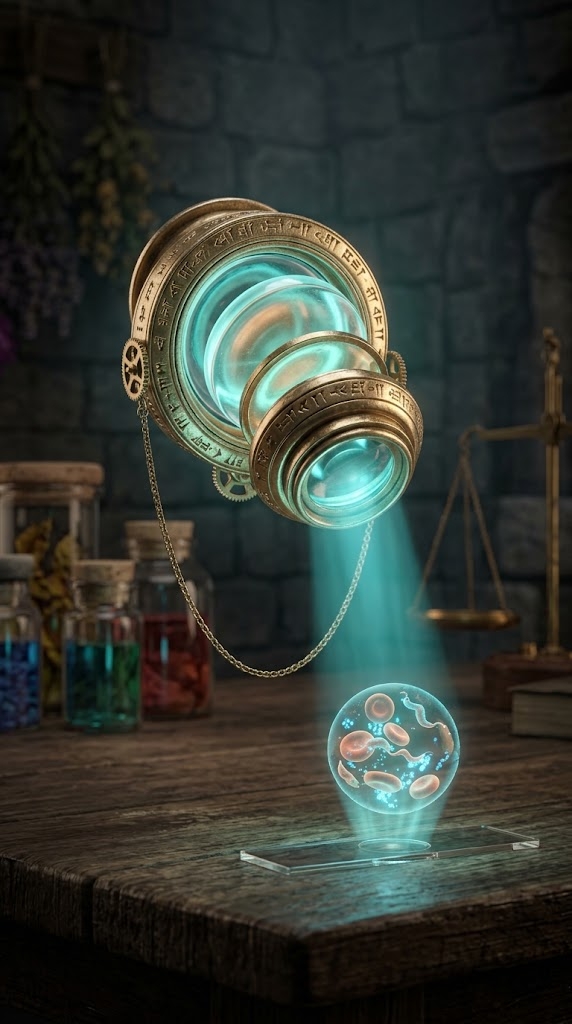
- This item consists of a handheld or wearable magnifying ocular roughly two inches in diameter, held within an engraved electrum armature with a folding brass bracket and fine chain. The central assembly holds three concentric, wafer-thin discs of ground desert beryl and polished rock crystal that slide into alignment via a tiny geared wheel. Around the electrum casing, microscopic cuneiform script recites the Persian litany of Simurgh’s maternal breath. When brought close to the eye and focused on a biological fluid or tissue sample, the inner lenses glow with a soft turquoise-amber light, projecting a floating, microscopic cross-section of living cells directly into the user’s line of sight. The instrument carries a faint aroma of pressed cedar oil, dried eucalyptus, and sterile alcohol.
- Detailed Stats:
- Item Rank: Common (Tier 1)
- Resilience: 10
- Item Hit Points: Avatar Maximum Hit Points plus 10 (Derived from Resilience 10 multiplied by Tier 1)
- Armor Check (AC): +0 AC bonus (Diagnostic and forensic optical tool)
- Weight: 0.3 pounds
- Attunement Requirements: Requires 1 minute of optical calibration while holding a drop of the user’s own blood against the slide well to harmonize the lenses with the user’s vital humors.
- Durability Mechanics: If the item suffers damage equal to half its maximum hit points or less, its internal alignment gears jam, distorting cellular scale and disabling its magical enhancements until repaired with fine jeweler’s tools. If reduced to 0 hit points, the beryl lenses fracture and the electrum armature collapses into scrap.
- Slot:
- Head / Eye Slot (can be worn over one eye via the ear-chain or held in one hand as an inspection loupe)
- Passive Magics:
- Cytological Magnification: The layered crystal lenses automatically magnify microscopic structures up to 1,000 times their true size without spherical aberration. The user gains a +1 bonus to all Medicine, Nature, or Alchemical skill checks made to analyze blood, tissue biopsies, microbial rot, cellular toxins, or pathogen cultures.
- Cellular Vitality Sense: Peering at a living creature’s open wound, mucous membrane, or drawn blood sample through the ocular reveals the creature’s general biological state, identifying whether the target’s cells are undergoing necrotic collapse, venom lysis, or virulent infection, granting a +1 bonus to saving throws and checks made to diagnose poisons and non-magical diseases.
- Micro-Parasite Discernment: The optic isolates microscopic foreign organisms within organic fluids. The wearer detects the presence of microscopic larvae, fungal spores, or foreign parasites in food, water, or medicinal tonics upon spending 1 round examining a single droplet.
- Activable Magics:
- Simurgh’s Luminescent Stain: As an action, the user channels mana into the electrum rim while inspecting an organic sample. The ocular projects a flash of gentle, turquoise-colored light across the target area (up to a 5-foot square or a single specimen). Any active cellular pathogens, foreign venoms, or necrotic micro-lesions in the illuminated area fluoresce with a bright, iridescent blue glow for 1 minute, eliminating the need for mundane chemical dyes or stain preparations. This ability can be used three times per day.
- Mitotic Preservation Field: As a utility action requiring 1 minute of focus, the user directs the lens onto a slide or small vial holding up to 1 ounce of biological fluid (such as cell cultures, venom, or whole blood). The lens emits a warm amber frequency that locks the cellular membranes in temporal stasis, preventing degradation, bacterial spoiling, or coagulation for 24 hours. This ability can be used once per long rest or full diagnostic cycle.
- Cellular Hemostasis Flash: As a reaction when an adjacent creature suffers a laceration or bleeding effect, the user angles the focused light of the ocular directly into the wound within 5 feet. The focused beam causes platelets and cellular matrices to rapidly coagulate, instantly stabilizing a dying creature or ending an active, minor bleeding condition. This ability can be used once per day.
- Tags:
- persian, common, tier 1, cytology, eye slot, medicine, diagnostic, magnification, simurgh, cellular, electrum, beryl, pathology, microbiology, hemostasis, forensics, optics, biopsy, venoms, histology, apothecary, parasite, sterilization
Commerce and Acquisition Venues for Persian 318 of the Simurgh’s Cellular Ocular
- Academy Scriptoriums and Botanical-Chirurgical Conservatories:
- Venue Type and Setting: High-vaulted scholarly cloisters, hospital lecture halls, and botanical dispensaries attached to the great academies of learning in medical centers and capital cities. These sanctums smell of rectified spirits, dried bitter herbs, distilled cedar oil, and beeswax polish, furnished with slate dissection tables, rows of specimen jars preserved in amber alcohol, and glass-fronted optical cabinets.
- Acquisition Method: Acquired as standard diagnostic field kits by apprentice chirurgeons, path-finders, and medical scholars. Avatars inspect the tiered beryl discs using their Mind’s Eye, verifying concentric focal alignment, absence of crystal inclusions, intact cuneiform litanies along the electrum housing, and an authenticated Tier 1 rating.
- Buying Cost: The standard institutional list price is 50 silver coins (or 5 gold coins). Independent scholars pay the full 50 silver. Avatars presenting verified documentation as licensed apothecaries, medical apprentices, or hospital orderlies receive a 10% discount per character tier. For a Tier 1 avatar, this reduces the price by 5 silver, totaling 45 silver.
- Selling Protocol and Haggling: Academic conservatories purchase pristine, well-maintained oculars from certified practitioners at the standard buyback rate discounted by 10% per tier level of the seller (45 silver for a Tier 1 avatar). Payouts are transferred directly into the character’s World Bank account minus the mandatory 1% bureaucratic service fee. Oculars exhibiting internal lens clouding, chipped beryl, or contaminated slide stages must undergo an alchemical cleansing deduction of 5 silver.
- Alchemical Dispensaries and Guild Pharmacies:
- Venue Type and Setting: Licensed apothecary shops and venom-distiller laboratories located in central trade plazas and herbalist districts. These shops feature polished brass balance scales, rows of labeled porcelain drug jars, marble mortar-and-pestle stations, and locked iron cabinets containing rare anti-venoms and microbial cultures.
- Acquisition Method: Sold directly over velvet-covered counters to toxicologists, master brewers, and field herbalists. Purchasers test the focal dial by placing a drop of standard poppy syrup or diluted viper venom onto the stage to observe the soft turquoise-amber field of cellular magnification.
- Buying Cost: High-end apothecary guilds retail the ocular for 55 to 60 silver coins, bundling the piece with an electrum ear-hook chain, three sterile quartz sample slides, and a padded goat-hide field case. Enrolled guild herbalists who display their recognized guild medallions receive the 10% tier discount, bringing the price to 49.5 silver (standardized to 50 silver or 49 silver and 5 copper).
- Selling Protocol and Haggling: Apothecaries readily buy functional diagnostic oculars for 45 to 50 silver to outfit traveling field collectors. Funds are credited through an official World Bank ledger deposit, though private distillers frequently offer payment in rare medicinal tinctures or crystallized anti-venoms of equivalent market value.
- Black-Alley Mortuaries and Illicit Poisoners’ Dens:
- Venue Type and Setting: Unsanctioned embalming basements, corpse-washer vaults, and clandestine toxicological labs situated beneath the docks of harbor quarters or within catacomb passages. These shadowed dens feature blood-grooved limestone slabs, vapor-scrubbing charcoal braziers, and cold iron dissection tools, managed by black-market poisoners, illegal morticians, and plague fences.
- Acquisition Method: Traded covertly without guild certifications, legal bills of sale, or city dispensary manifests. Assassins and counterfeit medicine dealers procure these lenses to verify the lethal potency of untraceable biological poisons, check for cellular decay in black-market organs, or detect tracking dyes in contraband elixirs.
- Buying Cost: Black-market purveyors demand a premium for unregistered diagnostic tools, pricing the ocular between 65 and 85 silver coins. Institutional credentials and guild discounts are disregarded entirely, and purchases must be transacted in physical silver coins, raw electrum scrap, or trade bars, avoiding World Bank surveillance.
- Selling Protocol and Haggling: Under-city fences and illicit poisoners purchase undamaged cellular oculars for 40 to 60 silver in cold physical coin. Devices bearing scraped cuneiform serials or signs of hasty extraction from deceased academy doctors are accepted without inquiry, though fences reduce payouts by 10 silver if blood dried on the geared wheel requires solvent re-tuning.
- Frontier Quarantine Posts and Military Field Lazarettos:
- Venue Type and Setting: Fortified triage stations, desert canal quarantine gates, and perimeter supply depots guarding marsh frontiers, swamp crossings, or border outposts prone to biological blights and venomous fauna. These stations combine military customs inspections with emergency surgical facilities.
- Acquisition Method: Distributed by chief field surgeons and quartermasters to scout-medics and quarantine wardens charged with inspecting drinking cisterns and diagnosing venomous bites in the field.
- Buying Cost: Driven by frontier supply lines and epidemic risk. Remote garrison surgeons price the ocular between 55 and 70 silver coins. Avatars purchasing within administrative quarantine perimeters must cover municipal clearing fees, including the 5% sanitation transit fee and the 1% regional administrative tariff.
- Selling Protocol and Haggling: Outpost lazarettos purchase operational oculars for 40 to 45 silver to replenish field surgical kits damaged in frontier patrols. Payment is credited through official provincial military chits or logged as an approved World Bank deposit by the post bursar.
Environmental Tactical Applications and Roleplay for Persian 318 of the Simurgh’s Cellular Ocular
- Subterranean Swamps, Fungal Caverns, and Muck-Trenches:
- Offensive Roleplay: Stalking a mutated marsh horror through spore-choked subterranean tunnels, the avatar uses Simurgh’s Luminescent Stain. The avatar projects a turquoise beam over the shallow bog water where the beast submerged. The concentrated light interacts with the creature’s shed mucus and necrotic epithelial trails, causing its cellular residue to fluoresce with a violent, electric blue radiance. Following the bright, bioluminescent wake straight through the murk, the party strikes before the ambush predator can burrow into the root-tangle.
- Defensive Roleplay: While wading through black water, an ally is struck by a barbed reed-viper whose venom causes rapid cellular necrosis. As the victim collapses, the avatar steps forward and triggers Cellular Hemostasis Flash. Angling the beryl lens directly into the puncture wounds, a pulse of coherent amber energy floods the laceration, forcing ruptured capillary walls to seal and platelets to cross-link instantly. The bleeding halts, stabilizing the ally’s vitals before the venom can disperse further into the bloodstream.
- Urban Sewers, Slum Quarters, and Plague-Stricken Canal Alleys:
- Offensive Roleplay: Tracking an assassin who coats blowgun darts with an engineered flesh-rotting micro-toxin, the avatar draws a droplet of fluid from an unexploded dart found in a tavern door. Applying the droplet to the ocular’s quartz slide well, the avatar activates Cytological Magnification. Isolating the venom’s unique bacterial flora and spore morphology, the avatar deduces the exact canal cellar where the damp mold cultures are being cultivated, allowing the party to storm the hideout before the poisons are loaded onto public water barges.
- Defensive Roleplay: Quarantining an underground tavern during a suspected bio-pathogen outbreak, panic erupts among the patrons who suspect the communal ale cask is poisoned. Peering through the lens using Micro-Parasite Discernment, the avatar sweeps a single drop of ale under the geared crystal assembly. Pinpointing dormant parasitic amoebas drifting among the yeast cells, the avatar immediately shouts a warning, knocking the cups from the hands of the militia before any soldier consumes the lethal draught.
- High-Altitude Cloud-Spire Sanctuaries and Sky-Docks:
- Offensive Roleplay: Confronting a rogue technomancer who conceals weaponized pathogen vials beneath the decking of a sky-skiff, the avatar activates Simurgh’s Luminescent Stain across the cargo crates. The beam penetrates thin glass ampoules hidden inside grease tins, causing the fragile pathogen cultures inside to flare with an unmistakable turquoise phosphorescence. Exposed by the beacon-like glow, the saboteur is forced out of hiding before the airship enters populated airspace.
- Defensive Roleplay: During a high-altitude dogfight along the rigging, an exploding shrapnel charge cuts an ally’s forearm artery, threatening fatal exsanguination in the freezing wind. As a reaction, the avatar activates Cellular Hemostasis Flash. Directing the focused crystal beam into the torn arterial tissue, the thermal-prana frequency locks the severed cellular layers together, terminating the arterial spray and keeping the crew member conscious at the steering helm.
- Salt Flats, Scorched Deserts, and Sunken Ruin Cisterns:
- Offensive Roleplay: In the arid heat of open salt flats where moisture is scarce, the avatar locates a carcass left behind by an unknown apex scavenger. Gathering a scrape of dried tissue from a bone, the avatar invokes Mitotic Preservation Field. The amber frequency stabilizes the cell membranes in stasis, keeping the fragile organic matter from turning to dry dust under the baking sun and preserving the sample’s genetic structure for delivery to the city assayer as proof of a monstrous incursion.
- Defensive Roleplay: Besieged inside a sun-baked stone redoubt by desert raiders who have fouled the courtyard cistern with rotting camel meat, the defenders face dehydration. The avatar draws a measure of water and conducts a rapid sweep using Cellular Vitality Sense and Micro-Parasite Discernment. The lens isolates the specific bacterial colonies, allowing the avatar to direct the defenders to skim off the buoyant contaminated layer and boil the remaining clean water, saving the garrison from virulent dysentery.
Perception of Activation:
- Visual Perception:
- User’s Perspective: Bringing the beryl lenses to your eye causes the mundane world to dim into a soft, cool vignette, while the target sample expands into an illuminated, high-resolution plane. Red blood cells appear as luminous, concave discs suspended in pale golden plasma; active bacteria or spirochetes register with sharp, geometric clarity. When activating Simurgh’s Luminescent Stain, the field washes with intense turquoise light, causing cellular membranes afflicted by toxins or necrotic rot to flare with an iridescent electric-blue halo. During Cellular Hemostasis Flash, an amber-gold crossbeam projects directly into the target wound, visual tissue knitting together in real-time under a golden lattice of coagulating platelets.
- Observer’s Perspective: Observers see the three concentric beryl rings slide into alignment with a soft, counter-rotating mechanical turn. The ocular’s aperture emits a concentrated cone of turquoise-amber light, projecting a translucent, fist-sized sphere of floating, magnified cells three inches above the slide or wound stage. When Cellular Hemostasis Flash is triggered, a quick, laser-sharp beam of warm amber light pulses from the lens directly onto the recipient’s skin.
- Positives: Microscopic pathogens, cellular damage, and parasite larvae become impossible to miss, standing out in bright bioluminescent relief without requiring invasive chemical staining.
- Negatives: The user’s field of view through the ocular is hyper-focused on the microscopic plane, creating tunnel vision that blinds that eye to surrounding macroscopic hazards.
- Auditory Perception:
- User’s Perspective: A gentle, rhythmic ticking resonates through the electrum rim against your temple, like the escapement wheel of an exquisite miniature timepiece. Beneath the mechanical ticking, you hear an organic, fluid whoosh—the amplified, rhythmic rush of capillary blood flow and cellular osmotic transfer within the specimen.
- Observer’s Perspective: Bystanders within a few paces hear the faint, delicate click of micro-gears engaging within the brass casing, followed by a low, soothing hum reminiscent of wind passing through high desert reeds. When Cellular Hemostasis Flash fires, a sharp, crisp snap—like a dry twig breaking underfoot—accompanies the light burst.
- Positives: The auditory tempo provides an immediate gauge of cellular agitation or hemodynamic shock without needing external monitors.
- Negatives: The quiet mechanical clicking and resonant hum can alert perceptive targets or stealth predators in quiet, enclosed spaces.
- Tactile Perception:
- User’s Perspective: The electrum casing resting against your brow or held in your fingertips turns pleasantly cool, akin to polished river stone drawn from a shaded mountain spring. When holding Mitotic Preservation Field, a faint, steady vibrational pulse thrums through your fingertips, vibrating at the exact frequency of dormant, preserved cellular matter.
- Observer’s Perspective: A wounded ally subjected to the Cellular Hemostasis Flash feels an immediate sensation of cool aloe followed by a rapid, tightening warmth along the wound edges, as if an invisible, soothing needle were drawing the torn skin and vessels closed.
- Positives: The cooling sensation at the user’s temple relieves mental fatigue, while the recipient feels rapid, pain-numbing relief during wound stabilization.
- Negatives: Prolonged use leaves a cold, numb ring around the user’s orbital socket, causing mild muscle stiffness in the brow for several minutes after removal.
- Olfactory Perception:
- User’s Perspective: The instrument releases a clean, clinical aroma of pressed cedarwood oil, medicinal eucalyptus, and cold grain alcohol, masking the organic stench of bile, gangrenous decay, or infected wounds beneath the lens.
- Observer’s Perspective: Those nearby catch a distinct, sharp draft of antiseptic cedar and aromatic camphor, cutting cleanly through foul dungeon stench, canal slime, or stagnant marsh air.
- Positives: Neutralizes noxious or sickening odors of necrosis, allowing the user to examine horrific biological samples without retching or losing concentration.
- Negatives: The sterile, medicinal scent is distinctly unnatural in wild or subterranean environments, alerting scent-tracking beasts to the user’s presence.
- Gustatory Perception:
- User’s Perspective: A dry, astringent sensation develops upon the palate, tasting faintly of pressed pomegranate rind, crushed coriander seeds, and a trace of bitter almond.
- Observer’s Perspective: A patient treated with Cellular Hemostasis Flash notes an instantaneous, dry metallic tang on their tongue, similar to the taste of clear spring water drawn through a clean silver pipe.
- Positives: The astringent dryness clears mucous buildup in the throat and sharpens focus during long diagnostic procedures.
- Negatives: Leaves a persistent, bitter taste in the mouth that suppresses appetite and makes trail rations unpalatable for an hour following intensive use.
- Extra-Sensory and Metaphysical Perception:
- User’s Perspective:
- Simurgh’s Seed-Sight: In the Mind’s Eye, you perceive the sample not merely as physical matter, but as part of the primordial World Tree. Healthy cells register as vibrant, blooming golden blossoms; cancerous or necrotic cells appear as blackened, withered thorns, allowing intuitive understanding of how the affliction deviates from natural order.
- Aura of Mitotic Time: When using Mitotic Preservation Field, you perceive a spherical dome of suspended amber time enveloping the vial, feeling the biological clock of the microorganisms come to an absolute standstill.
- Vital Spark Gauge: Looking at an injured creature reveals a soft, pulsing aura along their circulatory channels, providing an immediate mental tally of how much life-force remains before cellular collapse.
- Observer’s Perspective:
- Soul Sight Radiance: Observers utilizing Soul Sight witness the faint, ghostly silhouette of a turquoise-plumed Simurgh perched upon the user’s shoulder, sheltering the sample beneath its outspread wings.
- Aura of Sanctuary: Nearby living creatures experience an instinctive wave of physical calm and safety, their resting heart rates subtly decelerating in the presence of the Simurgh’s restorative harmonic field.
- Forensic Authority Presence: Technomancers and scholars nearby experience an involuntary sense of clinical confidence, knowing that any biological deceit or concealed blight is being laid bare.
- Positives: Grants absolute diagnostic certainty, removing all doubt or panic when identifying unknown bio-weapons, exotic venoms, or parasitic plagues.
- Negatives: The stark, mathematical perception of life as fragile, mechanical cellular bags can induce a temporary sense of cold clinical detachment toward the suffering of companions.
- User’s Perspective:
Crafting Recipe: Persian 318 of the Simurgh’s Cellular Ocular
- Materials Needed:
- Refined Electrum Ingot: 1 small bar of high-purity electrum (50/50 gold and silver alloy) for the housing and armature rings.
- Desert Beryl and Rock Crystal: 3 flawless, wafer-thin discs of ground desert beryl and optical rock crystal, free of inclusions.
- Brass Micro-Gearing: 1 set of precision miniature brass gears, pinions, and an indexing thumb-wheel.
- Electrum Ear-Chain and Bracket: 1 fine electrum link chain (12 inches) and a hinged temple bracket.
- Consecrated Cedar-Eucalyptus Oil: 1 vial of distilled mountain cedarwood oil blended with dried eucalyptus essence and pure grain alcohol.
- Sacrificial Component: 1 mundane magnifying glass, jeweler’s loupe, or simple glass prism (Tier 1; completely consumed during the attunement resonance).
- Alchemical Mounting Flux: 1 measure of pulverized quartz flux and clear pine resin cement.
- Tools Required:
- Artificer’s Micro-Burin: Diamond-tipped engraving stylus for cutting microscopic cuneiform script into electrum and crystal edges.
- Lapidary Dop, Faceting Rig, and Polishing Wheel: Specialized stone-grinding setup with diamond grit paste for polishing lenses to micro-tolerances.
- Precision Watchmaker’s Screwdrivers and Tweezers: Non-magnetic instruments for assembling micro-gears and tension springs.
- Jeweler’s Miniature Hearth and Soldering Blowpipe: Controlled fine-flame burner for assembling the electrum bezel frames.
- Sterile Quartz Cleansing Basin: Purified quartz dish used for holding the alchemical bath during sacrificial transfer.
- Skill Requirements:
- Lapidary / Lens-Grinding: Skill Level 2 (trained in cutting non-aberrant optical curves).
- Metalsmithing / Micro-Artifice: Skill Level 2 (trained in fine gear-cutting and bezel fabrication).
- Apothecary / Cytological Lore: Skill Level 1 (trained in biological humors, cellular stains, and tissue preparation).
- Arcane Scription / Cuneiform Lore: Skill Level 1 (trained to etch the litany of the Simurgh’s maternal breath).
- Mind’s Eye Proficiency: Required to align optical focal harmonics, weave the diagnostic prana channels, and stabilize the magnification enchantment.
- Crafting Steps:
- Step 1: Casting and Machining the Electrum Chassis:
- Melt the refined electrum ingot and cast the main cylindrical ocular housing, three concentric internal sleeve rings, and the hinged mounting bracket.
- Turn and bore the inner housing to fit the sliding lens sleeves with friction-tight tolerances.
- Mill mounting seats for the brass adjustment dial and the ear-chain anchor ring.
- Step 2: Grinding and Polishing the Beryl Lens Train:
- Cut the desert beryl and rock crystal into three concentric wafers of graduated thickness.
- Grind the outer lens into a planar-convex collector, the center beryl into a chromatic-correcting biconcave element, and the eye-facing crystal into a planar-convex eyepiece.
- Polish all optical surfaces using diamond dust down to a flawless, scratch-free finish.
- Using the micro-burin, engrave the microscopic cuneiform litany of the Simurgh around the non-optical circumference rims of all three crystal discs.
- Step 3: Gear Fabrication and Chassis Assembly:
- Fit the micro-brass gears into the housing wall, connecting the exterior indexing wheel to the internal sleeves so that rotating the dial moves the lenses in opposing, calibrated intervals.
- Seat each crystal disc into its respective electrum sleeve using clear pine resin cement.
- Coat the brass gear teeth with a drop of consecrated cedar-eucalyptus oil to ensure smooth, silent mechanical rotation.
- Attach the folding brass bracket and solder the fine electrum ear-chain to the lateral mount.
- Step 4: Imbuing the Alchemical Stain and Stasis Conduits:
- Submerge the assembled optical barrel in the quartz basin containing the remainder of the cedar-eucalyptus oil and distilled grain alcohol.
- Anoint the exterior rim with three drops of natural turquoise dye dissolved in pure alcohol.
- Use the diamond stylus to etch the sacred seal of Asha across the junction where the gear plate meets the electrum chassis.
- Step 5: Sacrificial Transference and Vital Alignment:
- Place the mundane sacrificial magnifying lens or loupe into the quartz basin beside the ocular.
- Open your Mind’s Eye and focus mana through the fluid, channeling the optical clarity of the sacrificial glass directly into the layered beryl matrices.
- The sacrificial item turns brittle and crumbles into opaque grey sand as its optical signature transfers.
- Place a single drop of clean blood onto the ocular’s sample stage; maintain steady mental focus as the inner lenses glow with a soft turquoise-amber light, locking the three beryl elements into permanent harmonic attunement.
- Step 1: Casting and Machining the Electrum Chassis:
Spotted Sheep-Carcass, Thousand Drops of Milk That Turned to Water, and Leech Who Split Gnat’s Egg
In the time before the water-wheel had twelve scoops of copper, when the broad river had only two mouths and the reeds were taller than four men standing upon each other’s shoulders, there was the mud redoubt of King Vahram-of-the-Fat-Tail. King Vahram possessed seventy-and-seven paddocks filled with the thick-tailed sheep whose grease is like sweet almond-butter, and nine hundred pots of wild clover honey buried in the cool gravel beneath his granary floor. Yet he had no joy in his fatness, for an invisible sickness had fallen upon the ewes of the marsh.
The ewes did not drop from an arrow, nor did the wolves bite their throats. They stood in the clover and became empty like blown bird-skins; their milk turned into clear swamp-water with grey curds floating upon it like duck-feathers, and when the butchers opened their chests with flint scrapers, the liver was soft like river-silt and full of black rot that had no worm. King Vahram called the spit-blowers and the cutters of entrails from the high mounds. They killed forty black rams and threw the fat upon the thorn-fire, muttering that the sky-bull was angry because the copper pots had not been washed with bull-gall; but the ewes died still, and the ditch was filled with three hundred carcasses that even the vultures would not taste, for the meat smelled of sour marsh-slime.
At the edge of the ditch lived a low-born washer of ulcers whose name upon the tallow-bark was Rostam-the-Nail-Cutter. He owned no ewes with fat tails, nor had he ever seen the face of the king except when the king’s chariot went past and the mud from the wooden wheels splashed upon Rostam’s linen wrapper. His craft was to take a small scoop of electrum and scrape the green water from the sores of the ditch-sleepers, washing the cloth in sour beer so that the linen might be tied around another foot.
Rostam saw that when a fly sat upon the sheep-carcass and then sat upon the lip of a child, the child’s spit turned into yellow scum before the evening star climbed out of the reed-beds. He said to the chief herdsman: “The sickness is not a ghost with an axe; it is a seed so small that forty can sit upon the edge of an electrum pin without touching their bellies. The seed drinks the blood and makes the marrow sour.”
The herdsman struck Rostam with his olive-wood staff until his scalp bled, shouting: “How can that which has no horns or hoofs kill a ram that weighs two talents? You speak the madness of those who drink the drain-water!” And the herdsman went to the high priests, who cast Rostam out into the salt-marsh where the wild sows root in the sulfur.
Rostam walked toward the Great Tree of the Southern Shore, which is called the Tree of All Seeds. Its roots do not go into common dirt, but into the warm marrow of the primordial bull that was slain when the mountains had no names. In the upper boughs, where the cloud-fog gathers like wet sheep-wool, nested the Great Mother-Bird, the Simurgh of the Thirty Colors. Her claws were each as long as a cedar roof-beam, and her feathers were made of green beryl and gold foil that clinked like forty copper cymbals whenever the sea-wind turned.
Rostam sat upon the salt-crust beneath the bough for forty-and-one days, eating only the dry berries that fell from the bird’s beak. On the forty-second morning, the Simurgh dropped from her nest a round stone of pale desert beryl that had passed through her belly, smooth as an egg of the river-goose.
The Simurgh spoke, and her voice was like the sound of seventy mill-stones turning in an empty grain-room: “Why does the washer of ulcers sit in the dung of the big bird? Do you seek the feather that turns an iron spear into a stalk of fennel, or the red stone that makes an old woman give suck to forty sons?”
Rostam touched the bird’s claw with his forehead, which was grey from the salt-dust. He said: “Mother of the Thirty Colors, the king’s sheep are dying of a thing that has no teeth, and the children of the ditch drink the milk of the rot. The priests say it is the wrath of the sky-bull, but I know it is a tiny creeping beast that walks in the river-drop. Give me an eye that can see the foot of the gnat while it is still inside the seed of the grass.”
The Simurgh shook her thirty-colored wings, and a rain of golden scurf fell upon Rostam’s hair. “The sons of the dirt have big eyes that see only big mountains and fat horses,” said she. “They think the mountain is strong because it does not run, and they do not see the thousand water-drops that carry the mountain away while they sleep. If I give you the stone that sees the small seeds, your eyes will weep forever; for you will see the worms that crawl in your mother’s porridge, and the rotten water that waits behind the red lip of the bride.”
“Let the tears come,” answered Rostam, “for the ditch is full of little children whose bellies are swollen like goat-bladders, and I would rather look upon the worm in the bread than bury my sisters in the ditch-clay.”
Then the Simurgh took from her plumage three small scales of mountain beryl that had never seen the fire of the coal-hearth. She sliced them thin with the edge of her middle talon, and she bound them together with a wire of pure electrum that she had pulled from the wreckage of a sky-chariot that fell in the first winter of the world. She ground the faces of the stones with the sand of the sulfur-pool until one stone made the water look broad, the second made the drop look deep, and the third made the small seed stand upright like an ox in a pen.
“Take this to the water-gate,” commanded the Simurgh. “Do not set it in bronze, for bronze has the bitter taste of war; set it only in electrum, which has the yellow color of the sun and the white color of the moon, which are the two rulers of the seed-grower. When you turn the wheel, the little water-beast shall stand before your eye as large as a river-carp.”
Rostam bowed nine times, hung the electrum loop about his ear, and walked back to the redoubt of King Vahram.
The palace courtyard was full of weeping, for the king’s favorite ewe had dropped in her pasture, and the king was tearing his purple beard with both hands, shouting that the god of the wells had spit into his well-bucket. Beside the dying beast stood the High Priest of the Copper Bowl, waving an iron knife and preparing to slit the throat of sixty captive slaves to appease the anger of the sky-bull.
Rostam ran into the midst of the lords and priests, though his wrapper was torn and his legs were crusted with the white scum of the salt-flats. He cried: “Do not spill the blood of the men, for the sky-bull has no hunger for their mutton! The murderer sits within the ewe’s tongue, smaller than the dust-mote upon a sunbeam!”
The High Priest raised his copper knife to strike Rostam for entering the presence of the throne with unwashed feet; but King Vahram, who was half-crazed with the loss of his fat-tailed flock, lifted his ivory whip and stayed the blade. “Let the ulcer-washer speak,” grunted the king. “If he shows me the murderer, he shall have forty copper dishes; if he shows me only his tongue, I will have his ribs split like a dried fish.”
Rostam took his electrum scoop, knelt beside the dying sheep, and drew a single drop of yellow froth from beneath the ewe’s tongue. He placed the drop upon a wafer of flat river-quartz and turned the beryl lens of the Simurgh down upon it.
He adjusted the small brass wheel that rotated the three stones. A soft, greenish-blue beam of light shot out from the beryl discs, and there, floating above the quartz wafer in the sight of all the spearmen, appeared a terrible vision.
The single drop of yellow froth was not empty water; it was a pool filled with ten thousand small, crooked worms, their bodies shaped like twisted willow-twigs, thrashing and biting the red discs of the sheep’s blood. Where the crooked worms struck, the round red discs burst open like ripe figs, their sweet red grease spilling into the water and turning it grey and sour.
The High Priest dropped his knife upon the stones, trembling like a leaf in the flood-wind, crying: “It is the demon of the marsh! It has forty mouths and no eyes!”
“It is no demon,” said Rostam, and his voice was steady like the stone pier of a bridge. “It is the small parasite that breeds in the rotting liver-weed by the lower canal, where the king’s drivers have let the marsh-mud sit in the sun. The sheep drink the weed-water, and the crooked seed enters their bellies and eats the blood from within.”
Then Rostam channeled his breath through the electrum ring, invoking the maternal litany of the Simurgh that was scratched upon the rim. He flashed the focused ray of amber light directly into the drop upon the quartz wafer. Instantly, the crooked willow-worms ceased their biting; their skins grew stiff like dried reed-husks, and the red discs of the blood clung together in a golden net, closing their tears and becoming round and whole again.
King Vahram stood from his ivory seat. He commanded the gate-masters to close the lower canal, to drain the stagnant water from the liver-weed, and to wash the troughs of the fat-tailed flock with strong vinegar of the wild apple. Within seven sunsets, the ewes of the marsh ceased to die; their milk returned white and sweet like thick cream, and the paddocks were filled with forty-and-four fat lambs whose tails dragged upon the grass like heavy pouches of money.
The king brought Rostam into his high cedar hall, offering him sixty bags of refined electrum and the seat of the Great Arch- Leecher who wears the tall cap of scarlet wool.
Rostam took the beryl ocular from his eye and laid it in its small leather pouch.
“King of the Paddocks,” Rostam said softly, “if I put on the scarlet cap and eat your sweet mutton, who will go to the salt-ditch to look at the sores of the basket-weavers? A man who wears the king’s wool soon forgets that the small gnat bites the beggar before it bites the prince. Keep your electrum and your dishes; give me only a pot of clean vinegar and three clean quartz slides, that I may find the seed of the rot before it reaches the bread of the low people.”
Rostam walked out from the gates of the redoubt, returning to his mud hut by the water-reeds. There he lived eighty-and-eight winters, cutting the dead flesh from the ulcers of the boatmen and teaching the women to boil the river-water in earthen jars until the little swimming twigs within the drop had turned to harmless sand.
When he died, the people did not build a stone mound over his bones, for he had forbidden it; but they placed the Simurgh’s beryl lens into the hand of his youngest daughter, who sat by the reed-gate and watched the drops of the well-water through the electrum ring, so that no poisoned cup was ever brought to the mouth of the thirsty.
Moral of the Story: The ruler who watches only the great army with bronze chariots shall fall to the unseen mite that burrows in the bread-basket; for the life of the mighty kingdom is not decided by the height of its walls, but by the cleanliness of the smallest drop that passes the teeth of its poorest child.
Suggested conversions to other systems:
Call of Cthulhu (7th Edition)
The Simurgh’s Cytological Ocular
- Classification: Arcane Optical Instrument / Hyper-Geometrical Lens
- Sanity Cost to Attune: 1 Sanity point upon optical calibration and blood attunement.
- Powers and Mechanics:
- Cytological Magnification (Passive): Magnifies microscopic entities up to 1,000 times without distortion. The investigator gains a +20% bonus (or a Bonus Die, Keeper’s discretion) to Medicine, Science (Biology/Forensics), or Pharmacy checks when analyzing blood spatter, tissue samples, cellular toxins, or infectious pathology.
- Micro-Parasite Discernment (Passive): By spending 1 combat round inspecting a droplet of liquid or foodstuff, the investigator automatically identifies non-magical micro-parasites, fungal spores, or foreign biological contaminations.
- Simurgh’s Luminescent Stain (Active Spell): Costs 2 Magic Points. The ocular projects a focused cone of turquoise light over a 1-yard area for 1 minute. Pathogens, foreign venoms, and necrotic cellular structures fluoresce in vivid, iridescent blue, revealing invisible biological evidence or tracking trails without chemical reagents.
- Mitotic Preservation Field (Active Spell): Costs 3 Magic Points. Focuses an amber ray upon a small glass vial containing up to 1 ounce of biological matter. Suspends cellular breakdown, venom decay, and bacterial reproduction for 24 hours.
- Cellular Hemostasis Flash (Active Spell): Costs 4 Magic Points. As a reaction when an adjacent human suffers bleeding or is dying from physical trauma, the user flashes a focused amber-gold beam into the wound from up to 2 yards away. Ruptured capillaries instantly coagulate; the target immediately stabilizes, halts active blood loss, and gains 1 temporary Hit Point.
Blades in the Dark
The Simurgh Ocular
- Item Type & Quality: Arcane Scientific Curio, Rare Spark-Craft Lens (Tier I Quality, 0 Load if worn on ear-chain, 1 Load carried in kit).
- Keywords: Arcane, Spark-Craft, Medical, Forensic.
- Rules and Mechanical Function:
- Cellular Analysis (Passive): Grants Potency to Doctor or Study actions when examining biological humors, poison residue, cellular degradation, or contaminated blood.
- Pathogen Discernment (Passive): Inspecting food, drink, or apothecary draughts allows the scoundrel to instantly detect biological spoilage or foreign parasites without rolling.
- Luminescent Stain (Pushing Yourself): Spend 1 Stress to emit a turquoise forensic beam across an area. Any concealed biological traces, blood trails, or venoms illuminate with iridescent light, granting +1d or improved position on tracking and forensic investigation rolls.
- Cellular Hemostasis Flash (Armor / Active Trait): Spend 1 Stress (or mark Special Armor) as a reaction when a crew member suffers bleeding or physical trauma within arm’s reach. The focused beam cauterizes severed tissue, reducing the severity of the incoming physical Harm by one level (e.g., Fatal Harm becomes Level 3 Harm).
- Preservation Stasis (Utility): Once per score, the user may place an organic sample in stasis for up to a day, preventing rot, coagulation, or the degradation of volatile alchemical venoms.
Dungeons & Dragons (5th Edition, 2024 Revision)
Simurgh’s Cellular Ocular
- Item Category: Wondrous Item
- Rarity: Common
- Attunement: Requires Attunement by an avatar over 1 minute of optical calibration with a drop of their own blood
- Properties and Action Economy:
- Cytological Magnification (Passive): While looking through the ocular, you gain a +1 bonus to Intelligence (Nature or Investigation) and Wisdom (Medicine) checks made to analyze biological tissues, poisons, diseases, and microscopic organisms.
- Parasite Detection (Passive): Spending 1 round examining a droplet of food or liquid reveals whether it harbors non-magical micro-parasites, fungal rot, or spoiled matter.
- Simurgh’s Luminescent Stain (Action, 3/Day): You project a 5-foot cone of turquoise light from the beryl lens. For 1 minute, diseased tissue, venomous coatings, and active pathogens within the area emit a soft blue bioluminescence, shedding dim light in a 5-foot radius and eliminating the need for mundane forensic stains.
- Mitotic Preservation Field (Action, 1/Day): You direct an amber beam onto a container holding up to 1 ounce of organic fluid. The fluid enters cellular stasis for 24 hours, preventing natural spoiling, coagulation, or degradation.
- Cellular Hemostasis Flash (Reaction, 1/Day): When a creature within 5 feet of you takes piercing or slashing damage or is reduced to 0 hit points, you can use your reaction to project a pulse of coherent amber light onto the wound. If the creature has 0 hit points, it instantly stabilizes. If the creature was suffering from an ongoing bleeding effect, that effect immediately ends.
Knave (Second Edition)
Simurgh Cellular Ocular
- Item Slots: Takes up 1 Item Slot (worn on head/eye or carried in gear).
- Durability: 3 Quality / 3 Item Hit Points.
- Rules and Mechanical Syntax:
- Microscopic Inspection (Passive): The user gains Advantage on Wisdom checks made to diagnose poisons, identify diseases, or analyze biological remains.
- Purity Sense (Passive): Examining a ration or waterskin through the lens reveals whether it is tainted by parasites or rot before consumption.
- Luminescent Reveal (Active Action, 3/Day): Projects a turquoise beam illuminating a 5-foot patch. Organic stains, toxic coatings on blades, and diseased secretions glow bright blue for 1 turn (10 minutes).
- Hemostasis Pulse (Active Reaction, Once Per Rest): When an adjacent ally drops to 0 HP from physical lacerations, the user flashes the beryl lens into the wound. The dying character is instantly stabilized, preventing further death checks for that turn.
- Preservation Beam (Active Action, Once Per Rest): Locks a single vial of venom, blood, or alchemical broth in stasis, keeping it fresh and fully potent until the next dawn.
- Fragility: If the bearer takes a direct bludgeoning hit or falls from a height, roll a d6; on a 1–2, the delicate internal gears jam, reducing the item’s Quality by 1. At 0 Quality, the crystal lenses shatter and the item is destroyed.
Fate Core
The Simurgh’s Cellular Ocular
- Aspect: Precision Cytological Lens of the Great Bird
- Stunts:
- Microscopic Cytology: Because you possess the Simurgh’s Cellular Ocular, you gain a +2 to Lore, Notice, or Crafts rolls when performing cellular forensics, diagnosing biological poisons or exotic pathogens, and analyzing blood or tissue samples.
- Simurgh’s Luminescent Stain: Once per scene, you can project a focused turquoise beam across a target area. You create a temporary scene aspect with one free invoke representing revealed biological tracks, fluorescent toxins, or illuminated pathogen trails (such as Glowing Microbial Spoor).
- Cellular Hemostasis Flash: Once per session, when an ally in your immediate zone suffers a physical consequence resulting from severe bleeding, laceration, or piercing trauma, you may spend 1 Fate point to reduce the severity of that consequence by one tier (e.g., from Severe to Moderate, or Moderate to Mild).
- Mitotic Stasis: Once per session, you may lock a vial of biological fluids, venom, or cellular culture in temporal stasis, preserving its potency and freshness indefinitely until the stasis is intentionally released.
- Trouble / Invoke Cost: The device requires intense, micro-focused concentration. Adversaries can invoke the ocular’s presence to exploit your tunnel vision and lack of peripheral awareness while conducting examinations.
Numenera & Cypher System
Simurgh’s Cytological Ocular
- Level: 2
- Form: Handheld or ear-mounted electrum ocular with tiered beryl and rock crystal lenses.
- Kind: Cypher or Artifact (Depletion: 1 in 1d20 when using Hemostasis Flash or Luminescent Stain)
- Mechanics:
- Cytological Magnification (Passive): All Intellect tasks involving the analysis of blood, cellular tissues, toxins, parasites, and non-magical diseases are eased by one step.
- Parasite Discernment (Passive): Inspecting food, water, or medicinal draughts for 1 round automatically reveals the presence of microscopic parasites, rot, or living biological contaminants without requiring a roll.
- Simurgh’s Luminescent Stain (Action): By spending 1 point from your Intellect pool, the ocular illuminates an immediate area in turquoise light for 10 minutes. Traces of venom, shed biological cells, and microbial residue fluoresce brightly, easing all forensic tracking and identification tasks in the area by two steps.
- Cellular Hemostasis Flash (Action): By spending 2 points from your Intellect pool, you project a concentrated pulse of amber light into a bleeding wound on a target within immediate range. The target immediately halts all active bleeding, stabilizes if incapacitated, and regains 2 points to their Might pool.
- Mitotic Preservation Field (Action): By spending 1 point from your Intellect pool, you place up to 1 ounce of organic fluid inside a stasis field for 28 hours, preventing decomposition, bacterial growth, and chemical degradation.
Pathfinder (Second Edition, Remaster Core)
Simurgh’s Cellular Ocular
- Traits: Item 1, Uncommon, Divination, Focus, Magical
- Usage: Worn (eyepiece) or Held in 1 hand; Bulk: —
- Activate: Single Action (Manipulate)
- Statistics and Rules:
- Cytological Magnification (Passive): You gain a +1 item bonus to Medicine checks to Treat Disease, Treat Poison, or Recall Knowledge regarding biological pathology, histology, and cellular structures.
- Micro-Parasite Discernment (Passive): You can spend 1 minute inspecting food or liquid through the lens to detect any mundane micro-parasites or bacterial rot, functioning as an automatic check to detect biological contamination.
- Activate — Simurgh’s Luminescent Stain: Single Action (Concentrate, Light). Frequency: Three times per day. Effect: The ocular projects a 10-foot cone of turquoise light for 1 minute. Pathogens, venoms, and biological secretions within the cone fluoresce brightly in iridescent blue, granting a +2 circumstance bonus to Survival checks to track a bleeding quarry or Perception checks to locate forensic fluids.
- Activate — Cellular Hemostasis Flash: Reaction (Concentrate, Healing, Primal). Trigger: A creature within 5 feet of you takes slashing or piercing damage, or gains the persistent bleed condition. Frequency: Once per day. Effect: You channel focused amber light into the laceration. The target’s persistent bleed damage ends immediately, or if the target has 0 Hit Points, it immediately stabilizes and loses the dying condition.
- Activate — Mitotic Preservation Field: Two Actions (Manipulate). Frequency: Once per day. Effect: You shine a warm amber frequency upon a vial containing up to 1 ounce of organic matter. The contents enter cellular stasis for 24 hours, preventing spoilage, coagulation, or loss of venom potency.
Savage Worlds (SWADE)
Simurgh Cellular Ocular
- Item Type: Arcane Forensic Tool / Optical Device
- Weight: 0.5 lbs
- Cost: $1,000 (or 50 Silver)
- Statistics and Game Mechanics:
- Microscopic Diagnostic (Passive): Grants a +1 bonus to Healing and Science rolls involving autopsy examination, poison identification, disease diagnosis, and cellular tissue analysis.
- Contamination Detection (Passive): Spending 1 round examining a ration or water container allows the user to detect biological contaminants, rot, or parasitic worms without a roll.
- Simurgh’s Luminescent Stain (Active): Once per encounter as an Action, the user illuminates a Medium Blast Template in turquoise light. Biological secretions, venoms, and pathogens fluoresce, granting a +2 bonus to Notice and Survival rolls made to inspect or track the targets for 5 minutes.
- Cellular Hemostasis Flash (Active): Once per day as an Instant Reaction when an adjacent character suffers a Bleeding Out condition or takes a Wound from an edged or piercing weapon, the user projects an amber beam into the wound. The bleeding ceases immediately, and an Incapacitated target is automatically stabilized.
- Mitotic Stasis (Active): Once per day as an Action, the ocular seals a small vial of venom or biological culture in an amber stasis field, halting biological decay and retaining full alchemical potency for 24 hours.
Shadowrun (Sixth World Edition)
The Simurgh Cytological Ocular (Optical Focus / Forensic Loupe)
- Item Type: Eyepiece / Hermetic Diagnostic Focus
- Essence Cost: 0.0 (Handheld or worn via ear-chain; external gear)
- Focus Rating: 1
- Availability: 2 (Sanctified Clinic / Licensed Forensic Guild)
- Cost: 8,500 Nuyen (or 50 Silver)
- Mechanical Profile and Statistics:
- Cytological Magnification (Passive): By resolving microscopic structures down to cellular layers, the ocular provides a +1 dice pool bonus to Biotechnology, Chemistry, and Perception tests involving forensic fluid analysis, pathology, toxicology, or biopsy inspections.
- Micro-Parasite Discernment (Passive): Spending 1 Major Action inspecting food, water, or chemical reagents reveals the presence of biological contaminants, microscopic larvae, or spoiled organic binders without requiring a test.
- Awakened Abilities and Activation:
- Simurgh’s Luminescent Stain (Minor Action): Once per combat encounter or forensic sweep, the user channels mana through the electrum bezel. The ocular projects a cone of coherent turquoise light over a 2-meter area. Pathogens, foreign venoms, and necrotic micro-residue fluoresce in vivid iridescent blue for 10 minutes, granting the user an Edge on tracking or evidence collection tests.
- Mitotic Preservation Field (Major Action): Focuses a gentle amber frequency upon a vial containing up to 30 milliliters of biological matter (such as venom, DNA cultures, or blood samples). Prevents organic decomposition, clotting, or loss of chemical potency for 24 hours.
- Cellular Hemostasis Flash (Minor Action / Reaction): When a character within 2 meters suffers physical damage from a slashing or piercing attack, the user flashes focused amber light directly into the wound. The target immediately ceases bleeding and negates the Bleeding status effect. This action inflicts 1 point of unresisted Stun Drain on the user.
Starfinder (Second Edition)
Simurgh’s Cellular Ocular
- Item Level: 1
- Price: 240 Credits
- Bulk: — (Negligible; worn as an eyepiece or held)
- Usage: Worn (eyepiece) or Held in 1 hand
- Traits: Biotech, Divination, Magical, Tech-Hybrid
- Item Statistics and Operational Syntax:
- Cytological Magnification (Passive): The multi-tiered beryl lenses grant a +1 item bonus to Medicine checks to Treat Disease, Treat Poison, or conduct biological forensics, as well as Life Science checks to identify microbial organisms.
- Micro-Parasite Discernment (Passive): By spending 1 minute examining a sample of food, water, or atmospheric condensation, the user automatically identifies foreign micro-parasites or active biological bacterial blights.
- Activate — Simurgh’s Luminescent Stain (Single Action — Concentrate, Light): Frequency: Three times per day. Effect: The ocular projects a 10-foot cone of turquoise light for 1 minute. Micro-pathogens, venomous residues, and microscopic fluid splatters fluoresce with iridescent blue light, granting a +2 circumstance bonus to Survival checks to track wounded quarries and Perception checks to discover biological trace evidence.
- Activate — Mitotic Preservation Field (Two Actions — Manipulate): Frequency: Once per day. Effect: You bathe a vial containing up to 1 ounce of organic fluid in amber stasis light. The sample does not degrade, coagulate, or lose chemical potency for 24 hours.
- Activate — Cellular Hemostasis Flash (Reaction — Concentrate, Healing): Trigger: An adjacent creature within 5 feet takes piercing or slashing damage, or begins suffering persistent bleed damage. Frequency: Once per day. Effect: The focused beryl beam causes immediate cellular coagulation. The target’s persistent bleed damage ends immediately, or if the target is dying at 0 Hit Points, it stabilizes immediately.
Traveller (Mongoose Second Edition)
The Simurgh Bio-Forensic Ocular
- Item Type: TL-11 Optical Diagnostic Instrument
- Mass: 0.2 kg
- Tech Level: TL-11
- Base Value: Cr 15,000 (Apothecary / Medical Grade)
- System Characteristics and Rules Profile:
- Microscopic Cytology (Passive): The calibrated crystal and electrum optics grant a +1 DM to Medic and Science (Life Sciences / Chemistry) checks made to analyze toxic samples, diagnose cellular infections, identify unknown alien parasites, or evaluate tissue biopsies.
- Contaminant Inspection (Passive): Spending 1 combat round examining a ration, water cartridge, or biological culture allows the user to detect biological contaminants, bacteria, or micro-parasites without rolling.
- Fluorescent Diagnostic Field (Active — Minor Action): Emits a turquoise optical beam across a 2-meter area for up to 10 minutes. Organic fluids, active venoms, and micro-lesions fluoresce clearly, granting a +1 DM on Investigate or Survival checks to trace biological spoor or locate concealed blood splatters.
- Mitotic Stasis Lock (Active — Minor Action): Projects a field of temporal-harmonic radiation into a sample vial. Preserves the specimen in cellular stasis for 24 hours, preventing degradation, biological clotting, or loss of venom toxicity.
- Hemostatic Coagulation Pulse (Active — Reaction): Once per day, when an adjacent ally takes damage from a cutting, piercing, or shrapnel attack, the user directs an amber beam into the trauma site. The target’s bleeding is halted immediately, granting a +1 DM to the next Medic check performed to stabilize the casualty.
Warhammer (Warhammer 40,000 Roleplay: Wrath & Glory)
Simurgh’s Auspex Ocular
- Tier: 1
- Value: 3 (Rare Medicae / Biologis Relic)
- Rarity: Rare
- Keywords: Imperium, Adeptus Mechanicus, Adeptus Ministorum, Medicae
- Rules Profile and Mechanical Syntax:
- Histological Diagnostics (Passive): Worn over an ocular or held in hand, the lens magnifies cellular structures. The bearer adds +1 bonus die to all Medicae and Scholar tests involving the diagnosis of non-warp contagions, forensic fluid extraction, necrotic poison analysis, or identification of biological xenobiotics.
- Tainted Flesh Discernment (Passive): Spending a Simple Action inspecting a food ration, water canister, or biological salve automatically identifies whether the sample contains mundane rot, foreign parasites, or bacterial impurities.
- Simurgh’s Luminescent Stain (Combat Action): Once per combat encounter, the bearer activates the electrum dial, bathing a 5-meter area in turquoise radiance for 10 minutes. Pathogen trails, venom coatings, and biological humors fluoresce in bright blue, granting +1 bonus die to Awareness and Survival tests made to track or inspect biological targets in the area.
- Mitotic Preservation (Simple Action): Once per operational cycle (day), the user directs the lens onto a vial of genetic material, venom, or organ tissue. The sample enters cellular stasis for 24 hours, preventing biological rot or loss of toxicity.
- Cellular Hemostasis Flash (Free Action / Reaction): Once per combat encounter, when an ally within 2 meters suffers damage that inflicts the Bleeding condition or drops them to 0 Wounds, the bearer pulses a focused amber beam into the laceration. The target’s Bleeding condition ends immediately, or if the target is Dying, they are immediately stabilized.