
Magical Powers: Threnar possesses powerful magical properties that enhance persuasion, influence, and the ability to compel others. When spoken or signed with intent, it can sway opinions, command attention, and instill a sense of urgency or importance. The language can also be used in rituals to bind agreements, inspire fervor, and enforce obedience.
Linguistic Attributes and Characteristics:
- Phonetics: Threnar is characterized by rich, resonant tones and dynamic, rhythmic intonations. The language is spoken with a powerful, authoritative voice, projecting confidence and charisma. It incorporates a mix of deep vowels and sharp consonants, creating a captivating and forceful auditory experience.
- Syntax and Structure: The language uses a Subject-Verb-Object (SVO) structure, emphasizing clarity and directness. This structure reflects the language’s focus on effective communication and the ability to convey commands and persuasive arguments.
- Grammar: Threnar has a complex grammatical system with numerous affixes and particles to denote levels of emphasis, urgency, and authority. It employs a variety of rhetorical devices and formal constructs to enhance persuasion and influence. The grammar is designed to be precise and impactful, ensuring that messages are compelling and authoritative.
Cultural Identity and Users:
- Cultural Significance: Threnar is primarily spoken by the Orators, a culture renowned for their skills in rhetoric and persuasion. The language is central to their culture, reflecting their values of eloquence, leadership, and the power of words.
- Users: While it is the native language of the Orators, Threnar is also learned by politicians, leaders, and diplomats who seek to enhance their persuasive abilities. It is spoken in regions and communities where influence and leadership are highly valued.
Rarity, Type, Script, Source, and History:
- Rarity: Threnar is relatively rare, known primarily to those who prioritize persuasion and leadership or who have close interactions with the Orators.
- Type: It is a spoken, written, and sign language, with a telepathic component for those skilled in mental influence. The telepathic form often involves projecting powerful, compelling thoughts directly into the minds of others.
- Script: The written form of Threnar consists of bold, sweeping characters that resemble flowing script and authoritative marks. These symbols are often inscribed with strong, deliberate strokes, using materials that evoke a sense of power and importance.
- Source and History: Threnar originated from the ancient Orator communities, who developed it to enhance their natural abilities to persuade and lead. Over centuries, it has evolved to incorporate magical elements that strengthen its compelling nature.
Sensory Experience:
- Auditory: Hearing Threnar feels like being drawn into a powerful, persuasive speech. The language sounds commanding and resonant, often inducing feelings of captivation and motivation in the listener.
- Visual: The written script of Threnar appears strong and assertive, like the marks of a confident leader. When signed, the language involves bold, emphatic hand movements and body postures that convey authority and conviction.
- Telepathic: When communicated telepathically, Threnar conveys not just words but the force of the speaker’s will. It creates a mental image of compelling arguments and persuasive authority, enhancing the feeling of being influenced and captivated.
Threnar is a compelling language with powerful magical properties that enhance persuasion, influence, and the ability to compel others. It is structured to be precise and impactful, reflecting its connection to leadership and eloquence. Culturally significant to the Orators, it is also used by politicians, leaders, and diplomats. Its rarity and unique characteristics make it a respected and influential language in the world of Saṃsāra. The auditory, visual, and telepathic aspects of Threnar all contribute to its distinctive sensory experience of captivation and authority.
Tags: Persuasive, Magical, Resonant, Rhythmic, Authoritative, Direct, Commanding, Impactful, Orator, Rare, Telepathic, Flowing Script, Ancient, Eloquent, Influential, Tribal, Charismatic
Inscriptions
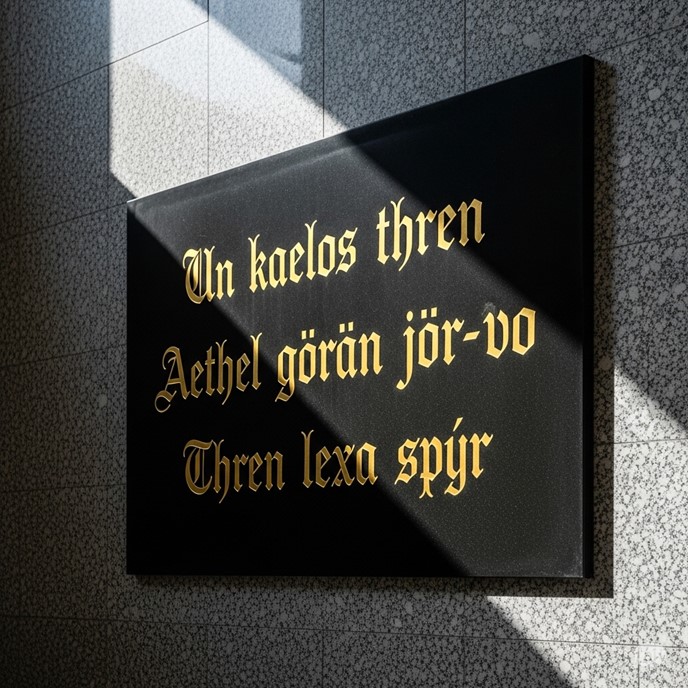
These powerful phrases would be inscribed on monuments, judicial gavels, scrolls of law, and the lintels of council chambers to magically enforce authority and compel respect.
- Thren-ix vex jor. (The great will, the people hear.)
- Kaelos lexa thren. (The word binds with power.)
- Un kaelos thren. (I speak authority.)
- Aethel goran jor-vo. (Noble leadership for the people.)
- Vex kaelos-un. (Hear my command.)
- Thren lexa spyr. (Will binds the spirit.)
- An vex aethel-ix. (We heed the great justice.)
- Kaelos-ix goran thren. (The great word guides with power.)
- Un lexa kaelos-un. (I bind my word.)
- Jor vex thren-ix. (The nation hears the great authority.)
- Aethel kaelos lexa. (The just word is binding.)
Political Oaths
These are solemn, binding declarations used in ceremonies where leaders, judges, and diplomats commit themselves to their duties, imbuing their pledge with magical weight.
- Un lexa spyr-un vo jor. (I swear my heart to the people.)
- Un goran jor-an vo aethel. (I will lead our people towards justice.)
- Un vex kaelos-jor, lexa-un. (I hear the word of the people, and I am sworn.)
- An lexa thren-an vo jor-ix. (We bind our authority to the great nation.)
- Un goran vo thren-aethel. (I will lead with noble power.)
- Un lexa spyr-un vo kaelos-lexa. (I swear my spirit to this binding word.)
- An goran jor-an, thren-an. (We lead our people with our authority.)
- Un vex spyr-jor, goran-un. (I listen to the heart of the people; I will lead.)
- Un lexa thren-un vo aethel-ix. (I bind my power to the great justice.)
- An lexa kaelos-an, jor-vo. (We swear our words for the people.)
- Un goran vo jor, spyr-un lexa. (I will lead for the people; my heart is sworn.)
Cultural Ceremonies
These are persuasive and inspirational phrases chanted during public addresses, legal verdicts, or festivals celebrating unity and leadership, designed to captivate the audience and inspire collective action.
- An vex kaelos-et, et’a. (We hear your words, honored one.)
- Jor-an goran vo thren-ix. (Our people lead with great power.)
- Spyr-an vex kaelos-aethel. (Our hearts hear the noble word.)
- Et goran jor, et’a. (You lead the people, with honor.)
- Kaelos-ix lexa jor-an. (The great command binds our nation.)
- An vex spyr-et, lexa-an. (We hear your spirit; we are bound to it.)
- Thren-et goran jor-an. (Your will guides our people.)
- Aethel-ix vex spyr-an. (Great justice, our hearts hear.)
- An goran vo kaelos, vo thren. (We lead with words, with authority.)
- Jor-an vex thren-et, et’a. (Our people hear your authority, honored one.)
- Kaelos-an lexa spyr-an. (Our words bind our spirits together.)
First Oration and the Binding Word
From the chronicles of the Orators, pieced together from worn stelae and scrolls whose edges have frayed into dust, comes the story of their tongue, Threnar. The translation is a difficult art, for the ancient glyphs convey not just meaning, but intent and resonance that our modern script cannot hope to capture. What follows is a humble rendering of the most known of these tales.
In the dawn of ages, the people who would become the Orators were a people adrift. They were not a unified tribe but a thousand scattered families, each with its own desires and fears. They possessed words, as all sentient beings do, but their speech was chaos. It was the cacophony of the market square, the shriek of the gale, a multitude of voices all speaking at once and none truly listening. They could not form lasting bonds, for their promises were whispers in the wind. They could not build great works, for their plans were lost in the clamor of disagreement. Their will was a scattered flock, and they were prey to all who possessed a unified mind.
It is said that there arose one among them, whose name is now lost, for their identity was deemed less important than the voice they would give to the people. In the fragmented texts, this figure is called simply the First Orator. This Orator looked upon the discord of their kin and felt a great emptiness where a great nation should be. Seeking wisdom, the Orator departed from the noise of the camps and journeyed to the heart of the Still Places, to the deep caves where the world itself seemed to breathe.
For a year and a day, the First Orator sat in the profound silence, listening. Not with the ears, for there was nothing to hear, but with the spirit. And in that deep quiet, a new sound was perceived. It was not a sound of the air, but a vibration in the rock, a slow, powerful resonance that pulsed from the very core of Saṃsāra. It was the world’s own voice: steady, authoritative, and inexorable. It was the hum of gravity, the resonance of ancient stone, the deep thrum of authority that commanded mountains to stand and rivers to flow.
The First Orator began to shape their own breath to match this resonance. They practiced for months, or perhaps years—here the tablets are scorched and unreadable. They learned to make their throat a cavern, their voice an echo of that deep, compelling hum. They discovered that when they spoke this way, their words were no longer fleeting sounds but tangible things, possessed of weight and power. The words resonated not in the ear, but in the very bones of any creature that heard them.
Then, the Orator considered the chaos of their people’s speech and understood its flaw. All spoke of the action, the desire, the object, but none first claimed the will to see it done. The First Orator forged a new structure, a new law for their language, mirroring the authority they had discovered. First must come the speaker, the source of the will. I. We. The Subject. Then must come the deed, the declaration of intent. Will. Promise. Command. The Verb. Finally comes the goal, the world to be shaped. The People. The Law. The Object. This clarity, this declaration of Subject-Verb-Object, was the key. It left no room for doubt. It was the grammar of leadership.
The First Orator returned to the scattered tribes. They did not shout above the din. They stood upon a great flat rock, took a deep, resonant breath, and spoke.
“Un goran jor.” (I will lead the people.)
The words were not loud, yet the chaos ceased. Every voice fell silent. Every eye turned to the speaker. The sentence was a perfect, undeniable thing. The will, the action, and the object were laid bare for all to see. The First Orator then spoke of unity, of justice, of a future in which they were not a thousand scattered voices but a single, mighty chorus. Each sentence was a resonant chain, binding the listeners’ attention. Each argument was a sweeping, deliberate stroke, painting a future they all suddenly desired.
This was the First Oration, and the language was Threnar. At the end of the speech, the First Orator spoke the First Covenant, a set of laws for the new, unified nation. As the people roared their assent, the magic of Threnar took hold. Their agreement was not just a social contract; it was a magical binding. The resonant words, backed by the collective will of the people, settled over them like a mantle of power, and from that day forward, they were no longer scattered. They were the Orators.
The Moral of the Story: A will unspoken is but a fleeting vapor, but a word spoken with true resonance can carve mountains and bind nations. The strength of a people is not in their arms, but in the clarity of their shared voice.