
Species
Talon-Trypanik
Physical Form and Sensory Traits
The Talon-Trypanik are upright, broad-shouldered humanoids with avian skeletal adaptations, their frames light but strong. Dense plumage covers most of their bodies, varying in shades of mottled umber, deep russet, and pale cream, patterned in natural camouflage resembling leaf shadows and weathered stone—a trait believed to be tied to ancestral forested homelands. Their heads are distinctly avian, bearing forward-facing eyes framed by a facial disc of fine feathers that focuses sound toward the ears. Beaks are short, hooked, and reinforced with keratin ridges strong enough to crack shell and bone.
Their eyesight is extraordinarily acute; each eye can adjust to daylight glare or near-total darkness with minimal delay. Their ears are asymmetrically placed—one higher, one lower—allowing precise three-dimensional sound mapping. Feather tufts above the head serve as subtle communication signals within their culture, shifting angle and spread to indicate mood or intent.
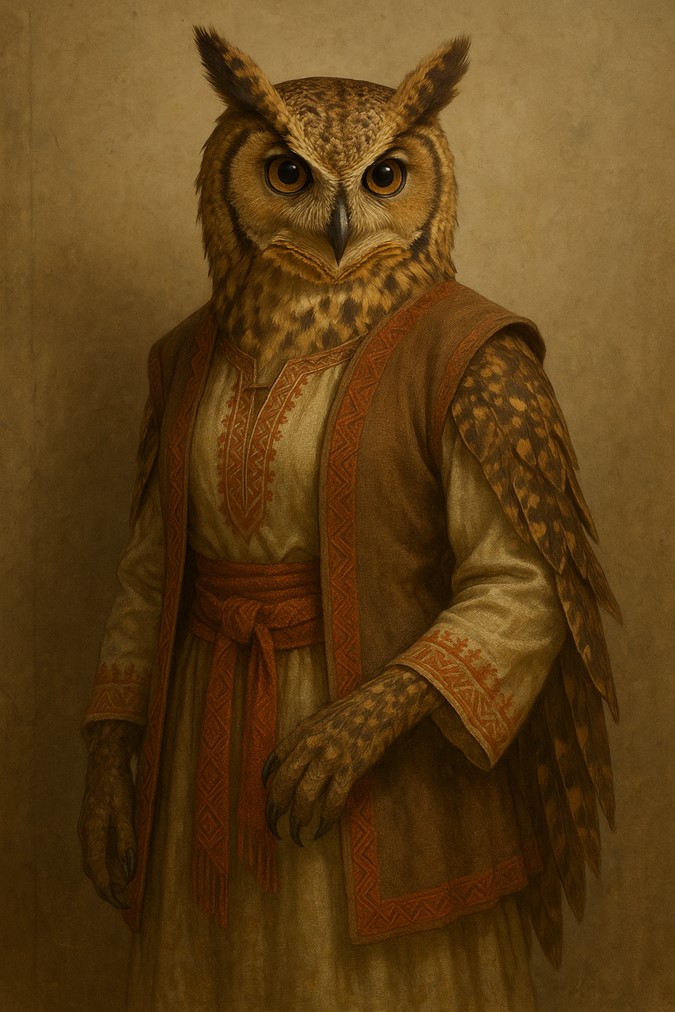
General Size
Average height: 5’9″ to 6’4″ for adults.
Average weight: 140 to 190 lbs, with a dense but hollow-boned frame. Wings are vestigial for full flight but functional for short-distance glides from high vantage points, with a span averaging 12 to 14 ft.
Body Pattern
Feather coloration is tied to family lineage and regional origin. Nobility often display the most intricate mottling patterns, with pale chest and facial feathers ringed by contrasting dark bands. Talon markings on feet and hands are unique enough to be used for identity verification. Molting occurs annually during the Dimming weeks of the Saṃsāra calendar, and lost feathers are often crafted into ceremonial fans, quills, or crest adornments.
Life Cycle
Egg-laying occurs once every six years for most families, with clutches of one or two eggs. Incubation lasts 47 Saṃsāra days. Chicks are down-covered for the first year, fledging between 18 and 24 months. Adolescence extends until approximately 12 Saṃsāra years, when plumage reaches full complexity. Average life expectancy is 78 Saṃsāra years, though elder gliders have been recorded surpassing 100 years in relative isolation.
Inheritance within the ruling family is matrilineal, with the eldest daughter or her designated kin taking the throne.
Potential Positives Due to Physical Form
• Exceptional low-light vision and precise depth perception.
• Acute hearing able to detect whispered speech at a distance of 60 ft in calm conditions.
• Strong talons on both hands and feet, capable of gripping and climbing in nearly any terrain.
• Short glides from elevated positions allow rapid relocation in combat or travel across broken ground.
• Camouflage patterns give advantage in still or dimly lit environments.
Potential Negatives Due to Physical Form
• Hollow bones, while strong for weight, are more susceptible to fracture under blunt force.
• Limited stamina in sustained ground sprints due to lighter muscle distribution in legs.
• Vulnerability to extreme heat due to dense feather coverage; must seek shade or cooling garments.
• Vestigial wings require open space to deploy effectively; restricted interiors limit glide use.
Tags: Avian-Humanoid, Nocturnal-Adapted, Glide-Capable, Matrilineal-Rulers, Camouflage-Patterned, Talon-Armed, Ceremonial-Crest, Hollow-Boned, Acute-Hearing, Keen-Sight, High-Altitude-Native, Cultural-Architectural-Integration, Plume-Rhetoric, Limited-Sprint-Stamina, Thermal-Sensitive, Dual-Script-Language, Feather-Molting, Trypillya-Native
Specialized Item Slots Available
In addition to standard avatar slots:
• Wing Mantle Slot — gear fitted to the back and upper shoulders, augmenting glide capability, wind control, or aerial maneuvering.
• Crest Ornament Slot — ceremonial or magical crests woven into head plumage for enhanced sensory focus or social influence.
• Talon Grip Slot — custom gauntlets or claw caps that channel magic through foot or hand talons for specialized combat or crafting uses.
Environmental Adaptability
Native to the varied highland forests and steppe plateaus of Trypillya, the Talon-Trypanik are comfortable in mixed terrain, from dense canopy hunting to cliffside habitation. They adapt quickly to elevated roost-like dwellings but find deep subterranean living disorienting. Maritime adaptation is moderate; coastal families have developed waterproofing oils for feathers, while inland dynasties rarely engage in extended sea travel except by airship.
Other Important Information
The Talon-Trypanik language, Trypanik, has strong auditory and visual elements, integrating feather and wing posturing into speech cadence. Rulers are often trained in the use of ceremonial “plume rhetoric,” where subtle plumage shifts carry political weight equal to spoken words. Cultural identity is tied heavily to the symbology of flight—freedom, vigilance, and perspective—and architecture in Trypillya reflects this, with multi-tiered towers, open terraces, and roost balconies built into nearly every civic structure.
Sky-Feathered Watcher and Burning of Four Winds
Once, when the world was young in its memory but old in its bones, there came a season without measure. The sun was thought to be stolen by a hand too vast to see, and the wind, which was once a friend, began to speak in knives. It was then the high nation of Trypillya called upon its Ruler, Sky-Feathered Watcher, whose eyes saw through the dark and whose feathers carried the whisper of the moon.
The people feared. The crops bent low, their leaves blackened with a frost that came from nowhere, and the rivers ran away as though ashamed. Traders told of beasts made from shadows walking in the harbors, their forms never the same twice, their feet never leaving the sound of waves. None knew if they were born of this world or from the old storms that live in the space between times.
The Watcher, robed in cloth that glimmered like molten silver, climbed the great steps of the Wind-Temple, where the carved mouths of the Four Winds opened into the sky. There, the Watcher spoke words older than stone, older than water, older than even the memory of feathers. Yet those who heard could not recall the phrases after, for they came from the First Tongue, which is too large for the human mind to carry without breaking.
On the first day, the East Wind came, carrying dust that turned to glass upon the fields. The Watcher met it with a cloak woven from midnight and frost, drawing the wind into its folds until the glass turned back to soil.
On the second day, the West Wind came, heavy with voices of the dead calling for the living to follow. The Watcher faced it with a staff of living cedar, each leaf whispering a truth. The voices fell silent, and the wind left carrying only its own breath.
On the third day, the South Wind came, aflame with no source but itself, fire upon fire, eating even the shadow of things. The Watcher unfurled their wings, each feather a mirror of the moon, and the fire saw its own hunger reflected back. It shrank, then vanished.
But on the fourth day, the North Wind came not as wind but as absence. No sound. No breath. No light. The Watcher could not bind it with cloak, could not silence it with cedar, could not burn it away with moonlight. So the Watcher stepped into it. For a thousand breaths the people saw nothing, and feared the Watcher gone forever.
When the Watcher returned, the absence was gone, but so too was the Watcher’s own voice. From that day forward, the Ruler spoke only through the ringing of bronze bells, and all of Trypillya listened. The winds never again rose together in fury, and the seasons remembered themselves.
The old ones say the Watcher gave their voice to the North Wind so that it might learn to speak, and in speaking, it would forget to destroy. In the palace, a single bell still hangs, and when it rings without human hand, the people close their eyes and remember the year when the winds were tamed by the one who walked into silence.
Moral: Strength is not only in the feather, the cloak, or the staff—it is in the giving of one’s own voice so that the world may speak in peace.