
Deity Name: Orynya the Weaver of Dawns
Lore:
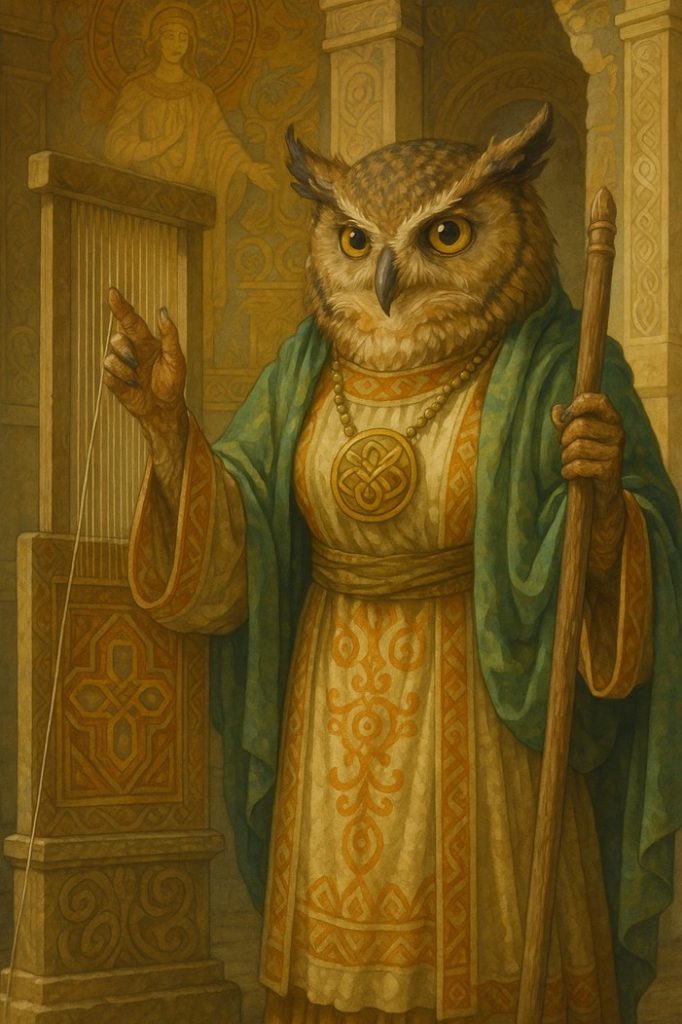
In the memory of the Trypillyan people, the first threads of existence were spun by Orynya, who dwelt in the twilight before the world’s shaping. Her loom was strung not with thread but with strands of light, wind, soil, and heartbeat. She wove each into the great Tapestry of Days, where every life was a knot, every death a pause, and every choice a turn in the pattern. It is said that when a storm breaks without warning or a new star appears in the sky, it is Orynya shifting a thread that had become tangled. Her followers believe the Island Nation rests upon the “First Loom”—a hidden anchor point where her earliest work began, deep beneath the central highlands.
The Faith of the Loomed Horizon teaches that the world is neither fixed nor wholly free—it is in constant weaving. To live well is to add strong threads to the pattern, to dye them with honesty, craft, and purpose. Disruption comes not from change, but from careless tangles—lies, greed, and needless destruction. The priesthood maintains great “Pattern Halls” where public records, prophecies, and histories are kept as woven tapestries that shift and change as events unfold.
Personality of the Deity:
Orynya is neither cold nor overly indulgent. She is patient, deliberate, and speaks in measured cadence—when she speaks at all. In visions, she appears as a tall, robed figure with a face half-hidden in shadow, the visible side radiant with the light of the first dawn. Her hands are always in motion, either weaving or knotting, never idle. She rewards perseverance and craftsmanship but punishes arrogance in those who believe they can cut or burn the threads of others without consequence.
Traits and Characteristics:
- Associated with the rising sun and long horizons.
- Patron of weavers, builders, navigators, judges, and archivists.
- Believes every person’s life is a thread, and each choice changes its color and texture.
- Symbolic balance between patience (long weaving) and decisiveness (cutting when necessary).
- Often invoked before major civic projects or voyages, to “set the threads straight.”
- Divinations in her faith are performed by tracing the “warp” of a tapestry until the path reveals a hidden image or omen.
Attributes:
- Domains: Creation, Destiny, Craft, Light, Memory.
- Symbols: A sun rising over a woven horizon; a loom with threads of gold, crimson, and black; a spindle encircled by a spiral of clouds.
- Sacred Colors: Saffron gold (for light), deep indigo (for patience), bone white (for clarity).
- Sacred Materials: Linen, gold leaf, carved bone, and dyed wool.
- Ritual Offerings: Strips of handwoven cloth dyed with personal symbols or events.
- Holy Sites: Loomed Horizon Temple in the capital, Pattern Halls in every major city, solitary weaving shrines on coastal cliffs where the rising sun can be seen without obstruction.
Followers and Commonality:
Roughly 52% of the Island Nation (≈48,164,000 people) are active practitioners. Followers include the ruling family, many urban artisans, coastal fishing clans, and inland agricultural stewards. The faith is inclusive but expects participation in the annual “Reweaving,” when communities gather to repair civic tapestries that serve as both record and living prayer. Even non-practitioners often attend out of civic pride.
Tags: Religion, Trypillya, Orynya, Weaver of Dawns, Creation Deity, Destiny, Light Magic, Craft Patron, Sun Worship, Pattern Lore, Island Faith, Cultural Unity, Tapestry Divination, Horizon Symbolism
Positives of the Faith of the Loomed Horizon
- Strong Cultural Unity: Followers see themselves as part of a shared design, which fosters cooperation across regions of Trypillya.
- Craftsmanship Excellence: The religion’s emphasis on weaving and pattern-work has elevated textile, architecture, and symbolic artistry to world-class quality.
- Long-Term Vision: Orynya’s teachings encourage patience and multi-generational thinking, making followers skilled planners for civic, agricultural, and political projects.
- Conflict Mediation: Priests trained in “thread reading” serve as impartial mediators, using the metaphor of untangling knots to resolve disputes without violence.
- Historical Preservation: Through tapestry-record keeping, the faith safeguards centuries of cultural history in a visually enduring form.
Negatives of the Faith of the Loomed Horizon
- Resistance to Rapid Change: The emphasis on deliberate action can slow responses to crises, leading to missed opportunities.
- Cultural Exclusivity: While not hostile to outsiders, there is a strong in-group bias; foreign ideas often require years of “pattern testing” before acceptance.
- Prophecy Dependence: Some leaders delay urgent action, waiting for omens or woven signs before proceeding.
- Political Influence: The close relationship between the ruling family and the faith risks intertwining spiritual authority with political power, breeding corruption in rare cases.
Type of Temple
The faith’s temples are called Pattern Halls, massive structures of stone and wood built in layered terraces reminiscent of woven cloth. Interiors are lit by filtered dawn-light through colored linen hangings. Each contains:
- Central Loom Shrine: A symbolic loom with golden warp threads that are never cut, said to represent the unbroken fabric of existence.
- Tapestry Walls: Ongoing civic and spiritual histories woven over decades.
- Weaver’s Court: An open forum where disputes are brought to be “untangled” by clerics.
- Sun Gate: An east-facing archway through which the rising sun pours on holy days.
Number of True Followers
Of the ≈48,164,000 practitioners in Trypillya, roughly 32,000,000 are considered true followers—meaning they adhere to ritual observance, attend Reweaving ceremonies, contribute woven offerings, and seek priestly counsel in life decisions. The rest are cultural participants who join festivals and share in the faith’s identity but do not maintain deep spiritual commitment.
What True Followers Do
- Begin mornings with Thread Blessing—a short recitation while touching a woven token.
- Attend Loom Days (weekly observances) where community updates are added to local Pattern Halls.
- Participate in the Annual Reweaving to repair and renew public tapestries, symbolizing the mending of society.
- Offer woven strips or symbols to the Central Loom Shrine before major undertakings.
- Consult Pattern Readers before signing trade contracts, arranging marriages, or launching political campaigns.
- Maintain at least one personal woven record of their own life events, which is interred with them at death, believed to help Orynya “find their thread” in the next weaving.
Core Beliefs of the Faith of the Loomed Horizon
- Life as a Weaving: All existence is part of an infinite tapestry woven by Orynya, the Loom-Mother, whose hands work in patterns unseen by mortals. Every being is a single thread, distinct yet inseparable from the whole.
- Interwoven Fate: Threads cross for a reason. Friendships, rivalries, births, and deaths are intentional crossings in the divine weave, even if their purpose is not immediately clear.
- Cycles of Reweaving: Death is not an end but the unpicking of a thread to be rewoven into the next pattern. The faithful believe that virtues and deeds affect where one’s thread is placed in the next design.
- Sacred Imperfections: Flaws in a tapestry are not mistakes but signs of divine intent. Imperfections in life—loss, failure, scars—are part of the balance of the greater pattern.
- Sun and Shadow Balance: The faith reveres both bright and dark threads, seeing them as necessary contrasts for the beauty of the whole.
Regular Services
- Loom Day Gatherings: Held once a week in the Pattern Halls, usually at dawn. The congregation sits in a semi-circle around the Central Loom Shrine. The service begins with the Warp Chant, a slow, harmonic recitation that imitates the rhythmic clatter of a loom shuttle.
- Thread Offerings: Each attendee ties a small strip of woven fabric to the communal loom as an offering—representing personal intentions, thanks, or burdens to be woven into the divine design.
- Pattern Reading: The presiding priest or priestess inspects the Hall’s great tapestry for changes, omens, or knots that have appeared since the last service, interpreting them as guidance for the community.
- Communal Weaving: After the reading, everyone joins in weaving a few strands into the ongoing civic tapestry, reinforcing the belief that all contribute to the shared life of the nation.
- Closing Circle: Attendees hold hands in a ring and sway slowly as a low chant is sung, representing the tension and harmony of threads under a weaver’s hands.
Funeral Rites for Believers
- Unspooling Ceremony: Upon death, the deceased’s personal life tapestry or woven record is laid beside them. Priests slowly unpick a section of the fabric while chanting the Release of the Thread, symbolizing the soul’s unraveling from its current place in the weave.
- Thread Cleansing: The body is washed in warm, scented water, then wrapped in a white shroud embroidered with gold thread—gold being the color of Orynya’s eternal warp threads.
- The Weft Walk: The wrapped body is carried in a slow procession through the village or city streets to the Pattern Hall, passing under woven arches held by mourners.
- Interment in the Loom Crypt: Rather than burial in soil, the faithful are placed in a stone chamber beneath the Pattern Hall, each resting place marked with a hanging woven strip that includes the deceased’s name and life motifs.
- Seven-Day Weaving Vigil: For a full week after interment, close family and friends gather nightly to weave a memorial cloth incorporating the deceased’s favorite colors and patterns. This cloth is hung in the Hall for a season, then stored in the Hall’s deep archives.
- Rejoining the Pattern: On the final night of the vigil, the priest cuts a single golden thread from the memorial cloth, symbolizing Orynya reclaiming the soul to weave anew.
The deity of Trypillya, Velyka Zoranya, channels magical power rooted in both the cycles of agrarian renewal and the unyielding vigilance of the celestial order. The magic attributed to her is fundamentally dual-aspected—every rite, invocation, and glyph can be turned toward protection of her people or toward striking down their foes, depending on the practitioner’s intent and the sanctioned context.
Defensive Applications
• Barrier of the Harvest Rings – Concentric, shimmering circles resembling plowed fields form around the target, each ring absorbing a portion of incoming magical or physical force. In war, entire formations can be ringed in these barriers, slowing siege weaponry and deflecting elemental projectiles.
• Veil of the Loomed Sky – A cloak of refracted starlight wraps around the faithful, rendering them indistinct to hostile eyes and distorting targeting attempts. It is especially potent during night ceremonies.
• Root-Binding Ward – Through soil-borne glyphs, attackers’ feet or siege machinery are locked in place by spectral roots, halting charges or immobilizing encroaching enemies at choke points.
• Sun-Hearth Renewal – Light is drawn down in shimmering columns that warm flesh, close wounds, and replenish breath, especially when invoked in temple courtyards or during solar alignment festivals.
Offensive Applications
• Plowshare of the Comet’s Path – A luminous, furrow-like slash of energy tears through enemy ranks, the magical “blade” behaving as though cutting through soil but dealing catastrophic force to armor, shields, and constructs.
• Culling Sickle Invocation – A crescent-shaped surge of lunar-charged light scythes through enemies, particularly effective against magical beasts or those carrying curses, as it “harvests” tainted life-force.
• Meteor-Seeding Rite – Invokes small, controlled starfire impacts upon distant foes, creating shockwaves and localized burning, the glowing embers leaving a curse of drought in enemy farmland.
• Threshing Gale – Glyphs traced in the air unleash a spiraling wall of wind and sharp-edged magical chaff that both cuts flesh and strips away protective enchantments.
The balance between these uses is tightly controlled by temple hierophants; while battlefield champions are permitted to wield both aspects, civic magi are often restricted to protective rites unless a formal declaration of war is in effect.
Furrow of Sky and Plow of Earth
It was told in the days when the fields were young and the rivers had not yet chosen their beds, that the great and many-named mother of light, Velyka Zoranya, walked between the top of the sky and the bottom of the soil. Her feet pressed upon stars and upon stones, and in each step the world was both opened and mended. The people of the land, not yet knowing how to plant nor how to guard, lived in drift and shadow, their nights long and their days without certain bread.
In that age came the Wind Without Anchor, a hungry thing that swallowed the warmth and the green, and drove the folk into hollows. The wind was said to have a voice like a thousand rusted plowshares dragged upon ice, and it stole seeds from hand and mouth. The elders went to the high ridge where the soil turned to sky and made their cries, but the wind scattered their words and sent them back tasting of sand.
On the seventh day of the great hunger, Velyka Zoranya looked down from her plow-star and saw the people binding their own bellies with rope to keep the emptiness from spilling out. She descended not in fire nor thunder, but in the form of a furrow drawn through the heavens, a long glowing wound in the sky. From it, she stepped, carrying in one hand the Plow That Cuts Two Ways, and in the other the Seed That Is Also a Stone.
She spoke, though the tongue she used has no sound in this world now. The poor translator of later ages rendered her words thus: “To eat is to guard, to guard is to eat. The furrow is a wall, the wall is a furrow.” The people did not understand, but they bowed, for her eyes were two suns, one rising and one setting.
She went to the edge of the wind’s hollow and set her plow into the ground. Where she turned the earth, a ridge rose so high it touched the low clouds, and behind it the seeds she pressed into the furrow sprang up as golden spears, their heads heavy with grain and their shafts unbreakable by storm. The Wind Without Anchor struck the ridge and howled, but could not pass, for the wall was rooted in both sky and soil.
Yet the wind was cunning and found the night side of the land, where the grain’s glow did not reach. There it crept in as frost upon the heart, and men began to distrust their neighbors, hiding food and locking the water jars. Again the people went to the ridge and called to her, and again she came, her plow glistening with both soil and starlight.
This time she turned the furrow in the air, cutting the sky into shining lanes. The stars slid down these furrows like grain into sacks, and when they touched the roofs of the homes, they flared into circles of warmth and light. The wind, finding no darkness to creep through, fled beyond the farthest horizon, where even Zoranya’s plow could not yet reach.
The people feasted on the grain that was also spears, for when the enemy came from across the wide waters, they found the stalks bent into bows and the seeds sharpened into arrow-heads. The folk learned then the meaning of her saying—fields can be walls, and walls can be fields, if the hand that tends them knows both harvest and battle.
In later days, when the furrows had been worn into the pattern of the land and the plow had been set in the temple at the city’s heart, the priests told this tale at the sowing and at the arming. Each year the wind would test the ridge, and each year the people would set their plows in the earth with one hand and their spears in the sky with the other.
The oldest tablets say there was once a verse at the end of this story, but it has been worn by time and ill copying. One broken fragment remains: “When the seed is kept only for the self, the furrow turns upon the hand that digs it.”
Moral: Protection and provision are the same furrow—when either is neglected, the harvest fails and the walls fall.