
The originals life forms referenced were: earthworm (from Annelida), toad (from Amphibia), octopus (from Cephalopoda), and skate (from Chondrichthyes).
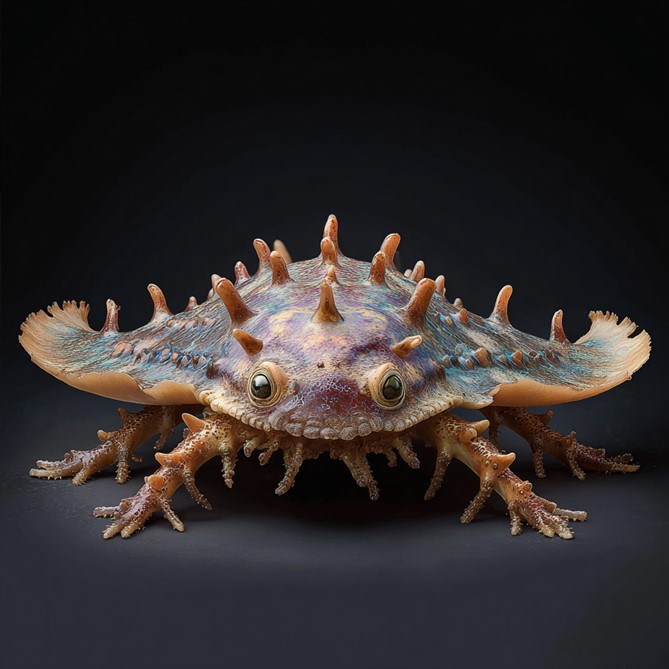
Appearance: The Vermoctoadskate 46 is a grotesque yet adaptive feral creature that blends the segmented, elongated body of an earthworm with the warty, moist skin of a toad, overlaid by the flexible, cartilaginous flatness of a skate and accented with eight sucker-lined tentacles reminiscent of an octopus. Its body is primarily flattened and disc-shaped like a skate, reaching outward in a ray-like span with undulating edges that ripple during movement, covered in a slimy, segmented epidermis that secretes a toad-like mucus for protection. The skin features irregular warts and barbs that can change color for camouflage, shifting from muddy browns to vibrant blues when threatened, with faint bioluminescent patterns along the segments glowing faintly in low light due to residual mana absorption. From the central body sprout the octopus-inspired tentacles, each segmented like worm rings and ending in toad-like adhesive pads rather than full suckers, allowing for grasping and burrowing. The head is a fused amalgamation: a broad, flattened mouth with earthworm-like bristles for sensing vibrations, flanked by bulging toad eyes that provide wide peripheral vision, and small gill slits from the skate for aquatic respiration. No distinct limbs exist, but the tentacles serve as pseudo-appendages, and the underside features a skate’s claspers modified into worm-like probing tendrils for digging. Overall, it appears as a slithering, pulsating mat of organic horror, evoking the hidden horrors of Saṃsāra’s mana-tainted wetlands.
Size: Vermoctoadskate 46 specimens typically measure 4 to 6 feet in diameter when fully extended in their flattened skate form, with tentacles stretching an additional 3 to 5 feet, and a body thickness of 6 to 12 inches. Weight ranges from 50 to 120 pounds, depending on environmental mana density, which can cause temporary swelling; juveniles start at 1 foot diameter, growing rapidly over 2-3 years to full size.
Speed: This creature moves at a moderate pace on land, slithering or undulating at 20 feet per round using its segmented body and tentacles for propulsion, similar to a worm’s peristalsis combined with toad hops for short bursts up to 40 feet. In water, it glides like a skate at 30 feet per round, with tentacles providing agile maneuvers; burrowing speed is 10 feet per round through soft mud, leveraging earthworm traits.
Stat Modifiers: As a feral life form in Saṃsāra, the Vermoctoadskate 46 has base stats modified for its hybrid nature: +2 to resilience (increasing base HP by 2 per tier if possessed), +3 to perception (enhancing Mind’s Eye passive activation for vibrations and scents), -2 to agility (reducing movement in confined spaces due to bulk), +1 to strength (for tentacle grapples), and -1 to charisma (its grotesque form induces unease in sentient observers). If possessed as an avatar, these modifiers apply to the character’s integration, affecting attunement efficiency for burrowing or aquatic gear.
Skills: Though feral and non-sentient, the Vermoctoadskate 46 exhibits instinctual behaviors that mimic trained skills: proficient in stealth through color-changing camouflage and mucus secretion to reduce visibility; adept at grappling with tentacles, allowing holds that disrupt enemy chants; sensory vibration detection akin to a passive Mind’s Eye for basic environmental stats; burrowing for evasion or ambush; and adhesive climbing on wet surfaces like toad pads. If possessed, these translate to easier training in related skills, such as ritual disruption or underwater navigation, without innate magic—all reliant on worn gear.
Behavior: Feral and territorial, the Vermoctoadskate 46 behaves as an ambush predator, burrowing into mud or sand to lie in wait, using tentacles to sense vibrations before striking with rapid uncoils. It forms loose packs of 3-6 in breeding seasons, cooperating to overwhelm larger prey through coordinated grapples, but otherwise solitary, migrating with mana ebbs to avoid over-tier threats. Non-aggressive unless provoked, it retreats by secreting disorienting mucus if outnumbered, and during mana storms, it surfaces to absorb energy, glowing and undulating in ritual-like patterns.
Diet: Omnivorous with a preference for soft-bodied prey, the Vermoctoadskate 46 consumes earthworms, small amphibians, mollusks, and fish, using its bristle-lined mouth to suck in nutrients like an earthworm while tentacles shred tougher items. It supplements with algae, detritus, and mana-rich fungi, digesting through a toad-like acidic stomach that breaks down organic matter efficiently; in scarcity, it can fast for weeks, drawing sustenance from absorbed environmental mana.
Emotions: As a feral creature, the Vermoctoadskate 46 displays basic instinctual emotions: curiosity when probing new environments with tendrils, aggression in territorial disputes shown by wart inflation and color shifts to red, fear triggering mucus bursts and rapid burrowing, and contentment during feeding or mana absorption, evident in slow, rhythmic pulsing of its segments. No complex social emotions, but packs exhibit primitive loyalty, sharing kills to maintain group cohesion.
Environment Where Found: Predominantly in coastal wetlands, muddy estuaries, and shallow mangrove swamps across Saṃsāra’s islands, where mana ebbs create nutrient-rich sediments; also in flooded cave systems or jungle riverbeds, avoiding arid or frozen areas due to mucus dependency. Common in Minoan’s backwoods and uncharted isles, where it thrives in somewhat safe zones near water, but ventures into unsafe mudflats for hunting.
Tags: Vermoctoadskate46, Feral Hybrid, Segmented Body, Tentacle Grappler, Mucus Camouflage, Burrow Ambusher, Mana Absorber, Wetland Dweller, Omnivorous Predator, Pack Hunter, Vibration Sensor, Aquatic Slitherer, Warty Skin, Cartilaginous Flat, Instinctual Emoter
Life Cycle: The Vermoctoadskate 46 follows a metamorphic life cycle that incorporates elements from its foundational life forms, beginning with egg-laying in clutches of 20-50 leathery capsules deposited in moist burrows or shallow water sediments, where they absorb ambient mana to incubate for 3-6 months depending on environmental flows. Upon hatching, larvae resemble miniature earthworms—segmented, blind, and burrowing—with rudimentary gill slits from skate ancestry, feeding on detritus and small invertebrates while growing to 6 inches in length over the first year. During this juvenile phase, they develop toad-like warts for mucus secretion and basic color-changing abilities for camouflage, remaining non-sentient and vulnerable to predators, relying on instinctual burrowing to evade threats. Around year two, metamorphosis accelerates with mana ebbs: tentacles sprout from the flattening body, adopting octopus flexibility, while the disc shape solidifies with cartilaginous reinforcements, and eyes emerge for enhanced perception. Adulthood is reached at 3-4 years, marked by full reproductive capability and the onset of mana absorption, allowing faint bioluminescence; at this stage, they gain territorial behaviors and can live 15-25 years, with size stabilizing at 4-6 feet diameter. Aging manifests as slowed undulation and dimmed patterns, leading to a dissolution phase where the body breaks down into nutrient-rich slime, leaving a small crystal residue if mana-saturated, which can be harvested as a minor conduit in Saṃsāra’s crafting. Possession by a character is rare but possible post-metamorphosis, integrating memories to form a sentient avatar with hybrid instincts, though feral specimens never advance beyond tier 1 without such merging.
Mating: Mating in the Vermoctoadskate 46 is a seasonal, communal affair influenced by mana cycles, occurring during high ebbs when packs of 3-6 individuals gather in shallow mudflats or mangrove roots, drawn by vibrational signals emitted through tentacle drumming—a blend of earthworm chemosignals and toad croaks amplified by octopus-like ink pulses that create temporary bioluminescent displays. Males and females are hermaphroditic like earthworms, but exhibit toad-inspired dimorphism where “dominant” individuals (larger, brighter warts) initiate courtship by extending tentacles to entwine with others, exchanging mucus packets containing genetic material via adhesive pads. This process, lasting hours, involves a group weave where multiple partners contribute, increasing clutch viability through diverse mana imprints; aggression is minimal, but territorial disputes lead to barb flares and color shifts to intimidate rivals. Fertilization occurs internally after exchange, with eggs laid 1-2 weeks later in protected burrows; no parental care follows, as adults disperse post-mating, though packs may reform for hunting. In possessed forms, mating instincts can clash with character memories, requiring trained skills to suppress for avatar sterility, but feral behaviors persist as emotional echoes.
Tactics: As a feral ambush predator, the Vermoctoadskate 46 employs cunning tactics rooted in its hybrid traits, favoring stealth and surprise over direct confrontation. It burrows shallowly into mud or sand, using earthworm-like bristles and toad sensory warts to detect vibrations up to 50 feet away, then erupts with octopus tentacles to grapple prey, coiling to disrupt movements or chants if facing magical foes. In packs, they coordinate via subtle mucus signals and color pulses, encircling targets to halve evasion speeds while one strikes with barbs injecting paralytic slime—a skate-derived venom mixed with toad toxins. For defense, it secretes a disorienting mucus cloud that imposes overwhelm debuffs, mimicking Mind’s Eye interference, allowing retreat via rapid burrowing or gliding swims. Against larger threats, it feigns death by flattening and dimming patterns, absorbing mana to heal minor wounds instinctively. If possessed as an avatar, these tactics translate to combat strategies, enhancing trained skills in grappling or camouflage without innate magic, reliant on attuned gear like mucus-infused belts for amplification.
Actions: The Vermoctoadskate 46’s actions are instinct-driven and versatile, centered on survival in Saṃsāra’s dynamic world. Primary actions include burrowing (10 feet per round) to create tunnels for ambush or shelter, grappling with tentacles (up to 8 simultaneous holds, each reducing target speed by half), secreting mucus (as a reaction to impose temporary blindness or slipperiness, akin to a 25% evasion penalty), and absorbing mana (passively during ebbs to regain 1-2 HP per hour in suitable environments). Offensive actions involve barbed strikes (dealing piercing damage with toxin that causes irregular HP loss via two d4 rolls) and tentacle whips (ranged grapples up to 15 feet). Defensive actions feature color-shifting camouflage (granting advantage on stealth in dim light) and gill-assisted dives (holding breath indefinitely in water). Feeding actions consist of probing tendrils to suck nutrients, while social actions in packs include vibrational communication for coordinated hunts. Non-combat actions encompass migrating with mana flows or laying eggs in burrows. When possessed, these actions become deliberate, allowing avatar use in exploration or utility, such as tentacle-assisted climbing or mucus for sealing wounds, all enhanced by gear attunement.
Other Interesting Information: The Vermoctoadskate 46 exhibits a unique mana symbiosis, where absorbed energy causes temporary bioluminescence that attracts smaller prey like glowing lures, but over-absorption in high-mana zones can trigger uncontrolled swelling, increasing size by 20% and reducing speed until dissipated. Packs form fluid hierarchies based on wart vibrancy, with “alphas” leading hunts but sharing kills equally, reflecting a primitive communal instinct that echoes Saṃsāra’s gestalt themes—though feral, they cannot merge tiers without possession. Toxin from its barbs is harvestable as a minor alchemical component, used in Minoan crafts for disruption potions that halve chant effects. Emotionally, it displays curiosity through tendril exploration, often “tasting” new objects with pads, which can lead to accidental alliances with sentient avatars who offer food. In cultural lore, Vermoctoadskate 46 are seen as omens of hidden paths, their crystals upon death prized for low-tier conduits that aid in vibration detection. Rare mutations from mana storms grant extra tentacles or enhanced color shifts, making them sought by beast tamers for utility in wetland trades. As non-sentient ferals, they cannot be directly possessed until “tamed” via rituals, but their hybrid resilience makes them hardy mounts or companions in packs, capable of carrying small gear loads without slots. In conflicts, they avoid higher-tier entities instinctively, burrowing deep during intrusions, and their slime trails can fertilize soil, inadvertently aiding jungle ecosystems.
In the world of Saṃsāra, where avatars navigate a high-magic landscape of political intrigue, trade routes, and uncharted mysteries, a party of adventurers might encounter or actively search for the Vermoctoadskate 46 for a variety of compelling reasons tied to the creature’s unique biology, habitat, and role in the ecosystem. These feral hybrids, lurking in coastal wetlands, muddy estuaries, and shallow mangrove swamps, represent both opportunistic threats and valuable opportunities, often intersecting with quests, survival needs, or cultural imperatives. Below, I’ll break down the scenarios for encounters and deliberate searches, drawing from Saṃsāra’s mechanics and lore to illustrate how such interactions could unfold in gameplay.
Reasons for Encounters
Encounters with the Vermoctoadskate 46 are typically accidental, arising from the party’s traversal of its preferred environments, which align with many common adventure paths in Saṃsāra’s island nations like Minoan. These creatures thrive in somewhat safe to unsafe areas where mana ebbs create nutrient-rich sediments, making them frequent hazards during exploration or travel.
- Travel Through Hazardous Terrains: Parties venturing into Minoan’s backwoods, jungle riverbeds, or flooded cave systems—common routes for quests involving ancient ruins or trade caravans—may stumble upon buried Vermoctoadskate 46 packs. The creature’s ambush tactics, such as detecting vibrations up to 50 feet away with earthworm-like bristles, allow it to erupt from mud as a surprise encounter. For instance, while crossing a mangrove estuary on a steam-powered barge or griffon-back, the party’s footsteps or vessel wake could trigger a grapple attack from below, with tentacles coiling around legs or oars to disrupt movement. In unsafe areas where AC is halved, this could escalate quickly, forcing the group to expend mana boosts defensively (e.g., one point to survive at 1 HP) or use silver fire spell power offensively post-hit. Such encounters highlight the world’s blurred lines between people, beasts, and monsters, as the creature might be defending a breeding burrow, leading to moral dilemmas if the party realizes it’s protecting eggs.
- Mana Storm Disruptions: During magical weather events, where mana bubbles forth unpredictably, Vermoctoadskate 46 surface to absorb energy, their bioluminescent patterns glowing brightly. Adventurers caught in a storm—perhaps while racing hot air balloons through labyrinthine clouds or sailing trade ships—might encounter glowing packs migrating en masse. The creatures’ mucus clouds could impose overwhelm debuffs, crossing senses (e.g., sounds as colors) and complicating Mind’s Eye identifications, turning a routine journey into a chaotic skirmish. In Minoan’s culture, these storms are seen as divine tests from Potnia Labyrinthia, so an encounter might tie into a religious quest, where the party must navigate without killing the beasts, viewed as omens of hidden paths.
- Intrusion into Beastly Enclaves: Saṃsāra’s perspective on ferals as potential “civilizations” means Vermoctoadskate 46 packs form loose hierarchies in jungle or underwater fringes, sometimes allying with sentient swarms or constructs. Parties exploring uncharted isles or cave networks for lost lore might encroach on these enclaves, provoking defensive actions like coordinated tentacle grapples or toxin barbs that cause irregular HP loss (via two d4 rolls). For example, seeking a forgotten temple in a mangrove swamp could lead to an encounter where the creatures guard mana-rich fungi, their pack behavior sharing “senses” instinctively to flank the intruders, mimicking higher-tier gestalt coordination.
- Collateral from Larger Threats: In deathly areas where every attack hits, Vermoctoadskate 46 might flee from bigger monsters (e.g., a gestalt dragon), crossing paths with the party. Or, during political intrigue, rivals might drive the creatures into a party’s camp via disrupted mana flows, using them as unwitting distractions. This could force a defensive stance, with the party’s attuned gear (e.g., a belt adding slots for anti-toxin conduits) tested against the mucus secretions.
These encounters often scale with the party’s tier: lower tiers (40% of the population) face them as survival challenges, while higher tiers (e.g., tier 3’s 10%) might view them as minor nuisances, using extended sensory sharing to avoid or exploit.
Reasons to Search for Them
Deliberate searches for Vermoctoadskate 46 stem from their utility in Saṃsāra’s gear-driven, resource-scarce world, where harvesting ferals provides materials for attunement, crafting, or quests. Parties might be motivated by rewards in precious metals (e.g., 10 silver per pelt) or cultural significance in places like Minoan, where the creatures are omens.
- Resource Harvesting for Crafting and Alchemy: The Vermoctoadskate 46’s biology yields valuable components, prompting hunts for alchemical or magical purposes. Its toxin barbs, harvestable post-kill (leaving a body in blood if unpossessed), can be refined into disruption potions that halve chant effects, ideal for rule breakers training body parts as conduits. The mucus slime serves as a sealant for wounds, granting temporary HP bonuses (up to 20 times tier), or as camouflage coatings for gear, enhancing stealth skills. Crystals from mana-saturated deaths function as low-tier conduits for vibration detection, useful in belts or bracers adding specialized slots. Parties might search packs in estuaries during breeding seasons, when clutches are vulnerable, to gather eggs for breeding tame variants as mounts— their gliding speed in water (30 feet) and burrowing make them excellent for wetland explorations. In Minoan’s steam-powered industry, the cartilaginous discs are processed into flexible armor covering multiple slots without excess pain.
- Quest-Driven Hunts or Studies: Quests from factions like the Cult of the Eternal Labyrinth often involve seeking these creatures as symbols of “hidden horrors” in the goddess’s mazes. A tier 2 party (20% demographic) might be tasked with collecting bioluminescent patterns for temple frescoes, navigating swamps to observe color shifts without killing, rewarding mana boosts (2 points per session). Trade guilds in megacities offer bounties for pelts to craft aquatic gear, incentivizing searches in underwater fringes where the creatures’ gill slits allow deep dives. Scholarly quests from libraries require live captures for Mind’s Eye studies, revealing stats like resilience modifiers (+2 to HP), aiding in avatar possession research—especially for hybrids echoing multiversal memories. In political intrigue, rivals might hire parties to drive Vermoctoadskate 46 into enemy territories as pests, secreting slime to disrupt factories, or to harvest toxins for assassination tools that cause irregular HP loss.
- Ecological or Protective Motivations: With Saṃsāra’s inclusive view of ferals, parties aligned with beastly civilizations might search to protect Vermoctoadskate 46 from overhunting, relocating packs from unsafe mudflats to safer enclaves, earning alliances with sentient swarms that share senses (up to 20 feet). Conversely, as pests in jungle riverbeds, they foul mana sources with slime, prompting eradication quests to restore ebbs, rewarding gear like torcs enhancing aquatic respiration. During festivals, Minoan rituals involve tracking them as omens, with successful hunts granting advantages in tier advancements or library research on abstract concepts like “mana symbiosis.”
- Personal or Survival Needs: Higher-tier adventurers (e.g., tier 4’s 5%) might seek rare mutations from mana storms—extra tentacles for grappling—for personal gestalt enhancements, merging instincts post-possession. Survival scenarios, like shipwrecks in estuaries, force searches for the creatures’ nutrient-rich slime as food (recovering 1 HP per “meal” over 20 minutes) or tendrils for makeshift tools that attune automatically when held.
Additional items and ingredients that can be harvested from the corpse of a Vermoctoadskate 46 in Saṃsāra provide a wealth of resources for adventurers, crafters, and alchemists, leveraging the creature’s hybrid biology to create tools, potions, and gear that align with the world’s high-magic mechanics. Since these ferals are non-sentient and unpossessed (dying in a pool of blood rather than vaporizing into sparks), their bodies remain intact for thorough dissection, typically yielding materials based on size (4-6 feet diameter adults provide more) and mana saturation at death. Harvesting requires trained skills in butchery or alchemy to avoid spoilage or self-inflicted effects like mucus-induced slips, and items must be attuned via conduits if magical. Below, I detail the harvestable components beyond the previously mentioned toxin barbs, mucus slime, crystals, and pelts, including extraction methods, yields, and uses in gameplay, tying into attunement, spellcasting, and survival.
Segmented Epidermis Strips
These are long, flexible strips peeled from the creature’s worm-like segmented skin, coated in residual warts and barbs that retain color-changing properties. Extraction involves careful slicing along the disc-shaped body with a held tool (auto-attuned when gripped), yielding 4-8 strips per adult corpse, each 2-3 feet long. They spoil in 3-5 days unless preserved with mana essence.
Uses: Crafters weave these into camouflage cloaks or belts, adding a specialized slot for stealth gear without counting toward tier limits (up to +1 slot bonus). When attuned (1 minute ritual), they grant advantages on hiding in wetland or aquatic environments by shifting colors, reducing visibility and aiding in avoiding unsafe area penalties (e.g., halved AC). Alchemically, strips can be ground into pigments for frescoes or inks, enhancing Mind’s Eye passive activations to reveal basic stats of camouflaged objects or creatures, useful for explorers in Minoan’s jungles. In combat, they form makeshift bandages that recover 1 temporary HP as a reaction, subtracted first from damage, capping at 20 times tier.
Adhesive Tentacle Pads
The toad-like pads at the end of each tentacle, segmented and sticky, can be severed with a sharp conduit, providing 8 pads per corpse (one per tentacle). They remain viable for 1-2 weeks if stored in moist containers, preventing drying.
Uses: These pads are ideal for crafting grappling hooks or gloves, attuning automatically when held to enhance climbing or burrowing skills without action penalties. In gear, they add adhesive properties to boots or bracers, allowing avatars to stick to wet surfaces during explorations, negating slip debuffs from mucus or rain. Alchemists distill them into glues for repairing magical circuits, reducing attunement times by 10 seconds for damaged items. For offense, pads can be thrown as projectiles (ranged grapple up to 15 feet), disrupting enemy chants by adhering to mouths or limbs, halving spell effects if the ritual exceeds 6 seconds. In cultural contexts like Minoan’s festivals, they’re used in serpent dances to symbolize Potnia Labyrinthia’s coils, granting minor mana boosts (1 point) during roleplayed rituals.
Bristle-Lined Jaw Bristles
The earthworm-inspired bristles around the flattened mouth, sensitive to vibrations, can be plucked or cut en masse, yielding 50-100 bristles per corpse. They are durable and can be stored indefinitely in dry pouches.
Uses: These serve as vibration sensors in crafted items like earrings or neck crests, attuning in 1 minute to extend sensory sharing distances by 10 feet (dimming at 20 feet base), aiding gestalt avatars in coordinating across terrains. In alchemy, bristles are powdered into detection potions that enhance passive Mind’s Eye for environmental stats, such as spotting hidden traps or mana ebbs, granting advantages on perception checks. For defense, they weave into armor suits covering multiple slots, providing a +1 modifier to resilience against ground-based attacks (e.g., burrowing foes), increasing base HP by 1 per tier if possessed. Crafters in underwater cities use them for fishing lures that attract small prey, recovering 1 HP from roleplayed meals over 20 minutes when consumed.
Gill Slit Membranes
Thin, cartilaginous membranes from the skate-derived gill slits, harvested by filleting the head area, produce 4-6 membranes per corpse, translucent and flexible, lasting 7-10 days fresh or longer if enchanted.
Uses: These membranes craft into breathing masks or torcs, attuning ritually (10 minutes) to allow underwater respiration indefinitely, negating drowning risks in flooded cave systems or Minoan’s aquatic population centers. In potions, they’re infused to create gill elixirs that triple swimming speeds for short bursts (up to 30 feet per round), useful for escaping deathly areas where every attack hits. For utility, membranes line backpacks or belts, adding waterproof slots (up to 3 extra without counting), protecting items from water damage during steam-powered travels. Offensively, they can be used in alchemical bombs that release choking vapors, imposing disruption on enemy breaths and halving ritual spell effects if inhaled.
Probing Tendril Claspers
Modified from skate claspers into worm-like tendrils on the underside, these 2-4 probing appendages are extracted by underbelly incision, yielding tendrils 1-2 feet long that twitch post-mortem for hours.
Uses: Tendrils are versatile probes for crafting wands or sheaths, attuning automatically when held to sense vibrations up to 50 feet, revealing basic stats of buried objects via Mind’s Eye without active concentration. In alchemy, they’re distilled into serums that enhance burrowing speeds (doubling to 20 feet per round), aiding in digging escape tunnels or accessing ruins. For medical uses, tendrils serve as sutures in healing kits, recovering 2 HP during long rests by simulating toad regeneration, especially effective in mana-rich environments. Culturally, in beastly enclaves, they’re traded as divination tools, granting advantages on abstract concept identifications like “hidden paths,” tying into quests for Potnia Labyrinthia’s omens.
Warty Barb Clusters
Clusters of irregular warts and barbs from the skin, gouged out in groups of 10-20 per corpse, spiky and color-shifting even after death.
Uses: Barbs forge into dart tips or bracer spikes, attuning in 1 minute to inject toxins causing irregular HP loss (two d4 rolls: higher for minutes between intervals, lower for damage), ideal for rule breakers using hand gestures as conduits. Clusters powder into camouflage dyes for gear, shifting colors to match environments and reducing overwhelm from multiple threats. In potions, they create wart elixirs that temporarily inflate avatar size by 20%, increasing strength modifiers (+1) but reducing agility (-1), useful for grappling larger foes. Crafters embed them in crowns or glasses, enhancing wide peripheral vision to spot ambushes, granting advantages on initiative in wetland combats.
Bioluminescent Segment Veins
Veins along the segmented body that hold residual mana glow, dissected carefully to extract 6-10 vein strands, pulsing faintly for days.
Uses: These veins weave into conduits for low-tier items, attuning ritually to produce 1 mana boost point per day (capping at 10 times tier), dissipating slower (half point daily) in light-absent areas like caves. In lamps or torcs, they provide dim illumination that reveals false stats on shielded creatures via Mind’s Eye, aiding in misdirection counters. Alchemically, veins infuse glow potions for temporary bioluminescence, extending sensory sharing by 10 feet in low light, perfect for night explorations or pack hunts. For defense, they line armor to absorb minor mana attacks, recovering 1 temporary HP as a reaction.
Internal Acidic Stomach Sac
The toad-derived stomach sac, removed intact from the central body, yields one per corpse, a pouch-like organ filled with digestive acids.
Uses: The sac crafts into acid vials or pouches, attuning as held tools to deal unresistable damage (silver fire equivalent) in close combat, ignoring resistances. Acids distill into etching solutions for inscribing symbols on gear, reducing attunement disruptions from environmental factors. In healing, diluted acids create regenerative salves for meals, adding 1 HP recovery if consumed over 20 minutes, simulating cycles. Culturally, sacs are used in Minoan alchemical factories to process steam components, enhancing elemental water-fire unions without combustion.
Harvesting a full corpse typically takes 1-2 hours with proper tools, risking mucus exposure (temporary slip debuffs), and yields scale with creature age—mutated specimens from mana storms provide extras like additional tentacles for double pads. These materials integrate with Saṃsāra’s economy, trading for 1-3 gold per item in markets, and require storage in containers (not counting as slots) to preserve benefits. In quests, harvesting promotes balance, as over-hunting disrupts ecosystems, potentially drawing Cult of the Eternal Labyrinth scrutiny for imbalance sins.
Slithering Horror and Mana’s Twisted Coil
In the shadowed annals before the great soul migrations, when the wetlands of Saṃsāra seeped with the first mana ebbs like blood from wounds unseen, and islands rose from the ocean’s maw as forgotten teeth of ancient beasts, there dwelled in the muddy depths a creature born of forbidden mergers. The faded etchings upon clay shards, rendered from tongues long dissolved into whispers, declare thus: “From the womb of slime and segment, the Vermoctoadskate arose, body flat as the skate’s shadow, tentacles coiling as the octopus’s grasp, warts bubbling like the toad’s curse, and rings writhing as the earthworm’s burrow.” But the unknown script bends, for it was not a womb but the chaotic fusion of life’s remnants, stirred by mana storms that twisted forms in irregular bursts, health draining as dice rolled in the gods’ hidden games.
This Vermoctoadskate 46, as the blurred runes number it, emerged in the estuaries where coastal cliffs met jungle rivers, its disc-shaped form pulsating with faint glows from absorbed energies. The first sightings came to avatars of low tier, those at one who comprised forty in every hundred souls, wandering the backwoods in search of conduits for their gear. A Thalorim explorer, tall with patterns swirling on iridescent skin, ventured into the mangroves where roots tangled like labyrinth paths, seeking crystals for attunement. “The horror slithered from the mud,” the translation falters, “tentacles grasping, mouth bristled with vibrations sensed, eyes bulging wide as the toad’s gaze.” The explorer, attuned to a belt adding slots for tools held, felt the ground tremble—vibrations up to fifty feet detected by the creature’s instincts.
The beast ambushed, its flattened body undulating at twenty feet per round on land, bursting forth with eight segmented tentacles ending in adhesive pads that coiled around limbs, disrupting the avatar’s chant. The ritual spell, lasting over six seconds for amplification, was halved in effect by the grapple, mucus secreting to impose slips and overwhelms, senses crossing as colors became sounds. The Thalorim fought, using mana boost—one point to survive at one health, silver fire unresistable added post-hit—but the Vermoctoadskate retreated, burrowing at ten feet per round into the sediment, leaving trails of slime that fertilized the soil yet fouled the mana flows.
Word spread through Minoan’s megacities, where the House of Aethera ruled with matriarchal lines, taxes funding steam roads and public parks. The queen, at tier five among the rare two in a hundred, declared a quest: “Seek the slithering horror, harvest its parts for the Cult’s altars.” Adventurers of tier two, twenty in the hundred, gathered—possessed avatars with memories from multiversal realms, gear attuned without exceeding slots to avoid pain’s irregular intervals. They sailed steam ships across the endless ocean, griffons scouting from above, into the mangrove swamps where the creature’s packs dwelled.
The pack, three to six strong, coordinated with vibrational drums and color pulses, their hermaphroditic forms entwining in seasonal rites under high mana ebbs. “The dominants, warts vibrant, led the weave,” the old text stumbles, “exchanging mucus packets, eggs laid in burrows protected.” The adventurers encountered this during a breeding moon, the beasts’ bioluminescence glowing like omens from Potnia Labyrinthia. One party member, a gestalt at tier three—ten in the hundred—shared senses tripled in distance, spotting the ambush from thirty feet before dimming.
Battle ensued in the unsafe mudflats, AC halved, tentacles grappling to reduce speeds, barbs injecting toxins that caused HP loss in fits—higher die for minutes, lower for damage, repeating until antidotes applied. The adventurers chanted in Kretari, tonal accents amplifying rituals by twenty-five percent, true names doubling damage if known through Mind’s Eye. A tier four warrior—five in the hundred—used silver fire from mana capped at ten times tier, unresistable blasts vaporizing a juvenile, its larval form still worm-like, blind and segmented.
From the corpses, they harvested: segmented epidermis for camouflage cloaks, adhesive pads for climbing gloves, bristle jaws for vibration wands, gill membranes for breathing masks, probing tendrils for detection serums, warty barbs for dart tips, bioluminescent veins for conduits producing mana, and acidic sacs for etching potions. “The parts wove into gear,” the script fragments, “belts adding slots, bracers enhancing grapples, without exceeding divine caps.” But woe, for one adventurer touched over-tier harvest, pain wracking in bursts until discarded.
The queen rewarded them with precious metals—ten copper to silver, two nickel equaling one, up to rhodium’s gleam—but warned of balance, for overhunting disrupted ecosystems, beastly civilizations rising in protest, their perspectives blurring lines between monster and kin. Packs reformed, migrating with ebbs, their omnivorous diets sustaining on detritus and small prey, emotions basic—curiosity in probing, aggression in flares, fear in bursts.
Legends grew: a tier five mystic—two in the hundred—sought a mutated Vermoctoadskate from storms, extra tentacles for gestalt merges, but hubris led to overwhelm, senses dimmed across planes. The creature’s slime trails fertilized fields, aiding Minoan’s terraced farms, yet fouled sacred grottos, drawing Cult scrutiny.
Thus the tale coils, fragments scattering like tendrils severed.
The moral of the story is: In the slime of merger, balance prevents the unravel, for greed in harvest invites the burrow’s curse, and only through guided respect does one emerge from the depths unscathed.
Suggested conversions to other systems:
Call of Cthulhu
Vermoctoadskate Abomination
STR 70 (3D6+6 x5), CON 60 (3D6+3 x5), SIZ 80 (4D6+6 x5), DEX 50 (3D6 x5), INT 20 (2D6-2 x5), POW 40 (2D6+3 x5), HP 14-15 (average), Move 6/8 swimming/burrowing 4, Build 1, Damage Bonus +1D4, Armor: 3-point slimy, segmented epidermis (mucus reduces fire/heat damage by half).
Attacks: Tentacle Grapple 45%, damage special (grapple and hold, victim must escape with STR vs. STR or suffer 1D6 crush damage per round); Barb Strike 35%, damage 1D6 + poison (victim rolls CON vs. POT 12, failure causes 1D3 HP loss per minute for 1D6 minutes); Mucus Spray 50%, damage special (blinds and disorients for 1D3 rounds, -20% to all actions).
Sanity Loss: 0/1D6 to see a Vermoctoadskate Abomination; 1/1D8 if witnessing its ambush or mucus secretion in action.
Description: This hybrid horror lurks in wetlands, ambushing with tentacles and secreting disorienting mucus. It senses vibrations up to 50 feet. In combat, it grapples to immobilize, then strikes with barbs injecting toxin that causes lingering damage. Adjusted for balance, its low INT makes it predictable but relentless, suitable for low-to-mid level investigators exploring mana-tainted swamps, where failed resistance rolls amplify horror through gradual HP erosion mimicking Sanity drain.
Blades in the Dark
The Slithering Vermoctoad Lurker
Threat Level: Risky (Scale 1 for solitary, Scale 2 for pack of 3-6; Quality 2 for ambush tactics, Quality 3 in wetlands). Magnitude 3 (potent mucus and grapples pose significant danger to a crew). Edge: Hidden (buried in mud, detects vibrations for surprise setups). Flaw: Predictable (feral instincts limit adaptation to clever ploys).
Resistances: Insight (vibration sense counters Prowl), Prowess (tentacles grapple to reduce effect of Skirmish), Resolve (mucus overwhelms, forcing resistance or reduced actions).
Harm: Tentacle Coil (Level 2 Harm, “Entangled and Crushed”); Barb Toxin (Level 2 Harm, “Poisoned and Weakened,” lingering if not resisted); Mucus Cloud (Level 1 Harm, “Disoriented and Slippery,” reduces position for actions).
Special: In its swampy domain, clocks for escape or detection start at 6 segments; mucus spray worsens position to Desperate on failed resistance, amplifying consequences like alerting nearby threats. Packs coordinate to fill “Overwhelm Prey” clocks faster.
Description: This feral hybrid ambushes from muck, using tentacles to entangle and mucus to disorient, ideal for heists in flooded scores or ghost fields. Balanced for Blades’ fiction-first play, it threatens Tier I-II crews with environmental edges (e.g., reduced effect in mud), but clever flashbacks (like baiting with vibrations) exploit its flaw, turning encounters into tense, narrative-driven chases rather than stat grinds.
Dungeons & Dragons
Vermoctoadskate
Medium aberration, unaligned
Armor Class 14 (natural armor)
Hit Points 52 (8d8 + 16)
Speed 20 ft., burrow 10 ft., swim 30 ft.
STR 14 (+2) DEX 12 (+1) CON 15 (+2) INT 3 (-4) WIS 14 (+2) CHA 5 (-3)
Skills Perception +4, Stealth +3
Senses tremorsense 50 ft., passive Perception 14
Languages —
Challenge 2 (450 XP)
Proficiency Bonus +2
Amphibious. The vermoctoadskate can breathe air and water.
Mucus Camouflage. The vermoctoadskate has advantage on Dexterity (Stealth) checks made to hide in muddy or wetland terrain.
Actions
Multiattack. The vermoctoadskate makes two Tentacle attacks.
Tentacle. Melee Weapon Attack: +4 to hit, reach 10 ft., one target. Hit: 6 (1d8 + 2) bludgeoning damage, and the target is grappled (escape DC 12). Until this grapple ends, the target is restrained. The vermoctoadskate has eight tentacles, each of which can grapple one target.
Barb Strike. Melee Weapon Attack: +4 to hit, reach 5 ft., one grappled creature. Hit: 7 (1d10 + 2) piercing damage plus 7 (2d6) poison damage.
Bonus Actions
Mucus Spray (Recharge 5–6). The vermoctoadskate sprays mucus in a 15-foot cone. Each creature in that area must make a DC 12 Dexterity saving throw or be blinded until the end of its next turn.
Description: This grotesque hybrid lurks in swamps, ambushing with grapples and toxin. Adjusted for 5E/2024 balance (CR 2 suits low-level parties), its tremorsense enables surprises, while mucus adds control; in packs, increase CR by 1. Mechanics emphasize restraint and conditions, synergizing with terrain for dynamic wetland encounters.
Knave
Vermoctoadskate Lurker
Morale 7, Armor 14 (slimy hide), HD 4 (18 HP), Attacks: tentacle grapple (d8 + restrain on hit, escape d20+STR vs. 14) or barb strike (d6 + poison: d20+CON vs. 14 or d4 damage/round for d3 rounds).
Special: Burrow 10 ft., swim 30 ft., tremorsense 50 ft. (advantage on surprise), mucus spray (reaction, d20+DEX vs. 14 or blinded 1 round, recharge d6:5-6).
Description: A flattened, tentacled horror that ambushes from mud. Balanced for Knave 2E’s simplicity (HD 4 for mid-threat), grapple restrains to enable follow-ups, poison adds lingering peril; in packs, add +1 HD each. Encounters in swamps leverage morale for retreats, rewarding clever tactics like distractions.
Fate
Vermoctoadskate Ambusher
Aspects: Grotesque Slithering Hybrid of Mud and Tentacles; Mucus-Secreting Camouflage Master; Vibration-Sensing Predator with Adhesive Grasp; Feral Instincts in Mana-Tainted Wetlands.
Skills: Great (+4) Notice (vibration sense and eyes), Good (+3) Fight (tentacles and barbs), Fair (+2) Physique (resilient body and grapples), Average (+1) Athletics (undulating movement and burrowing), Average (+1) Stealth (color-shifting and mucus).
Stunts: Ambush Coil—Once per scene, when hidden in mud or water, gain +2 to create advantage with Fight to grapple and restrain a foe, inflicting 2 stress if successful. Mucus Burst—Spend a fate point to spray mucus, creating the aspect “Disoriented and Slippery” on a zone with two free invokes, hindering actions. Toxin Barb—After a successful grapple, invoke to add +2 to inflict stress with poison that lingers as a mild consequence if not resisted.
Stress: Physical [ ] [ ] [ ], Mental [ ] [ ].
Consequences: Mild (2), Moderate (4), Severe (6).
Description: This feral hybrid excels in ambush scenarios in swamps or estuaries, using aspects for environmental ties (e.g., invoke wetlands for bonuses). Balanced for Fate Condensed’s narrative focus, it’s a Good threat for starting characters, emphasizing creates advantage over direct shifts; groups scale by adding minions with Fair Fight.
Numenera & Cypher System
Vermoctoadskate Hybrid (level 4; health 15; Armor 1 from slimy epidermis; movement short on land, long in water or burrowing)
Motive: Hunger and territory.
Environment: Coastal wetlands, estuaries, or mangrove swamps in groups of 3-6.
Damage Inflicted: 4 points (tentacle grapple or barb strike).
Modifications: Perception as level 5 (tremorsense 50 feet); Stealth as level 5 in mud; Speed defense as level 3 due to bulk.
Combat: It ambushes from burial, easing attacks by one step if undetected. Grapples with tentacles (might task to escape), inflicting 4 points crushing damage per round held; follows with barb strike injecting toxin (Intellect defense or 3 points poison damage/round for 3 rounds). Mucus spray (action, affects area short range) requires Speed defense or hinders actions by one step for 1 round (recharge on 5+ d6).
Interaction: Feral and instinctual; cannot be reasoned with but distracted by vibrations or bait.
Use: As a territorial guardian in swamp ruins, its mucus reveals hidden paths when analyzed (Intellect task level 4 yields cypher-like effect for camouflage).
Loot: 1d6+1 oddities (e.g., adhesive pad for temporary grip artifact), 1 cypher (toxin vial, level 4, inflicts lingering damage), segmented skin for Armor +1 mod.
Description: Balanced for Cypher System Revised, level 4 suits tier 1-2 explorers; packs increase effective level by 1 each. Mechanics emphasize intrusion and hindrance, fitting Numenera’s discovery theme—harvested parts as cyphers tie into mana lore.
Pathfinder
Vermoctoadskate (Creature 3)
N Medium Aberration Aquatic
Perception +9; tremorsense (imprecise) 50 feet
Skills Acrobatics +7, Athletics +10 (+12 to Grapple), Stealth +9 (+11 in mud or water), Survival +7
Str +3, Dex +2, Con +3, Int -4, Wis +2, Cha -3
AC 18; Fort +10, Ref +9, Will +7
HP 45
Speed 20 feet, burrow 10 feet, swim 30 feet
Melee [one-action] tentacle +10 (agile, reach 10 feet), Damage 1d8+3 bludgeoning plus Grab
Melee [one-action] barb +10, Damage 1d6+3 piercing plus vermoctoadskate toxin
Vermoctoadskate Toxin (poison) Saving Throw DC 18 Fortitude; Maximum Duration 6 rounds; Stage 1 1d6 poison and flat-footed (1 round); Stage 2 2d6 poison and flat-footed (1 round); Stage 3 2d6 poison, flat-footed, and slowed 1 (1 round)
Mucus Spray [two-actions] (manipulate) The vermoctoadskate sprays mucus in a 15-foot cone. Creatures in the area must attempt a DC 18 Reflex save or be dazzled for 1 round (blinded on critical failure). It can’t use Mucus Spray again for 1d4 rounds.
Description: Adapted for Pathfinder 2e Remaster balance (level 3 for low-level parties), it focuses on control via Grab and toxin conditions; packs use Aid actions to boost grapples. Tremorsense counters invisibility, tying into swamp ambushes for tactical depth.
Savage Worlds
Vermoctoadskate (Wild Card)
Attributes: Agility d6, Smarts d4 (A), Spirit d6, Strength d8, Vigor d8
Skills: Athletics d8, Fighting d8, Notice d10, Stealth d8
Pace: 5 (d6 running); Parry: 6; Toughness: 7 (1)
Hindrances: Animal Intelligence (instinctual, -2 to Smarts rolls)
Edges: Aquatic (swim Pace 6, can’t drown), Burrower (burrow 4″ per round in mud)
Special Abilities: Armor +1 (slimy epidermis); Tremorsense (ignores invisibility/illumination penalties within 50″); Tentacle Grapple (Fighting hit grapples, escape Athletics vs. d8; restrained foe takes Str+d4 crush on vermoctoadskate’s turn); Barb Toxin (Vigor vs. TN 4 or Fatigued for d6 rounds, stacking to Incapacitated); Mucus Spray (Cone Template, Agility vs. TN 4 or Shaken and -2 to actions for 1 round, recharge on Spirit d6: 4-6).
Description: Balanced for SWADE’s fast play (Toughness 7 suits Novice heroes), it emphasizes grapples and status effects; packs as Extras drop Wild Card for swarm tactics. Mechanics highlight ambush (Notice for surprise), fitting wetland heists or explorations.
Shadowrun
Sludgecrawler Vermocto Beast
Attributes: Body 4, Agility 3, Reaction 3, Strength 4, Willpower 3, Logic 1, Intuition 4, Charisma 1, Magic 2 (mana absorption).
Essence 3, Initiative 6 + 1D6, Movement 6/12/+1 (land), 8/16/+2 (swim/burrow).
Skills: Perception 6 (vibrations +2), Sneak 5 (camouflage +2), Unarmed Combat 6 (tentacles +2).
Qualities: Amphibious, Armor (Rating 3, slimy epidermis), Low-Light Vision, Natural Venom (barb toxin: Vector Contact, Speed 1 Combat Turn, Power 6, Effect Physical Damage and Nausea), Regeneration (minor, absorbs mana to heal 1 box/turn in wetlands).
Powers: Concealment (Self Only, color-shifting), Movement (Self Only, burrow/swim), Noxious Breath (mucus spray: DV 4S, AP -, cone 3m, causes Disoriented -2 for 3 turns).
Attacks: Tentacle Grapple (Reach 2, DV 4P, AP -), Barb Strike (Reach 0, DV 5P, AP -2, +toxin).
Notes: Critter Type: Paranormal Animal (Feral Hybrid). This vermocto beast ambushes from mud, using tentacles to grapple (opposed Strength + Unarmed vs. target’s Physical Limit) and mucus to disorient. Balanced for SR6’s urban sprawl meets magic—Rating 4 threat for street-level runners; in Seattle’s polluted bayous or corporate enclaves, its mana sense detects Awakened, escalating to magical ambushes with +1 die in high background count areas.
Starfinder
Mana-Lurking Octoskate Verm
Small aberration
Tier 1/2
Senses low-light vision, tremorsense 50 ft.
Defensive Abilities slimy camouflage ( +2 to Stealth in wetlands); Immunities poison (partial, +4 vs. toxins); Resistances acid 5.
Offensive Abilities tentacle grapple (KAC +8, damage 1d6+3 B & grab), barb toxin (Fort DC 12, 1d4 Con damage + sickened 1d3 rounds).
Statistics
Str +2, Dex +1, Con +3, Int -3, Wis +2, Cha -2
HP 25; RP 3
Speed 20 ft., burrow 10 ft., swim 30 ft.
Skills Athletics +7 (+9 grapple), Stealth +6 (+8 in mud), Survival +5
Special Attacks mucus spray (15-ft. cone, Reflex DC 12 or blinded 1 round, recharge 1d4)
Gear none (feral)
Ecology
Environment temperate or warm wetlands/swamps
Organization solitary or pack (3–6)
Description: This hybrid lurker ambushes in alien marshes, grappling to restrain before envenoming. Adjusted for Starfinder 1E balance (CR 2 for low-level parties); tremorsense counters concealment, mucus adds control—packs increase CR to 3 via aid actions. In Pact Worlds’ untamed biomes or Absalom Station’s underlevels, its mana absorption interacts with tech-magic hybrids, perhaps disrupting devices (GM fiat -2 to tech checks nearby).
Traveller
Vermoctoadskate Swamp Horror
Type: Ambush Predator (Aberration)
Size: 75kg (Size 6)
Hits: 14/7
Speed: 4m (land), 6m (swim/burrow)
Armor: Cloth +1 (slimy hide)
Attacks: Tentacles (Melee (unarmed) +2, Dmg 2D + grab: target must succeed Athletics (str) Diff 8+ or restrained), Barb Strike (Melee (blade) +1, Dmg 3D + toxin: Endurance DM -2 for 2D rounds if wounded)
Traits: Amphibious, Camouflage (+2 DM Stealth in wetlands), Poison (barb: injury, delay 1 round, damage 2D Endurance), Tremorsense (detects movement within 50m on ground).
Psionics: None (feral instincts mimic Awareness for ambushes +1 DM surprise).
Description: This feral hybrid lurks in swampy worlds, ambushing with grapples and mucus (ranged (shotgun) Diff 8+, scatter: all in Short range blinded 1 round, ammo 1/recharge 1 turn). Balanced for Mongoose Traveller 2E Update 2022 (Animal Encounter Table: Swamp, Hits suggest TL0 threat for starting characters); packs add +1 DM to attacks via coordination. In the Third Imperium’s frontier marshes or Solomani Rim backwaters, its vibrations sense scouts ships, making it a hazard for explorers—harvested parts craft survival gear (+1 DM Survival in wet environs).
Warhammer
Vermoctoadskate Bog Lurker (Beast)
M 4 (land)/6 (swim/burrow), WS 35, BS 0, S 40, T 40, I 30, Ag 25, Dex 20, Int 10, WP 25, Fel 5
Wounds 14
Traits: Amphibious, Armor 1 (all locations, slimy epidermis), Bestial, Size (Average), Skittish, Weapon +7 (tentacles: SB+3, Undamable, +grab: opposed S test or Restrained), Venom (Difficult -10, barb: 1D10+SL damage ignoring TB/AP, +Poisoned condition)
Special Rules: Mucus Spray (Breath template, all hit gain Blinded condition for 1 round, recharge on 5+), Tremorsense (detects hidden/moving foes within 50 yards on ground, no penalties).
Description: This warped beast ambushes from mires, grappling to restrain before envenoming. Tuned for WFRP 4E balance (Challenging foe for starting careers); Restrained enables follow-ups, venom stacks conditions—packs use Group Advantage. In the Old World’s Reik marshes or Empire’s black bogs, it haunts as a Chaos-tainted horror, its mana glow mimicking wyrdstone, luring fools for narrative hooks like mutation risks on failed Toughness tests.