
The original life forms referenced were: beetle (from Insecta), crab (from Crustacea), starfish (from Echinodermata), and kangaroo (from Mammalia).
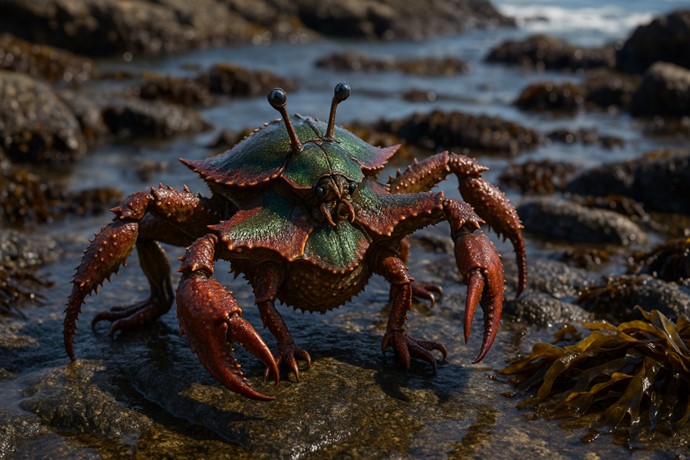
Appearance: The Beetcrabstarkanga 29 is a bizarre, armored feral creature that fuses the hard, iridescent exoskeleton of a beetle with the pinching claws and sideways scuttling legs of a crab, the regenerative, multi-armed radial symmetry of a starfish, and the powerful hind limbs and pouch-like structure of a kangaroo. Its body is primarily a flattened, star-shaped central disc like a starfish, covered in a shiny, segmented beetle carapace that shifts hues from metallic greens to rusty reds for intimidation or blending, with crab-like armored plates reinforcing the edges. From the disc extend five primary “arms” akin to starfish limbs, each ending in crab pincers that snap with force, while two oversized hind legs, muscular and jointed like a kangaroo’s, protrude from the rear for leaping propulsion. A ventral pouch, kangaroo-inspired but lined with starfish tube feet for adhesion, opens on the underside to store eggs or captured prey. The head is fused into the disc, featuring beetle mandibles for grinding and compound eyes on stalks for 360-degree vision, with small, regenerative barbs along the arms that regrow if severed. Overall, it resembles a hopping, armored star with scuttling claws, evoking the resilient oddities of Saṃsāra’s diverse biomes.
Size: Beetcrabstarkanga 29 individuals typically span 3 to 5 feet across the star-shaped disc, with hind legs extending an additional 2 to 3 feet when fully stretched, and a body height of 1 to 2 feet when crouched. Weight averages 80 to 150 pounds, influenced by environmental resources, with juveniles starting at 1 foot span and growing steadily over years.
Speed: This creature moves with erratic bursts, scuttling sideways like a crab at 25 feet per round on flat terrain, leaping forward with kangaroo hind legs up to 40 feet in short hops, and regenerating arms allowing clumsy climbing or swimming at 15 feet per round. Burrowing or regenerating in place reduces speed to 5 feet per round.
Stat Modifiers: The Beetcrabstarkanga 29 has base stat adjustments reflecting its hybrid resilience: +3 to armor (increasing base AC by 3 due to exoskeleton), +2 to strength (enhancing grapple and leap attempts), -2 to dexterity (hindering precise movements due to radial bulk), +1 to constitution (boosting regeneration for HP recovery), and -1 to intelligence (limiting complex behaviors as feral).
Skills: Instinctual rather than trained, the Beetcrabstarkanga 29 excels in grappling with pincers (advantage on holds that restrain foes), stealth through color-shifting carapace (bonuses in varied terrains), regeneration (recovering lost limbs or HP during long rests), scavenging with mandibles (efficient foraging), and leaping evasion (dodging area effects with hops).
Behavior: Feral and opportunistic, the Beetcrabstarkanga 29 behaves as a solitary scavenger that forms temporary alliances during mating seasons, using leaps to ambush prey from above or pincers to defend territory. It regenerates severed parts over days, often retreating to burrows to heal, and exhibits pack-like coordination in groups by clacking claws for signals.
Diet: Omnivorous with a scavenger bent, it consumes decaying vegetation, small invertebrates, and carrion ground by beetle mandibles, supplemented by starfish-like absorption of nutrients from adhered surfaces or pouched stores, thriving on mana-infused fungi that enhance regeneration.
Emotions: Basic and instinctual, displaying aggression through pincer snaps and color flares when threatened, curiosity via stalked eye probes, fear by rapid leaps to escape, and contentment in regenerative basking after feeding, with no complex social bonds.
Environment Where Found: Primarily in temperate coastal plains, jungle clearings, and island grasslands across Saṃsāra, where mixed terrains allow leaping and scavenging, avoiding deep waters or arid zones due to pouch dependency.
Tags: Beetcrabstarkanga29, Feral Hybrid, Armored Star, Pincer Leaper, Regenerative Scavenger, Pouch Carrier, Radial Clawer, Mana Forager, Hop Ambusher, Exo-Skeleton Shifter, Instinctual Pack, Vibration Clacker, Omnivore Grinder, Territorial Regen, Biome Blender
Life Cycle: The Beetcrabstarkanga 29 undergoes a protracted, multi-stage life cycle that highlights its hybrid resilience, beginning with egg deposition in shallow burrows or pouch-protected crevices within temperate coastal plains, where females lay clutches of 10-20 leathery eggs infused with a nutrient-rich jelly from the kangaroo-like pouch. These eggs incubate for 4-6 months, absorbing ambient mana to harden their beetle-derived shells against predators, hatching into larval forms that resemble miniature starfish—radial, armless discs with basic tube feet for adhesion and slow crawling. Over the first year, larvae scavenge detritus, developing crab-like armored plates and compound eyes on stalks for enhanced vision, while the central disc flattens and segments under mana influence. By year two, metamorphosis introduces kangaroo hind limbs, starting as stubs that elongate for tentative hops, and beetle mandibles emerge for grinding food, with the pouch forming ventrally to store water or scraps. Juvenile stages last 3-5 years, during which the five primary arms extend with regenerative barbs, pincers forming at tips through crustacean molting—shedding exoskeletons up to four times annually, each molt increasing size by 20% and incorporating environmental minerals for iridescent hues. Adulthood arrives at 6-8 years, marked by full reproductive capability and color-shifting mastery, allowing the creature to blend into grasslands or plains seamlessly. Lifespan extends 20-30 years, with aging evident in slowed regeneration (limbs taking weeks instead of days to regrow) and faded carapace shine, culminating in a dissolution phase where the body dehydrates into a brittle shell, leaving regenerative spores that can sprout new larvae if mana-saturated, tying into Saṃsāra’s reincarnation themes. Possession by a character can interrupt this cycle, integrating memories post-juvenile stage to form a sentient avatar, though feral instincts persist as emotional undercurrents influencing behavior.
Mating: Mating rituals of the Beetcrabstarkanga 29 are aggressive yet coordinated events driven by seasonal mana highs, when solitary individuals converge in jungle clearings or island grasslands, drawn by clacking pincer signals that echo like beetle stridulation amplified by starfish arm vibrations. Males, distinguished by brighter carapace iridescence and larger hind limbs for display leaps, initiate courtship by hopping in circular patterns around females, extending arms to showcase regenerative barbs that flick menacingly to ward off rivals. Competition escalates with pincer clashes, where contenders grapple radially, testing strength modifiers (+2 bonus) to pin opponents and force submission without lethal intent—losers retreat with severed arms that regrow over days. Victorious males approach females, who assess suitability by adhering tube feet from their pouches to sample genetic scents, a starfish-derived chemosensory exchange. Copulation involves entwining arms in a star-shaped lock, with kangaroo pouches aligning ventrally to transfer spermatophores, fertilized internally and stored in the female’s pouch for 1-2 months before egg laying. Females dominate post-mating, using leaps to disperse and burrow nests, while males may form temporary packs for protection. In feral states, mating occurs biennially, but possessed avatars suppress these instincts due to sterility, though residual emotions like territorial aggression can surface during high-mana events, requiring trained skills to manage.
Tactics: As a feral scavenger-predator, the Beetcrabstarkanga 29 employs hit-and-run tactics optimized for its hybrid form, favoring ambushes in mixed terrains where its radial symmetry allows multi-directional assaults. It leaps from cover using kangaroo hind limbs (up to 40 feet), landing with crab pincers extended to grapple and restrain prey, applying strength modifiers (+2) to hold while barbs regenerate for repeated stabs. In packs, they coordinate via clacking signals, encircling targets to exploit 360-degree vision and divide attention, with one individual distracting via arm waves while others hop in for flanking grapples. Defensive tactics involve color-shifting to blend (utilizing dexterity penalties offset by environment), retreating via burrows if overwhelmed, or severing arms as decoys that wriggle to divert pursuers—regenerating fully in 3-5 days. Against larger threats, it feigns death by flattening the disc and dimming hues, absorbing mana to accelerate healing. In unsafe areas where AC halves, it leverages leaps to evade, hopping over hazards, while in somewhat safe zones like walled clearings, packs use group tactics to overwhelm, snapping mandibles to grind through armor or gear.
Actions: The Beetcrabstarkanga 29’s actions are versatile and instinctual, divided into offensive, defensive, and utility maneuvers that reflect its merged traits. Offensive actions include pincer snaps (melee grapples dealing crushing damage and restraining to halve foe speeds), barb thrusts (piercing attacks with regenerative tips that ignore minor resistances), and mandible grinds (close-range bites for grinding soft tissues or items). Defensive actions feature arm severance (as a reaction, detaching a limb to distract while fleeing, regrowing without HP loss over rests), pouch adhesion (clinging to surfaces or foes to resist knockdowns), and color flares (intimidation displays shifting to reds, imposing fear debuffs on low-will targets). Utility actions encompass leaping propulsion (bonus movement bursts avoiding opportunity attacks), scavenging probes (using tube feet to detect hidden edibles or threats), and burrowing shelters (creating temporary hides for regeneration, recovering HP at accelerated rates in mana spots). In combat rounds, it multi-actions by allocating arms—two for grapples, one for thrusts, others for balance—while non-combat actions involve pouch storage (carrying small objects or eggs without encumbrance) or clacking communication (signaling packs over 100 feet in open plains).
Other Interesting Information: The Beetcrabstarkanga 29’s regenerative abilities extend beyond limbs, allowing it to heal from near-fatal wounds by entering a torpor state in mana-rich soils, recovering up to half HP over long rests without gear, making it a symbol of resilience in Minoan folklore where it’s viewed as an omen of renewal under Potnia Labyrinthia’s weave. Packs exhibit primitive hierarchies based on arm regeneration speed, with “alphas” leading hunts and sharing scavenged mana fungi that temporarily boost leap distances by 10 feet. Mutations from mana storms can add extra arms (up to seven) or enhanced pouch capacities for carrying live prey, prized by beast tamers for utility in trade caravans as hopping guardians. Its omnivorous diet includes absorbing nutrients osmotically like starfish, allowing survival in scarcity by adhering to larger creatures and siphoning traces without killing, sometimes forming symbiotic relationships with sentient avatars who tolerate the “hitchhiker” for its scouting leaps. Emotionally, it shows pack loyalty by clacking distress signals if a member is injured, drawing others to aid with collective grapples. In cultural contexts, Minoan quests reward harvesting its carapace for iridescent dyes used in frescoes, enhancing Mind’s Eye insights on abstract patterns, while over-hunting risks ecosystem imbalance, as the creature’s burrows aerate soils for jungle growth. Feral specimens cannot be possessed until “tamed” via rituals involving mana lures, but once integrated, their instincts ease training in leaping or grappling skills, though the radial symmetry complicates slot placements for gear, often requiring custom pouches or arm bands. Rare sightings in uncharted isles show variants with glowing barbs from high mana, serving as natural lanterns in cave explorations.
Reasons for Encounters
Encounters with the Beetcrabstarkanga 29 often occur incidentally as parties traverse the creature’s preferred habitats, which overlap with frequent adventure locales in Saṃsāra’s interconnected island networks, such as Minoan’s coastal plains or uncharted grasslands. These ferals, with their radial symmetry and leaping ambushes, pose dynamic threats in environments where mana fluctuations draw them out, turning routine journeys into unexpected skirmishes.
Parties exploring jungle clearings for ancient ruins or hidden grottos—common sites for quests involving forgotten civilizations or Cult of the Eternal Labyrinth artifacts—may disturb Beetcrabstarkanga 29 burrows during excavations. The creature’s compound eyes on stalks provide 360-degree vision, allowing it to detect vibrations from digging tools or footsteps up to 60 feet away, triggering a leap ambush where it hops from cover with hind legs, extending arms to grapple multiple adventurers at once. In somewhat safe areas like walled expedition camps, this could manifest as a nocturnal raid, with the feral scavenging camp supplies and using pincers to restrain guards, forcing the party to break grapples (opposed strength checks) while avoiding regenerative barbs that cause bleeding damage over intervals determined by two d4 rolls.
During travel across temperate coastal plains via steam carts or griffon caravans, adventurers might cross paths with solitary Beetcrabstarkanga 29 migrating between mana-rich patches. The creature’s color-shifting carapace blends into grasslands, granting it stealth advantages, and a sudden hop charge could knock travelers prone, especially in unsafe zones where AC halves, escalating to pack encounters if clacking signals summon nearby individuals. This ties into trade route protections, where parties hired to escort merchants from Minoan’s ports to inland cities face these ferals as roadside hazards, their pouch-stored scraps mimicking hidden loot that lures the unwary closer.
Mana ebbs, which bubble forth like weather across Saṃsāra, often coincide with Beetcrabstarkanga 29 activity, as the creatures surface to absorb energy through tube feet, causing their carapaces to shimmer iridescently. Adventurers navigating these events—perhaps during hot air balloon races through labyrinthine skies or zeppelin voyages over islands—might land in affected clearings, encountering glowing specimens that mistake the party’s gear for threats, leading to defensive pincer snaps and arm waves that disrupt group formations. In jungle riverbeds or coastal fringes, where underwater population centers transition to land, the ferals’ swimming capabilities (15 feet per round) allow them to emerge from shallows, ambushing foragers collecting mana fungi, their radial arms extending to multi-grapple in a star pattern.
Collateral encounters arise from larger disturbances, such as fleeing from tier-higher monsters like gestalt dragons in deathly areas where every attack hits, driving Beetcrabstarkanga 29 into the party’s path. Political intrigue in Minoan’s megacities might involve rivals using the creatures as diversions, herding them into enemy camps with vibrational lures to secrete barbs as caltrops, complicating escapes with lingering damage. During festivals honoring Potnia Labyrinthia, where bull-leaping rituals occur in clearings, participants could inadvertently rouse buried ferals, turning celebrations into chaotic defenses where the creature’s regenerative traits allow it to outlast initial strikes.
Reasons to Search for Them
Deliberate searches for the Beetcrabstarkanga 29 are motivated by its hybrid utility in Saṃsāra’s gear-focused, resource-driven society, where harvesting these ferals provides components for attunement, alchemy, and quests, often rewarded with precious metals or cultural honors in nations like Minoan.
Harvesting remains a primary driver, as the creature’s armored carapace, regenerative barbs, and pouch tube feet yield materials essential for crafting. Parties at tier 1 (40% of the population) might seek the iridescent shells to forge lightweight armor covering multiple slots without triggering pain intervals, ideal for lower-tier avatars building inventories. The barbs, regenerative and spiky, can be processed into darts or bracer spikes that cause ongoing damage (two d4 rolls for intervals and HP loss), useful for rule breakers training body parts as conduits or enhancing ritual disruptions. Pouch linings, with adhesive tube feet, craft into belts or sheaths adding extra slots (up to 3 without counting toward tier caps), waterproof and perfect for aquatic gear in underwater centers. Alchemists in Minoan’s steam factories prize the mandibles for grinding potions that boost leap distances, granting temporary movement bonuses (up to 40 feet hops) for escaping unsafe areas. Quests from trade guilds offer 10-20 silver per intact corpse, incentivizing hunts in coastal plains during molting seasons when exoskeletons shed, yielding double materials but increasing encounter risks from vulnerable, aggressive ferals.
Quests tied to cultural or religious imperatives frequently prompt searches, particularly in Minoan where the Beetcrabstarkanga 29 symbolizes renewal under Potnia Labyrinthia’s weave. Tier 2 parties (20% demographic) could be tasked by the Cult of the Eternal Labyrinth to collect live specimens for temple studies, observing regenerative arms to gain insights into abstract concepts like “soul weaving” via Mind’s Eye, rewarding mana boosts (2 points per session) or advantages in library research. Scholarly expeditions from megacities seek mutated variants from mana storms—those with extra arms—for gestalt experiments, where harvesting pouches aids in merging memories without disorientation clashes. Beast tamer guilds in jungle enclaves hire groups to capture young for mounts, their hopping speed and pouch storage making them ideal for carrying gear across plains without encumbrance, with successful taming rituals (requiring 10-minute attunements) granting loyal companions that enhance exploration in uncharted isles.
Ecological motivations drive searches for protection or control, as the Beetcrabstarkanga 29’s burrows aerate soils but can destabilize coastal defenses in Minoan’s ports. Tier 3 adventurers (10% of the population) might undertake quests to relocate packs from unsafe riverbeds threatening trade routes, using vibrational lures to guide them to safer grasslands, earning alliances with sentient swarms that share senses (up to 20 feet) for future aids. Conversely, overpopulation in jungle clearings prompts eradication bounties to prevent fouling sacred sites, with harvested carapaces traded for dyes that amplify Mind’s Eye clarity in frescoes. In beastly civilizations blurring lines with monsters, parties aligned with them search to defend Beetcrabstarkanga 29 from poachers, viewing the ferals as kin whose regenerative traits mirror their own gestalts.
Personal or survival needs compel searches, especially for higher tiers. Tier 4 explorers (5%) seek rare storm-mutated specimens for personal enhancements, like pouch infusions that increase temporary HP caps (to 22 times tier) during long rests. Survival in remote islands might require hunting them for nutrient-rich compost from dissolutions, used as regenerative meals recovering up to 2 HP over 20 minutes. Tier 5 mystics (2%) pursue them as omens, capturing to study clacking communications for plane-spanning insights, sharing senses unrestrictedly to uncover hidden stats in abstract fates.
Additional items and ingredients that can be harvested from the corpse of a Beetcrabstarkanga 29 in Saṃsāra offer a diverse array of resources for adventurers, artisans, and mystics, capitalizing on its hybrid anatomy to produce components for gear enhancement, alchemical concoctions, and ritual aids. As a feral, unpossessed creature (dying in a pool of blood rather than sparking into vapor), its body persists for harvesting, with yields varying by adult size (3-5 feet disc span) and mana exposure at death—storm-mutated specimens provide bonuses like extra arms. Harvesting demands trained skills in dissection or survival to prevent spoilage or self-injury from residual barbs, and magical elements require conduits for attunement. Below, I outline the harvestables beyond basic hides or generic parts, including methods, typical yields, and applications in gameplay, integrating with Saṃsāra’s mechanics for attunement, spellcasting, and progression.
Iridescent Carapace Segments
These shiny, color-shifting sections of the beetle-derived exoskeleton, reinforced with crab-like plates, are pried off the radial disc using held tools (auto-attuned when gripped), yielding 10-15 segments per corpse, each 1-2 feet across. They remain viable for 5-7 days unless preserved in mana-infused oils.
Uses: Segments forge into lightweight shields or bracers, attuning in 1 minute to provide +1 to armor modifiers without adding to slot counts, ideal for avatars avoiding pain from excess gear. In alchemy, ground into powders for dyes that enhance camouflage potions, granting advantages on stealth checks in grasslands or plains by shifting hues, reducing detection in somewhat safe areas. Crafters in Minoan’s fresco workshops use them for iridescent inks that amplify Mind’s Eye passive revelations of environmental stats, such as hidden paths in labyrinths. For offense, segments can be shaped into thrown discs (ranged attacks up to 30 feet) that embed like barbs, causing irregular HP loss via two d4 rolls (higher for interval minutes, lower for damage).
Regenerative Arm Barbs
The starfish-inspired barbs along the multi-arms, capable of regrowth, are plucked or sliced free post-mortem, producing 20-40 barbs per corpse (more from mutated variants), spiky and resilient, lasting indefinitely if dried.
Uses: Barbs craft into arrowheads or dart tips, attuning ritually (10 minutes) to ignore minor resistances and cause lingering wounds that reduce foe regeneration (halving HP recovery during long rests). Alchemically, they infuse salves for personal use, allowing avatars to regenerate minor injuries (1-2 HP per round in mana-rich zones) as a reaction, capping at 20 times tier for temporary bonuses. In Minoan’s cultural rituals, barbs are embedded in torcs or crowns, enhancing gestalt sensory sharing by 10 feet (dimming at 20 feet base), useful for coordinating across planes at tier 5. Defensively, they line armor suits covering multiple slots, granting +1 to constitution modifiers against severing attacks.
Pincer Claw Joints
The crab-like pinching mechanisms at arm ends, jointed for snapping force, are disarticulated with precise cuts, yielding 5 pairs (one per arm) per corpse, durable and springy, storable long-term in dry pouches.
Uses: Joints serve as components for mechanical traps or sheaths, attuning automatically when held to boost grappling skills ( +2 strength modifier for holds that restrain, reducing target speed by half). In potions, extracted oils create strength elixirs that temporarily increase leap distances (up to 40 feet hops), aiding evasion in unsafe areas where AC halves. Crafters integrate them into belts adding specialized slots for tools, preventing attunement disruptions from environmental vibrations. Offensively, joints forge into clamp weapons that auto-grapple on hits, allowing follow-up crushes without extra actions, ideal for rule breakers using hand gestures as conduits.
Compound Eye Stalks
The beetle-stalked eyes providing panoramic vision, harvested by severing at the base, produce 5-7 stalks per corpse (one per arm plus central), with lenses that retain light-refracting properties for weeks if kept moist.
Uses: Stalks craft into monocles or glasses, attuning in 1 minute to extend perception ranges (spotting threats up to 60 feet with advantages on checks), enhancing Mind’s Eye active identifications of hidden stats without cooldowns in dim light. Alchemically, lenses distill into vision serums that reveal false stats on shielded creatures, countering misdirection debuffs. In exploratory gear like backpacks, they add slots for scouting tools, granting bonuses to abstract concept comprehensions like “territorial boundaries.” For defense, stalks weave into helms that provide 360-degree awareness, reducing surprise ambushes and allowing reactions to multi-directional attacks.
Hind Leg Tendons
The muscular, kangaroo-derived tendons from the powerful rear limbs, extracted by filleting the legs, yield 2-4 long strands per corpse, elastic and tough, preserving well when salted.
Uses: Tendons string into bows or slings, attuning ritually to increase ranged leap-assisted attacks (adding 20 feet to projectile throws without penalties). In elixirs, they brew agility potions that offset dexterity penalties (-2 base reduced to 0 for bursts), useful for dodging in deathly areas where attacks always hit. Crafters use them in boots or bracers covering leg slots, enhancing movement speeds (base 25 feet scuttle to 35 feet) and enabling short hops as bonus actions. Utility-wise, tendons reinforce pouches or harnesses, adding extra storage slots without counting toward tier caps, perfect for carrying regenerative salves.
Mandible Grinding Plates
The beetle mandibles fused into the central disc for crushing, removed intact with chisels, provide 1-2 sets per corpse, hardened and serrated, enduring indefinitely.
Uses: Plates grind into pestles for alchemical mortars, attuning as held tools to process ingredients faster (reducing crafting times by half for potions like those boosting HP recovery from meals over 20 minutes). In weapons, they edge blades for grinding attacks that ignore armor on soft targets, dealing extra damage to unarmored foes. For rituals, plates inscribe symbols on gear, amplifying chant effects by 10% when using true names (doubling base damage). Defensively, they reinforce shields to absorb crushing blows, granting +1 to constitution modifiers against grapples.
Tube Foot Adhesive Glands
The starfish tube feet lining the pouch and undersides, scooped out in clusters, yield 50-100 glands per corpse, sticky and regenerative, viable for 3-5 days fresh.
Uses: Glands distill into adhesives for repairing gear, attuning damaged items without full rituals (shortening to 30 seconds). In salves, they create adhesion potions for climbing sheer surfaces, negating fall risks in jungle explorations. Crafters embed them in gloves or belts, adding grip slots that prevent disarms during grapples. Utility applications include sealing wounds for temporary HP ( +1 as a reaction, subtracted first), or in Minoan trades for fastening fresco panels that enhance Mind’s Eye clarity.
Radial Arm Sinews
The flexible sinews connecting the starfish arms to the disc, threaded out carefully, produce 5-10 sinews per corpse, regenerative and elastic, storing well dried.
Uses: Sinews weave into nets or lassos, attuning in 1 minute for multi-target grapples (restraining up to 3 foes at once). Alchemically, they infuse regeneration elixirs that heal severed limbs over long rests, boosting constitution modifiers (+1) for possessed avatars. In harnesses covering multiple slots, they allow arm extensions for reach advantages ( +5 feet to melee). Offensively, sinews string whips that regenerate after breaks, ignoring wear from disruptions.
Harvesting a complete corpse takes 1-3 hours with appropriate tools, risking barb pricks (minor HP loss intervals) or adhesive sticks (temporary dexterity penalties), and yields increase with specimen maturity—juveniles provide half, but rarer glands. These resources fuel Saṃsāra’s economy, trading for 2-4 gold per quality item in markets, and must be container-stored (not impacting slots) to retain properties. Quests emphasize sustainable harvesting to avoid ecological disruptions, as over-collection in grasslands can lead to soil erosion, drawing scrutiny from beastly civilizations or the Cult for imbalance.
Leaping Star-Claw and Weaver’s Forgotten Barb
In the veiled epochs ere the souls’ vast wanderings, when the grasslands of Saṃsāra stretched like endless tapestries woven by hands unseen, and mana pulsed through the earth as blood through veins of stone, there stirred in the coastal plains a being forged from life’s shattered remnants. The crumbling parchments, inscribed from tongues dissolved into echoes, proclaim thus: “From the shell of the beetle’s gleam, the pinch of the crab’s grasp, the arms of the starfish’s reach, and the bound of the kangaroo’s leap, arose the Beetcrabstarkanga, numbered twenty-nine in the gods’ cryptic count.” Yet the unknown script warps, for it was not shells but the chaotic merger of forms in mana storms that birthed it, body a radial disc armored in iridescent plates, arms five extending with barbs that renew, hind limbs mighty for hops, and pouch ventral for secrets held.
This Beetcrabstarkanga 29 first clacked its pincers in the jungle clearings where avatars of tier one—forty in each hundred souls—gathered herbs for attunement conduits. A Minoan scout, of Thalorim kin with patterns swirling on skin like waves eternal, ventured into the plains under the House of Aethera’s decree, seeking crystals amid the grass that swayed as forgotten memories. “The horror hopped from the burrow,” the text falters, “disc flattening to blend, eyes on stalks whirling full circle, arms snapping like claws of the deep.” The scout, gear attuned without excess slots to evade pain’s irregular bursts—minutes by higher die, loss by lower—felt the ground quake, the creature’s leaps closing forty feet in bursts.
The beast ambushed, its crab pincers grappling with strength modifiers enhanced, restraining the scout’s limbs to halve speeds, barbs thrusting with regenerative tips that ignored minor guards. The scout chanted in Kretari tones, ritual lasting over six seconds for amplification by twenty-five in the hundred, true name doubling damage if known through Mind’s Eye. But the Beetcrabstarkanga shifted hues to reds fierce, mandibles grinding the air as beetle jaws, pouch adhering to the ground for stability unyielding. The scout expended mana boost—one point to cling at one health, silver fire unresistable post-hit—but the feral retreated, hopping away, arms waving distractions like starfish decoys.
Tales spread through Minoan’s palace-cities, where the queen—tier five, two in the hundred—convened councils in Knossos Prime, taxes funding steam carts that traversed roads without combustion’s sin. “Hunt the leaping star-claw,” she commanded, “harvest its parts for the Cult’s labyrinth altars, symbols of renewal under Potnia’s weave.” Adventurers of tier two—twenty in the hundred—assembled, possessed with multiversal echoes, belts adding slots for tools held automatically attuned. They rode griffons over the endless ocean, zeppelins racing through clouds labyrinthine, into the coastal plains where packs of the creature dwelled.
The pack, five to ten converging, coordinated with clacking signals like beetle stridulations, their omnivorous maws grinding detritus and small prey. “The dominants, arms regenerative, led the radial dance,” the inscription bends, “pouches exchanging secrets, eggs clutched in burrows guarded.” The adventurers arrived during a mana high, the beasts’ carapaces shimmering iridescent, leaping in arcs to ambush from above. One tier three explorer—ten in the hundred—shared senses tripled, spotting the charge from sixty feet ere dimming.
Combat raged in the unsafe clearings, AC halved, pincers snapping to grapple multiple foes, barbs causing lingering wounds via dice rolled twice—intervals and loss repeating till remedied. The adventurers invoked rituals in Kretari, tonal shifts amplifying effects, gear attuned without exceeding caps to shun pain’s fits. A tier four guardian—five in the hundred—used silver fire from mana capped at ten times tier, blasts unresistable vaporizing a juvenile, its larval form still soft and radial, blind to the world.
From the fallen, they gathered: iridescent segments for cloaks of blend, regenerative barbs for salves of heal, pincer joints for traps of grasp, compound stalks for eyes of panorama, hind tendons for bows of leap, mandible plates for grinds of potion, tube glands for adhesions strong, radial sinews for nets of entwine. “The harvests wove into conduits low,” the fragments stutter, “belts granting slots extra, bracers boosting grapples, without divine wrath’s intervals.” Yet one adventurer hoarded excess, pain wracking in bursts till shared communally.
The queen bestowed rewards—ten copper to silver, two nickel equaling one, ascending to rhodium’s rarity—but cautioned equilibrium, for overhunting frayed ecosystems, beastly kin protesting the blur of monster and folk. Packs reformed, scavenging with mandibles, emotions basic—aggression in flares, curiosity in probes, fear in hops swift.
Legends swelled: a tier five mystic—two in the hundred—pursued a storm-mutated Beetcrabstarkanga, arms extra for gestalt trials, but hubris invited overwhelm, senses crossed in the radial whirl. The creature’s burrows aerated soils, aiding farms terraced, yet toppled clearings’ balance, drawing Cult’s gaze.
Thus the shards conclude, ink blurred as hues on aged shells.
The moral of the story is: In the leap of merger, equilibrium averts the snap, for greed in harvest summons the barb’s renewal, and only through woven respect does one traverse the plains ungrappled.
Suggested conversions to other systems:
Call of Cthulhu
Beetcrabstarkanga Horror
STR 75 (4D6 x5), CON 65 (3D6+4 x5), SIZ 70 (3D6+6 x5), DEX 55 (3D6+1 x5), INT 25 (2D6 x5), POW 45 (2D6+4 x5), HP 13-14 (average), Move 7/9 leaping/climbing, Build 1, Damage Bonus +1D6, Armor: 4-point iridescent exoskeleton (regenerates 1 point/round in mana-rich areas, halves slashing damage).
Attacks: Pincer Snap 50%, damage 1D8+DB + grab (victim restrained, escape STR vs. STR or suffer 1D4 crush/round); Barb Thrust 40%, damage 1D6+DB + regenerative wound (heals slowly, +1D3 damage next round if not treated); Arm Wave Distraction 60%, damage special (creates illusionary multiples, -20% to attacks on it for 1D3 rounds).
Sanity Loss: 1/1D6 to witness the Beetcrabstarkanga Horror; 1D4/1D10 if seeing its regeneration or multi-arm grapple in action.
Description: This radial abomination scuttles and leaps in grasslands, grappling with arms that regrow mid-fight and pincers that crush relentlessly. Adjusted for CoC 7E balance, its low INT keeps it animalistic but terrifying for pulp or investigative scenarios; in swampy or plain settings, regeneration ties to environmental horror, suitable for low-power keepers where failed dodges lead to Sanity-eroding restraints.
Blades in the Dark
Starclawed Hopper
Threat Level: Desperate (Scale 1 solitary, Scale 3 for group of 5-10; Quality 3 for regeneration, Quality 4 in grasslands). Magnitude 4 (resilient arms and leaps overwhelm crews). Edge: Resilient (regenerates harm levels mid-score with clock fills). Flaw: Territorial (predictable defense of burrows allows setups).
Resistances: Insight (360 vision counters Survey), Prowess (pincers hinder Wreck/Skirmish), Resolve (barbs linger as consequences).
Harm: Arm Grapple (Level 3 Harm, “Pinned and Crushed”); Barb Pierce (Level 2 Harm, “Bleeding and Weakened,” persists if not resisted); Leap Charge (Level 2 Harm, “Knocked Prone,” area effect).
Special: In clearings, “Regenerate Limb” clock (4 segments) fills automatically per turn if not attacked; pincer grapples reduce effect of resistance rolls by one tier.
Description: This hybrid scavenger ambushes with leaps and grapples, regenerating to prolong fights. Tuned for BitD’s heist focus, it’s a Risky foe for novice crews, emphasizing position worsening via restraints; groups build “Encircle Prey” clocks for escalating danger, rewarding clever cons or environmental exploits like luring to dead ends.
Dungeons & Dragons
Beetcrabstarkanga
Medium aberration, unaligned
Armor Class 16 (natural armor)
Hit Points 65 (10d8 + 20)
Speed 25 ft., climb 15 ft., jump (long jump up to 40 ft. with a 10 ft. run)
STR 16 (+3) DEX 14 (+2) CON 15 (+2) INT 4 (-3) WIS 14 (+2) CHA 6 (-2)
Saving Throws Con +4
Skills Athletics +5, Perception +4, Stealth +4
Senses passive Perception 14
Languages —
Challenge 3 (700 XP)
Proficiency Bonus +2
Radial Regeneration. If the beetcrabstarkanga loses a limb or takes slashing damage, it regrows the lost part at the start of its next turn, regaining 5 (1d10) hit points.
Pouch Adhesion. The beetcrabstarkanga has advantage on Strength (Athletics) checks to climb or grapple.
Actions
Multiattack. The beetcrabstarkanga makes three attacks: two with its pincers and one with its barb.
Pincer. Melee Weapon Attack: +5 to hit, reach 5 ft., one target. Hit: 7 (1d8 + 3) slashing damage, and the target is grappled (escape DC 13). The beetcrabstarkanga has five pincers, each can grapple one target.
Barb. Melee Weapon Attack: +5 to hit, reach 5 ft., one grappled creature. Hit: 8 (1d10 + 3) piercing damage.
Leap Charge [Recharge 5-6]. The beetcrabstarkanga leaps up to 40 ft. to a space it can see. Each creature in the landing space must make a DC 13 Dexterity saving throw or take 10 (2d6 + 3) bludgeoning damage and be knocked prone.
Description: This leaping star-shaped horror grapples and regenerates, ambushing in plains. Balanced for D&D 5E (CR 3 for levels 3-5), multiattack controls crowds; recharge on leap adds mobility—packs raise CR to 4 via aiding grapples. In campaigns, its pouch hides loot, tying to exploration in grasslands or ruins.
Knave
Beetcrabstarkanga Scuttler
Morale 8, Armor 16 (iridescent exoskeleton), HD 5 (22 HP), Attacks: pincer grapple (d10 + restrain: escape d20+STR vs. 16 or prone/reduced speed) or barb thrust (d8 + lingering wound: d20+CON vs. 16 or d4 bleed/round for d4 rounds).
Special: Leap 40 ft. (recharge d6:5-6, area d20+DEX vs. 16 or knocked prone), regenerate (heal d6 HP/round if not damaged that turn), climb/swim 15 ft.
Description: A radial hybrid that leaps to grapple and regenerate. Adapted for Knave 2E’s minimalism (HD 5 for moderate challenge), restrain enables bleeds; groups add +1 HD each. Encounters in plains leverage morale for hops away, rewarding inventory uses like nets to counter regeneration.
Fate
Beetcrabstarkanga Leaper
Aspects: Armored Star-Shaped Scuttler with Regenerative Arms; Leaping Predator of Grasslands and Clearings; Color-Shifting Camouflage and Pincer Grappler; Feral Scavenger with Adhesive Pouch; Territorial Hopper in Mana-Infused Plains.
Skills: Great (+4) Fight (pincers and barbs for multi-attacks), Good (+3) Athletics (leaps and scuttles), Fair (+2) Physique (resilient exoskeleton and regeneration), Average (+1) Notice (360-degree vision and vibrations), Average (+1) Stealth (color-shifting and radial symmetry).
Stunts: Leaping Charge—Once per scene, gain +2 to Athletics to overcome distance or create advantage by leaping into a zone, knocking foes prone or creating “Disrupted Formation” with free invoke. Radial Regeneration—As a reaction to taking stress, spend a fate point to reduce a consequence by one severity level by invoking “Regenerative Arms,” simulating limb regrowth. Pincer Entangle—Succeed with style on a Fight attack to grapple, creating “Multi-Limb Restrained” aspect with two free invokes, hindering the target’s defenses.
Stress: Physical [ ] [ ] [ ] [ ], Mental [ ] [ ].
Consequences: Mild (2), Moderate (4), Severe (6).
Description: This hybrid feral leaps and grapples with regenerative limbs, scavenging in plains. Balanced for Fate Condensed’s flexible play, it’s a Good opponent for novice groups, focusing on aspects for terrain advantages (e.g., invoke grasslands for +2 leaps); packs add minor threats with Fair Athletics. Stunts emphasize control and mobility, encouraging narrative invokes for regeneration in prolonged conflicts, without overwhelming direct shifts.
Numenera & Cypher System
Starkanga Beetcrab (level 4; health 15; Armor 2 from iridescent exoskeleton; movement long leaping/climbing, short scuttling)
Motive: Scavenging and territory defense.
Environment: Temperate plains, jungle clearings, or grasslands in packs of 5-10.
Damage Inflicted: 4 points (pincer snap) or 5 points (barb thrust with lingering).
Modifications: Athletics as level 5 (leaps and grapples); Stealth as level 5 in grass; Might defense as level 5 (regeneration).
Combat: Leaps to close gaps (eases attacks by one step from height), grapples with arms (might task to escape, inflicts 4 points crush/round); barb thrust causes lingering bleed (Speed defense or 2 points/round for 3 rounds). Regenerates 2 health/round if not damaged, or regrows arms instantly.
Interaction: Feral and skittish; clacks to signal but flees if outmatched.
Use: Guards scavenger hoards in plains or serves as a leaping hazard in ruins, its pouch containing oddities.
Loot: 1d6 shins, 1 oddity (color-shifting scale for camouflage), 1 cypher (regenerative barb, level 4, heals 1d6+level Might).
Description: This hopping star-clawed hybrid grapples and regenerates, ambushing explorers. Tuned for Cypher System Revised (level 4 for tier 1-2 groups); packs increase level by 1 via coordination. Mechanics highlight hindrance from grapples and bleed, fitting discovery—pouch loot as plot devices for mana echoes in Ninth World or Saṃsāra plains.
Pathfinder
Beetcrabstarkanga (Creature 3)
N Medium Aberration
Perception +9
Skills Acrobatics +8 (+10 leaping), Athletics +11 (+13 to Grapple), Stealth +9 (+11 in grasslands), Survival +7
Str +4, Dex +3, Con +3, Int -3, Wis +2, Cha -2
AC 19; Fort +10, Ref +8, Will +7
HP 50
Speed 25 ft., climb 15 ft.
Melee [one-action] pincer +11 (agile), Damage 1d10+4 slashing plus Grab
Melee [one-action] barb +11, Damage 1d8+4 piercing plus beetcrabstarkanga barb (DC 18 Fortitude or 1d4 persistent bleed)
Leap Ambush [two-actions] The beetcrabstarkanga leaps up to 40 ft. Each creature in the space must succeed at a DC 18 Reflex save or take 2d6+4 bludgeoning damage and be knocked prone.
Radial Regeneration The beetcrabstarkanga regains 4 HP at the start of its turn if it has at least 1 HP.
Description: This armored hopper grapples and regenerates, scavenging in plains. Balanced for Pathfinder 2E Remaster (level 3 for parties 3-5), Grab enables sustained damage; leap adds area control. Packs Aid for +1 bonuses. In Golarion wilds or Saṃsāra coasts, its pouch conceals items, encouraging post-fight searches for loot integration.
Savage Worlds
Beetcrabstarkanga Scuttler (Wild Card)
Attributes: Agility d8, Smarts d4 (A), Spirit d6, Strength d8, Vigor d8
Skills: Athletics d10, Fighting d8, Notice d8, Stealth d8, Survival d6
Pace: 6 (d8 running/leaping); Parry: 6; Toughness: 8 (2)
Hindrances: Animal Instincts (feral, -2 Smarts rolls)
Edges: Fleet-Footed (Pace +2, d10 run), Improved Arcane Resistance (but feral, no magic)
Special Abilities: Armor +2 (exoskeleton); Leap (long jump 20″, +4 damage if charging); Multi-Action (attack with up to 3 pincers, -2 each extra); Pincer Grapple (Fighting hit grapples, escape Athletics vs. d8; restrained takes Str+d6 crush); Regeneration (Vigor roll heals Wound/turn if not damaged); Size 0.
Description: This leaping scavenger grapples and regenerates. Adapted for SWADE (Toughness 8 for Seasoned heroes), multi-action controls foes; packs as Extras lose Wild Card. In adventures, leap adds dynamism to plain chases, regeneration prolongs fights—flaw allows exploits like lures for -2 Notice.
Shadowrun
Beetcrab Armored Leaper
Attributes: Body 5, Agility 4, Reaction 4, Strength 5, Willpower 3, Logic 1, Intuition 4, Charisma 1, Magic 3 (mana regeneration).
Essence 4, Initiative 8 + 1D6, Movement 8/16/+2 (scuttle/leap), Climb 6.
Skills: Athletics 6 (leaping +2), Perception 5 (360 vision +2), Sneak 4 (color-shift +2), Unarmed Combat 7 (pincers +2).
Qualities: Armor (Rating 4, iridescent exoskeleton), Regeneration (heals 1 box/turn in grasslands), Leaper (double jump distances), Multi-Limb (extra actions for grapples).
Powers: Concealment (Self, color-shifting), Movement (Self, enhanced leaps), Natural Weapon (Pincer: DV 5P, AP -1, Reach 1 + grab), Barb Venom (Vector Injury, Speed 1 turn, Power 8, Effect Physical Damage + Disoriented -2 dice for 3 turns).
Attacks: Pincer Snap (Reach 1, DV 6P, AP -), Barb Thrust (Reach 0, DV 4P, AP -2 + venom).
Notes: Critter Type: Paranormal Beast (Hybrid Feral). This armored hopper ambushes with leaps and grapples (opposed Strength + Unarmed vs. target’s Physical Limit, restrained reduces initiative). Balanced for SR6’s cyber-magic blend—Rating 5 threat for mid-level runners; in sprawl outskirts or corporate wilds, regeneration synergizes with background count, packs add +1 Initiative via coordination for escalating heists.
Starfinder
Beetcrabstarkanga Plains Hopper
Medium aberration
Tier 2
Senses 360-degree vision, low-light vision.
Defensive Abilities armored carapace (DR 5/-), radial regeneration (fast healing 3 if above 0 HP); Immunities bleed (partial, +4 vs. persistent damage).
Offensive Abilities pincer grapple (KAC +10, damage 1d8+5 S & grab), barb strike (KAC +10, damage 1d6+5 P + beetcrabstarkanga barb: Fort DC 14 or 1d4 bleed for 3 rounds).
Statistics
Str +4, Dex +3, Con +3, Int -3, Wis +2, Cha -2
HP 40; RP 4
Speed 25 ft., climb 15 ft., leap (long jump 40 ft. with run-up)
Skills Acrobatics +8, Athletics +10 (+12 grapple), Stealth +9 (+11 in grasslands), Survival +7
Special Attacks leap charge (charge without penalty, +2 damage if leaping, affects adjacent foes on Reflex DC 14 or prone)
Ecology
Environment temperate plains or grasslands
Organization solitary or pack (5–10)
Description: This leaping scavenger grapples and regenerates, ambushing in open terrains. Adjusted for Starfinder 1E (CR 3 for levels 3-5), grab controls combat; fast healing prolongs fights—packs raise CR to 4 via flanking. In frontier worlds or Absalom’s parks, its pouch hides tech oddities, adding salvage post-encounter.
Traveller
Beetcrabstarkanga Plains Scuttler
Type: Ambusher (Aberration)
Size: 100kg (Size 7)
Hits: 16/8
Speed: 6m (scuttle), 12m (leap/climb)
Armor: Mesh +2 (iridescent plates)
Attacks: Pincer Grapple (Melee (unarmed) +3, Dmg 3D + grab: opposed Str/End vs. Diff 10+ or restrained/reduced move), Barb Thrust (Melee (blade) +2, Dmg 2D + bleed: Endurance DM -1 for 1D6 rounds if wounded)
Traits: Camouflage (+2 DM Stealth in plains), Leaper (long jumps ignore terrain Diff), Regeneration (heal 1D hits/turn if not attacked), Territorial (+1 DM Initiative in home range).
Psionics: None (instinctual clacks mimic Telepathy for pack alerts within 100m).
Description: This hybrid ambusher leaps to grapple and bleed foes. Balanced for Mongoose Traveller 2E Update 2022 (Animal Table: Plains, Hits for mid-threat explorers); packs add +1 DM attacks via aids. In Charted Space frontiers or Vargr extents, its vibrations detect scouts, pouch loot includes oddities like mana crystals for UPP mods—encounters escalate with regeneration in prolonged skirmishes.
Warhammer
Beetcrabstarkanga Grassland Clawed Leaper (Beast)
M 5 (scuttle)/8 (leap), WS 40, BS 0, S 45, T 45, I 35, Ag 30, Dex 25, Int 15, WP 30, Fel 10
Wounds 16
Traits: Armor 2 (all, iridescent exoskeleton), Bestial, Leaper (long jumps ignore penalties, +10 WS on charge), Regenerator (heal 1D10/round if not hit), Size (Average), Weapon +8 (pincers: SB+4, Agile, +grab: opposed S or Restrained), Barb +7 (SB+2, Impale, +lingering bleed: Difficult -10 Toughness or 1D5 damage/round for D3 rounds)
Special Rules: Pouch Adhesion ( +20 to climb/grapple tests), Multi-Arm (extra attack with arms, no penalties for up to 3)
Description: This hopping horror grapples and regenerates, ambushing in plains. Adapted for WFRP 4E (T 45 for mid-challenge groups), Restrained sets up bleeds; regeneration extends fights—packs gain Group Advantage. In Empire grasslands or Border Princes, it haunts as a mutant omen, pouch hiding warpstone-like crystals for Corruption risks on failed tests.