
Species
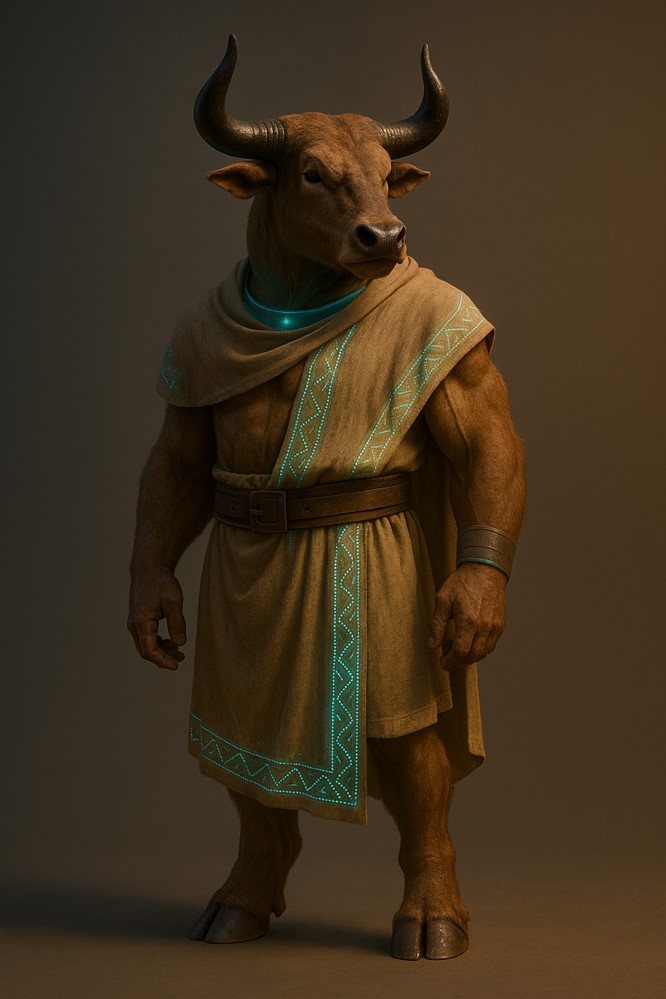
Sapient Boviform Humanoid. Thought-born souls inhabit large-framed, horned mammaloid avatars whose ancestral stock once roamed Hohokam’s canyon basins. They exist today as builders, water-engineers, and ceremonial guardians of the island nation.
Physical Form and Sensory Traits
Stature ranges between 7⅓ and 8 feet when standing relaxed, with barrel torsos tapering to narrow, flexile waists that ease turning in tight irrigation tunnels. Shoulders are broad enough to carry masonry blocks two abreast. Dense fibro-muscle surrounds a springy cartilage keel that shields lungs from sudden dust-storm pressure changes. Digits: four thick fingers with hardened keratin ridges suitable for chisel grips; plantigrade rear hooves spread into three splayed toes that anchor securely on loose talus. Cranial crown bears double forward-arching horns—upper ridges etched by clan artisans to track lineage and civil projects. Nostrils flare wide; a secondary vomeronasal fold detects humidity gradients to one part in five thousand, invaluable for spotting subterranean seepage. Binocular vision sits high on the head, allowing clear sight over riparian reeds; tapetum lucidum grants night clarity inside covered aqueducts. Auditory pinnae rotate individually, gauging water flow by resonance. A vestigial dewlap holds thermoregulatory vessels; when fanned, heat radiates rapidly.
General Size
Typical mass spans 310–430 pounds at adulthood. Calves reach half final height by age seven summers and achieve full height by thirteen.
Body Pattern
Hide bears short, velvety fur of ochre, umber, or sun-bleached sand. Across the shoulders and flanks appear darker tile-like chevrons, mirroring the check-gate patterns of mainland irrigation works. Horn keratin darkens with age; distinguished elders polish theirs to obsidian gloss.
Life Cycle
Gestation lasts ten months. Newborns walk within minutes and begin imprinting canal sounds that guide their later hydromancy. Adolescence from twelve to twenty features horn growth spurts requiring dietary limestone. Average lifespan—without tier extension—approaches ninety years. At sixty, most enter the Canal Quietus, devoting each dawn to listening for leaks then spending afternoons teaching sluice mathematics to apprentices.
Positives Stemming from Form
• Natural ram-momentum charge allows short burst impacts sufficient to fracture adobe walls.
• Humidity sense functions as an innate leak detector and fog compass.
• Hoofed anchors confer advantage on unstable scree or slick drainage stone.
• Bone-dense skull offers passive resistance against concussive spells.
Negatives Stemming from Form
• Bulk impedes movement through tight cave-spirals narrower than five feet.
• Extreme sensitivity to sonic canal-burst sirens can trigger vertigo.
• Keratin demands constant mineral intake; prolonged salt scarcity weakens horn integrity.
• Body mass increases water demand; desert patrols must carry greater supplies or risk heat drop.
Tags: Boviform, Horned, Hydromantic, Desert-Adapted, Canal-Builder, Humidity-Sensor, Ram-Charge, Hoof-Anchored, Night-Vision, Dewlap-Coolant, Clan-Scroll, Horn-Slot, Water-Engineer, Resonance-Chanter, Obsidian-Horn, Tile-Patterned, Linecanal-Steward
Specialized Item Slots
• Dual Horn Slots—capable of mounting specialized conduit-caps, resonance chimes, or clan crests; each horn counts as its own slot.
• Tail Slot—short but muscular, supports counterweight bells or balance fins.
• Dewlap Band Slot—thin collar-band fitted with cooling crystals or voice-amplifying channels.
• Hoof Bracer Slots (pair)—detachable greaves for shock absorption when ramming bulkhead doors.
Standard head, arms, torso, legs, back, and waist slots match most humanoids, giving an adult Kokorut nineteen slots at tier 1 including the four specialized placements.
Environmental Adaptability
Core metabolism excels at storing water in bound muscle glycogen, permitting three sun-cycles of desert labor on a single watering if shade rests are observed. Sweat is minimal; radiant heat shedding through dewlap and horn sinuses protects against canal-glare. Overnight temperature drops activate a slow-pulse hibernation reflex that halves caloric consumption while leaving vigilance intact— sentries can “stand dream” without losing situational awareness. High humidity marshlands are tolerable if companionship chants stave off mold lung.
Other Relevant Information
Ruling dynasties trace descent through maternal horn scroll-marks; removal or defacement of a scroll-mark constitutes treason. Social organization centers on linecanals—compound households maintaining one watercourse segment; each Kokorut swears life-long stewardship of a measured furlong. Marriage ceremonies involve carving a new linking furrow at junction of the partners’ ancestral irrigation zones. Mourning rites set the deceased’s horns as keystones in new flood-gate arches, binding memory to public service. A minority monastic order files horns to flute-like tips, channeling Sa hó tam incantations that ripple pressure waves through aqueducts to trigger distant locks. Kokorut diplomacy prizes measured patience; a treaty is seldom inked until both sides spend one full moonnight listening in silence beside the same flowing channel.
Song-Scroll of Horn-Canal Wanderer
Long ago in the dawn when dust still had first names, there lived Katu-ro, one born beneath crescent horns that shimmered copper at sunrise. Folk of the canyon river called this youngling “Stone Echo,” for every hoofbeat upon the baked floor rang twice: once in the air and once within the marrow of listeners. His people, the Kokorut, heard omen in such twin resonance, so elders laid a gentle binding across his dewlap—an embroidered braid that promised patience.
Katu-ro’s village guarded the Fifth Spillway, where flood waters turned right as a chisel finds grain. In that era the spillway stones swelled each midsummer, cracking joints and loosening lime. Masons repaired them yearly, yet water leapt free like a joyous serpent, soaking stores and sweeping infants from reed baskets. Many wept that the canal obeyed only the moon’s whim, not the builder’s measure.
On the day of second-harvest, Katu-ro woke beneath red cliffs and felt thin-water singing faint behind his eyes. The melody said: “Seek the mouth of the old storm, for there the channel remembers its straightness.” He shared this whisper with elders, yet they spoke slow caution—dreams are wind upon beans; stronger when planted, gone when cooked. Still, the youngling answered the dream’s tug. He girded his loins with ridge-cloth, placed cool clay upon his horns to keep thought steady, and began the pilgrimage upstream beyond maps.
He traveled seven heat-moons and four cold-moons. At the Valley of Shattered Gates he met whispering dune-jackals who asked toll in breath. Katu-ro exhaled a single water-note taught by Sa hó tam tongue, bending air into ripples that quenched the jackals’ burning gullets. They bowed and parted without fang.
Beyond the crimson buttes stood a hollow mountain where lightning had once hammered a crater shaped like a broken bowl. Inside roared a maelstrom of swirling dust, yet Katu-ro heard an older hush beneath it. He pressed horn to ground and, with breath slow as sediment, chanted the lineage of clay: the forming, the firing, the damp cracking, the patience of potter fingers. Each word pushed dust aside until the storm kneeled, revealing a secret tunnel glimmering with turquoise veins.
The tunnel walls bore glyphs: unspoiled flow-lines that predated any known canal. Katu-ro traced them with hoof, memorizing curves as though they were kin names. At the tunnel’s deep heart lay a stone spindle thicker than a dozen arms, greased forever by spring water. It listed askew, its grooves clogged with ages of silt. Understanding bloomed: this spindle once tuned the river’s heartbeat, and without its song the spillway faltered.
He set about cleansing silt using only his horn ridges, scraping until blood mottled dust and cry mixed with water. Days blurred; hunger gnawed but dedication ground stronger. When finally the last pebble fell free, he braced shoulders and heaved the spindle upright. Thin-water shot through the grooves, resonating until a clear chord rang canyon-wide. Downstream, unknown to him, Fifth Spillway straightened like a reed ready for fluting.
Yet the spindle demanded cost. Its awakening drew echoes of drought, for balance must pivot upon equal arms. Katu-ro remained beside it as guardian, promising no flood would turn ruinous nor drought crush hope. Elders searched years but found only horn etchings on the spindle’s base: wandering scrolls depicting clan marks joined with foreign curls—proof he had merged memory with river.
Seasons rolled. Canal-folk discovered fields no longer drowned, nor did thirst claw their throats. They left offerings by the spillway: obsidian-polished horns, small dewlap fans, and song-sticks carved in twin resonance. When children asked who stilled the water’s rebellion, parents recited the Song-Scroll of Stone Echo, though words wobbled through centuries like pottery shards re-glued with sap.
Thus the tale reached us—pressed leaf to leaf, tongue to ear, imperfect as a cracked basin yet still bearing sweetness of stored rain. Each Kokorut youth visiting Fifth Spillway bends hoof to ground, listening for two pulses: their own and the hidden guardian whose breath still calibrates the flood-gates.
Moral: The broadest canal begins inside the steady heart that chooses toil over triumph.