
The religion practiced predominantly on the Island nation of Gerzean, with its population of 65,312,000, is known as the Path of the Coiled Reed. This faith centers around the veneration of a single deity, Gerzara, whose worship originated in the ancient Gerzean culture that shaped the island’s earliest settlements along its fertile river valleys. Not all inhabitants follow this path; approximately 45,760,000 souls adhere to it as their primary belief system, including the majority of the Kherzani race and the ruling House of Amentet, while others blend it with minor local cults or remain agnostic amid the high magic flows of Saṃsāra. The religion emphasizes communal rituals tied to craftsmanship and natural cycles, influencing daily life from pottery workshops in walled towns to grand festivals in megacities, where chants in Kherzean invoke blessings for tier advancements and gear attunement.
The lore of Gerzara and the Path of the Coiled Reed traces back over nine thousand years, before the multiversal souls arrived, when the ancient Gerzean culture flourished in the island’s southern river deltas. During this era, marked by a decline in rainfall that forced reliance on irrigated farming and intricate stoneworking, Gerzara manifested as a guiding force amid environmental shifts. Legends, inscribed on decorated pottery shards and recited in elder councils, describe how Gerzara emerged from the primordial mud of the rivers, coiling reeds into the first vessels that captured magic essence. This deity aided the early Kherzani and other sentient beings in transitioning from nomadic monster-hunting to settled communities, teaching the secrets of metallurgy for crafting conduits and pottery for storing mana boosts. As islands appeared and disappeared in the endless ocean, Gerzara’s influence stabilized the land, weaving magical barriers against unsafe areas and deathly zones. When souls from the multiverse began possessing avatars, Gerzara’s lore evolved to include tales of the deity petitioning other gods to impose limits on worn items and technology, ensuring mortals did not rival divine power through overwhelming gear. Temples, built like stepped pyramids from river clay, house crystals from fallen avatars as relics, symbolizing the cycle of possession and memory retention. Quests often involve retrieving lost Gerzean artifacts from forgotten ruins, where Mind’s Eye users decipher stats on ancient tools, gaining library advantages for deeper insights. The religion’s texts, fragmented and translated through Kherzean glyphs, warn of Gerzara’s wrath during magical ebbs, when floods or droughts test followers’ adaptability, reinforcing the faith’s role in political intrigue among the 73 island countries.
Gerzara’s personality manifests as a nurturing yet exacting creator, portrayed in myths as a patient weaver who shapes destinies from humble materials but demands precision and harmony. This deity interacts with worshippers through omens in river currents or glowing patterns on crafted items, offering subtle guidance rather than overt interventions, encouraging self-reliance in training skills and attuning gear. Gerzara favors those who balance innovation with restraint, as seen in stories where the deity rewards artisans who limit their attuned items to avoid pain penalties, but punishes hubris by amplifying overwhelm debuffs during ritual chants. In higher-tier gestalts, Gerzara’s presence feels like a shared sensory hum across avatars, fostering unity without domination, much like the percentage-based soul control in possessed characters.
Traits of Gerzara include fertility, craftsmanship, and equilibrium, embodying the ancient Gerzean shift toward sustainable living through irrigated fields and communal production. As a deity of cycles, Gerzara governs rebirth through possession, aiding memory integration without clashes, and protects against misdirection by revealing hidden stats on shielded items during active Mind’s Eye use. Worshippers invoke these traits in spells, where chanting Gerzara’s name in Kherzean adds up to 25% potency for rituals lasting over six seconds, or doubles effects with true names tied to crafted objects.
Characteristics of the deity encompass a dual nature: benevolent in granting mana production from reed-based items, yet stern in enforcing cooldowns after repeated activations, mirroring the world’s magical weather patterns. Gerzara appears in visions as a towering figure of coiled vines and clay, with eyes like polished stone bowls reflecting ultraviolet spectra, symbolizing enhanced sensory traits. This deity influences environmental adaptability, tripling AC in designated temple safe areas through wards, but halving it in unsafe zones desecrated by over-attunement. Followers experience Gerzara’s characteristics in daily practices, such as roleplaying meals around pottery vessels to gain HP, or using steam-powered forges blessed by the deity for creating alchemical firearms without breaching god-imposed tech limits.
Attributes assigned to Gerzara cover domains of creation, restraint, and revelation. Creation attributes manifest in bonuses for crafting gear that adds slots, like belts from sacred reeds holding four pouches without counting extra. Restraint attributes enforce the tier +9 worn attuned item limit, with Gerzara’s temples offering storage for excess to prevent advancement triggers or health loss via two d4 rolls. Revelation attributes tie to the Mind’s Eye, granting advantages on abstract concepts like river flows or ancient riddles, revealing clues for puzzles centered on possession origins. At tier 5, devotees access planar communications without distance restrictions, attributing this to Gerzara’s quantum magic weaving.
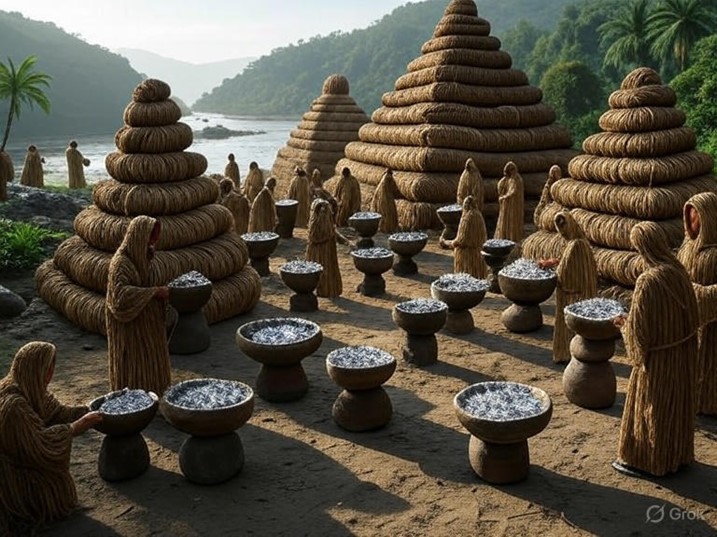
Symbols of Gerzara include the coiled reed, a spiral motif etched on pottery and amulets, representing life’s cycles and magic conduits. Decorated palettes, flat stones for grinding pigments, symbolize revelation, used in rituals to attune items over one minute. River mud figurines depict the deity as a Kherzani-like form with bark skin and vertical pupils, often holding a staff of fermented reeds for mana boosts. Temples feature stepped altars with stone bowls filled with silver fire essence, and followers wear circlets of woven vines in brow slots for sensory enhancements. These symbols appear in festivals, where zeppelins carry reed banners during races, or in underwater centers adapted with echo-modifiers for chants.
Tags: Gerzara, Coiled Reed, Fertility Deity, Craftsmanship, Equilibrium, River Guardian, Mana Weaver, Restraint Enforcer, Revelation Guide, Pottery Symbol, Reed Spiral, Palette Artifact, Mud Figurine, Temple Wards, Cycle Keeper, Ancient Lore, Communal Faith, Magic Cycle
The religion known as the Path of the Coiled Reed, centered around the deity Gerzara on the Island nation of Gerzean with a population of 65,312,000, offers a range of positives and negatives for its followers, features a distinct type of temple, and maintains a specific number of adherents. Approximately 45,760,000 individuals follow this faith, representing about 70% of the island’s population, including the majority of the Kherzani race and the ruling House of Amentet, though not all participate due to varying beliefs or agnostic tendencies amid the high magic environment.
Positives of following the Path of the Coiled Reed include enhanced magical potency during rituals, where chanting Gerzara’s name in Kherzean for over six seconds increases spell effects by up to 25%, or doubles damage with true names tied to crafted items, providing a strategic advantage in battles or negotiations. Followers gain access to temple wards that triple AC in designated safe areas, such as temple enclaves, offering protection against threats in a world with varying safety zones. The faith provides bonuses for crafting gear, such as reed-based belts adding four pouch slots without extra counts, easing the burden of item slot limits and supporting skill training in craftsmanship. Mind’s Eye users receive advantages when researching abstract concepts like river cycles or ancient riddles in temple libraries, aiding in unraveling mysteries or decoding artifacts from forgotten ruins. Additionally, Gerzara’s blessing on mana-producing items, like fermented reed staffs, grants extra points for boosts, enhancing combat with silver fire or preventing death at 0 HP, while communal rituals around pottery vessels allow roleplayed meals to restore 1 HP each, up to three times daily, supporting gradual health recovery.
Negatives encompass the strict enforcement of restraint by Gerzara, where exceeding the tier +9 worn attuned item limit triggers painful health loss via two d4 rolls for intervals and damage, continuing until reduction or death, reflecting divine displeasure with overreach. Overwhelm risks increase during prolonged ritual chants if misdirection shields are encountered, potentially causing temporary debuffs akin to Mind’s Eye exhaustion, especially in chaotic settings like deathly areas. The faith’s focus on communal harmony demands participation in time-intensive festivals or council duties, which may delay personal quests or tier advancement, particularly for lower-tier avatars. Environmental tests, such as floods or droughts during magical ebbs, challenge adaptability, halving AC in desecrated unsafe zones and requiring additional gear or mana to survive. Lastly, the deity’s exacting nature imposes cooldowns after repeated activations, limiting rapid spellcasting or gear attunement, which can hinder strategic planning in urgent situations.
The type of temple for the Path of the Coiled Reed is characterized by stepped pyramids constructed from river clay and reinforced with stone, echoing the ancient Gerzean culture’s architectural style found in early settlements. These temples rise in tiered levels, each step adorned with coiled reed motifs and decorated palettes for grinding pigments, symbolizing creation and revelation. The base level houses communal altars where followers attune gear over one minute or perform ritual attunements for ten minutes on specified items, surrounded by stone bowls filled with silver fire essence for mana boosts. Upper tiers contain hollowed chambers serving as libraries, with bark scrolls detailing Gerzara’s lore, granting Mind’s Eye advantages on research rolls. The central sanctum features a mud figurine of Gerzara, a Kherzani-like form with bark skin and vertical pupils, holding a staff, where priests conduct chants to invoke tripled AC wards. Temples integrate steam-powered forges blessed by Gerzara for crafting alchemical firearms, with mechanical power transmission systems using shafts and gears, reflecting the island’s industrial age driven by magic. Located in walled towns, floating cities, or cave megacities, these structures adapt to underwater peripheries with echo-modified chambers, ensuring accessibility across Gerzean’s diverse landscapes while remaining vulnerable to magical ebbs that weaken wards in unsafe areas.
The number of followers stands at 45,760,000, encompassing a broad spectrum of Gerzean’s inhabitants. This includes the ruling House of Amentet, who lead religious ceremonies to reinforce their authority, Kherzani artisans and scholars who craft and study within temples, and gestalt avatars incorporating woodland or riverine entities for shared rituals at higher tiers. Non-possessed creatures in group-formed towns, such as insect swarms or underwater dwellers, join in limited capacity, while Isekai souls from multiversal realms adopt the faith to align with local customs, enhancing their integration. The remaining 19,552,000 individuals either follow minor cults, practice personal magic without affiliation, or remain neutral, influenced by trade with other island nations or the high magic flow’s egalitarian nature, which allows diverse spiritual expressions.
Believers in the Path of the Coiled Reed hold that Gerzara, as the weaver of life’s cycles, governs the eternal flow of existence, where death marks not an end but a transformation into a state of renewed harmony with the magic of Saṃsāra, drawing from ancient Gerzean views on immortality through preserved forms and communal continuity. They accept that avatars, once possessed, carry memories across lives, and Gerzara ensures these souls integrate without loss, facilitating tier advancements as a divine reward for balanced living. Followers maintain that all things in the high magic realms possess intrinsic magic, and Gerzara’s equilibrium demands restraint in gear use to avoid divine penalties like pain from over-attunement. They affirm that the deity’s traits of fertility and craftsmanship manifest in daily acts, such as forging conduits from river clay, which channel mana for spells, and that true devotion reveals hidden stats via the Mind’s Eye during meditations on coiled reed symbols. Believers assert that possession honors Gerzara’s cycle, with non-possessed avatars achieving limited afterlife glimpses through grave goods attuned to the deity, while higher-tier gestalts share eternal insights across planes. They profess that greed disrupts this cycle, leading to magical ebbs that weaken wards, and that ethical conduct in trades or quests aligns with Gerzara’s revelation attribute, granting bonuses in library research for abstract concepts like river eternities. Followers believe Gerzara petitions other gods to limit technology and item slots, preserving mortal humility, and that chanting the deity’s name in Kherzean during rituals binds souls to the land’s fertility, preventing sterility’s burdens from derailing communal growth among the non-possessed. They hold that the afterlife involves a judgment where Gerzara weighs deeds against the coiled reed’s balance, allowing worthy souls to reincarnate as avatars in safer zones, with memories aiding future possessions. Believers maintain that mummification-like preservations honor this, ensuring bodies serve as vessels for mana residues that benefit surviving kin through inherited gear. They accept that Gerzara’s personality as nurturing yet exacting requires followers to train skills diligently, viewing failures as tests that build resilience for HP recovery via blessed meals. Followers affirm that the deity’s symbols, like decorated palettes, reveal omens in ultraviolet visions, guiding Isekai souls to adapt multiversal memories without clashing. They profess that equilibrium extends to social interactions, where shunning misdirection-shielded items prevents divine wrath, and that Gerzara’s guardianship over rivers ensures trade ships sail under protective flows, doubling spell potency for water-related chants. Believers hold that the faith’s lore, etched on pottery shards, teaches that early Gerzean communities invoked Gerzara to stabilize disappearing islands, linking belief to environmental adaptability in floating cities or cave megacities. They assert that true names spoken in devotion double revelations, aiding in puzzles or negotiations with NPCs who seek identification abilities. Followers believe that Gerzara’s creation domain inspires steam mechanics in factories, where mechanical power from elemental blends honors the deity without breaching limits, and that this faith fosters inclusivity among diverse avatars, from Kherzani to gestalt swarms, as all sentient beings can attune to the path’s equilibrium.
Regular services in the Path of the Coiled Reed take place weekly in the stepped pyramid temples, gathering followers at dawn when river mists carry magical ebbs, beginning with a procession around the base level altars where priests in vine-woven robes lead chants in Kherzean for six seconds or more to invoke up to 25% enhanced potency on communal spells for fertility blessings. Participants, often numbering in the hundreds in walled towns or thousands in skyscraper metropolises, bring crafted items like pottery vessels for anointing with river water mixed with mana essence, reciting prayers that touch upon Gerzara’s traits of craftsmanship and restraint, emphasizing ethical living to avoid overwhelm debuffs. Services include purification rites where attendees dip hands in stone bowls filled with silver fire, symbolizing revelation and washing away misdirection from daily encounters, followed by group meditations using the Mind’s Eye to view basic stats on shared artifacts, granting advantages for those who have previously identified related concepts in temple libraries. Priests from the House of Amentet or elder Kherzani then conduct skill-sharing sessions, training novices in gear attunement over one minute for standard items or ten minutes for ritual ones, demonstrating how to store excess attuned gear to prevent advancement triggers. Chants escalate with rhythmic Kherzean phrases, incorporating true names of local rivers to double protective effects, while gestalt avatars share senses across the congregation, allowing tier-4 or higher participants to extend communications without distance limits within the plane. Offerings of fermented reeds or alchemical components are placed on decorated palettes, burned in steam-powered braziers to release scents that heighten sensory traits like ultraviolet vision for detecting magical residues. Services feature readings from bark scrolls detailing Gerzara’s lore, such as the deity’s role in petitioning gods for item slot limits, interspersed with roleplayed discussions on balancing power to evade pain penalties from two d4 rolls. In underwater centers, services adapt with echo-modifiers amplifying chants, while floating city temples use zeppelin-borne symbols for aerial processions. Attendees partake in shared meals around pottery vessels, each lasting over 20 minutes to restore 1 HP per avatar, up to three times if extended across the day, fostering communal bonds. Services conclude with a final invocation for equilibrium, where priests touch symbolic mud figurines to recite spells against unsafe areas, halving risks in such zones for the week ahead, and dismissals encourage quests to retrieve ancient artifacts for deeper temple integrations.
Funeral rites for believers in the Path of the Coiled Reed commence as public events upon an avatar’s death, where the body, if not vaporized into sparks or leaving a crystal due to possession, undergoes a preservation process akin to ancient Gerzean embalming, wrapping the form in coiled reeds anointed with mana-infused oils to maintain the shell for potential memory echoes. The rite begins with purification of the deceased in temple rivers, reciting prayers and spells in Kherzean to invoke Gerzara’s revelation, touching the wrapped body with ritual objects like decorated palettes to cast protections. Family and community members, including gestalt kin sharing senses, form a procession to the tomb, often a stepped pyramid chamber or cave burial site, carrying grave goods such as attuned gear limited to the avatar’s tier slots, including pottery vessels filled with fermented foods for symbolic HP sustenance in eternity. Priests lead chants lasting over six seconds to amplify potency, using true names of the deceased to double the rite’s binding effects, ensuring memories transfer fully to the character without degradation. If the avatar was possessed, the crystal left behind is placed at the tomb’s center, surrounded by statuettes of reed figures to accompany the soul, forerunners of aids in future possessions. The rite includes anointing the body with specific essences from stone bowls, reciting protections for judgment under Gerzara’s equilibrium, weighing deeds against the coiled reed to grant rebirth. Mourners roleplay the deceased’s life through shared stories, invoking Mind’s Eye to recall stats of their gear and achievements, granting advantages for kin researching similar paths in libraries. In cases of non-possessed deaths, the body lies in a pool of blood, searched for items before wrapping, with parts potentially used in alchemical conduits blessed by Gerzara. Processions feature steam-powered carts in industrial areas or griffon-drawn litters in rural ones, halting at altars for final touches with ritual objects to seal the tomb against misdirection. Higher-tier believers incorporate gestalt elements, like swarm avatars contributing pheromones for eternal scents, or planar shares at tier-5 to link the rite across existences. The funeral concludes with a communal meal over 20 minutes, restoring HP for attendees while honoring the cycle, and temples store any over-tier items from the deceased to prevent penalties for inheritors. For rulers from the House of Amentet, rites scale with retainer elements diminished over time, focusing on symbolic sacrifices of gear rather than lives, ensuring the faith’s continuity amid political intrigue. Underwater or floating city funerals adapt with buoyant wrappings or aerial dispersions of reed ashes, maintaining the emphasis on transformation to eternal harmony under Gerzara’s guardianship. Believers view these rites as essential for ethical passage, blending ritual burial with the blessed state achieved through devotion.
The magical power of Gerzara, as venerated in the Path of the Coiled Reed, manifests through crafted conduits, ritual chants in Kherzean, and symbolic invocations tied to the deity’s domains of fertility, craftsmanship, equilibrium, and revelation, allowing followers to harness it for both offensive and defensive purposes in the high magic environment of Saṃsāra. These applications rely on gear worn by avatars, such as reed-woven amulets or clay vessels serving as foci, with no innate abilities granted—magic flows only through trained skills and attuned items, amplified by Gerzara’s influence to maintain balance and prevent overreach. Offensive uses draw on the deity’s stern aspect, channeling destructive forces like floods or withering curses, while defensive applications emphasize nurturing protection, coiling magical barriers around users or communities to ward off harm, all while adhering to god-imposed limits on technology and item slots to avoid pain penalties from excess attunement.
For offensive applications, Gerzara’s power can be invoked through execration-like rituals where followers inscribe an enemy’s name or representation on a red pottery shard, a conduit crafted from river clay blessed in temple forges, then smash it during a chant lasting over six seconds to unleash a curse that inflicts gradual health loss on the target, rolling two d4 dice for intervals and damage similar to over-tier item penalties, doubling the effect if the true name is uttered in Kherzean. This method, rooted in ancient Gerzean practices of sympathetic magic, allows avatars to target foes from afar, representing them as coiled reed figurines stepped upon or trampled, symbolizing the deity’s equilibrium tipping toward retribution, and can be enhanced with mana boosts for unresistible silver fire damage added post-hit, up to the avatar’s stored limit of 10 times tier. In combat scenarios, priests or higher-tier gestalts chant war spells invoking Gerzara’s river guardianship, summoning illusory floods that overwhelm enemies with temporary debuffs like sensory overload, halving their AC in unsafe areas while the caster maintains equilibrium through a reed staff conduit, preventing personal cooldowns if the ritual incorporates true names for doubled potency. Followers train skills in curse-weaving, using decorated palettes to grind pigments mixed with mana essence, creating inks for scrolls that, when read aloud, release offensive bursts akin to alchemical firearms, propelling elemental steam projectiles that bypass resistances, with Gerzara’s blessing increasing range in riverine environments. For group offenses, communal rituals in stepped pyramid temples gather adherents to form a circle around a central mud figurine of the deity, chanting in unison to amplify a collective spell that coils magical vines around adversaries, restricting movement and inflicting ongoing damage scaled by participant tiers, up to 25% more from extended recitations, ideal for sieges against monster groups or political rivals in trade disputes. Rule-breakers among devotees might use body parts as conduits, like knotting vocal cords during incantations to tie curses that bind enemies’ actions, preventing them from attuning new gear or forcing health loss until the knot is symbolically untied, aligning with Gerzara’s restraint enforcer tag to punish imbalance. In quests involving forgotten ruins, Gerzara’s revelation guide attribute reveals hidden stats on enemy artifacts via Mind’s Eye, allowing preemptive offensive strikes by crafting counter-gear, such as belts with pouches holding curse-infused reeds that release area effects when thrown, affecting multiple foes without exceeding slot limits. Higher-tier avatars in gestalts share offensive senses across planes at tier 5, coordinating attacks where one chants a Kherzean spell to double damage on a distant target, using quantum magic to ignore distance, particularly effective against Isekai intruders disrupting island stability. Offensive uses also extend to social interactions, where followers invoke Gerzara’s name in negotiations to curse deceitful NPCs with misdirection backlash, revealing their false stats and weakening their positions, or in airship races, channeling wind spells through coiled symbols to sabotage competitors’ levitation magic, causing controlled crashes that favor balanced devotees.
Defensively, Gerzara’s magical power provides robust safeguards through wards and protective spells, such as temple invocations that coil ethereal reeds around safe areas, tripling AC for all within as per designated zones, extending to personal gear like vine-woven robes attuned over one minute to grant temporary bonus HP capped at 20 times tier plus base, subtracted first from incoming damage to honor the deity’s fertility domain. Followers perform defensive rituals by dipping amulets in stone bowls filled with silver fire essence, chanting for spiritual defense that counters enemy curses or execrations, smashing symbolic pots inscribed with threats to shatter incoming magical assaults, preventing overwhelm debuffs and allowing mana points to be used reactively for death prevention at 0 HP, leaving the avatar with 1 HP amid battles. In everyday scenarios, believers craft protective knots from reeds during services, tying them while reciting Kherzean phrases to create barriers against poison or disease, invoking Gerzara’s craftsmanship to heal fishbones in throats or food poisoning, restoring HP gradually over long rests with tier die rolls, amplified by the deity’s equilibrium to cap at maximum without degradation. For gestalt avatars, defensive power shares across members, allowing tier-3 tripling of sensory distances within a plane to detect threats early, or tier-4 removal of limits for coordinated wards that halve damage from unsafe areas, using shared memories to anticipate attacks without clashing. Temple libraries offer advantages for researching defensive abstracts, like coiling life’s cycles to decipher shields on enemy items, revealing weaknesses for proactive protection. In underwater or cave environments, Gerzara’s river guardian tag adapts defenses with echo-modified chants, creating bubbles of equilibrium that double AC in somewhat safe zones, while steam-powered forges craft gear like nasal clips for scent wards against hidden foes, heightening ultraviolet vision to spot magical residues. Higher-tier devotees attune mud figurines as conduits for judgment spells, weighing incoming harms against the coiled reed to reflect curses back at attackers, enforcing restraint by inflicting pain penalties on overreaching enemies via two d4 rolls. During magical ebbs, followers invoke Gerzara’s nurturing personality through group meditations, viewing basic stats on allies to apply collective bonuses, such as fermented reed meals lasting 20 minutes for 1 HP restoration per avatar, up to three daily, bolstering resilience in deathly areas where AC is nullified. Protective uses also include amulets for fertility against sterility post-possession, symbolically guarding communal growth, or revelation spells to uncover misdirection, granting early warnings in political intrigue. In airship or zeppelin travels, defensive chants stabilize levitation against storms, coiling winds around vessels for safe passage, while personal defenses like brow circlets enhance claw retraction for evasion, tying into Gerzara’s ancient lore of stabilizing disappearing islands. Overall, these defensive and offensive applications ensure followers embody the deity’s traits, from mana weaver to cycle keeper, fostering a balanced approach where magic serves without overwhelming, always through gear and trained skills to align with Saṃsāra’s mechanics.
Gerzara’s Coiling and Reed’s Eternal Bend
In epochs past, when the rivers of Gerzean did swell with waters unknown, and the muds birthed forms not yet shaped by hand or eye, there arose a tale from scrolls of clay, marked with signs half-erased by floods and winds. This account, whispered from tongues long silenced, speaks of Gerzara, the Weaver of Balances, who came from depths where light feared to tread. The words, bent through translations of scribes who knew not the full glyph, tell thus: In the before-time, afore souls wandered from stars unseen, the land was barren save for monsters that roamed in packs, devouring the weak and leaving bones to bleach under suns that burned without mercy. Then, from the primal ooze, Gerzara stirred, a form of vine and clay, coiling reeds into shapes that held the first sparks of magic. The deity, called by some the Mud-Shaper or the Reed-Binder in older etchings, looked upon the chaos and decreed harmony, for without balance, all would unravel like thread in storm.
The story unfolds with Gerzara’s first act: the weaving of the Great Reed, a stalk that pierced the sky and rooted in the earth’s heart, drawing mana from hidden flows. But lo, jealous spirits of the deep waters rose against this, entities named in faded inks as the Uncoilers, who sought to fray the reed and scatter its power to winds. Gerzara, with eyes like polished stones that saw beyond veils, gathered the early folk—the Kherzani forebears, small of stature yet keen of sense—and taught them the art of pottery, vessels to capture essence, and palettes to grind colors that bound spells. “Craft with care,” the deity intoned, words echoed in chants, “for excess brings pain, as gods above limit what mortals may bear.” The people, in their burrows along riverbanks, fashioned mud figurines in Gerzara’s likeness, infusing them with chants that lasted beyond the count of breaths, amplifying power to push back the Uncoilers.
Yet the battle raged. The Uncoilers, forms of twisting shadow, flooded the valleys, overwhelming the senses of the faithful with illusions of endless water, debuffs that clouded the Mind’s Eye and drained health like irregular wounds. Gerzara, nurturing yet stern, petitioned the council of gods—those who imposed slots on gear and barred engines of fire—to lend aid. “Let not mortals rival us,” the deity pleaded, and the gods agreed, forging limits: no more than tier plus nine attuned worn, lest pain strike with dice of fate, two fours rolled for minutes and loss, repeating unto death. With this decree, Gerzara empowered the people to attune reeds as conduits, channeling silver fire that resisted no foe, boosting damage after strikes known true.
In the heart of the conflict, a hero emerged, a Kherzani named Amru the Potter, whose bark-skin glowed faintly in bioluminescent prayer. Amru, possessed by a soul from realms afar—an Isekai wanderer with memories of steam and gears—merged with a gestalt of river turtles, sharing senses across waters without dim. The hero crafted a palette inscribed with Gerzara’s true name, a glyph lost in translations but whispered as “Gerzara, Binder of Flows.” Chanting this over ten minutes in ritual, Amru doubled the spell’s might, summoning vines that coiled the Uncoilers, restricting their chaos and inflicting curses that halved their strength in unsafe realms.
The Uncoilers, in desperation, unleashed a great ebb, magical weather that withered crops and halved protections in walled havens. Temples, stepped pyramids of clay, shook as floods rose, but Gerzara’s faithful held services at dawn, dipping hands in bowls of essence, reciting Kherzean phrases with flourish for effects greater. Priests from the House of Amentet, lineage of rulers, led processions, anointing vessels with mana, roleplaying meals that restored life points over long feasts, up to three in a day’s turn. Amru, with mana boosts from crystal relics, reacted to near-death, preserving one health amid the torrent.
As the ebb peaked, Gerzara manifested in vision: a towering coil of reeds, eyes reflecting ultraviolet truths, revealing hidden stats on the Uncoilers’ shields. With this revelation, Amru’s gestalt, now tier-three, tripled distances for shared thoughts, coordinating attacks across the plane. They smashed execration shards, cursing the spirits with pain like over-tier touches, adding loss per level discrepancy. The battle climaxed at the Great Reed’s base, where communal circles chanted unison spells, vines bursting forth to bind and crush, scaled by tiers, up to quarter more from prolonged recitations.
Victorious, Gerzara blessed the land, stabilizing islands that vanished and appeared, weaving wards that tripled defenses in sacred groves. The deity taught equilibrium: craft without greed, attune without excess, for unlimited storage hides power, but worn limits enforce humility. Amru, ascending tiers, formed a dynasty, the House of Amentet, guarding lore in bark scrolls and libraries, where Mind’s Eye granted advantages on researched cycles.
Yet the tale warns of recurrence: in later ages, when souls multiplied to billions, and trade sailed endless oceans, some forgot balance. Factories of steam, powered by elemental blends, honored Gerzara, but overreaching artisans suffered cooldowns and overwhelms. Quests arose to retrieve artifacts from ruins, decoding riddles with coiled symbols, revealing deeper truths. In underwater depths and cave megacities, adaptations echoed: echo-chants for defenses, buoyant rites for funerals. The story, muddled through scribes’ errors—names shifted from Amru to Amrut or Gerzara to Gerzar—endures in festivals, where zeppelins carry reed banners, and griffon races test equilibrium.
Followers, from Kherzani to gestalt swarms, recite fragments: Gerzara’s power in offense curses the unbalanced, in defense coils the faithful. Through gear like nasal clips or brow circlets, magic flows, heightening senses against misdirection. In political intrigue among seventy-three nations, invocations sabotage rivals, while protections stabilize airships. The chronicle, etched on pottery shards half-broken, speaks of eternal vigilance, for Uncoilers lurk in ebbs, awaiting imbalance.
Moral of the Story: Seek balance in all crafts and conflicts, for excess unravels the reed of life, but harmony with the coil binds strength everlasting.