
The predominant race of avatars on the Island nation of Gerzean consists of the Kherzani, a diminutive humanoid species deeply intertwined with the land’s ancient heritage. Kherzani form the majority of the nation’s 65,312,000 inhabitants, comprising roughly 70% of the population, with their presence shaping societal structures, from rural communes to the ruling dynasty. The ruling family, known as the House of Amentet, traces its lineage back to the earliest Kherzani settlers who emerged alongside the ancient Gerzean culture, establishing hierarchical systems based on communal wisdom and stewardship of the island’s river valleys and lush woodlands. Kherzani avatars are sentient and self-aware, capable of possession by characters from the multiverse, allowing them to advance tiers through gear and trained skills, much like other beings in Saṃsāra. Their species evolved from the world’s cyclic reincarnations, blending with multiversal souls to create gestalts that often incorporate woodland creatures or riverine entities for enhanced survival. Kherzani society emphasizes collective decision-making, with elder councils advising the ruling family on matters of trade, magic conduits, and defense against unsafe areas, reflecting the ancient culture’s focus on shared rituals and artifact crafting.
Physical Form and Sensory Traits
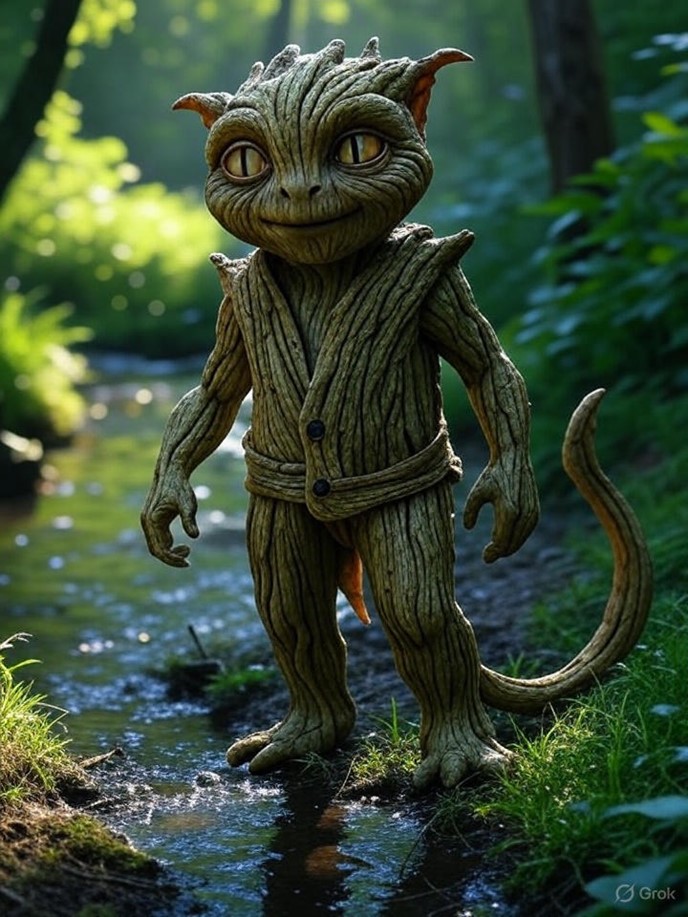
Kherzani possess a compact, wiry humanoid form adapted for navigating dense foliage and narrow riverbank tunnels, with elongated limbs proportional to their stature for efficient climbing and burrowing. Their skin varies in texture from smooth in youth to slightly bark-like in maturity, providing natural camouflage through mottled patterns that shift subtly with seasonal changes, influenced by the high magic flows of Saṃsāra. Heads are proportionally larger than in taller humanoids, featuring wide-set eyes with vertical pupils for enhanced depth perception in low light, broad noses with flared nostrils sensitive to humidity and scents, and ears that taper to slight points, attuned to high-frequency vibrations from insects or distant water flows. Mouths contain sharp incisors for gnawing plant fibers and small prey, alongside molars for grinding seeds. Hands and feet end in dexterous digits with retractable claws for gripping vines or digging, while a vestigial tail stub aids balance during leaps. Internally, their physiology includes a secondary stomach for fermenting fibrous foods, rapid metabolic rates for quick energy bursts, and bioluminescent glands under the skin that faintly glow during emotional highs, visible only in dim environments. Sensory traits heighten awareness of surroundings: vision extends into ultraviolet for detecting pollen trails or magical residues, hearing captures ultrasonic echoes for echolocation in fog-shrouded forests, smell discerns pheromones from miles away to track allies or foes, taste identifies toxic plants through bitterness receptors, and touch senses micro-vibrations in soil to predict tremors or approaching creatures.
General Size
Kherzani avatars typically measure between 2 feet 6 inches and 3 feet 6 inches in height, with weights ranging from 30 to 50 pounds, depending on age, diet, and environmental factors. Females average slightly taller and leaner, around 3 feet 2 inches and 40 pounds, while males tend toward stockier builds at 3 feet and 45 pounds. Gestalts involving Kherzani may alter size marginally, such as a swarm integration adding bulk through symbiotic vines, but individual forms remain within this range to maintain agility. At tier 1, a Kherzani avatar’s size facilitates hiding in underbrush or small crevices, but as tiers advance through possessed mergers, the character’s control over multiple avatars can distribute size-related tasks across the gestalt, like using one for scouting narrow paths while another handles heavier loads.
Body Pattern
The body pattern of Kherzani features earthy tones dominant in skin coloration, ranging from deep olive greens and browns to sandy tans, often with irregular stripes or spots that mimic dappled sunlight through canopy leaves or rippling river sediments. These patterns emerge at birth and evolve over time, darkening in forested regions for better concealment or lightening in open valleys for blending with reed beds. Hair grows in thick, curly tufts on the head, brows, and sometimes backs, in shades of moss green, bark brown, or reed yellow, styled into braids adorned with beads or feathers to honor ancient Gerzean pottery motifs. Facial features include high cheekbones etched with faint, natural ridges resembling hieroglyphic lines, and eyes in hues of amber, emerald, or sapphire, rimmed with dark sclera for glare reduction. Limbs display subtle veining like root systems, which pulse faintly during mana expenditure, and torsos bear spiral whorls around the navel, symbolizing life’s cycles in Saṃsāra. In maturity, scars or tattoos from rituals accentuate these patterns, incorporating geometric designs from ancient stonework, such as interlocking circles for unity or wavy lines for rivers.
Life Cycle
Kherzani life cycles span approximately 150 to 200 years without possession, extending indefinitely through tier advancements via character mergers, though avatars remain sterile post-possession. Birth occurs after a 7-month gestation, with litters of 1 to 3 offspring emerging in communal burrows lined with enchanted reeds for protection. Infancy lasts 2 years, during which young develop basic mobility and sensory acuity, fed on fermented plant milks and soft insects. Childhood extends to age 15, marked by playful exploration of woodlands, training in skills like foraging and crafting simple gear, with Mind’s Eye glimpses revealing basic stats of nearby flora. Adolescence from 15 to 30 involves apprenticeship in family trades, such as pottery or steam mechanics, building resilience against overwhelm from complex concepts. Adulthood begins at 30, focusing on community roles, gear attunement for magic, and potential possession, which halts physical aging but allows memory integration for tier growth. Elderhood after 100 years shifts to advisory positions, with bodies slowing but minds sharpening through recalled multiversal lives. Death, if not prevented by mana boosts, results in the avatar vaporizing into sparks or leaving a crystal, memories preserved in the character for future possessions. Cycles include seasonal molts every 5 years, shedding old skin patterns for renewal, and ritual rebirth ceremonies where elders attune gear to simulate possession-like enhancements.
Potential Positives and Negatives Due to Their Physical Form
Positives from the Kherzani physical form include exceptional agility for evading attacks in normal or unsafe areas, granting advantages in maneuvers requiring dexterity, such as dodging in dense terrain or climbing to safe vantage points. Their small stature allows access to confined spaces, like hidden ruins or narrow cave systems, facilitating exploration of forgotten areas with ancient artifacts. Heightened senses provide early warnings of dangers, improving survival in deathly zones by detecting hidden threats before engagement. Compact builds enable efficient resource use, requiring less food for HP recovery via meals, and their metabolic speed supports rapid short bursts of activity without fatigue penalties. Camouflage patterns offer stealth bonuses in forested environments, reducing detection risks during strategic planning or social interactions with wary NPCs. Dexterous digits excel in fine craftsmanship, easing the training of skills for creating or attuning gear, and bioluminescent glands serve as subtle signals in gestalt communications. Negatives encompass reduced physical strength, halving carrying capacity for heavy items and imposing disadvantages on tasks involving force, like wielding large weapons or resisting grapples. Fragility leads to lower base HP, making them vulnerable to overwhelm from multiple threats or high-damage attacks, with pain from over-tier items amplified due to sensitive physiology. Small size hinders reach in combat, requiring specialized gear for ranged options, and their sensory acuity can cause sensory overload in chaotic settings, triggering temporary debuffs akin to Mind’s Eye exhaustion. Dependence on fermentation for digestion limits diet variety, potentially slowing HP gains from meals in scarce environments, and vestigial tails offer minimal balance aid but snag easily on undergrowth.
Tags: Kherzani, Gerzean, Woodland, Small Stature, Bark Skin, Vertical Pupils, Retractable Claws, Bioluminescent, Camouflage, Riverine, Agile, Dexterous, Vestigial Tail, High Magic, Gestalt, Ruling Family, Ancient Heritage
Specialized Item Slots Available
Kherzani avatars possess standard slot limits based on tier—19 at tier 1 down to 15 at tier 5—but include specialized slots unique to their form, enhancing gear integration with their physical traits. A brow slot accommodates circlets or lenses for augmenting vision, such as ultraviolet enhancers, counting as one slot but allowing dual items like beads without conflict. Nasal slots permit rings or clips for scent amplification, limited to two per nostril for potions or trackers. Ear slots support up to four earrings or cuffs total, specialized for auditory conduits like echo amplifiers. A navel slot fits belts or amulets tied to spiral patterns, adding two extra pouch slots for small tools. Digit slots on hands and feet allow rings or claw sheaths, with ten total (one per digit), designed for fine manipulation gear like lockpicks. A back tuft slot integrates capes or harnesses woven into hair, providing three additional weapon or bedroll slots without encumbrance. Tail stub slots hold one anklet-like band for balance aids. These slots do not exceed overall limits but enable bonuses for nature-attuned items, like vine-wrapped conduits increasing chant potency. Exceeding slots triggers pain via two d4 rolls for intervals and HP loss, continuing until reduction or death.
Environmental Adaptability
Kherzani thrive in the temperate, river-laced woodlands and jungles of Gerzean, where high magic ebbs support their camouflage and sensory traits, doubling AC in somewhat safe walled groves or tripling it in designated burrow enclaves. They adapt well to island variability, burrowing into fertile soils for shelter against magical storms or disappearing islands, with retractable claws aiding navigation of shifting terrains. In underwater peripheries, they use reed gear for buoyancy, though prolonged submersion strains their air-dependent lungs. Cave systems suit their echolocation, but dark megacities challenge with overcrowding, halving stealth benefits. Unsafe jungle fringes test their agility, but deathly volcanic zones overwhelm senses with ash, cutting AC entirely. Hot air balloon or zeppelin travel accommodates their size, with gestalts sharing adaptations across avatars for planar shifts at higher tiers. Climate tolerance spans humid tropics to mild dry seasons, but extreme colds from imported magics slow metabolism, requiring warmed gear for HP maintenance.
Other Information Important to This Race
Kherzani culture mirrors the ancient Gerzean emphasis on pottery and stoneworking, with avatars crafting symbolic vessels as mana storage or ritual foci, often inscribed in Kherzean for spell amplification. Ruling family members wield heirloom gear passed through generations, enforcing god-imposed limits on worn items to prevent overwhelming power. Possession is viewed as an honor, with temples facilitating mergers for tier advancement, though clashing memories cause initial disorientation in their sensitive minds. Gestalts frequently include woodland entities like bird swarms for aerial scouting, quantum-linked without distance penalties at tier 4. Trade focuses on alchemical firearms and steam components, using their dexterity for intricate assemblies. Socially, they shun misdirection-shielded items, fearing insight loss via Mind’s Eye, and center quests on enhancing gear for deeper stats revelation. In battles, they favor ambush tactics, using silver fire from mana boosts post-hit. Memories from multiversal lives often recall inventive pasts, easing skill training in mechanics or magic conduits like vocal cords for rule-breakers. Libraries grant advantages on researched stats, with Kherzani scholars specializing in abstract concepts like river cycles for puzzle-solving. Sterility post-merger shifts focus to communal rearing, with non-possessed maintaining population growth. HP recovery relies heavily on fermented meals, granting 1 HP per 20-minute roleplayed feast, up to three daily. Touching over-tier items causes amplified pain, adding one HP loss per level discrepancy.
Kherzan-Keeper and River’s Whisper
In days of old, when mists did shroud the land of Gerzean, afore the souls from beyond did come, there was a Kherzan-Keeper, small of frame yet great in spirit, whose bark-like skin shimmered with faint glow beneath the canopy of ancient trees. This being, named by some as Zheru of the Rooted Clan, dwelt where rivers sang with magic flow, a place where stones bore marks of hands long gone to dust. The tale, scratched upon clay tablets and sung in broken chants, tells how Zheru, keeper of the sacred grove, heard whispers from the water, voices of the deep past speaking in tongues no ear could grasp full.
Long afore the sun’s cycle turned thrice nine thousand years, the rivers of Gerzean swelled with life, and from their depths rose monsters of scale and claw, yet among them walked the first Kherzani, born of earth and magic meld. Zheru, in this time, tended a grove where grew the Mana-Reeds, stalks that pulsed with silver fire, guarded by spirits of the old ones. One night, as moons hung low, a shadow fell upon the grove—not beast nor bird, but a form of mist, bearing a voice that called, “Keeper, thy light dims the world’s balance. Give us the Reeds, or the waters turn to ash.”
Zheru, with eyes wide as river stones, saw through the mist with the Mind’s Eye, glimpsing stats of a foe: a spirit named Khur-Vex, bound by ancient greed, with health low yet power to wither life. The Keeper, knowing gear alone could not prevail—clad in a tunic of woven vine and a circlet of reed—chose to chant. In Kherzean words, rough and guttural, Zheru sang, drawing mana from the Reeds, the sound rising like wind through branches. The chant, lasting beyond six beats of heart, swelled with power, yet the spirit laughed, its form shifting to misdirect, showing false weakness.
Undeterred, Zheru sought wisdom in the grove’s library, a hollowed tree with scrolls of bark. There, with advantage from past viewings, the Keeper read of Khur-Vex’s true name, etched in fading glyphs: “Khur-Vex, Eater of Springs.” With this, Zheru returned to the riverbank, chanting anew, voice trembling yet firm, “Khur-Vex, Eater of Springs, be bound!” The true name doubled the spell’s might, and silver fire leapt, striking the spirit’s core. Yet Khur-Vex, in rage, unleashed a flood, overwhelming Zheru’s senses with water and shadow, a debuff of mind and limb.
For days, the Keeper lay, HP drained to near zero, saved only by a mana boost reaction, leaving one point of life. In delirium, Zheru’s gestalt—formed with a river turtle avatar—shared senses, guiding the Keeper to a healing herb. Strength returned with slow rests, rolling tier die each dawn, gaining HP to face the foe again. On the seventh day, Zheru, now with a staff attuned from the Reeds, faced Khur-Vex once more. The staff, ritual-attuned over ten minutes, channeled water and fire, steam rising to bind the spirit. With a final chant, Zheru’s voice cracked the air, and Khur-Vex dissolved into sparks, leaving a crystal where it fell.
The grove flourished, and Zheru’s tale spread, carved into stone by the House of Amentet, who claimed descent from this Keeper. Yet the story warns of rivers drying when greed overshadows duty, a lesson passed to all Kherzani, their ruling family included, as they guard Gerzean’s magic with gear and skill. Over centuries, the tale warped, translated from an older tongue lost to time, its words muddled—Kherzan-Keeper became “Root-Warden,” Khur-Vex “Shade-Thief”—yet its core endured, sung in broken Kherzean by elders and children alike.
Moral of the Story: Guard the gifts of the land with wisdom, for greed turns life to ash, but harmony with nature’s flow brings strength eternal.