
Original life forms merged:
- Praying Mantis (from class Insecta)
- Axolotl (from class Amphibia)
- Anglerfish (from class Osteichthyes)
- Common Octopus (from class Cephalopoda)
Appearance
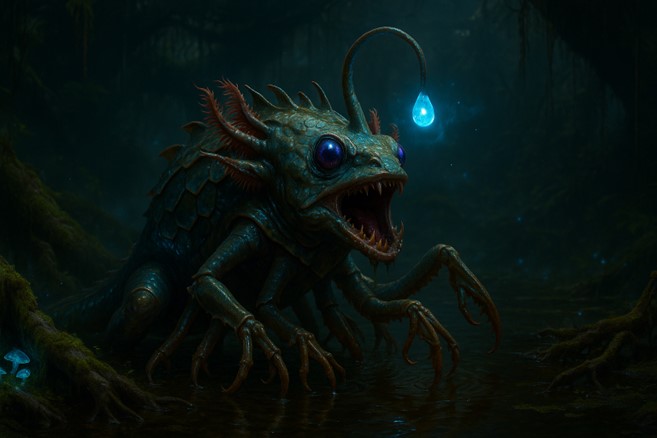
The Mantaxolotlopus 73 presents a grotesque yet mesmerizing fusion of its progenitor forms, embodying the feral wilderness of Saṃsāra’s high-magic ecosystems where evolutionary cycles blend multiversal influences with native reincarnations. Its body core resembles a bloated, gelatinous axolotl torso, scaled up with iridescent, chitinous plates echoing the mantis’s exoskeleton, providing segmented armor that shifts colors for camouflage in murky waters or dense undergrowth. From the head sprouts an anglerfish-like bioluminescent lure, dangling from a flexible stalk atop a bulbous cranium fringed with external gills that pulse like feathery mantis antennae, sensitive to vibrations and magical ebbs. Eight tentacular limbs, derived from the octopus, extend from the midsection, each ending in raptorial claws mimicking the mantis’s folding forelegs, lined with suction cups that secrete a sticky, paralytic mucus. The mouth is a gaping maw with anglerfish jaws unhinging to reveal rows of needle-teeth, while the eyes—compound and multifaceted like a mantis’s—bulge from sockets capable of independent movement, glowing with an inner light that detects ultraviolet spectra for spotting hidden mana flows. A streamlined, finned tail from the anglerfish merges with axolotl regeneration tissues, allowing rapid healing of wounds, and the overall skin texture combines slimy amphibian mucus with cephalopod chromatophores, enabling rapid pattern changes from mottled greens and blues for aquatic stealth to earthy browns and shadows for terrestrial ambushes. Subtle bioluminescent veins trace octopus-like patterns across the body, flaring during emotional surges or magical activations, and vestigial ink sacs near the rear can eject clouds of obscuring fluid infused with disorienting spores.
Size
Mantaxolotlopus 73 specimens typically measure 4 to 6 feet in length from lure-tip to tail-end, with a body girth of 2 to 3 feet at the widest point, weighing between 80 and 150 pounds depending on age and environmental mana exposure. Juveniles start at 1 foot long and 10 pounds, growing rapidly through predatory feasts, while elder alphas in high-magic zones can reach 8 feet and 250 pounds, their increased bulk supported by regenerative tissues that prevent structural collapse.
Speed
This creature exhibits versatile locomotion adapted to multiple terrains, swimming at speeds up to 20 feet per round in water using undulating tentacles and finned propulsion, akin to an octopus’s jetting but enhanced by anglerfish bursts for short sprints. On land, it scuttles at 15 feet per round with mantis-like agility, leaping up to 10 feet vertically via coiled limb springs, while in burrows or dense foliage, it crawls at 10 feet per round, using suction claws for adhesion and stealthy advances.
Stat Modifiers
As a feral life form in Saṃsāra, the Mantaxolotlopus 73 applies the following modifiers to its base stats, reflecting its merged traits: +4 to Dexterity for tentacular precision and rapid strikes, +3 to Constitution for regenerative healing that restores 1d4 HP per round in moist environments, +2 to Intelligence for compound-eye analysis granting advantages on perception checks via Mind’s Eye glimpses of basic stats, -2 to Strength due to gelatinous build limiting raw force, -1 to Charisma from grotesque appearance intimidating non-feral interactions, and +1 to Wisdom for sensory adaptations detecting magical ebbs. Armor Class starts at 14 (natural armor from chitin plates), with HP calculated as 6d10 + 18 (average 51), scalable by tier if possessed.
Skills
The Mantaxolotlopus 73 excels in skills honed from its origins, proficient in Stealth (+6) for chromatophore camouflage and ambush setups, Perception (+5) with ultraviolet and vibration senses to detect hidden foes or mana residues, Athletics (+4) for climbing or swimming in varied terrains, Survival (+4) to track prey through environmental clues, and Intimidation (+3) via bioluminescent flares and unhinging jaws. It gains advantages on rolls involving paralysis or grappling, using mucus-coated tentacles, and can train further if possessed, adapting to gear like reed conduits for magical enhancements.
Behavior
Feral and solitary by nature, the Mantaxolotlopus 73 exhibits predatory patience akin to a mantis waiting for prey, often lurking motionless with its lure dangling to attract curious creatures, then striking with raptorial speed. It forms temporary packs during magical ebbs, sharing sensory data like a gestalt without full merger, coordinating hunts against larger threats. Territorial, it defends lairs with ink clouds and paralytic traps, retreating to regenerate if overwhelmed, and displays curiosity toward shiny artifacts, sometimes hoarding gear remnants from fallen avatars. In high-magic flows, it becomes more aggressive, using bioluminescent displays to ward off rivals, while in safe zones, it may tolerate non-aggressive observers, viewing them through Mind’s Eye for basic stats before deciding on engagement.
Diet
Primarily carnivorous, the Mantaxolotlopus 73 sustains on a varied diet of aquatic and terrestrial prey, favoring fish, amphibians, and insects snatched with tentacles, but opportunistically consuming smaller monsters or avatars weakened in unsafe areas. It supplements with magical essences, absorbing mana from glowing flora or crystal residues to boost regeneration, and can ferment ingested materials in an axolotl-like gut for nutrient extraction, requiring meals every few days to maintain HP, with overfeeding leading to temporary speed debuffs from bloating.
Emotions
This creature experiences a spectrum of primal emotions influenced by its fusion: predatory glee flares bioluminescence during successful hunts, manifesting as rapid color shifts; fear triggers ink ejections and rapid retreats, dimming its lure to hide; curiosity pulses gills when encountering novel magic or artifacts, potentially leading to investigative pokes; anger unhinges jaws with threatening displays, escalating to paralytic strikes; and contentment settles as a low hum from vibrating antennae in secure lairs, fostering regenerative calm. In possessed states, these emotions blend with character memories, amplifying overwhelm risks during clashes.
Environment where found
Mantaxolotlopus 73 thrives in Saṃsāra’s transitional biomes, particularly Gerzean’s river deltas and coastal jungles where water meets land, lurking in murky shallows, reed-choked swamps, or cave pools with magical ebbs. It frequents unsafe areas with halved AC for ambushes, avoiding deathly zones unless mana-rich, and adapts to underwater extensions or floating reed islands, migrating during island appearances to claim new territories.
Tags
Mantaxolotlopus73, Feral Fusion, Aquatic Terrestrial, Lure Predator, Regenerative, Tentacle Grappler, Bioluminescent, Camouflage Shifter, Mana Absorber, Ambush Hunter, Sensory Acute, Primal Emotional, Delta Dweller, Gerzean Native, Possession Viable
Life Cycle
The life cycle of the Mantaxolotlopus 73 spans approximately 15 to 25 years in the wilds of Saṃsāra, influenced by the high magic flows that accelerate growth in mana-rich environments like Gerzean’s river deltas. It begins in egg form, laid in clutches of 50 to 100 gelatinous spheres clustered on submerged reeds or cave walls, each egg encased in a translucent mucus sheath that absorbs ambient mana for embryonic development over 2 to 4 weeks. Hatchlings emerge as larval forms, resembling miniature axolotls with nascent tentacles and a faint bioluminescent lure, measuring 2 to 4 inches long and relying on external gills for oxygen in aquatic nurseries. This larval stage lasts 6 to 12 months, during which they feed on microscopic plankton and small invertebrates, regenerating lost limbs rapidly due to axolotl-derived tissues, and beginning to develop compound eyes for basic perception of magical residues. Metamorphosis occurs around the 1-year mark, triggered by a surge in local magic ebbs, where the creature absorbs chitin from ingested insects to form exoskeletal plates, extends tentacles for grappling, and fully activates the anglerfish lure for luring prey. Juvenile phase extends from 1 to 5 years, with the creature growing to half adult size, honing predatory skills in transitional habitats, and experiencing periodic molts every 6 months that shed old skin patterns for updated camouflage, incorporating cephalopod chromatophores for better adaptation. Adulthood is reached at 5 years, marked by reproductive maturity and full sensory integration, allowing use of suction claws and ink ejections in hunts. Maturity persists until around 20 years, with elders developing thicker armor and brighter lures, though regeneration slows, leading to accumulation of scars from territorial battles. Death typically results from predation or magical overloads, with the body dissolving into sparks if possessed—though feral specimens rarely are—or lying in blood pools for scavenging, their crystals or remains enriching the environment with mana residues that fertilize reed growth.
Mating
Mating among Mantaxolotlopus 73 occurs seasonally during magical ebbs when river waters recede, exposing breeding grounds in shallow pools or flooded caves, typically once every 2 to 3 years for adults. Males initiate by flashing bioluminescent patterns across their bodies, derived from anglerfish and octopus traits, creating hypnotic displays that attract females through ultraviolet signals visible only to compound eyes, while emitting low-frequency vibrations via gills to signal territory control. Females, slightly larger and with more vibrant chromatophores, respond by extending tentacles in a ritual dance, intertwining limbs to assess compatibility through mucus exchange that conveys genetic and mana compatibility stats via passive Mind’s Eye glimpses. Courtship lasts 1 to 3 days, involving mock grapples where raptorial claws test strength without injury, regenerating any minor damage instantly. Copulation follows, with the male using specialized tentacles to transfer spermatophores into the female’s cloaca, a process blending octopus internal fertilization with axolotl external cues, lasting up to an hour under cover of ink clouds to deter rivals. Post-mating, females guard egg clutches aggressively, while males depart to avoid cannibalism risks echoing mantis behaviors, though in mana-rich zones, pairs occasionally form temporary bonds for joint defense. Offspring inherit merged traits variably, with higher mana exposure during gestation enhancing regeneration or lure potency, and non-possessed status ensures no sterility, allowing population growth in feral packs.
Tactics
Mantaxolotlopus 73 employs ambush tactics honed from its progenitors, positioning itself in murky waters or dense foliage with its lure dangling to mimic glowing prey, drawing victims close for a sudden strike with unhinging jaws or paralytic tentacles. In offense, it uses rapid tentacle grapples to immobilize foes, secreting mucus that induces temporary debuffs like slowed movement, followed by needle-teeth bites injecting digestive enzymes for internal damage. Defensively, it ejects ink clouds infused with disorienting spores to obscure vision and escape, regenerating wounds mid-fight to outlast opponents. Group tactics emerge in packs during ebbs, where individuals share sensory data via vibrations, coordinating lures to create illusory swarms that overwhelm larger predators, with alphas directing strikes through bioluminescent signals. In territorial disputes, it deploys camouflage shifts to blend with reeds, launching surprise leaps up to 10 feet with claws extended, and in aquatic chases, jets water for bursts of speed to flank enemies. Against possessed avatars, it targets gear with suction cups to disrupt attunements, exploiting misdirection by mimicking environmental stats via Mind’s Eye mimicry. Scavenging tactics involve lurking near death sites, absorbing mana from crystals to boost regeneration, and in unsafe areas, it halves risks by burrowing into mud for hidden recovery.
Actions
The Mantaxolotlopus 73 performs a range of actions adapted to its feral lifestyle, including the Lure Ambush as a standard action, where it dangles its bioluminescent stalk to attract targets within 30 feet, forcing a Wisdom save (DC 13) or drawing them 10 feet closer for a follow-up grapple. Grapple Strike uses tentacles as an action, rolling +6 to hit and restraining on success, dealing 1d6 piercing plus 1d4 poison damage, with ongoing paralysis until a Constitution save (DC 12). Ink Ejection, a reaction to threats, creates a 15-foot radius cloud obscuring vision and imposing disadvantage on attacks for 1 minute, dispersible by strong currents. Regenerative Surge, a bonus action once per short rest, heals 1d8 + Constitution modifier HP in moist environments. Sensory Scan, a free action, uses compound eyes to passively view basic stats of nearby creatures or objects via Mind’s Eye, granting advantage on next perception rolls. Camouflage Shift, an action, alters skin patterns for +4 to Stealth in matching terrain. Bite Lunge unhinges jaws for a melee attack (+5 to hit, 2d6 piercing), and Tentacle Jet propels it 20 feet in water as a move action. In packs, Coordinated Flare synchronizes lures as a group action to daze multiple foes (DC 14 Wisdom save or stunned for 1 round).
Other Interesting Information
Mantaxolotlopus 73 integrates deeply into Saṃsāra’s ecosystems, serving as both predator and prey, with its mana-absorbing diet influencing local magical weather—overpopulations cause ebbs that wither reeds, while balanced numbers stabilize flows for nearby settlements. Feral specimens occasionally form symbiotic relationships with non-people civilizations, like reed-dwelling insect swarms that clean parasites from gills in exchange for protection. In Gerzean’s deltas, they hoard shiny remnants from ancient ruins, their lairs accumulating gear fragments that attract adventurers seeking attunement clues via Mind’s Eye. Regeneration allows survival of severe injuries, regrowing tentacles in days, but overload from excessive mana ingestion triggers bioluminescent explosions, scattering spores that fertilize environments. Emotions manifest physically: glee in hunts causes lure pulses that inadvertently signal to allies, fear accelerates ink production for thicker clouds, and curiosity leads to exploratory migrations during island appearances. As possession-viable creatures, rare tamed or merged individuals advance tiers, enhancing lures as magical conduits for chants, with tier-5 gestalts sharing planar senses without limits. Diet includes opportunistic cannibalism of weaker kin during scarcities, echoing mantis traits, and their ink has alchemical uses in Gerzean crafts, brewed into potions for temporary camouflage. Tags like AquaticTerrestrial reflect habitat versatility, with sightings in underwater caves or jungle pools, where they interact with Kherzani scouts, sometimes trading scavenged items for food. In cultural lore, they symbolize feral balance, featured in Path of the Coiled Reed tales as guardians of hidden mana sources, their crystals post-death enriching temple rituals. Speed variations occur in magical storms, boosting jets but risking overwhelm, and skills like perception aid in detecting Isekai artifacts, making them unwitting quest catalysts.
Adventurers in the world of Saṃsāra might encounter or actively search for a Mantaxolotlopus 73 for a variety of reasons tied to the high-magic ecosystem, cultural lore, and mechanical incentives of the setting, where feral creatures like this fusion of insect, amphibian, fish, and cephalopod traits represent both peril and opportunity in quests, trades, and tier advancements. Encounters often arise organically during travel through Gerzean’s transitional biomes—river deltas, coastal jungles, murky shallows, reed-choked swamps, or cave pools—where the creature’s ambush tactics make it a common hazard in unsafe areas, halving AC and forcing parties to rely on heightened senses or gear like brow circlets for ultraviolet detection of its bioluminescent lure. For instance, while navigating these environments en route to forgotten ruins inscribed with ancient Gerzean motifs, a party could stumble upon one lurking with its dangling stalk mimicking a glowing artifact, luring curious members into a grapple strike that injects paralytic mucus, triggering a combat scenario where quick mana boosts prevent death at 0 HP and allow silver fire additions to counter its regeneration. Such random meetings escalate in magical ebbs, when packs form to coordinate flares that daze groups, turning a simple traversal into a survival test that rewards HP recovery via fermented reed meals scavenged nearby.
Deliberate searches for the Mantaxolotlopus 73 frequently stem from quests centered on its unique biological and magical properties, which align with the Path of the Coiled Reed religion’s emphasis on craftsmanship and equilibrium, or broader Gerzean cultural practices of harvesting feral essences for alchemical conduits. Artisans in walled towns or megacities might commission adventurers to retrieve the creature’s ink sacs, which brew into potions granting temporary camouflage shifts akin to its chromatophores, providing stealth advantages in unsafe zones or during political intrigue among the 73 island nations. These inks, infused with disorienting spores, serve as key ingredients in crafting gear like nasal clips that heighten scent wards against hidden threats, or belts with pouches holding paralytic darts for combat, all without exceeding slot limits to avoid pain penalties from two d4 rolls. Similarly, temple priests of Gerzara could task a party with capturing a specimen alive for ritual study, using its regenerative tissues—capable of healing 1d8 HP as a bonus action in moist settings—to symbolize the deity’s cycle keeper tag, potentially unlocking library advantages for researching abstract concepts like eternal renewal, aiding in puzzles or decoding artifacts from disappearing islands.
Another compelling motive involves the creature’s hoarding behavior, as it collects shiny remnants from ancient ruins or fallen avatars, amassing gear fragments in lairs that attract treasure-seeking parties. Explorers delving into reed-choked swamps might seek one out after Mind’s Eye passive activations reveal basic stats on a lost item trail leading to its den, where scavenged crystals enrich mana residues, offering boosts up to 10 times tier for unresistible damage in battles. This ties into story arcs where the Mantaxolotlopus guards Gerzean relics, such as coiled reed amulets that add specialized slots without counting extra, making it a target for quests from the House of Amentet to recover heirlooms disrupted by magical weather. In higher-tier campaigns, adventurers could hunt one for possession as an avatar, merging its traits into a gestalt for enhanced sensory shares—tripling distances at tier 3 or removing planar limits at tier 5—ideal for underwater or cave explorations where its aquatic-terrestrial adaptability shines, though initial memory clashes cause disorientation until integration.
Bounties from Gerzean settlements provide practical incentives, as the creature’s predatory glee during hunts disrupts trade routes or fishing communes, prompting rewards in precious metals (10 silver for a proven kill, escalating to platinum for alphas) or gear from monarchy stockpiles. In cultural contexts, it features in lore as a guardian of hidden mana sources, so parties aligned with the Path of the Coiled Reed might pursue one during festivals, using Kherzean chants invoking Gerzara’s river guardian tag to double spell potency against its camouflage, turning the hunt into a rite of balance. For Isekai characters recalling multiversal biomes, seeking this fusion evokes quests to adapt past-life skills, like training in curse-weaving to counter its paralytic strikes. Negatively, encounters risk overwhelm from its sensory daze or ink clouds, imposing debuffs that halt progress, but successes yield alchemical byproducts for HP-restoring meals or conduits that amplify rituals by 25% over six seconds. Overall, whether stumbled upon in unsafe wilds or hunted for its regenerative essence, the Mantaxolotlopus 73 embodies Saṃsāra’s feral balance, driving adventures that test equilibrium, reward craftsmanship, and deepen ties to Gerzean’s cyclical heritage.
Harvesting from the corpse of a Mantaxolotlopus 73 yields a variety of unique items and ingredients, prized in Saṃsāra’s high-magic ecosystems for their blended traits from the creature’s progenitor forms—praying mantis exoskeletal resilience, axolotl regenerative properties, anglerfish bioluminescent allure, and octopus adaptive secretions. These components, obtainable after the creature’s death (either vaporizing into sparks if possessed or lying in a blood pool if feral), can be gathered by skilled adventurers using tools like knives or alchemical vials, often requiring a Survival check (DC 13) to preserve potency without degradation. Yields vary by specimen size: juveniles provide 1-2 items, adults 3-5, and alphas up to 7, with mana-rich environments enhancing quality for better effects. Non-possessed corpses allow full dissection for parts, while possessed ones leave crystals alongside items, enriching harvests with residual silver fire essence. These materials serve as crafting reagents, magical conduits, or consumables, tying into Gerzean cultural practices of reed-weaving alchemicals and the Path of the Coiled Reed’s emphasis on balanced renewal, where overuse risks overwhelm debuffs or cooldowns akin to the creature’s own tactics.
- Bioluminescent Lure Stalk: This dangling appendage, a flexible 1-2 foot stalk topped with a glowing orb harvested intact from the cranium, retains its inner light for 1d4 days post-mortem before dimming unless preserved in mana-infused oils. Used as a conduit for light-based spells or gear, it can be attuned over one minute to create lures that attract prey in unsafe areas, granting advantages on fishing or trapping rolls via Mind’s Eye glimpses of basic environmental stats. Crafters in Gerzean forges weave it into brow slots as circlets, providing ultraviolet vision enhancements that detect magical residues up to 30 feet, ideal for exploring cave pools or reed-choked swamps, or infusing potions that grant temporary bioluminescent skin for stealth in dark zones, adding +2 to Stealth checks but risking attraction of other predators during magical ebbs.
- Chitinous Armor Plates: Segmented, iridescent plates covering the torso, each 6-12 inches across and weighing 1-2 pounds, can be pried off with tools for 4-8 pieces per adult corpse, their mantis-derived hardness offering natural armor properties. These serve as raw materials for crafting lightweight gear, such as belts or harnesses that add 2-4 specialized slots for small tools without counting toward limits, attuned over ten minutes in rituals invoking Gerzara’s craftsmanship for equilibrium bonuses that halve pain penalties from over-tier items during short intervals. In alchemical applications, ground plates mixed with river clay create inks for scrolls that summon illusory swarms, overwhelming enemies with sensory debuffs (DC 14 Wisdom save or dazed for 1 round), commonly used by Kherzani artisans in communal defenses or zeppelin races to sabotage competitors.
- Paralytic Mucus Glands: Sac-like organs along the tentacles, yielding 1-3 pints of sticky, translucent mucus per creature, harvested by milking the limbs post-mortem before it congeals in 1 hour. This secretion acts as a potent reagent for potions or coatings, applied to weapons for paralytic effects on hits (Constitution save DC 12 or restrained for 1d4 rounds), doubling potency if chanted over with true names in Kherzean for rituals lasting six seconds. Gerzean apothecaries use it in nasal clips or pouches for gear that grants resistance to grapples, adding +3 to escape rolls, or in meals fermented over 20 minutes to create antidotes restoring 1d6 HP from poison debuffs, tying into the culture’s emphasis on balanced healing without exceeding daily limits of three such feasts.
- Ink Sac Reservoirs: Paired sacs near the rear, containing 2-4 quarts of dark, spore-infused fluid that ejects as clouds in life, extractable via incision for use in obscuring potions or dyes. When brewed with mana essence, it produces inks for temporary camouflage gear, shifting patterns like the creature’s chromatophores to grant +4 Stealth in matching terrains for 1 hour, or scrolls that release 15-foot radius clouds imposing disadvantage on attacks, dispersible by currents but amplified 25% in extended chants. In underwater centers, it’s valued for echo-modified wards doubling AC in somewhat safe zones, while crafters integrate it into backpacks for three additional slots holding evasion tools, preventing misdirection in political intrigue or quests through forgotten ruins.
- Regenerative Gill Filaments: Feathery external gills fringing the head, 6-10 strands per side harvestable as soft, pulsing tissues that retain vitality for 2d6 hours if stored in moist vials. These filaments, axolotl-inspired, serve as key ingredients in salves or elixirs that promote healing, restoring 1d8 + Constitution modifier HP as a bonus action once per long rest when applied, or infused into mud figurines for rituals granting temporary bonus HP capped at 20 times tier plus base. Gerzean healers from the House of Amentet use them in temple services to enhance roleplayed meals, adding an extra 1 HP recovery per feast up to the daily three, symbolizing renewal under Gerzara’s cycle keeper tag, while alchemists craft them into conduits for spells invoking regeneration, reducing cooldowns after activations in moist environments.
- Needle-Teeth Array: Rows of 50-100 sharp, enameled teeth from the unhinging maw, extractable as durable needles weighing mere ounces collectively, resistant to breakage due to anglerfish durability. These are fashioned into fine tools for precision crafting, such as digit slots for rings or claw sheaths that add +2 to lockpicking or fine manipulation rolls, attuned automatically when held for use in skills like curse-weaving. In Gerzean factories, they’re ground into powders for alchemical firearms, propelling projectiles with bypassing resistances when invoking true names, or woven into nasal rings heightening scent wards to detect hidden mana sources, granting advantages on survival checks in deathly areas.
- Chromatophore Skin Patches: Sections of slimy, color-shifting skin, 2-4 square feet harvestable from the torso and limbs, flexible and preserved in oils to maintain adaptability. Used in tailoring lavish gear costumes, these patches create cloaks or robes that shift patterns for +3 to Deception or Stealth in social interactions, mimicking environmental stats to evade NPC scrutiny. Crafters attune them over one minute for belts holding illusion-infused pouches, releasing minor misdirections that reveal false stats via Mind’s Eye, ideal for negotiations or evading overwhelm in chaotic ebbs, and in underwater adaptations, they enhance buoyant wrappings for planar explorations at higher tiers.
- Bioluminescent Vein Network: Glowing internal veins, extractable as 3-5 feet of fibrous cords pulsing with light, harvested carefully to avoid rupture and loss of essence. These serve as threads for weaving into gear like ear cuffs or navel belts, granting low-light vision extensions up to 60 feet and detecting magical residues for basic stat glimpses, adding +1 to Wisdom saves against illusions. In rituals, they’re burned in steam-powered braziers during services to release scents heightening sensory traits, amplifying group meditations for shared gestalt bonuses at tier 3 or above, or infused into potions for temporary flares that daze foes (DC 13 Wisdom save or stunned), tying into Gerzean festivals where such essences honor the Coiled Reed’s revelation guide.
Other harvestables include the finned tail segments for buoyancy aids in underwater gear, adding swim speed bonuses without slot counts, or spermatophores from males used in fertility potions countering possession sterility symbolically, though limited to non-possessed uses. All harvests risk exposure to residual mucus, imposing a Constitution save (DC 11) or temporary paralysis for careless handlers, and in feral blood pools, scavenging parts can attract other predators, turning the site into an unsafe area with halved AC. Yields contribute to Gerzean trades, fetching 5-20 silver per item in ports, escalating to gold for alpha specimens, and integrate into cultural lore as symbols of feral balance, with temples blessing preserved parts for equilibrium bonuses that reduce pain from over-attunement. For possessed variants, crystals left behind absorb these essences, enhancing mana production when stored, up to two points per session for existing avatars, making hunts quests for tier advancement tools. In monster civilizations along borders, the creature’s parts are bartered for alliances, viewing them as civilized equals under Saṃsāra’s perspective, while Isekai adventurers seek them to adapt past-life alchemicals without clashing memories.
Lurking Glow-Beast and Depths’ Entwined Claws
In ages forgotten, when the waters of Saṃsāra churned with shadows not yet named, and the reeds bent under moons that wept silver fire, there came a beast from the muds deep and the lights dim. This creature, called in glyphs half-erased as the Mantaxolotlopus, number seventy-three in the counts of scribes who saw visions in dreams, arose from the blending of forms old as the world’s first breath. The tale, passed through tongues twisted by time, speaks of a praying stalker of leaves, an ever-young swimmer of pools, a light-dangler of abysses, and an arm-waver of seas, all woven by gods’ whims into one feral shape. The words, muddled from an unknown speech older than stones, tell how this lurker first stirred in the deltas of Gerzean, where rivers coiled like the Reed itself, and magic ebbed like breaths of weary giants.
Long afore souls wandered from stars unseen, the land was a soup of chaos, monsters roaming in packs that devoured without end, leaving sparks where life fled. Then, in the primal ooze, the gods—those who limited gears and pains—experimented with life’s threads, merging the stalker’s claws that fold swift, the swimmer’s gills that heal eternal, the dangler’s glow that tempts fools, and the waver’s arms that grasp unseen. Thus born the Mantaxolotlopus, a guardian of thresholds where water meets root, its body bloated yet swift, plates shining like stars in mud, lure swinging to mock the curious. The beast, in early days, lurked in caves pooling with mana, its eyes compound and bulging to spy the flows invisible, tentacles coiling to snare the unwary, and jaws unhinging to swallow whole the beasts lesser.
The story bends, as translations falter, to a great hunt when the Unseen Ebb came, a time of magic withdrawing like tides low, leaving the deltas dry and the reeds cracking. The Mantaxolotlopus, alone in its lair, felt the pull of the gods’ decree, for it held no tier yet, feral and unbound by possessions. A pack of shadow-wraiths, forms of envy from deeper abysses, sought to unravel the creature’s fusion, fraying its regeneration and dimming its lure. “Beast of blended curses,” they hissed in voices like ink spilling, “thy light offends the dark, thy arms mock the still.” The lurker, with instincts sharp as mantis strikes, flashed its veins in glee predatory, ejecting clouds of spore-dark to blind the foes, and lunged with claws raptorial, grappling one wraith in tentacles that secreted mucus of paralysis, holding firm as the enemy writhed.
Yet the wraiths numbered many, overwhelming the senses with illusions of endless deeps, debuffs that clouded the Mind’s Eye glimpses of basic stats—health low, weaknesses hidden. The Mantaxolotlopus, speed scuttling at fifteen feet on land, retreated to moist burrows, regenerating wounds with gill-filaments pulsing, healing dice of eight plus hardiness in the damp. There, in the cave’s heart, it absorbed mana residues from crystals old, boosting its fire silver to add damage unresisted after strikes true. The battle raged through ebbs, the creature’s lure dangling to attract lesser prey for sustenance, diet of fish and insects fermented in gut for strength renewed.
As the ebb peaked, the gods watched, petitioned by Gerzara the Coiled, who saw in the beast a symbol of balance feral. “Let this lurker teach restraint,” the deity intoned, words echoed in chants muddled. The gods agreed, infusing the Mantaxolotlopus with limits—its ink not endless, cooldowns after ejections, overwhelm if senses overloaded by too many foes at once. Empowered thus, the creature emerged, camouflage shifting to blend with reeds, leaping ten feet vertical to ambush the wraiths’ leader. With jaws unhinged, it bit lunge fierce, piercing two dice of six, while tentacles jetted propulsion in water, flanking swift. The wraiths, stats revealed by compound eyes—intelligence high but constitution frail—faltered under coordinated flares, the beast’s emotions of anger flaring light to daze, stunning for rounds short.
Victorious, the Mantaxolotlopus claimed the abyssal pools, its lair hoarding shiny remnants from fallen shadows—gears half-attuned, crystals pulsing mana. Scribes in Gerzean temples etched this on pottery shards, translations warping names: from Mantaxolotlopus to Glow-Claw-Dangler or Abyss-Arm-Healer. The beast became legend, symbol in the Path of the Coiled Reed for renewal feral, its regeneration teaching that wounds heal in moist havens, but excess lures danger. In later cycles, when souls possessed forms, some sought the creature for merger, its traits enhancing gestalts—sensory acute tripling distances at levels three, removing bounds planar at five, though clashes initial disoriented the mind.
The tale twists further, as ancient inks fade, to times when the Mantaxolotlopus migrated during islands appearing, its speed swimming twenty feet in bursts to claim new territories, packs forming in ebbs to share vibrations sensory, coordinating hunts like quantum links without distance dim. In underwater depths, it adapted with echo-modifiers from gills, detecting residues magical for stats basic, while in jungles coastal, it burrowed mud for ambushes, lures mimicking artifacts to draw adventurers unwitting. One such, a Kherzani scout of tier two, encountered the beast in swamp reed-choked, its grapple strike restraining with poison dice four, but the scout, with mana boost reactive, preserved one health, countering with fire silver unresisted.
The creature, in lore passed through festivals, warned of greed—hoarding too many shinies leading to overwhelm, debuffs temporary like cooldowns after activations repeated. Scribes noted its diet opportunistic, cannibalism in scarcities echoing stalker traits, and emotions primal: glee in hunts pulsing lure to signal unintended, fear accelerating ink for clouds thicker, curiosity poking at novelties with tentacles, leading migrations exploratory. In Gerzean trades, its parts harvested—lure stalks for circlets ultraviolet, chitin plates for belts slot-adding, mucus for potions paralytic—fetched silver ten or gold for alphas, blessed in temples to enhance meals roleplayed, restoring points health extra.
Yet the story warns of recurrence: in ebbs strong, the Mantaxolotlopus grows aggressive, its tags as ambush hunter and mana absorber drawing it to crystals fallen, enriching environments but attracting rivals. Adventurers, in quests from House of Amentet, hunt it for essences regenerative, symbolizing cycle eternal under Gerzara’s guardianship. The beast, viable for possession, merges into avatars feral, advancing tiers with lures as conduits chant-amplifying, twenty-five percent in recitations long. In underwater centers or cave megacities, adaptations echo: buoyant for planar at five, or symbiotic with swarms insect cleaning parasites for protection mutual.
The chronicle, etched on shards pottery half-broken, speaks of vigilance eternal, for the Mantaxolotlopus lurks in thresholds, its fusion teaching that blends bring strength but imbalance invites the deep’s wrath. Followers recite fragments in Kherzean guttural: the glow-beast guards the hidden, its claws entwine the bold, regeneration heals the broken, but excess dims the light.
Moral of the Story: Blend strengths with care, for excess unbalances the coil of life, but harmony in fusion lights the path eternal.
Suggested conversions to other systems:
Call of Cthulhu
Abyssal Mantid Lurker
STR 65 (3D6+6×5), CON 70 (4D6×5), SIZ 50 (3D6×5), INT 55 (3D6×5), POW 60 (3D6+3×5), DEX 80 (4D6+6×5).
Move 8/10 swimming. HP 12. Build 0. Damage Bonus +1D4.
Attacks: Tentacle Grapple 60%, damage 1D6 + DB + paralysis (victim must succeed on opposed CON roll or be paralyzed for 1D6 rounds); Bite 50%, damage 2D6; Lure Strike 45%, damage 1D4 + special (victim loses 1D3 Sanity if failing INT roll due to hypnotic glow).
Armor: 3-point chitinous plates and regenerative mucus (regenerates 1D3 HP per round in water).
Sanity Loss: 1/1D6 to see the creature; 1D3/1D8 if witnessing its unhinging jaws or bioluminescent flare.
Spells: None innate, but in high-magic zones, it may instinctively channel Contact Watery Depths (costs 1D3 Magic Points, summons minor aquatic horrors).
Notes: This feral abomination lurks in murky deltas, using its lure to hypnotize prey before striking. It regenerates rapidly in moist environments, making prolonged fights deadly. Balanced for mid-level investigators, it poses a threat in Sanity-draining ambushes but can be outmaneuvered on dry land.
Blades in the Dark
Coiled Depth Stalker
Magnitude 3 (Scale 1, Quality 2).
Harm: Lure Hypnosis (1 harm, desperate position if failed resistance), Tentacle Grasp (2 harm, risky position), Unhinging Bite (3 harm, limited effect against armored foes).
Clocks: Ambush Setup (4 segments: Lure dangles, Prey approaches, Strike launches, Escape or regenerate). Territorial Defense (6 segments: Detect intruder, Camouflage shift, Ink cloud ejection, Coordinated flare with pack, Retreat to heal, Re-emerge stronger).
Special: Regenerative Mucus (reduce harm by 1 if in water; resist with Prowess to avoid paralysis). Bioluminescent Allure (force a desperate Tinker or Survey roll to resist hypnotic draw, or take stress). Ink Obscurity (create a 4-segment clock for visibility hindrance, filling segments to blind the crew temporarily).
Notes: As a feral threat in Doskvol’s canals or flooded ruins, this creature ambushes with hypnotic lures, grappling to paralyze before biting. In scores involving underwater heists or swamp chases, it acts as a hazard with pack coordination during “ebbs” (treat as a +1 quality boost). Balance by allowing Hunt or Study actions to spot its glow early, reducing position from desperate to risky.
Dungeons & Dragons
Octomantis Angler
Medium aberration, neutral evil
Armor Class 15 (natural armor)
Hit Points 52 (8d8 + 16)
Speed 30 ft., swim 40 ft.
STR 14 (+2) DEX 16 (+3) CON 15 (+2) INT 10 (+0) WIS 14 (+2) CHA 8 (-1)
Saving Throws Dex +5, Con +4
Skills Perception +4, Stealth +5
Senses darkvision 60 ft., passive Perception 14
Languages —
Challenge 3 (700 XP)
Amphibious. The octomantis angler can breathe air and water.
Bioluminescent Lure. As a bonus action, the octomantis angler dangles its glowing lure to hypnotize one creature within 30 feet that can see it. The target must succeed on a DC 13 Wisdom saving throw or be charmed for 1 minute, moving toward the angler on its turns. The effect ends early if the angler attacks or the target takes damage.
Regenerative Mucus. At the start of its turn, if in water or moist terrain, the octomantis angler regains 5 hit points if it has at least 1 hit point.
Actions
Multiattack. The octomantis angler makes two tentacle attacks or one tentacle and one bite.
Tentacle. Melee Weapon Attack: +5 to hit, reach 10 ft., one target. Hit: 7 (1d8 + 3) bludgeoning damage, and the target is grappled (escape DC 13). Until this grapple ends, the target is restrained, and the angler can’t use that tentacle on another target.
Bite. Melee Weapon Attack: +5 to hit, reach 5 ft., one grappled target. Hit: 10 (2d6 + 3) piercing damage.
Ink Cloud (Recharge 5-6). The octomantis angler expels ink in a 15-foot radius. The area is heavily obscured for 1 minute, and creatures inside must succeed on a DC 13 Constitution saving throw or be poisoned for 1 minute.
Notes: This aberration lurks in swamps and deltas, using its lure for ambushes. Balanced for mid-level parties (CR 3 assumes group fights; adjust HP for solos). In campaigns, it guards ruins, with ink providing escape or debuff utility.
Knave
Glowclaw Ambusher
Level 4 (4d6 HD, 20 HP). Defenses: Physique 13, Agility 15, Intellect 11, Willpower 12. Armor 2 (chitin plates). Morale 7.
Attacks: Tentacle grapple (d8 damage + grab; on hit, target saves vs Agility or restrained, taking d4 ongoing poison), Bite (d10 damage to restrained targets).
Special: Lure Hypnosis (target within 30 ft saves vs Willpower or moves toward it, charmed 1 turn). Regenerate (regains d6 HP/turn in water). Ink Cloud (obscures 20 ft area 1 turn, poisoned on failed Physique save). Camouflage (+2 to stealth in wet/jungle terrain).
Notes: A feral swamp lurker ambushing with hypnotic glows and grapples. Balanced for Knave’s OSR simplicity—level 4 threatens small groups but flees low morale. In adventures, harvestable parts craft potions (e.g., ink for obscurity spells).
Fate
Luminous Delta Predator
Aspects: Feral Fusion of Depths and Reeds, Hypnotic Bioluminescent Lure, Regenerative Tentacle Ambusher
Skills: Athletics +3, Stealth +4, Physique +3, Notice +2, Will +1
Stress: Physical 4, Mental 2
Consequences: Mild (2), Moderate (4)
Stunts:
- Lure of the Abyss: Once per scene, spend a fate point to create an advantage with a +2 to create a “Charmed Approach” aspect on a target within 30 feet, requiring a Will resistance roll to avoid moving closer.
- Regenerative Resilience: Gain +2 to Physique rolls to recover from physical consequences when in water or moist terrain.
- Ink Obscurity: Once per scene, use Stealth to impose a “Blinded by Ink” aspect on all in a 15-foot radius, with a +2 to create this advantage, requiring a Physique roll to resist poison.
Notes: This creature embodies a challenging foe for Fate’s narrative focus, balanced for mid-tier parties with 2-4 fate points. Its aspects drive conflicts in Gerzean’s deltas, where ambushes test teamwork, and regeneration forces strategic resource use. Adjust difficulty by adding compel opportunities for its territorial aggression.
Numenera & Cypher System
Chromatic Abyss Stalker
Level: 4 (12 points of damage, effort cost 4)
Motive: Hungers for mana and prey
Environment: Any water or swamp near ruins (Gerzean deltas)
Health: 18
Damage Inflicted: 4 points
Armor: 2 (chitinous plates)
Movement: Short in land (15 ft.), long when swimming (40 ft.)
Modifications: Perception tasks as level 5 due to compound eyes; Speed defense as level 5 due to agility.
Combat:
- Tentacle Grasp: Melee attack, 4 damage + grapple (target makes Might defense roll or is immobilized, taking 2 points ongoing poison damage until freed).
- Bioluminescent Lure: Ranged trick, level 4 Intellect defense or charmed (moves toward stalker next turn).
- Ink Ejection: Creates a level 3 obscuring field (15-ft. radius) for 1 minute, level 3 Might defense or poisoned (2 points damage per round).
- Regeneration: Recovers 2 health per round in water if not at 0.
Loot: 1d6 shins, 1 rare cypher (camouflage generator), possible oddity (bioluminescent vein thread).
Notes: Designed for Numenera’s tier 2 explorers, this level 4 stalker balances threat with loot potential. Its regeneration and ink make it a durable ambush predator, adjusted for Cypher’s action economy by limiting lure and ink to once per encounter, ensuring parties can counter with effort or artifacts.
Pathfinder
Gleaming Marsh Ravager
Medium magical beast, chaotic neutral
Armor Class 16 (natural armor + Dexterity)
Hit Points 67 (9d8 + 27)
Speed 30 ft., swim 40 ft.
STR 14 (+2) DEX 18 (+4) CON 16 (+3) INT 6 (-2) WIS 12 (+1) CHA 8 (-1)
Saving Throws Dex +7, Con +6
Skills Perception +4, Stealth +7, Survival +4
Senses darkvision 60 ft., passive Perception 14
Languages —
Challenge 4 (1,100 XP)
Amphibious. The gleaming marsh ravager can breathe air and water.
Regenerative Mucus. At the start of its turn, the ravager regains 5 hit points if it has at least 1 hit point and is in water or moist terrain.
Bioluminescent Allure. As a bonus action, the ravager can hypnotize one creature within 30 feet that can see its lure. The target must succeed on a DC 14 Wisdom saving throw or be charmed for 1 minute, moving toward the ravager. The effect ends if the ravager attacks or the target takes damage.
Actions
Multiattack. The ravager makes two tentacle attacks or one tentacle and one bite attack.
Tentacle. Melee Weapon Attack: +7 to hit, reach 10 ft., one target. Hit: 9 (1d10 + 4) bludgeoning damage, and the target is grappled (escape DC 14). Until this grapple ends, the target is restrained, and the ravager can’t use the tentacle on another target.
Bite. Melee Weapon Attack: +7 to hit, reach 5 ft., one grappled target. Hit: 13 (2d8 + 4) piercing damage.
Ink Cloud (Recharge 5-6). The ravager expels ink in a 15-foot radius. The area is heavily obscured for 1 minute, and creatures inside must succeed on a DC 14 Constitution saving throw or be poisoned for 1 minute (1d4 poison damage per round).
Notes: Balanced for Pathfinder 2E mid-level parties (level 4-6), this ravager thrives in marshy ambushes, with regeneration and ink providing durability. Adjust encounter difficulty by pairing with environmental hazards or lowering HP for lower-level groups.
Savage Worlds
Tentacled Glow Stalker
Wild Card, Size 0
Attributes: Agility d10, Smarts d6, Spirit d6, Strength d8, Vigor d8
Skills: Fighting d8, Notice d8, Stealth d10, Swimming d8
Pace: 6; Parry: 6; Toughness: 8 (2 natural armor)
Special Abilities:
- Bioluminescent Lure: As an action, roll Persuasion (opposed by Spirit) to charm a target within 30” (75 ft.). On a success, the target moves toward the stalker next turn unless attacked.
- Tentacle Grapple: Fighting +2, 2d6 damage, and on a raise, the target is Shaken and grappled (Strength or Agility -2 to escape).
- Regenerative Mucus: In water or moist terrain, the stalker heals 1 Wound per round if not Incapacitated.
- Ink Cloud: As an action (recharge 1d6 rounds), creates a Medium Burst Template of obscuring ink. Targets within must make a Vigor roll (-2) or be Fatigued for 1d4 rounds.
- Camouflage: +2 to Stealth rolls in wet or jungle environments.
Gear: None
Notes: A Wild Card threat for Savage Worlds, balanced for a posse of Novice to Seasoned characters (2-4 players). Its regeneration and ink make it a durable ambush predator, with charm adding tactical challenge. Adjust by reducing Toughness or limiting ink recharges for balance in swamp encounters.
Shadowrun
Matrix Depth Crawler
B 4 A 6 R 5 S 4 W 3 L 2 I 4 C 2 EDG 3 M 0
Initiative 9 + 1D6 (Physical), Condition Monitor 10/10, Armor 6, Limits: Physical 5, Mental 4, Social 4
Qualities: Amphibious, Natural Venom (Paralysis, Vector: Contact, Speed: Immediate, Penetration: 0, Power: 8, Effect: Physical Damage and Stunned), Regeneration (Heals 1 box of Physical damage per Combat Turn in water)
Skills: Exotic Weapon (Tentacle) 5, Perception 4, Sneaking 6, Swimming 5, Unarmed Combat 6
Powers: Camouflage (Rating 3), Enhanced Senses (Bioluminescence, Compound Eyes), Natural Weapon (Bite: DV 5P, AP -1), Natural Weapon (Tentacle: DV 4S, AP 0, Reach 1)
Attacks: Tentacle Grapple (DV 4S + Net Hits, AP 0, Reach 1; on hit, target is grappled and must break free with Strength + Unarmed Combat test), Unhinging Bite (DV 6P, AP -2, if grappled target)
Notes: This critter fits Shadowrun’s paranormal animals, balanced as a moderate threat (Professional Rating 3) for street-level runners. Its lure acts as a hypnotic distraction (opposed Con + Intuition vs. creature’s Charisma + Willpower), imposing -2 dice pool on actions if failed. Adjust for higher threats by adding cyberware-like enhancements in urban sprawls.
Starfinder
Abyssal Tentacle Angler
CR 4; XP 1,200
N Medium aberration (aquatic)
Init +4; Senses darkvision 60 ft., low-light vision; Perception +10
Defense HP 50
EAC 16; KAC 18
Fort +6; Ref +6; Will +5
Defensive Abilities regeneration 5 (water/moist terrain); Immunities poison
Offense
Speed 30 ft., swim 40 ft.
Melee tentacle +11 (1d6+7 B plus grab) or bite +11 (1d8+7 P)
Space 5 ft.; Reach 10 ft. (tentacle)
Offensive Abilities constrict (1d6+7 B), hypnotic lure (DC 13 Will or charmed 1d4 rounds, move toward angler)
Statistics
Str +3; Dex +4; Con +2; Int -2; Wis +1; Cha -1
Skills Athletics +10, Stealth +15, Survival +10
Languages none
Other Abilities amphibious, ink cloud (20-ft. radius, obscured 1 minute, DC 13 Fort or poisoned [1d4 Con damage])
Ecology
Environment swamps, deltas (Gerzean biomes)
Organization solitary or pack (2-5 during ebbs)
Notes: Balanced for Starfinder’s CR 4 as a ambush predator for levels 3-5 parties. Regeneration stops if fire/cold damage exceeds threshold; ink cloud provides concealment. Loot includes bioluminescent glands (tech item: flashlight with hypnotic mod, 100 credits).
Traveller
Reef Lurkbeast
Scavenger/Intimidator
Hits 3D
Speed 4 m (swim 8 m)
Skills Recon 1, Athletics (co-ordination) 1, Survival 1, Melee (natural) 2
Attacks Tentacle (1D+2, grapple), Bite (2D)
Traits Armour (+2 chitin), Amphibious, Camouflage (+2 DM to stealth in water/jungle), Regenerator (heals 1D per day in moist areas), Poison (tentacle: 1D ongoing if failed Endurance check)
Behaviour: Ambusher, solitary but packs in high-threat zones (1D encountered)
Notes: In Mongoose Traveller 2e, this animal suits frontier worlds like Gerzean-inspired planets, balanced for scout encounters (difficulty Average). Lure grants +1 DM to surprise attacks (Recon vs. target’s Recon). Loot: Glands (Cr 500, usable for bioluminescent gear or poison antidotes). Adjust for higher danger by increasing Hits to 4D in core worlds.
Warhammer
Fathom Coiler
M 4 WS 45 BS 0 S 40 T 45 W 18 I 35 Ag 40 Dex – Int 20 WP 30 Fel –
Traits: Amphibious, Armour 2 (chitin plates), Bite +8, Constrictor (tentacle grapple: opposed Strength or restrained, +1D10 damage per round), Dark Vision, Regenerate (heals 1D10 Wounds/round in water, stopped by fire/cold), Venom (tentacle: TB + SL damage, Stunned Condition if failed Toughness test), Weapon +7 (tentacle)
Size: Average
Optional Traits: Hypnotic Lure (opposed Willpower or Dazed for 1D10 rounds, drawn closer), Ink Cloud (creates Blinded Condition in 4-yard radius for 1D10 rounds, failed Toughness or Poisoned)
Notes: In WFRP 4th Edition, this creature is a challenging foe for mid-career characters (Threat Rating: Major), lurking in Empire marshes or Gerzean-like swamps. Balance by adding Fear (1) for its grotesque form. Loot: Glands for alchemical ingredients (Regeneration potions, 10 GC value), used in rituals for +10% to Heal tests. Adjust Wounds for groups by scaling to party size.
Comments
One response to “Mantaxolotlopus 73”
[…] From: Mantaxolotlopus 73 […]