
Lore Long before the great migration of souls to Saṃsāra, a small community from an ancient Persian-speaking world found themselves upon the shores of the island country now known as Yazdgard. They were members of a weaving guild, devout followers of a minor Yazata, a benevolent spirit of artisanship and intricate patterns. They believed that the act of creation was a prayer and that every thread woven in alignment with the cosmic order, the asha, fortified the world against the encroaching chaos. Finding themselves in a world where magic flowed like water, they adapted their craft. They began to weave the ambient magic of Saṃsāra directly into their textiles, creating tapestries that could soothe troubled minds and rugs that would never stain. For their apprentices, the masters of the guild created simple tools to aid in their education and protect them from the subtle corruptions that could mar their work. The Weaver’s Kereshmeh was one such item, a common cuff given to a novice upon their acceptance into the guild. While the original guild has long since vanished into the mists of history, their artifacts, including thousands of these common cuffs, were scattered across the world by traders and explorers, becoming simple but reliable tools for crafters of all kinds.
Description The Weaver’s Kereshmeh is a wrist-worn cuff, approximately two inches wide, crafted from intricately interwoven brass and copper wires. The pattern of the weave is geometric and precise, forming a series of repeating, angular shapes that are pleasing to the eye and meant to evoke the concept of cosmic order and truth. The metal has a soft, warm patina from age, but it does not tarnish further. Set into the center of the cuff is a single, smooth, cabochon-cut carnelian, deep orange in color. The stone is cool to the touch and seems to absorb the light around it. The cuff is surprisingly light and adjusts to fit the wearer’s wrist snugly without the need for a physical clasp, holding its place through a gentle, magical pressure. When magic is actively channeled through it, the interwoven metal wires glow with a faint, steady white light, and the carnelian shimmers with an inner warmth.
Slot Wrists
Detailed Stats
- Crafting Finesse: +4 to tasks involving delicate manual dexterity, such as threading needles, setting tiny components, or performing fine engraving.
- Pattern Acuity: +5 to recognizing and replicating complex patterns, whether in weaving, leather tooling, or schematic design.
- Material Integrity: Reduces the chance of a critical failure due to material flaws (like a thread snapping or a piece of wood splitting) by 2%.
- Magical Infusion Stability: +3 when attempting to imbue a crafted item with a minor, non-permanent magical effect.
Passive Magics
- Mind’s Eye for Symmetry: The cuff constantly attunes the wearer’s perception, granting them an enhanced ability to perceive minute flaws, imperfections, and asymmetries in their own work. This manifests as a subtle, intuitive feeling of ‘wrongness’ when they look upon a misaligned stitch, an off-center engraving, or an unbalanced component, allowing for correction before the error is compounded. The effect is purely sensory and does not physically alter the work.
- Hum of Purity: The Kereshmeh emits a low, almost sub-audible hum that changes in pitch and intensity when in proximity to raw materials. It hums with a clear, pleasant tone near high-quality and pure materials suited for the wearer’s current craft. Conversely, it produces a discordant, flat vibration near materials that are flawed, spiritually tainted, or of poor quality. This allows a crafter to quickly sort components or identify the best section of a larger piece of raw material to work with.
Activable Magics
- Rite of Cleansing: By placing the hand wearing the cuff over a small batch of raw materials (such as a bundle of herbs, a spool of thread, a stack of leather pieces, or a handful of metal components) and murmuring a short, seven-word verse of intent, the wearer can channel their own magic flow through the Kereshmeh. The carnelian stone will pulse with a soft orange light for several seconds, purging the targeted materials of minor spiritual contaminants, lingering negative emotional charges, and mundane grime. This rite cannot repair physical damage but ensures the materials are spiritually pure for enchantment or delicate work. This can be performed once per hour.
- Asha’s Final Knot: The wearer can focus their will through the cuff to guide their hands and tools in one moment of perfect, magically-assisted craftsmanship. This allows them to perform a single, flawless action: setting a gemstone with an unbreakable hold, weaving a final knot that will never unravel through mundane means, tooling a seal of perfect clarity, or soldering a joint with seamless integrity. When activated, the wearer’s hands are momentarily guided by an invisible force, ensuring the single action is completed with a level of perfection that might otherwise be unattainable. This ability can be used three times between periods of extended rest.
Tags: Common, Tier 1, Crafting, Wrists, Persian, Armor, Textile, Jewelry, Purification, Enchanting, Artisan, Tool, Focus, Haptic, Defensive, Mental, Magical, Zoroastrian, Support, Non-Combat
In the bustling, steam-and-magic-fueled world of Saṃsāra, the “Persian Seven of the Weaver’s Kereshmeh,” as a common magical item, would circulate through a variety of commercial channels. Its value and the method of its acquisition would shift depending on the establishment, the knowledge of the proprietor, and the location within the 73 island countries. For currency, most established nations use a standardized system of Gold Lira, Silver Shards, and Copper Bits, with 100 Copper Bits to a Silver Shard, and 100 Silver Shards to a Gold Lira.
1. The Generalist Pawn & Curiosity Shop
Where: These shops are ubiquitous in the sprawling port metropolises and mid-sized towns. A typical example would be “The Gilded Cogwheel” or “Drusus’ Odds & Ends,” located in a crowded market district down a street slick with rain and smelling of ozone from nearby steam-vents. The interior is a chaotic treasure trove, with shelves stacked high with everything from deactivated mechanical servants and tarnished silverware to odd-looking magical trinkets and gear from adventurers who met an untimely end. The air is thick with the scent of dust, aged metal, and faint, overlapping magical auras.
How: The transaction is typically straightforward and impersonal. The proprietor, a shrewd individual who has seen it all, would place the Kereshmeh on a velvet mat and examine it with a jeweler’s loupe that has a magically enhanced lens. This lens doesn’t reveal the item’s history or specific rituals, but it does show the strength and nature of its magical flow. The shopkeeper sees a steady, low-tier aura aligned with enhancement and purification. They recognize it as a basic crafting aid. Haggling is expected. An avatar selling the item would be offered a low price initially, while an avatar buying it would be presented with a high one. Knowledge and a keen mind for negotiation are key.
Cost:
- Buying Price: The shopkeeper would likely start the price at 95 Silver Shards, knowing its utility for the city’s many artisans. A skilled negotiator might talk them down to 75 or 80 Silver Shards.
- Selling Value: An avatar looking to sell the item would likely be offered a mere 35 Silver Shards. The proprietor would cite its commonality and the niche market, hoping the seller is desperate for quick currency. A successful haggle might raise the offer to 45 Silver Shards.
2. The Specialist Artisan’s Supplier
Where: Found in the dedicated guild quarters or artisan districts of major cities, these establishments are clean, orderly, and professional. A shop like “The Weaver’s Hand” in a city known for its textiles, or “The Gem-Setter’s Eye” in a mining hub, would be a likely place to find a Kereshmeh. The shop is well-lit by glowing crystals, with fine tools, rare materials like enchanted silk thread or purified ores, and other crafting enhancers displayed neatly in glass cases.
How: The proprietor of such a shop is a master craftsperson, not just a merchant. They would handle the Kereshmeh with an expert’s touch, immediately recognizing its function and quality. They might not know its specific “Persian” origins, but they understand what “Asha’s Final Knot” means in practical terms for creating masterwork-quality goods. The transaction is less about haggling and more about a professional appraisal. The shopkeeper respects the item for its utility and may be more inclined to trade it for valuable materials rather than simple currency.
Cost:
- Buying Price: The price is higher here because its specific value is understood. It would be sold for a firm price, likely around 1 Gold Lira and 40 Silver Shards. The proprietor would explain its functions in detail as part of the sale.
- Selling Value: The shopkeeper, knowing they can sell it for a good price to a discerning customer, would offer a fair 80 Silver Shards in currency. They might offer a more tempting 1 Gold Lira in store credit, encouraging the avatar to trade for materials or other tools.
3. The Antiquarian and Lore-Keeper
Where: These rare establishments are often found in the quiet, historic districts of ancient cities or near major academies and libraries. A shop named “The Saṃsāran Archive” or “The Forgotten Page” would not look like a shop at all, but more like a private library. Artifacts are curated and displayed with notes on their history and origin. The air smells of old parchment, preservation magic, and brewed tea. These shops deal in history and knowledge as much as physical goods.
How: The item would be sold and bought based on its story. The proprietor, a scholar and historian, would be far more interested in the Kereshmeh’s connection to the lost Yazdgard weaving guild than its simple crafting bonuses. If an avatar were selling, the proprietor would conduct a lengthy interview about where it was found, cross-referencing details in their vast collection of books and scrolls. The item’s provenance is everything. When buying, an avatar would receive a full lecture on its cultural significance. The price is non-negotiable, as it reflects the item’s historical value.
Cost:
- Buying Price: Because of its documented history and status as a genuine artifact from a lost culture, the antiquarian would price it highly. It would cost at least 2 Gold Lira, and would likely be sold only to an avatar the proprietor deems “worthy” of preserving its history, such as a dedicated crafter or historian.
- Selling Value: An avatar with a Kereshmeh and a verifiable story of its discovery (e.g., found in a specific ruin tied to the Yazdgard guild) could receive a premium price, perhaps 1 Gold Lira and 20 Silver Shards. If the avatar has no information on its origin, the antiquarian would treat it as a curious but unproven artifact and offer a much lower price, perhaps only 50 Silver Shards.
4. The Traveling Merchant Caravan or Zeppelin Dock Market
Where: On the fringes of civilization, at major crossroads between nations, or at the bustling airship docks floating above major cities, one can find traveling merchants. These merchants operate out of colorful tents, the backs of large wagons, or stalls set up for a few days before their Zeppelin departs for the next island. Their inventory is eclectic and ever-changing, a mix of goods from all over Saṃsāra.
How: Commerce here is fast, fluid, and often involves bartering. The merchant, a worldly and adaptable individual, might have acquired a crate of similar items from a ruin explorer and be looking to sell them quickly. Their knowledge of the item might be limited, but they are experts at reading customers and sensing demand. Bartering is very common; the merchant might be willing to trade the Kereshmeh for a set of steam-engine repair tools, a map of an uncharted island, or a few ounces of rare alchemical reagents.
Cost:
- Buying Price: The price is highly volatile. If the merchant has many in stock, they might sell one for as little as 60 Silver Shards just to move inventory. If it’s their last one and they are in a town full of artisans, they might try to get as much as 1 Gold Lira and 50 Silver Shards.
- Selling Value: A selling avatar would be at the mercy of the merchant’s current needs. If the merchant is low on currency, they might only offer 25-30 Silver Shards. However, if the avatar has something the merchant desperately needs for their next journey, they could trade the Kereshmeh for goods worth far more than its typical monetary value.
The Persian Seven of the Weaver’s Kereshmeh is an artifact of creation, not destruction. Its magical properties are tuned to the quiet focus of the workshop, not the chaos of combat. For an avatar to use it for offense or defense, they must think like a crafter, viewing the environment and their opponents as a complex system of materials and patterns, full of flaws to be exploited and impurities to be cleansed. The item’s power lies not in overt force, but in subtle manipulation, creating small, critical advantages that can turn the tide of a conflict through ingenuity rather than might.
In a Bustling Urban Environment
The crowded streets, steam-powered lifts, and complex architecture of a metropolis offer a unique battlefield for a clever avatar.
Defense: While being pursued down a narrow, grimy alleyway, an avatar finds their path blocked by a heavy gate secured with a large, rust-pitted padlock. Their pursuers are closing in, their heavy footfalls echoing off the brick walls. The avatar, instead of trying to smash the lock, presses the hand wearing the Kereshmeh against it. They murmur the verse for the Rite of Cleansing. The carnelian stone pulses with orange light, and the magic flows into the lock. The rite does not possess the force to break the metal, but it instantly purges decades of accumulated rust, grime, and solidified grease from the internal tumblers. The lock, now free of its impurities, is loose and rattles in its housing. A single, well-aimed kick now easily shatters the corroded mechanism, allowing the avatar to slip through the gate just as their pursuers round the corner.
In another scenario, an assassin in a crowded market throws a glass orb that shatters at the avatar’s feet, releasing a viscous, alchemically-created sludge meant to ensnare them. As the goo spreads across the cobblestones towards their boots, the avatar activates the Rite of Cleansing, not on the sludge, but on the soles of their own boots. The cuff glows, and for a few crucial seconds, the leather is imbued with a purifying aura that repels the impure alchemical agent. The sticky trap flows around their feet as if they were coated in oil, allowing them to walk out of the snare unhindered, leaving their would-be ambusher stunned.
Offense: To create a distraction to escape from city guards, an avatar ducks into a side street where a large steam-crane is lifting a net of cargo. They look up and focus on the thick rope holding the load, channeling their intent through the Kereshmeh. They activate Asha’s Final Knot, not to tie something, but to apply the concept of a “perfect finish” to the act of severing. Drawing a small, simple knife, they make a single, precise slice against the taut rope. The magic guides their hand, finding the absolute weakest point in the weave and severing a critical strand with impossible efficiency. The rope doesn’t just cut; it unravels catastrophically under the load. The huge net of crates crashes to the street, blocking the alley and sending guards scrambling for cover while the avatar slips away into the ensuing chaos.
Confronting a low-tier clockwork security drone, the avatar uses the Mind’s Eye for Symmetry. The passive magic highlights not a weakness in its armor plating, but a subtle asymmetry in the rhythmic whirring of its internal gears, a sign of an unbalanced component. Using this perceptual advantage, the avatar doesn’t attack the drone directly but instead throws a handful of small, sharp metal shavings, like those found on a machinist’s floor. Guided by the knowledge of the drone’s specific imbalance, their aim is perfect. The shavings are sucked into a ventilation port and find their way into the flawed mechanism, causing it to grind, seize, and ultimately lock up, disabling the machine without a direct fight.
Within a Volatile Industrial Factory
The roar of furnaces, the hiss of steam, and the relentless movement of machinery create a dangerous and opportunity-rich environment.
Defense: Cornered on a gantry above a massive, steam-driven press, an opponent turns a valve to release a blast of scalding, particle-filled steam to flush the avatar out. The avatar, unable to dodge, raises the Kereshmeh. The Hum of Purity passive, which normally responds to pure materials, reacts to the superheated water, humming with a high, clear tone. Using this hum as a focusing aid, the avatar activates the Rite of Cleansing on the space directly in front of them. The burst of purifying magic momentarily forces the mundane impurities—soot, grit, and rust particles—out of the steam cloud. While it does little to cool the blast, it creates a pocket of cleaner, more breathable air, allowing the avatar to hold their breath and survive the worst of the particulate-heavy assault that would have otherwise choked them.
Offense: Needing to disable a factory’s primary power conduit to cover an escape, the avatar approaches a complex junction box of magical circuits and steam pipes. Opening a panel reveals a series of critical copper regulators held in place by finely-tuned bolts. Trying to smash them would trigger a magical alarm. Instead, the avatar takes a simple piece of copper wire and, using Asha’s Final Knot, creates a single, perfect, and magically-reinforced loop. They then deftly drop this loop over two of the main regulator bolts. The moment the system cycles, the perfectly-crafted and magically-hardened wire creates a dead short. The magical energy, unable to flow correctly, overloads the regulators. The system doesn’t explode but rather shuts down with a loud groan and a shower of sparks, plunging the factory into semi-darkness and silence. The act is one of sabotage through perfect, precise creation.
In a Wild and Untamed Jungle
The natural world presents its own threats, from predatory beasts to poisonous flora.
Defense: While being tracked through a dense jungle by a creature with a keen sense of smell, the avatar realizes their scent is a beacon. They come across a stream, but the Hum of Purity gives off a discordant, flat vibration, indicating the water is full of microbial contaminants and leached toxins from strange plants. The avatar uses a large leaf to scoop up the tainted water and performs the Rite of Cleansing. The water is now safe. They then submerge the Kereshmeh and the rest of their arm, and the purifying magic flows over them, temporarily neutralizing and washing away their scent. They emerge from the water downstream, their trail magically scrubbed, leaving the predator confused and unable to follow.
Offense: To set a trap for a pursuer, the avatar finds a patch of thorny, grasping vines. They notice, using their Mind’s Eye for Symmetry, a subtle flaw in the growth pattern—a place where the vines are pulled exceptionally taut across the path. Taking a spool of common twine, they use Asha’s Final Knot to tie a single, perfect slipknot connecting the tripwire-like vine to a heavy, dead branch laden with stinging insects’ nests overhead. The knot is a masterpiece of efficiency; it is perfectly balanced to hold the weight but release with the slightest tug. When their pursuer blunders through the path, the vine trips them, and the perfect knot releases instantly, dropping the branch and its angry inhabitants directly onto their target, creating a painful and venomous diversion.
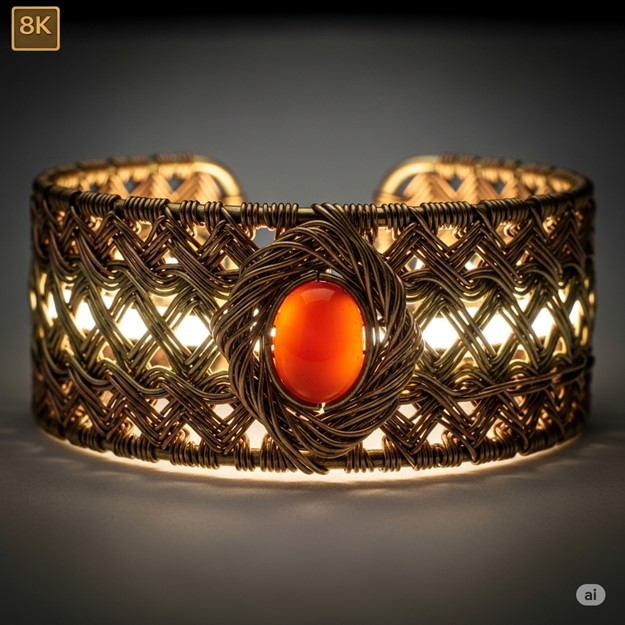
Perception of Activation:
Sight
- User’s Perspective: From the wearer’s point of view, the activation is intimate and focused. A soft, clean white light gently emanates from within the interwoven metal wires, illuminating the hands and the immediate workspace with perfect clarity, overriding harsh shadows without being blinding. The central carnelian stone does not emit light itself, but its deep orange color seems to gain depth and saturation, as if one were looking into a still, warm ember. The light is steady and unwavering, providing a stable visual field for detailed work.
- Observer’s Perspective: To someone watching, the cuff becomes an object of subtle beauty. They see a gentle, warm white light seeping through the intricate gaps in the brass and copper weave, highlighting the complex pattern. The carnelian at the center gives off a soft, pulsating warmth, a deeper orange glow that shimmers as if it contains a tiny, beating heart of fire. The overall effect is elegant and clearly magical, but not ostentatious or distracting to a casual glance.
- Positives: The focused light is a significant boon for any detailed crafting, eliminating the need for external lamps and allowing work in dim or dark conditions. For an observer, the effect is aesthetically pleasing and speaks to a refined form of magic.
- Negatives: In any situation requiring stealth, the light is an undeniable giveaway, broadcasting the user’s position in darkness. For an observer, the activation is a clear, unambiguous signal that the wearer is actively channeling magic, which could draw unwanted attention in hostile or magically-regulated areas.
Sound
- User’s Perspective: The wearer perceives a low, resonant hum. It is not an auditory sound in the conventional sense, but more of a haptic vibration that seems to travel directly through the bones of the wrist and into the forearm. It is perfectly steady, a single, pure note that helps to quieten distracting ambient noise and aids in achieving a state of deep focus.
- Observer’s Perspective: From even a foot away, the item is completely silent. The sound is so localized and low on the frequency spectrum that it is imperceptible to anyone but the wearer.
- Positives: The internal hum is a powerful meditative aid, helping the user to concentrate and find a rhythm in their work. Its silence to others ensures maximum discretion.
- Negatives: For an avatar who is particularly sensitive to monotonous sounds or suffers from certain sensory conditions, the constant, unwavering hum during very long periods of use could eventually become an irritating distraction, a background noise that cannot be turned off.
Touch
- User’s Perspective: A pleasant, penetrating warmth blooms from the cuff, spreading through the wrist and down into the fingers. It feels like immersing one’s hand in perfectly warm water, soothing away any stiffness in the joints and making the fingers feel more nimble and responsive. The gentle, magical pressure that holds the cuff in place tightens by a barest fraction, a reassuring and grounding sensation of being held.
- Observer’s Perspective: If an observer were to touch the activated cuff, they would only feel a mild warmth on the metal’s surface, similar to a stone that has been resting in the sun. They would not feel the user’s sensation of pressure or the deep, penetrating heat.
- Positives: The warmth is therapeutic, easing fatigue and promoting the fine motor control necessary for delicate tasks. It can keep a crafter’s hands functional and comfortable for much longer periods.
- Negatives: In an already hot or humid environment, such as a jungle or near a forge, the additional, unceasing warmth could become uncomfortable, leading to sweat and a feeling of being overheated.
Smell
- User’s Perspective: A faint, almost subliminal scent accompanies the activation. It is the clean, dry smell of hot stone and ozone, with a subtle metallic note of warm copper. It is not a perfume, but rather the simple scent of pure elements being charged with magical energy.
- Observer’s Perspective: The item is odorless to any observer. The scent is a psychic impression tied to the user’s perception of the magic flow, not a physical emission of particles.
- Positives: The clean, unobtrusive scent can help center the user, associating the aroma with a state of focus and creative flow. It cannot be detected by others or by creatures with a keen sense of smell.
- Negatives: For a user who is highly sensitive to metallic scents, it could be a minor distraction, though it is typically too faint to be truly unpleasant.
Taste
- User’s Perspective: A sympathetic reaction to the magic flow creates a faint but distinct taste of metal on the back of the user’s tongue. It is the clean, mineral-like taste of pure water that has been stored in a copper vessel.
- Observer’s Perspective: There is no taste perception for an observer.
- Positives: This provides an additional, subtle layer of sensory feedback, confirming that the item is active and magic is flowing correctly.
- Negatives: The unexpected metallic tang could be momentarily unpleasant or strange for a new user not yet accustomed to the sensation of channeling magic in this specific way.
Extra-Sensory Perception: Magical Resonance
- User’s Perspective: Through their Mind’s Eye, the user feels the chaotic sea of ambient magic around them become calm and orderly in their immediate vicinity. It is a feeling of a messy room suddenly being put in perfect order. Their own internal magic flow feels smoother and more refined, as if it were passing through a filter that removes all inefficiency.
- Observer’s Perspective: A magically-attuned observer would perceive a small, stable aura of tranquil magic enveloping the user. It would feel unusually coherent and well-structured, a stark contrast to the typical fluctuations of Saṃsāra’s magical environment.
- Positives: This effect dramatically reduces the mental effort needed to perform magical crafting or enchantments, decreasing the risk of failure and lessening mental fatigue.
- Negatives: This bubble of ordered magic is like a lighthouse in the fog for other magic-users or magical entities. It signals the presence of a skilled and controlled practitioner, which could attract the attention of rivals, magical predators, or authorities.
Extra-Sensory Perception: Empathic Connection
- User’s Perspective: The user experiences a profound sense of connection to the object of their craft. They can feel the grain of the wood, the tensile strength of the thread, or the crystalline structure of the gem not just with their hands, but with their mind. It feels less like imposing their will upon a material and more like entering into a cooperative dialogue with it.
- Observer’s Perspective: This is a purely internal experience and cannot be perceived by an observer.
- Positives: This empathic bond allows for a much higher level of craftsmanship. The user works in harmony with their materials, resulting in more beautiful, durable, and resonant creations.
- Negatives: The connection can be emotionally draining. If a piece of material is flawed and breaks during a delicate process, the user might feel a sharp, sympathetic pang of pain and failure, which can be disheartening.
Extra-Sensory Perception: Truth-Sense
- User’s Perspective: The user’s perception of quality becomes absolute and intuitive. A flaw, a slight asymmetry, or an impurity is perceived not just as a mistake, but as a jarring dissonance, a “lie” in the fabric of the object. A perfect, seamless joint or a symmetrical pattern feels harmonious, resonant, and “true.”
- Observer’s Perspective: Not perceivable.
- Positives: This drives the user to an extremely high standard of quality, enabling them to spot and correct flaws that others would completely miss.
- Negatives: This can lead to a crippling perfectionism. The user may feel compelled to spend hours correcting a minuscule, functionally irrelevant flaw simply because its “falseness” is a constant source of mental irritation, slowing down their overall progress significantly.
The Rite of Harmonious Weaving
This is the standardized process used by artisans to recreate a functional, if un-storied, version of the Kereshmeh cuff. While it lacks the specific historical resonance of an original artifact found in a Yazdgard ruin, it faithfully reproduces the magical functions required by a Tier 1 crafter. The process is a delicate balance of precise metalwork and focused magical infusion, a testament to the belief that true craftsmanship is a form of active meditation.
Materials Needed
- Core Metals:
- One spool of high-purity copper wire, approximately 18-gauge. The copper must be free of significant impurities.
- One spool of brass alloy wire, of the same gauge. The brass should be of a consistent and warm hue.
- Focal Stone:
- A single, uncut carnelian stone of at least 20 carats. The stone must possess a deep, even orange coloration and be free of internal fractures. It will be the vessel for the item’s core enchantments.
- Purification Agents:
- A bowl of clean, dry sand for polishing.
- A block of refined beeswax for finishing.
- Three drops of elemental water, magically sourced and held within a sealed glass vial. This is not mundane water, but its purified magical essence.
- Magical Catalyst:
- A small pouch of powdered silver. This will not be part of the final construction but will be consumed during the ritual infusion to help stabilize and channel the magic flow.
Tools Required
- Mundane Tools:
- A set of jeweler’s pliers, including flat-nosed, round-nosed, and wire-cutting varieties.
- A cylindrical mandrel of hardened steel or wood, sized to the intended wearer’s wrist.
- A lapidary grinder and polishing wheels, powered by a small, magic-to-steam-to-mechanical power transmission system.
- A small, magically-heated soldering iron, which uses a crystal focus to combine elemental fire and air for precise heat.
- Soft leather cloths for polishing.
- Magical Implements:
- An Infusion Slate: A flat, palm-sized piece of polished obsidian or slate inscribed with a simple magical circuit diagram. This tool helps the crafter focus and direct their personal magic flow into an object.
- A Harmonic Tuning Fork: A small, two-pronged fork made of silver. When struck, it emits a pure magical tone that helps align and settle enchantments, preventing magical “bleed” or instability.
Skill Requirements
- Wire Weaving (Journeyman): The crafter must be proficient in creating complex, tight, and symmetrical patterns with metal wire. A novice’s uneven tension or imprecise angles will cause the enchantment to fail.
- Lapidary Arts (Apprentice): Basic skill in cutting, shaping, and polishing gemstones is required to form the cabochon.
- Tier 1 Magic Infusion (Practiced): The crafter must have trained their Mind’s Eye to perceive and consciously direct their own magic flow. They need the control to channel a steady, low-intensity stream of magic for a sustained period.
- Ritual Focus (Novice): The ability to maintain concentration and follow the precise steps of a magical ritual without deviation is essential. A lapse in focus at a critical moment can result in a mundane, powerless object.
Crafting Steps
Step 1: Stone Preparation and Attunement The process begins with the focal point. The crafter takes the raw carnelian and uses their lapidary tools to carefully cut and shape it into a smooth, rounded oval cabochon. This is an act of mechanical skill, requiring patience and a steady hand. Once shaped and polished to a perfect sheen, the crafter places the finished stone in the center of their Infusion Slate. They then place their hands on either side of the slate and close their eyes, extending their Mind’s Eye to the stone. For several minutes, they must simply feel the stone’s internal structure and presence, establishing a preliminary magical connection.
Step 2: The Foundational Weave Using the mandrel as a form, the crafter begins the intricate weaving of the brass and copper wires. This is the longest and most physically demanding part of the process. They must create the repeating geometric pattern, ensuring every wrap is tight and every angle is precise. The pattern itself is a form of magical equation rendered in metal; its symmetry and order are what will later contain and direct the magic. This step requires intense focus, as a single significant mistake in the pattern will disrupt the final enchantment.
Step 3: Setting the Focus With the main body of the cuff woven, the crafter creates a nested bezel setting in the center of the pattern, designed to hold the carnelian cabochon. This setting must be perfectly symmetrical. The stone is then carefully placed within the bezel, and the metal wires are skillfully bent and tightened to secure it. No solder or adhesive is used here; the stone is held by pure mechanical tension, a physical representation of the magic being bound within a structure.
Step 4: The Rite of Cleansing and Sealing The crafter places the fully assembled but unenchanted cuff onto the Infusion Slate. They sprinkle the powdered silver in a circle around the cuff. Taking the vial of elemental water, they carefully let one drop fall onto the copper wire, one onto the brass wire, and the final drop directly onto the carnelian. A faint hiss and a wisp of clean-smelling steam will rise. This act purges the object of any lingering stray energies from its creation. The crafter then uses the magically-heated soldering iron to seal the ends of the wire weave on the underside of the cuff, completing the physical circuit.
Step 5: The Sustained Infusion This is the most critical magical step. The crafter again places their hands on the Infusion Slate, but this time they actively channel their magic flow. Visualizing the intended purpose of the cuff—purity, focus, symmetry—they push a slow, steady stream of magic into the slate. The powdered silver will begin to glow faintly as it is consumed, acting as a catalyst. The magic flows up into the cuff, which will begin to warm. The user must maintain this flow without interruption for at least ten minutes. The copper wires will absorb the purifying aspect of the enchantment, while the brass absorbs the focus and stability aspects. The magic flows into the carnelian, which acts as a capacitor and regulator for the stored power.
Step 6: Harmonious Stabilization As the infusion ends, while the cuff is still glowing with raw, untamed magic, the crafter takes the Harmonic Tuning Fork and strikes it sharply against the edge of their workbench. It emits its pure, magical tone. They slowly pass the vibrating fork over the entire cuff, from one end to the other. The tone from the fork will cause the light within the cuff to steady and the internal hum to settle into its final, stable resonance. This final step locks the enchantments in place, ensuring they are permanent and will not degrade over time. The cuff is then given a final polish with beeswax and is ready for use.
First Pattern and Gray Blight
It is told from the worn scrolls that in the time before times, on the island of the sun-stone which was called Yazdgard, there was a city of impossible beauty. The buildings were not made with rough hands, but were sung from the stone by masons of the highest order. The clothes of the people were not mere cloth, but woven light and captured seasons from the looms of the Weaving Guild. At the heart of the city, and at the heart of the Guild, stood the Great Loom. It was not a thing of wood and string, but a grand machine of brass and living crystal, and it was said its threads were the very lines of asha, which is Truth and Order, and its endless weaving held the city in a state of grace.
And so it was.
But from the Outer Dark, from the place of un-making, came a sickness. It had no body and made no sound. The Magi called it the Whispering Un-Truth, but the common folk knew it as the Gray Blight. It did not kill with fever or with sword. It was a plague upon Order itself.
At first, it was small things. A master potter would open his kiln, and his finest vase, which should have been perfect, would have a hairline crack, a line of untruth. A musician would play a flawless song upon his flute, but one sour note, a note of chaos, would cry out. Then the Blight came to the Weaving Guild. A thread of brilliant crimson would inexplicably snap. A pattern of pure gold would seem to tarnish overnight. The colors themselves seemed to tire and fade, bleeding into one another like tears. The Gray Blight was unraveling their work, and so it was unraveling their world.
The great masters of the Guild and the powerful Magi in their fire-temples performed the grand rituals. They chanted the ancient words of power and burned the sacred oils to drive back the Un-Truth. But their mighty spells found nothing to strike. Their magic was a great net, but the Blight was like water and passed through it. The Whispering Un-Truth could not be fought with power, for it was a flaw in the very idea of power. The Great Loom shuddered and stalled, its crystal heart dimming. And there was fear.
And so it was.
Now, there was in the guild a young woman named Parin. She was not a master, nor did she know the great words of power. Her hands were skilled, but her station was low. While the masters despaired, Parin watched and she saw. She saw that the Blight, this Un-Truth, was a thing of complexity and deception. It thrived in the places where many magics were knotted together. But it seemed to shy away from things that were simple and singularly true. A plain copper bowl, polished and clean, held its shine longer than a gilded one. A common river stone, the carnelian, held its deep orange fire when a faceted diamond grew cloudy.
An idea, a pattern, formed in her mind. It was not a grand spell, but a small, perfect thought.
She went not to the great vaults of the Guild, but to her own small chest. She took a spool of pure copper wire, which is the metal of honest conduction. She took a spool of strong brass wire, which is an alloy of purpose and structure. She took the finest carnelian she owned, a simple, smooth stone that looked like a drop of the setting sun.
She went to her small loom, and she began to work. She did not chant the words of the Magi. She did not draw power from the ether. Her one and only magic was an act of perfect, focused creation. She began to weave the wires of copper and brass, one over the other, into a geometric shape, a pattern of un-breaking order. Every twist was precise. Every line was true. Her breath was even. Her mind was clear. She braided the light of her mind into the metal strings. She was not enchanting the metal; she was making the metal itself into an enchantment through the sheer honesty of her work. She made a space for the carnelian, a nest of truth, and set the stone within the weave. She worked for a day and a night, and when she was done, she held a single cuff, a shackle of truth.
And so it was.
It was plain, yet perfect. She felt a small warmth from it. With trembling hands, she slid it onto her wrist. There was no flash of light, no clap of thunder. There was only a quiet hum, a note of pure harmony that only her soul could hear. A soft light, gentle and white, bloomed within the wires, and the stone at its heart glowed with a steady, inner warmth. Around her, a space no bigger than her own body, the world seemed to right itself. The air grew still and clean. She took a spool of thread that the Blight had grayed and faded, and as she drew it into the circle of her aura, the vibrant color returned to it. She pulled the thread, and it did not snap.
Parin, holding her arm and the new-made fetter of light, walked to the hall of the Great Loom. The masters saw her and the glow from her wrist, and they stood aside. She approached the vast, silent machine. Reaching out, she placed her hand, the hand wearing the cuff, upon the dim crystal heart of the Loom.
Her small aura of perfect order, the truth of her honest work, flowed from the cuff and into the machine. It was not enough to relight the whole crystal. It was not enough to drive the Blight from the city. But it was enough. It created a single, stable point in the chaos. The dim heart of the Loom steadied, and a small part of it began to glow with a pure, white light, pushing back the encroaching gray.
The Magi and the masters saw and at last they understood. The Gray Blight could not be defeated by a single, grand act of power. It had to be defeated by a thousand small, perfect acts of truth. Using Parin’s creation as the new pattern, they began to make more of the cuffs, one for every artisan whose work was true. Each cuff created another small island of order, and together, these islands pushed back the sea of Un-Truth, not by destroying it, but by simply leaving no place for it to exist. The city was saved.
And so it was.
Moral of the story: Great corruption is not always answered by great power, but by a small, perfect act of truth.
Suggested conversions to other systems:
Dungeons & Dragons (5th Edition)
Kereshmeh of the Artisan Wondrous item, common (requires attunement by a creature proficient with at least one type of artisan’s tools)
This two-inch-wide cuff is crafted from intricately interwoven brass and copper wires, forming a repeating geometric pattern. A single, smooth cabochon of deep orange carnelian is set in its center.
When you are wearing this cuff, you gain the following benefits:
- Artisan’s Focus. When you make an ability check using any artisan’s tools you are proficient with, you can add a d4 to the roll.
- Eye for Flaw. As an action, you can closely examine a single non-magical object or structure within 5 feet of you. You automatically learn of any structural weaknesses, mundane imperfections, or points of material impurity it possesses.
- Rite of Purity. The cuff has 3 charges. As an action, you may expend 1 charge to cast the Prestidigitation cantrip. When cast in this way, you can only use the “You instantaneously clean or soil an object no larger than 1 cubic foot” or “You make a color, a small mark, or a symbol appear on an object or a surface for 1 hour” effects. The cuff regains all expended charges daily at dawn.
- Knot of Order. When you make an ability check with artisan’s tools, you can expend 1 charge from the cuff as a reaction to treat the d20 roll as a 10. You can use this ability after you roll the d20 but before you know the outcome of the roll.
Call of Cthulhu (7th Edition)
The Yazdgard Cuff of True Weaving Artifact
This cuff is an authentic artifact traced back to a pre-historic Persian culture that, according to certain forbidden texts, fled to this world to escape an “unraveling of reality.” It is made of an unknown brass-like alloy and pure copper, woven in a pattern that is unnervingly precise and seems to shift slightly when not directly observed. A central carnelian stone feels unnaturally warm.
An Investigator who wears the cuff gains the following abilities:
- Harmonious Craft. The wearer gains one Bonus Die on all Art/Craft skill rolls.
- Perceive the Flaw. When closely examining a specific object or mechanism, the wearer may spend 1 Magic Point and make a Hard POW roll. If successful, they have a flash of insight, revealing its greatest structural weakness or a hidden, non-obvious point of failure. This knowledge may grant a Bonus Die on a subsequent Mechanical Repair, Spot Hidden, or other relevant skill roll, at the Keeper’s discretion.
- Ritual of Cleansing. By focusing intently for one minute, the wearer can purify a single small object (no larger than a book) of mundane dirt and grime. If the object is tainted by minor supernatural residue (e.g., the slime of a Mythos creature, ectoplasmic resonance), this ritual can cleanse it, though doing so costs the user 1 Magic Point and 1 Sanity point. This provides no protection from the entity that left the residue.
- The Perfect Action. Once per day, when attempting an Art/Craft or Mechanical Repair roll, the wearer can choose to automatically succeed with a Regular success, as if they had rolled exactly their skill value. Declaring this invokes a brief, alien understanding of cosmic order and perfection that the human mind was not meant to grasp. Cost: 1/1d4 Sanity points.
Blades in the Dark
The Whisper-Woven Kereshmeh Strange, Worn, Ritual Object
An ancient bracelet of woven wire from the Drowned City of Yazdgard. They say the first weavers who wore these could see the patterns that hold the world together and repair them when they frayed. It hums with a quiet, orderly power that resonates with the ghost field.
- When you Tinker to create or repair a delicate or intricate item, gain +1 effect.
- When you attempt to attune to a spirit or analyze a strange artifact, you can push yourself to gain +1d for only 1 stress (instead of the usual 2). The cuff absorbs the psychic strain.
- You can perceive the hidden flaws in objects and structures. When you study your environment, you can always ask the GM: “What’s the best way to break this?” and get an honest answer.
- When you perform a ritual to cleanse an object or location of spiritual residue, use the Kereshmeh as a focus to gain +1d to your roll.
Knave (2nd Edition)
Artisan’s Truth Cuff Item, Worn
A cuff made of interwoven copper and brass wires holding a polished orange stone. It feels warm and hums faintly.
- When you inspect a non-magical, crafted object for one minute, you automatically discover all of its flaws, weaknesses, and structural instabilities.
- Once per day, you can touch an object to instantly clean it of all mundane rust, dirt, and grime.
- When you attempt a task requiring delicate manual dexterity (e.g., repairing a watch, setting a trap, forging a signature), you may gain advantage on your roll. This ability can be used three times per day.
Fate Core System
The Pattern of True Asha
This item is an Extra, representing a powerful magical artifact.
- High Concept Aspect: Woven Cuff of Perfect Order
- Trouble Aspect: An Unyielding Standard of Perfection
Stunts:
- Eye for the Flaw: Because I wear the Woven Cuff of Perfect Order, once per scene, I can spend a Fate Point to discover a new Situation Aspect on an object or structure, representing a critical weakness or imperfection (e.g., Cracked Keystone, Frayed Support Rope, Jammed Mechanism).
- Harmonious Craftsmanship: Because I wear the Woven Cuff of Perfect Order, I get a +2 bonus to all Crafts rolls when I am attempting to create an object of exceptional quality or repair a delicate mechanism.
- The Unbroken Pattern: Because I wear the Woven Cuff of Perfect Order, when an opponent attempts to inflict mental or emotional stress on me by creating an advantage related to chaos, despair, or corruption, I can defend using my Crafts skill instead of Will. I must be able to justify how my focus on inner order and patterns allows me to resist the attack.
Numenera & Cypher System
Cuff of Coherent Patterning
- Level: 3
- Form: An intricate cuff of woven metallic fibers that glows with a soft, internal light when active. A polished orange gem is set at its center.
- Effect: This artifact aids in acts of creation, repair, and analysis. When worn, it eases all tasks involving fine craftsmanship, delicate repair, or the identification of complex patterns by one step. Once per day, the wearer can activate the cuff to purify a single object up to the size of a shield, instantly removing any mundane dirt, grime, or non-harmful chemical residue of level 3 or lower. The wearer can also concentrate on any object within immediate range to perceive its structural data. The GM should describe any points of weakness, material flaws, or instability. This is a narrative effect and does not require a roll.
- Depletion: 1 in 1d20 (Check each time the wearer uses the perception or purification ability.)
Pathfinder (2nd Edition)
Artisan’s Kereshmeh Item 2+
- Traits: Common, Invested, Magical, Divination, Transmutation
- Usage: Worn wrist; Bulk —
This cuff is made of intricately woven copper and brass wires that form a precise, geometric pattern around a central carnelian stone. It feels warm to the touch. You gain a +1 item bonus to Crafting checks while wearing this cuff.
- Activate [one-action] (Interact); Frequency once per 10 minutes; Effect You touch an object and run your fingers over its surface. You learn about one of its mundane structural flaws, areas of weakness, or imperfections. This gives you a +2 circumstance bonus to your next check to Disable, Repair, or Break that object.
- Activate [free-action] (Envision); Frequency once per day; Trigger You are about to roll a Crafting check to create or repair an item; Effect Instead of rolling the d20, you receive a result of 10 on the die. You still add your total Crafting modifier to this result. This result cannot be a critical success.
Type: Artisan’s Kereshmeh; Level 2; Price 30 gp Type: Greater Artisan’s Kereshmeh; Level 8; Price 450 gp The item bonus to Crafting is +2, and the circumstance bonus from the first activation is +3. You can use the second activation three times per day.
Savage Worlds (Adventure Edition)
The Cuff of True Making
This is a magical item of ancient origin, a testament to a culture that valued perfect craftsmanship above all else. The cuff is made of finely woven metal wires and a central orange stone. It feels warm and hums with a barely perceptible energy.
A character wearing the cuff gains the following benefits:
- Master’s Hand: The wearer gains a +1 bonus to all Repair rolls, as well as any other skill roll involving fine, delicate crafting (such as creating jewelry, fine tailoring, or intricate carving), at the GM’s discretion.
- Eye for Imperfection: By handling an object for a full round, the wearer can automatically identify any mundane weaknesses or structural flaws. This may grant a bonus to attempts to break or exploit the flaw, as determined by the GM.
- Purifying Touch: Once per day, the wearer can touch an object to instantly clean it of all mundane dirt, rust, or grime.
- Inspired Rework: Once per session, when the wearer spends a Bennie to re-roll a Repair roll or another crafting-related skill roll, they may add +2 to the final result of the re-roll.
Shadowrun (6th Edition)
Patterner’s Weave Foci
This is an Artificer-made focus, created from designs allegedly recovered from a pre-Awakening archaeological dig in the Middle East. It is a woven cuff of gold, copper, and orichalcum wires that holds a flawless fire opal. It is favored by high-end magical artisans and forensic mages.
- Focus Type: Skill Focus (Artisan)
- Force: 2
- Activation: Simple Action
- Availability: 8R
- Cost: 10,000 Nuyen
Game Mechanics:
- Artisan’s Edge: As a Force 2 Skill Focus, this item adds 2 dice to the user’s dice pool for any test using the Artisan skill.
- Pattern Recognition: The focus’s magic assists in perceiving ordered systems. The wearer gains 1 Edge on any Engineering or Electronics test made to assess the structural integrity, data patterns, or flaws of a device or object. This Edge must be used on that test.
- Cleansing Wave: Once per hour, the wearer can use a Simple Action to touch an object or surface. The focus magically cleans an area equal to its Force in square meters, scouring it of mundane dirt, grime, and non-toxic residue.
- Perfected Detail: Once per day, after making an Artisan or Engineering test, the wearer may choose to add 1 hit to their final result automatically. This must be declared before the GM describes the outcome.
Starfinder
Kereshmeh of the Star-Weaver
- Level: 3
- Price: 1,400 credits
- Bulk: L
- Hands: —
- Type: Magic Item; Slot: Wrists
This elegant cuff is woven from threads of copper and a gold-like alloy around a central, warm carnelian stone. It is an artifact of a forgotten culture that blended high art with cosmic magic. It is popular among envoys who wish to project an air of classic taste and mechanics who appreciate its utility.
- While wearing this cuff, you gain a +2 insight bonus to skill checks to craft or repair items (such as Engineering or Mysticism checks).
- Once per day, as a standard action, you can touch an object to analyze its structure. You learn of one critical vulnerability or mundane flaw in the object. The next time you attempt to sunder, disable, or otherwise exploit that flaw, you gain a +2 circumstance bonus to your attack roll or skill check.
- As a standard action, you may activate the cuff to perfectly clean and sterilize a single object of up to 1 bulk.
- Once per day, you may choose to take 10 on an Engineering or Mysticism check to craft or repair an item, even if stress or distractions would normally prevent you from doing so.
Traveller (Mongoose 2nd Edition)
Pattern-Weaver’s Nanobracelet (TL 16)
This device appears to be a simple, elegant piece of jewelry made of intricately woven, warm-hued metals. It is an artifact of a Precursor race, believed to be an advanced diagnostic and fabrication tool. Its inner workings rely on near-sentient nanotechnology that interfaces with the user’s bio-signature. It cannot be manufactured with modern technology and is considered a priceless artifact.
- Skill Interface: The bracelet’s internal systems guide the user’s hands through complex tasks. It provides DM+1 to all Mechanic and Engineer skill checks.
- Structural Analysis: The bracelet contains a full-spectrum analysis suite. By holding the cuff against an object for one minute, the device performs a complete structural scan, revealing all material flaws, stress fractures, or points of weakness. For highly complex devices (TL 10+), the user must succeed on an Electronics (sensors) 8+ check to properly interpret the detailed diagnostic data.
- Nanite Purification Cycle: Once per day, the bracelet can release a cloud of programmable nanites. These nanites will swarm over a single object up to 10kg, disassembling and rendering inert all foreign matter (dirt, grime, non-corrosive chemicals, biological contaminants). The process takes one minute.
- Fabrication Enhancement: Once per day, when making a Mechanic or Engineer check to craft or repair an item, the user may choose to treat the Effect of the roll as being 2 points higher than the result rolled. This must be declared after the roll is made but before the outcome is determined.
Warhammer Fantasy Roleplay (4th Edition)
The Cuff of Yazad
This magical bracelet is rumored to be a relic from the strange, faraway lands of Araby, or perhaps even older Ind. It is not a product of the Colleges of Magic, but seems to be an article of faith, imbued with the spirit of a foreign god of order, artisans, and truth. The Cult of Sigmar views it with suspicion, but its utility is undeniable, and it shows no overt signs of chaotic taint.
- Honest Craft: The wearer feels a sense of calm purpose when engaged in their trade. They gain a +10 bonus to all Tests using the Trade (any) skill.
- Perceive the Flaw: By spending a minute carefully examining an object, the wearer may make a Challenging (+0) Perception Test. If they succeed, they identify a single, critical weakness or imperfection in its construction (e.g., a weak hinge, a loose stone, a poorly-mixed mortar patch). The wearer gains +1 SL on their next Test made to exploit this identified flaw.
- Prayer of Purity: Once per day, the wearer may whisper a short prayer to the foreign god Yazad and touch an object. The object is instantly cleansed of all mundane filth and grime. This is a minor, non-sinful act that requires no Test.
- An Act of Truth: Once per day, before making a Test using any Trade skill, the wearer may declare they are performing an Act of Truth. They immediately gain 2 Advantage, which must be used on that Test. After the Test is resolved, any remaining Advantage gained from this ability is lost.