
Definition: Ragnosh is a unique and potent language that revolves around the expression of anger, rage, and intense emotions. It enables communication across species, channeling and amplifying the power of fury to influence the emotions and actions of others.
Linguistic Attributes and Characteristics:
- Intense Vocabulary: Ragnosh is characterized by a vocabulary that emphasizes powerful and aggressive words, designed to evoke and amplify feelings of anger and indignation.
- Forceful Syntax: The language is structured to convey a sense of urgency and dominance, with sentences often arranged in a way that demands attention and respect.
- Elemental Infusion: Ragnosh incorporates elements of nature’s fury, such as thunderous roars, fiery metaphors, and sharp gusts, making it feel like the very elements are raging within the words.
Structure: Ragnosh follows a structured but adaptable pattern, giving speakers the flexibility to convey their anger in various forms, from simmering resentment to explosive wrath. The language enables speakers to invoke vivid mental imagery, making the listeners experience the intensity of the emotion.
Cultural Identity and Usage: Ragnosh is often associated with warrior cultures, creatures with a strong connection to elemental forces, and those who seek to dominate or intimidate others through sheer force of anger. It is used in confrontations, conflicts, and battle scenarios, as well as by those who wish to rally allies with passionate rhetoric.
Rarity, Type, Script, Source, and History:
- Rarity: Ragnosh is relatively rare and not widely known among all species. Its powerful nature means that it is often guarded and shared only among select individuals or groups.
- Type: Ragnosh falls under the category of magical languages, as it possesses an inherent power to influence emotions and actions. It is reserved for specific situations where anger is to be harnessed as a tool.
- Script: Ragnosh is written in jagged, bold strokes that reflect the sharpness and aggression associated with the language.
- Source and History: Legends tell of ancient beings who mastered their rage and channeled it into words of power, creating Ragnosh as a means to assert dominance and command respect. Over time, it spread through clans, warrior societies, and secret circles.
Sensory Experience: The use of Ragnosh is an intense experience for both the speaker and the listener. When spoken, the words carry a weight of authority and evoke a sense of impending danger, sending shivers down the spine. The tone and volume of the language can evoke primal responses, triggering a fight-or-flight response in those who hear it. In telepathic communication, the emotions behind the words are transmitted directly, intensifying the listener’s emotional reaction.
Ragnosh is a potent language with an emphasis on anger and power. Its linguistic attributes, cultural significance, and intense sensory experience make it a formidable tool in the hands of those seeking to harness and direct the force of rage.
Tags: anger, rage, fury, dominance, aggression, intensity, wrath, battle, power, intimidation, elemental, forceful, primal, urgency, command, passion, conflict
Inscriptions:
- “Gravoth rualven” — Rage carved eternal into stone.
- “Thural veynak” — Let fury guard these walls forever.
- “Vorash drulven” — Anger endures longer than steel.
- “Kravon sulveth” — Wrath strikes from every mark.
- “Dorvak enrath” — Fury is the shield of this place.
- “Veyrol thragan” — Anger echoes louder than time.
- “Drash venoth” — Fury burns unending in these lines.
- “Korath ulvash” — Rage itself binds this stone.
- “Beyruk tharven” — Fury roars in every carved wound.
- “Morash griven” — Anger’s scars become immortal here.
- “Thyrok velarn” — Wrath watches all who pass.
Political Oaths:
- “Ravok drulnar” — I swear with fury as my bond.
- “Thaven groval” — In wrath, I bind my will to rule.
- “Kraveth sulran” — My vow is fire, unbroken, unyielding.
- “Vorak enral” — I lead with fury to protect the people.
- “Dravoth ulkan” — Wrath is my oath, strength in flame.
- “Gorath venral” — By anger’s roar, I shall not falter.
- “Thrakor dulven” — Rage steels my hand in governance.
- “Beyruth orlan” — My promise is wrath, unbending.
- “Morvak ulthar” — I stand unbroken, fury as guide.
- “Zorath crenul” — I vow eternal rage against betrayal.
- “Velgrash uthorn” — Wrath is my law, and my word eternal.
Cultural Ceremonies:
- “Rathven sulkar” — Together we ignite fury into flame.
- “Drakoth venul” — Our bond sealed in wrathful unity.
- “Vorash krenar” — Anger binds us as one people.
- “Tharven ulkor” — Fury blesses the union of strength.
- “Korvak drulan” — Rage sanctifies this rite of fire.
- “Grynal vothar” — Wrath roars across this gathering.
- “Brakul envor” — Anger burns the path for our future.
- “Veyrath dulven” — Fury is witness to our vows.
- “Thrakul orven” — Wrath consecrates the turning of time.
- “Zeyrak morval” — Together we roar, fury everlasting.
- “Dorval uthesh” — Our voices in anger become eternal flame.
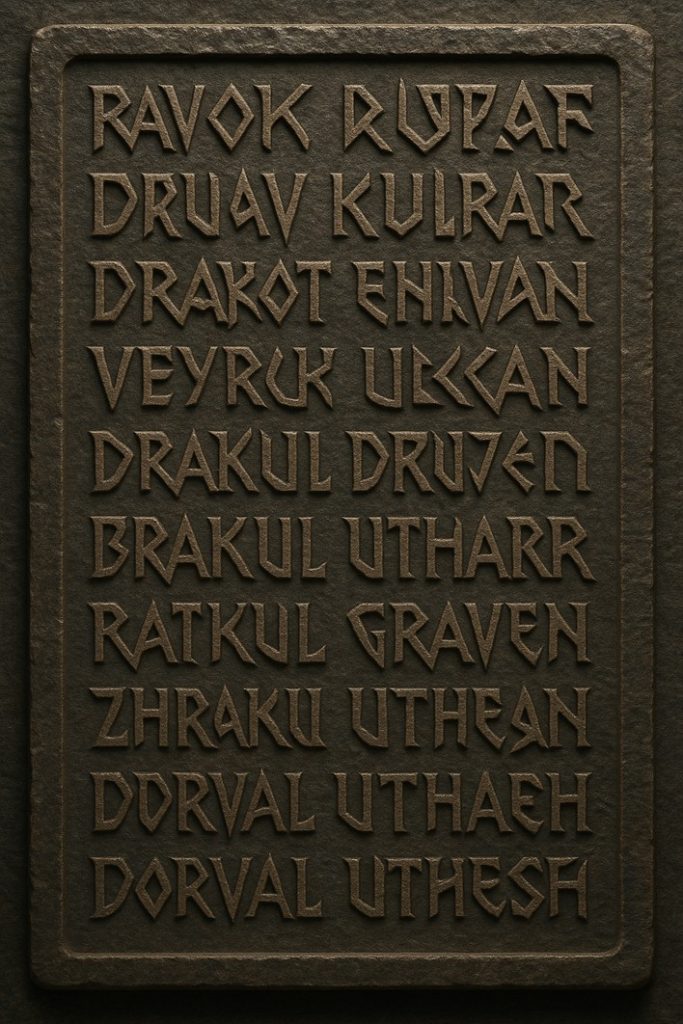
Roar That Broke the Sky
In the half-burned scrolls and shattered tablets of forgotten ages, there lingers the tale of a language forged not in quiet halls nor in whispered prayer, but in the fury of storms and the cries of battle. This language, remembered now as Ragnosh, was said to be born when the earth trembled and the heavens cracked, when mortals and spirits alike sought words fierce enough to carry their rage into the marrow of the world.
The tale begins with the figure called The First Shouter. His true name is lost, replaced in translation with fragments: “He-Who-Roared-Against-the-Stars.” He was said to be a warrior who had lost all—his clan burned, his blade shattered, his gods silent. Standing upon a cliff as thunder split the skies, he bellowed a cry not meant for men, but for the elements themselves. His voice, filled with wrath so pure it seared the air, echoed back not as an echo but as words—strange and jagged, filled with fire and storm. Thus, the first syllables of Ragnosh were torn into being.
Those who heard him were shaken. Enemies stumbled, allies trembled, even the beasts of the field fled. The words did not soothe, nor persuade, nor explain—they commanded. And in their command, anger became strength. Soon, others sought to shape their fury in the same way, repeating the guttural roars, mimicking the crack of rage that rolled like thunder from the mouth of the First Shouter.
Over time, the fragments say, entire clans rose in the power of Ragnosh. Warriors painted its jagged script onto shields, carved it into stone gates, and roared its phrases before charging into battle. The sound of the language was said to summon storms, to cause fire to leap higher, to make steel ring sharper in the hands of the furious. Rulers swore oaths in Ragnosh, their voices shaking halls of stone, and the people followed not out of trust, but out of fear and awe.
Yet the story holds warning, too. One translation speaks of the City of Red Walls, where every street was carved with the runes of rage. Its people, drunk on fury, roared endlessly, day and night. Their voices grew louder, harsher, until even they could not tell enemy from ally. The city devoured itself in wrath, its stones cracked by the force of voices too fierce to be borne. On a scorched tablet, one line remains: “Wrath without purpose is fire without fuel; it consumes itself.”
Still, Ragnosh endured, not because it promised peace, but because anger always endures. In each generation, when the weak are pressed, when the strong are betrayed, when the sky itself feels deaf to pleas, someone will roar. And in that roar, the syllables return, jagged and alive, reminding all that fury has its tongue.
The final fragment of the tale, repeated in many broken forms, reads: “Rage given word is rage given power.”
Moral of the Story: Anger, when shaped and directed, becomes strength; but when left to burn uncontrolled, it destroys all, even itself.