
Perplexo is a language that embodies confusion, disorientation, and a constant state of bewilderment. It is a linguistic maze, where meaning is often obscured by contradictory elements and nonsensical constructions, leaving speakers and listeners alike in a perpetual state of puzzlement.
Linguistic Attributes and Characteristics:
- Perplexo defies conventional grammar and syntax, with words and phrases seemingly arranged in a haphazard and illogical manner.
- The language is rife with homophones, homographs, and ambiguous terms, allowing for multiple interpretations of the same utterance.
- Perplexo incorporates elements from various other languages, often blending them in ways that defy comprehension, creating a linguistic melting pot of confusion.
- The language employs a unique system of inflections and tonal shifts, which can completely alter the meaning of a word or phrase, adding to the overall sense of bewilderment.
Magical Powers:
- While not inherently magical, Perplexo is believed to hold a certain mystical power, as its ability to confound and disorient is seen as a form of enchantment by some cultures.
- Skilled speakers of Perplexo can weave intricate tapestries of confusion, using the language’s inherent ambiguity to obfuscate meaning and misdirect their listeners.
- It is rumored that ancient sorcerers once used Perplexo as a means of concealing powerful incantations and arcane knowledge, ensuring that only the truly initiated could decipher their hidden meanings.
Cultural Identity and Users:
- Perplexo is spoken by the enigmatic Maze Wanderers, a nomadic tribe that roams the vast, ever-shifting labyrinths that span the realms.
- These nomads have embraced the language as a means of navigating the inherent confusion and disorientation of their nomadic existence, using Perplexo as a tool for survival and adaptation.
- Perplexo is also favored by tricksters, riddle-makers, and those who revel in the art of obfuscation, as it allows them to weave intricate linguistic puzzles for others to unravel.
Rarity and Type:
- Perplexo is a rare and esoteric language, with few outsiders possessing the mental fortitude and patience required to master its intricate nuances.
- It is primarily a spoken language, as its constantly shifting nature and lack of consistent structure make it ill-suited for written communication.
- However, some scholars have attempted to transcribe Perplexo into written form, resulting in a baffling array of glyphs, symbols, and seemingly nonsensical scripts.
Source and History:
- The origins of Perplexo are shrouded in mystery, with various theories attributing its creation to everything from a divine prank to the byproduct of a powerful enchantment gone awry.
- Some legends speak of an ancient civilization that deliberately developed Perplexo as a means of concealing their most closely guarded secrets, ensuring that only the truly dedicated could unravel the language’s enigmatic puzzles.
- Regardless of its origins, Perplexo has endured through the ages, spreading confusion and bewilderment in its wake, even as it continues to defy comprehension.
Sensory Experience:
- To hear Perplexo spoken is to experience a constant state of mental whiplash, as the language’s contradictory elements and nonsensical constructions assault the senses.
- The shifting tones and inflections create a disorienting auditory experience, making it nearly impossible to grasp the intended meaning behind the words.
- For those fluent in Perplexo, the act of speaking and comprehending the language is akin to navigating a labyrinth of linguistic riddles, requiring a heightened state of mental agility and a willingness to embrace confusion.
Perplexo is a language that defies convention and revels in its own bewildering nature. It is a testament to the enduring human capacity for puzzlement and a reminder that sometimes, the true meaning lies not in clarity but in the very act of untangling the perplexing mysteries that language can weave.
Tags: confusion, disorientation, ambiguity, contradiction, riddles, misdirection, labyrinth, chaos, obfuscation, paradox, illusion, trickery, bewilderment, uncertainty, complexity, entanglement, enigma
Ceremonial phrases in Perplexo that might appear on magical inscriptions, political oaths, or cultural ceremonies. They are intentionally layered with ambiguity, paradox, and shifting meanings—reflecting the bewildering essence of the language:
Magic Inscriptions
- “Circle straight, path broken whole.”
- “Key without lock, door without end.”
- “Flame frozen, water burning, truth unbound.”
- “Step forward backward into the still.”
- “One word hides two, two words hide none.”
Political Oaths
- “I swear by unsworn silence, to hold power by yielding.”
- “In confusion we trust, in disorder we find order.”
- “The leader follows, the follower leads, and both are lost.”
- “My tongue twists to bind, my words unbind to tie.”
- “I vow to keep secrets I do not know, and reveal truths I cannot tell.”
Cultural Ceremonies
- “The labyrinth breathes, and so do we, yet we walk unmoving.”
- “Confusion is clarity, clarity is the mask of confusion.”
- “We gather apart, divided together, whole in fragments.”
- “The ancestor speaks in riddles, and the riddle becomes flesh.”
- “Celebrate the loss of the way, for the way is the loss.”
- “May bewilderment bind us tighter than truth ever could.”
- “To end is to begin where we never started.”
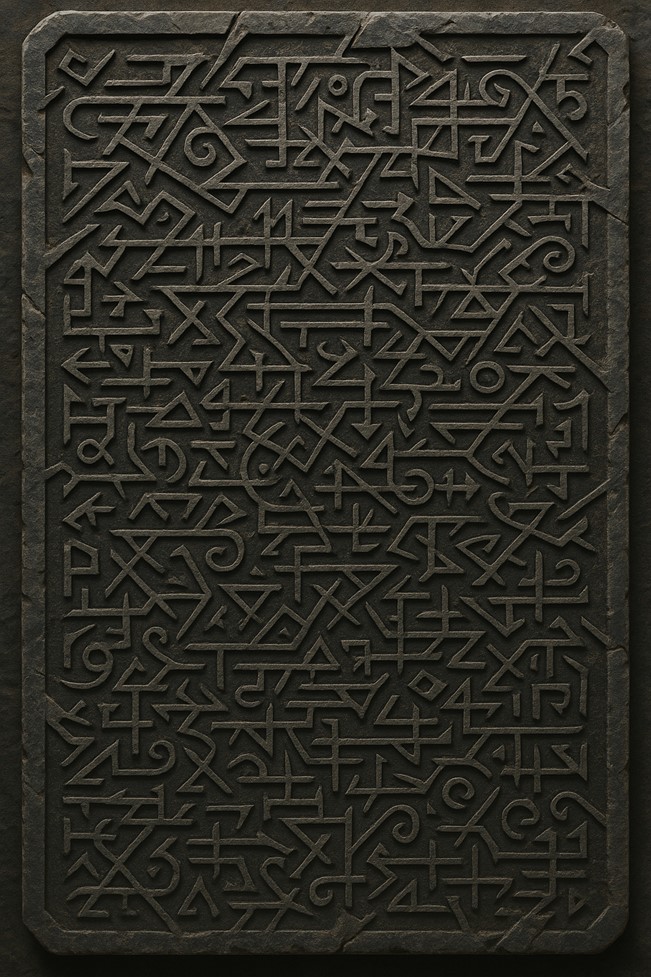
Wanderers Who Lost Their Way in Words
In a time before times, when the world was not yet shaped as we see it now, there was a people who spoke with too many tongues and yet no clear voice. These were called the Maze Wanderers, though their true name is long forgotten. They lived among paths that bent back upon themselves, walls that shifted when looked upon, and skies that told lies about the sun’s rising and setting. In such a world, they needed a language to bind them, yet the one they made—Perplexo—was more snare than salvation.
The elders tell us that once the Wanderers had a simple speech, one of straight lines and clear waters. But a shadow crept upon them: fear that their secrets would be stolen, fear that their paths would be traced by outsiders. So they began to twist their words, knotting them like ropes, folding them as one folds a labyrinth’s map upon itself. In time, they no longer remembered which knot concealed wisdom and which knot was only a tangle.
It is said a great trickster spirit, whose name may have been Tahlis or perhaps Tharn, whispered into their dreams: “Confusion is safety, bewilderment is strength.” And so the Wanderers made of their tongue a shifting puzzle. One word meant three things, but only if spoken at dawn; another meant nothing, but only if sung at dusk. A phrase might be blessing, curse, or command depending on which foot touched the ground as it was spoken.
Travelers who entered the Maze to trade with the Wanderers often returned empty-handed, their minds fogged, their memories of bargains unclear. One traveler swore he had been promised gold, yet returned with a sack of sand. Another believed he had been cursed, though the Wanderers claimed they had blessed him. Thus Perplexo became both weapon and veil, sheltering its speakers from the sharp arrows of truth but also binding them in chains of their own making.
There is a story of a child, pure of heart, who asked his mother in Perplexo: “What is the word for love?” The mother answered, but her tone bent in the wrong way, and the child heard instead: “What is the word for loss?” From then on, he spoke of love but meant sorrow, and his sorrow grew so vast that the Maze itself twisted to mirror his grief, paths folding tighter, walls whispering echoes of things never said.
In the end, some say the Maze Wanderers vanished because they could no longer understand one another. Others say they became the Maze itself, transformed into stone, path, and shadow, their words still drifting through the corridors as murmurs of Perplexo. Those who listen too closely to the whispers may lose themselves, speaking riddles until their own names dissolve.
Moral of the Story: Perplexo teaches that to twist words too greatly is to twist the self. Confusion may protect for a season, but in time it devours its keepers. Clarity is the lantern in the labyrinth; without it, all paths lead to forgetting.