
Definition: Heartflow is a unique language in the TTRPG world that emphasizes care, compassion, and empathy in its communication. It is a versatile language that can be expressed through written, telepathic, body, sign, and vocal symbols, allowing it to connect beings of different species through a shared sense of understanding and empathy. Heartflow enables speakers to convey thoughts, ideas, emotions, and information with deep care and consideration for the well-being of others.
Magical Powers: Heartflow possesses magical powers deeply rooted in the essence of care and compassion. When spoken or expressed with genuine empathy and love, it can create a profound emotional connection between the speaker and the listener. Skilled users of Heartflow can soothe emotional wounds, ease psychological burdens, and even heal physical ailments that are a result of emotional distress.
Linguistic Attributes and Characteristics: Heartflow is characterized by its gentle and warm tones, evoking feelings of comfort and understanding. It utilizes words and symbols representing emotions, kindness, and support, allowing speakers to convey care and compassion effectively. The language emphasizes active listening, encouraging the speaker to truly understand the needs and emotions of the listener.
Structure: Heartflow follows a fluid and empathetic structure, focusing on the emotions and experiences of both the speaker and the listener. Sentences are constructed to convey understanding and support, fostering an atmosphere of safety and trust. The language also employs mirroring techniques, where the speaker reflects the emotions and expressions of the listener, deepening the emotional connection.
Cultural Identity and Users: Heartflow is not tied to a specific cultural identity but rather serves as a universal language of care and empathy. It is embraced by healers, counselors, mentors, and individuals who seek to foster emotional well-being and support among others. While not exclusive to any particular group, it is most commonly used by those who dedicate themselves to caring for others and promoting emotional harmony.
Rarity, Type, Script, Source, and History: Heartflow is not inherently rare, but its true power lies in the depth of care and empathy with which it is spoken. It exists primarily as a spoken language, passed down through generations through personal mentorship and emotional connection. There is no specific script for Heartflow, as its essence is in the emotions and intentions of the speaker. The source of Heartflow is believed to be the collective wisdom of caregivers and healers throughout history, who sought to communicate in a way that transcended language barriers and nurtured the souls of those they cared for.
Sensory Experience: Experiencing Heartflow is an emotionally enriching and comforting sensory experience. When spoken or expressed, it feels like being wrapped in a warm and loving embrace, creating an immediate sense of safety and understanding. The language’s magical properties can be sensed as a gentle energy that flows between the speaker and the listener, fostering emotional connection and healing. The absence of a specific script or symbols enhances the focus on emotions and intentions, allowing the sensory experience of Heartflow to be deeply personal and meaningful to each individual who encounters it.
The sensory experience of Heartflow leaves those who experience it feeling cared for, understood, and embraced in a loving and supportive atmosphere.
Tags: Empathy, Compassion, Healing, Soothing, Supportive, Gentle, Warm, Vocal, Telepathic, Somatic, Empathetic, Magical, Universal, Fluid, Restorative, Intuitive, Connecting
Inscriptions
- Sound: Selah’vuum, oona’shem Meaning: Flowing spirit, gentle touch.
- Sound: Asha’na’lor, em’vo’la Meaning: Sanctuary of peace, welcome heart.
- Sound: Elen’suul, ma’na’va Meaning: Guiding light, shield of life.
- Sound: Oona’esh, vo’la’na Meaning: With a caring hand, a heart awakens.
- Sound: Shae’lin’suum, a’nae’va Meaning: A shared current, an endless journey.
- Sound: Vo’la’shaan, em’selah Meaning: A heart’s warmth, a tranquil flow.
- Sound: Nuun’ema, suul’esh Meaning: Deep seeing, soulful light.
- Sound: Ma’na’lor, oona’vo Meaning: A haven of life, a gentle heart.
- Sound: Elen’shem, asha’nuum Meaning: A guiding touch, a peaceful soul.
- Sound: Suum’a’lor, vo’la’va Meaning: The spirit’s home, the heart’s path.
- Sound: Shae’na’ema, oona’selah Meaning: We see with kindness, we flow with care.
Political Oaths
- Sound: Oma’na’esh, el’vo’la’shem Meaning: My heart hears the people’s heart.
- Sound: La’suul’ema, vo’na’shem Meaning: With clear eyes and a gentle hand.
- Sound: Shae’lin’vo, shae’lin’suul Meaning: One path of hearts, one guiding light.
- Sound: Esh’oona’va, selah’lor Meaning: I serve with care, for the home that flows.
- Sound: Vo’la’nuun, asha’na’esh Meaning: My soul reflects the peace of the people.
- Sound: El’oma’na, ma’na’lor Meaning: I am a guardian for the life of our home.
- Sound: Suum’a’shem, vo’la’selah Meaning: My spirit’s touch is the heart’s current.
- Sound: A’nae’vo, shae’lin’ema Meaning: An endless heart, a shared vision.
- Sound: Oona’lor, oma’na’va Meaning: For the caring home, I walk my path.
- Sound: La’suul’esh, asha’na’vo Meaning: With the light of truth, I bring a peaceful heart.
- Sound: Em’vo’la’nuum, el’shem’oona Meaning: I welcome all souls with a gentle touch.
Cultural Ceremonies
- Sound: Vo’la’nuum, esh’a’leena Meaning: My soul joins with your soul. (Union/Wedding)
- Sound: Suul’a’na, oona’lor Meaning: A new light awakens in our home. (Birth)
- Sound: Shem’a’lor, vo’la’suum Meaning: Return to the embrace, the spirit flows on. (Funeral)
- Sound: Shae’va’na, elen’suul Meaning: Your path awakens, follow the light. (Coming of Age)
- Sound: Selah’shaan, asha’na’lor Meaning: The warm current brings peace to our home. (Seasonal Festival)
- Sound: Oona’ema, vo’la’esh Meaning: We see you, and our hearts understand. (Rite of Welcome/Inclusion)
- Sound: Nuun’shem, suum’a’va Meaning: A deep touch heals the spirit’s path. (Healing Ritual)
- Sound: A’nae’lor, shae’lin’vo Meaning: An eternal home, a shared heart-path. (Community Founding)
- Sound: Esh’ema’suul, vo’la’na Meaning: I see your light, and my heart awakens. (Vow of Friendship/Mentorship)
- Sound: Ma’na’selah, suum’a’shaan Meaning: The flow of life brings warmth to the spirit. (Harvest Celebration)
- Sound: Vo’la’suum, elen’a’nae Meaning: The heart’s spirit guides us forever. (Ancestor Remembrance)
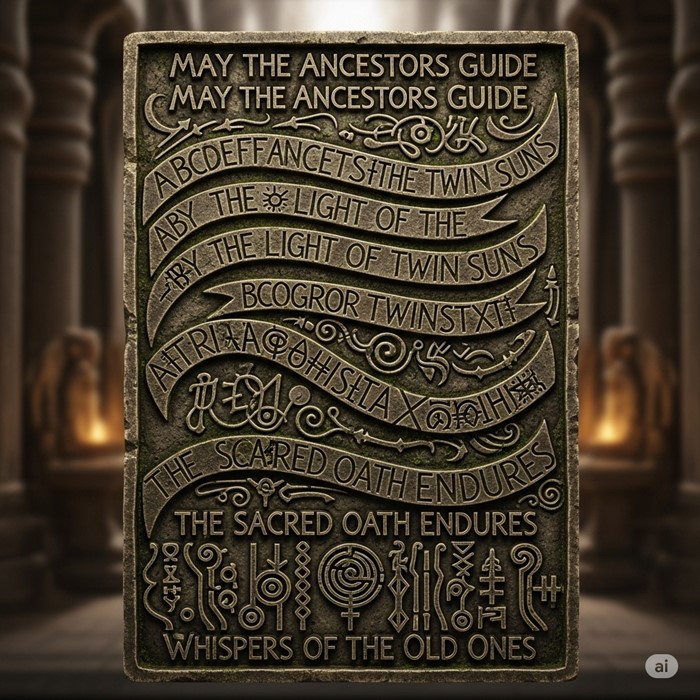
Sundering of Voices and First Warmth
It is told, from the readings of the broken tablets, that there was an Age of Loud Emptiness. In this age, the people possessed many and very many words. Their mouths were full of sounds, and these sounds were sharp, like broken stones. When one person made sounds to another person, the second person heard only the sharpness of the stones, and not the meaning that was carried inside the sounds. Their hearts were closed boxes, and their words were the rattling of pebbles against those boxes, and no meaning could enter.
And so, there was a great cacophony. A man would speak to his neighbor, and the neighbor would hear an insult where there was a question. A woman would call to her child, and the child would feel a command where there was care. The people built walls. First, they built walls of stone around their homes so the sharp sounds of their neighbors would not enter. Then, they built walls of silence inside their homes, so the sharp sounds of their family would not wound them. And finally, they built walls inside their own minds, and they became lonely islands in a sea of noise. The sorrow of the people was a great and heavy blanket upon the land.
In this time, there was a child, and the name of the child was Elen’a. This child Elen’a was thought to be incomplete, for her mouth made no sounds. While other children threw word-stones at each other, Elen’a was a vessel of silence. But her silence was not empty. Where other people had walls around their hearts, Elen’a had none. The angry sounds of the people crashed into her. The lonely feelings of the people flooded her. The pain of the world was her pain, and it was a great burden that made her small shoulders ache.
One day, the great noise of her village was too much to be borne. Elen’a ran away from the sounds. She ran until her legs were weak and her breath was gone, and she came to a quiet place where old trees grew. In this quiet place, she found a small bird that had fallen from its nest. Its wing was bent in a wrong way, and its fear was a small, sharp needle in the quiet of the grove.
Elen’a did not have words, for her mouth was silent. She could not say to the bird, “I will not cause you harm.” She could not say, “Be at peace.” Instead, she sat near the small bird. She remembered the feeling of her mother’s hand when she was sick. She remembered the warmth of the sun after a cold rain. She gathered these feelings inside herself, this warmth and this gentleness, and she let the feeling flow out from her. She did not use her hands. She did not use her eyes. She used her heart, which had no walls. She pushed the feeling of safety toward the bird.
And the bird, it became still. Its fear-needle softened. It looked at Elen’a, and in its small way, it understood. It did not understand words of men, but it understood the warmth. Elen’a stayed, and she let the feeling flow, and this was the first speaking of what was not yet a language.
After a time, Elen’a returned to the village of the people. Her heart was not as heavy, for she now knew a thing that was not a word. She saw two brothers, and they were shouting. Their words were very big stones, and they threw them with great force at each other over the matter of a lost tool. Their faces were red with anger, but beneath the anger, Elen’a could feel their hurt. One felt disrespected. The other felt accused. These feelings were the true thing, but the sharp words were hiding them.
Elen’a walked to the two brothers. They did not see her at first, for their anger made them blind. She reached out her small hands and placed one on the arm of the first brother, and one on the arm of the second brother. Then she did the new thing she had learned. She took the feeling of disrespect from the first brother, the deep and aching hurt of it, and she sent it not into the brother himself, but into the other. And she took the feeling of being wrongly accused from the second brother, the hot sting of it, and she sent it to the first. She wrapped these feelings in the warmth she had found in the grove, so they were not sharp attacks, but invitations to understand.
The shouting of the brothers stopped. Their mouths, which had been open with word-stones, closed. The first brother felt the sting of a false accusation for the first time. The second brother felt the ache of being disrespected for the first time. They looked at each other, and their eyes were not blind with anger anymore. They were seeing. They looked at the small child Elen’a, who made no sounds but had spoken the truest thing.
This was the beginning of the knowing. Elen’a, the silent one, taught the people. She could not teach with her mouth, so she taught with her touch, with her gaze, with her heart. She taught them to be still and feel the truth beneath the word-stones. She taught them to send their own truth not as a sharp thing, but as a warm and flowing thing. A Heartflow. It was a slow learning, for the people had built their inner walls very thick. But a little flow of warmth can find a crack, and a steady flow can wear down the strongest stone.
The people did not stop using their old words, but they learned to speak the Heartflow first. The warmth would open the box of the heart, so that when the words came, they could be received. And the walls of stone around the homes came down, and the walls of silence in the families came down. And the people were still islands, for each soul is an island, but now they knew there was a warm current that flowed between them all, connecting them.
Moral: To listen with the ears is to hear a word. To listen with the heart is to know a soul.