
Definition: Foretellica is a unique language with a strong emphasis on expressing anticipation, foresight, and premonitions. It allows individuals to communicate their sense of expectation and insight into future events, fostering a deep understanding of what lies ahead, even across species.
Linguistic Attributes and Characteristics:
- Foresight Vocabulary: Foretellica’s vocabulary is filled with words and phrases that convey anticipation, premonitions, and insights into the future. It enables speakers to articulate their foreknowledge with clarity and depth.
- Metaphorical Expressions: The language often employs metaphorical expressions and poetic imagery to describe forthcoming events, enriching the experience of anticipating the future.
- Temporal Flexibility: Foretellica has a unique structure that allows for the seamless intermingling of past, present, and future tenses, reflecting the perception of time as fluid and interconnected.
Structure: Foretellica follows a structured yet fluid pattern, enabling speakers to describe the progression of events and anticipate future outcomes. The language encourages the use of rhythm and cadence to evoke a sense of foresight and mystique.
Cultural Identity and Usage: Foretellica is primarily used by seers, diviners, and those with heightened psychic abilities to communicate their visions and premonitions. It is considered a sacred language among those who possess the gift of foresight, and its usage is often limited to specific individuals or secretive groups.
Rarity, Type, Script, Source, and History:
- Rarity: Foretellica is rare, as it is a language that requires a deep connection to the forces of divination and foretelling. Those who use it are often revered or feared for their ability to see into the future.
- Type: Foretellica falls under the category of mystical languages, as it possesses an inherent magical power to convey foresight and premonitions. Its words hold an aura of mystery and insight.
- Script: Foretellica’s script appears elegant and flowing, reflecting the language’s connection to the ethereal and the enigmatic.
- Source and History: The origins of Foretellica are shrouded in mysticism, with tales of ancient seers and oracles who developed the language to communicate their visions. Its history is intertwined with the secrets of divination and the ability to foresee future events.
Sensory Experience: When spoken, Foretellica has a captivating and otherworldly quality, as if the words themselves carry a glimpse of the future. Listeners often feel a sense of wonder and intrigue, drawn into the speaker’s foreknowledge. The sensory experience is enhanced when used telepathically, as the visions and premonitions behind Foretellica’s words can be directly transmitted, creating a profound connection between the speaker and the recipient.
Foretellica is a unique language with an emphasis on expressing anticipation and foresight. Its linguistic attributes, cultural significance, and sensory experience make it a powerful tool for seers, diviners, and those with psychic abilities.
Tags: Anticipatory, Prophetic, Mystical, Divinatory, Metaphorical, Poetic, Fluid, Rare, Sacred, Elegant Script, Otherworldly, Enigmatic, Foresight, Premonition, Seer, Temporal, Telepathic
Inscriptions
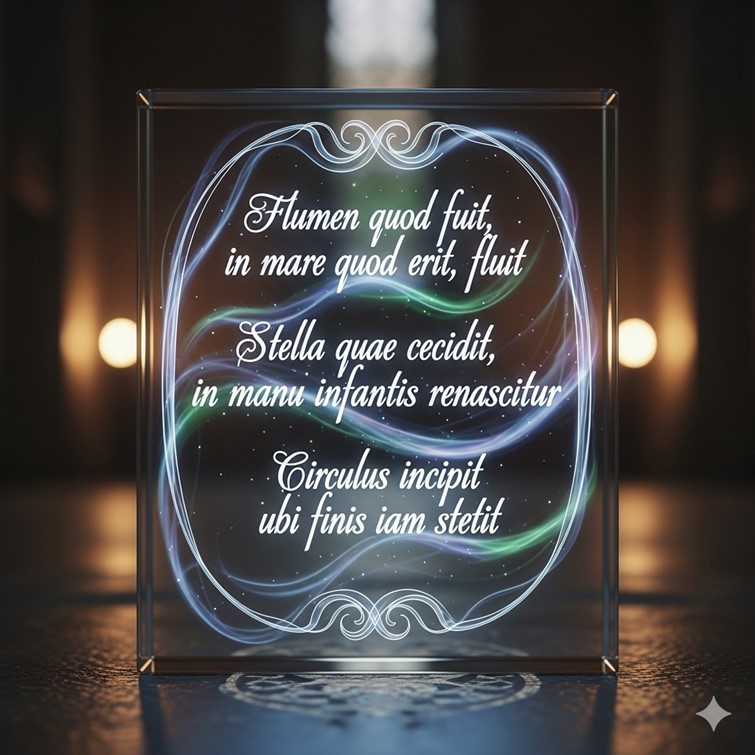
- As it sounds: Flumen quod fuit, in mare quod erit, fluit. Meaning: The river that was, flows into the sea that will be.
- As it sounds: Echo praeteriti, in silentio futuri, cantat. Meaning: The echo of the past, sings in the silence of the future.
- As it sounds: Hic lapis somniat arborem quae umbram dabit. Meaning: This stone dreams of the tree whose shade it will one day give.
- As it sounds: Stella quae cecidit, in manu infantis renascitur. Meaning: The star that fell is reborn in the hand of the child who is to come.
- As it sounds: Semen in tenebris, lucem solis venturi iam sentit. Meaning: The seed in the darkness already feels the light of the coming sun.
- As it sounds: Clavis haec portam claudit quae iam aperta est. Meaning: This key locks the door that has already been opened.
- As it sounds: Verba haec leguntur ab oculo qui nondum natus est. Meaning: These words are read by an eye that is not yet born.
- As it sounds: Memoria viae, est primus gradus in reditu. Meaning: The memory of the path is the first step on the return journey.
- As it sounds: Ferrum frigidum, calorem ignis crastini exspectat. Meaning: The cold iron awaits the heat of tomorrow’s fire.
- As it sounds: Circulus incipit ubi finis iam stetit. Meaning: The circle begins where the end has already stood.
- As it sounds: Pulvis hic ventum manet qui eum ad astra portabit. Meaning: This dust awaits the wind that will carry it to the stars.
Political Oaths
- As it sounds: Fio pons super aquas quae mox crescent. Meaning: I am becoming the bridge over the waters that will soon rise.
- As it sounds: Sanguis meus est atramentum quo foedus futurum scribitur. Meaning: My blood is the ink with which the future’s treaty is written.
- As it sounds: Sum pastor gregis qui per vallem umbrae ambulabit. Meaning: I am the shepherd for the flock that will walk through the valley of shadow.
- As it sounds: Hodie sero arborem cuius fructus a nepotibus edetur. Meaning: Today I plant the tree whose fruit will be eaten by my grandchildren.
- As it sounds: Vigilo in nocte quae peperit auroram. Meaning: I keep watch in the night that has already given birth to the dawn.
- As it sounds: Corona haec est onus montis quem nondum ascendi. Meaning: This crown is the burden of a mountain I have not yet climbed.
- As it sounds: Lex quam fero, est echo iudicii venturi. Meaning: The law I carry is the echo of a coming judgment.
- As it sounds: Verba mea erunt radix ex qua pax florebit. Meaning: My words will be the root from which peace has already bloomed.
- As it sounds: Porto facem quae viam illuminavit quam sequemur. Meaning: I carry the torch that has lit the path we are about to follow.
- As it sounds: Manebo ut saxum contra tempestatem quae iam cooritur. Meaning: I will remain as the rock against the storm that is already gathering.
- As it sounds: Memini promissionis quae in fine dierum meorum implebitur. Meaning: I remember the promise that will be fulfilled at the end of my days.
Cultural Ceremonies
- As it sounds: Duo flumina iunguntur, oceanum unum creantia. Meaning: Two rivers that were separate now join, having already created a single ocean.
- As it sounds: Infans hic est carmen cuius verba mox discemus. Meaning: This child is a song whose words we will soon have learned.
- As it sounds: Navis ad litus rediit, iter novum inceptura. Meaning: The ship has returned to shore, about to begin a new journey.
- As it sounds: Hodie celebramus messem ex seminibus quae cras serentur. Meaning: Today we celebrate the harvest from the seeds that will be sown tomorrow.
- As it sounds: Rogus hic non est finis, sed stella quae viam monstrabit. Meaning: This pyre is not an end, but the star that was always guiding the way.
- As it sounds: Stamus in memoria futuri, praeteritum honorantes. Meaning: We stand in the memory of the future, honoring the past it creates.
- As it sounds: Hoc vinum bibimus ad salutem itineris quod iam coeptum est. Meaning: We drink this wine to the health of the journey that has already begun.
- As it sounds: Facies nova est imago vultus quem olim cognovimus. Meaning: The new face is the image of a countenance we will one day recognize.
- As it sounds: Silentium nostrum est expectatio verbi quod dictum est. Meaning: Our silence is the anticipation of the word that has already been spoken.
- As it sounds: Solstitium hoc est punctum ubi hiems aestatem somniavit. Meaning: This solstice is the point where winter dreamed it would become summer.
- As it sounds: Ianua aperitur quae ad cubiculum iam notum ducit. Meaning: The door is opening, leading to a room we have always known.
Weaver at Estuary
This telling is taken from the Glyphs of Whispering Spools, which are known to be a later-age interpretation of a history that was first sung into the memory of water. The meaning of many phrases is therefore fluid.
There was a woman, whose name is given as Lyra, though the symbol more closely means ‘the string that vibrates before it is plucked.’ She lived not in a place of solid ground, but in a hut of woven reeds at the great Estuary, where the River of Past-Things empties into the Ocean of What-Might-Be. Lyra did not speak the common tongue of barter and fact. She spoke Foretellica, the language that tastes of both memory and anticipation. Her words were not for the present moment, for she saw the present as merely the shore where two great bodies of water met and mingled.
Kings and queens, desperate for knowledge, would make the long journey to her hut. They would ask questions of solid things: “Will my kingdom stand?” “Will my child be a great ruler?” Lyra would not answer directly. To a king who asked of his kingdom’s endurance, she looked at the river and said, “Hodie sero arborem cuius fructus a nepotibus edetur.” (Today I plant the tree whose fruit will be eaten by my grandchildren.) The king, a man of simple speech, heard this as a promise of a long and fruitful legacy. He left satisfied and built great monuments to himself, believing his line secure. He did not understand that the fruit might be bitter, or that his grandchildren might eat it as exiles in a foreign land. The language did not lie; it only told a truth larger than his question.
Another time, a young woman, a commoner, came to the Estuary. She was to be wed and her heart was full of a simple, present-tense happiness. She did not ask a question, but offered Lyra a small, smooth stone from the riverbank. Lyra held the stone and her eyes looked far away, not towards the ocean of the future, but back up the river of the past. She spoke softly, “Stella quae cecidit, in manu infantis renascitur.” (The star that fell is reborn in the hand of the child who is to come.) The young woman did not understand, but the words felt like a blessing, and she kept them in her heart. Years later, after her own hair was grey, her first great-grandchild was born with a peculiar birthmark on her palm, shaped like a five-pointed star. The child grew to be a great leader, a light in a dark time, and the woman finally understood that the prophecy was not for her, but for a future she was helping to create, just by living her life.
The most famous account tells of the Silent Fleet. A great armada from a foreign land was sailing to conquer the coastal cities. The seers of the cities looked into their scrying bowls and saw fire and ruin. They despaired. They traveled to the Estuary and begged Lyra for a way to defeat the fleet. Lyra did not look at the water. Instead, she pointed to a spider weaving a web in the reeds of her hut. After a long silence, she spoke a single phrase. “Circulus incipit ubi finis iam stetit.” (The circle begins where the end has already stood.)
The seers were confounded. They saw this as a prophecy of inescapable doom—that their end was already written and their beginning was just a part of that end. They returned to their cities with heavy hearts and told the people that all was lost. But one young acolyte, who had listened not just to the words but to their rhythm, felt a different meaning. He did not see a circle of fate, but a loop, a return. He convinced the city elders not to meet the fleet in open battle on the sea, but to let them land. The armada, finding the shores undefended, grew arrogant. Their supply lines stretched thin as they marched inland, into the unfamiliar territory where the cities’ armies, having circled around behind them, were waiting. The invaders were trapped, their end coming at the very place their invasion had begun.
Lyra remained at the Estuary, speaking her fluid truths. Her language was never a map of the one true path, but a description of the water itself—how the currents of the past shape the tides of the future, and how the shores of the present are forever changing.
Moral of the story: The future is not a destination to be seen, but a language to be understood. Its grammar is rooted in all that has been, and its words are the possibilities we live today.