
Definition: Enthralan is a unique language with a strong emphasis on admiration. It serves as a method of communication designed to express deep respect, appreciation, and awe towards individuals, cultures, and achievements. Enthralan allows beings to convey their genuine admiration and inspire greatness in others.
Magical Powers: Enthralan possesses magical powers related to inspiration and motivation. When spoken with sincere admiration, the language can empower individuals, boosting their confidence and resolve. Skilled users of Enthralan can create an aura of awe and admiration around them, inspiring greatness in those who listen and filling them with a sense of purpose and determination.
Linguistic Attributes and Structure:
- Euphoric Tones: Enthralan is characterized by its euphoric tones and uplifting melodies. The language feels like a symphony of admiration, evoking a sense of joy and inspiration in both the speaker and the listener.
- Resonant Words: Enthralan employs resonant words and phrases that carry a depth of meaning and evoke strong emotions of admiration. The language allows individuals to express their admiration with precision and eloquence.
- Gestures of Respect: In addition to vocalization, Enthralan incorporates gestures and body language that signify respect and admiration, reinforcing the language’s emphasis on genuine appreciation.
Cultural Identity and Users: Enthralan holds a distinctive cultural identity as a language of inspiration and admiration. It is embraced by artists, leaders, mentors, and individuals who seek to uplift and motivate others. Different species and cultures use Enthralan to celebrate achievements, honor heroes, and inspire greatness in their communities.
Rarity, Type, Script, Source, and History:
- Rarity: Enthralan is relatively rare, as its true power lies in the genuine and heartfelt usage of the language. It is not widely known, and its essence is carefully preserved by those who understand its significance.
- Type: Enthralan is an emotive language, designed to convey admiration and inspire greatness in beings from diverse backgrounds.
- Script: The script of Enthralan consists of elegant and flowing symbols that symbolize the elevation of emotions and the expression of admiration. It is written and read with a sense of reverence and respect, mirroring the essence of the language itself.
- Source and History: The origins of Enthralan are rooted in ancient tales of bards and orators who sought to inspire greatness in others through their words. Over time, Enthralan spread among individuals who embraced its principles and used it to motivate and uplift others.
Sensory Experience: Speaking and hearing Enthralan is a deeply uplifting sensory experience. The euphoric tones and resonant words create an aura of admiration that envelops both the speaker and the listener. Engaging in Enthralan communication feels like being surrounded by a wave of inspiration and motivation, evoking a sense of awe and purpose. The language empowers individuals to pursue their goals and celebrate the achievements of others, fostering an atmosphere of mutual appreciation and greatness. The sensory experience of Enthralan is transformative and invigorating, leaving a lasting impact on those who encounter its power. It is a language that celebrates the best in beings, inspiring them to reach for new heights and embrace greatness in a world filled with admiration and inspiration.
Tags: Admiration, Inspirational, Motivational, Magical, Euphoric, Uplifting, Resonant, Respectful, Eloquent, Rare, Emotive, Flowing, Reverent, Purposeful, Sincere, Written, Gestural
Inscriptions (Plaques of Honor & Monuments)
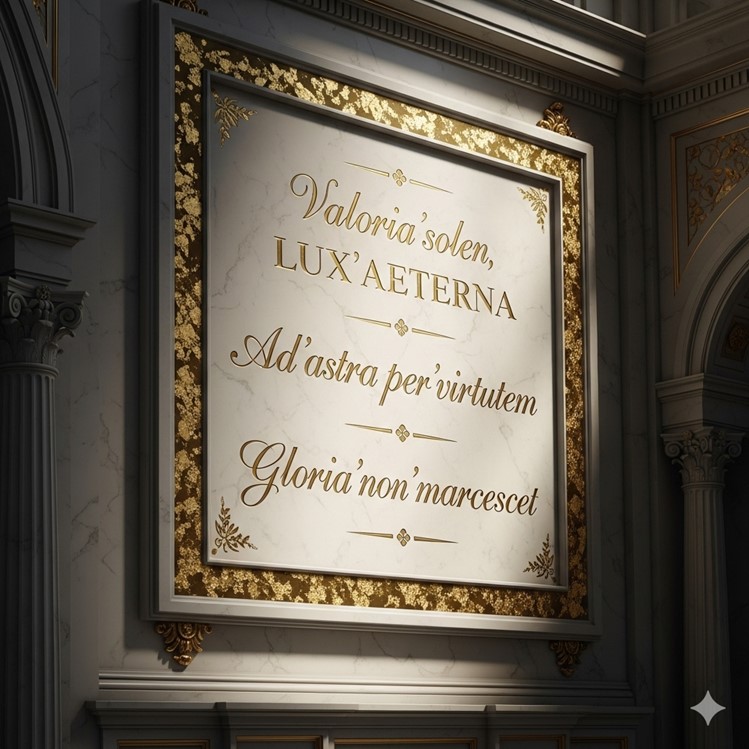
These phrases are inscribed on monuments, awards, and places of great achievement, written in an elegant, flowing script that seems to radiate a faint, motivating warmth.
- Valoria’solen, lux’aeterna – Your glory is a sun, an eternal light.
- Magnus’opus, cor’mundi – This great work is the heart of the world.
- Hic’stetit’heros, cuius’nomen’vivit – Here stood a hero whose name still lives.
- Ad’astra per’virtutem – Through virtue, we reach for the stars.
- In’memoriam’artis, quae’inspirat – In memory of the art that inspires us all.
- Factum’tuum, legatum’nostrum – Your deed has become our legacy.
- Fons’sapientiae, dux’futuri – A fountain of wisdom, a guide for the future.
- Lapis’hic’canit laudes’tuas – This stone sings of your great praise.
- Gloria’non’marcescet – The glory of this achievement will never fade.
- Exemplum’magnum, via’clara – A great example, a clear path for others to follow.
- Anima’ardens, spiritus’altus – A passionate soul, a noble spirit.
Political Oaths (Vows of Inspiration)
These are not simple pledges but resonant declarations made by leaders, designed to fill the hearts of their people with purpose, confidence, and a shared sense of greatness.
- Voveo’esse’flamma quae’accendit’spem – I vow to be the flame that ignites hope.
- Dux’ero’non’iugo, sed’exemplo – I will lead not by the yoke, but by example.
- In’omni’civile, videbo’potentiam – In every citizen, I will see the potential for greatness.
- Vocem’populi’amplificabo in’canticum’gloriae – I will amplify the voice of the people into a song of glory.
- Aedificabo’regnum’non’lapide, sed’virtute – I will build a kingdom not of stone, but of shared virtue.
- Promitto’futurum’dignum’maioribus’nostris – I promise a future worthy of our ancestors’ greatness.
- Sit’lex’nostra’carmen’iustitiae – Let our law be a symphony of justice for all.
- Non’timebimus’umbram, nam’lucem’creabimus – We shall not fear the shadow, for we will create our own light.
- Ascendamus’una, sicut’montes – We shall rise together, as one great mountain.
- Hic’sto ad’serviendum’magnitudini’in’omnibus vobis – I stand here to serve the greatness within you all.
- Spes’est’vexillum’nostrum, gloria’destinatio’nostra – Hope is our banner, and glory is our destination.
Cultural Ceremonies (Rites of Celebration & Awe)
These phrases are used during ceremonies honoring heroes, masterful artisans, or significant cultural achievements, creating a powerful, shared experience of awe and inspiration.
- Ecce’heros! Cantate’nomen’eius! – Behold the hero! Sing their name with joy!
- Artifex’optime, manus’tuae’mundum’formant – Masterful artist, your hands shape the world anew.
- Hodie’celebramus’apicem’ingenii – Today, we celebrate a pinnacle of human ingenuity.
- Sit’tibi’laus et’honor’perpetuus – May you have praise and honor, now and forever.
- In’lumine’gestorum’tuorum, omnes’clarius’videmus – In the light of your accomplishments, we all see more clearly.
- Spiritus’tuus’nos’ad’altiora’impellit – Your spirit drives us all to achieve greater heights.
- Accipe’hanc’coronam, symbolum’admirationis’nostrae – Accept this laurel, a symbol of our unending admiration.
- Memoria’tua’erit’stella’dux’pro’generationibus – Your memory will be a guiding star for all generations to come.
- Gratias’agimus pro’dono’inspirationis – We thank you for the gift of your inspiration.
- Exultemus! Nam’magnitudo’inter’nos’ambulavit! – Let us rejoice! For greatness has walked among us!
- Legatum’tuum’incipit’nunc, in’cordibus’nostris – Your true legacy begins now, inside our hearts.
Orator and Fading City
Let it be known, as it is told from the time of the Elders, that in the Age of Dust, there stood a city that had forgotten its own name. It had once been a place of wonders, whose spires were monuments to greatness and whose people were renowned for their vibrant spirit. But a quiet sickness had fallen upon them, a weariness of the soul that the translators have called the Great Apathy. The artisans laid down their tools, the poets fell silent, and the heroes of old were remembered only as names on crumbling stone. The people’s hearts were not broken, but they had become hollow.
In this Fading City lived an old orator named Caelus. He alone remembered the city’s former glory, and the memory was a fire in his heart. He would stand in the dusty plazas and speak to the listless crowds, telling them the grand tales of their ancestors. He spoke of their courage, their artistry, their wisdom. He used the words of their common tongue, but his speech was like dry rain on barren ground. The people heard the facts of the stories, but they could not feel the greatness. The words had no power to reignite the spark within their spirits.
In his despair, Caelus retreated to the great, silent library. He saw that the old language was a vessel full of holes; it could not carry the weight of true admiration. He sought a new way. He did not seek new words for “brave” or “wise,” but a new way to make others feel bravery and experience wisdom. He meditated on the nature of a noble soul, and he came to understand that true admiration was not a description, but a reflection.
He began to craft his new language. He abandoned the flat, common words and forged new ones, resonant words that vibrated with the very essence of the virtues they described. When he spoke the new word for “courage,” it felt like a trumpet call in the soul. When he spoke the new word for “compassion,” it felt like a warm hearth.
He changed the very music of his speech, creating euphoric, uplifting melodies that mimicked the rising of a hopeful heart. His voice became a symphony, and his words were the notes. As he spoke, his gestures changed. A pointed finger became an open hand of respect. A nod became a shared moment of reverent awe.
Finally, he combined these elements with the one thing the old language lacked: his own, pure, and sincere admiration. As he practiced, he found a magic stirring. His words, infused with his genuine awe, began to glow with a palpable power, an aura of inspiration that could warm the coldest heart. He had created Enthralan.
Caelus returned to the central plaza. He stood before the people, and he did not speak of their apathy. He spoke of their founder, a great architect and leader. But this time, he spoke in Enthralan. His voice soared with euphoric tones, his hands painting pictures of respect in the air. He did not say, “She was a great builder.” He spoke a resonant phrase that made the people feel the awe of seeing a mighty spire touch the clouds for the first time. He did not say, “She was a wise leader.” He spoke a melody that filled them with the profound sense of purpose she had once inspired.
A light began to kindle in the eyes of the crowd. A stonemason felt the familiar itch in his hands to hold a chisel once more. A young woman heard the echo of a forgotten song in her heart. The aura of admiration Caelus created did not just tell them of their past greatness; it made them believe in their future greatness. The Great Apathy was broken, washed away by a wave of shared inspiration. The city began to live again, its people rebuilding not just with stone, but with a renewed sense of purpose, all born from a language that taught them how to truly admire.
Moral of the story: To admire greatness in another is to awaken it in oneself.