
Deity Name: Varestris Hearthbinder
Lore
In the age before the Urnfield knew kings, when clans wandered between stone ridges and great rivers, the dead were carried not to the soil but to the fire. Their bones were kept in urns sealed with ash and bronze, guarded in sanctuaries of woven walls and open skies. It was said that Varestris, the Hearthbinder, descended upon the smoke of these pyres, shaping the rising ash into visions of counsel for the living.
Varestris is believed to have woven the first bindings of oath and kinship—strings of braided cord placed around urns to keep their wisdom safe. In return for these bindings, the spirits of the dead guide the hearths of the living, whispering in the crackle of logs and the hiss of cooking pots.
The religion holds that Varestris still walks unseen in the embers of every home and keeps watch over the sealed ashes of ancestors. Temples keep central flame-pits where coals are never allowed to die, with each coal said to be a captured breath of divine fire gifted to the people when they first bound their dead.
Personality of Varestris Hearthbinder
Varestris is depicted as patient but unyielding, the keeper of both memory and promise. She does not rage, but her silence is a sign of deep displeasure. She honors endurance over swiftness, duty over desire, and the harmony of the clan over the freedom of the lone wanderer. She is believed to withhold her warmth from those who break oaths or discard the memory of their ancestors.
Traits & Characteristics
- Appears in visions as a tall, broad-shouldered figure with a cloak of flickering embers and an urn cradled in one arm.
- Speaks in the layered voices of many ancestors at once.
- Her footsteps are marked by the smell of woodsmoke and the faint heat of banked coals.
- Associated with hearths, family bonds, remembrance, and the sacredness of the dead’s counsel.
- Believed to have taught the first artisans how to seal urns so spirits could dwell undisturbed.
Attributes
- Domain of Fire: Warmth for the living, transformation for the dead.
- Domain of Memory: Preservation of history and oath.
- Domain of Kinship: The weaving of clans into one enduring hearth.
- Domain of Guardianship: Protection against the forgetting of names.
Symbols
- Primary Symbol: A bound urn wreathed in flame.
- Secondary Symbols:
- The braided cord, representing unity and binding promises.
- A tri-legged cauldron, representing hearth, sustenance, and transformation.
- The eternal coal, a glowing ember encased in bronze latticework.
Tags
Hearth, Kinship, Fire, Memory, Ancestors, Oath-Binding, Ash, Urn, Bronze, Flame-Pits, Guardianship, Clan Unity, Endurance, Silence, Counsel, Eternal Flame, Vision-Smoke, Remembrance, Pyre-Rites, Ember-Cloth, Spirit-Whisper, Oath-Cord, Ash-Seal, Coal-Vigil, Urnwatcher, Smoke-Vision, Flame-Kin
Positives:
Strengthens cultural unity through shared rituals; reinforces respect for ancestry and lineage; promotes disciplined civic order; grants strong moral identity; encourages community responsibility and mutual aid; provides structured guidance for major life transitions; instills long-term thinking and historical awareness.
Negatives:
Rigid ceremonial obligations can burden individuals; can lead to social exclusion of non-believers; risk of excessive conservatism and resistance to change; political factions may exploit religious authority; overemphasis on ancestral purity can spark disputes; strict mourning customs may hinder emotional recovery for some.
Type of Temple:
Central ceremonial complexes called Ember-Halls—fortified stone structures with open-roof pyre courts, subterranean ossuaries for urn storage, and smoke-towers for ritual signaling. Each features a Hall of Names where ancestral lineages are recorded and updated, and an Inner Chamber containing the Ever-Pyre, an eternally burning flame guarded by hereditary priestly orders.
Number of True Followers:
Approximately 51,500,000 across Urnfield and diaspora communities—those who adhere fully to doctrine, participate in all key rites, and submit to Ember-Hall authority.
What They Do:
True followers maintain regular offerings of incense, crafted urns, and ash-sealed scrolls; tend communal pyres during seasonal rites; serve as keepers of family genealogies; enforce sacred oaths in civic and military contexts; participate in the Ember Vigil during eclipses to “guard the passage of spirits”; act as mediators in disputes where ancestral honor is at stake; train apprentices in the Ash-Script used for sacred inscriptions.
Beliefs of the Faithful
Believers hold that all living beings are bound by an unbroken chain of spirit and ash linking them to their ancestors, and that the flame is the visible breath of this eternal cycle. The deity—Thurnas, Keeper of the Ember Path—is thought to stand at the meeting place of life and death, tending the fire that guides spirits from the mortal world into the Great Ember Beyond. The faithful believe that memory, properly preserved through names, urns, and rites, fuels the strength of the living and grants peace to the dead. They see civic order, personal honor, and care for the ancestral line as sacred duties, and hold that neglecting one’s lineage weakens not only the family but the nation itself.
Regular Services
Services, called Ash Gatherings, are held weekly at the Ember-Hall. Each begins with the ringing of bronze fire-bells, summoning the faithful to the pyre court. Offerings of resin, herbs, and symbolic tokens are cast into the communal flame while the high-priest chants from the Litany of Ember Steps. Attendees recite their family names aloud, in order from eldest to youngest, reaffirming their place in the ancestral chain. The service concludes with the Passing of the Coal—embers carried in small braziers to rekindle household hearths, symbolizing the continuation of the sacred flame in daily life.
Funeral Rites for Believers
When a believer dies, their body is ritually cleansed with smoke and oil before being wrapped in a cloth dyed ember-red. The funeral procession moves from the home to the Ember-Hall, accompanied by slow drumbeats and the chanting of lineage verses. The body is placed upon the ceremonial pyre, and the family’s eldest matriarch lights the flame from the Ever-Pyre. Ashes are gathered into a specially crafted urn inscribed with the deceased’s name, deeds, and family line in Ash-Script. The urn is sealed with a band of bronze and placed in the subterranean ossuary beneath the Ember-Hall, among generations of kin. Once a year, during the Ember Vigil, families return to commune with their ancestors, leaving small gifts and reciting updated lineage records to the spirits.
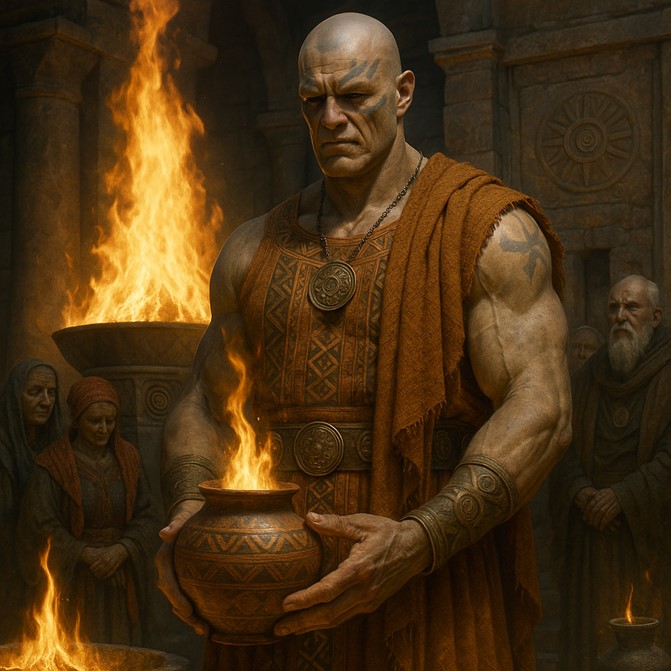
The magical power of the Urnfield deity can be harnessed in both protective and aggressive ways, shaped by the god’s association with fire, metal, and ancestral memory.
For defense, their power manifests in creating shimmering walls of heat-distorted air that bend projectiles away, forging instant bronze-like barriers from raw earth, and imbuing followers with the clarity and steadiness of ancestral spirits, resisting fear and magical compulsion. Ritual circles can call upon a storm of ember-motes that hang in the air, scorching anything hostile while leaving allies untouched, creating safe zones during sieges. Shields and armor blessed in the deity’s name can radiate deterrent heat, making them painful for enemies to strike.
For offense, the god’s flame aspect allows conjuring lances of molten metal that harden mid-flight into jagged spikes, bursts of superheated ash that obscure vision while searing flesh, and calling down short-lived rainstorms of fire to break enemy formations. The ancestral memory aspect grants warriors the combat instincts of generations, letting them exploit weaknesses instantly, while smith-priests can ritually forge “spirit-bound” weapons that erupt in spectral fire when striking true foes of the faith. In large-scale warfare, coordinated rites can awaken the earth itself, sending rivulets of molten metal snaking through enemy encampments.
Burning Jar of First Forgemother
It was in the days before the Great Ploughing, when the fields of Urnfield were stones and ash, that the people wandered without fire of their own. They lived by the cold of the moonlight, drinking the dew, gnawing roots, and fearing the Night-Voices that walked the low hills. It is told in the fragments of the Broken Tablet that in those days came the Forgemother, whose true name no one remembers, for it was said only once, and the wind took it away.
She was not tall, nor wrapped in gold, but carried on her back the Great Jar, sealed with clay and bound in straps of reed. She came to the Council Hollow where the people sat in hunger and quiet. When they asked her what was in the Jar, she spoke not, but struck the earth with her staff three times. The ground opened in a seam, and from the seam leapt a glow that hurt the eyes. The people covered their faces, thinking the sun had fallen.
But the Forgemother broke the seal of the Jar, and from within poured forth the First Flame. It did not burn like wild grass-fire; it sat still, waiting like a beast, and hummed like a forge bellows. She showed the people how to place metal within it, and the metal drank the flame and became strong. She showed how to place grain beside it, and the grain gave sweetness instead of rot. She showed how to stand before it, and no shadow could hold fast to their backs.
Yet there was one among the gathered, a man named Rell of the Ash-River, who whispered to himself that such a gift should be bound to his own name. When the Forgemother slept, he lifted the Great Jar and ran into the hill caves. There he tried to feed the flame with oil and fat, but it spat at him and roared like the coming storm. The fire leapt to the walls, and the metal seams in the stone melted, flowing into his arms and chest, making him heavy. The flame shrank back into the Jar, and the Jar closed without his hand. When they found him, he could not stand, for his limbs were bronze and his eyes were blind from the glare. The Forgemother told the people, “Fire serves the hand that honors the hearth, not the grasp that honors itself.”
The people begged her to stay, to guard the Jar forever. She said the Jar was not hers, but the god who lay in the center of all things—He Who Remembers the Sparks—had given it for the keeping of many hands. She chose seven keepers, each sworn by oath and ash-mark upon the brow, and taught them the prayers of bellows and the steps of the forge dance. Then she walked into the hills carrying only her staff, and the stories say the Night-Voices fled before her until they were never heard again.
In the years after, the keepers lit their village hearths from the Great Jar, and the fields warmed, the stones split, and rivers ran clear. In war, they turned the flame to spears that glowed like the morning star. In famine, they made great jars of bronze to keep grain from rot. And every year on the day the Forgemother first struck the earth, they danced the forge dance, stamping thrice in her memory, so the ground would remember her tread.
Some say the Forgemother yet walks in the hills, her staff in hand, waiting to strike the earth once more when the fields grow cold. Others whisper she stands at the side of the god in the center, turning the bellows that keep the stars alight.
Moral: The flame that builds is the same that destroys; only the hands that serve all may keep it bright.